REVIEW 2 major objections 5 minor 1 cited by
Neural Plasticity Networks
T0 review · 2 major / 5 minor · reviewed 2026-08-14 · deepseek-v4-flash
Pith's one-line read One parameter k can make a neural network prune itself or grow new neurons during training.
desk verdict The k-scheduler and dropout framing are nice, but the generalized ARM estimator is biased for every gate function the experiments actually use, so the training does not minimize the stated L0-regularized objective. read the letter →
The pith
A machine-rendered reading of the paper's core claim, the machinery that carries it, and where it could break.
The reading
What carries the argument
The load-bearing object is the stochastic binary gate $z_j \sim \mathrm{Bernoulli}(g(\varphi_j))$ attached to each weight, neuron, or channel; $\varphi_j$ is the gate's logit-like parameter. The mechanical core is the ARM gradient estimator, which the paper restates for a general gate function $g$ and asserts remains unbiased for any smooth or non-smooth $g:\mathbb{R}\to[0,1]$ with $g(-\varphi)=1-g(\varphi)$. This identity is what lets the same framework use scaled sigmoid or hard sigmoid gates, and what lets a single parameter $k$ act as a learning-stage scheduler: at $k=0$ the gate is constant at $1/2$ (dropout), at $k=\infty$ it is a step function (fixed architecture), and at intermediate $k$ units can flip on and off.
What would settle it
Take a single binary variable with gate probability $g(\varphi)=\sigma(k\varphi)$, fix a simple function $f$, and compare the Monte Carlo average of the ARM update against the analytic derivative of $\mathbb{E}[f(z)]$ over a range of $\varphi$ and $k$; if the two disagree, the unbiasedness claim that the training dynamics depend on is false.
Extended reading notes
Core claim
The paper's central discovery is that network sparsification and network expansion are two ends of one $L_0$-regularized binary optimization problem, rather than separate procedures. Each unit carries a Bernoulli gate $z$ with probability $g(\varphi)$, where $g$ is a gate function such as scaled sigmoid $g(\varphi)=\sigma(k\varphi)$; the gates are trained with the ARM gradient estimator. Because a scaled sigmoid has nonzero gradient everywhere, a unit that has been deactivated can be reactivated later, which the paper identifies as the mechanism that makes expansion possible alongside pruning. The paper further claims that this generalization of ARM remains unbiased for any gate function $g$ with $g(-\varphi)=1-g(\varphi)$, and that with a single $k$ the framework reproduces dropout ($k=0$), conventional training ($k=\infty$), and the intermediate plastic regime. In experiments, both sparsification and expansion converge to comparable compact architectures with competitive accuracy.
Load-bearing premise
Everything rests on the claim that the gradient estimator used to update the binary gates stays unbiased when the gate function is something other than the standard sigmoid, such as a scaled sigmoid or hard sigmoid.
Editorial extensions
If this is right
- If the central claim is right, the standard three-stage pruning pipeline (pretrain, prune, fine-tune) collapses into one continuous optimization whose stage is set by a scalar $k$.
- Sparsification and expansion become symmetric views: starting from a large or small network should converge to the same task-appropriate capacity, as the paper observes on the synthetic, MNIST, and CIFAR experiments.
- Dropout gains a reading as the $k=0$ limit of a plastic gate, which could connect dropout-rate selection to $L_0$ regularization strength.
- Because the scaled-sigmoid gate has nonzero gradient everywhere, a neuron pruned early in training can re-enter, making pruning reversible; this distinguishes NPN from hard-concrete gates that freeze a unit once zeroed.
Reading between the lines
- A natural next step the paper does not take is to make $k$ itself learned or layer-dependent; the scheduler shows that $k$ controls plasticity, so a learned or annealed $k$ could give each layer its own pace of growth and pruning.
- The convergence of sparsification and expansion to similar capacities suggests a practical way to diagnose task complexity: the final architecture under this framework could serve as a data-driven estimate of how many parameters a task actually needs.
- Connecting to neural architecture search, the gate parameters $\varphi$ can be read as a continuous architecture encoding, with $k$ playing the role of a temperature; one could try to anneal $k$ within a single run to search over capacities rather than running separate searches.
Signed reviews
Editorial analysis
A structured set of objections, weighed in public.
Referee Report
Summary. The paper proposes Neural Plasticity Networks (NPNs), a framework that attaches stochastic binary gates to network units and optimizes an L0-regularized objective to unify network sparsification and expansion. The method builds on the authors' prior L0-ARM algorithm and introduces a family of gate functions g(φ) parameterized by a steepness k, together with a learning-stage scheduler that modulates pre-training, sparsification/expansion, and fine-tuning by changing k. The paper claims that the ARM gradient estimator remains unbiased for any gate function satisfying g(-φ)=1-g(φ), that dropout is a special case (k=0), and that standard training corresponds to k=∞; experiments are reported on a synthetic dataset, MNIST with LeNet5, and CIFAR-10/100 with ResNet56.
Significance. If the core theoretical claim were correct, the unification of sparsification and expansion in a single L0-regularized pipeline would be a valuable contribution, and the learning-stage scheduler is a practical idea that could simplify training pipelines. The manuscript also ships source code and reports extensive experiments, which is a strength. However, the paper's central mathematical assertion — that the ARM estimator remains unbiased for arbitrary anti-symmetric gate functions — is false, and this assertion directly underpins the gradient updates used to train all gate parameters in every experiment. Because the training algorithm is not actually minimizing the stated L0-regularized objective, the theoretical foundation of the paper is invalid as written. The empirical results may still indicate a useful heuristic, but they do not support the paper's principled claims.
major comments (2)
- [Section II-A, Eq. (7)-(9)] The claim that the ARM estimator in Eq. (7) remains unbiased for any g: R→[0,1] with g(-φ)=1-g(φ) is incorrect. For a single gate, the expectation of the estimator in Eq. (7) equals (f(1)-f(0))·g(φ)·(1-g(φ)), while the true gradient of E_z[f(z)] is (f(1)-f(0))·g'(φ). These agree only when g'(φ)=g(φ)(1-g(φ)), i.e., for the logistic sigmoid (up to scaling by a constant of 1). For the scaled sigmoid g(φ)=σ(kφ) used with k=7 and k=0.5 in all experiments, the estimator is off by a factor of 1/k relative to the true data-loss gradient. For the hard sigmoid in Eq. (11), the mismatch is not a constant factor: on the linear segment the true derivative is k/7 while the estimator expectation is g(φ)(1-g(φ)). Consequently, Eq. (9) is not an unbiased gradient estimator for any gate function actually used in the paper, and the training updates for φ do not descend the stated L0-regularized objective. This is a load-bearing error because the entire gate-parameter training dynamics rest on this estimator.
- [Section IV (Algorithm 1) and Section VI] The network expansion method presented in Algorithm 1 adds neurons dynamically when validation loss improves, but the experiments do not evaluate Algorithm 1. In Section VI, the authors state they 'resort to this approach to simulate network expansion' by initializing a large network with most φ's set to large negative values and then randomly activating a few hibernating neurons. The reported results therefore validate a simulation of expansion, not the proposed algorithm. This disconnect between the proposed method and the evaluated method weakens the central claim of a unified end-to-end expansion pipeline, and should be addressed directly.
minor comments (5)
- [Section II-A] The word 'unbiasness' should be 'unbiasedness'.
- [Section I] The word 'closly' should be 'closely' in the phrase 'closly related hard concrete estimator'.
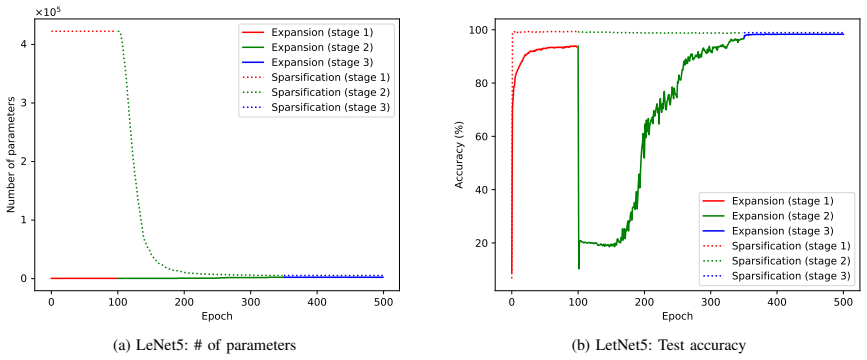
- [Figure 3 caption] The caption spells 'LetNet5' but the model is LeNet5.
- [Section VI-B] The text claims 'over 99% weights are pruned' for the MNIST experiment, but from Table I the final sparse architecture has 5,320 parameters versus a baseline of 4.23e5, which corresponds to roughly 98.7% pruning, not over 99%.
- [References] Reference [15] is a YouTube talk; for a formal paper, a peer-reviewed citation for neurogenesis or brain plasticity would be more appropriate.
Circularity Check
No significant circularity: the NPN training outcome is emergent from the L0-regularized objective, and the invoked self-citation is not load-bearing.
full rationale
The paper's derivation chain is self-contained with respect to its empirical claims. The central mechanism is an L0-norm regularized objective (Eq. 8) whose gate parameters φ are optimized by the ARM estimator (Eq. 9), with the unbiased estimator theorem quoted from the external ARM reference [17]. The reported sparsified and expanded architectures are not fitted quantities: they emerge from optimizing gate parameters under the L0 penalty, and are compared against external methods (SFP, AMC, FPGM, TAS, HRank) on MNIST and CIFAR benchmarks. The dropout, pre-training, and fine-tuning limits (k=0, k=∞) are algebraic special cases of the chosen gate family (Eqs. 10-13), not predictions derived from the results, so there is no self-definitional reduction. The only substantive self-citation is to the authors' prior L0-ARM [16], which is used as a starting framework and baseline; the paper extends it to expansion and validates against external baselines, so the self-citation is not load-bearing in a circular sense. The questionable claim that ARM remains unbiased for arbitrary g with g(-φ)=1-g(φ) (Section II-A) is a correctness issue, not a circularity issue, and does not make the derivation equivalent to its inputs.
Assumptions & free parameters
free parameters (5)
- lambda (L0 regularization strength) =
Varies per experiment: (10, 0.5, 0.1, 10)/N on MNIST, 1e-5 or 0 on CIFAR
- k (gate steepness in stage 2) =
7 for sparsification, 0.5 for expansion
- initial phi values =
phi = 3/k for active neurons, -3/k for inactive
- hard sigmoid scaling constant 7 =
7
- learning rate schedules and stage durations =
e.g., 100/250/150 epochs for MNIST; 20/180/20 for CIFAR
assumptions (5)
- standard math Stochastic variational optimization inequality: min_z F(z) <= E_{z~q(z)}[F(z)]
- standard math ARM gradient estimator theorem (Yin and Zhou, 2019)
- ad hoc to paper The ARM estimator remains unbiased for any g: R -> [0,1] with g(-phi)=1-g(phi)
- domain assumption L0 norm is an appropriate measure of model complexity for network sparsification and expansion
- domain assumption The three-stage training (pretrain, sparsify/expand, fine-tune) is beneficial and can be modulated by a single parameter k
Cite this review
Pith. "Pith review of Neural Plasticity Networks." pith.science (2026). https://pith.science/paper/JQGDKGPL
@misc{pith2026190808118,
  author       = {Pith},
  title        = {Pith review of: Neural Plasticity Networks},
  year         = {2026},
  howpublished = {\url{https://pith.science/paper/JQGDKGPL}},
  note         = {Machine review of arXiv:1908.08118}
}
abstract
Neural plasticity is an important functionality of human brain, in which number of neurons and synapses can shrink or expand in response to stimuli throughout the span of life. We model this dynamic learning process as an $L_0$-norm regularized binary optimization problem, in which each unit of a neural network (e.g., weight, neuron or channel, etc.) is attached with a stochastic binary gate, whose parameters determine the level of activity of a unit in the network. At the beginning, only a small portion of binary gates (therefore the corresponding neurons) are activated, while the remaining neurons are in a hibernation mode. As the learning proceeds, some neurons might be activated or deactivated if doing so can be justified by the cost-benefit tradeoff measured by the $L_0$-norm regularized objective. As the training gets mature, the probability of transition between activation and deactivation will diminish until a final hardening stage. We demonstrate that all of these learning dynamics can be modulated by a single parameter $k$ seamlessly. Our neural plasticity network (NPN) can prune or expand a network depending on the initial capacity of network provided by the user; it also unifies dropout (when $k=0$), traditional training of DNNs (when $k=\infty$) and interpolates between these two. To the best of our knowledge, this is the first learning framework that unifies network sparsification and network expansion in an end-to-end training pipeline. Extensive experiments on synthetic dataset and multiple image classification benchmarks demonstrate the superior performance of NPN. We show that both network sparsification and network expansion can yield compact models of similar architectures, while retaining competitive accuracies of the original networks.
Figures


Forward citations
Cited by 1 Pith paper
-
Grow-Prune-Freeze Networks: Adaptive & Continual Learning Technique for Olfactory Navigation
Grow-Prune-Freeze networks enable continual learning for turbulent plume navigation using Expected SARSA, achieving 94% success rate while extending random matrix theory results.
Reference graph
Works this paper leans on
-
[1]
Imagenet: A large-scale hierarchical image database,
J. Deng, W. Dong, R. Socher, L.-J. Li, K. Li, and L. Fei-Fei, “Imagenet: A large-scale hierarchical image database,” in IEEE Conference on Computer Vision and Pattern Recognition (CVPR) , 2009
work page 2009
-
[2]
Bert: Pre-training of deep bidirectional transformers for language understanding,
J. Devlin, M.-W. Chang, K. Lee, and K. Toutanova, “Bert: Pre-training of deep bidirectional transformers for language understanding,” arXiv preprint arXiv:1810.04805, 2018
arXiv 2018
-
[3]
Mastering the game of go with deep neural networks and tree search,
D. Silver, A. Huang, C. J. Maddison, A. Guez, L. Sifre, G. van den Driessche, J. Schrittwieser, I. Antonoglou, V . Panneershelvam, M. Lanc- tot, S. Dieleman, D. Grewe, J. Nham, N. Kalchbrenner, I. Sutskever, T. Lillicrap, M. Leach, K. Kavukcuoglu, T. Graepel, and D. Hassabis, “Mastering the game of go with deep neural networks and tree search,” Nature, vo...
2016
-
[4]
Deep residual learning for image recognition,
K. He, X. Zhang, S. Ren, and J. Sun, “Deep residual learning for image recognition,” inIEEE Conference on Computer Vision and Pattern Recognition (CVPR), 2016, pp. 770–778
2016
-
[5]
Densely connected convolutional networks,
G. Huang, Z. Liu, L. van der Maaten, and K. Q. Weinberger, “Densely connected convolutional networks,” in IEEE Conference on Computer Vision and Pattern Recognition (CVPR) , 2017
work page 2017
-
[6]
S. Zagoruyko and N. Komodakis, “Wide residual networks,” in The British Machine Vision Conference (BMVC) , 2016
work page 2016
-
[7]
Learning both weights and con- nections for efficient neural network,
S. Han, J. Pool, J. Tran, and W. Dally, “Learning both weights and con- nections for efficient neural network,” in Advances in neural information processing systems, 2015, pp. 1135–1143
work page 2015
-
[8]
S. Han, H. Mao, and W. J. Dally, “Deep compression: Compressing deep neural networks with pruning, trained quantization and huffman coding,” in International Conference on Learning Representations (ICLR) , 2016
work page 2016
Show all 40 references
-
[9]
Structured bayesian pruning via log-normal multiplicative noise,
K. Neklyudov, D. Molchanov, A. Ashukha, and D. Vetrov, “Structured bayesian pruning via log-normal multiplicative noise,” in Advances in Neural Information Processing Systems (NIPS) , 2017
2017
-
[10]
Learning sparse neural networks through l0 regularization,
C. Louizos, M. Welling, and D. P. Kingma, “Learning sparse neural networks through l0 regularization,” in International Conference on Learning Representations (ICLR) , 2018
2018
-
[11]
Learning structured sparsity in deep neural networks,
W. Wen, C. Wu, Y . Wang, Y . Chen, and H. Li, “Learning structured sparsity in deep neural networks,” in Advances in Neural Information Processing Systems (NIPS) , 2016
2016
-
[12]
Pruning filters for efficient convnets,
H. Li, A. Kadav, I. Durdanovic, H. Samet, and H. P. Graf, “Pruning filters for efficient convnets,” arXiv preprint arXiv:1608.08710 , 2016
2016 arXiv
-
[13]
Bayesian compression for deep learning,
C. Louizos, K. Ullrich, and M. Welling, “Bayesian compression for deep learning,” in Advances in Neural Information Processing Systems , 2017, pp. 3288–3298
2017
-
[14]
Variational dropout sparsi- fies deep neural networks,
D. Molchanov, A. Ashukha, and D. Vetrov, “Variational dropout sparsi- fies deep neural networks,” arXiv preprint arXiv:1701.05369 , 2017
2017 arXiv
-
[15]
You can grow new brain cells. here’s how
S. Thuret, “You can grow new brain cells. here’s how.” https://www. youtube.com/watch?v=B tjKYvEziI, Oct. 2015
2015
-
[16]
L0-ARM: Network sparsification via stochastic bi- nary optimization,
Y . Li and S. Ji, “L0-ARM: Network sparsification via stochastic bi- nary optimization,” in The European Conference on Machine Learning (ECML), 2019
2019
-
[17]
Arm: Augment-REINFORCE-merge gradient for stochastic binary networks,
M. Yin and M. Zhou, “Arm: Augment-REINFORCE-merge gradient for stochastic binary networks,” in International Conference on Learning Representations (ICLR), 2019
2019
-
[18]
Dropout: A simple way to prevent neural networks from overfit- ting,
N. Srivastava, G. Hinton, A. Krizhevsky, I. Sutskever, and R. Salakhut- dinov, “Dropout: A simple way to prevent neural networks from overfit- ting,” Journal of Machine Learning Research , vol. 15, pp. 1929–1958, 2014
1929
-
[19]
Akaike, Selected Papers of Hirotugu Akaike
H. Akaike, Selected Papers of Hirotugu Akaike . Springer, 1998, pp. 199–213
1998
-
[20]
Estimating the dimension of a model,
G. Schwarz, “Estimating the dimension of a model,” The Annals of Statistics, vol. 6, pp. 461–464, 1978
1978
-
[21]
Stochastic variational optimization,
T. Bird, J. Kunze, and D. Barber, “Stochastic variational optimization,” arXiv preprint arXiv:1809.04855 , 2018
2018 arXiv
-
[22]
Estimating or propagating gradients through stochastic neurons for conditional computation,
Y . Bengio, N. Leonard, and A. Courville, “Estimating or propagating gradients through stochastic neurons for conditional computation,” arXiv preprint arXiv:1308.3432, 2013
2013 arXiv
-
[23]
Adap- tive network sparsification with dependent variational beta-bernoulli dropout,
J. Lee, S. Kim, J. Yoon, H. B. Lee, E. Yang, and S. J. Hwang, “Adap- tive network sparsification with dependent variational beta-bernoulli dropout,” arXiv preprint arXiv:1805.10896 , 2018
2018 arXiv
-
[24]
Optimal brain damage,
Y . LeCun, J. S. Denker, and S. A. Solla, “Optimal brain damage,” in Advances in neural information processing systems , 1990, pp. 598–605
1990
-
[25]
Neural architecture search with reinforcement learning,
B. Zoph and Q. V . Le, “Neural architecture search with reinforcement learning,” in International Conference on Learning Representations (ICLR), 2017
2017
-
[26]
Learning transferable architectures for scalable image recognition,
B. Zoph, V . Vasudevan, J. Shlens, and Q. V . Le, “Learning transferable architectures for scalable image recognition,” in IEEE Conference on Computer Vision and Pattern Recognition (CVPR) , 2018
2018
-
[27]
Aging evolution for image classifier architecture search,
E. Real, A. Aggarwal, Y . Huang, and Q. V . Le, “Aging evolution for image classifier architecture search,” in AAAI, 2019
2019
-
[28]
Dynamic node creation in backpropagation networks,
T. Ash, “Dynamic node creation in backpropagation networks,” Con- nection Science, vol. 1, p. 365–375, 1989
1989
-
[29]
Online incremental feature learning with denoising autoencoders,
G. Zhou, K. Sohn, and H. Lee, “Online incremental feature learning with denoising autoencoders,” in International Conference on Artificial Intelligence and Statistics (AIStats) , 2012, p. 1453–1461
2012
-
[30]
Growing a brain: Fine-tuning by increasing model capacity,
Y .-X. Wang, D. Ramanan, and M. Hebert, “Growing a brain: Fine-tuning by increasing model capacity,” in IEEE Conference on Computer Vision and Pattern Recognition (CVPR) , 2017
2017
-
[31]
AdaNet: Adaptive structural learning of artificial neural networks,
C. Cortes, X. Gonzalvo, V . Kuznetsov, M. Mohri, and S. Yang, “AdaNet: Adaptive structural learning of artificial neural networks,” in Interna- tional Conference on Machine Learning (ICML) , 2017
2017
-
[32]
Virtual adversarial training: a regularization method for supervised and semi-supervised learning,
T. Miyato, S.-i. Maeda, S. Ishii, and M. Koyama, “Virtual adversarial training: a regularization method for supervised and semi-supervised learning,” IEEE transactions on pattern analysis and machine intelli- gence, 2018
2018
-
[33]
Gradient-based learning applied to document recognition,
Y . Lecun, L. Bottou, Y . Bengio, and P. Haffner, “Gradient-based learning applied to document recognition,” in Proceedings of the IEEE, 1998, pp. 2278–2324
1998
-
[34]
Learning multiple layers of features from tiny images,
A. Krizhevsky and G. Hinton, “Learning multiple layers of features from tiny images,” Master’s thesis, Department of Computer Science, University of Toronto, 2009
2009
-
[35]
Adam: A method for stochastic optimization,
D. P. Kingma and J. Ba, “Adam: A method for stochastic optimization,” in International Conference on Learning Representations (ICLR) , 2015
2015
-
[36]
Soft filter pruning for accelerating deep convolutional neural networks,
Y . He, G. Kang, X. Dong, Y . Fu, and Y . Yang, “Soft filter pruning for accelerating deep convolutional neural networks,” arXiv preprint arXiv:1808.06866, 2018
2018 arXiv
-
[37]
Amc: Automl for model compression and acceleration on mobile devices,
Y . He, J. Lin, Z. Liu, H. Wang, L.-J. Li, and S. Han, “Amc: Automl for model compression and acceleration on mobile devices,” in Proceedings of the European Conference on Computer Vision (ECCV) , 2018, pp. 784–800
2018
-
[38]
Filter pruning via geometric median for deep convolutional neural networks acceleration,
Y . He, P. Liu, Z. Wang, Z. Hu, and Y . Yang, “Filter pruning via geometric median for deep convolutional neural networks acceleration,” in Proceedings of the IEEE Conference on Computer Vision and Pattern Recognition, 2019, pp. 4340–4349
2019
-
[39]
Network pruning via transformable architecture search,
X. Dong and Y . Yang, “Network pruning via transformable architecture search,” in Advances in Neural Information Processing Systems , 2019, pp. 760–771
2019
-
[40]
Hrank: Filter pruning using high-rank feature map,
M. Lin, R. Ji, Y . Wang, Y . Zhang, B. Zhang, Y . Tian, and L. Shao, “Hrank: Filter pruning using high-rank feature map,” in Proceedings of the IEEE/CVF Conference on Computer Vision and Pattern Recognition, 2020, pp. 1529–1538
2020
Reviewed August 14, 2026 · model on record in the stance chip above.
Discussion (0). Continue with ORCID to comment.