Fisher information of accelerated two-qubit system in the presence of the color and white noise channels
Pith reviewed 2026-05-25 12:09 UTC · model grok-4.3
The pith
The two-qubit form of Fisher information provides larger estimation accuracy for parameters of an accelerated two-qubit system under color and white noise than the single-qubit form.
A machine-rendered reading of the paper's core claim, the machinery that carries it, and where it could break.
Core claim
For an accelerated two-qubit system subject to color and white noise channels, the estimation of the system's initial parameters achieves a higher degree of accuracy when Fisher information is computed in the two-qubit form compared to the single-qubit form, while the noise channels modify the generated entanglement quantified by concurrence.
What carries the argument
Fisher information calculated separately in single-qubit and two-qubit forms to estimate initial parameters of the system.
If this is right
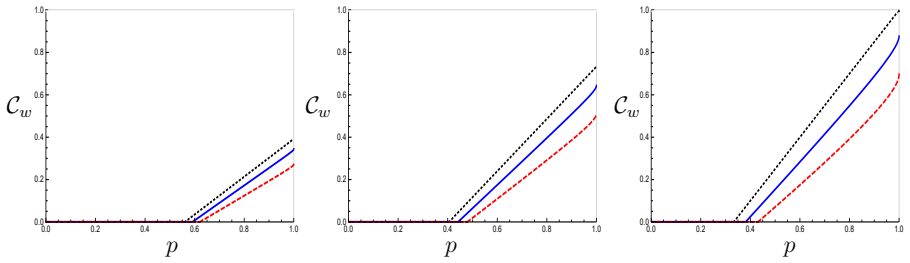
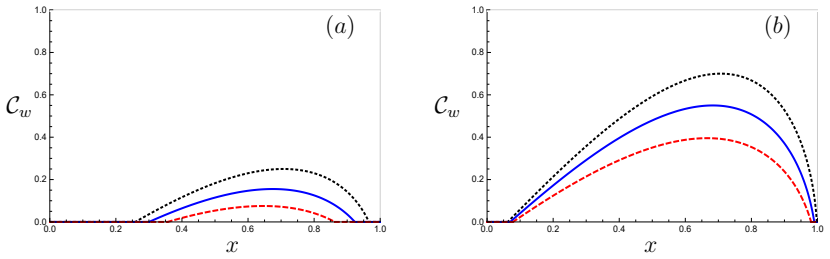
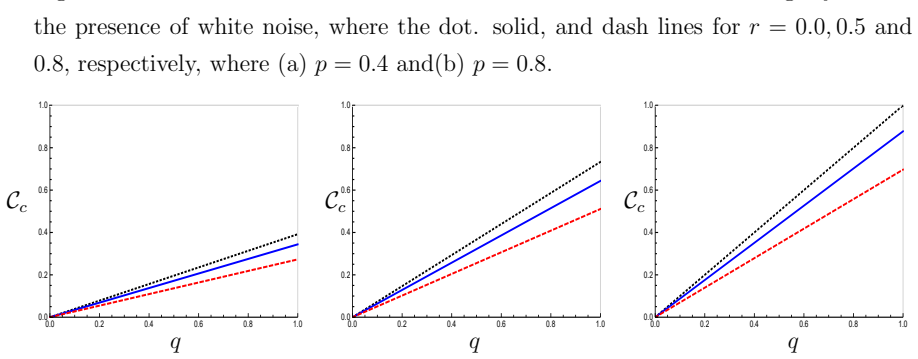
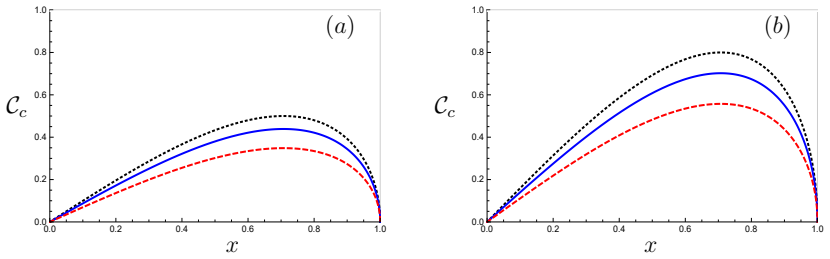
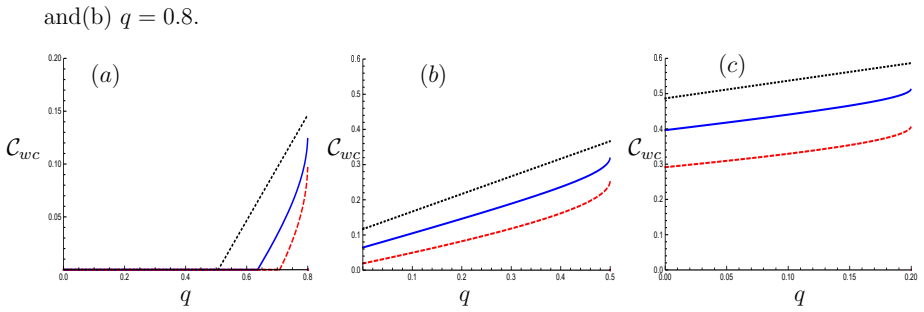
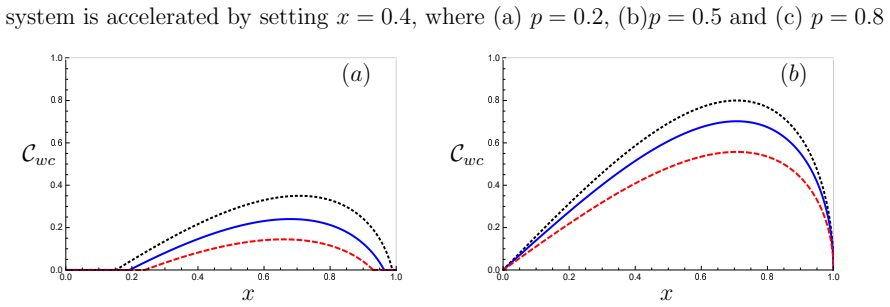
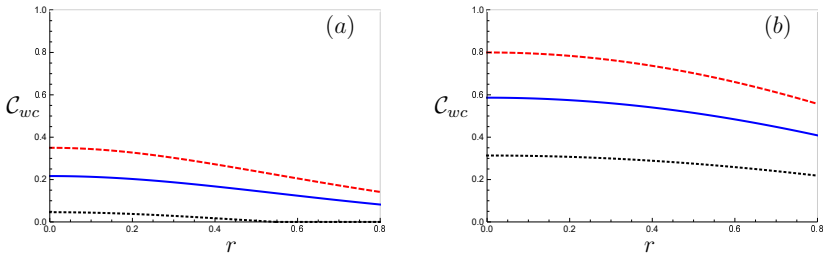
- Color noise enhances the generated entanglement between the two particles even for small values of the initial purity.
- Larger values of the white noise strength improve the generated entanglement.
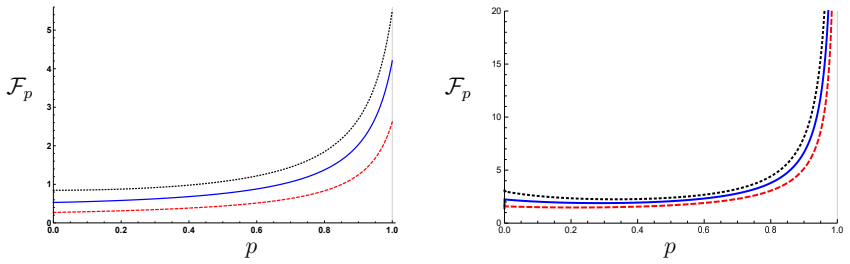
- The two-qubit form of Fisher information gives a larger estimation degree of the parameters than the single-qubit form.
- Concurrence quantifies the survival amount of entanglement in the accelerated system under noise.
Where Pith is reading between the lines
- Two-qubit measurements may offer practical advantages for quantum parameter estimation in relativistic settings with environmental noise.
- The differential impact of color versus white noise on entanglement suggests tailored noise management strategies for preserving quantum correlations during acceleration.
- Extensions to multi-qubit systems could further improve estimation precision based on the observed scaling from one to two qubits.
Load-bearing premise
The chosen models for the color and white noise channels correctly describe the dynamics acting on the accelerated two-qubit system.
What would settle it
An experimental or numerical test showing that the Fisher information estimation accuracy is the same or lower in the two-qubit form compared to single-qubit for this system would falsify the central claim.
Figures
read the original abstract
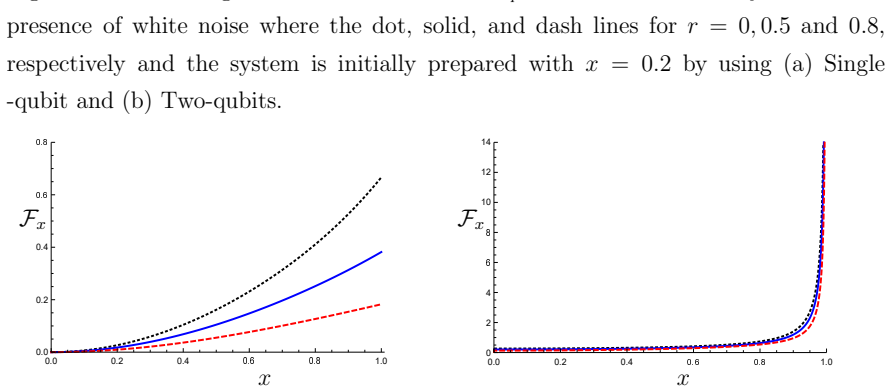
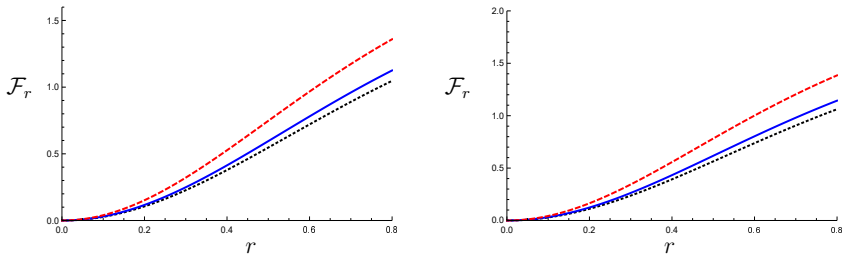
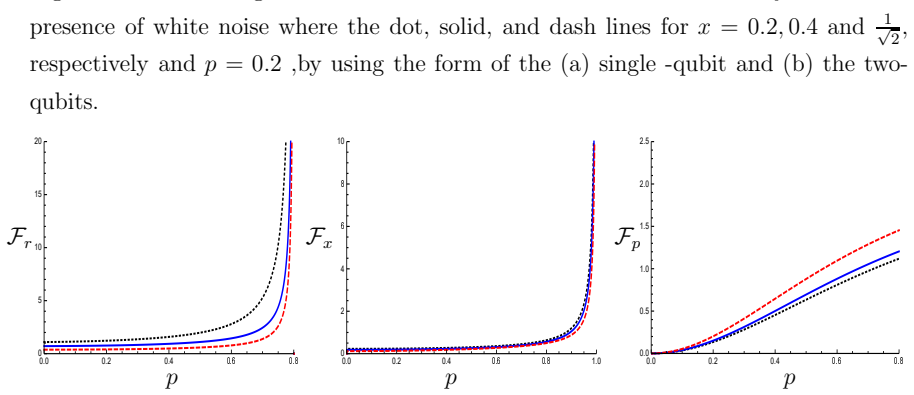
In this manuscript, we investigate the effect of the white and color noise on a accelerated two-qubit system, where different initial state setting are considered. The behavior of the survival amount of entanglement is quantified for this accelerated system by means of the concurrence. We show that, the color noise enhances the generated entanglement between the two particles even for small values of the initial purity of the accelerated state. However, the larger values of the white noise strength improve the generated entanglement. The initial parameters that describe this system are estimated by using Fisher information, where two forms are considered, namely by using a single and two-qubit forms. It is shown that, by using the two-qubit form, the estimation degree of these parameters is larger than that displayed by using a single-qubit form.
Editorial analysis
A structured set of objections, weighed in public.
Referee Report
Summary. The manuscript investigates the effects of color and white noise channels on an accelerated two-qubit system for various initial states. Entanglement survival is quantified via concurrence, with claims that color noise enhances generated entanglement even at small initial purity while larger white-noise strengths improve it. Initial parameters are estimated via Fisher information, with explicit comparison showing that the two-qubit form yields larger estimation values than the single-qubit reduction.
Significance. If the numerical comparisons hold, the work demonstrates a concrete advantage of retaining the full two-qubit density matrix for Fisher-information-based parameter estimation under combined acceleration and standard noise channels. This supplies a falsifiable, quantitative benchmark for relativistic quantum metrology and is grounded in conventional Kraus representations rather than ad-hoc models.
major comments (1)
- [Results on Fisher information] The central comparative claim (two-qubit Fisher information exceeds single-qubit) requires that both quantities be evaluated on the identical evolved state and the same set of parameters; the manuscript must state explicitly (in the section deriving the reduced single-qubit density matrix) how the reduction is performed and confirm that the parameter vector remains unchanged.
minor comments (2)
- [Abstract] The abstract uses the non-standard phrase 'estimation degree'; replace with a precise statement such as 'the value of the Fisher information' or 'the precision bound'.
- [Methods] Clarify whether the reported Fisher information is the quantum or classical version, and list the explicit parameters being estimated.
Simulated Author's Rebuttal
We thank the referee for the careful reading of our manuscript and the constructive comment. We address the point raised below.
read point-by-point responses
-
Referee: [Results on Fisher information] The central comparative claim (two-qubit Fisher information exceeds single-qubit) requires that both quantities be evaluated on the identical evolved state and the same set of parameters; the manuscript must state explicitly (in the section deriving the reduced single-qubit density matrix) how the reduction is performed and confirm that the parameter vector remains unchanged.
Authors: We agree that an explicit statement is required to substantiate the comparison. In the revised manuscript we have added a paragraph in the section on the reduced single-qubit density matrix that (i) specifies the reduction is performed by taking the partial trace over one qubit of the evolved two-qubit state obtained after the combined acceleration and noise-channel evolution, and (ii) confirms that the identical parameter vector (acceleration parameter, noise strengths, and initial-state parameters) is used for both the two-qubit and single-qubit Fisher-information calculations. revision: yes
Circularity Check
No significant circularity; derivations rest on standard QI formulas
full rationale
The paper computes concurrence via the standard Wootters formula on the evolved two-qubit density matrix under Kraus channels for color and white noise, then evaluates classical/quantum Fisher information on the same state for parameter estimation. Both the single-qubit and two-qubit FI expressions are obtained by direct differentiation of the respective density-matrix elements; the comparison that two-qubit FI is larger is therefore a direct numerical consequence of the larger Hilbert-space dimension and is not obtained by fitting, renaming, or self-referential definition. No load-bearing step reduces to a prior self-citation or to an ansatz smuggled from the authors' earlier work. The derivation chain is therefore self-contained against external benchmarks.
Axiom & Free-Parameter Ledger
Lean theorems connected to this paper
-
IndisputableMonolith/Cost/FunctionalEquation.leanwashburn_uniqueness_aczel unclear?
unclearRelation between the paper passage and the cited Recognition theorem.
It is shown that, by using the two-qubit form, the estimation degree of these parameters is larger than that displayed by using a single-qubit form.
-
IndisputableMonolith/Foundation/AbsoluteFloorClosure.leanreality_from_one_distinction unclear?
unclearRelation between the paper passage and the cited Recognition theorem.
the color noise enhances the generated entanglement... white noise strength improve the generated entanglement
What do these tags mean?
- matches
- The paper's claim is directly supported by a theorem in the formal canon.
- supports
- The theorem supports part of the paper's argument, but the paper may add assumptions or extra steps.
- extends
- The paper goes beyond the formal theorem; the theorem is a base layer rather than the whole result.
- uses
- The paper appears to rely on the theorem as machinery.
- contradicts
- The paper's claim conflicts with a theorem or certificate in the canon.
- unclear
- Pith found a possible connection, but the passage is too broad, indirect, or ambiguous to say the theorem truly supports the claim.
Reference graph
Works this paper leans on
-
[1]
Yu T., Eberly, J.H.: Finite-time disentanglement via spontaneous em ission. Phys. Rev. Lett. 93, 140404 (2004); Yu, T., Eberly, J.” Sudden Death of Entanglement : Classical Noise Effects”, Opt. Commun. 264, 393 (2006); Yu, T., Eb erly, ”Quan- tum Open System Theory: Bipartite Aspects”,J. Phys. Rev. Lett. 97, 140403 (2006)
work page 2004
- [2]
-
[3]
Yu, T., Eberly, J.H.: Sudden death of entanglement. Science 30, 598601 (2009)
work page 2009
-
[4]
G. M. Palma, K. A. Suominen, and A. K. Ekert,” Quantum computer s and dissi- pation”, Proc. R. Soc. London A 452, 567 (1996)
work page 1996
-
[5]
H. Prakash, N. Chandra, R. Prakash and Shivani, ”Effect of dec oherence on fidelity in teleportation using entangled coherent states”, J. Phys. B 40, 1613 (2007)
work page 2007
-
[6]
H. Eleuch and I. Rotter, Resonances in open quantum systems, Phys. Rev. A 95, 022117 (2017)
work page 2017
-
[7]
Metwally,” Information Loss in Local dissipation environments” , Int
N. Metwally,” Information Loss in Local dissipation environments” , Int. J. Theor. Phys. 49 1571 (2010)
work page 2010
-
[8]
N. Metwally, ”Dynamics of encrypted information in superconduc ting qubits with the presence of imperfect operations”, J. Opt. Soc. Am. B, Vol. 2 9, No. 3 (2102)
-
[9]
P. M. Alsing, I. F. Schuller, R. B. Mann and T. E. Tessier, Phys. Re v. A 74 032326 (2006)
work page 2006
-
[10]
Andre G. S. Landulfo, George E. A. Matsas, Phys. Rev. A 80, 032315, (2009); L. C. Celeri, A. G. S. Landulfo, R. M. Serra, G. E. A. Matsas, Phys. Rev. A 81, 062130 (2010)
work page 2009
-
[11]
Metwally”Usefulness classes of travelling entangled channels in nonintertial frames” Int
N. Metwally”Usefulness classes of travelling entangled channels in nonintertial frames” Int. J. Mod Phys. B, Vol. 27 No 28 1350155 (2013)
work page 2013
-
[12]
Metwally” Teleportation of Accelerated Information” J
N. Metwally” Teleportation of Accelerated Information” J. Opt . Soc. Am. B, Vol. 30, No. 1, 233-237 (2013)
work page 2013
-
[13]
N. Metwally and A. Sagheer” Quantum coding in non-inertial fram es” Quantum Information processing, 13, 771-780 (2014)
work page 2014
-
[14]
A. -Sagheer, H. Hamdoun and N. Metwally” Teleportation with mu ltiparties ac- celerated partners” , Comm. Theor. Phys. 63 287-194 (2015)
work page 2015
-
[15]
M. Nielsen, I. Chuang, Quantum Computation and Quantum Info rmation (Cam- bridge University Press, Cambridge, 2000) 14
work page 2000
- [16]
-
[17]
V. Giovannetti, S. Lloyd, L. Maccone, Quantum metrology. Phy s. Rev. Lett. 96, 010401 (2006)
work page 2006
- [18]
-
[19]
Ozaydin, Quantum Fisher information of W States in Decohere n ce channels
F. Ozaydin, Quantum Fisher information of W States in Decohere n ce channels. Phys. Lett. A 378, 3161 (2014)
work page 2014
-
[20]
Metwally, Estimation of teleported and gained parameters in a non-inertial frame
N. Metwally, Estimation of teleported and gained parameters in a non-inertial frame. Laser Phys. Lett. 14, 045202 (2017)
work page 2017
-
[21]
D. E. Bruschi, J. Louko, E. Martn-Martnez, A. Dragan, and I . Fuentes,”Unruh effect in quantum information beyond the single-mode approximation ,” Phys. Rev. A 82 pp. 042332-042342 (2010)
work page 2010
-
[22]
A. Cabello, A. Feito, and A.L.-Linares, ”Bell’s inequalities with realist ic noise for polarization-entangled photons” Phys. Rev. A 72, 052112
-
[23]
S. Dotsenko ,R. Korobka ,” Entanglement Swapping in the Presen ce of White and Color Noise”, Communications in Theoretical Physics, 2018, 69(2): 143
work page 2018
-
[24]
M. Aspachs, G. Adesso, and I. Fuentes,”Optimal Quantum Est imation of the Unruh-Hawking Effect,” Phys. Rev. Lett. 105, pp. 151301–151303 (2010)
work page 2010
-
[25]
Zhong, Wei and Sun, Zhe and Ma, Jian and Wang, Xiaoguang and N ori, Franc, ”Fisher information under decoherence in Bloch representation”, Phys. Rev. A 87 022337 (2013)
work page 2013
-
[26]
S. Hill and W. K. Wootters,”Entanglement of a Pair of Quantum Bit s”, Phys. Rev. Lett. 78 pp. 5022-5025 (1997)
work page 1997
-
[27]
W. K. Wootters W K,”Entanglement of Formation of an Arbitrary State of Two Qubits”, Phys. Rev. Lett. 80 pp. 2245–2248 (1998). 15
work page 1998
discussion (0)
Sign in with ORCID, Apple, or X to comment. Anyone can read and Pith papers without signing in.