REVIEW 4 major objections 5 minor 74 references
Spinor Bose-Einstein condensate as an analog simulator of molecular bending vibrations
T0 review · 4 major / 5 minor · reviewed 2026-08-07 · deepseek-v4-flash
Pith's one-line read A spin-1 BEC maps exactly onto the vibron model of triatomic bending; at $\gamma_c=1/5$, the maximal gap between optimal squeezing and inverse quantum Fisher information switches from $N$-independent to linear in $N$, witnessing the…
desk verdict Exact spinor-BEC/vibron mapping is real and worth knowing, but the numerical witness is computed in a truncated subspace that the full Hamiltonian does not leave invariant. read the letter →
The pith
A machine-rendered reading of the paper's core claim, the machinery that carries it, and where it could break.
The reading
What carries the argument
The load-bearing object is the exact Hamiltonian correspondence between the spinor BEC Hamiltonian and the essential vibron Hamiltonian, realized by three ingredients: the three-mode bosonic expression of $\hat J^2$, a $\pi/2$ rotation of mode 0 that corrects the sign of the pair-creation terms, and the parameter condition $q/c=2(1-\gamma)/\gamma$ that sets the relative weight of the one-body and two-body terms. Dynamics are studied in the mode-$x$ subspace with $n_y=0$, where spin-coherent states parametrize molecular configurations and the mean-field energy density $h_x^{\rm mf}=-(1-\gamma)(1+z)/2-\gamma(1-z^2)\cos^2\phi$ generates a separatrix for $\gamma>1/5$. The witness is built from the two eigenvalues $\lambda_\pm$ of the covariance matrix: the optimal squeezing parameter is $\xi_{\rm opt}^2=N^2\lambda_-/(4\langle \hat X_z\rangle^2)$ and the optimal inverse QFI is $\zeta_{\rm opt}^2=1/\lambda_+$; the maximal value of $\xi_{\rm opt}^2-\zeta_{\rm opt}^2$ over time is the quantity whose $N$-scaling changes at $\gamma_c$.
What would settle it
Run exact time evolution under the full three-mode spinor Hamiltonian $\hat H=-q\hat N_0-(c/2N)\hat J^2$ without the $n_y=0$ projection, for $N=50,100,200,500,1000$ at fixed $\gamma=0.3$, and compute $\max_t[\xi_{\rm opt}^2-\zeta_{\rm opt}^2]$ from the full state; if the maximum does not grow linearly in $N$ once the $y$-mode pair-creation terms are included, the central dynamical claim fails. An experimental counterpart would be to measure the QFI and squeezing in a tunable $q/c$ spinor BEC across the predicted critical ratio and look for the kink in the $N$-scaling.
Extended reading notes
Core claim
The central discovery is an exact operator mapping between the spin-1 BEC Hamiltonian, $\hat H=-q\hat N_0-(c/2N)\hat J^2$, and the essential vibron Hamiltonian, $\hat H=(1-\gamma)\hat n-[\gamma/(N-1)]\hat W^2$. When $\hat J^2$ is expressed in the three-mode basis, the only mismatched terms are the pair-creation and pair-annihilation terms $2\hat a_-^\dagger \hat a_+^\dagger \hat a_0\hat a_0$ and its conjugate; a $\pi/2$ rotation of mode 0 flips their signs, and with $q/c=2(1-\gamma)/\gamma$ the two Hamiltonians coincide up to a multiplicative factor for finite $N$. The paper uses the Wigner quasiprobability distribution in the mode-$x$ subspace to connect BEC states with molecular configurations, and a mean-field analysis of that subspace shows a separatrix appearing for $\gamma>1/5$. In the quench dynamics of a linear initial state under a bent-phase Hamiltonian, the optimal squeezing parameter $\xi_{\rm opt}^2$ and optimal inverse quantum Fisher information $\zeta_{\rm opt}^2$ both detect entanglement, but their maximal difference over time is flat in $N$ for $\gamma<1/5$ and grows linearly in $N$ for $\gamma>1/5$, marking the transition at $\gamma_c=1/5$.
Load-bearing premise
The exact-dynamics results are obtained after projecting the three-mode spinor Hamiltonian onto the mode-$x$ subspace with $n_y=0$, but the full Hamiltonian contains pair-creation terms that can populate the $y$ mode; the claim that the scaling witness characterizes the spinor BEC therefore assumes that this $y$-mode coupling can be neglected or that the system can be physically confined to that subspace, which the paper does not demonstrate.
Editorial extensions
If this is right
- A spinor BEC with tunable quadratic Zeeman shift can prepare coherent states representing linear or bent triatomic molecules and observe their bending dynamics on accessible timescales, including parameter regimes a real molecule cannot reach.
- Quenching a linear initial state into the bent phase drives a dynamical instability along the separatrix, generating spin squeezing and multipartite entanglement that standard QFI measurements can detect.
- The maximal difference $\max_t[\xi_{\rm opt}^2-\zeta_{\rm opt}^2]$ is a system-size scaling witness: approximately $N$-independent below $\gamma_c$ and linear in $N$ above it, so measurements at a few atom numbers can locate the transition.
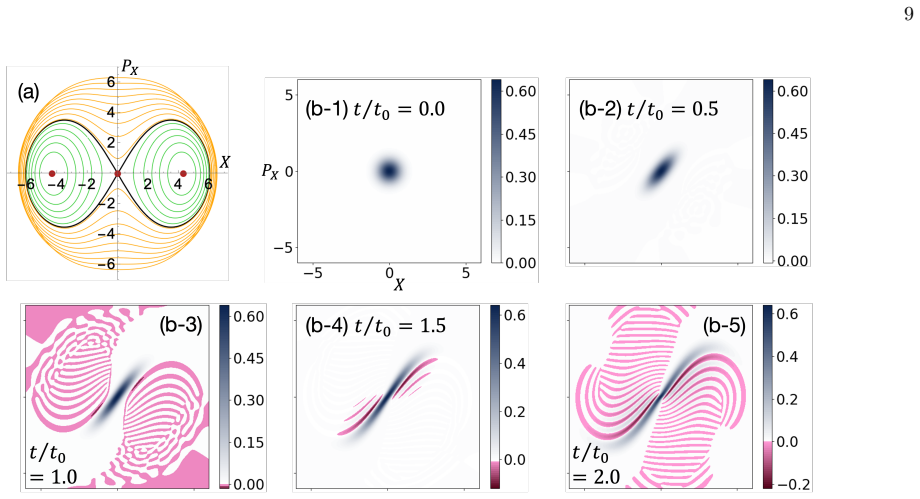
- The Wigner quasiprobability in the mode-$x$ subspace, reconstructible by homodyne-like atomic measurements, encodes the position and momentum of the molecule's central atom, linking BEC phase-space data to molecular configuration.
Reading between the lines
- A direct test of the paper's central assumption would be to simulate the full three-mode Hamiltonian, including the $y$-mode pair-creation terms, and check whether the linear-in-$N$ scaling of $\max_t[\xi_{\rm opt}^2-\zeta_{\rm opt}^2]$ survives; if it does, the witness is robust, and if not, the projection onto the mode-$x$ subspace is the limiting ingredient.
- Because the mapping is exact at finite $N$, the same scaling witness could be transferred to other systems governed by $U(3)$ pairing algebras, such as bosonic Josephson junctions, giving a cross-platform probe of the same phase transition.
- The level clustering visible in the spectrum at $\gamma>\gamma_c$ is a feature of an excited-state quantum phase transition, so the quench witness may also serve as a dynamical probe of that ESQPT in addition to the ground-state transition.
Signed reviews
Editorial analysis
A structured set of objections, weighed in public.
Referee Report
Summary. The manuscript proposes that a spin-1 spinor Bose-Einstein condensate can act as an analog quantum simulator of the two-dimensional vibron model for molecular bending vibrations. The central algebraic claim is that the spinor Hamiltonian (13), after a π/2 rotation of the mF=0 mode and a suitable choice of the quadratic Zeeman shift q, coincides with the essential vibron Hamiltonian (7) up to a multiplicative factor. The paper then uses coherent states and Wigner functions to visualize linear and bent molecular configurations, and studies quench dynamics from a linear initial state into the bent phase. The dynamical quantity of interest is the maximal difference between the optimal squeezing parameter ξ²_opt and the optimal inverse quantum Fisher information ζ²_opt, evaluated over a long time window. Numerical simulations show that this difference is essentially N-independent below γ_c=1/5 and grows with N above it; this scaling change is proposed as a dynamical witness of the linear-to-bent quantum phase transition. The numerical results are obtained in a projected 'mode x' subspace, and the code is made available.
Significance. If the central claims hold, the paper offers a concrete, tunable cold-atom platform for simulating molecular bending Hamiltonians, going beyond the mean-field level thanks to an exact finite-N algebraic identity. The witness based on ξ²_opt−ζ²_opt is an interesting and experimentally accessible idea, and the mean-field phase portrait plus exact finite-N diagonalization in the projected subspace give a coherent picture. The paper also ships reproducible code and clearly identifies the parameter regime (ferromagnetic spin-1 BEC). The main reservation is that the numerical evidence for the central witness is obtained in a subspace that is not invariant under the full spinor Hamiltonian; therefore the claim that the observed N-scaling characterizes the spinor BEC itself is not yet established.
major comments (4)
- [Sec. IV, around Eq. (15)] The parameter condition stated before Eq. (15), q/c = 2(1−γ)/γ, is inconsistent with Eq. (15) itself. From Eq. (13), H/(c/2) = −(2q/c)N0 − (1/N)J^2, so matching the coefficient in Eq. (15) requires 2q/c = (1−γ)/γ, i.e., q/c = (1−γ)/(2γ). The stated condition would produce an N0 coefficient four times too large. This is a load-bearing error because an experimentalist following the text would not realize the claimed simulator Hamiltonian. Please correct it and verify that the values of γ used in Figs. 6 and 7 correspond to the intended mapping.
- [Sec. V.B and Sec. V.C] The 'exact dynamics in mode x subspace' is not exact for the full spin-1 Hamiltonian (15). The subspace S^N_1/2 = span{|n_x,N−n_x,0>_xy} is not invariant under the full dynamics: the pair term 2a†_-a†_+a0a0 + h.c. in Eq. (14a), after rotation and in Cartesian modes, contains a contribution proportional to a†_y^2 a0^2 + h.c. that creates n_y=2 excitations while preserving J_z. Consequently, the time evolutions in Figs. 5(c), 6, and 7 solve an effective two-mode model, not the spinor BEC Hamiltonian claimed in the abstract and conclusions. The manuscript provides no estimate of the y-mode population and no demonstration that the n_y=0 truncation is dynamically faithful over the time scales t/t0 up to 1000 used in Fig. 7. Without such a justification, the claimed N-scaling of max_t[ξ²_opt−ζ²_opt] and its interpretation as a witness for the spinor BEC phase transition are not established.
- [Sec. II and Eq. (7) vs. Eq. (10) and Appendix A3] There is an internal sign inconsistency in the definition of the essential vibron Hamiltonian. Eq. (7) defines H = (1−γ)n − γ/(N−1)W^2, but the mean-field energy density in Eq. (10) and the appendix version in Eq. (A14) require the +γ/(N−1)W^2 sign; since W^2 is non-negative on physical states, these two forms are not equivalent. The critical point γ_c=1/5 is derived from the plus-sign version, so Eq. (7) appears to contain a sign typo. Because Eq. (15) is constructed to match Eq. (7) as printed, the sign of the W^2 term needs to be reconciled between the main text, the mean-field analysis, and the spinor mapping.
- [Sec. IV, Eq. (15) and Eq. (7)] Even after correcting the q/c factor, the finite-N correspondence between Eq. (15) and Eq. (7) is not exact as claimed: Eq. (15) has a 1/N prefactor for J^2_rot, while the vibron Hamiltonian (7) has 1/(N−1) for W^2. These differ by O(1/N), so the statement that the mapping holds 'beyond the mean-field approximation' requires an N-dependent adjustment of the parameters, e.g., q/c = (1−γ)(N−1)/(2γN) for the plus-sign convention, or an explicit statement that the correspondence is only asymptotic in N. Please clarify whether the numerical results are intended to describe the exact finite-N spinor system or the large-N limit.
minor comments (5)
- [Sec. III and Sec. V.B] The decomposition in Eq. (19) and the phrase 'restrict to the zero magnetization subspace' in Sec. V.B are not obviously compatible: the Fock states |n_x,N−n_x,0>_xy generally do not have vanishing variance of the original J_z. Please clarify which conserved quantity selects the projected subspace, and whether J_z is computed for the original spin-1 operators or for the effective SU(2) subalgebra of Eq. (B12).
- [Sec. V.C, Eqs. (29)-(30)] The angle φ is introduced as a Bloch-sphere azimuth in Eq. (20) and then used as a phase-space azimuth in Eqs. (30). Please state explicitly how these two parameterizations are related, since the Wigner distributions in Fig. 8 are interpreted in terms of position and momentum of the central atom.
- [Fig. 7 caption] The caption mentions 'linear fittings for γ>γ_c are added' and an inset showing slopes, but the fitting range and any uncertainty estimates are not given. Please specify the fit interval and the fit residuals or confidence intervals so that the claimed linear scaling can be assessed.
- [Abstract and Sec. VII] The phrase 'composition of triatomic atoms' in Sec. VII should read 'composition of triatomic molecules'. The same wording appears in the abstract.
- [Appendix A3, Eq. (A14)] Eq. (A14) writes H = (1−γ)n + γ/(N−1)W^2, while Eq. (7) has a minus sign. This is part of the sign inconsistency noted above; please ensure the final version uses one consistent convention throughout.
Circularity Check
No circularity: the BEC-to-vibron mapping is an explicit algebraic identity and the gamma_c witness is computed, not fitted.
full rationale
The central mapping is a direct algebraic identity: Eqs. (14a)-(14b) express the spin-1 J^2 and vibron W^2 operators in the same bosonic operators, and Eq. (15) implements the pi/2 mode-0 rotation together with the stated q/c condition, so the spinor Hamiltonian coincides with the essential vibron Hamiltonian (7) without any fitted parameter. The critical value gamma_c = 1/5 is obtained analytically from the mean-field energy density (10), not from the numerical witness, and the witness in Fig. 7 is generated by exact time evolution of the projected Hamiltonian (Sec. V.B) rather than by fitting to the transition point. Self-citations (e.g., Refs. [61,62]) supply standard formulas for optimal spin squeezing and inverse QFI; they are used as tools, and the scaling result does not reduce to them. The main limitation is dynamical, not circular: the n_y = 0 subspace used for Figs. 5-7 is not invariant under the full spin-1 Hamiltonian because pair terms such as 2 a^dagger_- a^dagger_+ a_0 a_0 + h.c. can create y-mode excitations, so the witness is strictly a property of the projected two-mode model. This, together with the low-depletion approximation discussed in Appendix C, is a physical-fidelity caveat; it does not correspond to any self-referential derivation chain. No circular step is present.
Assumptions & free parameters
free parameters (2)
- γ (control parameter) =
varied values 0.1, 0.3, 0.5, and range in Fig. 7
- Time frame T for max_t[ξ²_opt − ζ²_opt] =
t ∈ [0, 1000] with 10000 points
assumptions (5)
- standard math Bosonic commutation relations and standard quantum mechanics
- domain assumption Single-mode approximation for the spinor BEC
- domain assumption Ferromagnetic interaction c2 > 0 (e.g., 87Rb)
- domain assumption Interpretation of coherent state parameters x, y as center-atom coordinates
- standard math QFI and squeezing entanglement criteria
Cite this review
Pith. "Pith review of Spinor Bose-Einstein condensate as an analog simulator of molecular bending vibrations." pith.science (2026). https://pith.science/paper/JR7HKIEI
@misc{pith2026250519836,
  author       = {Pith},
  title        = {Pith review of: Spinor Bose-Einstein condensate as an analog simulator of molecular bending vibrations},
  year         = {2026},
  howpublished = {\url{https://pith.science/paper/JR7HKIEI}},
  note         = {Machine review of arXiv:2505.19836}
}
read the original abstract
We demonstrate that spinor Bose-Einstein condensates (BEC) can be operated as an analog simulator of the two-dimensional vibron model. This algebraic model for the description of bending and stretching vibrations of molecules, in the case of a triatomic molecules, exhibits two phases where linear and bent configurations are stabilised. Spinor BECs can be engineered to simulate states that correspond to linear or bent triatomic molecules, with the BEC's Wigner function encoding information about the molecular configuration. We show how quantum simulations of the bending dynamics of linear molecules can be realized, and how the straightening of a bent molecule leads to a dynamical instability. In the dynamics triggered by the corresponding instability, a significant amount of entanglement is generated, and we characterise the dynamics with the squeezing parameter and the quantum Fisher information (QFI). The scaling of the non-Gaussian sensitivity, described by the difference between squeezing and QFI, grows with the system size once the spinor system crosses from the linear to the bent phase, thus serving as a dynamical witness for the quantum phase transition.
Figures


Figures from the paper (6 more)



Reference graph
Works this paper leans on
-
[1]
The function⟨ ˆX⟩/ √ Nis concave and yields zero forθ= 0, πfor anyN
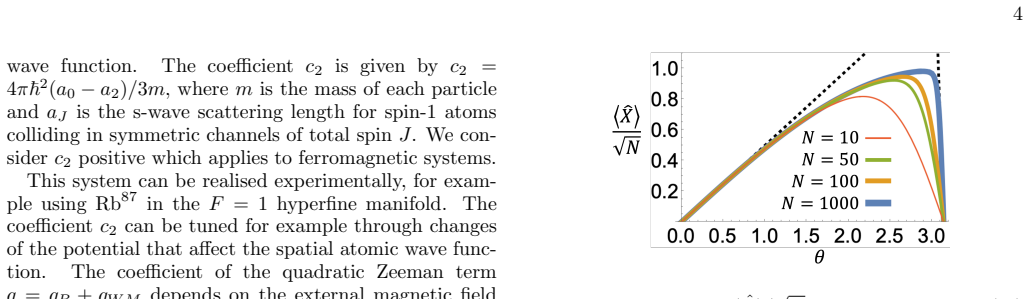
Note that the coherent state|ϕ⟩has vanishing average momentum, ⟨ ˆPX ⟩ ≡ ⟨ϕ|ˆPX |ϕ⟩= 0.(18) Figure 3 shows a plot of⟨ ˆX⟩/ √ Nas a function ofθfor differentN. The function⟨ ˆX⟩/ √ Nis concave and yields zero forθ= 0, πfor anyN. For smallθ, the function ⟨ ˆX⟩/ √ Nis independent ofNsince the state is close to the vacuum state|0⟩. The maximum approachesθ=π f...
-
[2]
Y. Kawaguchi and M. Ueda, Spinor bose–einstein con- densates, Physics Reports520, 253 (2012)
work page 2012
-
[3]
D. M. Stamper-Kurn and M. Ueda, Spinor bose gases: Symmetries, magnetism, and quantum dynamics, Rev. Mod. Phys.85, 1191 (2013)
work page 2013
-
[4]
Pezz` e, A
L. Pezz` e, A. Smerzi, M. K. Oberthaler, R. Schmied, and P. Treutlein, Quantum metrology with nonclassical states of atomic ensembles, Rev. Mod. Phys.90, 035005 (2018)
2018
-
[5]
Tian, H.-X
T. Tian, H.-X. Yang, L.-Y. Qiu, H.-Y. Liang, Y.-B. Yang, Y. Xu, and L.-M. Duan, Observation of dynam- ical quantum phase transitions with correspondence in an excited state phase diagram, Phys. Rev. Lett.124, 043001 (2020)
2020
- [6]
-
[7]
J. Cabedo and A. Celi, Excited-state quantum phase transitions in spin-orbit-coupled bose gases, Physical Re- view Research3, 043215 (2021)
work page 2021
-
[8]
P. Feldmann, C. Klempt, A. Smerzi, L. Santos, and M. Gessner, Interferometric order parameter for excited- state quantum phase transitions in bose-einstein conden- sates, Phys. Rev. Lett.126, 230602 (2021)
work page 2021
Show all 74 references
-
[10]
C. S. Chisholm, S. Hirthe, V. B. Makhalov, R. Ramos, R. Vatr´ e, J. Cabedo, A. Celi, and L. Tarruell, Probing supersolidity through excitations in a spin-orbit-coupled bose-einstein condensate, arXiv (2024)
2024
-
[11]
Zhang and L.-M
Z. Zhang and L.-M. Duan, Generation of massive en- tanglement through an adiabatic quantum phase transi- tion in a spinor condensate, Phys. Rev. Lett.111, 180401 (2013)
2013
-
[12]
Luo, Y.-Q
X.-Y. Luo, Y.-Q. Zou, L.-N. Wu, Q. Liu, M.-F. Han, M. K. Tey, and L. You, Deterministic en- tanglement generation from driving through quan- tum phase transitions, Science355, 620 (2017), 11 https://www.science.org/doi/pdf/10.1126/science.aag1106
2017 doi
-
[13]
Feldmann, M
P. Feldmann, M. Gessner, M. Gabbrielli, C. Klempt, L. Santos, L. Pezz` e, and A. Smerzi, Interferometric sen- sitivity and entanglement by scanning through quan- tum phase transitions in spinor bose-einstein conden- sates, Phys. Rev. A97, 032339 (2018)
2018
-
[14]
Pezz` e, M
L. Pezz` e, M. Gessner, P. Feldmann, C. Klempt, L. San- tos, and A. Smerzi, Heralded generation of macroscopic superposition states in a spinor bose-einstein condensate, Phys. Rev. Lett.123, 260403 (2019)
2019
-
[15]
Kruse, K
I. Kruse, K. Lange, J. Peise, B. L¨ ucke, L. Pezz` e, J. Arlt, W. Ertmer, C. Lisdat, L. Santos, A. Smerzi, and C. Klempt, Improvement of an atomic clock using squeezed vacuum, Phys. Rev. Lett.117, 143004 (2016)
2016
-
[17]
Anders, A
F. Anders, A. Idel, P. Feldmann, D. Bondarenko, S. Lori- ani, K. Lange, J. Peise, M. Gersemann, B. Meyer-Hoppe, S. Abend, N. Gaaloul, C. Schubert, D. Schlippert, L. San- tos, E. Rasel, and C. Klempt, Momentum entanglement for atom interferometry, Phys. Rev. Lett.127, 140402 (2021)
2021
-
[18]
Jaksch and P
D. Jaksch and P. Zoller, The cold atom hubbard toolbox, Annals of Physics315, 52 (2005)
2005
-
[19]
Bloch, J
I. Bloch, J. Dalibard, and S. Nascimb` ene, Quantum sim- ulations with ultracold quantum gases, Nature Physics 8, 267 (2012)
2012
-
[20]
Gross and I
C. Gross and I. Bloch, Quantum simulations with ultra- cold atoms in optical lattices (2017)
2017
-
[21]
Sch¨ afer, T
F. Sch¨ afer, T. Fukuhara, S. Sugawa, Y. Takasu, and Y. Takahashi, Tools for quantum simulation with ultra- cold atoms in optical lattices, Nature Reviews Physics 2020 2:82, 411 (2020)
2020
-
[22]
P. J. J. O’Malley, R. Babbush, I. D. Kivlichan, J. Romero, J. R. McClean, R. Barends, J. Kelly, P. Roushan, A. Tranter, N. Ding, B. Campbell, Y. Chen, Z. Chen, B. Chiaro, A. Dunsworth, A. G. Fowler, E. Jef- frey, E. Lucero, A. Megrant, J. Y. Mutus, M. Neeley, C. Neill, C. Quin...
2016
-
[23]
Hempel, C
C. Hempel, C. Maier, J. Romero, J. McClean, T. Monz, H. Shen, P. Jurcevic, B. P. Lanyon, P. Love, R. Babbush, A. Aspuru-Guzik, R. Blatt, and C. F. Roos, Quantum chemistry calculations on a trapped-ion quantum simu- lator, Phys. Rev. X8, 031022 (2018)
2018
-
[24]
Arg¨ uello-Luengo, A
J. Arg¨ uello-Luengo, A. Gonz´ alez-Tudela, T. Shi, P. Zoller, and J. I. Cirac, Analogue quantum chemistry simulation, Nature 2019 574:7777574, 215 (2019)
2019
-
[25]
A. J. Daley, I. Bloch, C. Kokail, S. Flannigan, N. Pearson, M. Troyer, and P. Zoller, Practical quantum advantage in quantum simulation, Nature607, 667 (2022)
2022
-
[26]
Schneider, D
C. Schneider, D. Porras, and T. Schaetz, Experimental quantum simulations of many-body physics with trapped ions, Reports on Progress in Physics75, 024401 (2012)
2012
-
[27]
Schlawin, M
F. Schlawin, M. Gessner, A. Buchleitner, T. Sch¨ atz, and S. S. Skourtis, Continuously parametrized quantum simulation of molecular electron-transfer reactions, PRX Quantum2, 010314 (2021)
2021
-
[28]
V. So, M. D. Suganthi, A. Menon, M. Zhu, R. Zhuravel, H. Pu, P. G. Wolynes, J. N. Onuchic, and G. Pagano, Trapped-ion quantum simulation of electron transfer models with tunable dissipation, Sci. Adv10, 8011 (2024)
2024
-
[29]
A. C. C. de Albornoz, R. G. C. nas, M. Sch¨ afer, N. E. Frattini, B. Allen, D. G. A. Cabral, P. E. Videla, P. Khaz- aei, E. Geva, V. S. Batista, and M. H. Devoret, Oscilla- tory dissipative tunneling in an asymmetric double-well potential, arXiv:2409.13113 (2024)
2024 arXiv
-
[30]
Iachello and R
F. Iachello and R. D. Levine,Algebraic Theory of Molecules(Oxford University Press, 1995)
1995
-
[31]
Iachello and S
F. Iachello and S. Oss, Algebraic approach to molecular spectra: Two-dimensional prob- lems, The Journal of Chemical Physics104, 6956 (1996), https://pubs.aip.org/aip/jcp/article- pdf/104/18/6956/19077006/6956 1 online.pdf
1996
-
[32]
P´ erez-Bernal and F
F. P´ erez-Bernal and F. Iachello, Algebraic approach to two-dimensional systems: Shape phase transitions, mon- odromy, and thermodynamic quantities, Phys. Rev. A 77, 032115 (2008)
2008
-
[33]
Johansson, P
J. Johansson, P. Nation, and F. Nori, Qutip: An open- source python framework for the dynamics of open quan- tum systems, Computer Physics Communications183, 1760 (2012)
2012
-
[34]
Johansson, P
J. Johansson, P. Nation, and F. Nori, Qutip 2: A python framework for the dynamics of open quantum systems, Computer Physics Communications184, 1234 (2013)
2013
-
[35]
Usui and A
A. Usui and A. Niezgoda,https://github.com/ ayaka-usui/spinorBEC_simulator_of_2DVM(2025)
2025
-
[36]
Cejnar and F
P. Cejnar and F. Iachello, Phase structure of interacting boson models in arbitrary dimension, Journal of Physics A: Mathematical and Theoretical40, 581 (2007)
2007
-
[37]
Caprio, P
M. Caprio, P. Cejnar, and F. Iachello, Excited state quan- tum phase transitions in many-body systems, Annals of Physics323, 1106 (2008)
2008
-
[38]
Larese, F
D. Larese, F. P´ erez-Bernal, and F. Iachello, Signatures of quantum phase transitions and excited state quantum phase transitions in the vibrational bending dynamics of triatomic molecules, Journal of Molecular Structure 1051, 310 (2013)
2013
-
[39]
Cejnar, P
P. Cejnar, P. Str´ ansk´ y, M. Macek, and M. Kloc, Excited- state quantum phase transitions, Journal of Physics A: Mathematical and Theoretical54, 133001 (2021)
2021
-
[40]
J. M. Radcliffe, Some properties of coherent spin states, Journal of Physics A4, 313 (1971)
1971
-
[41]
F. T. Arecchi, E. Courtens, R. Gilmore, and H. Thomas, Atomic coherent states in quantum optics, Physical Re- view A6, 2211 (1972)
1972
-
[42]
Iachello and A
F. Iachello and A. Arima,The Interacting Boson Model, Cambridge Monographs on Mathematical Physics (Cam- bridge University Press, 1987)
1987
-
[43]
R. J. Glauber, Coherent and incoherent states of the ra- diation field, Physical Review131, 2766 (1963)
1963
-
[44]
Mandel and E
L. Mandel and E. Wolf,Optical Coherence and Quantum Optics(Cambridge University Press, 1995)
1995
-
[45]
S. S. Mirkhalaf, D. Benedicto Orenes, M. W. Mitchell, and E. Witkowska, Criticality-enhanced quantum sens- ing in ferromagnetic bose-einstein condensates: Role of readout measurement and detection noise, Physical Re- view A103, 023317 (2021)
2021
-
[46]
Feldmann,Generalized quantum phase transitions for quantum-state engineering in spinor Bose-Einstein con- densates, Ph.D
P. Feldmann,Generalized quantum phase transitions for quantum-state engineering in spinor Bose-Einstein con- densates, Ph.D. thesis, Gottfried Wilhelm Leibniz Uni- versit at (2021). 12
2021
-
[47]
Gross, H
C. Gross, H. Strobel, E. Nicklas, T. Zibold, N. Bar- Gill, G. Kurizki, and M. K. Oberthaler, Atomic ho- modyne detection of continuous-variable entangled twin- atom states, Nature480, 219 (2011)
2011
-
[48]
Peise, I
J. Peise, I. Kruse, K. Lange, B. L¨ ucke, L. Pezz` e, J. Arlt, W. Ertmer, K. Hammerer, L. Santos, A. Smerzi, and C. Klempt, Satisfying the einstein–podolsky–rosen crite- rion with massive particles, Nature Communications6, 8984 (2015)
2015
-
[49]
E. M. Bookjans, A. Vinit, and C. Raman, Quantum phase transition in an antiferromagnetic spinor bose- einstein condensate, Phys. Rev. Lett.107, 195306 (2011)
2011
-
[50]
Zhang, D
W. Zhang, D. L. Zhou, M.-S. Chang, M. S. Chapman, and L. You, Coherent spin mixing dynamics in a spin-1 atomic condensate, Phys. Rev. A72, 013602 (2005)
2005
-
[51]
Zibold, E
T. Zibold, E. Nicklas, C. Gross, and M. K. Oberthaler, Classical bifurcation at the transition from rabi to joseph- son dynamics, Phys. Rev. Lett.105, 204101 (2010)
2010
-
[52]
L. Zhao, J. Jiang, T. Tang, M. Webb, and Y. Liu, Dy- namics in spinor condensates tuned by a microwave dress- ing field, Phys. Rev. A89, 023608 (2014)
2014
-
[53]
D. J. Rowe, B. C. Sanders, and H. de Guise, Rep- resentations of the Weyl group and Wigner func- tions for SU(3), Journal of Mathematical Physics 40, 3604 (1999), https://pubs.aip.org/aip/jmp/article- pdf/40/7/3604/19016963/3604 1 online.pdf
1999
-
[54]
G. A. Raggio and R. F. Werner, Quantum statistical me- chanics of general mean field systems, Helvetica Physica Acta62, 980 (1989)
1989
-
[55]
N. G. Duffield and R. F. Werner, Mean- field dynamical semigroups on c*-algebras, Re- views in Mathematical Physics04, 383 (1992), https://doi.org/10.1142/S0129055X92000108
1992 doi
-
[56]
N. G. Duffield and R. F. Werner, Classical hamiltonian dynamics for quantum hamiltonian mean-field limits, in Stochastics and quantum mechanics (Swansea, 1990), edited by A. Truman and I. Davies (World Sci. Publish- ing, 1992) pp. 115–129
1990
-
[57]
D. J. Wineland, J. J. Bollinger, W. M. Itano, and D. J. Heinzen, Squeezed atomic states and projection noise in spectroscopy, Physical Review A50, 67 (1994)
1994
-
[58]
C. W. Helstrom, Quantum detection and estimation the- ory, Journal of Statistical Physics1, 231 (1969)
1969
-
[59]
S. L. Braunstein and C. M. Caves, Statistical distance and the geometry of quantum states, Phys. Rev. Lett. 72, 3439 (1994)
1994
-
[60]
D. J. Wineland, J. J. Bollinger, W. M. Itano, F. L. Moore, and D. J. Heinzen, Spin squeezing and reduced quantum noise in spectroscopy, Phys. Rev. A46, R6797 (1992)
1992
-
[61]
Pezz´ e and A
L. Pezz´ e and A. Smerzi, Entanglement, nonlinear dy- namics, and the heisenberg limit, Phys. Rev. Lett.102, 100401 (2009)
2009
-
[62]
Gessner, A
M. Gessner, A. Smerzi, and L. Pezz` e, Metrological non- linear squeezing parameter, Physical Review Letters122, 090503 (2019)
2019
-
[63]
Sorelli, M
G. Sorelli, M. Gessner, A. Smerzi, and L. Pezz` e, Fast and optimal generation of entanglement in bosonic josephson junctions, Phys. Rev. A99, 022329 (2019)
2019
-
[64]
Hyllus, W
P. Hyllus, W. Laskowski, R. Krischek, C. Schwem- mer, W. Wieczorek, H. Weinfurter, L. Pezz´ e, and A. Smerzi, Fisher information and multiparticle entan- glement, Phys. Rev. A85, 022321 (2012)
2012
-
[65]
Hyllus, W
P. Hyllus, W. Laskowski, R. Krischek, C. Schwem- mer, W. Wieczorek, H. Weinfurter, L. Pezz´ e, and A. Smerzi, Fisher information and multiparticle entan- glement, Physical Review A85, 22321 (2012)
2012
-
[66]
Z. Ren, W. Li, A. Smerzi, and M. Gessner, Metrolog- ical detection of multipartite entanglement from young diagrams, Physical Review Letters126, 080502 (2021)
2021
-
[67]
Strobel, W
H. Strobel, W. Muessel, D. Linnemann, T. Zibold, D. B. Hume, L. Pezz` e, A. Smerzi, and M. K. Oberthaler, Fisher information and entanglement of non-gaussian spin states, Science345, 424 (2014), https://www.science.org/doi/pdf/10.1126/science.1250147
2014 doi
-
[68]
M. F. Riedel, P. B¨ ohi, Y. Li, T. W. H¨ ansch, A. Sina- tra, and P. Treutlein, Atom-chip-based generation of en- tanglement for quantum metrology, Nature464, 1170 (2010)
2010
-
[69]
McConnell, H
R. McConnell, H. Zhang, J. Hu, S. ´Cuk, and V. Vuleti´ c, Entanglement with negative wigner function of almost 3,000 atoms heralded by one photon, Nature519, 439 (2015)
2015
-
[70]
Meyer-Hoppe, F
B. Meyer-Hoppe, F. Anders, P. Feldmann, L. Santos, and C. Klempt, Excited-state phase diagram of a ferromag- netic quantum gas, Phys. Rev. Lett.131, 243402 (2023)
2023
-
[71]
Peise, B
J. Peise, B. L¨ ucke, L. Pezz´ e, F. Deuretzbacher, W. Ert- mer, J. Arlt, A. Smerzi, L. Santos, and C. Klempt, Interaction-free measurements by quantum zeno stabi- lization of ultracold atoms, Nature Communications6, 6811 (2015)
2015
-
[72]
C. D. Hamley, C. S. Gerving, T. M. Hoang, E. M. Book- jans, and M. S. Chapman, Spin-nematic squeezed vac- uum in a quantum gas, Nature Physics8, 305 (2012)
2012
-
[73]
Linnemann, H
D. Linnemann, H. Strobel, W. Muessel, J. Schulz, R. J. Lewis-Swan, K. V. Kheruntsyan, and M. K. Oberthaler, Quantum-enhanced sensing based on time reversal of nonlinear dynamics, Phys. Rev. Lett.117, 013001 (2016). 13 Appendix A: Algebraic models in two dimensions The generato...
2016
-
[74]
Here,Nis the total number of bound states,nis the vibrational quantum number, and lis the value of the angular momentum along thez-axis
Chain (I) In the subalgebra chain (I) in (A2a), the basis is de- termined by the quantum numbers as U(3)→N(A6a) U(2)→n(A6b) O(2)→l.(A6c) These numbers characterise the states in this chain and have physical meaning. Here,Nis the total number of bound states,nis the vibrational...
-
[75]
, Norω= 1,3
Chain (II) In chain (II) in (A2b), we identify the following quan- tum numbers: U(3)→N(A10a) O(3)→ω(A10b) O(2)→l.(A10c) The quantum numbers are bounded in a similar way to chain (I):ω= 0,2. . . , Norω= 1,3. . . , Nfor even or 14 oddNandl=−ω,−ω+ 1, . . . , ω−1, ω. For the sake ...
-
[76]
Nevertheless, the phase transition between the two chains is captured by only two terms
Intermediate regime chain I and chain II The intermediate regime between these two chains can be studied by diagonalising the general Hamiltonian (3). Nevertheless, the phase transition between the two chains is captured by only two terms. The Casimir operator for O(2) is shar...
Reviewed August 7, 2026 · model on record in the stance chip above.
Discussion (0). Continue with ORCID to comment.