Accelerating Sparse Transformer Inference on GPU
Pith reviewed 2026-05-22 01:12 UTC · model grok-4.3
The pith
STOF accelerates sparse Transformer inference on GPUs by mapping attention to row-wise or blockwise kernels and searching fusion templates.
A machine-rendered reading of the paper's core claim, the machinery that carries it, and where it could break.
Core claim
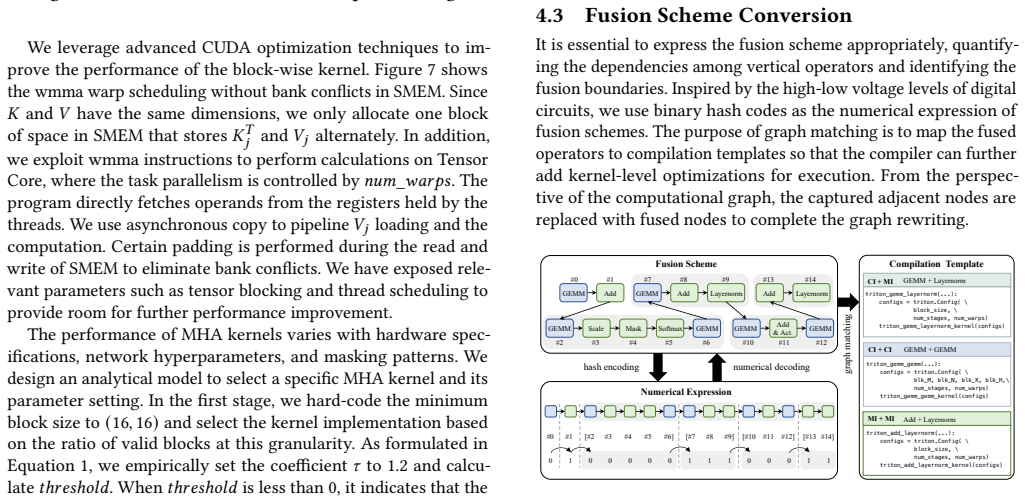
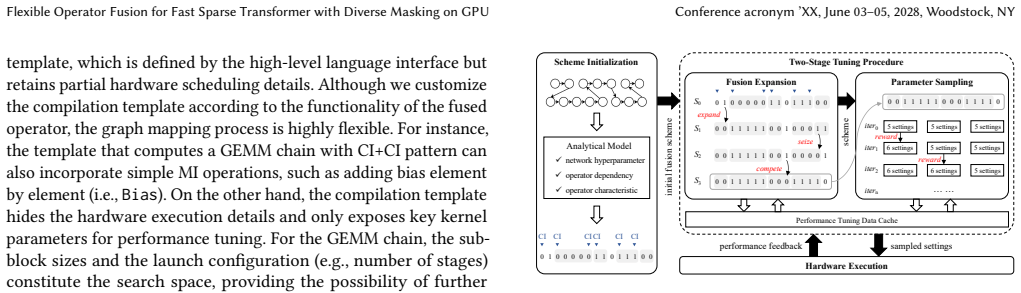
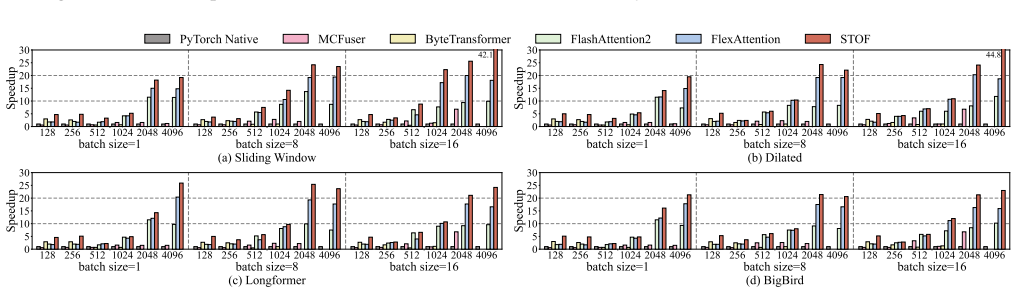
STOF is a framework that incorporates optimizations for Sparse Transformer that enables flexible masking and Operator Fusion on GPU. For multi-head attention (MHA) structure, STOF maps the computation to row-wise or blockwise kernels with unique storage formats according to analytical modeling. For downstream operators, STOF maps the fusion scheme to compilation templates and determines the optimal running configuration through two-stage searching. The experimental results show that compared to the state-of-the-art work, STOF achieves maximum speedups of 1.6x in MHA computation and 1.4x in end-to-end inference.
What carries the argument
Analytical modeling to select row-wise versus blockwise kernels for MHA plus two-stage search over compilation templates for downstream operator fusion.
If this is right
- MHA computation in sparse Transformers runs faster when the kernel layout matches the sparsity pattern through modeling.
- End-to-end inference time decreases when fusion schemes are chosen by searching compilation templates rather than using static rules.
- Flexible masking becomes practical on GPUs because the framework adapts storage and execution to the mask without manual rewriting.
- Speedups of 1.6x in attention and 1.4x overall hold when the two-stage search converges on good templates for the target hardware.
Where Pith is reading between the lines
- The same modeling and search approach could be applied to other sparse operators beyond attention to compound gains in full model inference.
- Extending the analytical model to predict energy use in addition to latency would help deployment decisions for large-scale LLM serving.
- Testing the framework on emerging GPU architectures would reveal whether the row-versus-block decision rules remain stable or need recalibration.
Load-bearing premise
Analytical modeling of GPU kernel performance for row-wise versus blockwise mappings, together with two-stage template search, will reliably identify optimal configurations across diverse sparse masks and hardware.
What would settle it
Running STOF on a new sparse mask pattern or different GPU model and finding that a hand-tuned or alternative kernel choice runs faster than the automatically selected configuration.
Figures





read the original abstract
Large language models (LLMs) are popular around the world due to their powerful understanding capabilities. As the core component of LLMs, accelerating Transformer through parallelization has gradually become a hot research topic. Mask layers introduce sparsity into Transformer to reduce calculations. However, previous works rarely focus on the performance optimization of sparse Transformer. In addition, current static operator fusion schemes fail to adapt to diverse application scenarios. To address the above problems, we propose STOF, a framework that incorporates optimizations for Sparse Transformer that enables flexible masking and Operator Fusion on GPU. For multi-head attention (MHA) structure, STOF maps the computation to row-wise or blockwise kernels with unique storage formats according to analytical modeling. For downstream operators, STOF maps the fusion scheme to compilation templates and determines the optimal running configuration through two-stage searching. The experimental results show that compared to the stateof-the-art work, STOF achieves maximum speedups of 1.6x in MHA computation and 1.4x in end-to-end inference.
Editorial analysis
A structured set of objections, weighed in public.
Referee Report
Summary. The manuscript proposes STOF, a framework for accelerating sparse Transformer inference on GPUs. It enables flexible masking and operator fusion by mapping MHA computations to row-wise or blockwise kernels (with tailored storage formats) via analytical performance modeling, and by mapping downstream operator fusion to compilation templates whose optimal configurations are selected via two-stage search. Experiments are reported to yield maximum speedups of 1.6x in MHA and 1.4x end-to-end versus prior state-of-the-art work.
Significance. If the modeling and search reliably generalize, the work could deliver practical speedups for sparse Transformer deployments on GPUs. The combination of analytical modeling with lightweight search is a potentially efficient alternative to exhaustive autotuning or purely static fusion, provided the predictions hold across varied sparsity patterns and hardware.
major comments (2)
- The central claim that analytical modeling of row-wise versus blockwise kernel performance, together with two-stage search, identifies configurations that generalize to diverse sparse masks and hardware (abstract and STOF design description) is load-bearing for the adaptability and speedup assertions. The manuscript provides no explicit validation of the modeling equations or search procedure on held-out mask families, alternate densities, or different GPU architectures; without such evidence the reported 1.6x/1.4x gains risk being instance-specific rather than framework-driven.
- Experimental results section: the maximum speedups are stated without accompanying details on sparsity densities, mask generation methods, number of runs, error bars, or the precise set of baselines and datasets. This absence prevents assessment of whether the gains are robust or sensitive to post-hoc configuration choices.
minor comments (2)
- Abstract: 'stateof-the-art' is missing a hyphen.
- Notation for the unique storage formats associated with row-wise and blockwise mappings should be introduced explicitly when first used.
Simulated Author's Rebuttal
We thank the referee for the constructive comments on our manuscript. We provide detailed responses to each major comment below and indicate the revisions we plan to make to address the concerns raised.
read point-by-point responses
-
Referee: The central claim that analytical modeling of row-wise versus blockwise kernel performance, together with two-stage search, identifies configurations that generalize to diverse sparse masks and hardware (abstract and STOF design description) is load-bearing for the adaptability and speedup assertions. The manuscript provides no explicit validation of the modeling equations or search procedure on held-out mask families, alternate densities, or different GPU architectures; without such evidence the reported 1.6x/1.4x gains risk being instance-specific rather than framework-driven.
Authors: We recognize that the manuscript does not present explicit validation on held-out data or different hardware. The modeling equations are derived from analytical performance models based on GPU memory hierarchy and arithmetic intensity, which are intended to be general. However, to fully substantiate the generalization claim, we will add experiments validating the model predictions on additional mask families and report results on a second GPU architecture in the revised manuscript. We have also clarified in the design section how the two-stage search adapts to new configurations. revision: yes
-
Referee: Experimental results section: the maximum speedups are stated without accompanying details on sparsity densities, mask generation methods, number of runs, error bars, or the precise set of baselines and datasets. This absence prevents assessment of whether the gains are robust or sensitive to post-hoc configuration choices.
Authors: We agree with the referee that additional experimental details are necessary. The revised manuscript now includes: sparsity densities used in experiments (e.g., 25%, 50%, 75% sparsity), mask generation methods (random masking and block-sparse patterns), number of runs (10 runs per configuration with mean and standard deviation reported), error bars in all figures, the full list of baselines with citations, and the specific datasets for end-to-end inference (e.g., language modeling tasks). These additions will allow readers to better evaluate the robustness of the reported speedups. revision: yes
Circularity Check
No circularity: engineering framework with independent experimental validation
full rationale
The paper describes STOF as a GPU optimization framework that applies analytical modeling to select row-wise or blockwise kernels for MHA and uses two-stage search over compilation templates for operator fusion. No equations, fitted parameters presented as predictions, or self-citation chains are invoked to derive the reported speedups. The 1.6x MHA and 1.4x end-to-end gains are measured against external SOTA baselines on concrete hardware and masks, making the contribution self-contained rather than tautological. This is a standard engineering result with no load-bearing derivation that reduces to its own inputs by construction.
Axiom & Free-Parameter Ledger
axioms (2)
- domain assumption Analytical modeling can accurately predict and select between row-wise and blockwise kernel performance for sparse MHA on GPU hardware.
- domain assumption Two-stage search over compilation templates will identify near-optimal fusion configurations for downstream operators.
Lean theorems connected to this paper
-
IndisputableMonolith/Cost/FunctionalEquation.leanwashburn_uniqueness_aczel unclear?
unclearRelation between the paper passage and the cited Recognition theorem.
STOF maps the computation to row-wise or blockwise kernels with unique storage formats according to analytical modeling... two-stage searching
-
IndisputableMonolith/Foundation/RealityFromDistinction.leanreality_from_one_distinction unclear?
unclearRelation between the paper passage and the cited Recognition theorem.
We propose STOF, a framework that incorporates optimizations for Sparse Transformer via flexible masking and operator fusion on GPU
What do these tags mean?
- matches
- The paper's claim is directly supported by a theorem in the formal canon.
- supports
- The theorem supports part of the paper's argument, but the paper may add assumptions or extra steps.
- extends
- The paper goes beyond the formal theorem; the theorem is a base layer rather than the whole result.
- uses
- The paper appears to rely on the theorem as machinery.
- contradicts
- The paper's claim conflicts with a theorem or certificate in the canon.
- unclear
- Pith found a possible connection, but the passage is too broad, indirect, or ambiguous to say the theorem truly supports the claim.
discussion (0)
Sign in with ORCID, Apple, or X to comment. Anyone can read and Pith papers without signing in.