REVIEW 4 major objections 5 minor 58 references
Sparse Fine-Tuning of Transformers for Generative Tasks
T0 review · 4 major / 5 minor · reviewed 2026-08-06 · deepseek-v4-flash
Pith's one-line read Fine-tuning a transformer can be recast as sparse coding, with the adapted feature at each layer a sparse combination of learned feature-dictionary atoms that serve as the interpretable units of adaptation.
desk verdict A clean sparse-dictionary parameterization for fine-tuning transformers, worth reviewing, but the DreamBooth evaluation is under-powered and the editing claims are qualitative. read the letter →
The pith
A machine-rendered reading of the paper's core claim, the machinery that carries it, and where it could break.
The reading
What carries the argument
The load-bearing object is the sparse dictionary factorization $\Delta O = \sigma_\lambda(A X W_s) D$ imposed on the adapted feature at each attention layer: $D \in \mathbb{R}^{M \times C_o}$ is the learned feature dictionary (the atoms), $W_s$ produces the coefficient pre-activations, and $\sigma_\lambda$ enforces sparsity so that only a few atoms contribute to each output. This factorization turns fine-tuning into dictionary learning—freeze the pre-trained output $O$, learn $D$ and $W_s$ for the downstream task—and sparsity is what makes the coefficients usable as atom-importance indicators. A supplementary polynomial-expansion analysis is used to argue that shallow-layer atoms shape global structure while deep-layer atoms contribute detail.
What would settle it
On a large set of personalization subjects, measure at each attention layer the reconstruction error of the observed adapted feature $\Delta O$ against its best sparse approximation using $M=256$ atoms; if many subjects require far more than 4% active atoms to reach the fidelity of the full fine-tuned model, the sparse-span premise fails. A complementary test: with the learned dictionary $D$ fixed, replace the sparse coefficients by dense low-rank coefficients of equal parameter count and compare prompt-modified generations; if the dense version is equally stable, sparsity itself is not what the experiments demonstrate.
Extended reading notes
Core claim
The central claim is that the residual feature that fine-tuning needs to add at each attention layer can be written as $\Delta O = \sigma_\lambda(A X W_s) D$, where $D$ is a learned dictionary of $M$ feature atoms, $A$ is the attention map, $X$ the input, $W_s$ a learned projection, and $\sigma_\lambda$ a sparsifying nonlinearity such as soft-thresholding, shifted ReLU, or top-k activation. The adapted output is $O + \Delta O$, with $O$ from frozen pre-trained weights, so the pre-trained model is untouched and the new knowledge is a sparse combination of atoms. The paper argues that the sparse coefficients are importance indicators, that the atoms themselves are the units that must be tuned, and that a small number of atoms suffices: a toy Fourier experiment shows atoms (not coefficients) carry the new task, a two-layer transformer VAE flips generated “8” digits into “3” digits with 12 atoms, and a diffusion-transformer image model reconstructs a target concept with about 40 atoms, with 4 atoms fixing its core structure.
Load-bearing premise
The method assumes that the small adjustment a fine-tuned model needs at every attention layer can be expressed as a sparse combination of a few hundred learned dictionary atoms—with only 2–4% of atoms active—and that this sparse span is rich enough for arbitrary generative concepts; the experiments test this on a limited set of subjects and mostly qualitative editing examples.
Editorial extensions
If this is right
- A fine-tuned concept can be represented by a small set of dictionary atoms (about 40 in the paper's experiments, with the core structure in about 4), so adaptation is sparse and inspectable rather than a dense weight change.
- Editing an image becomes a matter of choosing coefficient density: raising sparsity keeps only the most essential atoms and improves text alignment, while lowering sparsity adds fidelity.
- Sparse coefficient updates are more stable than low-rank ones under prompt changes: with a single active atom the method keeps generating the intended concept under a modified prompt, whereas the rank-one low-rank baseline produces disrupted outputs.
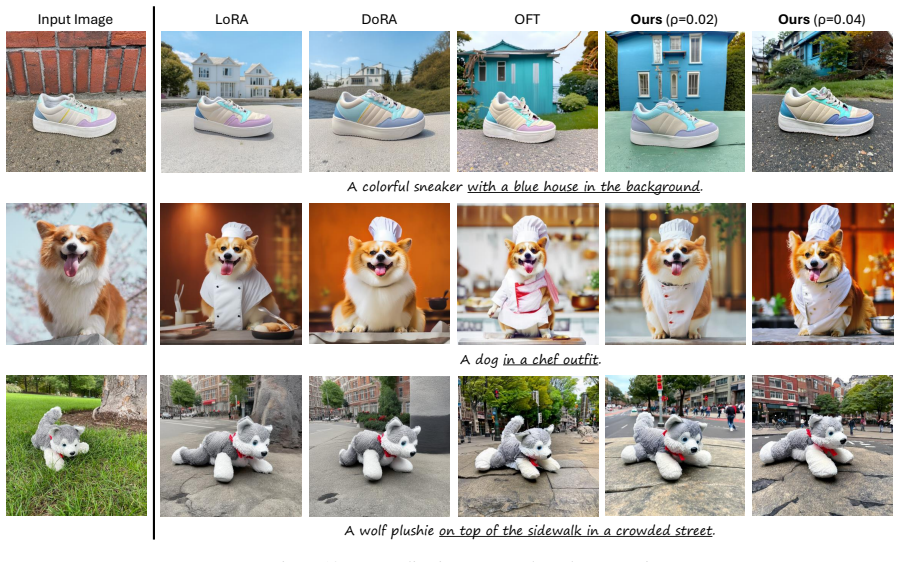
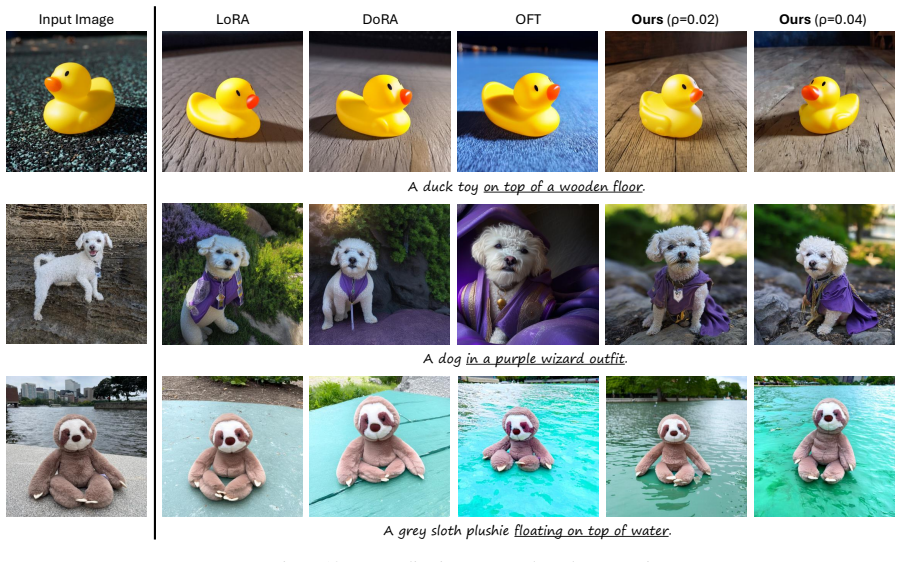
- On the 30-subject personalization benchmark used in the paper, the sparse dictionary method improves text-to-image alignment and diversity over the compared fine-tuning baselines while preserving comparable fidelity.
- The dictionary size $M$ is a controllable trade-off: a larger dictionary improves fidelity, while a smaller dictionary improves alignment and diversity.
Reading between the lines
- If the sparse dictionary view holds across layers, the same atoms could be clustered by the visual attributes they control (texture, pose, object parts), which would turn fine-tuning into a direct concept-editing interface; the paper only shows this qualitatively with a few examples.
- The toy experiment's conclusion—that tuning atoms matters more than tuning coefficients—predicts a direct ablation on the text-to-image model: fine-tuning only value/output projections should outperform fine-tuning only query/key projections at matched capacity. That comparison is not reported.
- The expressivity bet that a few hundred atoms span any needed residual could be tested systematically by measuring how reconstruction error of $\Delta O$ drops as $M$ grows across many subjects; the paper reports the effect of $M$ on generation metrics but not the underlying reconstruction error.
- A stronger falsification of the sparsity mechanism would replace the sparse coefficients with dense low-rank coefficients of the same parameter count while keeping the same atoms; if stability under prompt changes persists, the benefit comes from the dictionary parameterization rather than from sparsity.
Editorial analysis
A structured set of objections, weighed in public.
Referee Report
Summary. The paper proposes a sparse-coding view of fine-tuning for transformers in generative tasks. Instead of adapting weight matrices densely, the method represents the adapted feature residual ΔO at each attention layer as ΔO = σλ(AXWs)D, where D is a learned dictionary of feature atoms and σλ is a sparsifying nonlinearity (soft-threshold, ReLU, or top-k). The authors argue that this sparse representation makes fine-grained adaptation interpretable and controllable. They demonstrate the formulation on a 1D Fourier toy task, a 2-layer VAEs digit-generation experiment, qualitative image editing on DiT (PixArt-Σ), and DreamBooth concept customization comparing against LoRA, DoRA, and OFT. The central claim is that sparse dictionary atoms act as building blocks for new concepts, enabling better text-aligned image editing and concept customization than existing dense or low-rank fine-tuning methods.
Significance. If the central claim is established, the paper offers a genuinely different perspective on fine-tuning: instead of modifying weights or dense residual features, it represents the adapted representation as a sparse combination of a small dictionary, which could improve interpretability and controllability of generative transformers. The formulation in Eq. (8)-(9) is simple and clean, and the analysis in Section 3.3 distinguishing the roles of atoms versus coefficients is a useful conceptual contribution. The paper also provides a constructive parameter-count and FLOPs comparison with LoRA in Section 3.5. However, the empirical evidence is currently too weak to support the headline claims: the main quantitative comparison (Table 1) lacks error bars and uses post hoc density selection, and the editing results are entirely qualitative. The interpretability claims rely partly on definitional properties of the parameterization and on an unverified orthogonality assumption in the influence decomposition. With additional experiments and analysis, the ideas could be a solid contribution, but in its present form the significance is not fully demonstrated.
major comments (4)
- [Section 4.3, Table 1] The claim that the proposed method outperforms LoRA, DoRA, and OFT on concept customization is not supported by the evidence as reported. Table 1 presents a single run per method with no standard errors, confidence intervals, or significance tests, so the reader cannot assess the stability of the reported differences. Moreover, the two densities ρ = 0.02 and ρ = 0.04 are selected post hoc per metric: Section 4.4 states that the authors adopt both 'for either better diversity or better fidelity'. For any metric, there are two chances to beat the baselines, which inflates the apparent advantage. Please report multiple seeds with error bars or a fixed model-selection rule (e.g., choose ρ on a validation set and keep it fixed for all metrics), and state which density is used for each reported number.
- [Section 4.2, Figures 5-6] The image-editing claim is currently qualitative. There is no quantitative evaluation, no comparison with editing-specific baselines (e.g., SINE [58] or another standard editing method), and no ablation that isolates atom removal from simply increasing sparsity of the residual. As a result, the proposed mechanism—that removing unimportant atoms improves text alignment—is not actually tested; the observed differences in Figures 5-6 could come from stronger sparsity alone or from better hyperparameters. Please add a quantitative editing benchmark, or at least compare against a sparsity-only variant of the same fine-tuning objective under identical training budgets.
- [Section 3.2, Eq. (9); Section 4.1, Figure 3] The claim that atoms are semantic building blocks is partly definitional: ΔO is, by construction, a sparse combination of the learned atoms, so the fact that a few atoms can reconstruct a concept when the dictionary is trained per concept on a single image is not independent evidence of interpretability. The per-concept dictionary can overfit the single image, and the observation that 4 atoms approximate the concept may reflect the dictionary's capacity rather than any semantic decomposition. Without testing whether atoms transfer across concepts or whether the same dictionary structure recovers interpretable parts when trained on multiple concepts, the interpretability claim is not established. This matters because it is the basis for the proposed editing application.
- [Appendix A, Eqs. (11)-(13); Figure 1(c)] The influence decomposition assumes that dictionary atoms are mutually orthogonal, ⟨di,dj⟩=0 for i≠j. The paper states that this 'can be achieved with a simple regularization term', but no such regularizer is used or reported in any experiment. Therefore the atom-importance visualizations in Figure 1(c) and the associated claims about which atoms contribute to the generated digit rely on an unverified assumption. Please either add the orthogonality regularizer and verify the assumption, or report the decomposition with the actual non-orthogonal atoms and quantify the resulting approximation error.
minor comments (5)
- [Section 4.4 heading] The heading 'Abalation Study' contains a typo; it should be 'Ablation Study'.
- [Section 3.5 and Section 4.2] There are typos: 'compututation' in Section 3.5 and 'addtion' in Section 4.2.
- [Figure ordering] Figure 4 is referenced and discussed in Section 3.5, before Figure 3 is introduced in Section 4.1. The figures should be reordered or renumbered so that they appear in order of first reference.
- [Section 3.5 vs Section 4.3] The parameter-count example in Section 3.5 reports 264k parameters for the proposed method versus 131k for LoRA, while Section 4.3 reports approximately 17M versus 4M for the full model. These numbers are not contradictory because the Section 3.5 example assumes a particular configuration (M=256, Ci=Co=1024), but the discrepancy could confuse readers. Please clarify that the two sets of numbers correspond to different configurations.
- [Section 4.3 and Appendix B] The main text says the concept customization experiment uses the AdamW optimizer with learning rate 1e-4, while Appendix B states the CAME optimizer with learning rate 1e-4 for the DiT experiments. Please reconcile these descriptions.
Circularity Check
No significant circularity; the sparse-atom formulation is a modeling choice, and the core evidence comes from external benchmarks and controlled toy experiments.
full rationale
The paper's key equation (9) defines the adapted feature as O + Delta-O = O + sigma_lambda(A X W_s) D. Statements such as 'feature dictionary atoms function as fundamental building blocks' are descriptions of that parameterization rather than predictions derived from it. The empirical claims--customization metrics in Table 1, editing results in Figures 5-6, the MNIST atom-influence study, and the Fourier toy experiment in Section 3.3--are evaluated against external quantities: LoRA/DoRA/OFT baselines, CLIP/ImageReward scores, and reconstruction of synthetic signals. The sparse coefficients S are learned from data, but the paper does not fit a parameter to a subset of data and then 'predict' that same subset; the density rho is a hyperparameter chosen post hoc, which is a statistical robustness issue, not circularity. The related-work self-citations ([8], [33]) are not load-bearing: no uniqueness theorem or crucial ansatz is imported from them to force the sparse dictionary form. The definitional framing could be called tautological in the sense that Delta-O is by construction a sparse combination of atoms, but no derived result reduces to its own input, so the circularity score is 0.
Assumptions & free parameters
free parameters (4)
- Sparsity threshold λ =
not reported
- Coefficient density ρ =
0.01, 0.02, 0.04 (selected per experiment)
- Dictionary size M =
256 (main), 100 (MNIST), 16-2048 (ablation)
- Number of active atoms for editing visualization =
4, 40, approximately all
assumptions (4)
- domain assumption Residual adapted features at each attention layer lie in a sparse linear span of a small learned dictionary D, with coefficients σλ(AXWs).
- domain assumption Freezing pre-trained weights and adding a residual dictionary preserves the pre-trained model's capabilities.
- ad hoc to paper Atoms are mutually orthogonal for the influence decomposition in Appendix A.
- domain assumption Findings from a 1D Fourier signal toy experiment transfer to large diffusion transformers.
Cite this review
Pith. "Pith review of Sparse Fine-Tuning of Transformers for Generative Tasks." pith.science (2026). https://pith.science/paper/JS76CPLV
@misc{pith2026250710855,
  author       = {Pith},
  title        = {Pith review of: Sparse Fine-Tuning of Transformers for Generative Tasks},
  year         = {2026},
  howpublished = {\url{https://pith.science/paper/JS76CPLV}},
  note         = {Machine review of arXiv:2507.10855}
}
read the original abstract
Large pre-trained transformers have revolutionized artificial intelligence across various domains, and fine-tuning remains the dominant approach for adapting these models to downstream tasks due to the cost of training from scratch. However, in existing fine-tuning methods, the updated representations are formed as a dense combination of modified parameters, making it challenging to interpret their contributions and understand how the model adapts to new tasks. In this work, we introduce a fine-tuning framework inspired by sparse coding, where fine-tuned features are represented as a sparse combination of basic elements, i.e., feature dictionary atoms. The feature dictionary atoms function as fundamental building blocks of the representation, and tuning atoms allows for seamless adaptation to downstream tasks. Sparse coefficients then serve as indicators of atom importance, identifying the contribution of each atom to the updated representation. Leveraging the atom selection capability of sparse coefficients, we first demonstrate that our method enhances image editing performance by improving text alignment through the removal of unimportant feature dictionary atoms. Additionally, we validate the effectiveness of our approach in the text-to-image concept customization task, where our method efficiently constructs the target concept using a sparse combination of feature dictionary atoms, outperforming various baseline fine-tuning methods.
Figures


Figures from the paper (12 more)




Reference graph
Works this paper leans on
-
[58]
Zhixing Zhang, Ligong Han, Arnab Ghosh, Dimitris N Metaxas, and Jian Ren. Sine: Single image editing with text- to-image diffusion models. In CVPR, 2023. 6, 7 Sparse Fine-Tuning of Transformers for Generative Tasks Supplementary Material A. Analysis A.1. Analysis of Adapted Feature Representation With our formulation, the adapted feature representation ∆O...
work page 2023
-
[1]
Decomposing and interpreting image representations via text in vits beyond CLIP
Sriram Balasubramanian, Samyadeep Basu, and Soheil Feizi. Decomposing and interpreting image representations via text in vits beyond CLIP. In The Thirty-eighth An- nual Conference on Neural Information Processing Systems,
-
[2]
A fast iterative shrinkage- thresholding algorithm for linear inverse problems
Amir Beck and Marc Teboulle. A fast iterative shrinkage- thresholding algorithm for linear inverse problems. SIAM journal on imaging sciences, 2009. 3
work page 2009
-
[3]
Long- former: The long-document transformer
Iz Beltagy, Matthew E Peters, and Arman Cohan. Long- former: The long-document transformer. arXiv preprint arXiv:2004.05150, 2020. 2
arXiv 2004
-
[4]
Rep- resentation learning: A review and new perspectives
Yoshua Bengio, Aaron Courville, and Pascal Vincent. Rep- resentation learning: A review and new perspectives. IEEE transactions on pattern analysis and machine intelligence , 35(8):1798–1828, 2013. 5
work page 2013
-
[5]
Towards monosemanticity: De- composing language models with dictionary learning
Trenton Bricken, Adly Templeton, Joshua Batson, Brian Chen, Adam Jermyn, Tom Conerly, Nicholas L Turner, Cem Anil, Carson Denison, Amanda Askell, Robert Lasenby, Yi- fan Wu, Shauna Kravec, Nicholas Schiefer, Tim Maxwell, Nicholas Joseph, Alex Tamkin, Karina Nguyen, Brayden McLean, Josiah E Burke, Tristan Hume, Shan Carter, Tom Henighan, and Chris Olah. To...
work page 2023
-
[6]
Emmanuel J Cand `es et al. Compressive sampling. In Pro- ceedings of the international congress of mathematicians , pages 1433–1452, 2006. 3
work page 2006
-
[7]
Pixart- σ: Weak-to-strong training of dif- fusion transformer for 4k text-to-image generation
Junsong Chen, Chongjian Ge, Enze Xie, Yue Wu, Lewei Yao, Xiaozhe Ren, Zhongdao Wang, Ping Luo, Huchuan Lu, and Zhenguo Li. Pixart- σ: Weak-to-strong training of dif- fusion transformer for 4k text-to-image generation. In Euro- pean Conference on Computer Vision, pages 74–91, 2024. 6, 7, 2
work page 2024
Show all 58 references
-
[8]
Large convolutional model tuning via filter subspace
Wei Chen, Zichen Miao, and Qiang Qiu. Large convolutional model tuning via filter subspace. International Conference on Learning Representations, 2025. 2
2025
-
[9]
Graph con- volution with low-rank learnable local filters
Xiuyuan Cheng, Zichen Miao, and Qiang Qiu. Graph con- volution with low-rank learnable local filters. arXiv preprint arXiv:2008.01818, 2020. 1
2008 arXiv
-
[10]
Generating long sequences with sparse transformers
Rewon Child, Scott Gray, Alec Radford, and Ilya Sutskever. Generating long sequences with sparse transformers. arXiv preprint arXiv:1904.10509, 2019. 2
1904 arXiv
-
[11]
An image is worth 16x16 words: Trans- formers for image recognition at scale
Alexey Dosovitskiy. An image is worth 16x16 words: Trans- formers for image recognition at scale. ICLR, 2021. 1
2021
-
[12]
Transcoders enable fine-grained interpretable circuit analy- sis for language models
Jacob Dunefsky, Philippe Chlenski, and Neel Nanda. Transcoders enable fine-grained interpretable circuit analy- sis for language models. 2024. AI Alignment Forum. 2
2024
-
[13]
The vendi score: A diversity evaluation metric for machine learning
Dan Friedman and Adji Bousso Dieng. The vendi score: A diversity evaluation metric for machine learning. arXiv preprint arXiv:2210.02410, 2022. 7
2022 arXiv
-
[14]
Svdiff: Compact param- eter space for diffusion fine-tuning
Ligong Han, Yinxiao Li, Han Zhang, Peyman Milanfar, Dimitris Metaxas, and Feng Yang. Svdiff: Compact param- eter space for diffusion fine-tuning. In CVPR, 2023. 7
2023
-
[15]
Conceptexpress: Harnessing diffusion models for single-image unsupervised concept extraction
Shaozhe Hao, Kai Han, Zhengyao Lv, Shihao Zhao, and Kwan-Yee K Wong. Conceptexpress: Harnessing diffusion models for single-image unsupervised concept extraction. In European Conference on Computer Vision, 2024. 2
2024
-
[16]
Lora: Low- rank adaptation of large language models
Edward J Hu, Phillip Wallis, Zeyuan Allen-Zhu, Yuanzhi Li, Shean Wang, Lu Wang, Weizhu Chen, et al. Lora: Low- rank adaptation of large language models. In International Conference on Learning Representations, 2021. 1, 7, 8
2021
-
[17]
Sara: High-efficient diffusion model fine-tuning with progressive sparse low-rank adapta- tion
Teng Hu, Jiangning Zhang, Ran Yi, Hongrui Huang, Yabiao Wang, and Lizhuang Ma. Sara: High-efficient diffusion model fine-tuning with progressive sparse low-rank adapta- tion. arXiv preprint arXiv:2409.06633, 2024. 2
2024 arXiv
-
[18]
Text embed- ding is not all you need: Attention control for text-to-image semantic alignment with text self-attention maps
Jeeyung Kim, Erfan Esmaeili, and Qiang Qiu. Text embed- ding is not all you need: Attention control for text-to-image semantic alignment with text self-attention maps. In Pro- ceedings of the Computer Vision and Pattern Recognition Conference, pages 8031–8040, 2025. 2
2025
-
[19]
Learning to cus- tomize text-to-image diffusion in diverse context
Taewook Kim, Wei Chen, and Qiang Qiu. Learning to cus- tomize text-to-image diffusion in diverse context. arXiv preprint arXiv:2410.10058, 2024. 2
2024 arXiv
-
[20]
An introduction to variational autoencoders
Diederik P Kingma, Max Welling, et al. An introduction to variational autoencoders. Foundations and Trends® in Ma- chine Learning, 2019. 5
2019
-
[21]
Segment any- thing
Alexander Kirillov, Eric Mintun, Nikhila Ravi, Hanzi Mao, Chloe Rolland, Laura Gustafson, Tete Xiao, Spencer White- head, Alexander C Berg, Wan-Yen Lo, et al. Segment any- thing. In Proceedings of the IEEE/CVF International Con- ference on Computer Vision, pages 4015–4026, 2023. 1
2023
-
[22]
Multi-concept customization of text-to-image diffusion
Nupur Kumari, Bingliang Zhang, Richard Zhang, Eli Shechtman, and Jun-Yan Zhu. Multi-concept customization of text-to-image diffusion. In Proceedings of the IEEE/CVF Conference on Computer Vision and Pattern Recognition ,
-
[23]
Flexprefill: A context-aware sparse attention mech- anism for efficient long-sequence inference
Xunhao Lai, Jianqiao Lu, Yao Luo, Yiyuan Ma, and Xun Zhou. Flexprefill: A context-aware sparse attention mech- anism for efficient long-sequence inference. arXiv preprint arXiv:2502.20766, 2025. 2
2025 arXiv
-
[24]
Dora: Weight-decomposed low-rank adaptation
Shih-Yang Liu, Chien-Yi Wang, Hongxu Yin, Pavlo Molchanov, Yu-Chiang Frank Wang, Kwang-Ting Cheng, and Min-Hung Chen. Dora: Weight-decomposed low-rank adaptation. arXiv preprint arXiv:2402.09353, 2024. 1, 7, 8
2024 arXiv
-
[25]
Re-imagining multimodal instruction tuning: A representation view
Yiyang Liu, James Chenhao Liang, Ruixiang Tang, Yugyung Lee, Majid Rabbani, Sohail Dianat, Raghuveer Rao, Lifu Huang, Dongfang Liu, Qifan Wang, et al. Re-imagining multimodal instruction tuning: A representation view. arXiv preprint arXiv:2503.00723, 2025. 2
2025 arXiv
-
[26]
Came: Confidence-guided adaptive memory efficient optimization
Yang Luo, Xiaozhe Ren, Zangwei Zheng, Zhuo Jiang, Xin Jiang, and Yang You. Came: Confidence-guided adaptive memory efficient optimization. arXiv preprint arXiv:2307.02047, 2023. 2
2023 arXiv
-
[27]
Supervised dictionary learning
Julien Mairal, Jean Ponce, Guillermo Sapiro, Andrew Zis- serman, and Francis Bach. Supervised dictionary learning. Advances in neural information processing systems, 2008. 1
2008
-
[28]
Sparse feature cir- cuits: Discovering and editing interpretable causal graphs in language models
Samuel Marks, Can Rager, Eric J Michaud, Yonatan Be- linkov, David Bau, and Aaron Mueller. Sparse feature cir- cuits: Discovering and editing interpretable causal graphs in language models. arXiv preprint arXiv:2403.19647, 2024. 2
2024 arXiv
-
[29]
Con- tinual learning with filter atom swapping
Zichen Miao, Ze Wang, Wei Chen, and Qiang Qiu. Con- tinual learning with filter atom swapping. In International Conference on Learning Representations, 2021. 1
2021
-
[30]
Spatiotemporal joint filter decomposition in 3d convolutional neural networks
Zichen Miao, Ze Wang, Xiuyuan Cheng, and Qiang Qiu. Spatiotemporal joint filter decomposition in 3d convolutional neural networks. Advances in Neural Information Process- ing Systems, 34:3376–3388, 2021. 1
2021
-
[31]
Training diffusion models towards diverse image generation with reinforcement learning
Zichen Miao, Jiang Wang, Ze Wang, Zhengyuan Yang, Li- juan Wang, Qiang Qiu, and Zicheng Liu. Training diffusion models towards diverse image generation with reinforcement learning. In Proceedings of the IEEE/CVF Conference on Computer Vision and Pattern Recognition , pages 108...
2024
-
[32]
Tuning timestep- distilled diffusion model using pairwise sample optimiza- tion
Zichen Miao, Zhengyuan Yang, Kevin Lin, Ze Wang, Zicheng Liu, Lijuan Wang, and Qiang Qiu. Tuning timestep- distilled diffusion model using pairwise sample optimiza- tion. arXiv preprint arXiv:2410.03190, 2024. 2
2024 arXiv
-
[33]
Coeff-tuning: A graph filter subspace view for tuning attention-based large models
Zichen Miao, Wei Chen, and Qiang Qiu. Coeff-tuning: A graph filter subspace view for tuning attention-based large models. In Proceedings of the Computer Vision and Pattern Recognition Conference, pages 20146–20157, 2025. 2
2025
-
[34]
Emergence of simple- cell receptive field properties by learning a sparse code for natural images
Bruno A Olshausen and David J Field. Emergence of simple- cell receptive field properties by learning a sparse code for natural images. Nature, pages 607–609, 1996. 1
1996
-
[35]
Dinov2: Learning robust visual features without supervision
Maxime Oquab, Timoth ´ee Darcet, Th ´eo Moutakanni, Huy V o, Marc Szafraniec, Vasil Khalidov, Pierre Fernandez, Daniel Haziza, Francisco Massa, Alaaeldin El-Nouby, et al. Dinov2: Learning robust visual features without supervision. arXiv preprint arXiv:2304.07193, 2023. 7
2023 arXiv
-
[36]
Ef- ficient source-free time-series adaptation via parameter sub- space disentanglement
Gaurav Patel, Christopher Sandino, Behrooz Mahasseni, Ellen L Zippi, Erdrin Azemi, Ali Moin, and Juri Minxha. Ef- ficient source-free time-series adaptation via parameter sub- space disentanglement. arXiv preprint arXiv:2410.02147 ,
-
[37]
Scalable diffusion models with transformers
William Peebles and Saining Xie. Scalable diffusion models with transformers. In CVPR, 2023. 6
2023
-
[38]
Posterior sampling via langevin dynamics based on generative priors.arXiv preprint arXiv:2410.02078, 2024
Vishal Purohit, Matthew Repasky, Jianfeng Lu, Qiang Qiu, Yao Xie, and Xiuyuan Cheng. Posterior sampling via langevin dynamics based on generative priors.arXiv preprint arXiv:2410.02078, 2024. 2
2024 arXiv
-
[39]
Dcfnet: Deep neural network with decomposed convolutional filters
Qiang Qiu, Xiuyuan Cheng, Guillermo Sapiro, et al. Dcfnet: Deep neural network with decomposed convolutional filters. In International Conference on Machine Learning , pages 4198–4207. PMLR, 2018. 1
2018
-
[40]
Controlling text-to-image diffusion by orthogo- nal finetuning
Zeju Qiu, Weiyang Liu, Haiwen Feng, Yuxuan Xue, Yao Feng, Zhen Liu, Dan Zhang, Adrian Weller, and Bernhard Sch¨olkopf. Controlling text-to-image diffusion by orthogo- nal finetuning. Advances in Neural Information Processing Systems, 36:79320–79362, 2023. 1, 7, 8
2023
-
[41]
Learning transferable visual models from natural language supervi- sion
Alec Radford, Jong Wook Kim, Chris Hallacy, Aditya Ramesh, Gabriel Goh, Sandhini Agarwal, Girish Sastry, Amanda Askell, Pamela Mishkin, Jack Clark, et al. Learning transferable visual models from natural language supervi- sion. In International conference on machine learning, 2021. 7
2021
-
[42]
Unveiling and mitigating mem- orization in text-to-image diffusion models through cross at- tention
Jie Ren, Yaxin Li, Shenglai Zeng, Han Xu, Lingjuan Lyu, Yue Xing, and Jiliang Tang. Unveiling and mitigating mem- orization in text-to-image diffusion models through cross at- tention. In European Conference on Computer Vision, 2024. 2
2024
-
[43]
High-resolution image syn- thesis with latent diffusion models
Robin Rombach, Andreas Blattmann, Dominik Lorenz, Patrick Esser, and Bj¨orn Ommer. High-resolution image syn- thesis with latent diffusion models. In CVPR, pages 10684– 10695, 2022. 1
2022
-
[44]
Dreambooth: Fine tuning text-to-image diffusion models for subject-driven generation
Nataniel Ruiz, Yuanzhen Li, Varun Jampani, Yael Pritch, Michael Rubinstein, and Kfir Aberman. Dreambooth: Fine tuning text-to-image diffusion models for subject-driven generation. In Proceedings of the IEEE/CVF conference on computer vision and pattern recognition , pages 2250...
2023
-
[45]
Unpacking sdxl turbo: Interpreting text-to-image models with sparse au- toencoders
Viacheslav Surkov, Chris Wendler, Mikhail Terekhov, Justin Deschenaux, Robert West, and Caglar Gulcehre. Unpacking sdxl turbo: Interpreting text-to-image models with sparse au- toencoders. arXiv preprint arXiv:2410.22366, 2024. 2
-
[46]
Sparse sinkhorn attention
Yi Tay, Dara Bahri, Liu Yang, Donald Metzler, and Da- Cheng Juan. Sparse sinkhorn attention. In International conference on machine learning, 2020. 2
2020
-
[47]
Longer attention span: Increasing transformer context length with sparse graph processing techniques
Nathaniel Tomczak and Sanmukh Kuppannagari. Longer attention span: Increasing transformer context length with sparse graph processing techniques. arXiv preprint arXiv:2502.01659, 2025. 2
2025 arXiv
-
[48]
Attention is all you need
Ashish Vaswani, Noam Shazeer, Niki Parmar, Jakob Uszko- reit, Llion Jones, Aidan N Gomez, Łukasz Kaiser, and Illia Polosukhin. Attention is all you need. Advances in neural information processing systems, 2017. 1, 2, 3
2017
-
[49]
Stochastic conditional generative networks with basis de- composition
Ze Wang, Xiuyuan Cheng, Guillermo Sapiro, and Qiang Qiu. Stochastic conditional generative networks with basis de- composition. arXiv preprint arXiv:1909.11286, 2019. 1
1909 arXiv
-
[50]
Image generation using continuous filter atoms
Ze Wang, Seunghyun Hwang, Zichen Miao, and Qiang Qiu. Image generation using continuous filter atoms. Advances in Neural Information Processing Systems, 34:17826–17838, 2021
2021
-
[51]
Adaptive convolutions with per-pixel dynamic filter atom
Ze Wang, Zichen Miao, Jun Hu, and Qiang Qiu. Adaptive convolutions with per-pixel dynamic filter atom. InProceed- ings of the IEEE/CVF International Conference on Com- puter Vision, pages 12302–12311, 2021. 1
2021
-
[52]
Advancing parameter efficiency in fine-tuning via representation editing
Muling Wu, Wenhao Liu, Xiaohua Wang, Tianlong Li, Changze Lv, Zixuan Ling, Jianhao Zhu, Cenyuan Zhang, Xi- aoqing Zheng, and Xuanjing Huang. Advancing parameter efficiency in fine-tuning via representation editing. 2024. 2
2024
-
[53]
Reft: Representation finetuning for language models
Zhengxuan Wu, Aryaman Arora, Zheng Wang, Atticus Geiger, Dan Jurafsky, Christopher D Manning, and Christo- pher Potts. Reft: Representation finetuning for language models. 2024. 2
2024
-
[54]
Imagere- ward: Learning and evaluating human preferences for text- to-image generation
Jiazheng Xu, Xiao Liu, Yuchen Wu, Yuxuan Tong, Qinkai Li, Ming Ding, Jie Tang, and Yuxiao Dong. Imagere- ward: Learning and evaluating human preferences for text- to-image generation. Advances in Neural Information Pro- cessing Systems, 2023. 7
2023
-
[55]
Jingyang Yuan, Huazuo Gao, Damai Dai, Junyu Luo, Liang Zhao, Zhengyan Zhang, Zhenda Xie, Y . X. Wei, Lean Wang, Zhiping Xiao, Yuqing Wang, Chong Ruan, Ming Zhang, Wenfeng Liang, and Wangding Zeng. Native sparse atten- tion: Hardware-aligned and natively trainable sparse atten-...
2025
-
[56]
Enhancing semantic fidelity in text-to-image synthesis: Attention regulation in diffusion models
Yang Zhang, Teoh Tze Tzun, Lim Wei Hern, and Kenji Kawaguchi. Enhancing semantic fidelity in text-to-image synthesis: Attention regulation in diffusion models. In Euro- pean Conference on Computer Vision, 2024. 2
2024
-
[57]
Object- conditioned energy-based attention map alignment in text-to- image diffusion models
Yasi Zhang, Peiyu Yu, and Ying Nian Wu. Object- conditioned energy-based attention map alignment in text-to- image diffusion models. In European Conference on Com- puter Vision, 2024. 2
2024
Reviewed August 6, 2026 · model on record in the stance chip above.
Discussion (0). Sign in to comment.