REVIEW 3 major objections 5 minor 50 references
One Object, Multiple Lies: A Benchmark for Cross-task Adversarial Attack on Unified Vision-Language Models
T0 review · 3 major / 5 minor · reviewed 2026-08-06 · deepseek-v4-flash
Pith's one-line read A single perturbation flips one object's identity across four vision-language tasks.
desk verdict The benchmark is genuinely new and the attack method makes sense, but the detection success criterion counts adding a target detection as changing the object's identity, which inflates CTSR-4. read the letter →
The pith
A machine-rendered reading of the paper's core claim, the machinery that carries it, and where it could break.
The reading
What carries the argument
The load-bearing mechanism is CRAFT's region token localization combined with cross-modal contrastive alignment. Given the source object's bounding box, the image is divided into a patch-token grid and Eqs. (8)–(9) map the box to the token set $R$; the contrastive loss of Eq. (10), $\mathcal{L}_{\text{contrast}} = \max(0, \mathrm{sim}(F_R, E_{\text{neg}}) - \mathrm{sim}(F_R, E_{\text{pos}}) + \tau)$, pulls the region's image-encoder features $F_R$ toward the target category's text embedding $E_{\text{pos}}$ and away from the source and other category embeddings $E_{\text{neg}}$. This loss is optimized with projected gradient descent under an $\ell_\infty$ budget (Eq. (11)). The paper's hypothesis is that because all four task heads read from the same unified representation, aligning the region tokens in that space is sufficient to shift every decoded output.
What would settle it
Run CRAFT on a unified VLM, then take a successful adversarial image and feed it to the four decoders while replacing the adversarial region tokens with the clean image's region tokens at the feature level; if any decoder still outputs the source category rather than the target, then those aligned tokens are not the whole story. Alternatively, collect examples with high feature alignment (low contrastive loss) but failure on at least one task; if such examples are non-negligible, the proxy-to-output transfer is broken.
Extended reading notes
Core claim
On the paper's own terms, the central discovery is that object identity in a unified VLM lives in a cross-modal feature space shared by all task decoders, so steering the region tokens' features toward the target category's text embedding is enough to change the decoded output across captioning, detection, region classification, and localization simultaneously. The benchmark shows the resulting attacks are substantially more effective than adapted single-task attack methods: on Florence-2, CRAFT reaches 0.471 CTSR-4 and 0.609 CTSR-3, compared with 0.264 CTSR-4 for the best adapted baseline (MF-ii), and similar advantages hold on UnifiedIO-2 (0.485 vs. 0.098) and OFA (0.286 vs. 0.087). The paper also reports that attacks optimized for the region-categorization task transfer best to other tasks, and that within-semantic-category transformations are easier than cross-category ones, with some surprising cross-category successes attributed to visual or contextual similarity.
Load-bearing premise
That aligning the object's visual tokens with the target category's text embedding in the shared feature space is sufficient to shift the outputs of all four task decoders — the contrastive loss is optimized on features while success is judged on decoded text and boxes, and the link between the two is supported only empirically.
Editorial extensions
If this is right
- If the shared-representation hypothesis holds, any single heading's robustness fix can be bypassed through the same perturbation, so defenses must protect the joint feature space or the region-token geometry rather than individual decoders.
- Current single-task evaluation underestimates the risk to deployed unified models: a perturbation judged 'failed' on captioning alone can still be a fully successful object-change attack when all four tasks are considered together.
- The benchmark's 79 change-pairs define a difficulty ordering for object replacement, giving robustness researchers a concrete testbed for semantic-category-aware defenses.
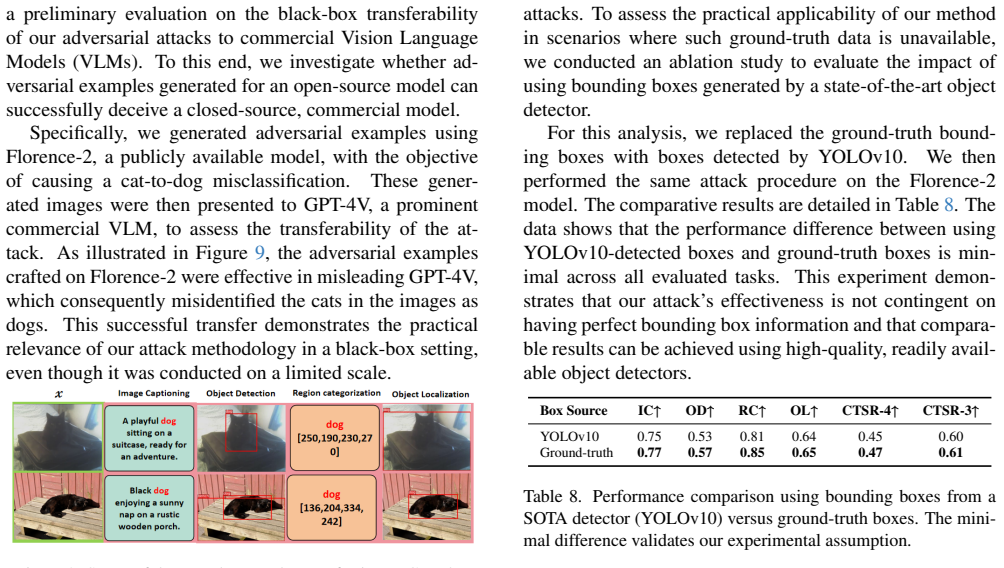
- The small cat-to-dog transfer test to a commercial VLM indicates that black-box closed models may inherit the same vulnerability if they share a similar unified representation space.
- Region-focused perturbation is more efficient and more transferable than full-image noise, so future attacks are likely to be region-centric as well.
Reading between the lines
- Beyond the paper: if the feature-proxy link is real, then a defense that randomizes the token-to-text alignment (e.g., perturbing the text embeddings per task) could break cross-task transfer without hurting per-task accuracy; a cheap experiment is to re-run CRAFT with the target text embedding shifted by a random rotation.
- Beyond the paper: the benchmark's success criteria check only that the caption mentions the target and omits the source; a stricter, more realistic criterion would require the entire caption to remain coherent with the scene, which could lower CTSR-4 and change the ranking of methods.
- Beyond the paper: CRAFT's white-box dependence on the model's own image and text encoders means its transfer value across model families is untested; extending it with an ensemble of encoders would show whether the aligned feature geometry generalizes across architectures.
- Beyond the paper: a direct test of the load-bearing premise is to ablate the region tokens after the attack — feed the attacked image but replace the region tokens with the original clean tokens; if the decoders then revert to the source category, the attack is exactly the token shift the paper posits.
Editorial analysis
A structured set of objections, weighed in public.
Referee Report
Summary. The paper introduces CrossVLAD, a benchmark of 3,000 MSCOCO images with 79 source-to-target category change-pairs, together with cross-task metrics CTSR-4 and CTSR-3 that measure whether a single adversarial perturbation simultaneously flips an object's identity across image captioning, object detection, region categorization, and object localization. The authors also propose CRAFT, a PGD-based region-centric attack that aligns image-encoder region tokens with the target category's text embedding and pushes them away from negative category embeddings. Experiments on Florence-2, UnifiedIO-2, and OFA report that CRAFT outperforms adapted baselines on CTSR-4/CTSR-3, with ablations on region token localization and negative-text selection, plus qualitative examples and a small black-box transfer test to GPT-4V.
Significance. The benchmark addresses a real gap: prior evaluations either report per-task success rates or generate separate adversarial examples per task, whereas CrossVLAD asks whether one perturbation can simultaneously mislead a unified VLM across four tasks. The CRAFT method is simple, well-motivated, and the paper includes useful ablations, qualitative visualizations, and a black-box transfer sanity check. If the detection success criterion is tightened and the quantitative claims are made robust with variance estimates, the paper would provide a valuable benchmark and baseline for cross-task adversarial robustness in unified VLMs.
major comments (3)
- [§3.3.1, Eq. (3)] Sdet as written requires only that a target-category detection appears at the source box; it never requires the source category to disappear from that location. In Florence-2, OFA, and UnifiedIO-2, detection is a multi-output sequence task, so the model can output both source and target category boxes overlapping the same region, and the sample is scored as a successful object-change even though the source identity was not flipped. Because CTSR-4 and CTSR-3 are the headline metrics for the paper's central claim, this definitional looseness can inflate the reported 0.471 CTSR-4 and affect the comparison with baselines. Please redefine Sdet to require both the presence of a target-category detection at the source box and the absence of a source-category detection whose IoU with the source box exceeds θbox, and rerun the experiments.
- [§5.1, Tables 1–3 and Fig. 5] All quantitative results are single-run point estimates with no standard deviations, confidence intervals, or significance tests. The central superiority claim (e.g., CTSR-4 of 0.471 versus 0.264 for the best baseline on Florence-2) cannot be assessed for robustness without repeated runs or bootstrap intervals. Please report mean ± std over at least three independent runs (or equivalent) for the main tables and the ablation, and state the number of seeds used.
- [§5.1 and App. 9.1] The baseline comparison is information-asymmetric. CRAFT is given the source bounding box and uses it for region-token localization, whereas the adapted baselines receive only image-level target captions and no region-level supervision. Since the paper's own ablation shows that region token localization is a major contributor to performance (Table 3: CTSR-4 rises from 0.17 to 0.46 when RTL is added with no negatives), the reported gains may partly reflect this additional supervision rather than the proposed alignment objective. Please adapt the baselines with comparable region knowledge (e.g., restrict their optimization to the source box or provide the box to their loss), or explicitly discuss this confound and its effect on the comparison.
minor comments (5)
- [§3.2 and App. 7.2] The main text says the caption-verification criterion is 'object mentioned of 5 captions' while the appendix specifies 'at least 3 of the 5'; please make the criterion explicit and consistent.
- [§5.1] The exact task prompts or instructions used for each of the four tasks on each model are not provided; please include them in the appendix for reproducibility, since task phrasing can materially affect unified VLM outputs.
- [§3.3.1] The IoU thresholds θbox and θloc are fixed at 0.6 without a sensitivity analysis; please report results for at least one alternative threshold (e.g., 0.5) to show the metrics are stable.
- [Fig. 5] The legend entries combine ϵ and α in a way that is hard to read; consider listing ϵ only and specifying the corresponding α separately in the caption or text.
- [§4.3] The paper would be strengthened by a short discussion of why contrastive alignment of image-encoder token features is expected to transfer to the autoregressive decoder outputs that define the task success criteria; currently this transfer is supported only empirically.
Circularity Check
No significant circularity: CrossVLAD and CRAFT are self-contained; CRAFT's success is measured empirically against defined metrics rather than derived from its own optimization objective.
full rationale
The derivation chain is transparent and non-circular. The benchmark defines task-specific success criteria (Eqs. 2-5), the attack objective (Eq. 1), the CRAFT token-region localization (Eqs. 8-9), contrastive alignment loss (Eq. 10), PGD update (Eq. 11), and the aggregate metrics CTSR-4/CTSR-3 (Eqs. 6-7). CRAFT optimizes the feature-level contrastive objective in Eq. 10, whereas the reported success is evaluated on decoded captions, detections, region labels, and boxes via Eqs. 2-5; there is no identity between the optimized loss and the evaluation metric, so the reported 0.471 CTSR-4 on Florence-2 is an empirical result, not a tautology. Hyperparameters (epsilon = 16/255, 100 iterations, alpha = 4/255, margin tau = 0.9) are selected and reported via ablations in the same paper (Section 5.5, Figure 5); this is ordinary hyperparameter tuning and is not presented as an independent prediction, so it does not constitute fitted-input-called-prediction. The paper contains self-citations by co-authors ([8], [9], [10]) in the introduction and related work, but none is load-bearing: no method component, benchmark construction step, or metric definition depends on these works. The supplementary section 9.4 explicitly labels the black-box GPT-4V test as 'preliminary evaluation' and 'limited scale,' which is an honest limitation rather than a circular justification. One non-circular validity concern: Eq. (3) defines detection success by the existence of a target-category detection overlapping the source box and never requires the source category to disappear, so CTSR-4 could reward adding a detection rather than flipping identity; this is a metric-validity limitation that may affect the interpretation of the reported advantage, but it is not a circularity in the derivation sense because the success metric is not claimed to be equivalent to the optimization objective.
Assumptions & free parameters
free parameters (5)
- epsilon (L-infinity perturbation budget) =
16/255
- alpha (PGD step size) =
4/255
- tau (contrastive margin) =
0.9
- theta_box and theta_loc (IoU thresholds) =
0.6
- Number of PGD iterations =
100
assumptions (4)
- domain assumption Unified VLMs share a common representation space such that manipulating image-encoder features transfers to all downstream task outputs.
- domain assumption MSCOCO ground-truth bounding boxes and category labels reliably define the source object for attack and evaluation.
- domain assumption GPT-4-generated target captions are valid descriptions of the scene with the object replaced.
- domain assumption The fixed task prompts used for attack and evaluation represent the tasks faithfully; results may not hold under different instruction phrasings.
Cite this review
Pith. "Pith review of One Object, Multiple Lies: A Benchmark for Cross-task Adversarial Attack on Unified Vision-Language Models." pith.science (2026). https://pith.science/paper/JSU5BVGM
@misc{pith2026250707709,
  author       = {Pith},
  title        = {Pith review of: One Object, Multiple Lies: A Benchmark for Cross-task Adversarial Attack on Unified Vision-Language Models},
  year         = {2026},
  howpublished = {\url{https://pith.science/paper/JSU5BVGM}},
  note         = {Machine review of arXiv:2507.07709}
}
read the original abstract
Unified vision-language models(VLMs) have recently shown remarkable progress, enabling a single model to flexibly address diverse tasks through different instructions within a shared computational architecture. This instruction-based control mechanism creates unique security challenges, as adversarial inputs must remain effective across multiple task instructions that may be unpredictably applied to process the same malicious content. In this paper, we introduce CrossVLAD, a new benchmark dataset carefully curated from MSCOCO with GPT-4-assisted annotations for systematically evaluating cross-task adversarial attacks on unified VLMs. CrossVLAD centers on the object-change objective-consistently manipulating a target object's classification across four downstream tasks-and proposes a novel success rate metric that measures simultaneous misclassification across all tasks, providing a rigorous evaluation of adversarial transferability. To tackle this challenge, we present CRAFT (Cross-task Region-based Attack Framework with Token-alignment), an efficient region-centric attack method. Extensive experiments on Florence-2 and other popular unified VLMs demonstrate that our method outperforms existing approaches in both overall cross-task attack performance and targeted object-change success rates, highlighting its effectiveness in adversarially influencing unified VLMs across diverse tasks.
Figures


Figures from the paper (6 more)


Reference graph
Works this paper leans on
-
[1]
Image hijacks: Adversarial images can control generative models at runtime
Luke Bailey, Euan Ong, Stuart Russell, and Scott Emmons. Image hijacks: Adversarial images can control generative models at runtime. arXiv preprint arXiv:2309.00236, 2023. 3
arXiv 2023
-
[2]
Context-aware transfer attacks for ob- ject detection
Zikui Cai, Xinxin Xie, Shasha Li, Mingjun Yin, Chengyu Song, Srikanth V Krishnamurthy, Amit K Roy-Chowdhury, and M Salman Asif. Context-aware transfer attacks for ob- ject detection. In Proceedings of the AAAI Conference on Artificial Intelligence, pages 149–157, 2022. 5
work page 2022
-
[3]
Attentional feature erase: Towards task-wise transferable ad- versarial attack on cloud vision apis
Bo Cheng, Yantao Lu, Yilan Li, Tao You, and Peng Zhang. Attentional feature erase: Towards task-wise transferable ad- versarial attack on cloud vision apis. Displays, 82:102634,
-
[4]
Unihcp: A unified model for human-centric perceptions
Yuanzheng Ci, Yizhou Wang, Meilin Chen, Shixiang Tang, Lei Bai, Feng Zhu, Rui Zhao, Fengwei Yu, Donglian Qi, and Wanli Ouyang. Unihcp: A unified model for human-centric perceptions. In Proceedings of the IEEE/CVF Conference on Computer Vision and Pattern Recognition, pages 17840– 17852, 2023. 2, 3
work page 2023
-
[5]
On the robustness of large multimodal mod- els against image adversarial attacks
Xuanming Cui, Alejandro Aparcedo, Young Kyun Jang, and Ser-Nam Lim. On the robustness of large multimodal mod- els against image adversarial attacks. In Proceedings of the IEEE/CVF Conference on Computer Vision and Pattern Recognition, pages 24625–24634, 2024. 2, 3
work page 2024
-
[6]
How robust is google’s bard to adversarial image at- tacks? arXiv preprint arXiv:2309.11751, 2023
Yinpeng Dong, Huanran Chen, Jiawei Chen, Zhengwei Fang, Xiao Yang, Yichi Zhang, Yu Tian, Hang Su, and Jun Zhu. How robust is google’s bard to adversarial image at- tacks? arXiv preprint arXiv:2309.11751, 2023. 3, 5, 7, 1
arXiv 2023
-
[7]
Enhancing cross-task transferability of adversarial examples via spatial and channel attention
Weiwei Feng, Nanqing Xu, Tianzhu Zhang, Yongdong Zhang, and Feng Wu. Enhancing cross-task transferability of adversarial examples via spatial and channel attention. IEEE Transactions on Multimedia, 2024. 2, 3
work page 2024
-
[8]
Similarity distribution based member- ship inference attack on person re-identification
Junyao Gao, Xinyang Jiang, Huishuai Zhang, Yifan Yang, Shuguang Dou, Dongsheng Li, Duoqian Miao, Cheng Deng, and Cairong Zhao. Similarity distribution based member- ship inference attack on person re-identification. InProceed- ings of the AAAI conference on artificial intelligence , pages 14820–14828, 2023. 2
work page 2023
Show all 50 references
-
[9]
Styleshot: A snap- shot on any style
Junyao Gao, Yanchen Liu, Yanan Sun, Yinhao Tang, Yan- hong Zeng, Kai Chen, and Cairong Zhao. Styleshot: A snap- shot on any style. arXiv preprint arXiv:2407.01414, 2024. 2
2024 arXiv
-
[10]
Faceshot: Bring any character into life
Junyao Gao, Yanan Sun, Fei Shen, Xin Jiang, Zhening Xing, Kai Chen, and Cairong Zhao. Faceshot: Bring any character into life. arXiv preprint arXiv:2503.00740, 2025. 2
2025 arXiv
-
[11]
Ot-attack: Enhancing adversarial transferability of vision-language models via optimal trans- port optimization
Dongchen Han, Xiaojun Jia, Yang Bai, Jindong Gu, Yang Liu, and Xiaochun Cao. Ot-attack: Enhancing adversarial transferability of vision-language models via optimal trans- port optimization. arXiv preprint arXiv:2312.04403, 2023. 2
2023 arXiv
-
[12]
Instruct-reid: A multi-purpose person re-identification task with instructions
Weizhen He, Yiheng Deng, Shixiang Tang, Qihao Chen, Qingsong Xie, Yizhou Wang, Lei Bai, Feng Zhu, Rui Zhao, Wanli Ouyang, et al. Instruct-reid: A multi-purpose person re-identification task with instructions. In Proceedings of the IEEE/CVF Conference on Computer Vision and Pat...
2024
-
[13]
As firm as their foundations: Can open-sourced foundation models be used to create adver- sarial examples for downstream tasks? arXiv preprint arXiv:2403.12693, 2024
Anjun Hu, Jindong Gu, Francesco Pinto, Konstantinos Kam- nitsas, and Philip Torr. As firm as their foundations: Can open-sourced foundation models be used to create adver- sarial examples for downstream tasks? arXiv preprint arXiv:2403.12693, 2024. 2, 3
2024 arXiv
-
[14]
Vlm-rl: A unified vision language models and reinforcement learning framework for safe autonomous driv- ing
Zilin Huang, Zihao Sheng, Yansong Qu, Junwei You, and Sikai Chen. Vlm-rl: A unified vision language models and reinforcement learning framework for safe autonomous driv- ing. arXiv preprint arXiv:2412.15544, 2024. 2, 3
2024 arXiv
-
[15]
You only learn one query: learning unified human query for single-stage multi-person multi-task human-centric perception
Sheng Jin, Shuhuai Li, Tong Li, Wentao Liu, Chen Qian, and Ping Luo. You only learn one query: learning unified human query for single-stage multi-person multi-task human-centric perception. In European Conference on Computer Vision , pages 126–146. Springer, 2024. 2
2024
-
[16]
Uni-perceiver v2: A generalist model for large-scale vision and vision-language tasks
Hao Li, Jinguo Zhu, Xiaohu Jiang, Xizhou Zhu, Hongsheng Li, Chun Yuan, Xiaohua Wang, Yu Qiao, Xiaogang Wang, Wenhai Wang, et al. Uni-perceiver v2: A generalist model for large-scale vision and vision-language tasks. In Proceed- ings of the IEEE/CVF Conference on Computer Visio...
2023
-
[17]
Lawrence Zitnick, and Piotr Doll ´ar
Tsung-Yi Lin, Michael Maire, Serge Belongie, Lubomir Bourdev, Ross Girshick, James Hays, Pietro Perona, Deva Ramanan, C. Lawrence Zitnick, and Piotr Doll ´ar. Microsoft coco: Common objects in context, 2015. 3
2015
-
[18]
A survey of attacks on large vision- language models: Resources, advances, and future trends
Daizong Liu, Mingyu Yang, Xiaoye Qu, Pan Zhou, Yu Cheng, and Wei Hu. A survey of attacks on large vision- language models: Resources, advances, and future trends. arXiv preprint arXiv:2407.07403, 2024. 3
2024 arXiv
-
[19]
Set-level guidance at- tack: Boosting adversarial transferability of vision-language pre-training models
Dong Lu, Zhiqiang Wang, Teng Wang, Weili Guan, Hongchang Gao, and Feng Zheng. Set-level guidance at- tack: Boosting adversarial transferability of vision-language pre-training models. In Proceedings of the IEEE/CVF In- ternational Conference on Computer Vision, pages 102–111,
-
[20]
Unified-io: A unified model for vision, language, and multi-modal tasks
Jiasen Lu, Christopher Clark, Rowan Zellers, Roozbeh Mot- taghi, and Aniruddha Kembhavi. Unified-io: A unified model for vision, language, and multi-modal tasks. In The Eleventh International Conference on Learning Representa- tions, 2022. 2, 3
2022
-
[21]
Unified-io 2: Scaling autoregressive multimodal models with vision language audio and action
Jiasen Lu, Christopher Clark, Sangho Lee, Zichen Zhang, Savya Khosla, Ryan Marten, Derek Hoiem, and Aniruddha Kembhavi. Unified-io 2: Scaling autoregressive multimodal models with vision language audio and action. In Proceed- ings of the IEEE/CVF Conference on Computer Vision ...
2024
-
[22]
Time-aware and task-transferable adversarial attack for perception of autonomous vehicles.Pattern Recog- nition Letters, 178:145–152, 2024
Yantao Lu, Haining Ren, Weiheng Chai, Senem Velipasalar, and Yilan Li. Time-aware and task-transferable adversarial attack for perception of autonomous vehicles.Pattern Recog- nition Letters, 178:145–152, 2024. 3
2024
-
[23]
An image is worth 1000 lies: Adversarial transferability across prompts on vision-language models
Haochen Luo, Jindong Gu, Fengyuan Liu, and Philip Torr. An image is worth 1000 lies: Adversarial transferability across prompts on vision-language models. arXiv preprint arXiv:2403.09766, 2024. 3
2024 arXiv
-
[24]
Ct-gat: Cross-task generative adversarial attack based on transferability
Minxuan Lv, Chengwei Dai, Kun Li, Wei Zhou, and Songlin Hu. Ct-gat: Cross-task generative adversarial attack based on transferability. arXiv preprint arXiv:2310.14265, 2023. 3
2023 arXiv
-
[25]
Boosting cross-task transferability of adversarial patches 9 with visual relations
Tony Ma, Songze Li, Yisong Xiao, and Shunchang Liu. Boosting cross-task transferability of adversarial patches 9 with visual relations. arXiv preprint arXiv:2304.05402 ,
-
[26]
Towards deep learn- ing models resistant to adversarial attacks
Aleksander Madry, Aleksandar Makelov, Ludwig Schmidt, Dimitris Tsipras, and Adrian Vladu. Towards deep learn- ing models resistant to adversarial attacks. arXiv preprint arXiv:1706.06083, 2017. 5
2017 arXiv
-
[27]
Pick-object-attack: Type-specific adver- sarial attack for object detection
Omid Mohamad Nezami, Akshay Chaturvedi, Mark Dras, and Utpal Garain. Pick-object-attack: Type-specific adver- sarial attack for object detection. Computer Vision and Im- age Understanding, 211:103257, 2021. 5
2021
-
[28]
High-resolution image synthesis with latent diffusion models
Robin Rombach, Andreas Blattmann, Dominik Lorenz, Patrick Esser, and Bj ¨orn Ommer. High-resolution image synthesis with latent diffusion models. In Proceedings of the IEEE/CVF conference on computer vision and pattern recognition, pages 10684–10695, 2022. 3
2022
-
[29]
On the adversarial robustness of multi-modal foundation models
Christian Schlarmann and Matthias Hein. On the adversarial robustness of multi-modal foundation models. In Proceed- ings of the IEEE/CVF International Conference on Com- puter Vision, pages 3677–3685, 2023. 3
2023
-
[30]
Unival: Unified model for image, video, au- dio and language tasks
Mustafa Shukor, Corentin Dancette, Alexandre Rame, and Matthieu Cord. Unival: Unified model for image, video, au- dio and language tasks. Transactions on Machine Learning Research Journal, 2023. 2, 3
2023
-
[31]
How many unicorns are in this im- age? a safety evaluation benchmark for vision llms
Haoqin Tu, Chenhang Cui, Zijun Wang, Yiyang Zhou, Bingchen Zhao, Junlin Han, Wangchunshu Zhou, Huaxiu Yao, and Cihang Xie. How many unicorns are in this im- age? a safety evaluation benchmark for vision llms. arXiv preprint arXiv:2311.16101, 2023. 3, 5, 7, 1, 2
2023 arXiv
-
[32]
Benchmarking zero-shot robustness of multimodal founda- tion models: A pilot study.arXiv preprint arXiv:2403.10499,
Chenguang Wang, Ruoxi Jia, Xin Liu, and Dawn Song. Benchmarking zero-shot robustness of multimodal founda- tion models: A pilot study.arXiv preprint arXiv:2403.10499,
-
[33]
Trans- ferable multimodal attack on vision-language pre-training models
Haodi Wang, Kai Dong, Zhilei Zhu, Haotong Qin, Aishan Liu, Xiaolin Fang, Jiakai Wang, and Xianglong Liu. Trans- ferable multimodal attack on vision-language pre-training models. In 2024 IEEE Symposium on Security and Privacy (SP), pages 102–102. IEEE Computer Society, 2024. 3
2024
-
[34]
Psat-gan: Efficient adversarial attacks against holistic scene understanding
Lin Wang and Kuk-Jin Yoon. Psat-gan: Efficient adversarial attacks against holistic scene understanding. IEEE Transac- tions on Image Processing, 30:7541–7553, 2021. 2, 3
2021
-
[35]
Ofa: Unifying architectures, tasks, and modalities through a simple sequence-to-sequence learning framework
Peng Wang, An Yang, Rui Men, Junyang Lin, Shuai Bai, Zhikang Li, Jianxin Ma, Chang Zhou, Jingren Zhou, and Hongxia Yang. Ofa: Unifying architectures, tasks, and modalities through a simple sequence-to-sequence learning framework. In International conference on machine learn- i...
2022
-
[36]
Florence-2: Advancing a unified representation for a variety of vision tasks
Bin Xiao, Haiping Wu, Weijian Xu, Xiyang Dai, Houdong Hu, Yumao Lu, Michael Zeng, Ce Liu, and Lu Yuan. Florence-2: Advancing a unified representation for a variety of vision tasks. In Proceedings of the IEEE/CVF Conference on Computer Vision and Pattern Recognition , pages 481...
2024
-
[37]
Highly transferable diffusion- based unrestricted adversarial attack on pre-trained vision- language models
Wenzhuo Xu, Kai Chen, Ziyi Gao, Zhipeng Wei, Jingjing Chen, and Yu-Gang Jiang. Highly transferable diffusion- based unrestricted adversarial attack on pre-trained vision- language models. In Proceedings of the 32nd ACM Interna- tional Conference on Multimedia, pages 748–757, 2...
2024
-
[38]
Cross-task attack: A self-supervision generative framework based on attention shift
Qingyuan Zeng, Yunpeng Gong, and Min Jiang. Cross-task attack: A self-supervision generative framework based on attention shift. In 2024 International Joint Conference on Neural Networks (IJCNN), pages 1–8. IEEE, 2024. 2, 3
2024
-
[39]
X 2-vlm: All-in-one pre- trained model for vision-language tasks
Yan Zeng, Xinsong Zhang, Hang Li, Jiawei Wang, Jipeng Zhang, and Wangchunshu Zhou. X 2-vlm: All-in-one pre- trained model for vision-language tasks. IEEE Transactions on Pattern Analysis and Machine Intelligence, 2023. 2, 3
2023
-
[40]
Anyattack: Towards large-scale self-supervised generation of targeted adversar- ial examples for vision-language models
Jiaming Zhang, Junhong Ye, Xingjun Ma, Yige Li, Yunfan Yang, Jitao Sang, and Dit-Yan Yeung. Anyattack: Towards large-scale self-supervised generation of targeted adversar- ial examples for vision-language models. arXiv preprint arXiv:2410.05346, 2024. 5
-
[41]
Boosting cross-task ad- versarial attack with random blur
Yaoyuan Zhang, Yu-an Tan, Mingfeng Lu, Tian Chen, Yuanzhang Li, and Quanxin Zhang. Boosting cross-task ad- versarial attack with random blur. International journal of intelligent systems, 37(10):8139–8154, 2022. 3
2022
-
[42]
Benchmarking trustworthiness of multi- modal large language models: A comprehensive study.arXiv preprint arXiv:2406.07057, 2024
Yichi Zhang, Yao Huang, Yitong Sun, Chang Liu, Zhe Zhao, Zhengwei Fang, Yifan Wang, Huanran Chen, Xiao Yang, Xingxing Wei, et al. Benchmarking trustworthiness of multi- modal large language models: A comprehensive study.arXiv preprint arXiv:2406.07057, 2024. 1
2024 arXiv
-
[43]
On evalu- ating adversarial robustness of large vision-language mod- els
Yunqing Zhao, Tianyu Pang, Chao Du, Xiao Yang, Chongx- uan Li, Ngai-Man Man Cheung, and Min Lin. On evalu- ating adversarial robustness of large vision-language mod- els. Advances in Neural Information Processing Systems , 36:54111–54138, 2023. 3, 5, 7, 2
2023
-
[44]
Adversarial attacks on hidden tasks in multi- task learning
Yu Zhe, Rei Nagaike, Daiki Nishiyama, Kazuto Fukuchi, and Jun Sakuma. Adversarial attacks on hidden tasks in multi- task learning. arXiv preprint arXiv:2405.15244 , 2024. 2, 3 10 One Object, Multiple Lies: A Benchmark for Cross-task Adversarial Attack on Unified Vision-Languag...
2024 arXiv
-
[45]
[SOURCE_CATEGORY]
Dataset Construction Details 7.1. Comparison with Other Adversarial Attack Benchmarks Table 4 compares CrossVLAD with existing adversarial attack benchmarks for vision-language models. While some prior works have considered unified VLMs or mul- tiple tasks, CrossVLAD uniquely ...
-
[46]
[SOURCE_CATEGORY]
[CAPTION_5] Task: Imagine replacing the primary object "[SOURCE_CATEGORY]" with a new object "[ TARGET_CATEGORY]". Create a caption describing the scene with this replacement. We implemented quality control by verifying that each generated caption: (1) explicitly mentioned the...
-
[47]
The procedure begins by initializing the adversar- ial example and locating the token indices corresponding to the source object region
Pseudocode Algorithm 1 presents the detailed procedure of our CRAFT method. The procedure begins by initializing the adversar- ial example and locating the token indices corresponding to the source object region. In each iteration, we extract image features from the current ad...
-
[48]
Implementation Details of Compared Methods We provide detailed implementation information for all compared methods to ensure reproducibility and fair com- parison
Experimental Details 9.1. Implementation Details of Compared Methods We provide detailed implementation information for all compared methods to ensure reproducibility and fair com- parison. Attack-Bard We adopt the text description attack from Attack-Bard [6], which maximizes ...
-
[49]
0.48 0.75 0.68 0.52 0.38 0.52
-
[50]
Comparison with object detection attack baselines on Florence-2
0.45 0.67 0.64 0.50 0.32 0.48 CRAFT (ours) 0.77 0.57 0.85 0.65 0.47 0.61 Table 7. Comparison with object detection attack baselines on Florence-2. Our method demonstrates superior cross-task trans- ferability. 9.6. Effect of Bounding Box Source In our primary experiments, we a...
Reviewed August 6, 2026 · model on record in the stance chip above.
Discussion (0). Sign in to comment.