Talking to Your Data: Exploring Embodied Conversation as an Interface for Personal Health Reflection
Pith reviewed 2026-06-26 23:18 UTC · model grok-4.3
The pith
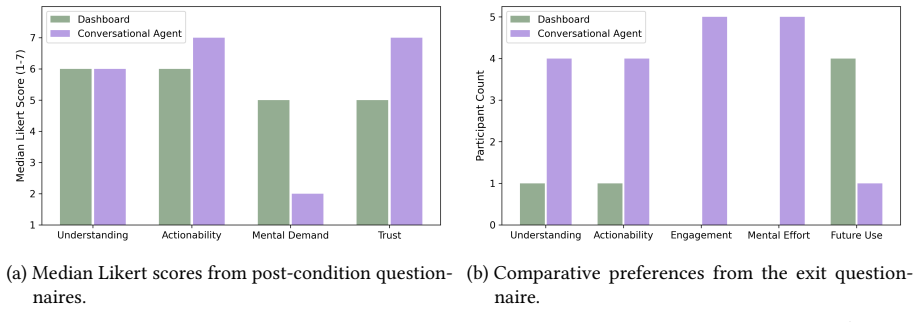
Embodied conversation with a virtual agent leads to higher perceived understanding and more specific health actions than viewing dashboard charts.
A machine-rendered reading of the paper's core claim, the machinery that carries it, and where it could break.
Core claim
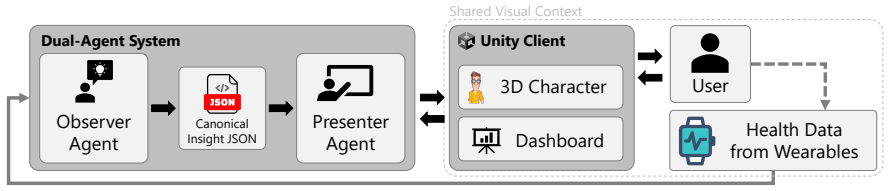
The paper claims that embodied conversational reflection on personal health data, using a dual-agent system in which an Observer extracts descriptive statistics and temporal trends while a Presenter communicates findings through spoken statistics with a Unity-based character, produces higher perceived understanding, more specific generated actions, and a cognitive shift from passive viewing to active sensemaking compared with traditional dashboard exploration, as measured in a within-subject simulated-self study with N=5 participants adopting personas from the LifeSnaps dataset.
What carries the argument
Dual-agent embodied conversational system with an Observer agent for statistics and trends and a Presenter agent for objective spoken narrative, implemented in Unity to isolate the effect of dialogue modality.
If this is right
- Users generate more specific health-related actions after conversational reflection than after dashboard exploration.
- The conversational format produces a measurable cognitive shift toward active sensemaking rather than passive viewing.
- The dual-agent design isolates interaction modality effects by deliberately avoiding clinical advice.
- The approach supplies a reusable design pattern for generating objective health data narratives.
Where Pith is reading between the lines
- Integrating the system directly with live wearable feeds rather than pre-processed personas could reveal whether personal ownership strengthens the observed effects.
- Users with lower data literacy might benefit more from the conversational format, suggesting a possible equity angle for future tests.
- Long-term behavior change could be tracked by measuring whether the specific actions generated in dialogue are actually followed.
Load-bearing premise
A within-subject study with five participants using simulated personas from a dataset can validly measure real differences in how people interpret their own personal health data.
What would settle it
A follow-up study with participants reflecting on their own real wearable data that finds no difference in perceived understanding or action specificity between the embodied conversational interface and the dashboard would falsify the central claim.
Figures
read the original abstract
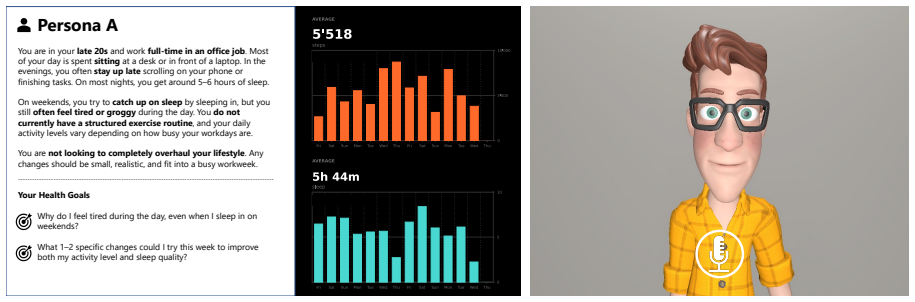
Personal health data from wearables are typically presented through dashboards of charts and summary statistics, requiring users to actively interpret patterns and implications. We explore an alternative interaction paradigm: engaging with personal health data through an embodied conversational agent that facilitates objective data reflection in dialogue with the user. We present a system that combines lightweight preprocessing of wearable data with a Unity-based embodied character. Internally, the system follows a dual-agent design in which an Observer agent extracts descriptive statistics and temporal trends, and a Presenter agent communicates these findings through "spoken statistics," intentionally refraining from clinical advice to isolate the impact of the interaction modality. We evaluate this approach through a simulated-self user study (N=5) using a within-subject design. Participants adopted health personas and goals derived from the LifeSnaps dataset to compare traditional dashboard exploration with embodied conversational reflection. Our evaluation focuses on perceived understanding, the specificity of generated actions, and the cognitive shift from passive viewing to active sensemaking. The paper contributes a functional prototype, a design pattern for objective health data narrative generation, and early empirical insights into how embodiment affects the interpretation of personal health metrics.
Editorial analysis
A structured set of objections, weighed in public.
Referee Report
Summary. The manuscript describes a Unity-based embodied conversational agent system for personal health data reflection from wearables. It uses a dual-agent architecture (Observer for extracting descriptive statistics and temporal trends; Presenter for communicating via 'spoken statistics' without clinical advice) and evaluates the approach in a within-subject study (N=5) where participants adopted LifeSnaps-derived personas to compare embodied conversation against traditional dashboard exploration. The evaluation targets perceived understanding, specificity of generated actions, and cognitive shift from passive viewing to active sensemaking. Contributions include a functional prototype, a design pattern for objective health data narrative generation, and early empirical insights.
Significance. If substantiated, the work offers a novel interaction paradigm for personal informatics that could reduce the interpretive burden of dashboard-based health data. The prototype and narrative generation pattern represent concrete, reusable contributions to HCI. The small-scale simulated study, however, provides only preliminary evidence whose generalizability is constrained by sample size and role-play design.
major comments (2)
- [Abstract] Abstract / Evaluation description: The central claims of higher perceived understanding, more specific actions, and a cognitive shift rest on a within-subject comparison with N=5 simulated-self participants. No statistical results, effect sizes, power analysis, or explicit controls for demand characteristics and persona-adoption fidelity are supplied, leaving the comparative outcomes unsupported.
- [Evaluation] Evaluation section: The simulated-self design using LifeSnaps personas directly threatens validity for claims about real personal data sensemaking, because participants lack personal stakes; this confound is load-bearing for the three measured outcomes yet receives no qualitative safeguards or discussion.
minor comments (1)
- [Abstract] Abstract: The evaluation focus is stated but no summary of actual findings (even directional) is provided; adding a brief results clause would improve completeness.
Simulated Author's Rebuttal
We thank the referee for the detailed and constructive feedback. The evaluation is exploratory and small-scale by design, and we agree that the manuscript should more explicitly frame the results as preliminary insights rather than supported comparative outcomes. We address each major comment below and will revise the abstract, evaluation section, and limitations discussion accordingly.
read point-by-point responses
-
Referee: [Abstract] Abstract / Evaluation description: The central claims of higher perceived understanding, more specific actions, and a cognitive shift rest on a within-subject comparison with N=5 simulated-self participants. No statistical results, effect sizes, power analysis, or explicit controls for demand characteristics and persona-adoption fidelity are supplied, leaving the comparative outcomes unsupported.
Authors: We agree that N=5 precludes meaningful statistical analysis, effect sizes, or power calculations, and the manuscript does not report any such results. The evaluation is presented as a within-subject simulated-self study yielding qualitative observations rather than statistically supported claims. To address the concern, we will revise the abstract to remove any phrasing that could imply comparative support and will add explicit language in the evaluation section stating that outcomes are exploratory and not statistically validated. We will also note the absence of controls for demand characteristics and persona fidelity as a limitation. revision: yes
-
Referee: [Evaluation] Evaluation section: The simulated-self design using LifeSnaps personas directly threatens validity for claims about real personal data sensemaking, because participants lack personal stakes; this confound is load-bearing for the three measured outcomes yet receives no qualitative safeguards or discussion.
Authors: The simulated-self approach was chosen to permit a controlled within-subject comparison while sidestepping privacy and ethical issues with real personal health data. We acknowledge that the absence of personal stakes is a core limitation that weakens claims about authentic sensemaking and that the paper currently provides insufficient discussion of this issue. We will expand the evaluation and limitations sections to discuss this confound explicitly, its potential effects on perceived understanding, action specificity, and cognitive shift, and the lack of additional qualitative safeguards beyond the described persona briefing. Future work with actual users will be highlighted as necessary. revision: partial
Circularity Check
No significant circularity; empirical system + study paper
full rationale
The paper contains no equations, derivations, fitted parameters, or mathematical claims. It describes a prototype system (dual-agent Observer/Presenter design) and reports results from a within-subject user study (N=5 simulated-self personas). The evaluation outcomes (perceived understanding, action specificity, cognitive shift) are measured directly from participant responses rather than derived from any self-citation chain, ansatz, or input data by construction. No load-bearing uniqueness theorems or renamed empirical patterns appear. The derivation chain is therefore self-contained and non-circular.
Axiom & Free-Parameter Ledger
Reference graph
Works this paper leans on
-
[1]
Demiris, S
G. Demiris, S. J. Iribarren, K. Sward, S. Lee, R. Yang, Consumer health informatics: Past, present, and future, Yearbook of Medical Informatics 25 (2016) S42–S47
2016
-
[2]
Demiris, Y
G. Demiris, Y. Choi, K. J. Chun, Personal health informatics: New tools and roles for health care, International Journal of Medical Informatics 166 (2022) 104832
2022
-
[3]
A. M. Lai, J. L. Warner, S. Luhanga, H.-C. Kum, C. Condit, Present and future trends in consumer health informatics and patient-generated health data, Yearbook of Medical Informatics 26 (2017) 38–43
2017
-
[4]
M. R. Turchioe, D. A. Asch, A. B. Troxel, H. J. Sweitzer, R. R. Townsend, R. M. Merchant, A systematic review of patient-facing visualizations of personal health data, Applied Clinical Informatics 10 (2019) 47–63
2019
-
[5]
L. K. Chan, et al., The shape of mobile health: A systematic review of health visualization on mobile devices, Journal of the American Medical Informatics Association 31 (2024) 275–289
2024
-
[6]
I. Li, A. K. Dey, J. Forlizzi, A stage-based model of personal informatics systems, in: Proceedings of the SIGCHI Conference on Human Factors in Computing Systems, ACM, 2010, pp. 557–566
2010
-
[7]
Consolvo, P
S. Consolvo, P. Klasnja, D. W. McDonald, D. Avrahami, J. Froehlich, L. LeGrand, R. Libby, K. Mosher, J. A. Landay, Activity sensing in the wild: A field trial of ubifit garden, in: Proceedings of the SIGCHI Conference on Human Factors in Computing Systems, ACM, 2008, pp. 1797–1806
2008
-
[8]
D. A. Epstein, A. Ping, J. Fogarty, S. A. Munson, Beyond abandonment to next steps: Understanding and designing for life after personal informatics tool use, in: Proceedings of the SIGCHI Conference on Human Factors in Computing Systems, ACM, 2015, pp. 1105–1114
2015
-
[9]
Y. Kim, X. Xu, D. McDuff, C. Breazeal, H. W. Park, Health-llm: Large language models for health prediction via wearable sensor data, in: Proceedings of the fifth Conference on Health, Inference, and Learning, volume 248 ofProceedings of Machine Learning Research, PMLR, 2024, pp. 522–539
2024
-
[10]
J. Cosentino, A. Belyaeva, X. Liu, N. A. Furlotte, Z. Yang, C. Lee, E. Schenck, Y. Patel, J. Cui, L. D. Schneider, R. Bryant, R. G. Gomes, A. Jiang, R. Lee, Y. Liu, J. Perez, J. K. Rogers, C. Speed, S. Tailor, M. Walker, J. Yu, T. Althoff, C. Heneghan, J. Hernandez, M. Malhotra, L. Stern, Y. Matias, G. S. Corrado, S. Patel, S. Shetty, J. Zhan, S. Prabhaka...
-
[11]
X. Wang, J. Griffith, D. A. Adler, J. Castillo, T. Choudhury, F. Wang, Exploring personalized health support through data-driven, theory-guided llms: A case study in sleep health, in: Proceedings of the 2025 CHI Conference on Human Factors in Computing Systems, CHI ’25, ACM, 2025, pp. 1–15. doi:10.1145/3706598.3713852
-
[12]
C. M. Fang, V. Danry, N. Whitmore, A. Bao, A. Hutchison, C. Pierce, P. Maes, Physiollm: Supporting personalized health insights with wearables and large language models, in: 2024 IEEE EMBS International Conference on Biomedical and Health Informatics (BHI), IEEE, 2024, pp. 1–8. doi: 10. 1109/bhi62660.2024.10913781
arXiv 2024
-
[13]
Cassell, J
J. Cassell, J. Sullivan, S. Prevost, E. Churchill, More than just a pretty face: Conversational protocols and the role of embodiment in hci, Communications of the ACM 43 (2000) 70–84
2000
-
[14]
Paiva, I
A. Paiva, I. Leite, H. Boukricha, I. Wachsmuth, Empathy in virtual agents and robots: A survey, in: ACM Transactions on Interactive Intelligent Systems (TiiS), volume 7, 2017, pp. 1–40
2017
-
[15]
Provoost, H
S. Provoost, H. M. Lau, J. Ruwaard, H. Riper, Embodied conversational agents in clinical psychology: A scoping review, Journal of Medical Internet Research 19 (2017) e151
2017
-
[16]
ter Stal, L
S. ter Stal, L. L. Kramer, M. Tabak, H. op den Akker, H. Hermens, Design features of embodied conversational agents in ehealth applications: Scoping review, Journal of Medical Internet Research 22 (2020) e18839
2020
-
[17]
T. W. Bickmore, D. Schulman, C. L. Sidner, A reusable framework for health counseling dialogue systems based on a behavioral medicine ontology, Journal of Biomedical Informatics 44 (2011) 183–197. doi:https://doi.org/10.1016/j.jbi.2010.12.006
-
[18]
C. Nass, J. Steuer, E. R. Tauber, Computers are social actors, in: Proceedings of the SIGCHI conference on Human factors in computing systems, 1994, pp. 72–78
1994
-
[19]
E. K. Choe, B. Lee, S. Munson, W. Pratt, J. A. Kientz, Understanding quantified-selfers’ practices in collecting and exploring personal data, in: Proceedings of the SIGCHI Conference on Human Factors in Computing Systems (CHI), ACM, 2014, pp. 1143–1152
2014
-
[20]
Pirolli, S
P. Pirolli, S. Card, The sensemaking process and leverage points for analyst technology as identified through cognitive task analysis, in: Proceedings of the International Conference on Intelligence Analysis, volume 5, 2005, pp. 2–4
2005
-
[21]
H. Lee, S. J. Joo, C. Kim, J. Jang, D. Kim, K.-W. On, M. Seo, How well do large language models truly ground?, in: Proceedings of the 2024 Conference of the North American Chapter of the Association for Computational Linguistics: Human Language Technologies (Volume 1: Long Papers), Association for Computational Linguistics, 2024, pp. 2437–2465. doi: 10.18...
-
[22]
Yfantidou, C
S. Yfantidou, C. Karagianni, S. Efstathiou, A. Vakali, J. Palotti, D. P. Giakatos, T. Marchioro, A. Kazlouski, E. Ferrari, v. Girdzijauskas, Lifesnaps, a 4-month multi-modal dataset captur- ing unobtrusive snapshots of our lives in the wild, Scientific Data 9 (2022). doi: 10.1038/ s41597-022-01764-x
2022
discussion (0)
Sign in with ORCID, Apple, or X to comment. Anyone can read and Pith papers without signing in.