REVIEW 2 major objections 7 minor 89 references
GroupFace: Imbalanced Age Estimation Based on Multi-hop Attention Graph Convolutional Network and Group-aware Margin Optimization
T0 review · 2 major / 7 minor · reviewed 2026-08-11 · deepseek-v4-flash
Pith's one-line read GroupFace claims that training a multi-hop attention graph convolutional feature extractor with a reinforcement-learning-tuned per-group margin loss improves overall age-estimation accuracy while simultaneously narrowing the per-group…
desk verdict Plausible incremental system with a careful ablation, but the headline balanced-performance numbers don't reconcile across text and tables and the RL reward equations are too muddled to support the mechanism. read the letter →
The pith
A machine-rendered reading of the paper's core claim, the machinery that carries it, and where it could break.
The reading
What carries the argument
The machinery is a two-component joint learning loop. EMAGCN (Enhanced Multi-hop Attention Graph Convolutional Network) is the feature extractor: it builds a k-NN patch graph from a face image, computes a softmax attention matrix, diffuses it over K hops with adaptive learnable decay weights $\delta_k$ rather than fixed decay, applies DropMessage to the message matrix, adds residual connections to prevent over-smoothing, and approximates the dense inverse with a power-iteration method so the higher-order model stays linear in cost. DGMO (Dynamic Group-aware Margin Optimization) is the controller: a deep Q-network observes state $s_t = \{G, D_{\text{inter}}, M\}$, where $G$ is one of four age groups, $D_{\text{inter}}$ is the deviation of inter-class distance from the head adult group, and $M$ is the current margin; it picks an action in $\{-1, O, +1\}$ that shrinks, keeps, or expands the margin by a constant $\kappa$, and receives reward $r = -(D_{\text{intra}} + D_{\text{inter}})$, intended to tie the choice to both within-group cohesion and between-group separation. The chosen margins feed the dynamic group-aware margin loss $L_{\text{DGM}}$, which replaces the cosine term in the softmax large-margin loss with $e^{a_i(t)(\theta_j - h_i(t))^2 + k_i(t)}$, letting three learnable parameters per group reshape intra-class compactness and inter-class separation. The joint loss $\lambda L_{\text{CE}} + (1-\lambda) L_{\text{MAE}}$ couples the margin policy to final age accuracy.
What would settle it
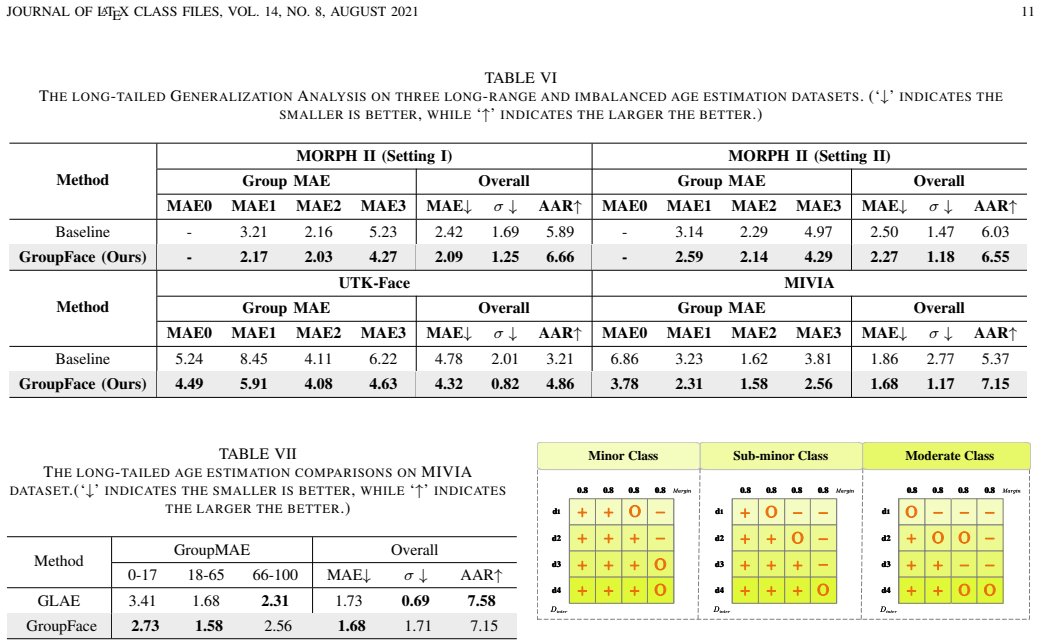
Implement Eqs. (11) and (12) verbatim on any trained feature set: both formulas compute the same average cosine distance from each sample to its group center, so $D_{\text{intra}} \equiv D_{\text{inter}}$ and the reward $r = -(D_{\text{intra}} + D_{\text{inter}})$ reduces to a single term; a GroupFace run whose reward keeps only one of the two terms should then produce the same margin policy as the full reward, showing that the balancing mechanism as written has no separate intra-class versus inter-class signal. Separately, recompute $\sigma$ and AAR from the per-group MAE values in Table VI for MIVIA: those table entries give $\sigma = 1.17$ and AAR $= 7.15$, while Section IV-E claims the lowest $\sigma$ of 0.77 and highest AAR of 7.54, so reproducing the text's headline numbers requires checking the released model and evaluation protocol.
Extended reading notes
Core claim
On its own terms, GroupFace's claim is that representation learning and margin calibration should be solved together, not in decoupled stages. The Enhanced Multi-hop Attention Graph Convolutional Network (EMAGCN) turns a face into a graph of image patches, computes attention at multiple hop distances with learnable per-hop decay weights so distant nodes contribute useful context rather than noise, drops messages randomly (DropMessage) to prevent over-fitting, and adds residual connections plus a power-iteration inverse approximation to keep deep training stable with linear complexity. The Dynamic Group-aware Margin Optimization (DGMO) partitions ages into children, teenager, adult, and senior, keeps the adult (head) margin as a fixed anchor, and runs deep Q-learning over a Markov decision process whose state is the triple {group, inter-class deviation, current margin}, with actions $\{-1, O, +1\}$ and reward $r = -(D_{\text{intra}} + D_{\text{inter}})$. The resulting margins enter a quadratic large-margin loss with per-group parameters $a_i(t)$, $h_i(t)$, $k_i(t)$, and the whole system is trained with $\lambda L_{\text{CE}} + (1-\lambda) L_{\text{MAE}}$. The paper reports that this joint optimization reaches competitive MAE across MORPH II, UTK-Face, ChaLearn LAP 2015, and CACD, the best $\epsilon$-error of 0.239 on CLAP2015, and balanced long-tailed accuracy with the lowest $\sigma$ of 0.77 and highest AAR (Age Accuracy and Regularity) of 7.54 on MIVIA, which it interprets as reducing representation bias and margin deviation simultaneously.
Load-bearing premise
The balancing story rests on the RL reward being a meaningful two-term signal $r = -(D_{\text{intra}} + D_{\text{inter}})$; in Section III-C, Eq. (11) and Eq. (12) define $D_{\text{inter}}$ and $D_{\text{intra}}$ with identical formulas, so the two terms collapse and the reward cannot distinguish within-group compactness from between-group separability.
Editorial extensions
If this is right
- The same end-to-end model can improve overall MAE and reduce per-group error spread simultaneously, eliminating the need for a separate balanced-sampling stage or a decoupled classifier retraining step.
- A graph-based face representation with about 8.6M parameters can match or approach 138M-parameter CNN and ViT baselines on age benchmarks, making the accuracy-per-parameter trade-off favor the graph model.
- The RL margin policy learned on one long-tailed age distribution carries over to other datasets with different group skews, shrinking $\sigma$ and raising AAR on UTK-Face and MIVIA.
- On ChaLearn LAP 2015 the method reports the lowest $\epsilon$-error of 0.239, indicating it tolerates apparent-age label variance, not just class-count imbalance.
- Adaptive-decay multi-hop diffusion with DropMessage and residual connections is claimed to prevent over-smoothing and distant-node noise, a design that transfers to graph networks used for other irregular visual inputs.
Reading between the lines
- A natural next test is to freeze the converged per-group margin parameters and re-train without the DQN; if the AAR gains persist, the agent itself is not the active ingredient and the margin-loss shape or the EMAGCN features carry the improvement.
- Because the stated reward collapses to a single term if Eqs. (11) and (12) are identical, the mechanism narrative is stronger than the equations; the inter/intra balancing should be re-derived with genuinely distinct distance measures, such as mean pairwise cosine distance for intra-class scatter and center-to-center cosine distance for inter-class separation.
- The four-group discretization throws away fine-grained age structure; the same RL loop could instead output continuous margin offsets per estimated age, and the framework would apply to other skewed biometric attributes such as ethnicity, gender, or expression.
- The AAR metric mixes accuracy (70%) and regularity (30%), so part of the reported 'balanced' improvement on MIVIA could come from a lower overall MAE rather than from leveling group errors; the per-group MAE tables, which the paper does provide, are the safer evidence.
Editorial analysis
A structured set of objections, weighed in public.
Referee Report
Summary. The paper proposes GroupFace, a framework for imbalanced age estimation that combines an Enhanced Multi-hop Attention Graph Convolutional Network (EMAGCN) for feature extraction with a reinforcement-learning-based dynamic group-aware margin optimization. The authors claim that the method improves overall accuracy and balances performance across long-tailed age groups, supported by experiments on MORPH II, UTK-Face, ChaLearn LAP 2015, CACD, and MIVIA. The evaluation uses MAE, epsilon-error, and a composite metric AAR that combines overall MAE and the standard deviation sigma of groupwise MAEs.
Significance. If the claims were reliable, GroupFace would offer a useful integration of multi-hop graph attention with RL-tuned margins for long-tailed age estimation, and the paper provides a relatively compact architecture (8.6M parameters) with ablations for its components. The manuscript also makes the goal of balanced group performance explicit through the AAR metric and applies it across several benchmarks. However, the experimental evidence for the central claims is internally inconsistent, and the proposed reward function is not well-defined, so the current contribution is not verifiable from the manuscript.
major comments (2)
- [III-C, Eqs. (11)-(12)] The reward in Eq. (13) is the sum of two terms intended to quantify inter-class deviation and intra-class deviation, but the definitions do not deliver distinct quantities. Eq. (11) defines d^i_inter as 1/N_i sum_{i=1}^{N_i} max_{k=1:N_i} cos(x_k, x_i), and Eq. (12) defines d^i_intra as 1/N_i sum_{i=1}^{N_i} cos(x_k, x_i) (with the same notational problems: x_i is later called the feature center of group i, yet is also indexed by i in a sum over N_i samples). If x_k and x_i are sample embeddings, both expressions are averages of within-group pairwise cosine similarities; the max in Eq. (11) makes the inter-class term equal to the average of the maximal within-group similarity, which is not an inter-class distance, and if k is allowed to equal i, it is trivially 1. Consequently r(s_t,a_t) cannot balance inter-class separability against intra-class proximity; it is effectively a single within-group dispersion term. The authors should replace these definitions with a genuine between-group distance (e.g., between class centers) and a within-group dispersion, and then re-run the RL training.
- [IV-E and Tables VI-VII] The reported sigma and AAR values are inconsistent with Eq. (18) and with each other. For MIVIA in Table VI, GroupFace reports group MAEs (3.78, 2.31, 1.58, 2.56) and overall MAE 1.68, yet the table lists sigma=1.17 and AAR=7.15. Using Eq. (18) with these four group MAEs gives sigma approximately 0.79 (population) or 0.91 (sample) and AAR approximately 7.53 or 7.40, not 7.15. The text in Section IV-E additionally claims 'the lowest sigma of 0.77 and the highest AAR of 7.54', which matches neither the table nor the recomputation. In Table VII, the three group MAEs (2.73, 1.58, 2.56) with overall MAE 1.68 imply sigma approximately 0.51 and AAR approximately 7.81, whereas the table lists sigma=1.71 and AAR=7.15; if sigma=1.71, Eq. (18) yields AAR=6.61. Since these numbers are the primary evidence for the abstract's claim of 'balanced performance in long-tailed group estimation', the discrepancies are load-bearing and must be resolved with corrected tables or corrected text.
minor comments (7)
- [III-B, Eq. (10)] Eq. (10) has a typographical issue: the numerator's exponent uses theta_j where the true-class angle theta_{y_i} is intended, and the denominator's summation notation is nonstandard; please clarify the loss function.
- [III-A, near Eq. (4)] There are two equations labeled (4); the second one, which defines the multi-head self-attention output, should be renumbered to avoid confusion.
- [III-A, Eq. (7)] Eq. (7) refers to (I-Q)^{-1} converging to a series in M; the series should be in Q, and the convergence condition (spectral radius less than 1) should be stated explicitly.
- [IV-E] The sentence claiming 'the lowest sigma of 0.77 and the highest AAR of 7.54' does not match any value in Table VI or Table VII; please align the text with the tables or add a table that contains those results.
- [IV-C and Table I] The dataset is called 'CLAP15' in Table I but 'CLAP 2015' in Section IV-D; please unify the naming.
- [IV-C and III-C] Several hyperparameters of the DQN and the margin strategy (kappa, gamma, lambda, n_D, n_M) are not specified; please provide them, along with the train/test splits and random seeds, to support reproducibility.
- [VI] The Acknowledgement section thanks the anonymous reviewers and the AE; this is inappropriate in a submitted manuscript and should be removed before submission.
Circularity Check
No significant circularity; the pipeline is trained on data and evaluated on held-out benchmarks.
full rationale
GroupFace's derivation chain is self-contained in the sense required here: the feature extractor (EMAGCN) is assembled from cited external components (GAT, MAGNA, DropMessage, power iteration), the group-aware margin loss follows the external X2-softmax formulation, and the RL margin policy is trained with a reward computed from the model's own features and then evaluated on standard held-out test splits (MORPH-II, UTK-Face, CLAP2015, CACD, MIVIA). The margins are fitted parameters, but the central claims are benchmark MAE/sigma/AAR numbers on external test sets, not quantities obtained by construction from the training objective. The two reward terms D_inter and D_intra are not identical: Eq. (11) includes a max over k while Eq. (12) is a plain mean, so the reward does not collapse to a single term. Self-citations to Shou et al. [5] and Zhang et al. [27] appear in related work and as a patch-embedding reference, but they are not used to justify the main result or to forbid alternatives; the load-bearing citations for the margin loss and multi-hop attention are external ([51], [67]). No uniqueness theorem is imported from the authors' prior work. The apparent inconsistency between the reported sigma/AAR values and Eq. (18) is a numerical-reproducibility concern, not a circularity of the derivation.
Assumptions & free parameters
free parameters (8)
- adaptive decay factor delta_k per hop =
not reported
- DropMessage drop ratio rho =
not reported
- margin parameters a_i(t), h_i(t), k_i(t) =
not reported
- margin step size kappa =
not reported
- DQN discount factor gamma =
not reported
- loss weight lambda =
not reported
- graph construction hyperparameters =
K=4 reported; patch count, KNN count, and depth not reported
- state discretization sizes n_D and n_M =
not reported
assumptions (4)
- domain assumption KNN graph on image patches is a faithful representation of facial aging structure
- domain assumption Four age groups with Adult as anchor capture the relevant imbalance
- ad hoc to paper Power iteration recurrence approximates (I-Q)^{-1} with linear complexity
- domain assumption Feature cosine distances Dinter and Dintra are reliable proxies for imbalanced generalization
Cite this review
Pith. "Pith review of GroupFace: Imbalanced Age Estimation Based on Multi-hop Attention Graph Convolutional Network and Group-aware Margin Optimization." pith.science (2026). https://pith.science/paper/JT6SMNTR
@misc{pith2026241211450,
  author       = {Pith},
  title        = {Pith review of: GroupFace: Imbalanced Age Estimation Based on Multi-hop Attention Graph Convolutional Network and Group-aware Margin Optimization},
  year         = {2026},
  howpublished = {\url{https://pith.science/paper/JT6SMNTR}},
  note         = {Machine review of arXiv:2412.11450}
}
read the original abstract
With the recent advances in computer vision, age estimation has significantly improved in overall accuracy. However, owing to the most common methods do not take into account the class imbalance problem in age estimation datasets, they suffer from a large bias in recognizing long-tailed groups. To achieve high-quality imbalanced learning in long-tailed groups, the dominant solution lies in that the feature extractor learns the discriminative features of different groups and the classifier is able to provide appropriate and unbiased margins for different groups by the discriminative features. Therefore, in this novel, we propose an innovative collaborative learning framework (GroupFace) that integrates a multi-hop attention graph convolutional network and a dynamic group-aware margin strategy based on reinforcement learning. Specifically, to extract the discriminative features of different groups, we design an enhanced multi-hop attention graph convolutional network. This network is capable of capturing the interactions of neighboring nodes at different distances, fusing local and global information to model facial deep aging, and exploring diverse representations of different groups. In addition, to further address the class imbalance problem, we design a dynamic group-aware margin strategy based on reinforcement learning to provide appropriate and unbiased margins for different groups. The strategy divides the sample into four age groups and considers identifying the optimum margins for various age groups by employing a Markov decision process. Under the guidance of the agent, the feature representation bias and the classification margin deviation between different groups can be reduced simultaneously, balancing inter-class separability and intra-class proximity. After joint optimization, our architecture achieves excellent performance on several age estimation benchmark datasets.
Figures


Figures from the paper (6 more)



Reference graph
Works this paper leans on
-
[1]
Dex: Deep expectation of apparent age from a single image,
R. Rothe, R. Timofte, and L. Van Gool, “Dex: Deep expectation of apparent age from a single image,” in Proceedings of the IEEE international conference on computer vision workshops , 2015, pp. 10– 15
2015
-
[2]
Ssr-net: Spatial–spectral re- construction network for hyperspectral and multispectral image fusion,
X. Zhang, W. Huang, Q. Wang, and X. Li, “Ssr-net: Spatial–spectral re- construction network for hyperspectral and multispectral image fusion,” IEEE Transactions on Geoscience and Remote Sensing , vol. 59, no. 7, pp. 5953–5965, 2020
2020
-
[3]
Exploiting unfairness with meta-set learning for chronological age estimation,
C. Wang, Z. Li, X. Mo, X. Tang, and H. Liu, “Exploiting unfairness with meta-set learning for chronological age estimation,” IEEE Transactions on Information Forensics and Security , 2023
2023
-
[4]
Conversational emotion recognition studies based on graph convolutional neural networks and a dependent syntactic analysis,
Y . Shou, T. Meng, W. Ai, S. Yang, and K. Li, “Conversational emotion recognition studies based on graph convolutional neural networks and a dependent syntactic analysis,” Neurocomputing, vol. 501, pp. 629–639, 2022
2022
-
[5]
Masked contrastive graph representation learning for age estimation,
Y . Shou, X. Cao, H. Liu, and D. Meng, “Masked contrastive graph representation learning for age estimation,” Pattern Recognition , vol. 158, p. 110974, 2025
2025
-
[6]
Object detection in medical images based on hierarchical transformer and mask mechanism,
Y . Shou, T. Meng, W. Ai, C. Xie, H. Liu, and Y . Wang, “Object detection in medical images based on hierarchical transformer and mask mechanism,” Computational Intelligence and Neuroscience , vol. 2022, no. 1, p. 5863782, 2022
2022
-
[7]
A comprehensive survey on multi-modal conversational emotion recognition with deep learning,
Y . Shou, T. Meng, W. Ai, N. Yin, and K. Li, “A comprehensive survey on multi-modal conversational emotion recognition with deep learning,” arXiv preprint arXiv:2312.05735 , 2023
arXiv 2023
-
[8]
Adversarial alignment and graph fusion via information bottleneck for multimodal emotion recognition in conversations,
Y . Shou, T. Meng, W. Ai, F. Zhang, N. Yin, and K. Li, “Adversarial alignment and graph fusion via information bottleneck for multimodal emotion recognition in conversations,” Information Fusion, vol. 112, p. 102590, 2024
2024
Show all 89 references
-
[9]
Deep imbalanced learning for multimodal emotion recognition in conversations,
T. Meng, Y . Shou, W. Ai, N. Yin, and K. Li, “Deep imbalanced learning for multimodal emotion recognition in conversations,” IEEE Transactions on Artificial Intelligence , 2024
2024
-
[10]
Adversarial representation with intra-modal and inter-modal graph contrastive learning for multi- modal emotion recognition,
Y . Shou, T. Meng, W. Ai, N. Yin, and K. Li, “Adversarial representation with intra-modal and inter-modal graph contrastive learning for multi- modal emotion recognition,” arXiv preprint arXiv:2312.16778 , 2023. JOURNAL OF LATEX CLASS FILES, VOL. 14, NO. 8, AUGUST 2021 14
2023 arXiv
-
[11]
Using ranking-cnn for age estimation,
S. Chen, C. Zhang, M. Dong, J. Le, and M. Rao, “Using ranking-cnn for age estimation,” in Proceedings of the IEEE conference on computer vision and pattern recognition , 2017, pp. 5183–5192
2017
-
[12]
An image is worth 16x16 words: Transformers for image recognition at scale,
A. Dosovitskiy, L. Beyer, A. Kolesnikov, D. Weissenborn, X. Zhai, T. Unterthiner, M. Dehghani, M. Minderer, G. Heigold, S. Gelly et al., “An image is worth 16x16 words: Transformers for image recognition at scale,” arXiv preprint arXiv:2010.11929 , 2020
2010 arXiv
-
[13]
Mivolo: Multi-input transformer for age and gender estimation,
M. Kuprashevich and I. Tolstykh, “Mivolo: Multi-input transformer for age and gender estimation,” in International Conference on Analysis of Images, Social Networks and Texts . Springer, 2023, pp. 212–226
2023
-
[14]
Swinface: a multi-task transformer for face recognition, expression recognition, age estimation and attribute estimation,
L. Qin, M. Wang, C. Deng, K. Wang, X. Chen, J. Hu, and W. Deng, “Swinface: a multi-task transformer for face recognition, expression recognition, age estimation and attribute estimation,” IEEE Transactions on Circuits and Systems for Video Technology , 2023
2023
-
[15]
Der-gcn: Dialogue and event relation-aware graph convolutional neural network for multimodal dialogue emotion recognition,
W. Ai, Y . Shou, T. Meng, N. Yin, and K. Li, “Der-gcn: Dialogue and event relation-aware graph convolutional neural network for multimodal dialogue emotion recognition,” arXiv preprint arXiv:2312.10579 , 2023
2023 arXiv
-
[16]
Der-gcn: Dialog and event relation-aware graph convolutional neural network for multimodal dialog emotion recognition,
W. Ai, Y . Shou, T. Meng, and K. Li, “Der-gcn: Dialog and event relation-aware graph convolutional neural network for multimodal dialog emotion recognition,” IEEE Transactions on Neural Networks and Learning Systems, 2024
2024
-
[17]
A multi-message passing framework based on heterogeneous graphs in conversational emotion recognition,
T. Meng, Y . Shou, W. Ai, J. Du, H. Liu, and K. Li, “A multi-message passing framework based on heterogeneous graphs in conversational emotion recognition,” Neurocomputing, vol. 569, p. 127109, 2024
2024
-
[18]
Contrastive graph representation learning with adversarial cross-view reconstruction and information bottleneck,
Y . Shou, H. Lan, and X. Cao, “Contrastive graph representation learning with adversarial cross-view reconstruction and information bottleneck,” arXiv preprint arXiv:2408.00295 , 2024
2024 arXiv
-
[19]
Spegcl: Self-supervised graph spec- trum contrastive learning without positive samples,
Y . Shou, X. Cao, and D. Meng, “Spegcl: Self-supervised graph spec- trum contrastive learning without positive samples,” arXiv preprint arXiv:2410.10365, 2024
2024 arXiv
-
[20]
Efficient long-distance latent relation-aware graph neural network for multi-modal emotion recognition in conversations,
Y . Shou, W. Ai, J. Du, T. Meng, and H. Liu, “Efficient long-distance latent relation-aware graph neural network for multi-modal emotion recognition in conversations,” arXiv preprint arXiv:2407.00119 , 2024
2024 arXiv
-
[21]
Prediction model of dow jones index based on lstm-adaboost,
R. Ying, Y . Shou, and C. Liu, “Prediction model of dow jones index based on lstm-adaboost,” in 2021 International Conference on Com- munications, Information System and Computer Engineering (CISCE) . IEEE, 2021, pp. 808–812
2021
-
[22]
Graph information bottleneck for remote sensing segmentation,
Y . Shou, W. Ai, T. Meng, and N. Yin, “Graph information bottleneck for remote sensing segmentation,” arXiv preprint arXiv:2312.02545 , 2023
2023
-
[23]
Czl-ciae: Clip-driven zero- shot learning for correcting inverse age estimation,
Y . Shou, W. Ai, T. Meng, and K. Li, “Czl-ciae: Clip-driven zero- shot learning for correcting inverse age estimation,” arXiv preprint arXiv:2312.01758, 2023
2023 arXiv
-
[24]
Masked graph learning with recurrent alignment for multimodal emotion recognition in conversation,
T. Meng, F. Zhang, Y . Shou, H. Shao, W. Ai, and K. Li, “Masked graph learning with recurrent alignment for multimodal emotion recognition in conversation,”IEEE/ACM Transactions on Audio, Speech, and Language Processing, 2024
2024
-
[25]
Revisiting multi-modal emotion learning with broad state space models and probability-guidance fusion,
Y . Shou, T. Meng, F. Zhang, N. Yin, and K. Li, “Revisiting multi-modal emotion learning with broad state space models and probability-guidance fusion,” arXiv preprint arXiv:2404.17858 , 2024
2024 arXiv
-
[26]
Edge-enhanced minimum-margin graph attention network for short text classification,
W. Ai, Y . Wei, H. Shao, Y . Shou, T. Meng, and K. Li, “Edge-enhanced minimum-margin graph attention network for short text classification,” Expert Systems with Applications , vol. 251, p. 124069, 2024
2024
-
[27]
A multi-view mask contrastive learning graph convolutional neural network for age estimation,
Y . Zhang, Y . Shou, T. Meng, W. Ai, and K. Li, “A multi-view mask contrastive learning graph convolutional neural network for age estimation,” Knowledge and Information Systems , pp. 1–26, 2024
2024
-
[28]
Effective training of convolutional neural networks for age estimation based on knowledge distillation,
A. Greco, A. Saggese, M. Vento, and V . Vigilante, “Effective training of convolutional neural networks for age estimation based on knowledge distillation,” Neural Computing and Applications , pp. 1–16, 2022
2022
-
[29]
Lae: Long- tailed age estimation,
Z. Bao, Z. Tan, Y . Zhu, J. Wan, X. Ma, Z. Lei, and G. Guo, “Lae: Long- tailed age estimation,” in Computer Analysis of Images and Patterns: 19th International Conference, CAIP 2021, Virtual Event, September 28–30, 2021, Proceedings, Part II 19 . Springer, 2021, pp. 308–316
2021
-
[30]
Pml: Progres- sive margin loss for long-tailed age classification,
Z. Deng, H. Liu, Y . Wang, C. Wang, Z. Yu, and X. Sun, “Pml: Progres- sive margin loss for long-tailed age classification,” in Proceedings of the IEEE/CVF conference on computer vision and pattern recognition , 2021, pp. 10 503–10 512
2021
-
[31]
Meta descent learning for class im- balanced age estimation,
W. Cai, X. Dong, and H. Liu, “Meta descent learning for class im- balanced age estimation,” in 2022 IEEE International Conference on Multimedia and Expo (ICME) . IEEE, 2022, pp. 1–6
2022
-
[32]
Graph convo- lutional neural network for human action recognition: A comprehensive survey,
T. Ahmad, L. Jin, X. Zhang, S. Lai, G. Tang, and L. Lin, “Graph convo- lutional neural network for human action recognition: A comprehensive survey,” IEEE Transactions on Artificial Intelligence , vol. 2, no. 2, pp. 128–145, 2021
2021
-
[33]
Feature interactive graph neural network for kg-based recommendation,
S. Yan, C. Li, H. Wang, B. Lin, and Y . Yuan, “Feature interactive graph neural network for kg-based recommendation,” Expert Systems with Applications, vol. 237, p. 121411, 2024
2024
-
[34]
Dynamic graph convolutional recurrent network for traffic prediction: Benchmark and solution,
F. Li, J. Feng, H. Yan, G. Jin, F. Yang, F. Sun, D. Jin, and Y . Li, “Dynamic graph convolutional recurrent network for traffic prediction: Benchmark and solution,” ACM Transactions on Knowledge Discovery from Data, vol. 17, no. 1, pp. 1–21, 2023
2023
-
[35]
Semi-supervised classification with graph convolutional networks,
T. N. Kipf and M. Welling, “Semi-supervised classification with graph convolutional networks,” arXiv preprint arXiv:1609.02907 , 2016
2016 arXiv
-
[36]
A two- stage multimodal emotion recognition model based on graph contrastive learning,
W. Ai, F. Zhang, T. Meng, Y . Shou, H. Shao, and K. Li, “A two- stage multimodal emotion recognition model based on graph contrastive learning,” in 2023 IEEE 29th International Conference on Parallel and Distributed Systems (ICPADS). IEEE, 2023, pp. 397–404
2023
-
[37]
Revisiting multimodal emotion recognition in conversation from the perspective of graph spectrum,
T. Meng, F. Zhang, Y . Shou, W. Ai, N. Yin, and K. Li, “Revisiting multimodal emotion recognition in conversation from the perspective of graph spectrum,” arXiv preprint arXiv:2404.17862 , 2024
2024 arXiv
-
[38]
Mcsff: Multi-modal consistency and specificity fusion framework for entity alignment,
W. Ai, W. Deng, H. Chen, J. Du, T. Meng, and Y . Shou, “Mcsff: Multi-modal consistency and specificity fusion framework for entity alignment,” arXiv preprint arXiv:2410.14584 , 2024
2024 arXiv
-
[39]
Graphunet: Graph make strong encoders for remote sensing segmentation,
Y . Shou, W. Ai, T. Meng, F. Zhang, and K. Li, “Graphunet: Graph make strong encoders for remote sensing segmentation,” in 2023 IEEE 29th International Conference on Parallel and Distributed Systems (ICPADS). IEEE, 2023, pp. 2734–2737
2023
-
[40]
Graph contrastive learning via cluster-refined negative sampling for semi- supervised text classification,
W. Ai, J. Li, Z. Wang, J. Du, T. Meng, Y . Shou, and K. Li, “Graph contrastive learning via cluster-refined negative sampling for semi- supervised text classification,” arXiv preprint arXiv:2410.18130 , 2024
2024 arXiv
-
[41]
A low-rank matching attention based cross-modal feature fusion method for conversational emotion recognition,
Y . Shou, H. Liu, X. Cao, D. Meng, and B. Dong, “A low-rank matching attention based cross-modal feature fusion method for conversational emotion recognition,” IEEE Transactions on Affective Computing, 2024
2024
-
[42]
Graph domain adaptation with dual-branch encoder and two-level alignment for whole slide image-based survival prediction,
Y . Shou, P. Yan, X. Yuan, X. Cao, Q. Zhao, and D. Meng, “Graph domain adaptation with dual-branch encoder and two-level alignment for whole slide image-based survival prediction,”arXiv preprint arXiv:2411.14001, 2024
2024 arXiv
-
[43]
Seg: Seeds-enhanced iterative refinement graph neural network for entity alignment,
W. Ai, Y . Gao, J. Li, J. Du, T. Meng, Y . Shou, and K. Li, “Seg: Seeds-enhanced iterative refinement graph neural network for entity alignment,” arXiv preprint arXiv:2410.20733 , 2024
2024 arXiv
-
[44]
Contrastive multi- graph learning with neighbor hierarchical sifting for semi-supervised text classification,
W. Ai, J. Li, Z. Wang, Y . Wei, T. Meng, and K. Li, “Contrastive multi- graph learning with neighbor hierarchical sifting for semi-supervised text classification,” Expert Systems with Applications , p. 125952, 2024
2024
-
[45]
Sdr-gnn: Spectral domain reconstruction graph neural network for incomplete multimodal learning in conversational emotion recognition,
F. Fu, W. Ai, F. Yang, Y . Shou, T. Meng, and K. Li, “Sdr-gnn: Spectral domain reconstruction graph neural network for incomplete multimodal learning in conversational emotion recognition,”Knowledge- Based Systems, p. 112825, 2024
2024
-
[46]
Dynamic graph neural ordinary differential equation network for multi-modal emotion recognition in conversation,
Y . Shou, T. Meng, W. Ai, and K. Li, “Dynamic graph neural ordinary differential equation network for multi-modal emotion recognition in conversation,” arXiv preprint arXiv:2412.02935 , 2024
2024 arXiv
-
[47]
Graph attention networks,
P. Veli ˇckovi´c, G. Cucurull, A. Casanova, A. Romero, P. Lio, and Y . Ben- gio, “Graph attention networks,” arXiv preprint arXiv:1710.10903, 2017
2017 arXiv
-
[48]
Inductive representation learning on large graphs,
W. Hamilton, Z. Ying, and J. Leskovec, “Inductive representation learning on large graphs,” Advances in neural information processing systems, vol. 30, 2017
2017
-
[49]
Simplifying graph convolutional networks,
F. Wu, A. Souza, T. Zhang, C. Fifty, T. Yu, and K. Weinberger, “Simplifying graph convolutional networks,” in International conference on machine learning . PMLR, 2019, pp. 6861–6871
2019
-
[50]
Mixhop: Higher-order graph convolutional architectures via sparsified neighborhood mixing,
S. Abu-El-Haija, B. Perozzi, A. Kapoor, N. Alipourfard, K. Lerman, H. Harutyunyan, G. Ver Steeg, and A. Galstyan, “Mixhop: Higher-order graph convolutional architectures via sparsified neighborhood mixing,” in international conference on machine learning . PMLR, 2019, pp. 21–29
2019
-
[51]
Multi-hop attention graph neural network,
G. Wang, R. Ying, J. Huang, and J. Leskovec, “Multi-hop attention graph neural network,” arXiv preprint arXiv:2009.14332 , 2020
2009 arXiv
-
[52]
C3ae: Exploring the limits of compact model for age estimation,
C. Zhang, S. Liu, X. Xu, and C. Zhu, “C3ae: Exploring the limits of compact model for age estimation,” in Proceedings of the IEEE/CVF conference on computer vision and pattern recognition , 2019, pp. 12 587–12 596
2019
-
[53]
Moving window regression: A novel approach to ordinal regression,
N.-H. Shin, S.-H. Lee, and C.-S. Kim, “Moving window regression: A novel approach to ordinal regression,” in Proceedings of the IEEE/CVF conference on computer vision and pattern recognition , 2022, pp. 18 760–18 769
2022
-
[54]
Daa: A delta age adain operation for age estimation via binary code transformer,
P. Chen, X. Zhang, Y . Li, J. Tao, B. Xiao, B. Wang, and Z. Jiang, “Daa: A delta age adain operation for age estimation via binary code transformer,” in Proceedings of the IEEE/CVF Conference on Computer Vision and Pattern Recognition , 2023, pp. 15 836–15 845
2023
-
[55]
Deep imbalanced regression via hierarchical classification adjustment,
H. Xiong and A. Yao, “Deep imbalanced regression via hierarchical classification adjustment,” in Proceedings of the IEEE/CVF Conference on Computer Vision and Pattern Recognition , 2024, pp. 23 721–23 730
2024
-
[56]
Nested collaborative learning for long-tailed visual recognition,
J. Li, Z. Tan, J. Wan, Z. Lei, and G. Guo, “Nested collaborative learning for long-tailed visual recognition,” in Proceedings of the IEEE/CVF Conference on Computer Vision and Pattern Recognition , 2022, pp. 6949–6958. JOURNAL OF LATEX CLASS FILES, VOL. 14, NO. 8, AUGUST 2021 15
2022
-
[57]
Dbn-mix: Training dual branch network using bilateral mixup augmentation for long-tailed visual recognition,
J. S. Baik, I. Y . Yoon, and J. W. Choi, “Dbn-mix: Training dual branch network using bilateral mixup augmentation for long-tailed visual recognition,” Pattern Recognition, vol. 147, p. 110107, 2024
2024
-
[58]
Mitigating bias in face recognition us- ing skewness-aware reinforcement learning,
M. Wang and W. Deng, “Mitigating bias in face recognition us- ing skewness-aware reinforcement learning,” in Proceedings of the IEEE/CVF conference on computer vision and pattern recognition, 2020, pp. 9322–9331
2020
-
[59]
General vs. long- tailed age estimation: An approach to kill two birds with one stone,
Z. Bao, Z. Tan, J. Li, J. Wan, X. Ma, and Z. Lei, “General vs. long- tailed age estimation: An approach to kill two birds with one stone,” IEEE Transactions on Image Processing, vol. 32, pp. 6155–6167, 2023
2023
-
[60]
Deep reinforcement learning for imbal- anced classification,
E. Lin, Q. Chen, and X. Qi, “Deep reinforcement learning for imbal- anced classification,” Applied Intelligence, vol. 50, no. 8, pp. 2488–2502, 2020
2020
-
[61]
Fair loss: Margin-aware reinforcement learning for deep face recognition,
B. Liu, W. Deng, Y . Zhong, M. Wang, J. Hu, X. Tao, and Y . Huang, “Fair loss: Margin-aware reinforcement learning for deep face recognition,” in Proceedings of the IEEE/CVF international conference on computer vision, 2019, pp. 10 052–10 061
2019
-
[62]
Vision gnn: An image is worth graph of nodes,
K. Han, Y . Wang, J. Guo, Y . Tang, and E. Wu, “Vision gnn: An image is worth graph of nodes,” Advances in neural information processing systems, vol. 35, pp. 8291–8303, 2022
2022
-
[63]
Dropmessage: Unifying random dropping for graph neural networks,
T. Fang, Z. Xiao, C. Wang, J. Xu, X. Yang, and Y . Yang, “Dropmessage: Unifying random dropping for graph neural networks,” in Proceedings of the AAAI Conference on Artificial Intelligence , vol. 37, no. 4, 2023, pp. 4267–4275
2023
-
[64]
Cosface: Large margin cosine loss for deep face recognition,
H. Wang, Y . Wang, Z. Zhou, X. Ji, D. Gong, J. Zhou, Z. Li, and W. Liu, “Cosface: Large margin cosine loss for deep face recognition,” in Proceedings of the IEEE conference on computer vision and pattern recognition, 2018, pp. 5265–5274
2018
-
[65]
Arcface: Additive angular margin loss for deep face recognition,
J. Deng, J. Guo, N. Xue, and S. Zafeiriou, “Arcface: Additive angular margin loss for deep face recognition,” in Proceedings of the IEEE/CVF conference on computer vision and pattern recognition, 2019, pp. 4690– 4699
2019
-
[66]
Elasticface: Elastic margin loss for deep face recognition,
F. Boutros, N. Damer, F. Kirchbuchner, and A. Kuijper, “Elasticface: Elastic margin loss for deep face recognition,” in Proceedings of the IEEE/CVF conference on computer vision and pattern recognition, 2022, pp. 1578–1587
2022
-
[67]
X2-softmax: Margin adaptive loss function for face recognition,
J. Xu, X. Liu, X. Zhang, Y .-W. Si, X. Li, Z. Shi, K. Wang, and X. Gong, “X2-softmax: Margin adaptive loss function for face recognition,”Expert Systems with Applications , p. 123791, 2024
2024
-
[68]
Morph: A longitudinal image database of normal adult age-progression,
K. Ricanek and T. Tesafaye, “Morph: A longitudinal image database of normal adult age-progression,” in 7th international conference on automatic face and gesture recognition (FGR06) . IEEE, 2006, pp. 341–345
2006
-
[69]
Age estimation using expectation of label distribution learning
B.-B. Gao, H.-Y . Zhou, J. Wu, and X. Geng, “Age estimation using expectation of label distribution learning.” in IJCAI, vol. 1, 2018, p. 3
2018
-
[70]
Efficient group-n encoding and decoding for facial age estimation,
Z. Tan, J. Wan, Z. Lei, R. Zhi, G. Guo, and S. Z. Li, “Efficient group-n encoding and decoding for facial age estimation,” IEEE transactions on pattern analysis and machine intelligence , vol. 40, no. 11, pp. 2610– 2623, 2017
2017
-
[71]
Age progression/regression by condi- tional adversarial autoencoder,
Z. Zhang, Y . Song, and H. Qi, “Age progression/regression by condi- tional adversarial autoencoder,” in Proceedings of the IEEE conference on computer vision and pattern recognition , 2017, pp. 5810–5818
2017
-
[72]
Chalearn looking at people 2015: Apparent age and cultural event recognition datasets and results,
S. Escalera, J. Fabian, P. Pardo, X. Bar ´o, J. Gonzalez, H. J. Escalante, D. Misevic, U. Steiner, and I. Guyon, “Chalearn looking at people 2015: Apparent age and cultural event recognition datasets and results,” in Proceedings of the IEEE international conference on computer...
2015
-
[73]
Face recognition and retrieval using cross-age reference coding with cross-age celebrity dataset,
B.-C. Chen, C.-S. Chen, and W. H. Hsu, “Face recognition and retrieval using cross-age reference coding with cross-age celebrity dataset,” IEEE Transactions on Multimedia , vol. 17, no. 6, pp. 804–815, 2015
2015
-
[74]
Deep learning approach for facial age classification: a survey of the state-of-the-art,
O. Agbo-Ajala and S. Viriri, “Deep learning approach for facial age classification: a survey of the state-of-the-art,” Artificial Intelligence Review, vol. 54, no. 1, pp. 179–213, 2021
2021
-
[75]
Joint face detection and alignment using multitask cascaded convolutional networks,
K. Zhang, Z. Zhang, Z. Li, and Y . Qiao, “Joint face detection and alignment using multitask cascaded convolutional networks,” IEEE signal processing letters , vol. 23, no. 10, pp. 1499–1503, 2016
2016
-
[76]
Adam: A method for stochastic optimization,
D. P. Kingma and J. Ba, “Adam: A method for stochastic optimization,” arXiv preprint arXiv:1412.6980 , 2014
2014 arXiv
-
[77]
Divergence-driven consistency training for semi-supervised facial age estimation,
Z. Bao, Z. Tan, J. Wan, X. Ma, G. Guo, and Z. Lei, “Divergence-driven consistency training for semi-supervised facial age estimation,” IEEE Transactions on Information Forensics and Security , vol. 18, pp. 221– 232, 2022
2022
-
[78]
Taa-gcn: A temporally aware adaptive graph convolutional network for age estimation,
M. Korban, P. Youngs, and S. T. Acton, “Taa-gcn: A temporally aware adaptive graph convolutional network for age estimation,” Pattern Recognition, vol. 134, p. 109066, 2023
2023
-
[79]
Metaage: meta- learning personalized age estimators,
W. Li, J. Lu, A. Wuerkaixi, J. Feng, and J. Zhou, “Metaage: meta- learning personalized age estimators,” IEEE Transactions on Image Processing, vol. 31, pp. 4761–4775, 2022
2022
-
[80]
Label distribution learning forests,
W. Shen, K. Zhao, Y . Guo, and A. L. Yuille, “Label distribution learning forests,” Advances in neural information processing systems , vol. 30, 2017
2017
-
[81]
Mean-variance loss for deep age estimation from a face,
H. Pan, H. Han, S. Shan, and X. Chen, “Mean-variance loss for deep age estimation from a face,” in Proceedings of the IEEE conference on computer vision and pattern recognition , 2018, pp. 5285–5294
2018
-
[82]
Ssr- net: A compact soft stagewise regression network for age estimation
T.-Y . Yang, Y .-H. Huang, Y .-Y . Lin, P.-C. Hsiu, and Y .-Y . Chuang, “Ssr- net: A compact soft stagewise regression network for age estimation.” in IJCAI, vol. 5, no. 6, 2018, p. 7
2018
-
[83]
Bridgenet: A continuity-aware probabilistic network for age estimation,
W. Li, J. Lu, J. Feng, C. Xu, J. Zhou, and Q. Tian, “Bridgenet: A continuity-aware probabilistic network for age estimation,” in Pro- ceedings of the IEEE/CVF conference on computer vision and pattern recognition, 2019, pp. 1145–1154
2019
-
[84]
Efficient facial representations for age, gender and identity recognition in organizing photo albums using multi-output convnet,
A. V . Savchenko, “Efficient facial representations for age, gender and identity recognition in organizing photo albums using multi-output convnet,” PeerJ Computer Science, vol. 5, p. e197, 2019
2019
-
[85]
Rank consistent ordinal regres- sion for neural networks with application to age estimation,
W. Cao, V . Mirjalili, and S. Raschka, “Rank consistent ordinal regres- sion for neural networks with application to age estimation,” Pattern Recognition Letters, vol. 140, pp. 325–331, 2020
2020
-
[86]
Deep conditional distribution learning for age estimation,
H. Sun, H. Pan, H. Han, and S. Shan, “Deep conditional distribution learning for age estimation,” IEEE Transactions on Information Foren- sics and Security , vol. 16, pp. 4679–4690, 2021
2021
-
[87]
Deeply-learned hybrid representations for facial age estimation
Z. Tan, Y . Yang, J. Wan, G. Guo, and S. Z. Li, “Deeply-learned hybrid representations for facial age estimation.” in IJCAI, 2019, pp. 3548– 3554
2019
-
[88]
Deep label distribution learning with label ambiguity,
B.-B. Gao, C. Xing, C.-W. Xie, J. Wu, and X. Geng, “Deep label distribution learning with label ambiguity,” IEEE Transactions on Image Processing, vol. 26, no. 6, pp. 2825–2838, 2017
2017
-
[89]
Facial age estimation using a multi-task network combining classification and regression,
N. Liu, F. Zhang, and F. Duan, “Facial age estimation using a multi-task network combining classification and regression,” IEEE Access, vol. 8, pp. 92 441–92 451, 2020
2020
Reviewed August 11, 2026 · model on record in the stance chip above.
Discussion (0). Continue with ORCID to comment.