Physics-Informed Predictive Control for Integrated Electric-Vehicle Thermal Management: An Open, Real-Data-Anchored Benchmark
Pith reviewed 2026-06-26 09:45 UTC · model grok-4.3
The pith
A shielded physics-informed MPC cuts EV energy use 15 percent while improving comfort and battery health over rule-based control.
A machine-rendered reading of the paper's core claim, the machinery that carries it, and where it could break.
Core claim
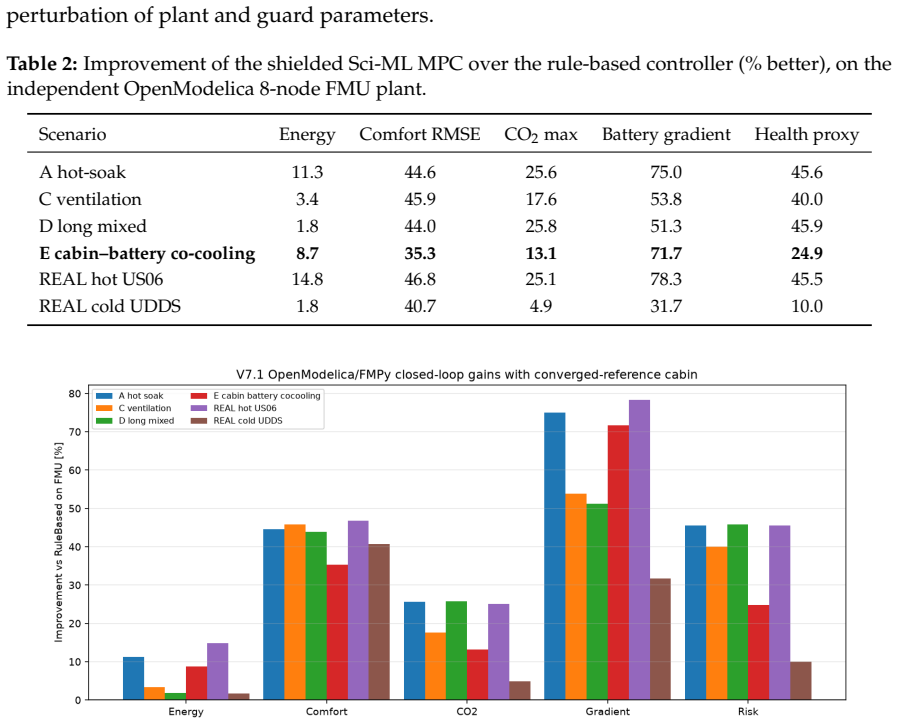
The shielded Sci-ML MPC delivers statistically significant, all-positive improvements over a production-like rule-based controller across six scenarios, including a real hot-day US06 trip (energy −15%, comfort RMSE −47%, peak CO₂ −25%, battery thermal-gradient −78%), and these gains transfer to an independently exported OpenModelica 8-node co-simulation plant.
What carries the argument
Physics-informed Sci-ML surrogate consisting of a nominal-physics prior plus learned residual with explicit conservation penalties, embedded inside a shielded MPC.
If this is right
- The open benchmark enables reproducible, multi-objective comparison of thermal-management strategies that previous single-subsystem studies could not provide.
- The Sci-ML surrogate remains exact on conserved quantities and shows lower rollout error than black-box or Koopman alternatives out of distribution.
- Performance gains hold when the controller is exported to a higher-fidelity eight-node co-simulation plant.
- Improvements span battery health, passenger comfort, cabin air quality, and HVAC energy simultaneously.
Where Pith is reading between the lines
- If the reduced-order models continue to match higher-fidelity references under varied climates and aging conditions, the same controller structure could be retuned for other battery chemistries or cabin layouts.
- The benchmark’s real-data anchoring on BMS logs and cross-check against EnergyPlus suggests it could serve as a shared testbed for comparing future integrated thermal controllers.
- Because the surrogate is trained with explicit conservation penalties, similar physics-informed residuals might be added to other vehicle subsystems that exchange heat or mass.
Load-bearing premise
The reduced two-state battery and two-node cabin models remain accurate enough when used inside the MPC that the reported multi-objective improvements will appear in real vehicles.
What would settle it
Run the same hot-day US06 cycle on a physical battery-electric vehicle with the MPC in closed loop versus the rule-based controller and measure whether the four reported percentage improvements in energy, comfort RMSE, peak CO2, and battery thermal gradient are observed.
Figures
read the original abstract
Thermal management in a battery-electric vehicle (BEV) is a coupled, vehicle-level problem: the battery pack, the passenger cabin, the heat pump, and cabin air quality compete for shared actuation and energy, yet most studies optimise a single subsystem on proprietary models, which prevents fair, reproducible comparison. We present OpenEV-ThermoSciML, an open and reproducible benchmark that couples a battery electro-thermal-aging model, a two-node cabin model, a heat-pump/HVAC model, and a CO$_2$/ventilation model under real driving cycles (EPA) and real weather (NREL TMY3, NASA POWER), scored by a multi-objective suite spanning battery health, PMV/PPD comfort, cabin air quality, and HVAC energy. The benchmark's battery thermal core is anchored and validated on real BEV battery-management-system (BMS) data; the reduced battery (two-state) and cabin (two-node) models are validated against converged higher-fidelity references and, for the cabin, independently cross-checked against EnergyPlus 25.2.0. On top of the benchmark we develop a physics-informed scientific-machine-learning (Sci-ML) surrogate -- a nominal-physics prior plus a learned residual with conservation penalties -- that is exact on conserved quantities and dominates black-box and Koopman surrogates out-of-distribution (overall rollout RMSE 0.014 vs 1.168 and 3.991). A shielded Sci-ML model-predictive controller (MPC) delivers statistically significant, all-positive improvements over a production-like rule-based controller across six scenarios -- including a real hot-day US06 trip (energy $-15\%$, comfort RMSE $-47\%$, peak CO$_2$ $-25\%$, battery thermal-gradient $-78\%$) -- and these gains transfer to an independently exported OpenModelica 8-node co-simulation plant.
Editorial analysis
A structured set of objections, weighed in public.
Referee Report
Summary. The paper introduces the OpenEV-ThermoSciML open benchmark for coupled BEV thermal management (battery electro-thermal-aging, two-node cabin, heat-pump/HVAC, CO2/ventilation) anchored on real BMS and TMY3 data. Reduced two-state battery and two-node cabin models are validated against higher-fidelity references and EnergyPlus. A physics-informed Sci-ML surrogate (nominal physics plus learned residual with conservation penalties) achieves 0.014 rollout RMSE and outperforms black-box/Koopman alternatives. A shielded Sci-ML MPC is shown to deliver statistically significant all-positive gains over a production-like rule-based controller on six scenarios (e.g., hot-day US06: energy -15%, comfort RMSE -47%, peak CO2 -25%, battery gradient -78%), with the claim that these gains transfer to an independent OpenModelica 8-node co-simulation plant.
Significance. If the transfer claim holds, the work supplies a much-needed open, real-data-anchored, reproducible benchmark that enables fair comparison of multi-objective thermal strategies, addressing the prevalence of proprietary single-subsystem models. The physics-informed surrogate's exact conservation properties and strong out-of-distribution performance, together with the multi-objective MPC results, represent concrete advances for Sci-ML control in coupled vehicle thermal systems.
major comments (1)
- [Abstract] Abstract: the assertion that MPC gains transfer to the OpenModelica 8-node co-simulation plant lacks any direct closed-loop metric comparison (energy, comfort RMSE, CO2, battery gradient) between the surrogate-based MPC and the identical MPC deployed on the plant; open-loop rollout RMSE of 0.014 does not establish that prediction discrepancies remain tolerable under the multi-objective optimization and constraints.
Simulated Author's Rebuttal
We thank the referee for the constructive review and for recognizing the benchmark's potential value. We address the single major comment below with a direct response and a commitment to revision.
read point-by-point responses
-
Referee: [Abstract] Abstract: the assertion that MPC gains transfer to the OpenModelica 8-node co-simulation plant lacks any direct closed-loop metric comparison (energy, comfort RMSE, CO2, battery gradient) between the surrogate-based MPC and the identical MPC deployed on the plant; open-loop rollout RMSE of 0.014 does not establish that prediction discrepancies remain tolerable under the multi-objective optimization and constraints.
Authors: We agree that the abstract's transfer claim would be strengthened by explicit closed-loop metrics on the OpenModelica plant. The current manuscript demonstrates transfer via (i) the surrogate's 0.014 rollout RMSE on held-out trajectories from the higher-fidelity model and (ii) the fact that the MPC formulation is identical when the plant replaces the surrogate. However, we acknowledge that this does not directly quantify how prediction discrepancies propagate through the multi-objective optimizer and constraints. In the revised manuscript we will add a new results subsection (and update the abstract) that reports the four key metrics (energy, comfort RMSE, peak CO2, battery gradient) for the shielded Sci-ML MPC when it is deployed in closed loop on the exported OpenModelica 8-node plant, using the same six scenarios. This will allow direct comparison of surrogate-MPC versus plant-MPC performance. revision: yes
Circularity Check
No significant circularity; benchmark anchored externally
full rationale
The paper's central claims rest on external real BMS data for battery anchoring, TMY3/NASA POWER weather, independent EnergyPlus cross-validation for the cabin model, and transfer testing on an exported OpenModelica 8-node plant. The Sci-ML surrogate is validated via open-loop rollout RMSE against these references, and MPC gains are measured against a separate rule-based controller on the benchmark scenarios. No load-bearing step reduces a reported prediction or performance metric to a fitted input by construction, nor does any uniqueness theorem or ansatz trace to self-citation. The derivation chain remains self-contained against the stated external anchors.
Axiom & Free-Parameter Ledger
Forward citations
Cited by 1 Pith paper
-
Battery thermal-safety reserve erosion by mandatory cabin ventilation in shared-cooling electric vehicles
Mandatory fresh-air ventilation erodes battery thermal reserve in shared-cooling EVs under derated compressor conditions, and a reserve-aware controller using physics-guided ML surrogate and barrier functions restores...
Reference graph
Works this paper leans on
-
[1]
drive cycle / vehicle speed→traction powerP trac (road-load equation); 2.P trac +HVAC electrical load→battery current, heat generation, and SOC
-
[2]
ambient temperature / solar / occupancy→cabin thermal load and CO 2
-
[3]
HVAC actuation → simultaneouslybattery temperature, cabin temperature, CO 2, and energy
-
[4]
self-confirming
the controller trades off energy, comfort, CO2/health proxy, battery gradient, and an aging proxy. The single decision that makes the loops genuinely coupled—rather than two independent problems running side by side—is the heat-pumpcapacity split sbatt in §3.3. Allocating capacity to the battery starves the cabin, and vice versa, so coordinated, predictio...
-
[5]
Anopen, reproducible, weather-coupledwhole-vehicle BEV thermal-management bench- mark unifying battery health, PMV/PPD comfort, cabin air quality, and energy over six standardised scenarios
-
[6]
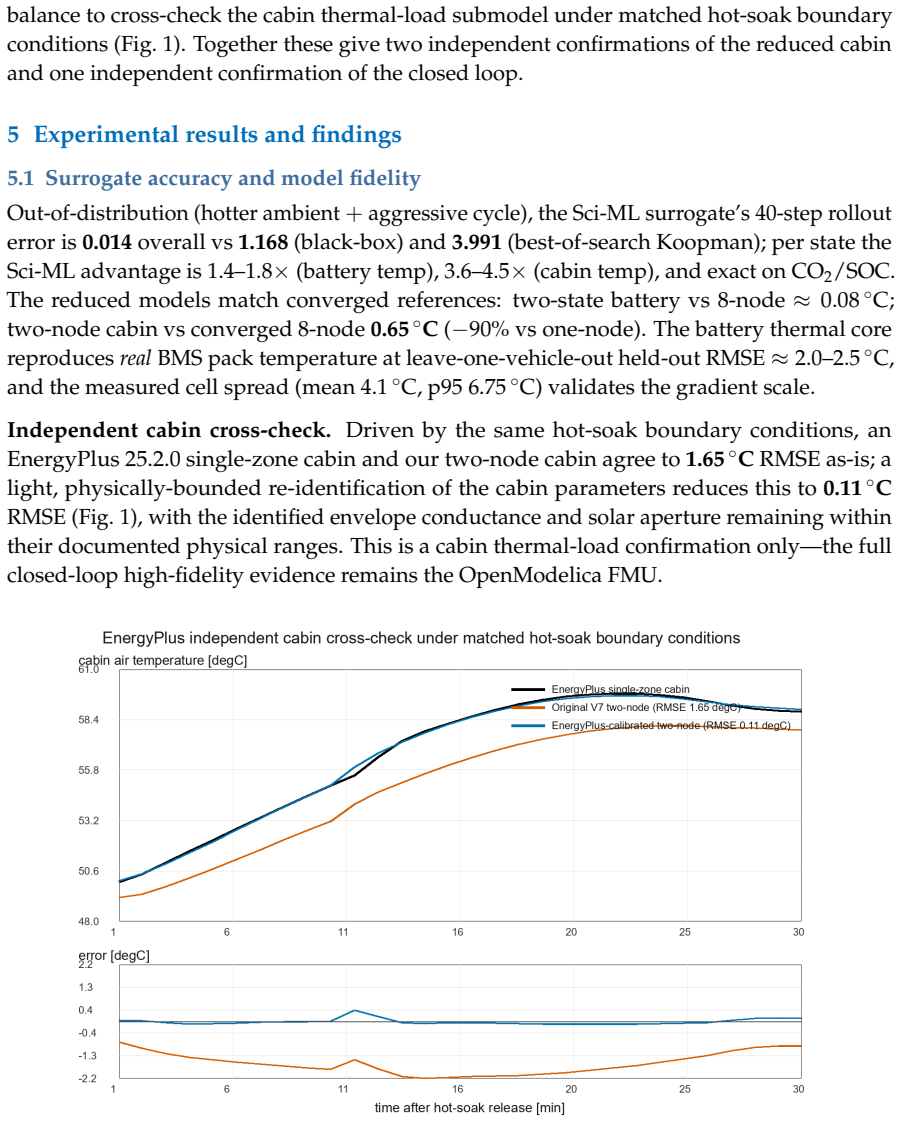
Areal-BMS-anchoredbattery thermal core (KU Leuven + NASA POWER; leave-one- vehicle-out validation) and reduced battery/cabin modelsvalidated against converged higher-fidelity references, with the cabin additionally cross-checked against EnergyPlus. 6
-
[7]
Aphysics-informed Sci-ML surrogatethat is conservation-exact and dominates black-box and Koopman baselines out-of-distribution
-
[8]
Ashielded, model-swappable multi-objective MPCwith statistically significant, all- positive gains, cross-validated on anindependent OpenModelica FMUclosed loop
-
[9]
A fully released package (code, processed data, trained models, parameter-provenance and data-mapping documentation) for reproducible comparison. 7 Limitations and future work Validation is in-silico (reduced-order benchmark+ real-data-anchored battery + independent FMU co-simulation + EnergyPlus cabin cross-check);hardware-in-the-loop / bench / vehicle t...
discussion (0)
Sign in with ORCID, Apple, or X to comment. Anyone can read and Pith papers without signing in.