REVIEW 4 major objections 6 minor 30 references
Recasting Classical Motion Planning for Contact-Rich Manipulation
T0 review · 4 major / 6 minor · reviewed 2026-08-07 · deepseek-v4-flash
Pith's one-line read This paper claims that an RRT variant planning on a force-balanced equilibrium manifold, with edge lengths set by a haptic metric, turns contact-rich manipulation into a tree-search problem solvable from one potential per task.
desk verdict Solid RRT-on-manifold planner with real robot demos, but the headline branch-discovery claim is unsupported by the algorithm as written. read the letter →
The pith
A machine-rendered reading of the paper's core claim, the machinery that carries it, and where it could break.
The reading
What carries the argument
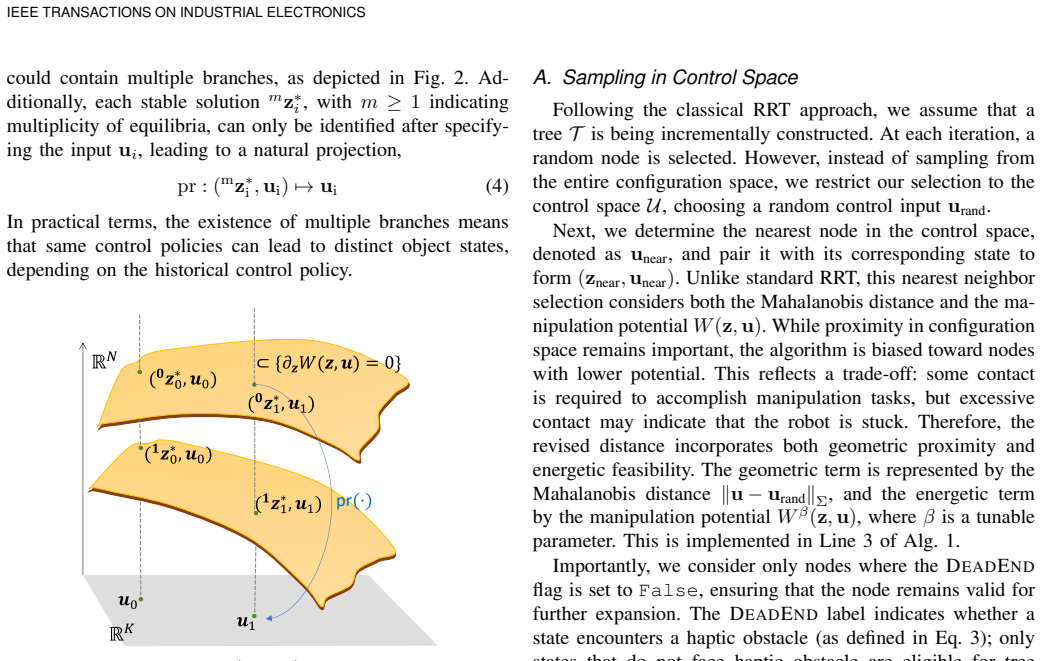
The load-bearing object is the quasi-static equilibrium manifold $M_{\mathrm{eq}} := \{(z,u) \in Z \times U \mid \partial_z W(z,u)=0\}$ generated by a smooth manipulation potential $W$; on this manifold the system is always in force balance, so every point is a stable or unstable contact configuration. Two associated objects carry the planner: the haptic metric $G_m = \partial^2_{uu} W - \partial^2_{uz} W (\partial^2_{zz} W)^{-1} \partial^2_{zu} W$, the Schur complement of the Hessian evaluated on $M_{\mathrm{eq}}$, whose square root defines haptic distance and therefore the tree's edge length, and the haptic obstacle condition $\det(\partial^2_{zz} W) > \lambda$, which marks where the manifold folds and expansion must stop. The adaptive ODE $\dot z = -(\partial^2_{zz}W)^{-1}\partial^2_{uz}W\,\dot u - \eta(\partial^2_{zz}W)^{-1}\partial_z W$ simultaneously tracks the infinitesimal projection of control changes onto $z$ and applies Newton corrections that hold the state on $M_{\mathrm{eq}}$. Branches of $M_{\mathrm{eq}}$ (multiple stable $z^*$ for the same $u$) are what the tree explores, and each branch corresponds to a distinct manipulation strategy.
What would settle it
Run HapticRRT on a task whose governing physics include a contact mode intentionally omitted from the potential, such as dry friction or jamming between the inserted object and the shelf; if the planner yields a policy whose simulated force profile diverges from measured forces, or if the ODE drifts off $M_{\mathrm{eq}}$ near a singularity, the claim that a single smooth potential suffices is falsified.
Extended reading notes
Core claim
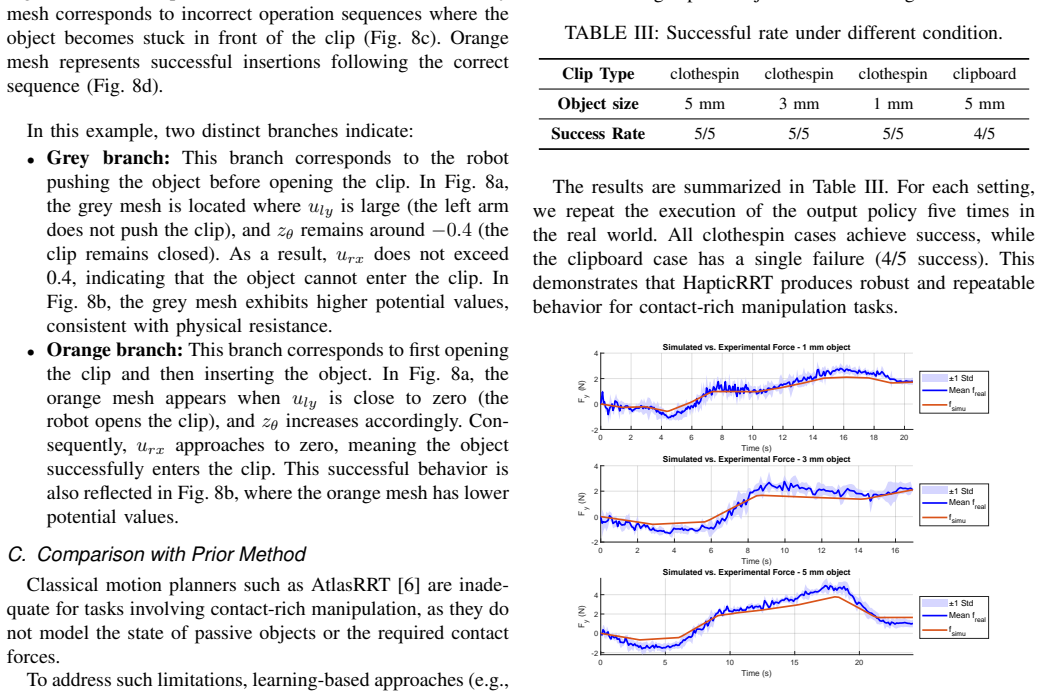
The paper's central claim is that adapting RRT to operate on the implicit equilibrium manifold of a quasi-static manipulation system turns strategic contact reasoning into a standard tree-search problem. For a system with internal state $z$ and control $u$ described by a manipulation potential $W(z,u)$, the planner samples candidate controls, selects the nearest surviving tree node using a Mahalanobis-plus-potential distance, and extends edges by integrating an adaptive ODE that keeps the system on $M_{\mathrm{eq}}$ while accumulating haptic distance; expansion stops when a fixed haptic distance is reached or when $\det(\partial^2_{zz}W)$ crosses a stiffness threshold, marking a haptic obstacle. Because $M_{\mathrm{eq}}$ can have multiple stable branches over a single control, the tree can discover qualitatively different policies, and the paper shows this concretely: a grey branch where the book or object gets stuck and an orange branch where the robot first creates space or opens the clip, with the successful branch carrying lower potential. The claim is validated by real-world trials on a hinged pendulum with changing mass, spring-loaded clip insertion with varying object size, and crowded-shelf book insertion, where HapticRRT succeeds in most or all trials and matches simulated external forces with measured ones, while using substantially less computation than a prior DMP-BBO policy optimizer.
Load-bearing premise
The load-bearing premise is that one hand-written smooth energy function for the task, together with the quasi-static assumption, faithfully captures all physics that matter, so every useful contact behavior appears as a branch of the equilibrium manifold and the adaptive ODE can follow that branch reliably; if the potential omits friction, jamming, or an unmodeled collision, the planned policy can fail.
Editorial extensions
If this is right
- One differentiable potential per task is sufficient to generate contact-rich policies; no manual contact-phase sequencing or per-phase controllers are required.
- The planner naturally discovers multiple strategies because distinct branches of $M_{\mathrm{eq}}$ are explored as separate RRT branches, and the successful branch is identifiable by lower potential.
- Contact-rich planning inherits the computational properties of sampling-based planners: HapticRRT solved the clip task in 2.74 s and the book task in 48.71 s, versus 16.14 s and 791.22 s for the compared DMP-BBO optimizer.
- Force predictions from $-\partial_u W$ match measured external forces well enough that the planner can be validated sim-to-real across all three tasks.
- HapticRRT generalizes to tasks where a purely kinematic constraint planner fails, because the potential encodes mass and contact, so the planner can infer a need for sustained pushing rather than only geometric feasibility.
Reading between the lines
- The same pipeline should transfer to any task whose mechanics can be written as a smooth potential, including compliant assembly, door and drawer opening, and multi-object rearrangement; the paper's three demonstrations sample that space but do not exhaust it.
- Because tree edges are measured in haptic distance, the planner's notion of closeness is force cost, which suggests a natural route to cost-aware sampling: biasing $u_{\mathrm{rand}}$ or pruning by accumulated haptic distance could trade path optimality for computation.
- A direct testable extension is online adaptation: the adaptive ODE gives a local model of how $z$ responds to changes in $u$, so force feedback from joint torques could be used to correct the tree's predictions at execution time, addressing failures the paper attributes to jagged or excessive-force trajectories.
- The branch structure itself could be used as a symbolic abstraction: detecting when a planned path crosses a haptic obstacle or jumps branches may be a way to segment a contact-rich skill into phases automatically.
Editorial analysis
A structured set of objections, weighed in public.
Referee Report
Summary. The paper proposes HapticRRT, a sampling-based planner that adapts classical RRT to operate on the quasi-static equilibrium manifold M_eq defined by the zero-gradient condition of a manipulation potential W(z,u). The planner samples in control space, selects nearest neighbors with a potential-weighted Mahalanobis distance, and extends tree edges by integrating an adaptive ODE that tracks M_eq while measuring haptic distance. The authors claim three contributions: adapting RRT to contact-rich manipulation on M_eq, discovering multiple equilibrium branches corresponding to distinct manipulation strategies, and validating the method on three real-world tasks (pendulum pushing, spring-loaded clip opening, crowded bookshelf insertion). The experimental sections report success rates of 4/5 to 5/5 and compare planning time against the authors' earlier DMP-BBO method.
Significance. If the central claims hold, the paper offers a transparent, interpretable alternative to optimization-based contact-rich planning: a single differentiable potential per task, combined with a classical RRT-style exploration of the equilibrium manifold, yields executable policies with substantially lower planning time than the DMP-BBO baseline. The real-world validation across three qualitatively different tasks, including force-profile comparisons, is a genuine strength, as is the explicit visualization of haptic metrics and obstacles. However, the genuinely new algorithmic claim—autonomous discovery of multiple equilibrium branches—is not supported by the algorithm as written, and the termination conditions in the pseudocode are internally inconsistent. The framework itself is largely inherited from the authors' prior work [12]–[14], and the only nontrivial baseline is also the authors' own method, so the significance of the incremental contribution depends on whether the branch-discovery claim can be substantiated or appropriately revised.
major comments (4)
- [Sec. III-B, Alg. 2, Eq. (3)] The termination logic in Alg. 2 is internally inconsistent and contradicts the text. Section III-B states that one termination condition occurs when the haptic distance satisfies phi(t) <= epsilon, but line 3 of Alg. 2 stops when phi(t) > epsilon; since phi(0)=0, the text's condition would stop immediately, while the pseudocode extends past the intended distance. In addition, Eq. (3) defines a haptic obstacle as det(d^2_zz W) > lambda > 0, but the surrounding text and Fig. 5 identify haptic obstacles with singularities, i.e., with det near zero, and Alg. 2 line 5 stops and marks DEAD END when det > lambda, which would terminate expansion at every high-stiffness stable configuration. These contradictions make the algorithm as specified unexecutable; please correct the inequality directions and specify the stopping rule unambiguously.
- [Sec. V-B, Fig. 8, Sec. VI-B, Fig. 11] The claim that HapticRRT discovers multiple branches of M_eq is not supported by the algorithm as written. EXTEND terminates an edge as soon as the ODE encounters a haptic obstacle (Eq. 3), and distinct stable equilibrium branches are separated by fold or saddle-node bifurcations where det(d^2_zz W) vanishes. Starting from a single seed node (Alg. 3), every tree node is reached by continuous integration within one connected component of the stable part of M_eq, so the tree cannot cross the singularity that separates the grey and orange meshes in Figs. 8 and 11. The paper provides no mechanism for branch crossing, such as multiple initial seeds or random jumps, and does not state whether the two meshes come from the same run or from different initial conditions. Please either provide such a mechanism, report the initial conditions used for each mesh, or revise the branch-discovery claim and the associated abstract/conclusion language.
- [Sec. III-A, III-B, IV, V, VI] Key algorithm parameters are not reported or studied: the potential weight beta, the Mahalanobis covariance Sigma, the haptic-obstacle threshold lambda, the ODE step size eta, the extension distance epsilon, and the stiffness constants kmin, kmax, d0, Kc, K1, K2, k_theta. These quantities directly determine the nearest-neighbor bias, the termination of edges, the accuracy with which the ODE tracks M_eq, and the shape of the manifold itself. Without reporting their values or providing a sensitivity study, the success rates and planning times cannot be reproduced, and it is unclear whether the results depend on fine-tuned constants rather than on the proposed method.
- [Sec. III-B, Eq. (7)] The adaptive ODE in Eq. (7) is cited from prior work, but the paper does not analyze its behavior for finite integration steps near singularities. The Newton-correction term eta (d^2_zz W)^{-1} d_z W becomes unbounded as det(d^2_zz W) approaches zero, and the planner's correctness depends on the ODE tracking M_eq closely enough during each EXTEND step. Please provide a local error bound, a practical criterion for choosing eta and lambda, or an ablation demonstrating that the planner's performance is insensitive to these choices.
minor comments (6)
- [Abstract] The abstract contains a grammatical error: 'we presents Haptic Rapidly-Exploring Random Trees' should be 'we present Haptic Rapidly-Exploring Random Trees'.
- [Sec. IV-E] The text refers to 'Table IV' when presenting the pendulum results, but the actual table is labeled Table I; please correct the cross-reference.
- [Sec. II-C, Eq. (6)] Eq. (5) defines a matrix G_m, but Eq. (6) uses G_m^2 in the line element. Please clarify whether the haptic metric is G_m or its square, and define the notation consistently.
- [Sec. IV-B, Eq. (12)] The gravitational potential term 1/2 m g L0 sin z_theta has an unusual factor of 1/2 and no stated reference configuration; please clarify the zero of potential and the coordinate convention for z_theta.
- [Sec. VI-B, Fig. 11] The statement that z_y = 0 corresponds to a fully inserted book is confusing because Fig. 11a plots z_y against u_y and u_theta; please specify the world-frame axes and the insertion direction.
- [Sec. V-A, Eq. (14)] The state vector z includes z_r, the positions of the dual-arm end effectors, while u contains the desired positions; please clarify why the actual end-effector positions are treated as internal states rather than as controlled outputs under impedance control.
Circularity Check
No significant circularity: HapticRRT's outputs are not equivalent by construction to its inputs; heavy self-citation is to independently validated prior framework.
full rationale
The paper's derivation chain runs from a hand-specified manipulation potential W through the equilibrium manifold Meq (Eq. 2), the haptic metric (Eq. 5), the adaptive ODE (Eqs. 7-8), and the RRT exploration (Algs. 1-3). None of the claimed outputs—planned control policies, discovered manifold branches, or simulated contact forces—are definitionally equal to the inputs. The nearest-neighbor heuristic in Alg. 1 does use W as a soft bias, but it does not preselect the branch or policy returned; the tree still searches over the equilibrium manifold, and the reported force/trajectory comparisons are against independently measured real-world sensor data, not against quantities computed from the same fitted parameters used to steer the search. The cited prior works ([12], [13], [14], [26]) supply the quasi-static/haptic-metric framework, but those are published external results, and the present paper's real-world success rates (Tables I, III, V) provide an independent check that the framework is not vacuous. I therefore find no step where a 'prediction' reduces by construction to a fitted input or to a self-citation chain.
Assumptions & free parameters
free parameters (7)
- beta =
not reported
- Sigma =
not reported
- lambda =
not reported
- epsilon =
not reported
- eta =
not reported
- stiffness parameters kmin, kmax, d0 =
not reported
- control and resistance stiffnesses Kc, K1, K2, k_theta =
not reported
assumptions (6)
- domain assumption The quasi-static assumption: all forces are balanced at every instant, and inertial and Coriolis effects are negligible.
- standard math The Hessian grad_zz W is full rank on Meq, so by the implicit function theorem Meq is a smooth embedded submanifold.
- ad hoc to paper The adaptive ODE (Eq. 7) with finite step eta converges to and tracks Meq accurately enough for planning.
- ad hoc to paper The contact stiffness function (Eq. 11) with tanh transition and the proxy contact model (Eq. 13) faithfully represent physical contacts.
- ad hoc to paper The nearest-neighbor cost W^beta ||u-u_rand||_Sigma biases exploration in a way that finds feasible strategies.
- domain assumption Multiple stable equilibria (branches) for a given control u exist and correspond to distinct manipulation strategies.
Cite this review
Pith. "Pith review of Recasting Classical Motion Planning for Contact-Rich Manipulation." pith.science (2026). https://pith.science/paper/JTPJBKOK
@misc{pith2026250600351,
  author       = {Pith},
  title        = {Pith review of: Recasting Classical Motion Planning for Contact-Rich Manipulation},
  year         = {2026},
  howpublished = {\url{https://pith.science/paper/JTPJBKOK}},
  note         = {Machine review of arXiv:2506.00351}
}
read the original abstract
In this work, we explore how conventional motion planning algorithms can be reapplied to contact-rich manipulation tasks. Rather than focusing solely on efficiency, we investigate how manipulation aspects can be recast in terms of conventional motion-planning algorithms. Conventional motion planners, such as Rapidly-Exploring Random Trees (RRT), typically compute collision-free paths in configuration space. However, in many manipulation tasks, contact is either unavoidable or essential for task success, such as for creating space or maintaining physical equilibrium. As such, we presents Haptic Rapidly-Exploring Random Trees (HapticRRT), a planning algorithm that incorporates a recently proposed optimality measure in the context of \textit{quasi-static} manipulation, based on the (squared) Hessian of manipulation potential. The key contributions are i) adapting classical RRT to operate on the quasi-static equilibrium manifold, while deepening the interpretation of haptic obstacles and metrics; ii) discovering multiple manipulation strategies, corresponding to branches of the equilibrium manifold. iii) validating the generality of our method across three diverse manipulation tasks, each requiring only a single manipulation potential expression. The video can be found at https://youtu.be/R8aBCnCCL40.
Figures


Figures from the paper (8 more)




Reference graph
Works this paper leans on
-
[12]
L. Yang, S. H. Turlapati, C. Lv, and D. Campolo, “Planning for quasi- static manipulation tasks via an intrinsic haptic metric: A book insertion case study,” IEEE Robotics and Automation Letters , 2025
work page 2025
-
[14]
Quasi-static mechanical manipulation as an optimal process,
D. Campolo and F. Cardin, “Quasi-static mechanical manipulation as an optimal process,” in 2023 62nd IEEE Conference on Decision and Control (CDC), pp. 4753–4758. IEEE, 2023
work page 2023
-
[1]
A survey of robot manipulation in contact,
M. Suomalainen, Y . Karayiannidis, and V . Kyrki, “A survey of robot manipulation in contact,” Robotics and Autonomous Systems , vol. 156, p. 104224, 2022. IEEE TRANSACTIONS ON INDUSTRIAL ELECTRONICS
work page 2022
-
[2]
Rapidly-exploring random trees: A new tool for path planning,
S. LaValle, “Rapidly-exploring random trees: A new tool for path planning,” Research Report 9811 , 1998
1998
-
[3]
Visualizing high-dimensional config- uration spaces: A comprehensive analytical approach,
J. O. Jimenez and W. Suleiman, “Visualizing high-dimensional config- uration spaces: A comprehensive analytical approach,” IEEE Robotics and Automation Letters , 2024
work page 2024
-
[4]
Sampling-based methods for motion planning with constraints,
Z. Kingston, M. Moll, and L. E. Kavraki, “Sampling-based methods for motion planning with constraints,” Annual review of control, robotics, and autonomous systems , vol. 1, pp. 159–185, 2018
work page 2018
-
[5]
Path planning under kinematic constraints by rapidly exploring manifolds,
L. Jaillet and J. M. Porta, “Path planning under kinematic constraints by rapidly exploring manifolds,” IEEE Transactions on Robotics , vol. 29, no. 1, pp. 105–117, 2012
work page 2012
-
[6]
Exploring implicit spaces for constrained sampling-based planning,
Z. Kingston, M. Moll, and L. E. Kavraki, “Exploring implicit spaces for constrained sampling-based planning,” The International Journal of Robotics Research, vol. 38, no. 10-11, pp. 1151–1178, 2019
work page 2019
Show all 30 references
-
[7]
Complex in-hand manipulation via compliance-enabled finger gaiting and multi- modal planning,
A. S. Morgan, K. Hang, B. Wen, K. Bekris, and A. M. Dollar, “Complex in-hand manipulation via compliance-enabled finger gaiting and multi- modal planning,” IEEE Robotics and Automation Letters , vol. 7, no. 2, pp. 4821–4828, 2022
2022
-
[8]
Spa- tiotemporal optimal trajectory planning for safe planar manipulation of a moving object,
Y . Zhou, G. Sun, Y . Miao, Y . Zhang, X. Chen, and H. Wang, “Spa- tiotemporal optimal trajectory planning for safe planar manipulation of a moving object,” IEEE Transactions on Industrial Electronics , vol. 71, no. 7, pp. 7466–7476, 2023
2023
-
[9]
Quasi-static assembly of compliantly supported rigid parts,
D. E. Whitney et al. , “Quasi-static assembly of compliantly supported rigid parts,” Journal of Dynamic Systems, Measurement, and Control , vol. 104, no. 1, pp. 65–77, 1982
1982
-
[10]
Grasp and dexterous manipulation of multi- fingered robotic hands: a review from a control view point,
R. Ozawa and K. Tahara, “Grasp and dexterous manipulation of multi- fingered robotic hands: a review from a control view point,” Advanced Robotics, vol. 31, no. 19-20, pp. 1030–1050, 2017
2017
-
[11]
A planning framework for robotic insertion tasks via hydroelastic contact model,
L. Yang, M. Z. Ariffin, B. Lou, C. Lv, and D. Campolo, “A planning framework for robotic insertion tasks via hydroelastic contact model,” Machines, vol. 11, no. 7, p. 741, 2023
2023
-
[13]
A geometric framework for quasi-static manipulation of a network of elastically connected rigid bodies,
D. Campolo and F. Cardin, “A geometric framework for quasi-static manipulation of a network of elastically connected rigid bodies,” Applied Mathematical Modelling , vol. 143, p. 116003, 2025
2025
-
[15]
Robotic assembly of rounded parts with and without threads,
A. Salem and Y . Karayiannidis, “Robotic assembly of rounded parts with and without threads,” IEEE Robotics and Automation Letters , vol. 5, no. 2, pp. 2467–2474, 2020
2020
-
[16]
Cooperative control for dual-arm robots based on improved dynamic movement primitives,
D. Wang, C. Qiu, J. Lian, W. Wan, Q. Pan, and Y . Dong, “Cooperative control for dual-arm robots based on improved dynamic movement primitives,” IEEE Transactions on Industrial Electronics , 2024
2024
-
[17]
Robust and adaptive dexterous manipulation with vision-based learning from multiple demonstrations,
N. Chen, L. Wan, and Y .-J. Pan, “Robust and adaptive dexterous manipulation with vision-based learning from multiple demonstrations,” IEEE Transactions on Industrial Electronics , 2024
2024
-
[18]
A review on reinforce- ment learning for contact-rich robotic manipulation tasks,
´I. Elguea-Aguinaco, A. Serrano-Mu ˜noz, D. Chrysostomou, I. Inziarte- Hidalgo, S. Bøgh, and N. Arana-Arexolaleiba, “A review on reinforce- ment learning for contact-rich robotic manipulation tasks,” Robotics and Computer-Integrated Manufacturing, vol. 81, p. 102517, 2023
2023
-
[19]
Solving robotic manipulation with sparse reward reinforcement learning via graph-based diversity and proximity,
Z. Bing, H. Zhou, R. Li, X. Su, F. O. Morin, K. Huang, and A. Knoll, “Solving robotic manipulation with sparse reward reinforcement learning via graph-based diversity and proximity,” IEEE Transactions on Indus- trial Electronics, vol. 70, no. 3, pp. 2759–2769, 2022
2022
-
[20]
Control strategies for inverted pendulum: A comparative analysis of linear, nonlinear, and artificial intelligence approaches,
S. Irfan, L. Zhao, S. Ullah, A. Mehmood, and M. Fasih Uddin Butt, “Control strategies for inverted pendulum: A comparative analysis of linear, nonlinear, and artificial intelligence approaches,” Plos one , vol. 19, no. 3, p. e0298093, 2024
2024
-
[21]
Door-opening technologies: Search for affordable assistive technology,
J. Shaikh-Mohammed, Y . Alharbi, and A. Alqahtani, “Door-opening technologies: Search for affordable assistive technology,” Technologies, vol. 11, no. 6, p. 177, 2023
2023
-
[22]
Integrated linkage-driven dexterous anthropomor- phic robotic hand,
U. Kim, D. Jung, H. Jeong, J. Park, H.-M. Jung, J. Cheong, H. R. Choi, H. Do, and C. Park, “Integrated linkage-driven dexterous anthropomor- phic robotic hand,” Nature communications , vol. 12, no. 1, p. 7177, 2021
2021
-
[23]
A study of book arrangement task by robot arm-book insert operation to bookshelf,
T. Nakajima, T. Yoshimi, M. Mizukawa, and Y . Ando, “A study of book arrangement task by robot arm-book insert operation to bookshelf,” in 2011 IEEE/SICE International Symposium on System Integration (SII) , pp. 738–743. IEEE, 2011
2011
-
[24]
Multi-stage book perception and bimanual manipulation for rearranging book shelves,
B. Sygo, S.-C. Liu, F. Wieczorek, M. Koshil, M. G ¨orner, N. Hendrich, and J. Zhang, “Multi-stage book perception and bimanual manipulation for rearranging book shelves,” in International Conference on Intelligent Autonomous Systems , pp. 495–507. Springer, 2023
2023
-
[25]
Spivak, Calculus on manifolds: a modern approach to classical theorems of advanced calculus
M. Spivak, Calculus on manifolds: a modern approach to classical theorems of advanced calculus . CRC press, 2018
2018
-
[26]
An energy- based numerical continuation approach for quasi-static mechanical ma- nipulation,
L. Yang, H.-T. Nguyen, C. Lv, D. Campolo, and F. Cardin, “An energy- based numerical continuation approach for quasi-static mechanical ma- nipulation,” Data-Centric Engineering , vol. 6, p. e18, 2025
2025
-
[27]
Jaklic, A
A. Jaklic, A. Leonardis, and F. Solina, Segmentation and recovery of superquadrics, vol. 20. Springer Science & Business Media, 2000
2000
-
[28]
Poston and I
T. Poston and I. Stewart, Catastrophe theory and its applications . Courier Corporation, 2014
2014
-
[29]
Robot skill learning: From reinforcement learn- ing to evolution strategies,
F. Stulp and O. Sigaud, “Robot skill learning: From reinforcement learn- ing to evolution strategies,” Paladyn, Journal of Behavioral Robotics , vol. 4, no. 1, pp. 49–61, 2013. Lin Yang received his Bachelor’s degree from Beihang University, Beijing, China, in 2022. He is curr...
2013
-
[2016]
Researcher with the EECS Department, Uni- versity of California at Berkeley
From 2014 to 2015, he was a Joint Ph.D. Researcher with the EECS Department, Uni- versity of California at Berkeley. He is currently an Assistant Professor with Nanyang Technol- ogy University, Singapore. His research inter- ests include cyber-physical systems, hybrid sys- tem...
2014
Reviewed August 7, 2026 · model on record in the stance chip above.
Discussion (0). Sign in to comment.