Theoretical Aspects of Lie Groupoid and Lie Algebroid Equivariant Convolutional Neural Networks
Pith reviewed 2026-06-28 12:22 UTC · model grok-4.3
The pith
Lie groupoid equivariant neural networks are built from lifting convolutions and convolution layers that are equivalent to Lie algebroid versions for suitable groupoids.
A machine-rendered reading of the paper's core claim, the machinery that carries it, and where it could break.
Core claim
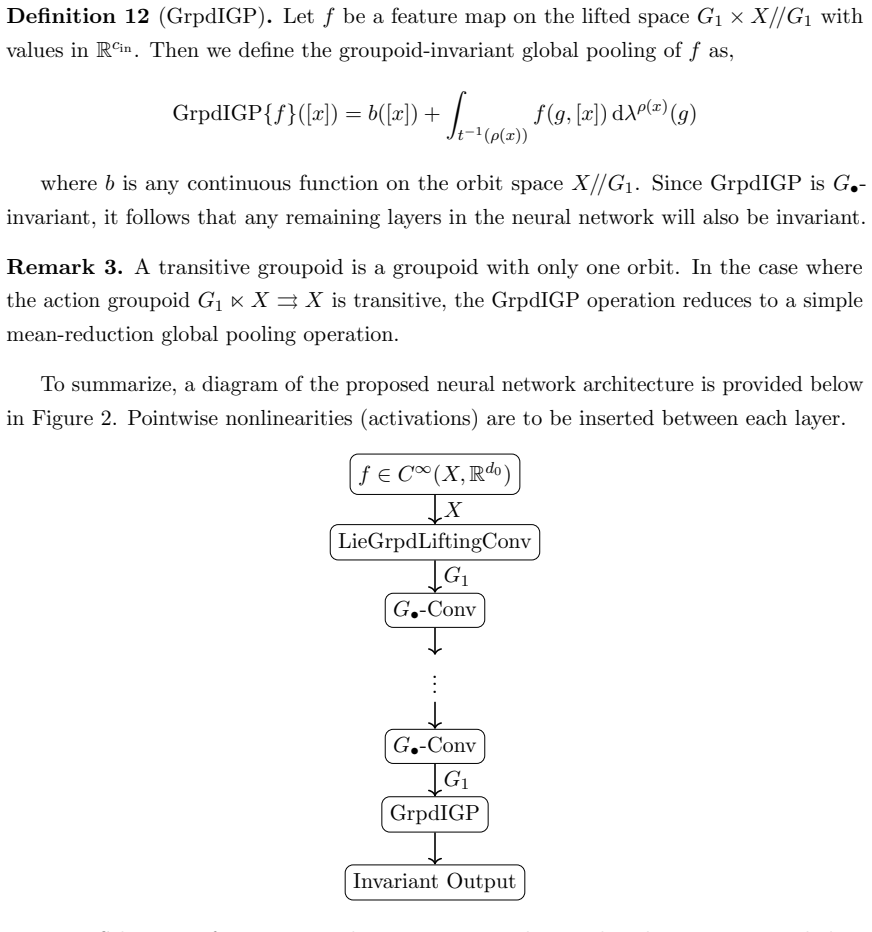
Lie groupoid equivariant neural networks consist of Lie groupoid lifting convolutions and Lie groupoid convolution layers. For suitable Lie groupoids they are equivalent to certain Lie algebroid-equivariant neural networks. Each layer defines continuous natural transformations between continuous feature functors, making them special cases of admissible category-equivariant layers. Groupoid invariant global pooling is introduced as a generalization of group invariant global pooling.
What carries the argument
Lie groupoid lifting convolutions and Lie groupoid convolution layers that induce continuous natural transformations between continuous feature functors.
If this is right
- Networks equivariant to Lie groupoid actions can be built layer by layer using the defined convolutions.
- Equivalence allows transferring results between groupoid and algebroid equivariant networks under the suitable condition.
- Groupoid invariant global pooling applies to a wider class of symmetries than standard group pooling.
- All such layers fit into the broader framework of admissible category-equivariant layers.
Where Pith is reading between the lines
- The equivalence might enable using algebroid differential geometry tools to analyze or optimize groupoid-based networks.
- This approach could be tested on specific Lie groupoids arising from manifolds with symmetries to verify practical equivariance.
- Extending the construction beyond suitable groupoids may require additional continuity checks.
Load-bearing premise
Specializing topological category-equivariant networks to differentiable Lie groupoids preserves the necessary continuity and naturality without further restrictions.
What would settle it
A specific Lie groupoid and layer construction where the induced map between feature functors is not continuous or natural, violating the equivalence or special case property.
Figures
read the original abstract
We introduce Lie groupoid equivariant neural networks as a specialization of recently proposed topological category-equivariant neural networks to the differentiable setting. Lie groupoid equivariant neural networks are composed from Lie groupoid lifting convolutions and Lie groupoid convolution layers, and we show how for suitable Lie groupoids they are equivalent to certain Lie algebroid-equivariant neural networks. We additionally describe groupoid invariant global pooling as a generalization of group invariant global pooling. Furthermore, we show that each of the aforementioned layers is a special case of recently introduced admissible category-equivariant layers by demonstrating that they define continuous natural transformations between continuous feature functors.
Editorial analysis
A structured set of objections, weighed in public.
Referee Report
Summary. The manuscript introduces Lie groupoid equivariant neural networks as a specialization of topological category-equivariant neural networks to the differentiable setting. Networks are built from Lie groupoid lifting convolutions and Lie groupoid convolution layers; for suitable Lie groupoids these are shown equivalent to certain Lie algebroid-equivariant networks. Groupoid invariant global pooling is presented as a generalization of group invariant global pooling. Each layer is shown to define continuous natural transformations between continuous feature functors and is therefore a special case of admissible category-equivariant layers.
Significance. If the equivalences and naturality statements hold, the work supplies a rigorous categorical and differential-geometric foundation that unifies several strands of equivariant network design. The explicit reduction to admissible category-equivariant layers and the generalization of global pooling are concrete contributions that could facilitate transfer of results across geometric deep learning frameworks.
minor comments (3)
- [abstract and §3] The qualifier 'suitable Lie groupoids' appears repeatedly (abstract, §1, §3) without an explicit characterization or list of sufficient conditions; a dedicated paragraph or lemma stating the precise hypotheses under which the equivalence holds would improve readability and verifiability.
- [§2 and §4] Notation for the lifting convolution and the feature functors is introduced in §2 but the continuity requirements on the functors are only stated informally; adding a short remark on the topology used on the space of sections would clarify the natural-transformation claim in §4.
- [§1] The manuscript cites the topological category-equivariant framework but does not include a self-contained one-paragraph recap of the relevant definitions; a brief reminder would help readers who are not already familiar with that prior work.
Simulated Author's Rebuttal
We thank the referee for their positive summary of the manuscript, recognition of its potential contributions to unifying equivariant network frameworks, and recommendation for minor revision. No specific major comments were provided in the report.
Circularity Check
No significant circularity in the derivation chain
full rationale
The paper frames its central claims as explicit definitions and constructive demonstrations: Lie groupoid equivariant networks are introduced by specialization from topological category-equivariant networks, composed from lifting convolutions and convolution layers, shown equivalent to Lie algebroid versions for suitable groupoids, with groupoid invariant pooling as a generalization, and each layer verified as a special case of admissible category-equivariant layers by direct demonstration that they yield continuous natural transformations between continuous feature functors. No fitted parameters, statistical predictions, or self-referential reductions appear; the specialization is asserted to preserve continuity and naturality under the stated qualifier, rendering the chain self-contained without reliance on unverified external self-citations for load-bearing steps.
Axiom & Free-Parameter Ledger
Reference graph
Works this paper leans on
-
[1]
Aintablian.Differentiation of higher groupoid objects in tangent categories
L. Aintablian.Differentiation of higher groupoid objects in tangent categories. PhD thesis, Universit¨ atsund Landesbibliothek Bonn, 2025. URL https://bonndoc.ulb. uni-bonn.de/xmlui/handle/20.500.11811/13688
2025
-
[2]
L. Aintablian and C. Blohmann. Differentiable groupoid objects and their abstract 24 Lie algebroids.Applied Categorical Structures, 33(5):33, 2025. doi:10.1007/s10485-025- 09830-2
-
[3]
A. Arsie and E. Frazzoli.Groupoids in Control Systems and the Reachability Problem for a Class of Quantized Control Systems with Nonabelian Symmetries, page 18–31. Springer Berlin Heidelberg, 2007. ISBN 9783540714934. doi:10.1007/978-3-540-71493- 4 5
-
[4]
Bodnar, F
C. Bodnar, F. Frasca, Y. G. Wang, G. Mont´ ufar, P. Li` o, and M. M. Bronstein. Weisfeiler and Lehman go topological: Message passing simplicial networks. InProceedings of the 38th International Conference on Machine Learning (ICML), volume 139 ofProceedings of Machine Learning Research, 2021. URL https://proceedings.mlr.press/v139/ bodnar21a.html
2021
-
[5]
M. M. Bronstein, J. Bruna, T. Cohen, and P. Veliˇ ckovi´ c.Geometric Deep Learn- ing: Grids, Groups, Graphs, Geodesics, and Gauges. ArXiv Preprint, 2021. doi:10.48550/arxiv.2104.13478
work page internal anchor Pith review Pith/arXiv arXiv doi:10.48550/arxiv.2104.13478 2021
-
[6]
R. Brown. Th´ eorie de jauge et groupo¨ ıdes.Fundamenta Mathematicae, 171(1):1–30,
-
[7]
doi:10.4064/fm171-1-1
-
[8]
A. J. Bruce. From L ∞-algebroids to higher Schouten/Poisson structures.Reports on Mathematical Physics, 67(2):157–177, 4 2011. ISSN 0034-4877. doi:10.1016/s0034- 4877(11)00010-3
-
[9]
K. Bujel, Y. Gideoni, C. K. Joshi, and P. Li` o. Group invariant global pooling.CoRR, abs/2305.19207, 2023. doi:10.48550/arXiv.2305.19207
-
[10]
Cohen and M
T. Cohen and M. Welling. Group equivariant convolutional networks. In M. F. Balcan and K. Q. Weinberger, editors,Proceedings of The 33rd International Conference on Machine Learning, volume 48 ofProceedings of Machine Learning Research, pages 2990–2999, New York, New York, USA, 6 2016. PMLR. URL https://proceedings. mlr.press/v48/cohenc16.html
2016
-
[11]
Cohen, M
T. Cohen, M. Weiler, B. Kicanaoglu, and M. Welling. Gauge equivariant convolu- tional networks and the icosahedral CNN. InInternational conference on Machine 25 learning, pages 1321–1330. PMLR, 2019. URL https://proceedings.mlr.press/ v97/cohen19d/cohen19d.pdf
2019
-
[12]
L. Colombo and D. M. d. Diego. Second-order variational problems on Lie groupoids and optimal control applications.Discrete and Continuous Dynamical Systems, 36(11): 6023–6064, Aug. 2016. ISSN 1078-0947. doi:10.3934/dcds.2016064
-
[13]
de Haan.Machine learning with generalized symmetries
P. de Haan.Machine learning with generalized symmetries. PhD thesis, Universiteit van Amsterdam, 2025. URL https://hdl.handle.net/11245.1/ f4bff619-cb1e-46e7-8f5e-aeb7c4d40dd9
2025
-
[14]
Dehmamy, R
N. Dehmamy, R. Walters, Y. Liu, D. Wang, and R. Yu. Automatic symmetry dis- covery with lie algebra convolutional network. In M. Ranzato, A. Beygelzimer, Y. Dauphin, P. Liang, and J. W. Vaughan, editors,Advances in Neural Infor- mation Processing Systems, volume 34, pages 2503–2515. Curran Associates, Inc.,
-
[15]
URL https://proceedings.neurips.cc/paper_files/paper/2021/file/ 148148d62be67e0916a833931bd32b26-Paper.pdf
2021
-
[16]
Einizade, D
A. Einizade, D. Thanou, F. D. Malliaros, and J. H. Giraldo. Continuous simplicial neural networks. InThe Thirty-ninth Annual Conference on Neural Information Processing Systems, 2026. URLhttps://openreview.net/forum?id=fPPfFMVTZo
2026
-
[17]
uller, David I. and Schuh, Daniel , title =
M. Favoni, A. Ipp, D. I. M¨ uller, and D. Schuh. Lattice gauge equivariant convolu- tional neural networks.Physical Review Letters, 128(3), Jan. 2022. ISSN 1079-7114. doi:10.1103/physrevlett.128.032003
-
[18]
Finzi, S
M. Finzi, S. Stanton, P. Izmailov, and A. G. Wilson. Generalizing convolutional neural networks for equivariance to Lie groups on arbitrary continuous data. InProceedings of the 37th International Conference on Machine Learning, ICML’20. JMLR, 2020. URLhttps://proceedings.mlr.press/v119/finzi20a/finzi20a.pdf
2020
-
[19]
D. H. Fremlin.Measure theory: Set-theoretic measure theory v. 5-I. Torres Fremlin, Colchester, England, dec 2008
2008
-
[20]
Grabowska, J
K. Grabowska, J. Grabowski, M. Ku´ s, and G. Marmo. Lie groupoids in information geometry.Journal of Physics A: Mathematical and Theoretical, 52(50):505202, Nov
-
[21]
ISSN 1751-8121. doi:10.1088/1751-8121/ab542e. 26
-
[22]
D. Harel. On folk theorems.Communications of the ACM, 23(7):379–389, 7 1980. ISSN 1557-7317. doi:10.1145/358886.358892
-
[23]
Kock.Synthetic Geometry of Manifolds
A. Kock.Synthetic Geometry of Manifolds. Cambridge University Press, Nov. 2009. ISBN 9780511691690. doi:10.1017/cbo9780511691690
-
[24]
Kubarski
J. Kubarski. Exponential mapping for Lie groupoids. InColloquium Mathematicum, volume 47, pages 267–282. Institute of Mathematics Polish Academy of Sciences, 1982. URLhttps://eudml.org/doc/264774
1982
-
[25]
Mac Lane.Categories for the Working Mathematician, volume 5 ofGraduate Texts in Mathe- matics
S. Mac Lane.Categories for the Working Mathematician. Springer New York, 1978. ISBN 9781475747218. doi:10.1007/978-1-4757-4721-8
-
[26]
K. C. H. Mackenzie.General Theory of Lie Groupoids and Lie Algebroids. Cambridge University Press, June 2005. ISBN 9780521499286. doi:10.1017/cbo9781107325883
-
[27]
Y. Maruyama. Categorical equivariant deep learning: Category-equivariant neu- ral networks and universal approximation theorems.ArXiv Preprint, 2025. doi:10.48550/arXiv.2511.18417
-
[28]
Maruyama
Y. Maruyama. Categorical trace loop networks for gauge-randomized holonomy regres- sion. InICLR 2026 Workshop on Geometry-grounded Representation Learning and Generative Modeling, 2026. URLhttps://openreview.net/forum?id=pH1KuDsEIL
2026
-
[29]
Opperman, E
B. Opperman, E. Alonso, and E. Mondragon. Groupoid-based internal state represen- tations for reinforcement learning with local symmetries. InProceedings of the 25th International Conference on Autonomous Agents and Multiagent Systems (AAMAS 2026), Workshop on Adaptive and Learning Agents (ALA), Paphos, Cyprus, May 2026. URLhttps://openaccess.city.ac.uk/i...
2026
-
[30]
A. Rayat and G.-W. Chern. Graph neural networks in the Wilson loop representation of abelian lattice gauge theories, 2026. URLhttps://arxiv.org/abs/2605.03901
Pith/arXiv arXiv 2026
-
[31]
A. Rayat, Y. Li, and G.-W. Chern. Gauge-equivariant graph neural networks for lattice gauge theories, 2026. URLhttps://arxiv.org/abs/2604.20797. 27
Pith/arXiv arXiv 2026
-
[32]
A. Rom´ an and J. Villatoro. Convolution algebras of double groupoids and strict 2-groups.Symmetry, Integrability and Geometry: Methods and Applications, 10 2024. ISSN 1815-0659. doi:10.3842/sigma.2024.093
-
[33]
V. G. Satorras, E. Hoogeboom, and M. Welling. E(n) equivariant graph neural networks. In M. Meila and T. Zhang, editors,Proceedings of the 38th International Conference on Machine Learning, volume 139 ofProceedings of Machine Learning Research, pages 9323–9332. PMLR, 18–24 Jul 2021. URL https://proceedings.mlr.press/v139/ satorras21a.html
2021
-
[34]
V. G. Satorras, E. Hoogeboom, and M. Welling. E(n) equivariant graph neural networks. InProceedings of the 38th International Conference on Machine Learning (ICML), volume 139 ofProceedings of Machine Learning Research, pages 9323–9332, 2021. URL https://proceedings.mlr.press/v139/satorras21a.html
2021
-
[35]
The Graph Neural Network Model
F. Scarselli, M. Gori, A. C. Tsoi, M. Hagenbuchner, and G. Monfardini. The graph neural network model.IEEE Transactions on Neural Networks, 20(1):61–80, 2009. doi:10.1109/TNN.2008.2005605
-
[36]
Schreiber, L
U. Schreiber, L. Alfonsi, J. Lopez, and Anonymous. Lie infinity-algebroid, April
-
[37]
Non Peer- Reviewed Article
URL https://ncatlab.org/nlab/show/Lie+infinity-algebroid. Non Peer- Reviewed Article. Accessed: May 31, 2026
2026
-
[38]
C. Tang et al. Deepscnn: A simplicial convolutional neural network for deep learning. Applied Intelligence, 55(4):281, 2025. doi:10.1007/s10489-024-06121-6
-
[39]
O. M. Velarde, L. C. Parra, P. Boldi, and H. A. Makse. The role of fibration symmetries in geometric deep learning.Proceedings of the National Academy of Sciences, 123(4): e2416552123, 2026. doi:10.1073/pnas.2416552123
-
[40]
D. P. Williams. Haar systems on equivalent groupoids.Proceedings of the American Mathematical Society, Series B, 3(1):1–8, 2016. ISSN 2330-1511. doi:10.1090/bproc/22. URLhttp://www.ams.org/bproc/2016-03-01/S2330-1511-2016-00022-6/
-
[41]
C. Zhu. n-groupoids and stacky groupoids.International Mathematics Research Notices,
-
[42]
ISSN 1687-0247. doi:10.1093/imrn/rnp080. 28
discussion (0)
Sign in with ORCID, Apple, or X to comment. Anyone can read and Pith papers without signing in.