REVIEW 3 major objections 3 minor 202 references
Advancing Digital Precision Medicine for Chronic Fatigue Syndrome through Longitudinal Large-Scale Multi-Modal Biological Omics Modeling with Machine Learning and Artificial Intelligence
T0 review · 3 major / 3 minor · reviewed 2026-08-06 · deepseek-v4-flash
Pith's one-line read An explainable deep network reconstructs ME/CFS symptoms from multi-omics and classifies patients with 91% AUC.
desk verdict A valuable longitudinal multi-omics resource and a sensible multi-task modeling idea, but the headline 91% AUC is likely inflated by sample-level cross-validation and needs a patient-level reanalysis before it can be trusted. read the letter →
The pith
A machine-rendered reading of the paper's core claim, the machinery that carries it, and where it could break.
The reading
What carries the argument
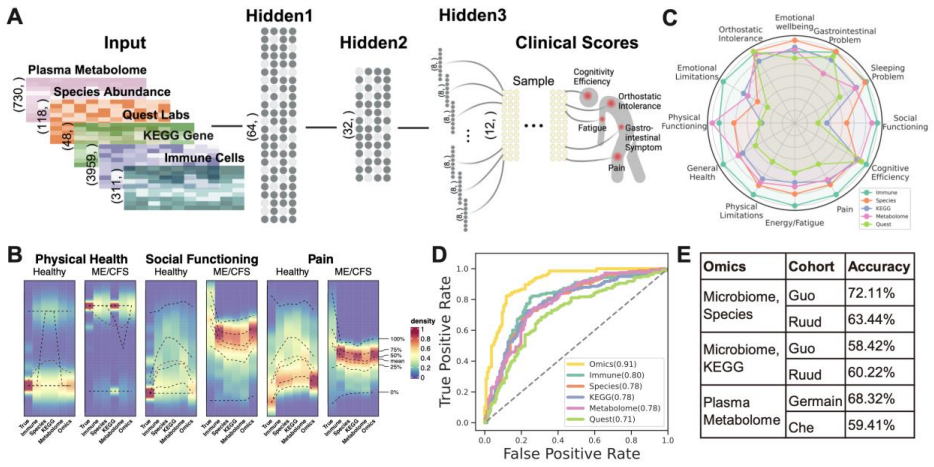
The central object is the BioMapAI architecture: a deep neural network whose hidden layers are split into two shared general-pattern layers and a third layer of parallel sub-networks, one per clinical outcome, so the model learns both disease-wide and symptom-specific representations. This design lets a single model map high-dimensional omics inputs to a mixed-type outcome matrix of 12 clinical scores, with loss functions chosen per outcome. Explainability comes from SHAP values computed on reconstructed per-symptom sub-models, and the connectivity map is built separately with WGCNA co-expression modules and Spearman correlations between modules across omics layers.
What would settle it
Re-run the five-fold cross-validation with all timepoints from each participant assigned to the same fold (grouped or leave-one-participant-out), and compare the AUC to the reported 91%. If the grouped AUC drops substantially toward chance, the in-cohort result is inflated by within-participant leakage rather than reflecting true disease classification.
Extended reading notes
Core claim
BioMapAI is a fully connected neural network with two shared hidden layers (64 and 32 nodes) followed by a parallel layer of 12 outcome-specific sub-networks, one per clinical score, with each output assigned its own loss function. Trained with five-fold cross-validation on five omics inputs, the network reconstructs the distribution of the twelve symptom scores and, through an auxiliary classification layer, distinguishes ME/CFS from healthy controls with 91% AUC using integrated multi-omics. Immune profiling is the strongest single modality (80% AUC), followed by KEGG gene abundance (78%) and blood measures (71%). In external cohorts, BioMapAI outperforms GBDT and a standard DNN, supporting the paper's claim that connecting omics to symptoms improves generalizability. The paper further identifies shared disease-specific biomarkers (e.g., increased B cells and CD4 naive T cells, Dysosmobacter welbionis, bile acid changes) and symptom-specific biomarkers (e.g., Faecalibacterium prausnitzii showing a biphasic relationship with pain), and describes how healthy microbiome-immune-metabolome networks, including butyrate, BCAA, and tryptophan pathways, become dysbiotic in patients.
Load-bearing premise
The headline 91% AUC assumes that repeated samples from the same participant are effectively independent, so that five-fold cross-validation without participant-level grouping does not let the model memorize patient-specific signatures and inflate performance.
Editorial extensions
If this is right
- Multi-omics profiles can reconstruct the twelve clinical symptom scores well enough that predicted scores serve as a disease classifier with 91% AUC.
- Immune profiling is the most informative single modality for most symptoms, while the gut microbiome is the best predictor of gastrointestinal, emotional, and sleep scores.
- The model's architecture and SHAP decoding separate disease-specific from symptom-specific biomarkers, enabling per-symptom biomarker discovery in heterogeneous chronic disease.
- Healthy microbiome-immune-metabolome networks are established as a baseline, and their dysregulation in ME/CFS—loss of butyrate and BCAA interactions, gain of inflammatory gamma-delta T and MAIT cell connections—points to testable targets for intervention.
- The same framework is portable to other heterogeneous chronic conditions, including long COVID, by swapping the input omics matrix and the output symptom matrix.
Reading between the lines
- If the 91% AUC survives participant-grouped cross-validation, the strongest immediate use is not diagnosis but patient stratification: predicted symptom scores could guide personalized symptom management even without a biomarker-based diagnostic test.
- The multi-task architecture suggests a general recipe for other omics studies of heterogeneous disease: predicting the full symptom vector rather than a single label may yield richer biomarkers and better external generalizability—an effect that could be tested on public single-cohort datasets.
- The reported loss of butyrate/BCAA interactions with regulatory T cells implies a concrete experiment: short-term butyrate or BCAA supplementation in a small ME/CFS cohort should shift the SHAP-predicted pain, GI, and fatigue scores if the connectivity map reflects causal biology.
- The absence of strong temporal signals over 3-4 years may indicate that baseline omics capture a stable trait-like disease state; testing this requires longer follow-up or event-based modeling of symptom flares rather than yearly averages.
Editorial analysis
A structured set of objections, weighed in public.
Referee Report
Summary. The thesis chapter presents a longitudinal multi-omics cohort study of ME/CFS (153 patients, 96 healthy controls, 515 timepoints) and introduces BioMapAI, an explainable multi-task deep neural network that maps omics matrices to 12 clinical symptom scores and then uses the predicted scores for binary disease classification. The paper claims that omics-derived predicted scores achieve a 91% AUC in distinguishing ME/CFS patients from healthy controls within the cohort, that BioMapAI outperforms LR, SVM, GDBT, and a standard DNN, and that it validates on four external cohorts with accuracies between 58% and 72%. The authors further use WGCNA and SHAP to identify disease- and symptom-specific biomarkers and to construct microbiome-immune-metabolome interaction networks, proposing mechanistic hypotheses involving butyrate, BCAA, tryptophan, benzoate, and mucosal immune cells.
Significance. If the central performance claims were established, the work would be valuable: the longitudinal multi-omics dataset is rich, the multi-output neural architecture is a sensible response to disease heterogeneity, the code and trained models are promised on GitHub, and the external cohort attempts go beyond most single-cohort studies. The confounder analyses (MaAsLin2, residual adjustment for immune and metabolome data) and the use of SHAP for interpretability are concrete strengths. However, the headline 91% AUC and the claimed superiority over baselines rest on a cross-validation procedure that is not shown to be participant-stratified in a repeated-measures design, and the external validation is quantitatively weak, with several accuracies near chance and feature overlaps as low as 19%. The microbial metabolite inference in Chapter 1 also has a circularity concern. These issues are load-bearing for the central claims, so the manuscript needs substantive revision before its main conclusions can be accepted.
major comments (3)
- [Chapter 2, Methods, 'Cross-Validation and Model Training'] The five-fold cross-validation used to produce the 91% AUC is described only as 'a robust 5-fold cross-validation' in the main text and in the Methods section. The cohort contains 515 timepoints from 249 participants, so repeated samples from the same individual are almost certainly present in multiple folds if splitting is performed on samples rather than on participants. Because both the omics features and the 12 clinical scores are strongly person-specific, sample-level folds allow the model to memorize patient identity, inflating the symptom reconstruction accuracy and hence the downstream binary classification AUC of the optional ScoreLayer. The Discussion acknowledges that the model was 'trained on < 500 samples with fivefold cross-validation' without stating that folds were grouped by participant. The authors must either demonstrate that cross-validation was stratified by participant (e.g., groupKFold) or re-run the entire evaluation with participant-level splitting and report the resulting AUCs and baseline comparisons. Without this, the central 'state-of-the-art precision' claim is not established.
- [Chapter 2, Results, 'External Validation' and Methods, 'External Validation with Independent Dataset'] The external validation protocol zero-imputes all missing features to align external datasets to the BioMapAI feature set. With the Che metabolome cohort featuring only 19% feature overlap, and the Germain cohort 79%, the test effectively runs the model on matrices that are mostly zeros, which can attenuate performance in either direction and makes the reported accuracies (59% and 68%) difficult to interpret. Moreover, the claim that 'BioMapAI significantly surpassed GDBT and DNN in external cohort validation' is not supported by any statistical test, confidence interval, or repeated subsampling of the external data; the accuracies of 58-72% are also close to chance for a binary classification. The authors should report the external validation with only overlapping features (or a principled imputation), include uncertainty estimates, and test whether the difference from baselines is statistically significant.
- [Chapter 1, Methods, 'Gut metabolic status prediction' and Results, 'Gut and plasma butyrate is reduced in early-stage…] The MCMC-based inference of gut isobutyrate (Figure 6B) accepts simulation steps only when the simulated growth rate correlates with the metagenomic species abundance profile (Pearson ρ > 0.6). This means the predicted gut metabolome is not independent of the species abundance differences used to define the patient groups. The subsequent claim that 'inferred concentrations of isobutyrate were significantly decreased in ME/CFS' is therefore not an independent confirmation of reduced gut butyrate; it is a re-statement of the species-level differences already used to calibrate the simulation. The authors should either present the species-abundance-based result as the primary evidence, or recalibrate the MCMC without the abundance-correlation acceptance criterion and show that the predicted butyrate difference still holds.
minor comments (3)
- [Chapter 2, Methods, 'BioMapAI'] The learning rate is stated as 0.01 in the initial description ('The learning rate was set to 0.01') and then as 0.0005 in the 'Cross-Validation and Model Training' section ('a learning rate of 0.0005, optimized through grid search'). Please clarify which value was used for the reported models or describe the grid search that led to the final choice.
- [Chapter 2, Figure 2E] The external validation bar chart reports accuracies without error bars or sample sizes per cohort in the main figure. Adding bootstrapped confidence intervals and the number of test samples would make the comparison with baselines interpretable.
- [General] There are several typos and formatting inconsistencies, for example 'intergrading' in Chapter 1 ('our 'omics workflows could be one of the guiding frameworks to intergrading'), 'in the in the TissueLyser' in Chapter 2 Methods, and the inconsistent use of 'GDBT' versus 'GBDT' across the thesis. A careful proofread is needed.
Circularity Check
Inferred gut isobutyrate is constrained to match the metagenomic species profile that already showed butyrate depletion; the central BioMapAI classification claim is not circular.
-
fitted input called prediction
[Chapter 1 Methods, 'Gut metabolic status prediction'; reported in Results, 'Gut and plasma butyrate is reduced in early-stage disease and is associated with host abnormal physiology']
"In each step, we sampled one metabolite and used the Flux balance analysis to model reaction flux with a slight change of the target metabolites and accepted the step only if the probed growth rate is correlated with the species relative abundance. Samples were first subjected to 100,000 search steps, and 100,000 steps were subsequently added until a high Pearson correlation (ρ > 0.6) with the target metagenomic abundance profile was achieved."
The MCMC metabolite 'prediction' is accepted only when the simulated biomass profile correlates with the observed species relative abundance at ρ > 0.6, and the final output averages the iterations with the highest such correlation. The inferred gut isobutyrate is therefore constructed to track the metagenomic species profile. Because the same species profile already showed depletion of butyrate producers (e.g., Roseburia, F. prausnitzii) and butanoate-pathway genes in ME/CFS, the reported decrease in predicted isobutyrate is not an independent measurement; it is a transformed restatement of the input species differences.
full rationale
The main BioMapAI derivation chain in Chapter 2 is self-contained: omics matrices are inputs, twelve clinical scores are predicted by a neural network, and an auxiliary layer maps the predicted scores to a binary disease label. The reported 91% AUC is a genuine supervised-learning evaluation, not an identity with the inputs, though the lack of participant-level grouping in the stated five-fold cross-validation is a correctness risk rather than a circularity. External validation with zero-imputed missing features is a methodological hazard but does not reduce to the model's own inputs by definition. The one circularity-adjacent step is the Chapter 1 MCMC gut-metabolite inference, whose acceptance criterion forces correlation with the species abundance profile, so its group comparison is partly forced by construction. Because this inferred metabolite is a supporting element of the butyrate story rather than the basis of the state-of-the-art classification claim, the overall circularity is partial and localized rather than a collapse of the central derivation.
Assumptions & free parameters
free parameters (5)
- BioMapAI hyperparameters (nodes 64/32/8, dropout 0.5, L2 lambda=0.008, learning rate 0.0005, 500 epochs) =
64/32/8 nodes, 0.5 dropout, 0.008 L2, 5e-4 learning rate, 500 epochs
- Disease-specific biomarker cutoff =
75%
- WGCNA soft-thresholding powers =
species=6, KEGG=7, immune=5, metabolome=6
- MAMBO MCMC acceptance threshold =
Pearson rho > 0.6
- Feature prevalence filters =
species avg rel abundance > 1e-4; genes prevalence > 20%; metabolites present in > 50% samples
assumptions (5)
- domain assumption The 12 clinical scores derived from questionnaires and clinical tests fully capture the relevant ME/CFS phenotype space.
- domain assumption Cross-sectional short-term versus long-term cohorts can stand in for disease progression.
- domain assumption MAMBO and MCMC produce valid estimates of gut metabolite concentrations from metagenomes without matched fecal metabolomics.
- ad hoc to paper Zero-imputation of unmeasured features preserves cross-cohort comparability in external validation.
- ad hoc to paper Repeated samples from the same participant can be treated as independent in five-fold cross-validation.
Cite this review
Pith. "Pith review of Advancing Digital Precision Medicine for Chronic Fatigue Syndrome through Longitudinal Large-Scale Multi-Modal Biological Omics Modeling with Machine Learning and Artificial Intelligence." pith.science (2026). https://pith.science/paper/JU7PTNRM
@misc{pith2026250615761,
  author       = {Pith},
  title        = {Pith review of: Advancing Digital Precision Medicine for Chronic Fatigue Syndrome through Longitudinal Large-Scale Multi-Modal Biological Omics Modeling with Machine Learning and Artificial Intelligence},
  year         = {2026},
  howpublished = {\url{https://pith.science/paper/JU7PTNRM}},
  note         = {Machine review of arXiv:2506.15761}
}
read the original abstract
We studied a generalized question: chronic diseases like ME/CFS and long COVID exhibit high heterogeneity with multifactorial etiology and progression, complicating diagnosis and treatment. To address this, we developed BioMapAI, an explainable Deep Learning framework using the richest longitudinal multi-omics dataset for ME/CFS to date. This dataset includes gut metagenomics, plasma metabolome, immune profiling, blood labs, and clinical symptoms. By connecting multi-omics to a symptom matrix, BioMapAI identified both disease- and symptom-specific biomarkers, reconstructed symptoms, and achieved state-of-the-art precision in disease classification. We also created the first connectivity map of these omics in both healthy and disease states and revealed how microbiome-immune-metabolome crosstalk shifted from healthy to ME/CFS.
Figures


Figures from the paper (13 more)




Reference graph
Works this paper leans on
-
[1]
& Buchwald, D
Afari, N. & Buchwald, D. Chronic fatigue syndrome: a review. Am. J. Psychiatry 160, 221–236 (2003)
2003
-
[2]
Nacul, L. et al. How Myalgic Encephalomyelitis/Chronic Fatigue Syndrome (ME/CFS) Progresses: The Natural History of ME/CFS. Front. Neurol. 11, 826 (2020)
2020
-
[3]
T., Komaroff, A
Holgate, S. T., Komaroff, A. L., Mangan, D. & Wessely, S. Chronic fatigue syndrome: understanding a complex illness. Nat. Rev. Neurosci. 12, 539–544 (2011)
2011
-
[4]
Bested, A. C. & Marshall, L. M. Review of Myalgic Encephalomyelitis/Chronic Fatigue Syndrome: an evidence-based approach to diagnosis and management by clinicians. Rev. Environ. Health 30, 223–249 (2015)
2015
-
[5]
Pheby, D. F. H. et al. A Literature Review of GP Knowledge and Understanding of ME/CFS: A Report from the Socioeconomic Working Group of the European Network on ME/CFS (EUROMENE). Medicina (Mex.) 57, 7 (2021)
2021
-
[6]
Naviaux, R. K. et al. Metabolic features of chronic fatigue syndrome. Proc. Natl. Acad. Sci. 113, E5472–E5480 (2016)
2016
-
[7]
& Carding, S
Navaneetharaja, N., Griffiths, V., Wileman, T. & Carding, S. R. A Role for the Intestinal Microbiota and Virome in Myalgic Encephalomyelitis/Chronic Fatigue Syndrome (ME/CFS)? J. Clin. Med. 5, E55 (2016)
2016
-
[8]
Sheedy, J. R. et al. Increased d-lactic Acid intestinal bacteria in patients with chronic fatigue syndrome. Vivo Athens Greece 23, 621–628 (2009). 117
2009
Show all 202 references
-
[9]
& De Meirleir, K
Frémont, M., Coomans, D., Massart, S. & De Meirleir, K. High-throughput 16S rRNA gene sequencing reveals alterations of intestinal microbiota in myalgic encephalomyelitis/chronic fatigue syndrome patients. Anaerobe 22, 50–56 (2013)
2013
-
[10]
Shukla, S. K. et al. Changes in Gut and Plasma Microbiome following Exercise Challenge in Myalgic Encephalomyelitis/Chronic Fatigue Syndrome (ME/CFS). PloS One 10, e0145453 (2015)
2015
-
[11]
Giloteaux, L. et al. Reduced diversity and altered composition of the gut microbiome in individuals with myalgic encephalomyelitis/chronic fatigue syndrome. Microbiome 4, 30 (2016)
2016
-
[12]
Giloteaux, L., Hanson, M. R. & Keller, B. A. A Pair of Identical Twins Discordant for Myalgic Encephalomyelitis/Chronic Fatigue Syndrome Differ in Physiological Parameters and Gut Microbiome Composition. Am. J. Case Rep. 17, 720–729 (2016)
2016
-
[13]
Nagy-Szakal, D. et al. Fecal metagenomic profiles in subgroups of patients with myalgic encephalomyelitis/chronic fatigue syndrome. Microbiome 5, 44 (2017)
2017
-
[14]
Visconti, A. et al. Interplay between the human gut microbiome and host metabolism. Nat. Commun. 10, 4505 (2019)
2019
-
[15]
Wikoff, W. R. et al. Metabolomics analysis reveals large effects of gut microflora on mammalian blood metabolites. Proc. Natl. Acad. Sci. 106, 3698–3703 (2009)
2009
-
[16]
Turnbaugh, P. J. et al. An obesity-associated gut microbiome with increased capacity for energy harvest. Nature 444, 1027–1031 (2006)
2006
-
[17]
V., Littman, D
Hooper, L. V., Littman, D. R. & Macpherson, A. J. Interactions Between the Microbiota and the Immune System. Science 336, 1268–1273 (2012). 118
2012
-
[18]
Nicholson, J. K. et al. Host-gut microbiota metabolic interactions. Science 336, 1262– 1267 (2012)
2012
-
[19]
M., Walter, J., Segal, E
Valdes, A. M., Walter, J., Segal, E. & Spector, T. D. Role of the gut microbiota in nutrition and health. BMJ 361, k2179 (2018)
2018
-
[20]
L., Vieira, A., Sato, F
Corrêa-Oliveira, R., Fachi, J. L., Vieira, A., Sato, F. T. & Vinolo, M. A. R. Regulation of immune cell function by short-chain fatty acids. Clin. Transl. Immunol. 5, e73 (2016)
2016
-
[21]
& Distrutti, E
Fiorucci, S., Biagioli, M., Zampella, A. & Distrutti, E. Bile Acids Activated Receptors Regulate Innate Immunity. Front. Immunol. 9, 1853 (2018)
2018
-
[22]
Sorgdrager, F. J. H., Naudé, P. J. W., Kema, I. P., Nollen, E. A. & Deyn, P. P. D. Tryptophan Metabolism in Inflammaging: From Biomarker to Therapeutic Target. Front. Immunol. 10, 2565 (2019)
2019
-
[23]
Bellono, N. W. et al. Enterochromaffin Cells Are Gut Chemosensors that Couple to Sensory Neural Pathways. Cell 170, 185-198.e16 (2017)
2017
-
[24]
Bian, X. et al. The artificial sweetener acesulfame potassium affects the gut microbiome and body weight gain in CD-1 mice. PLOS ONE 12, e0178426 (2017)
2017
-
[26]
S., Kumar, S., Mohanty, A
Singh, K. S., Kumar, S., Mohanty, A. K., Grover, S. & Kaushik, J. K. Mechanistic insights into the host-microbe interaction and pathogen exclusion mediated by the Mucus- binding protein of Lactobacillus plantarum. Sci. Rep. 8, 14198 (2018). 119
2018
-
[27]
Xu, L., Sun, L., Zhang, S., Wang, S. & Lu, M. High-Resolution Profiling of Gut Bacterial Communities in an Invasive Beetle using PacBio SMRT Sequencing System. Insects 10, E248 (2019)
2019
-
[28]
P., Eng, A
Noecker, C., McNally, C. P., Eng, A. & Borenstein, E. High-Resolution Characterization of the Human Microbiome. Transl. Res. J. Lab. Clin. Med. 179, 7–23 (2017)
2017
-
[29]
McHardy, I. H. et al. Integrative analysis of the microbiome and metabolome of the human intestinal mucosal surface reveals exquisite inter-relationships. Microbiome 1, 17 (2013)
2013
-
[30]
H., Tung, M
de Mel, S., Lim, S. H., Tung, M. L. & Chng, W.-J. Implications of Heterogeneity in Multiple Myeloma. BioMed Res. Int. 2014, 232546 (2014)
2014
-
[31]
Wallstrom, G., Anderson, K. S. & LaBaer, J. Biomarker Discovery for Heterogeneous Diseases
-
[32]
M., McCarthy, T
Weyand, C. M., McCarthy, T. G. & Goronzy, J. J. Correlation between disease phenotype and genetic heterogeneity in rheumatoid arthritis. J. Clin. Invest. 95, 2120–2126 (1995)
1995
-
[33]
Xiong, R. et al. Multi-‘omics of gut microbiome-host interactions in short- and long- term myalgic encephalomyelitis/chronic fatigue syndrome patients. Cell Host Microbe 31, 273-287.e5 (2023)
2023
-
[34]
& Orr-Urtreger, A
Giladi, N., Mirelman, A., Thaler, A. & Orr-Urtreger, A. A Personalized Approach to Parkinson’s Disease Patients Based on Founder Mutation Analysis. Front. Neurol. 7, (2016). 120
2016
-
[35]
Brown, S. M. et al. Consistent Effects of Early Remdesivir on Symptoms and Disease Progression Across At-Risk Outpatient Subgroups: Treatment Effect Heterogeneity in PINETREE Study. Infect. Dis. Ther. 12, 1189–1203 (2023)
2023
-
[36]
& Sano, H
Iwasaki, T. & Sano, H. Predicting Treatment Responses and Disease Progression in Myeloma using Serum Vascular Endothelial Growth Factor and Hepatocyte Growth Factor Levels. Leuk. Lymphoma 44, 1275–1279 (2003)
2003
-
[37]
J., LaGree, T
Hare, P. J., LaGree, T. J., Byrd, B. A., DeMarco, A. M. & Mok, W. W. K. Single-Cell Technologies to Study Phenotypic Heterogeneity and Bacterial Persisters. Microorganisms 9, 2277 (2021)
2021
-
[38]
M., Haggerty, S
Cohen, R. M., Haggerty, S. & Herman, W. H. HbA1c for the Diagnosis of Diabetes and Prediabetes: Is It Time for a Mid-Course Correction? J. Clin. Endocrinol. Metab. 95, 5203–5206 (2010)
2010
-
[39]
Zhou, W. et al. Longitudinal multi-omics of host–microbe dynamics in prediabetes. Nature 569, 663–671 (2019)
2019
-
[40]
Hong, S. et al. Cancer Statistics in Korea: Incidence, Mortality, Survival, and Prevalence in 2017. Cancer Res. Treat. 52, 335–350 (2020)
2020
-
[41]
Zeeshan, S., Xiong, R., Liang, B. T. & Ahmed, Z. 100 years of evolving gene–disease complexities and scientific debutants. Brief. Bioinform. 21, 885–905 (2020)
2020
-
[42]
T., Arcos-Burgos, M
Cortes Rivera, M., Mastronardi, C., Silva-Aldana, C. T., Arcos-Burgos, M. & Lidbury, B. A. Myalgic Encephalomyelitis/Chronic Fatigue Syndrome: A Comprehensive Review. Diagnostics 9, 91 (2019). 121
2019
-
[43]
Sweetman, E. et al. Current Research Provides Insight into the Biological Basis and Diagnostic Potential for Myalgic Encephalomyelitis/Chronic Fatigue Syndrome (ME/CFS). Diagnostics 9, 73 (2019)
2019
-
[44]
Noor, N. et al. A Comprehensive Update of the Current Understanding of Chronic Fatigue Syndrome. Anesthesiol. Pain Med. 11, e113629 (2021)
2021
-
[45]
& Zabaleta, A
Ruiz-Pablos, M., Paiva, B., Montero-Mateo, R., Garcia, N. & Zabaleta, A. Epstein-Barr Virus and the Origin of Myalgic Encephalomyelitis or Chronic Fatigue Syndrome. Front. Immunol. 12, 656797 (2021)
2021
-
[46]
Su, R. et al. The TLR3/IRF1/Type III IFN Axis Facilitates Antiviral Responses against Enterovirus Infections in the Intestine. mBio 11, 10.1128/mbio.02540-20 (2020)
2020 doi
-
[47]
Anderson, D. E. et al. Lack of cross-neutralization by SARS patient sera towards SARS- CoV-2. Emerg. Microbes Infect. 9, 900–902 (2020)
2020
-
[48]
J., Corrales-Medina, V
Poenaru, S., Abdallah, S. J., Corrales-Medina, V. & Cowan, J. COVID-19 and post- infectious myalgic encephalomyelitis/chronic fatigue syndrome: a narrative review. Ther. Adv. Infect. Dis. 8, 20499361211009385 (2021)
2021
-
[49]
Reuken, P. A. et al. Longterm course of neuropsychological symptoms and ME/CFS after SARS-CoV-2-infection: a prospective registry study. Eur. Arch. Psychiatry Clin. Neurosci. (2023) doi:10.1007/s00406-023-01661-3
2023 doi
-
[50]
Lim, E.-J. et al. Systematic review and meta-analysis of the prevalence of chronic fatigue syndrome/myalgic encephalomyelitis (CFS/ME). J. Transl. Med. 18, 100 (2020). 122
2020
-
[51]
Shikova, E. et al. Cytomegalovirus, Epstein-Barr virus, and human herpesvirus-6 infections in patients with myalgic еncephalomyelitis/chronic fatigue syndrome. J. Med. Virol. (2020) doi:10.1002/jmv.25744
2020 doi
-
[52]
Clmc, van C., Fwa, V., Pc, R. & Fc, V. Cerebral blood flow is reduced in ME/CFS during head-up tilt testing even in the absence of hypotension or tachycardia: A quantitative, controlled study using Doppler echography. Clin. Neurophysiol. Pract. 5, (2020)
2020
-
[53]
& De Meirleir, K
De Becker, P., McGregor, N. & De Meirleir, K. A definition-based analysis of symptoms in a large cohort of patients with chronic fatigue syndrome. J. Intern. Med. 250, 234– 240 (2001)
2001
-
[54]
Roma, M. et al. Impaired Health-Related Quality of Life in Adolescent Myalgic Encephalomyelitis/Chronic Fatigue Syndrome: The Impact of Core Symptoms. Front. Pediatr. 7, 26 (2019)
2019
-
[55]
J., Oh, J., Robison, J., Grady, J
Larson, P. J., Oh, J., Robison, J., Grady, J. & Kuchel, G. 1206. Association of Aging, Frailty and Place of Residence with Skin, Oral and Gut Microbiome Characteristics and Pathogenicity Reservoirs. Open Forum Infect. Dis. 7, S625 (2020)
2020
-
[56]
Larson, P. J. et al. Associations of the skin, oral and gut microbiome with aging, frailty and infection risk reservoirs in older adults. Nat. Aging 2, 941–955 (2022)
2022
-
[57]
& Hugot, J
Mosca, A., Leclerc, M. & Hugot, J. P. Gut Microbiota Diversity and Human Diseases: Should We Reintroduce Key Predators in Our Ecosystem? Front. Microbiol. 7, 455 (2016)
2016
-
[58]
A biodiversity hypothesis
Haahtela, T. A biodiversity hypothesis. Allergy 74, 1445–1456 (2019). 123
2019
-
[59]
Behary, J. et al. Gut microbiota impact on the peripheral immune response in non- alcoholic fatty liver disease related hepatocellular carcinoma. Nat. Commun. 12, 187 (2021)
2021
-
[60]
M., Sun, E
Martin, A. M., Sun, E. W., Rogers, G. B. & Keating, D. J. The Influence of the Gut Microbiome on Host Metabolism Through the Regulation of Gut Hormone Release. Front. Physiol. 10, 428 (2019)
2019
-
[61]
Muñiz Pedrogo, D. A. et al. An Increased Abundance of Clostridiaceae Characterizes Arthritis in Inflammatory Bowel Disease and Rheumatoid Arthritis: A Cross-sectional Study. Inflamm. Bowel Dis. 25, 902–913 (2019)
2019
-
[62]
Emiola, A. & Oh, J. High throughput in situ metagenomic measurement of bacterial replication at ultra-low sequencing coverage. Nat. Commun. 9, 4956 (2018)
2018
-
[63]
Canani, R. B. et al. Potential beneficial effects of butyrate in intestinal and extraintestinal diseases. World J. Gastroenterol. WJG 17, 1519–1528 (2011)
2011
-
[64]
Ferrer-Picón, E. et al. Intestinal Inflammation Modulates the Epithelial Response to Butyrate in Patients With Inflammatory Bowel Disease. Inflamm. Bowel Dis. 26, 43–55 (2020)
2020
-
[65]
& Van de Wiele, T
Hosseini, E., Grootaert, C., Verstraete, W. & Van de Wiele, T. Propionate as a health- promoting microbial metabolite in the human gut. Nutr. Rev. 69, 245–258 (2011)
2011
-
[66]
Tryptophan Dietary Impacts Gut Barrier and Metabolic Diseases
Taleb, S. Tryptophan Dietary Impacts Gut Barrier and Metabolic Diseases. Front. Immunol. 10, 2113 (2019)
2019
-
[67]
K., Jung, K
Go, E. K., Jung, K. J., Kim, J. Y., Yu, B. P. & Chung, H. Y. Betaine Suppresses Proinflammatory Signaling During Aging: The Involvement of Nuclear Factor-κB via 124 Nuclear Factor-Inducing Kinase/IκB Kinase and Mitogen-Activated Protein Kinases. J. Gerontol. Ser. A 60, 1252–12...
2005
-
[68]
Zhao, G. et al. Betaine in Inflammation: Mechanistic Aspects and Applications. Front. Immunol. 9, 1070 (2018)
2018
-
[70]
Nkiliza, A. et al. Sex-specific plasma lipid profiles of ME/CFS patients and their association with pain, fatigue, and cognitive symptoms. J. Transl. Med. 19, 370 (2021)
2021
-
[71]
Noda, M., Ifuku, M., Hossain, Md. S. & Katafuchi, T. Glial Activation and Expression of the Serotonin Transporter in Chronic Fatigue Syndrome. Front. Psychiatry 9, 589 (2018)
2018
-
[72]
Guo, P., Zhang, K., Ma, X. & He, P. Clostridium species as probiotics: potentials and challenges. J. Anim. Sci. Biotechnol. 11, 24 (2020)
2020
-
[73]
Brkic, S., Tomic, S., Maric, D., Mikic, A. N. & Turkulov, V. Lipid peroxidation is elevated in female patients with chronic fatigue syndrome. Med. Sci. Monit. 16, CR628–CR632 (2010)
2010
-
[74]
& Mikic, A
Tomic, S., Brkic, S., Maric, D. & Mikic, A. N. Lipid and protein oxidation in female patients with chronic fatigue syndrome. Arch. Med. Sci. AMS 8, 886–891 (2012)
2012
-
[75]
Low T3 Syndrome
Ruiz-Núñez, B., Tarasse, R., Vogelaar, E. F., Janneke Dijck-Brouwer, D. A. & Muskiet, F. A. J. Higher Prevalence of “Low T3 Syndrome” in Patients With Chronic Fatigue Syndrome: A Case–Control Study. Front. Endocrinol. 9, 97 (2018). 125
2018
-
[76]
& Evans, M
Flores, S., Brown, A., Adeoye, S., Jason, L. & Evans, M. Examining the Impact of Obesity on Individuals with CFS. Workplace Health Saf. 61, 299–307 (2013)
2013
-
[77]
Germain, A., Ruppert, D., Levine, S. M. & Hanson, M. R. Prospective Biomarkers from Plasma Metabolomics of Myalgic Encephalomyelitis/Chronic Fatigue Syndrome Implicate Redox Imbalance in Disease Symptomatology. Metabolites 8, 90 (2018)
2018
-
[78]
Lakhan, S. E. & Kirchgessner, A. Gut inflammation in chronic fatigue syndrome. Nutr. Metab. 7, 79 (2010)
2010
-
[79]
Jackson, M. L. & Bruck, D. Sleep Abnormalities in Chronic Fatigue Syndrome/Myalgic Encephalomyelitis: A Review. J. Clin. Sleep Med. JCSM Off. Publ. Am. Acad. Sleep Med. 8, 719–728 (2012)
2012
-
[80]
Boneva, R. S. et al. Endometriosis as a Comorbid Condition in Chronic Fatigue Syndrome (CFS): Secondary Analysis of Data From a CFS Case-Control Study. Front. Pediatr. 7, 195 (2019)
2019
-
[81]
W., Young, W
Pataky, M. W., Young, W. F. & Nair, K. S. Hormonal and Metabolic Changes of Aging and the Influence of Lifestyle Modifications. Mayo Clin. Proc. 96, 788–814 (2021)
2021
-
[82]
& Kozak, Leslie
Jura, M. & Kozak, Leslie. P. Obesity and related consequences to ageing. Age 38, 23 (2016)
2016
-
[83]
Natelson, B. H. Myalgic Encephalomyelitis/Chronic Fatigue Syndrome and Fibromyalgia: Definitions, Similarities and Differences. Clin. Ther. 41, 612–618 (2019)
2019
-
[84]
Harris, S. et al. A qualitative investigation of eating difficulties in adolescents with chronic fatigue syndrome/myalgic encephalomyelitis. Clin. Child Psychol. Psychiatry 22, 128–139 (2017). 126
2017
-
[85]
Donohoe, D. R. et al. The Microbiome and Butyrate Regulate Energy Metabolism and Autophagy in the Mammalian Colon. Cell Metab. 13, 517–526 (2011)
2011
-
[86]
Müller, M. et al. Circulating but not faecal short-chain fatty acids are related to insulin sensitivity, lipolysis and GLP-1 concentrations in humans. Sci. Rep. 9, 12515 (2019)
2019
-
[87]
Guo, C. et al. Deficient butyrate-producing capacity in the gut microbiome of Myalgic Encephalomyelitis/Chronic Fatigue Syndrome patients is associated with fatigue symptoms. 2021.10.27.21265575 Preprint at https://doi.org/10.1101/2021.10.27.21265575 (2021)
2021 doi
-
[88]
& Marshall, T
Proal, A. & Marshall, T. Myalgic Encephalomyelitis/Chronic Fatigue Syndrome in the Era of the Human Microbiome: Persistent Pathogens Drive Chronic Symptoms by Interfering With Host Metabolism, Gene Expression, and Immunity. Front. Pediatr. 6, 373 (2018)
2018
-
[89]
Lupo, G. F. D. et al. Potential role of microbiome in Chronic Fatigue Syndrome/Myalgic Encephalomyelits (CFS/ME). Sci. Rep. 11, 7043 (2021)
2021
-
[90]
Sanchez-Morate, E. et al. Relationship between Diet, Microbiota, and Healthy Aging. Biomedicines 8, 287 (2020)
2020
-
[91]
Fromentin, S. et al. Microbiome and metabolome features of the cardiometabolic disease spectrum. Nat. Med. 28, 303–314 (2022)
2022
-
[92]
Karhan, E. et al. Perturbation of Effector and Regulatory T Cell Subsets in Myalgic Encephalomyelitis/Chronic Fatigue Syndrome (ME/CFS). 2019.12.23.887505 https://www.biorxiv.org/content/10.1101/2019.12.23.887505v1 (2019) doi:10.1101/2019.12.23.887505. 127
2019 doi
-
[93]
Russell, L. et al. Illness progression in chronic fatigue syndrome: a shifting immune baseline. BMC Immunol. 17, 3 (2016)
2016
-
[94]
Bar, N. et al. A reference map of potential determinants for the human serum metabolome. Nature 588, 135–140 (2020)
2020
-
[95]
Yancey, J. R. & Thomas, S. M. Chronic fatigue syndrome: diagnosis and treatment. Am. Fam. Physician 86, 741–746 (2012)
2012
-
[96]
Hickie, I. et al. Post-infective and chronic fatigue syndromes precipitated by viral and non-viral pathogens: prospective cohort study. BMJ 333, 575 (2006)
2006
-
[97]
Pendergrast, T. et al. Housebound versus nonhousebound patients with myalgic encephalomyelitis and chronic fatigue syndrome. Chronic Illn. 12, 292–307 (2016)
2016
-
[98]
Komaroff, A. L. & Bateman, L. Will COVID-19 Lead to Myalgic Encephalomyelitis/Chronic Fatigue Syndrome? Front. Med. 7, 1132 (2021)
2021
-
[99]
Fukuda, K. et al. The chronic fatigue syndrome: a comprehensive approach to its definition and study. International Chronic Fatigue Syndrome Study Group. Ann. Intern. Med. 121, 953–959 (1994)
1994
-
[100]
Carruthers, B. M. Definitions and aetiology of myalgic encephalomyelitis: how the Canadian consensus clinical definition of myalgic encephalomyelitis works. J. Clin. Pathol. 60, 117–119 (2007)
2007
-
[101]
Beyond Myalgic Encephalomyelitis/Chronic Fatigue Syndrome: Redefining an Illness
Committee on the Diagnostic Criteria for Myalgic Encephalomyelitis/Chronic Fatigue Syndrome, Board on the Health of Select Populations, & Institute of Medicine. Beyond Myalgic Encephalomyelitis/Chronic Fatigue Syndrome: Redefining an Illness. (National Academies Press (US), Wa...
2015
-
[102]
Beghini, F. et al. Integrating taxonomic, functional, and strain-level profiling of diverse microbial communities with bioBakery 3. eLife 10, e65088 (2021)
2021
-
[104]
I., Huber, W
Love, M. I., Huber, W. & Anders, S. Moderated estimation of fold change and dispersion for RNA-seq data with DESeq2. Genome Biol. 15, 550 (2014)
2014
-
[105]
R., van Verk, M
Garza, D. R., van Verk, M. C., Huynen, M. A. & Dutilh, B. E. Towards predicting the environmental metabolome from metagenomics with a mechanistic model. Nat. Microbiol. 3, 456–460 (2018)
2018
-
[106]
Mallick, H. et al. Multivariable association discovery in population-scale meta-omics studies. PLoS Comput. Biol. 17, e1009442 (2021)
2021
-
[107]
Bretherick, A. D. et al. Typing myalgic encephalomyelitis by infection at onset: A DecodeME study. NIHR Open Res. 3, 20 (2023)
2023
-
[108]
& Lin, J.-M
Bae, J. & Lin, J.-M. S. Healthcare Utilization in Myalgic Encephalomyelitis/Chronic Fatigue Syndrome (ME/CFS): Analysis of US Ambulatory Healthcare Data, 2000–2009. Front. Pediatr. 7, (2019)
2019
-
[109]
& Zhu, Z
Zheng, Y. & Zhu, Z. Editorial: Retrieving meaningful patterns from big biomedical data with machine learning approaches. Front. Genet. 14, (2023)
2023
-
[110]
Leelatian, N. et al. Unsupervised machine learning reveals risk stratifying glioblastoma tumor cells. eLife 9, e56879 (2020)
2020
-
[111]
Su, Q. et al. The gut microbiome associates with phenotypic manifestations of post- acute COVID-19 syndrome. Cell Host Microbe 32, 651-660.e4 (2024). 129
2024
-
[112]
R., van Goor, H., Faber, K
Bourgonje, A. R., van Goor, H., Faber, K. N. & Dijkstra, G. Clinical Value of Multiomics- Based Biomarker Signatures in Inflammatory Bowel Diseases: Challenges and Opportunities. Clin. Transl. Gastroenterol. 14, e00579 (2023)
2023
-
[113]
Marcos-Zambrano, L. J. et al. Applications of Machine Learning in Human Microbiome Studies: A Review on Feature Selection, Biomarker Identification, Disease Prediction and Treatment. Front. Microbiol. 12, (2021)
2021
-
[114]
Guo, C. et al. Deficient butyrate-producing capacity in the gut microbiome is associated with bacterial network disturbances and fatigue symptoms in ME/CFS. Cell Host Microbe 31, 288-304.e8 (2023)
2023
-
[115]
Raijmakers, R. P. H. et al. Multi-omics examination of Q fever fatigue syndrome identifies similarities with chronic fatigue syndrome. J. Transl. Med. 18, 448 (2020)
2020
-
[116]
Germain, A. et al. Plasma metabolomics reveals disrupted response and recovery following maximal exercise in myalgic encephalomyelitis/chronic fatigue syndrome. JCI Insight 7, (2023)
2023
-
[117]
Che, X. et al. Metabolomic Evidence for Peroxisomal Dysfunction in Myalgic Encephalomyelitis/Chronic Fatigue Syndrome. Int. J. Mol. Sci. 23, 7906 (2022)
2022
-
[118]
Liñares-Blanco, J., Fernandez-Lozano, C., Seoane, J. A. & López-Campos, G. Machine Learning Based Microbiome Signature to Predict Inflammatory Bowel Disease Subtypes. Front. Microbiol. 13, (2022)
2022
-
[119]
He, F. et al. Development and External Validation of Machine Learning Models for Diabetic Microvascular Complications: Cross-Sectional Study With Metabolites. J. Med. Internet Res. 26, e41065 (2024). 130
2024
-
[120]
Hawken, S. et al. External validation of machine learning models including newborn metabolomic markers for postnatal gestational age estimation in East and South-East Asian infants. Preprint at https://doi.org/10.12688/gatesopenres.13131.2 (2021)
2021 doi
-
[121]
& Claus, S
Mora-Ortiz, M., Trichard, M., Oregioni, A. & Claus, S. P. Thanatometabolomics: introducing NMR-based metabolomics to identify metabolic biomarkers of the time of death. Metabolomics 15, 37 (2019)
2019
-
[122]
Balasubramanian, R. et al. Metabolomic profiles associated with all-cause mortality in the Women’s Health Initiative. Int. J. Epidemiol. 49, 289–300 (2020)
2020
-
[123]
Li, H., Ren, M. & Li, Q. 1H NMR-Based Metabolomics Reveals the Intrinsic Interaction of Age, Plasma Signature Metabolites, and Nutrient Intake in the Longevity Population in Guangxi, China. Nutrients 14, 2539 (2022)
2022
-
[124]
& Kameda, M
Kondoh, H. & Kameda, M. Metabolites in aging and aging-relevant diseases: Frailty, sarcopenia and cognitive decline. Geriatr. Gerontol. Int. 24, 44–48 (2024)
2024
-
[125]
& Zhang, J
Peng, S., Shen, Y., Wang, M. & Zhang, J. Serum and CSF Metabolites in Stroke-Free Patients Are Associated With Vascular Risk Factors and Cognitive Performance. Front. Aging Neurosci. 12, (2020)
2020
-
[126]
Duerler, P., Vollenweider, F. X. & Preller, K. H. A neurobiological perspective on social influence: Serotonin and social adaptation. J. Neurochem. 162, 60–79 (2022)
2022
-
[127]
B., Paliarin, F
Pomrenze, M. B., Paliarin, F. & Maiya, R. Friend of the Devil: Negative Social Influences Driving Substance Use Disorders. Front. Behav. Neurosci. 16, (2022). 131
2022
-
[128]
Commentary on Bischof et al.: Empirical and conceptual paradigms for studying secondary impacts of a person’s substance use
Laslett, A.-M. Commentary on Bischof et al.: Empirical and conceptual paradigms for studying secondary impacts of a person’s substance use. Addiction 117, 3148–3149 (2022)
2022
-
[129]
Carco, C. et al. Increasing Evidence That Irritable Bowel Syndrome and Functional Gastrointestinal Disorders Have a Microbial Pathogenesis. Front. Cell. Infect. Microbiol. 10, (2020)
2020
-
[130]
Saffouri, G. B. et al. Small intestinal microbial dysbiosis underlies symptoms associated with functional gastrointestinal disorders. Nat. Commun. 10, 2012 (2019)
2019
-
[131]
& Jin, F
Liang, S., Wu, X., Hu, X., Wang, T. & Jin, F. Recognizing Depression from the Microbiota–Gut–Brain Axis. Int. J. Mol. Sci. 19, 1592 (2018)
2018
-
[132]
& Chen, T
Zhu, F., Tu, H. & Chen, T. The Microbiota–Gut–Brain Axis in Depression: The Potential Pathophysiological Mechanisms and Microbiota Combined Antidepression Effect. Nutrients 14, 2081 (2022)
2022
-
[133]
& Scott, S
Topan, R. & Scott, S. M. Sleep: An Overlooked Lifestyle Factor in Disorders of Gut- Brain Interaction. Curr. Treat. Options Gastroenterol. 21, 435–446 (2023)
2023
-
[134]
Moens de Hase, E. et al. Impact of metformin and Dysosmobacter welbionis on diet- induced obesity and diabetes: from clinical observation to preclinical intervention. Diabetologia 67, 333–345 (2024)
2024
-
[135]
O., Agbalalah, T
Amabebe, E., Robert, F. O., Agbalalah, T. & Orubu, E. S. F. Microbial dysbiosis- induced obesity: role of gut microbiota in homoeostasis of energy metabolism. Br. J. Nutr. 123, 1127–1137 (2020). 132
2020
-
[136]
Kavanagh, P. et al. Tentative identification of the phase I and II metabolites of two synthetic cathinones, MDPHP and α-PBP, in human urine. Drug Test. Anal. 12, 1442– 1451 (2020)
2020
-
[137]
Wang, J.-H. et al. Clinical evidence of the link between gut microbiome and myalgic encephalomyelitis/chronic fatigue syndrome: a retrospective review. Eur. J. Med. Res. 29, 148 (2024)
2024
-
[138]
Lenoir, M. et al. Butyrate mediates anti-inflammatory effects of Faecalibacterium prausnitzii in intestinal epithelial cells through Dact3. Gut Microbes (2020)
2020
-
[139]
Sokol, H. et al. Faecalibacterium prausnitzii is an anti-inflammatory commensal bacterium identified by gut microbiota analysis of Crohn disease patients. Proc. Natl. Acad. Sci. 105, 16731–16736 (2008)
2008
-
[140]
Quévrain, E. et al. Identification of an anti-inflammatory protein from Faecalibacterium prausnitzii, a commensal bacterium deficient in Crohn’s disease. Gut 65, 415–425 (2016)
2016
-
[141]
Miquel, S. et al. Identification of Metabolic Signatures Linked to Anti-Inflammatory Effects of Faecalibacterium prausnitzii. mBio 6, 10.1128/mbio.00300-15 (2015)
2015 doi
-
[142]
Vital, M., Howe, A. C. & Tiedje, J. M. Revealing the Bacterial Butyrate Synthesis Pathways by Analyzing (Meta)genomic Data. mBio 5, e00889-14 (2021)
2021
-
[143]
& Shi, X.-Z
Recharla, N., Geesala, R. & Shi, X.-Z. Gut Microbial Metabolite Butyrate and Its Therapeutic Role in Inflammatory Bowel Disease: A Literature Review. Nutrients 15, 2275 (2023). 133
2023
-
[144]
Monteiro, C. R. A. V. et al. In Vitro Antimicrobial Activity and Probiotic Potential of Bifidobacterium and Lactobacillus against Species of Clostridium. Nutrients 11, 448 (2019)
2019
-
[145]
& Deng, Y
Zhao, M., Li, G. & Deng, Y. Engineering Escherichia coli for Glutarate Production as the C5 Platform Backbone. Appl. Environ. Microbiol. 84, e00814-18 (2018)
2018
-
[146]
T., Selzner, N., Wrana, J
Nguyen-Lefebvre, A. T., Selzner, N., Wrana, J. L. & Bhat, M. The hippo pathway: A master regulator of liver metabolism, regeneration, and disease. FASEB J. 35, e21570 (2021)
2021
-
[147]
A., Gupta, A., Sastry, J
Khan, M. A., Gupta, A., Sastry, J. L. N. & Ahmad, S. Hepatoprotective potential of kumaryasava and its concentrate against CCl4-induced hepatic toxicity in Wistar rats. J. Pharm. Bioallied Sci. 7, 297–299 (2015)
2015
-
[148]
Roles of Diet-Associated Gut Microbial Metabolites on Brain Health: Cell- to-Cell Interactions between Gut Bacteria and the Central Nervous System
Kim, C.-S. Roles of Diet-Associated Gut Microbial Metabolites on Brain Health: Cell- to-Cell Interactions between Gut Bacteria and the Central Nervous System. Adv. Nutr. 15, 100136 (2024)
2024
-
[149]
& Pot, C
Rebeaud, J., Peter, B. & Pot, C. How Microbiota-Derived Metabolites Link the Gut to the Brain during Neuroinflammation. Int. J. Mol. Sci. 23, 10128 (2022)
2022
-
[150]
Ahmad, S. et al. Gut microbiome-related metabolites in plasma are associated with general cognition. Alzheimers Dement. 17, e056142 (2021)
2021
-
[151]
L., Bleiberg, J., Vice, J
Lathan, C., Spira, J. L., Bleiberg, J., Vice, J. & Tsao, J. W. Defense Automated Neurobehavioral Assessment (DANA)-psychometric properties of a new field- deployable neurocognitive assessment tool. Mil. Med. 178, 365–371 (2013). 134
2013
-
[152]
Resnick, H. E. & Lathan, C. E. From battlefield to home: a mobile platform for assessing brain health. mHealth 2, 30 (2016)
2016
-
[153]
Lee, J. et al. Hemodynamics during the 10-minute NASA Lean Test: evidence of circulatory decompensation in a subset of ME/CFS patients. J. Transl. Med. 18, 314 (2020)
2020
-
[154]
Beyond Myalgic Encephalomyelitis/Chronic Fatigue Syndrome: Redefining an Illness
Committee on the Diagnostic Criteria for Myalgic Encephalomyelitis/ChronicFatigue Syndrome, Board on the Health of Select Populations, & Institute of Medicine. Beyond Myalgic Encephalomyelitis/Chronic Fatigue Syndrome: Redefining an Illness. (National Academies Press (US), Was...
2015
-
[155]
36-Item Short Form Survey (SF-36) Scoring Instructions
Monica, 1776 Main Street Santa & California 90401-3208. 36-Item Short Form Survey (SF-36) Scoring Instructions. https://www.rand.org/health- care/surveys_tools/mos/36-item-short-form/scoring.html
-
[156]
Shen, W., Le, S., Li, Y. & Hu, F. SeqKit: A Cross-Platform and Ultrafast Toolkit for FASTA/Q File Manipulation. PLOS ONE 11, e0163962 (2016)
2016
-
[157]
Blanco-Míguez, A. et al. Extending and improving metagenomic taxonomic profiling with uncharacterized species using MetaPhlAn 4. Nat. Biotechnol. 41, 1633–1644 (2023)
2023
-
[158]
Edgar, R. C. Search and clustering orders of magnitude faster than BLAST. Bioinformatics 26, 2460–2461 (2010)
2010
-
[159]
I., Huber, W
Love, M. I., Huber, W. & Anders, S. Moderated estimation of fold change and dispersion for RNA-seq data with DESeq2. Genome Biol. 15, 550 (2014). 135
2014
-
[160]
V., Bowyer, K
Chawla, N. V., Bowyer, K. W., Hall, L. O. & Kegelmeyer, W. P. SMOTE: Synthetic Minority Over-sampling Technique. J. Artif. Intell. Res. 16, 321–357 (2002)
2002
-
[161]
A., & Shutao Li
Haibo He, Yang Bai, Garcia, E. A., & Shutao Li. ADASYN: Adaptive synthetic sampling approach for imbalanced learning. in 2008 IEEE International Joint Conference on Neural Networks (IEEE World Congress on Computational Intelligence) 1322–1328 (IEEE, Hong Kong, China, 2008). do...
2008
-
[162]
& Jorgensen, B
Saripuddin, M., Suliman, A., Syarmila Sameon, S. & Jorgensen, B. N. Random Undersampling on Imbalance Time Series Data for Anomaly Detection. in Proceedings of the 2021 4th International Conference on Machine Learning and Machine Intelligence 151–156 (Association for Computing...
2021
- [163]
- [164]
- [165]
-
[166]
& Horvath, S
Langfelder, P. & Horvath, S. WGCNA: an R package for weighted correlation network analysis. BMC Bioinformatics 9, 559 (2008)
2008
- [167]
-
[168]
Koo, T. K. & Li, M. Y. A Guideline of Selecting and Reporting Intraclass Correlation Coefficients for Reliability Research. J. Chiropr. Med. 15, 155–163 (2016)
2016
-
[169]
Nelder, J. A. & Wedderburn, R. W. M. Generalized Linear Models. J. R. Stat. Soc. Ser. Gen. 135, 370–384 (1972)
1972
-
[170]
Bakdash, J. Z. & Marusich, L. R. Repeated Measures Correlation. Front. Psychol. 8, (2017)
2017
-
[171]
Smoothing Spline ANOVA Models: R Package gss
Gu, C. Smoothing Spline ANOVA Models: R Package gss. Smoothing Spline ANOVA Models
-
[172]
& Liang, B
Ahmed, Z., Zeeshan, S., Xiong, R. & Liang, B. T. Debutant iOS app and gene‐disease complexities in clinical genomics and precision medicine. Clin. Transl. Med. 8, e26 (2019)
2019
-
[173]
& Liang, B
Ahmed, Z., Zeeshan, S., Xiong, R. & Liang, B. T. PAS-Gen: Guide to iOS app with gene- disease
-
[174]
& Zhong, W
Ahmed, Z., Wan, S., Zhang, F. & Zhong, W. Artificial intelligence for omics data analysis. BMC Methods 1, 4 (2024)
2024
-
[175]
& Dong, X
Ahmed, Z., Mohamed, K., Zeeshan, S. & Dong, X. Artificial intelligence with multi- functional machine learning platform development for better healthcare and precision medicine. Database J. Biol. Databases Curation 2020, baaa010 (2020)
2020
-
[176]
Germain, A., Ruppert, D., Levine, S. M. & Hanson, M. R. Prospective Biomarkers from Plasma Metabolomics of Myalgic Encephalomyelitis/Chronic Fatigue Syndrome Implicate Redox Imbalance in Disease Symptomatology. Metabolites 8, 90 (2018). 137
2018
-
[177]
& Son, C.-G
Lim, E.-J. & Son, C.-G. Review of case definitions for myalgic encephalomyelitis/chronic fatigue syndrome (ME/CFS). J. Transl. Med. 18, 289 (2020)
2020
-
[178]
K., Levine, S
Germain, A., Barupal, D. K., Levine, S. M. & Hanson, M. R. Comprehensive Circulatory Metabolomics in ME/CFS Reveals Disrupted Metabolism of Acyl Lipids and Steroids. Metabolites 10, 34 (2020)
2020
-
[179]
Holistic Treatment of Fibromyalgia Based on Physiopathology: An Expert Opinion
Martínez-Lavín, M. Holistic Treatment of Fibromyalgia Based on Physiopathology: An Expert Opinion. JCR J. Clin. Rheumatol. 26, 204 (2020)
2020
-
[180]
López-Hernández, Y. et al. The plasma metabolome of long COVID patients two years after infection. Sci. Rep. 13, 12420 (2023)
2023
-
[181]
Iqbal, M., Elzembely, H. I. & Said, O. M. Letter to the Editor: “Self-Reported Student Awareness and Prevalence of Computer Vision Syndrome During COVID-19 Pandemic at Al-Baha University” [Letter]. Clin. Optom. 14, 193–194 (2022)
2022
-
[182]
Sedeh, F. B. et al. The correlation between self‐reported hand eczema and clinically based diagnosis in professional cleaners. Contact Dermatitis cod.14611 (2024) doi:10.1111/cod.14611
2024 doi
-
[183]
A., Yoo, S
Jason, L. A., Yoo, S. & Bhatia, S. Patient perceptions of infectious illnesses preceding Myalgic Encephalomyelitis/Chronic Fatigue Syndrome. Chronic Illn. 18, 901–910 (2022)
2022
-
[184]
Hanson, M. R. The viral origin of myalgic encephalomyelitis/chronic fatigue syndrome. PLOS Pathog. 19, e1011523 (2023). 138
2023
-
[185]
Hamine, S., Gerth-Guyette, E., Faulx, D., Green, B. B. & Ginsburg, A. S. Impact of mHealth Chronic Disease Management on Treatment Adherence and Patient Outcomes: A Systematic Review. J. Med. Internet Res. 17, e3951 (2015)
2015
-
[186]
Clark, N. M. Management of Chronic Disease by Patients. Annu. Rev. Public Health 24, 289–313 (2003)
2003
-
[187]
Derman, I. D. et al. High-throughput bioprinting of the nasal epithelium using patient- derived nasal epithelial cells. Biofabrication 15, 044103 (2023)
2023
-
[188]
Fleming, E. et al. Cultivation of common bacterial species and strains from human skin, oral, and gut microbiota. BMC Microbiol. 21, 278 (2021)
2021
-
[189]
C., Hlavacek, P
Ren, J., Cislo, P., Cappelleri, J. C., Hlavacek, P. & DiBonaventura, M. Comparing g- computation, propensity score-based weighting, and targeted maximum likelihood estimation for analyzing externally controlled trials with both measured and unmeasured confounders: a simulation...
2023
-
[190]
V., Buchman, L
Lynn, J. V., Buchman, L. K., Breuler, C. J. & Buchman, S. R. Surgical Timing and Neurocognitive Development among Patients with Craniosynostosis: Analysis of Confounders. Plast. Reconstr. Surg. 151, 821 (2023)
2023
-
[191]
Krumina, A. et al. Clinical Profile and Aspects of Differential Diagnosis in Patients with ME/CFS from Latvia. Medicina (Mex.) 57, 958 (2021)
2021
-
[192]
Zubcevik, N. et al. Symptom Clusters and Functional Impairment in Individuals Treated for Lyme Borreliosis. Front. Med. 7, (2020). 139
2020
-
[193]
G., Pereira, A
Costa, G. G., Pereira, A. R. & Carvalho, A. S. Pericardite lúpica: dor torácica e febre em tempos de COVID-19. Rev. Port. Med. Geral E Fam. 38, 300–4 (2022)
2022
-
[194]
& Finlay, A
Vyas, J., Muirhead, N., Singh, R., Ephgrave, R. & Finlay, A. Y. Impact of myalgic encephalomyelitis/chronic fatigue syndrome (ME/CFS) on the quality of life of people with ME/CFS and their partners and family members: an online cross-sectional survey. BMJ Open 12, e058128 (2022)
2022
-
[195]
& Wells, B
Martinez, A., Okoh, A., Ko, Y.-A. & Wells, B. Racial Differences in FMD. 2023.02.10.23285630 Preprint at https://doi.org/10.1101/2023.02.10.23285630 (2023)
2023 doi
-
[196]
Trivedi, M. S. et al. Identification of Myalgic Encephalomyelitis/Chronic Fatigue Syndrome-associated DNA methylation patterns. PLOS ONE 13, e0201066 (2018)
2018
-
[197]
Bouquet, J. et al. Whole blood human transcriptome and virome analysis of ME/CFS patients experiencing post-exertional malaise following cardiopulmonary exercise testing. PLOS ONE 14, e0212193 (2019)
2019
-
[198]
Lande, A. et al. Human Leukocyte Antigen alleles associated with Myalgic Encephalomyelitis/Chronic Fatigue Syndrome (ME/CFS). Sci. Rep. 10, 5267 (2020)
2020
-
[199]
Almenar-Pérez, E. et al. Epigenetic Components of Myalgic Encephalomyelitis/Chronic Fatigue Syndrome Uncover Potential Transposable Element Activation. Clin. Ther. 41, 675–698 (2019)
2019
-
[200]
& Gardner, S
Das, S., Taylor, K., Kozubek, J., Sardell, J. & Gardner, S. Genetic risk factors for ME/CFS identified using combinatorial analysis. J. Transl. Med. 20, 598 (2022). 140
2022
-
[201]
J., Roman, M., Hernández-Sánchez, J
Caruana, E. J., Roman, M., Hernández-Sánchez, J. & Solli, P. Longitudinal studies. J. Thorac. Dis. 7, E537–E540 (2015)
2015
-
[202]
White, R. T. & Arzi, H. J. Longitudinal Studies: Designs, Validity, Practicality, and Value. Res. Sci. Educ. 35, 137–149 (2005)
2005
-
[203]
& Adina, H
Aurora, C., Cecilia, A. & Adina, H. The Role of Diet in the Treatment of Chronic Diseases Case Study. ARS Medica Tomitana 27, 153–156 (2021)
2021
-
[204]
& Doyle, S
Therrien, R. & Doyle, S. Role of training data variability on classifier performance and generalizability. in Medical Imaging 2018: Digital Pathology vol. 10581 58–70 (SPIE, 2018)
2018
-
[205]
K., Pan, H
Zhang, B., Qin, A. K., Pan, H. & Sellis, T. A Novel DNN Training Framework via Data Sampling and Multi-Task Optimization. in 2020 International Joint Conference on Neural Networks (IJCNN) 1–8 (2020). doi:10.1109/IJCNN48605.2020.9207329
2020
Reviewed August 6, 2026 · model on record in the stance chip above.
Discussion (0). Continue with ORCID to comment.