REVIEW 4 major objections 6 minor 2 cited by
Protecting Young Users on Social Media: Evaluating the Effectiveness of Content Moderation and Legal Safeguards on Video Sharing Platforms
T0 review · 4 major / 6 minor · reviewed 2026-08-15 · deepseek-v4-flash
Pith's one-line read Simulated 13-year-old accounts are served harmful videos more often and sooner than accounts declared as 18.
desk verdict A policy-relevant cross-platform audit with a plausible direction of effect, but the paper's own data table cannot reproduce its headline percentages, so the quantitative claims are not yet usable. read the letter →
The pith
A machine-rendered reading of the paper's core claim, the machinery that carries it, and where it could break.
The reading
What carries the argument
The load-bearing instrument is a Unified Harmful Content Framework, a taxonomy assembled by merging the community guidelines of YouTube, Instagram, and TikTok into one list of harm categories with severity levels (low, medium, high). Around it the authors build a controlled audit: two fresh accounts per platform per age (13 and 18), two interaction modes (pure passive scrolling and search-based scrolling with normal then low-risk keywords), fixed 20-second view durations, and a four-annotator adjudication pipeline for labelling. The framework converts each platform's policy language into comparable measurement, so that a percentage of recommended videos rated harmful, a time-to-first-harmful-video, and a category-by-severity distribution can be computed across platforms. The mechanism's key move is comparing exactly matched account types whose only deliberate difference is declared age and scrolling mode.
What would settle it
Re-run the audit with the same 3,000 videos rated by panels of adolescents, with annotators blind to which account age each video came from: if the YouTube 15% versus 8.17% passive-scroll gap shrinks or reverses under teen harm ratings, the paper's conclusion that platforms fail younger users through recommendation feeds is an artifact of adult labelling. A second check would be platform-side transparency data showing 13-year-old accounts receiving equal or lower harmful-recommendation rates than 18-year-old accounts under fresh-account conditions.
Extended reading notes
Core claim
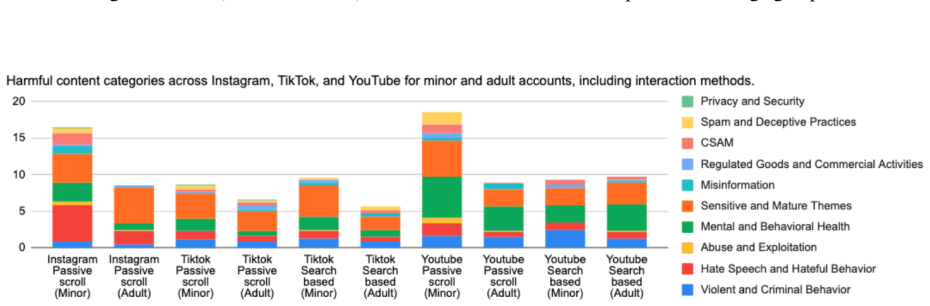
On the paper's own terms, the discovery is that accounts declared as 13 do not receive safer recommendation feeds than accounts declared as 18; they receive riskier ones. Across platforms and interaction modes, 13-year-old accounts saw harmful content in 7.83% to 15% of videos, while 18-year-old accounts saw 4.67% to 8.33%, and the gap appeared without any user searches, likes, or follows. YouTube was the clearest case: passive scrolling recommended harmful videos to 15% of the minor feed versus 8.17% of the adult feed, and the first harmful video appeared after an average of 3:06 minutes for minors versus roughly nine minutes for adults. The paper also finds that low-severity harm dominates the harmful content served to both ages, with Sensitive and Mature Themes the most common category, and it interprets the overall pattern as evidence that recommendation systems amplify rather than suppress harmful material for minors.
Load-bearing premise
The results rest on adult researchers' manual ratings of what is harmful and how severe it is; if adults and 13-year-olds systematically disagree about those judgments, the age-group gap could reflect adult perceptions rather than actual risk to minors.
Editorial extensions
If this is right
- If the finding is correct, YouTube, TikTok, and Instagram's age-based filtering is not delivering the protection their community guidelines promise for the youngest permitted users, at least for fresh accounts with minimal interaction.
- Regulators auditing under the EU Digital Services Act or the UK Online Safety Act would have a concrete reason to demand recommender-level transparency: today's published enforcement reports count removals, while this study measures what the default feed actually serves within minutes.
- Low-severity harmful content, not just extreme material, would need to be treated as a moderation target, since it dominates what minors receive and repeated exposure may normalize harm.
- The time-to-first-harm measure implies that moderation quality cannot be judged by aggregate take-down volumes; a child's first minutes on a platform are the decisive exposure window.
- Search-based behavior is not uniformly riskier: on YouTube searching reduced minors' harmful exposure sharply from 15% to 8%, while TikTok stayed flat at 7.83%, so platform-specific algorithm audits are needed rather than one-size-fits-all conclusions.
Reading between the lines
- Our inference: if the age gap is real, strengthening age verification alone will not fix it, because the accounts in this study truthfully declared age 13 and still received more harmful recommendations; the feed composition itself would have to change.
- Our inference: the result suggests an engagement-based explanation rather than a content-policy one: recommendation algorithms may optimise watch time over safety, and if 13-year-olds' viewing patterns differ, the same core algorithm will surface different content even under identical moderation rules.
- Our inference: the adult-labelling caveat could be turned into a direct test by having adolescents rate the same videos; such participatory labelling would likely shift severity boundaries and could reveal whether the 15% versus 8.17% gap is experienced by teens as a harm gap or as a tone gap.
- Our inference: the method is repeatable as a lightweight regulatory audit; a small number of seeded accounts with fixed protocols can benchmark whether a platform's protections for minors improve after policy changes.
Signed reviews
Editorial analysis
A structured set of objections, weighed in public.
Referee Report
Summary. The paper reports an experimental audit of content moderation on TikTok, YouTube, and Instagram using sock-puppet accounts aged 13 and 18. For each platform, the authors created accounts for each age and, for TikTok and YouTube, for both passive scrolling and search-based scrolling, while Instagram was limited to passive scrolling. They collected approximately 3,000 recommended videos and manually labeled each as harmful or not using a unified taxonomy derived from the platforms' community guidelines, also assigning severity levels. The central finding is that 13-year-old accounts encounter harmful videos more frequently and more quickly than 18-year-old accounts; for example, 15% of YouTube recommendations to 13-year-old accounts during passive scrolling were harmful versus 8.17% for 18-year-old accounts, and the first harmful video appeared at 3:06 minutes for the younger group. The paper concludes that platform moderation is materially weaker for minors and that stronger age verification and enforcement are needed.
Significance. If the results were verifiable, this would be a useful empirical contribution to an active policy debate. The study covers three major platforms, uses a unified harm taxonomy, and attempts to compare both passive and active exposure modes, addressing gaps in prior work that focused on single platforms or single harm categories. The authors are transparent about the subjective nature of harm and explicitly acknowledge the adult-labeling limitation. However, the manuscript's quantitative claims are currently undermined by internal inconsistencies in the only disaggregated results table and by the absence of any statistical inference, so the headline conclusions cannot be relied upon as reported.
major comments (4)
- [Section 4.2 / Table 6] The reported headline percentages cannot be reproduced from the paper's only disaggregated results table. Summing the Low, Medium, and High rows for YouTube 13 Passive in Table 6 gives 18.51% (Low 18.01% + Medium 0.50% + High 0.00%), not the 15% stated in the abstract and Section 4.2. Similarly, YouTube 18 Passive sums to 9.01% rather than 8.17%, and TikTok 13 Passive sums to 8.67% rather than 7.83%. These discrepancies are far beyond rounding error and mean that the central quantitative claim of the paper cannot be verified from the presented data.
- [Section 3.5 / Table 6] Section 3.5 explicitly states that Privacy and Security and Enforcement Actions were excluded from manual annotation, yet Table 6 contains a 'Privacy & Sec.' column with nonzero values in several blocks, including TikTok 13 Passive Low (0.17%), TikTok 18 Passive Low (0.17%), and Instagram 13 Passive Low (0.17%). This contradicts the described labeling scope and suggests either a different annotation procedure or an undisclosed change in category handling, further undermining the table's validity.
- [Section 3.4 / Sections 4.1-4.4] The experimental design uses a single account per age-by-mode cell (one 13-year-old passive, one 13-year-old search-based, one 18-year-old passive, one 18-year-old search-based per platform). Consequently, all comparisons between age groups and interaction modes, including the time-to-first-harmful-video values (e.g., YouTube 3:06 vs 1:28), rest on single draws with no variance estimate or statistical test. Without replication or error bars, the paper's comparative claims (e.g., 'children commonly encounter harmful content in under five minutes, compared to roughly nine minutes for adults') are not supported.
- [Section 3.6 / Section 5] The study's outcome measure relies on adult annotators applying a taxonomy derived from platform policies, yet the paper's central claim concerns what is harmful for 13-year-olds. Section 3.6 acknowledges this disconnect, but no evidence is provided that adult severity ratings correspond to adolescent perceptions. Because every quantitative result (the 15% vs 8.17% rates, time-to-first-harm figures, and severity distributions) depends on these adult labels, the validity of the measure is load-bearing and is not established in the manuscript.
minor comments (6)
- [Section 4.6] The phrase 'videos moderation' should be 'video moderation'.
- [Section 2.2.2] The abbreviation 'RSD' is used without definition; the manuscript should spell out 'Regulation (EU) 2022/2065 (Digital Services Act)' at first use.
- [Section 3.5] The reference to 'the Methodology Section' is vague; the authors should cite Section 3.2 specifically when describing the harmful content framework.
- [Section 3.5] The paper states that inter-annotator agreement was verified by two additional experts, but it reports no agreement statistics (e.g., Cohen's kappa) or counts of disagreements, making the reliability of the labeling process difficult to assess.
- [Title / Abstract] The title and abstract emphasize 'legal safeguards,' but the empirical study does not evaluate any legal instrument; the legal discussion is a literature review only. The authors should either narrow the scope or adjust the framing to accurately reflect the absence of a legal intervention.
- [Table 6] The heatmap colors described in the text are not visible in a black-and-white printout; the table should be interpretable without color, for example by adding numeric labels or distinct patterns.
Circularity Check
No circularity: the central 13-vs-18 exposure comparisons are direct empirical measurements, and the only self-citation is not load-bearing.
full rationale
The paper's central claims are experimental observations: labeled counts of harmful videos encountered by 13- and 18-year-old accounts under passive and search-based scrolling, plus time-to-first-harmful-video. There is no fitted parameter, derived constant, or formal derivation that could reduce a prediction to an input. The Unified Harmful Content Framework (Section 3.2) is an annotation taxonomy, not a mathematical model; the age-group differences are not entailed by the taxonomy's definitions. The only self-citation ([29], cited in Sections 1 and 3.4 regarding age-verification weakness) is not load-bearing for the exposure measurements: the study's own account-creation procedure demonstrates that self-declared ages were accepted, and the exposure-rate comparisons stand independently of that prior work. The acknowledged limitations—adult annotators (Section 3.6), single accounts per cell (Section 3.4), and the inability to reproduce the headline percentages from Table 6—are validity and reproducibility concerns, not circularity. No claim in the paper is equivalent by construction to its own premises.
Assumptions & free parameters
assumptions (4)
- domain assumption The unified harmful content framework derived from platform community guidelines is a valid operational definition of harm for minors.
- domain assumption Adult annotators can reliably judge which videos minors would experience as harmful, and severity ratings transfer across ages.
- domain assumption One account per platform-age-mode condition is representative of the recommendation algorithm's typical output for that demographic.
- domain assumption A fixed 20-second viewing time and immediate skipping of non-English videos approximates real passive use.
Cite this review
Pith. "Pith review of Protecting Young Users on Social Media: Evaluating the Effectiveness of Content Moderation and Legal Safeguards on Video Sharing Platforms." pith.science (2026). https://pith.science/paper/JVH2MRES
@misc{pith2026250511160,
  author       = {Pith},
  title        = {Pith review of: Protecting Young Users on Social Media: Evaluating the Effectiveness of Content Moderation and Legal Safeguards on Video Sharing Platforms},
  year         = {2026},
  howpublished = {\url{https://pith.science/paper/JVH2MRES}},
  note         = {Machine review of arXiv:2505.11160}
}
read the original abstract
Video-sharing social media platforms, such as TikTok, YouTube, and Instagram, implement content moderation policies aimed at reducing exposure to harmful videos among minor users. As video has become the dominant and most immersive form of online content, understanding how effectively this medium is moderated for younger audiences is urgent. In this study, we evaluated the effectiveness of video moderation for different age groups on three of the main video-sharing platforms: TikTok, YouTube, and Instagram. We created experimental accounts for the children assigned ages 13 and 18. Using these accounts, we evaluated 3,000 videos served up by the social media platforms, in passive scrolling and search modes, recording the frequency and speed at which harmful videos were encountered. Each video was manually assessed for level and type of harm, using definitions from a unified framework of harmful content. The results show that for passive scrolling or search-based scrolling, accounts assigned to the age 13 group encountered videos that were deemed harmful, more frequently and quickly than those assigned to the age 18 group. On YouTube, 15\% of recommended videos to 13-year-old accounts during passive scrolling were assessed as harmful, compared to 8.17\% for 18-year-old accounts. On YouTube, videos labelled as harmful appeared within an average of 3:06 minutes of passive scrolling for the younger age group. Exposure occurred without user-initiated searches, indicating weaknesses in the algorithmic filtering systems. These findings point to significant gaps in current video moderation practices by social media platforms. Furthermore, the ease with which underage users can misrepresent their age demonstrates the urgent need for more robust verification methods.
Figures


Figures from the paper (3 more)


Forward citations
Cited by 2 Pith papers
-
Child-Oriented AIGC Video Risk Reviewing: A Benchmark and Knowledge-Supported Iterative Reasoning Framework
A multi-agent iterative-questioning framework plus a 605-video benchmark for detecting developmentally inappropriate risks in AI-generated children's videos.
-
Towards an Automated Framework to Audit Youth Safety on TikTok
An audit of TikTok in Italy finds that accounts set to age 13 and 18+ receive similar levels of harmful content, especially when actively searching.
Reference graph
Works this paper leans on
-
[1]
Number of social media users worldwide from 2017 to 2028
Stacy Jo Dixon. Number of social media users worldwide from 2017 to 2028. (archived on 2024-8-22), 2024
work page 2017
-
[2]
Most popular social networks worldwide as of april 2024, by number of monthly active users
Stacy Jo Dixon. Most popular social networks worldwide as of april 2024, by number of monthly active users. (archived on 2024-8-22), 2024
work page 2024
-
[3]
Digital childhoods: a survey of children and parents, 2022
Children’s Commissioner. Digital childhoods: a survey of children and parents, 2022
work page 2022
-
[4]
Teens, social media & technology 2023
A Monica, F Michelle, and G Jeffrey. Teens, social media & technology 2023. (archived on 2024-8-22), 2023
work page 2023
-
[5]
O Beresford, A Cooney, A Keogh, E Flynn, and M Messena. Keeping kids safer online. (archived on 2024-8-22), 2022-2023
work page 2024
-
[6]
WeProtect Global Alliance. Global threat assessment 2023. 2023
work page 2023
-
[7]
Underage social platform usage: Research with children aged 11-14, 2023
Childwise. Underage social platform usage: Research with children aged 11-14, 2023
work page 2023
-
[8]
Caroline Violot, Tu˘grulcan Elmas, Igor Bilogrevic, and Mathias Humbert. Shorts vs. regular videos on youtube: A comparative analysis of user engagement and content creation trends. InProceedings of the 16th ACM Web Science Conference, WEBSCI ’24, page 213–223, New York, NY , USA, 2024. Association for Computing Machinery
work page 2024
Show all 61 references
-
[9]
Norvilitis, and Tian Xiao
Mingli Liu, Aixia Zhuang, Jill M. Norvilitis, and Tian Xiao. Usage patterns of short videos and social media among adolescents and psychological health: A latent profile analysis. Computers in Human Behavior, 151:108007, 2024
2024
-
[10]
Effect of short video ads on sales through social media: the role of advertisement content generators
Jiaoju Ge, Yuepeng Sui, Xiaofeng Zhou, and Guoxin Li and. Effect of short video ads on sales through social media: the role of advertisement content generators. International Journal of Advertising, 40(6):870–896, 2021
2021
-
[11]
Algorithmic content moderation: Technical and political challenges in the automation of platform governance
Robert Gorwa, Reuben Binns, and Christian Katzenbach. Algorithmic content moderation: Technical and political challenges in the automation of platform governance. Big Data & Society, 7(1):2053951719897945, 2020
2020
-
[12]
Unicef. Unicef. Whatisharmfulcontent?(archived on 2015-11-4), 2025
2015
-
[13]
Reddit rules! characterizing an ecosystem of governance
Casey Fiesler, Jialun Jiang, Joshua McCann, Kyle Frye, and Jed Brubaker. Reddit rules! characterizing an ecosystem of governance. In Proceedings of the International AAAI Conference on Web and Social Media , volume 12, 2018
2018
-
[14]
Moderator engagement and community development in the age of algorithms
Joseph Seering, Tony Wang, Jina Yoon, and Geoff Kaufman. Moderator engagement and community development in the age of algorithms. New media & society, 21(7):1417–1443, 2019
2019
-
[15]
Custodians of the Internet: Platforms, content moderation, and the hidden decisions that shape social media
Tarleton Gillespie. Custodians of the Internet: Platforms, content moderation, and the hidden decisions that shape social media. Yale University Press, 2018
2018
-
[16]
Crossmod: A cross- community learning-based system to assist reddit moderators
Eshwar Chandrasekharan, Chaitrali Gandhi, Matthew Wortley Mustelier, and Eric Gilbert. Crossmod: A cross- community learning-based system to assist reddit moderators. Proceedings of the ACM on human-computer interaction, 3(CSCW):1–30, 2019
2019
-
[17]
Meta’s moderation shift and the tiktok ban: what’s cooking in the us and what this means for eu platform regulation
Konstantina Bania. Meta’s moderation shift and the tiktok ban: what’s cooking in the us and what this means for eu platform regulation. 2025. 18 A PREPRINT - AUGUST 11, 2025
2025
-
[18]
Facebook community standards
Meta. Facebook community standards. (archived on 2024-8-29), 2024
2024
-
[19]
Instagram community standards
Meta. Instagram community standards. (archived on 2024-8-29), 2024
2024
-
[20]
Instagram warning screen
Meta. Instagram warning screen. (archived on 2024-8-29), 2024
2024
-
[21]
Apply age restrictions in youtube
YouTube. Apply age restrictions in youtube. (archived on 2024-8-29), 2020
2024
-
[22]
Youtube community standards
YouTube. Youtube community standards. (archived on 2024-8-29), 2024
2024
-
[23]
Tiktok content moderation
TikTok. Tiktok content moderation. (archived on 2024-8-29), 2024
2024
-
[24]
Apply age restrictions in twitter
X. Apply age restrictions in twitter. (archived on 2024-8-29), 2024
2024
-
[25]
Restricted mode on tiktok
TikTok. Restricted mode on tiktok. (archived on 2024-8-29), 2024
2024
-
[26]
Age-restricted content on tiktok live
TikTok. Age-restricted content on tiktok live. (archived on 2024-8-29), 2025
2024
-
[27]
Efforts to protect minors in youtube
YouTube. Efforts to protect minors in youtube. (archived on 2024-8-29), 2024
2024
-
[28]
Efforts to protect minors in facebook
Meta. Efforts to protect minors in facebook. (archived on 2024-8-29), 2024
2024
-
[29]
The digital loophole: Evaluating the effectiveness of child age verification methods on social media
Fatmaelzahraa Eltaher, Rahul Krishna Gajula, Luis Miralles-Pechuán, Christina Thorpe, and Susan Mckeever. The digital loophole: Evaluating the effectiveness of child age verification methods on social media. In Proceedings of the 11th International Conference on Information Sy...
2025
-
[30]
Does the use of social networking sites increase children’s risk of harm? Computers in human behavior, 29(1):40–50, 2013
Elisabeth Staksrud, Kjartan Ólafsson, and Sonia Livingstone. Does the use of social networking sites increase children’s risk of harm? Computers in human behavior, 29(1):40–50, 2013
2013
-
[31]
Disturbed youtube for kids: Characterizing and detecting inappropriate videos targeting young children
Kostantinos Papadamou, Antonis Papasavva, Savvas Zannettou, Jeremy Blackburn, Nicolas Kourtellis, Ilias Leontiadis, Gianluca Stringhini, and Michael Sirivianos. Disturbed youtube for kids: Characterizing and detecting inappropriate videos targeting young children. In Proceedin...
2020
-
[32]
Exposure to pornography through social media on sexual behavior of high school teenagers in metro city
Firda Fibrilla, Martini Fairus, and Holiratul Raifah. Exposure to pornography through social media on sexual behavior of high school teenagers in metro city. IOSR Journal of Nursing and Health Science, 1â, 8, 2021
2021
-
[33]
Driven into the darkness: How tiktok encourages self-harm and suicidal ideation, 2023
Amnesty International. Driven into the darkness: How tiktok encourages self-harm and suicidal ideation, 2023
2023
-
[34]
Safer scrolling: How algorithms popularise and gamify online hate and misogyny for young people, 2024
K Regehr, C Shaughnessy, M Zhao, and N Shaughnessy. Safer scrolling: How algorithms popularise and gamify online hate and misogyny for young people, 2024
2024
-
[35]
Recommending toxicity: The role of algorithmic recommender functions on youtube shorts and tiktok in promoting male supremacist influencers, 2024
Catherine Baker, Debbie Ging, and Maja Brandt Andreasen. Recommending toxicity: The role of algorithmic recommender functions on youtube shorts and tiktok in promoting male supremacist influencers, 2024. April 2024
2024
-
[36]
Surveilling young people online: An investigation into tiktok’s data processing practices, 2021
Dylan Williams, Rys Farthing, and Alex McIntosh. Surveilling young people online: An investigation into tiktok’s data processing practices, 2021
2021
-
[37]
Algorithms as a weapon against women: How youtube lures boys and young men into the ‘manosphere’, 2022
Elise Thomas and Kata Balint. Algorithms as a weapon against women: How youtube lures boys and young men into the ‘manosphere’, 2022
2022
-
[38]
Deadly by design: Tiktok pushes harmful content promoting eating disorders and self-harm into young users’ feeds, 2022
CCDH. Deadly by design: Tiktok pushes harmful content promoting eating disorders and self-harm into young users’ feeds, 2022
2022
-
[39]
https://www.eko.org/about/(archived on 2015-1-24), 2023
Ek ¯o. https://www.eko.org/about/(archived on 2015-1-24), 2023
2015
-
[40]
Suicide, incels, and drugs: How tiktok’s deadly algorithm harms kids, 2023
Eko. Suicide, incels, and drugs: How tiktok’s deadly algorithm harms kids, 2023
2023
-
[41]
Community standards, 2024
Meta Platforms. Community standards, 2024. Accessed: April 2024
2024
-
[42]
Community guidelines overview, 2024
TikTok. Community guidelines overview, 2024. Accessed: April 2024
2024
-
[43]
Community guidelines, 2024
YouTube. Community guidelines, 2024. Accessed: April 2024
2024
-
[44]
Content moderation: How the eu and the us approach striking a balance between protecting free speech and protecting public interest
Rrita Rexhepi. Content moderation: How the eu and the us approach striking a balance between protecting free speech and protecting public interest. Trento Student Law Review, 5(1), 2023
2023
-
[45]
Regulating platforms’ invisible hand: Content moderation policies and processes
Karanjot Gill. Regulating platforms’ invisible hand: Content moderation policies and processes. Wake Forest J. Bus. & Intell. Prop. L., 21:182, 2020
2020
-
[46]
Cho and Ling Zhu
Clare Y . Cho and Ling Zhu. Social media: Content dissemination and moderation practices, 2025
2025
-
[47]
European Union. Regulation (eu) 2022/2065 of the european parliament and of the council of 19 october 2022 on a single market for digital services and amending directive 2000/31/ec (digital services act). Official Journal of the European Union, 2022. 19 A PREPRINT - AUGUST 11, 2025
2022
-
[48]
Do not recommend? reduction as a form of content moderation
Tarleton Gillespie. Do not recommend? reduction as a form of content moderation. Social Media+ Society, 8(3):20563051221117552, 2022
2022
-
[49]
Protecting children from harms online—a summary of our consultation
Ofcom. Protecting children from harms online—a summary of our consultation. https://www.ofcom.org.uk/ online-safety/protecting-children/protecting-children-from-harms-online , 2024. Accessed: 2024-08-05
2024
-
[50]
The role of requests for information in governing digital platforms under the digital services act: The case of x
Matteo Fabbri. The role of requests for information in governing digital platforms under the digital services act: The case of x. Journalism and Media, 6(1):41, 2025
2025
-
[51]
Child safety policy, n.d
YouTube. Child safety policy, n.d. Retrieved March 19, 2025, from https://www.youtube.com/intl/ALL_ ie/howyoutubeworks/our-commitments/managing-harmful-content/#remove
2025
-
[52]
Child sexual exploitation, abuse, and nudity, n.d
Meta. Child sexual exploitation, abuse, and nudity, n.d. Retrieved March 19, 2025, fromhttps://transparency. meta.com/policies/community-standards/child-sexual-exploitation-abuse-nudity/
2025
-
[53]
Youth sexual and physical abuse, 2024
TikTok. Youth sexual and physical abuse, 2024. Retrieved March 19, 2025, from https://www.tiktok.com/ community-guidelines/en/safety-civility#4
2024
-
[54]
Transparency: Content moderation, 2024
Meta. Transparency: Content moderation, 2024. Accessed: April 2024
2024
-
[55]
Youtube policy removals, 2024
Google. Youtube policy removals, 2024. Accessed: April 2024
2024
-
[56]
Behind the screen: Content moderation in the shadows of social media
Ysabel Gerrard. Behind the screen: Content moderation in the shadows of social media. New Media & Society, 22:579–582, 09 2019
2019
-
[57]
K. E. Smith, R. Acevedo-Duran, J. L. Lovell, A. V . Castillo, and V . Cardenas Pacheco. Youth are the experts! youth participatory action research to address the adolescent mental health crisis. Healthcare, 12(5):592, 2024
2024
-
[58]
Designing toxic content classification for a diversity of perspectives, 2021
Deepak Kumar, Patrick Gage Kelley, Sunny Consolvo, Joshua Mason, Elie Bursztein, Zakir Durumeric, Kurt Thomas, and Michael Bailey. Designing toxic content classification for a diversity of perspectives, 2021
2021
-
[59]
Corrigan, Karina J
Patrick W. Corrigan, Karina J. Powell, Joyce K. Fokuo, and Kristin A. Kosyluk. Does humor influence the stigma of mental illnesses? The Journal of Nervous and Mental Disease, 202(5):397–401, 2014
2014
-
[60]
L. F. Albers, F. B. Bergsma, H. Mekelenkamp, R. C. M. Pelger, E. Manten-Horst, and H. W. Elzevier. Discussing sexual health with adolescent and young adults with cancer: A qualitative study among healthcare providers. Journal of Cancer Education, 37(1):133–140, 2022
2022
-
[61]
Has social media desensitized us?, 2022
Desiree Smith. Has social media desensitized us?, 2022. 20
2022
Reviewed August 15, 2026 · model on record in the stance chip above.
Discussion (0). Continue with ORCID to comment.