REVIEW 4 major objections 6 minor 17 references
FLARE++: Low-rank attention with dynamic attention routing
T0 review · 4 major / 6 minor · reviewed 2026-08-16 · deepseek-v4-flash
Pith's one-line read FLARE++ computes its M routing queries from the input itself, keeping FLARE's rank-M factorization and linear cost while cutting relative error by 24 percent on average across five PDE benchmarks.
desk verdict FLARE++ is a genuinely novel dynamic low-rank routing mechanism with consistent empirical gains, but the central attribution of those gains to dynamic routing is unsupported until a parameter-matched control is run. read the letter →
The pith
A machine-rendered reading of the paper's core claim, the machinery that carries it, and where it could break.
The reading
What carries the argument
The load-bearing object is the synthesized routing-query set $Q_h(X)$, produced by an extra SDPA encode call from learned seed queries $\tilde Q_h$ and separate key/value projections of the input. With $W_{\mathrm{enc},h}(X)$ and $W_{\mathrm{dec},h}(X)$ the softmax routing factors built from $Q_h(X)$, the mixer composes them as $Y_h = W_{\mathrm{dec},h}(X)W_{\mathrm{enc},h}(X)V_h$, an explicit rank-at-most-$M$ operator implemented by three fused SDPA calls. This keeps FLARE's structure while making the compression template field-dependent; the mixer costs $O(N(5C^2+3MC))$ time and $O(NC)$ space, and the context-parallel encoder reduction uses only the latent log-normalizers and outputs, with a collective payload independent of $N$.
What would settle it
Train a fixed-query control: FLARE with the same two extra $C\times C$ projections and one extra softmax attention call, but with those queries left constant after training, matched in parameter count; if that control matches FLARE++'s error on Elasticity, Darcy, Airfoil, Pipe, and DrivAerML-40K, then dynamic routing itself is not what drives the reported gains.
Extended reading notes
Core claim
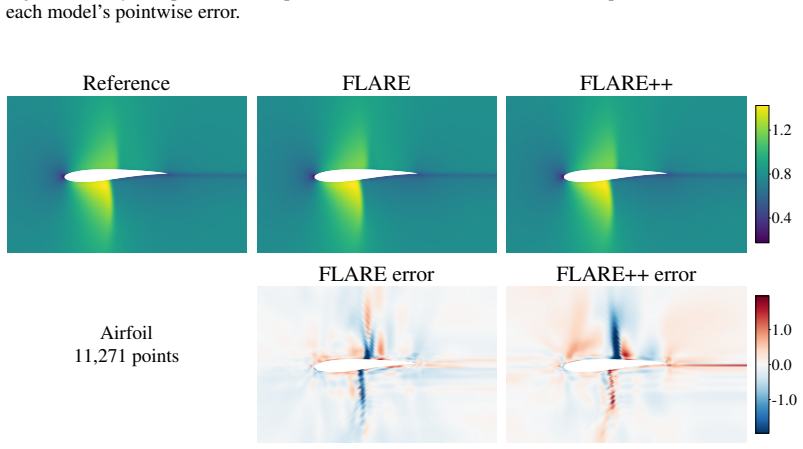
On the paper's own terms, the discovery is that replacing fixed learned routing queries with input-conditioned ones makes low-rank attention a better token mixer while preserving the explicit rank-$M$ encode–decode structure. The synthesized queries are $Q_h(X) = \mathrm{SDPA}(\tilde Q_h, \tilde K_h, \tilde V_h)$, one extra encode call that gathers the input tokens through learned seeds; those queries then define both factors of the routing matrix, so the effective input-to-input attention matrix still has rank at most $M$. Empirically, FLARE++ records the lowest relative $L^2$ error on all five PDE benchmarks, cutting FLARE's error by 9–41% (24% on average) and Transolver-3's by 18–44% (31% on average). It also improves on FLARE on all five Long Range Arena tasks, raising the average from 58.08 to 60.36, and in ablation it wins in every matched $(M,B)$ cell while FLARE saturates or degrades with larger latent budgets on some benchmarks. The paper reads the depth ablation as showing that dynamic routing substitutes for depth: FLARE++ at half the residual depth is more accurate than FLARE at full depth in the configurations swept.
Load-bearing premise
The result stands or falls on the assumption that the accuracy gain comes from making the routing queries depend on the input, not from the extra parameters and extra computation the method adds, and the paper does not test a fixed-query FLARE with the same added parameters.
Editorial extensions
If this is right
- At matched depth and width, dynamic routing beats fixed-query routing on every measured benchmark, with the lowest error on all five PDE tasks and an average 24% reduction in relative $L^2$ error over FLARE.
- Dynamic routing substitutes for depth: in the joint sweep, FLARE++ at four residual blocks is more accurate than FLARE at eight, which is the mechanism the paper proposes for recovering its 1.3–1.5$\times$ step-time overhead.
- Input-conditioned routing uses added latent capacity better: FLARE++ keeps converting latent budget into accuracy where fixed-query FLARE saturates or degrades.
- The mechanism transfers outside PDE surrogates: FLARE++ raises the Long Range Arena average from 58.08 to 60.36, above the full self-attention row, with gains on all five tasks.
- Token-sharded context parallelism keeps parallel efficiency at or near unity over four ranks, so the low-rank mixer can train on meshes that do not fit on one device without ever gathering the full token sequence.
Reading between the lines
- If the attribution holds, the same one-extra-encode recipe could be applied to other fixed-template mixers, such as PerceiverIO's latent array or Linformer's projection, turning any learned compression template into an input-dependent one; FLARE++ is the first test of that pattern.
- A direct test the paper leaves open is a parameter-matched fixed-query FLARE control: adding the same two $C\times C$ projections and one extra attention call while keeping the queries constant would separate the effect of dynamic routing from the effect of extra capacity.
- The finding that fixed queries saturate in $M$ while input-built queries keep improving suggests that in practice the latent budget $M$ can be set more aggressively with dynamic routing, trading per-block cost for fewer blocks at equal or better accuracy.
Signed reviews
Editorial analysis
A structured set of objections, weighed in public.
Referee Report
Summary. The paper proposes FLARE++, a low-rank attention mixer that replaces FLARE's learned latent routing queries with input-conditioned queries synthesized by one additional scaled dot-product attention call over learned seeds (Eqs. 8–11). The authors claim this preserves FLARE's rank-M encode–decode factorization and O(NM) complexity while improving average test relative L2 error by 24% on five PDE benchmarks (Table 1) and raising the Long Range Arena average by 2.3 points (Table 6). They also provide an exact token-sharded multi-GPU implementation whose collective payload is independent of N, with measured parallel efficiency near unity over four ranks (Table 2, Appendix A). The paper presents a joint (M,B) ablation on Elasticity and Darcy in which FLARE++ beats FLARE in all 21 cells, and it reports that dynamic routing can reach a given error at half the residual depth of FLARE, with the caveat that wall-clock end-to-end savings are not directly measured.
Significance. If the empirical claims hold, FLARE++ is a useful contribution: it is a clean, well-motivated modification of a known low-rank mixer, preserves the explicit rank-bound interpretation and linear complexity, and the experimental sweep across five PDE benchmarks and five LRA tasks is broader than what is typical for a mixer study. The exact token-sharded encoder with global softmax normalization and its backward pass (Eqs. 13–40) is a solid systems contribution with machine-checkable algebra. The paper also ships quantitative efficiency measurements over three orders of magnitude in N. The main caveat is that the paper's headline attribution—that gains come from dynamic routing rather than added parameters—is not supported by the experiments as reported, because the comparison is not parameter-matched and the paper explicitly identifies a shared-projection control that would resolve the issue but does not run it.
major comments (4)
- [Section 3.2, Eqs. (7)–(11)] The attribution statement that 'any accuracy difference is therefore attributable to how the M routes are chosen' is not secured. FLARE++ adds two C×C projection matrices per head plus one additional SDPA call per mixer, so at C=128, H=8, B=8 the extra projections alone add on the order of 2·8·128²·8 ≈ 2.1M parameters, before counting the extra attention path. The 24% average PDE gain, the 2.3-point LRA gain, and every cell of the (M,B) grid are consistent with the alternative explanation that the extra capacity, or the additional nonlinear aggregation in query synthesis, is responsible for the improvement while routing itself is neutral. Section C.2 explicitly names a shared-projection variant that would remove the extra projections and states that its accuracy cost is unknown; that control is not run, and without it the central claim that dynamic routing—rather than added capacity—drives the gains is unsupported.
- [Table 1 and Section C.1] The main accuracy tables report no confidence intervals, seed counts, or standard deviations, and Section C.1 states that 'every number in this comparison is a single seed.' With differences as small as 0.02–0.05 on Airfoil and Pipe (0.52 vs 0.57 and 0.34 vs 0.51), a single seed cannot establish that the improvement is real rather than noise, especially given the run-to-run spread the paper itself cites in Appendix A.7. The claim that dynamic routing wins in all 21 (M,B) cells needs at least repeated-seed means with error bars or a paired-seed analysis before it can be called a consistent effect.
- [Section 4.2, Table 6] The LRA comparison is presented as evidence that 'the same backbone gains 2.3 points of average accuracy from dynamic routing alone,' but many baseline rows and the FLARE row are reproduced from the authors' own prior papers rather than re-run in this work, and the protocol states that FLARE++ uses a 'matched configuration' without specifying whether the FLARE row is the same configuration. Since the paper's broader claim is about a mechanism rather than a tuned architecture, the baseline provenance and exact configuration matching should be stated per row, and the FLARE++ numbers should be accompanied by seed-level statistics, particularly on Image and Pathfinder-32 where gains of 5.2 and 3.5 points are the largest.
- [Section 5.2 and Section C.2] The depth-substitution claim ('FLARE++ reaches a lower error than FLARE at a shallower residual depth') is presented as an efficiency argument, but the paper explicitly notes that end-to-end training-time savings are not measured. Because FLARE++ incurs 1.3–1.5× FLARE's step time, the claim that halving depth reduces wall-clock cost is an extrapolation from operation counts plus a per-step-time ratio; this should either be verified with actual end-to-end training-time measurements at matched accuracy or be reworded as a per-block cost claim.
minor comments (6)
- [Abstract] 'This removes the restriction withFLARE++' has a missing space; the typo appears in the first sentence of the abstract.
- [Section 3.3, Eq. (13)] The symbol B is used both for batch size (Eq. 14) and for the number of blocks in Table 4 and Figure 3. The paper warns about this in Appendix A.1, but the main text still switches between the two meanings without explicit visual distinction; consider renaming one of them.
- [Table 3] The benchmark summary reproduces Plasticity from the FLARE paper, but Plasticity is never used in any experiment; either remove the row or state why it is listed.
- [Section C.1, Figure 4] The precision-sensitivity figure is based on single-seed runs and the text says the comparison against full self-attention is precision-dependent; this is reported honestly, but the figure caption should repeat the single-seed caveat rather than leaving it only in the main text.
- [Section 3.2] The notation eQ_h, eK_h, eV_h is introduced without a placeholder subscript for the head in the text of Eq. (7)–(8); the head index is clear from context but should be spelled out in the surrounding prose.
- [Section 4.1, Table 1] The table caption says bold and underline mark best and second-best, but the text only discusses the best entry; the second-best entries are not described, which weakens the interpretation of the ranking.
Circularity Check
No derivation-equals-input circularity: FLARE++'s accuracy gains are measured against external benchmarks and do not reduce to FLARE's equations; minor self-citation of the authors' FLARE paper for baselines and benchmark characterization keeps the score at 2 rather than 0.
full rationale
FLARE++ is a modification of the authors' own FLARE operator, and its correctness claim rests on measured test relative L2 error on five PDE benchmarks and on Long Range Arena accuracy. These targets are external to the model equations: the 24% average PDE reduction (Table 1) and the 2.3-point LRA gain (Table 6) are not quantities defined by Eq. (8)-(12), and no fitted parameter is later renamed as a prediction. The low-rank property 'rank(W_dec,h W_enc,h) <= M' in Eq. (12) is inherited by construction from the same two SDPA calls used in FLARE, but the paper does not present that algebraic identity as an empirical discovery. The load-bearing attribution in Section 3.2 — 'any accuracy difference is therefore attributable to how the M routes are chosen' — is not secured, because Eq. (7) adds two C x C projections per head; Section C.2 explicitly leaves a shared-projection control unmeasured ('would remove the extra projections entirely, at an unknown cost in accuracy'). This is an experimental confound and a correctness risk, not circularity: the benchmark numbers do not reduce to the model's own equations. Self-citations to Puri et al. (2026) for FLARE baseline numbers, dataset definitions (Table 3), LRA reruns (Table 6), and the low-rank/rank-limited characterization of Elasticity and Darcy are real earlier work and are externally falsifiable; none of these citations is invoked as a uniqueness theorem or as a substitute for the measured comparison. Section C.1's single-seed caveat is another limitation but again not a circular step. No equation in the paper is equivalent to its own input by construction, so no circular step is recorded; the score of 2 reflects only the paper's heavy, non-load-bearing reliance on the authors' prior FLARE study.
Assumptions & free parameters
free parameters (2)
- Latent budget M =
64 (Elasticity, Airfoil, Pipe, DrivAerML-40K), 128 (Darcy)
- Residual depth B =
8 (Elasticity, Darcy, Airfoil), 2 (Pipe), 4 (DrivAerML-40K)
assumptions (3)
- standard math rank(W_dec W_enc) is at most M for each fixed input because it is a product of an N by M and an M by N matrix.
- domain assumption The benchmark datasets, splits, and the low-rank versus rank-limited characterization of Elasticity and Darcy are taken from the authors' own FLARE paper.
- ad hoc to paper The extra projections in the query-synthesis branch do not by themselves account for the observed accuracy gains; the gains are attributable to input-conditioned routing.
Cite this review
Pith. "Pith review of FLARE++: Low-rank attention with dynamic attention routing." pith.science (2026). https://pith.science/paper/JVO3ZJHV
@misc{pith2026260811519,
  author       = {Pith},
  title        = {Pith review of: FLARE++: Low-rank attention with dynamic attention routing},
  year         = {2026},
  howpublished = {\url{https://pith.science/paper/JVO3ZJHV}},
  note         = {Machine review of arXiv:2608.11519}
}
read the original abstract
Full self-attention is a strong token mixer for PDE surrogates on irregular domains, but its quadratic cost limits its use on high-resolution problems. Efficient latent-attention models such as the Fast Low-rank Attention Routing Engine (FLARE) avoid that cost by routing all N tokens through M << N learned latent queries, but those queries are parameters: once trained, the same learned query templates serve every input. We remove this restriction with FLARE++, a low-rank attention architecture with dynamic token routing. FLARE++ reuses FLARE's own encoder to build its routing queries: learned latent seeds drive one extra encode call that gathers the N input tokens into M input-conditioned queries, and those queries then determine how the same tokens are compressed and redistributed. This preserves FLARE's explicit low-rank factorization and linear O(NM) complexity, and expresses the complete routing operation with standard scaled dot-product attention (SDPA) calls alone. We also provide a multi-GPU context-parallel implementation that shards input tokens across devices without ever gathering the full token sequence on one of them. FLARE++ is competitive across a set of standard PDE surrogate benchmarks, improving on fixed-query FLARE by 24% on average, and it gains 2.3 points of average accuracy on Long Range Arena.
Figures


Figures from the paper (6 more)



Reference graph
Works this paper leans on
-
[6]
Andrew Jaegle, Sebastian Borgeaud, Jean-Baptiste Alayrac, Carl Doersch, Catalin Ionescu, David Ding, Skanda Koppula, Daniel Zoran, Andrew Brock, Evan Shelhamer, et al. Perceiver IO: A general architecture for structured inputs & outputs.arXiv preprint arXiv:2107.14795, 2021a. Andrew Jaegle, Felix Gimeno, Andy Brock, Oriol Vinyals, Andrew Zisserman, and Jo...
-
[7]
Reformer: The efficient transformer.arXiv preprint arXiv:2001.04451,
Nikita Kitaev, Lukasz Kaiser, and Anselm Levskaya. Reformer: The efficient transformer.arXiv preprint arXiv:2001.04451,
arXiv 2001
-
[9]
Lu Lu, Pengzhan Jin, Guofei Pang, Zhongqiang Zhang, and George Em Karniadakis
URL https://arxiv.org/abs/ 2504.19452. Lu Lu, Pengzhan Jin, Guofei Pang, Zhongqiang Zhang, and George Em Karniadakis. Learning nonlinear operators via deeponet based on the universal approximation theorem of operators. Nature Machine Intelligence, 3(3):218–229,
-
[11]
URLhttps://arxiv.org/abs/2501.19205. NVIDIA PhysicsNeMo Team. Transformer models for external aerodynamics on irregular meshes,
-
[14]
Latent neural operator for solving forward and inverse pde problems
Tian Wang and Chuang Wang. Latent neural operator for solving forward and inverse pde problems. arXiv preprint arXiv:2406.03923,
-
[15]
Haixu Wu, Huakun Luo, Haowen Wang, Jianmin Wang, and Mingsheng Long. Transolver: A fast transformer solver for pdes on general geometries.arXiv preprint arXiv:2402.02366,
-
[16]
URL https://arxiv.org/abs/1910. 07467. Michael Zhang, Kush Bhatia, Hermann Kumbong, and Christopher Ré. The hedgehog & the porcupine: Expressive linear attentions with softmax mimicry.arXiv preprint arXiv:2402.04347,
arXiv 1910
-
[17]
Transolver-3: Scaling up transformer solvers to industrial-scale geometries
Hang Zhou, Haixu Wu, Haonan Shangguan, Yuezhou Ma, Huikun Weng, Jianmin Wang, and Mingsheng Long. Transolver-3: Scaling up transformer solvers to industrial-scale geometries. arXiv preprint arXiv:2602.04940,
Show all 17 references
-
[2017]
Linformer: Self-attention with linear complexity.arXiv preprint arXiv:2006.04768,
Sinong Wang, Belinda Z Li, Madian Khabsa, Han Fang, and Hao Ma. Linformer: Self-attention with linear complexity.arXiv preprint arXiv:2006.04768,
2006 arXiv
-
[2018]
Pablo Miralles-González, Javier Huertas-Tato, Alejandro Martín, and David Camacho
URL https: //arxiv.org/abs/1710.03740. Pablo Miralles-González, Javier Huertas-Tato, Alejandro Martín, and David Camacho. On the locality bias and results in the long range arena.arXiv preprint arXiv:2501.14850,
-
[2019]
Fourier neural operator for parametric partial differential equations
Zongyi Li, Nikola Kovachki, Kamyar Azizzadenesheli, Burigede Liu, Kaushik Bhattacharya, Andrew Stuart, and Anima Anandkumar. Fourier neural operator for parametric partial differential equations. arXiv preprint arXiv:2010.08895,
2010 arXiv
-
[2020]
Zihang Dai, Guokun Lai, Yiming Yang, and Quoc V . Le. Funnel-transformer: Filtering out sequential redundancy for efficient language processing.arXiv preprint arXiv:2006.03236,
2006 arXiv
-
[2021]
Generating long sequences with sparse transformers.arXiv preprint arXiv:1904.10509,
Rewon Child, Scott Gray, Alec Radford, and Ilya Sutskever. Generating long sequences with sparse transformers.arXiv preprint arXiv:1904.10509,
1904 arXiv
-
[2023]
Krzysztof Choromanski, Valerii Likhosherstov, David Dohan, Xingyou Song, Andreea Gane, Tamas Sarlos, Peter Hawkins, Jared Davis, Afroz Mohiuddin, Lukasz Kaiser, et al
URL https://proceedings.neurips.cc/paper_files/paper/2023/file/ 24f8dd1b8f154f1ee0d7a59e368eccf3-Paper-Conference.pdf. Krzysztof Choromanski, Valerii Likhosherstov, David Dohan, Xingyou Song, Andreea Gane, Tamas Sarlos, Peter Hawkins, Jared Davis, Afroz Mohiuddin, Lukasz Kaise...
2023 arXiv
-
[2024]
Efficiently modeling long sequences with structured state spaces.arXiv preprint arXiv:2111.00396,
Albert Gu, Karan Goel, and Christopher Ré. Efficiently modeling long sequences with structured state spaces.arXiv preprint arXiv:2111.00396,
-
[2025]
Iz Beltagy, Matthew E
URL https://arxiv.org/abs/2502.09692. Iz Beltagy, Matthew E. Peters, and Arman Cohan. Longformer: The long-document transformer. arXiv preprint arXiv:2004.05150,
2004
-
[2026]
Zhen Qin, Xiaodong Han, Weixuan Sun, Dongxu Li, Lingpeng Kong, Nick Barnes, and Yiran Zhong
URLhttps://arxiv.org/abs/2508.12594. Zhen Qin, Xiaodong Han, Weixuan Sun, Dongxu Li, Lingpeng Kong, Nick Barnes, and Yiran Zhong. The devil in linear transformer.arXiv preprint arXiv:2210.10340, 2022a. Zhen Qin, Weixuan Sun, Hui Deng, Dongxu Li, Yunshen Wei, Baohong Lv, Junjie...
Reviewed August 16, 2026 · model on record in the stance chip above.
Discussion (0). Continue with ORCID to comment.