REVIEW 4 major objections 4 minor 1 cited by
Plug-and-Play Training Framework for Preference Optimization
T0 review · 4 major / 4 minor · reviewed 2026-08-10 · deepseek-v4-flash
Pith's one-line read A plug-and-play weighting scheme uses repeated sampling to focus preference optimization on hard math problems, lifting accuracy on GSM8K and MATH500 across DPO, SimPO, DPOP, and IPO.
desk verdict Reasonable reweighting idea, but the paper's own tables don't support 'consistent improvements' and the evaluation confounds weight with data construction. read the letter →
The pith
A machine-rendered reading of the paper's core claim, the machinery that carries it, and where it could break.
The reading
What carries the argument
The load-bearing object is the weight $w$ from Equation (2): $w = 1 + \alpha P_e/N$ when $P_c = 0$, and $w = \max(1,\, 1 + \alpha P_e/((P_c+\epsilon)N))$ when $P_c > 0$, where $P_c$ and $P_e$ are the numbers of correct and incorrect answers among $N$ samples, and $\alpha$ is a hyperparameter that controls the adjustment magnitude. This scalar is a direct estimate of per-question difficulty from the model's own output distribution, and it is inserted as a multiplicative factor on the reward gap in the pairwise preference loss. It carries the argument by turning an observed sampling statistic into a training signal that shifts optimization effort toward questions the model has not mastered.
What would settle it
Shuffle the computed weights across training questions while keeping their distribution fixed, retrain with the same preference optimizer, and compare GSM8K and MATH500 accuracy against the proposed weighting; if shuffled weights match the gains, the per-question difficulty signal carries no explanatory power.
Extended reading notes
Core claim
The paper's central claim is that a model's own repeated-sampling answer distribution provides a usable, model-specific difficulty measure, and that feeding this measure back as a scalar weight on each preference pair improves mathematical reasoning. For each question, the model samples N=16 responses at temperature 0.7; the count of correct and incorrect extractions (Pc and Pe) is turned into a weight w via Equation (2). This weight multiplies the reward difference in the preference objective, so pairs on which the model consistently fails get a larger gradient. The paper further shows that choosing the model's own correct response as the 'chosen' example, rather than the dataset's gold answer, helps training on mathematical tasks. The reported experiments show that this weighting generally outperforms the unweighted baselines across four preference optimization methods and several open-weight model families.
Load-bearing premise
The method assumes that a handful of sampled answers at one temperature reliably indicates how well the model has mastered each problem, so weighting by that count reflects true difficulty rather than sampling noise.
Editorial extensions
If this is right
- Any pairwise preference optimization method (DPO, SimPO, DPOP, IPO) can incorporate the weights with negligible added compute: one extra sampling pass over the training set and a scalar multiply in the loss.
- Training emphasis shifts to systematic mistakes: questions where the model repeats the same wrong answer receive the largest weights, so the gradient concentrates on undoing those misconceptions.
- Using the model's own correct response as the chosen example keeps the optimized policy close to the original model's distribution, reducing the style-mimicry failure mode that gold-answer training can trigger in math.
- The gains should be most visible on harder, accuracy-critical benchmarks like MATH500 and on models with intermediate error rates, because models that are too strong or too weak yield less informative sampling distributions.
Reading between the lines
- One testable extension the paper does not run: shuffle the computed weights across questions while keeping their distribution fixed. If shuffled weights reproduce the gains, the per-question difficulty signal is not what matters; the improvement would come merely from uneven weighting.
- The difficulty estimate is a snapshot of the model before training. As the model improves, the weights become stale; recomputing them mid-training or using an online estimator could yield larger or more persistent gains.
- The framework's dependence on answer equivalence classes, acknowledged in the paper's limitation, means the same recipe could be applied to open-ended tasks by replacing exact numeric matching with semantic-equivalence clustering.
- Because the chosen answer is sampled from the model itself, the method may compound existing biases or style quirks when the model is weak; a stronger model or a higher sampling temperature would reduce the risk of locking in errors.
Editorial analysis
A structured set of objections, weighed in public.
Referee Report
Summary. The paper proposes a plug-and-play weighting framework for preference optimization in mathematical reasoning. For each training question, the base model is sampled N times; the responses are grouped by extracted numeric answer, the numbers of correct and incorrect samples are counted, and a per-question weight w is computed by Eq. (2). Preference pairs are then constructed from the model's own samples (a self-generated correct answer as chosen, the most frequent wrong answer as rejected), and the pairwise preference loss of DPO, SimPO, DPOP, or IPO is multiplied by w. Experiments on GSM8K and MATH500 across Qwen2-1.5B/7B, GLM4-9B, and ChatGLM3-6B are reported in Tables 1-2, and the Abstract claims consistent improvements.
Significance. If the central claim were established, a simple scalar reweighting of pairwise preference losses that focuses training on questions the model has not mastered would be a useful and cheap addition to existing preference optimization methods. The framework is simple, applies to several losses, and the authors honestly discuss the answer-equivalence limitation and include a failure-case analysis for LLaMA3 in Appendix C. However, the current evidence does not support the claimed consistency: Table 1 contains many negative weighted-vs-unweighted differences, the design does not isolate the weight w from the self-sampled data-construction change, and no variance or significance information is provided. The value of the contribution will be clear only after a controlled comparison on identical preference pairs with error bars.
major comments (4)
- [§4.5, Table 1] The Abstract's claim of "consistent improvements" is contradicted by the reported numbers. Across the 24 weighted-vs-unweighted comparisons in Table 1, only 13 show a positive difference and several are negative, e.g., Qwen2-1.5B GSM8K DPO 64.59 vs 64.74 (-0.15), Qwen2-1.5B GSM8K DPOP 64.36 vs 64.74 (-0.38), GLM4-9B GSM8K SimPO 57.92 vs 58.75 (-0.83), and GLM4-9B GSM8K IPO 58.68 vs 58.83 (-0.15). Table 2 adds another negative entry (IPO 54.28 vs 55.34, -1.06). The text should be revised to report this mixed pattern accurately, and the consistency claim should be either supported with an appropriate aggregate statistic or removed.
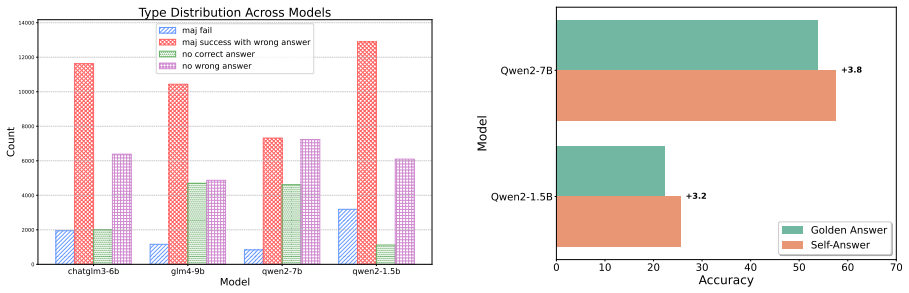
- [§3.2 and §4.5] The experimental design does not isolate the effect of the weight w from the data-construction changes. The treatment changes two factors simultaneously: (i) preference pairs are built from self-sampled responses, with the chosen response being a self-generated correct answer and the rejected response being the most common wrong answer, and (ii) the pairwise loss is multiplied by w. The baselines in Tables 1 and 2 are described only as "DPO", "SimPO", "DPOP", and "IPO"; the paper never states whether these baselines use the identical self-constructed preference pairs with uniform weights or a different preference dataset. Because Figure 8 shows large accuracy gains from using self-generated answers over golden answers as the chosen response, the observed improvements in Tables 1-2 could be attributable entirely to the data construction rather than to Eq. (2). The authors should add an unweighted control trained on the same self-constructed pairs.
- [§3.2, Eq. (2)] Equation (2) is not fully reproducible as written and its effect size is unclear. In the Pc>0 branch, the expression 1 + α·Pe/((Pc+ϵ)·N) is always greater than 1 for valid counts, making the max(1, ·) redundant; the placement of "· 1/N" is ambiguous and the first branch (1 + α·Pe/N) does not share the same scaling structure as the second branch. With N=16 and α=1, the weights lie approximately in [1, 1.94], which is a weak rescaling. The paper reports no sensitivity analysis for α, N, or sampling temperature, and no evidence that 16 samples at temperature 0.7 produce a stable estimate of per-question difficulty; if the counts are noisy, the weights add variance without a clear signal.
- [§4.4, Tables 1 and 2] All experimental results are single-run and no error bars, multiple seeds, or significance tests are reported. Many weighted-vs-unweighted differences are within ±1 point on test sets of 500 (MATH500) or 1,319 (GSM8K) examples, so these differences cannot be distinguished from sampling noise without variance estimates. The authors should report multiple seeds or bootstrap confidence intervals, and a significance test for any aggregate improvement across models and methods.
minor comments (4)
- [Throughout] There are multiple typos and grammatical errors, including "we assigns" (Section 1), "responds" in the Figure 3 and Figure 5 axis labels, "Bdfore" in Figure 5, "Comparision" in the Figure 9 caption, and "T ype" in Figure 6. The manuscript should be proofread.
- [§3.3, Eqs. (3)-(4)] The derivation from Eq. (3) to Eq. (4) multiplies the logit difference by w, but it is not stated whether this is a heuristic modification or a consequence of a weighted Bradley-Terry likelihood. If the latter, the likelihood should be defined explicitly.
- [§4.2] The sentence "we use ChatGLM3-6B for alignment with GSM data" is unclear; it should specify which training subset is used and that GSM8K is the evaluation set. The model-selection criterion in the same paragraph ("selecting models that maintain a certain error rate") should be made more precise.
- [Appendix B] The GLM4-9B prompt discussion reports an inability to reproduce official accuracy but does not state the reproduced numbers or explain how the resulting baseline differences affect the comparison. Please provide the actual reproduced accuracies and clarify that the prompts are held fixed across methods.
Circularity Check
No significant circularity: the difficulty weights are an externally defined function of sampling counts, and the reported training objective is a standard weighted preference optimization.
full rationale
The derivation chain is self-contained and does not reduce to its inputs. The weight w in Equation (2) is defined directly from the base model's repeated sampling counts (Pc and Pe) on each question; it is not defined in terms of the test accuracy or the training loss being optimized. The objective in Equations (3)-(6) is the standard Bradley-Terry / DPO loss with w inserted as a scalar multiplier, so the prediction (that weighting affects optimization) is not equivalent to the construction of w. The chosen and rejected responses are selected by correctness and frequency, not by the weight formula, and no fitted parameter is renamed as a prediction: α, N, and temperature are stated as fixed settings rather than tuned to the test set. The paper contains no meaningful self-citations: the cited prior work (Brown et al., Snell et al., Rafailov et al., etc.) is external and is used only for standard sampling and preference-optimization machinery, not to justify the central claim. The limitation section and Appendix C candidly discuss boundary conditions and style mismatch, but they do not reveal a circular step. Some empirical results in Tables 1 and 2 are negative or mixed, which weakens the 'consistent improvements' claim, and the baselines may not have used the same self-constructed preference pairs, but those are attribution and experimental-design concerns, not circularity. Accordingly, no circular step meets the quoted reduction bar, and the score is 0.
Assumptions & free parameters
free parameters (4)
- alpha (weight magnitude) =
1
- N (sampling count per question) =
16
- epsilon (stabilizer in Eq. 2) =
unspecified small constant
- sampling temperature =
0.7
assumptions (5)
- standard math Bradley-Terry preference model: P(yw > yl) follows a logistic function of reward differences.
- domain assumption Repeated sampling with N=16 at temperature 0.7 gives a reliable estimate of the model's per-question output distribution and mastery.
- domain assumption Numeric answer equivalence classes are sufficient to determine correctness for math questions.
- domain assumption The model's own correct response is a better chosen answer than the golden answer.
- ad hoc to paper The weight formula in Equation (2) is a valid difficulty measure.
Cite this review
Pith. "Pith review of Plug-and-Play Training Framework for Preference Optimization." pith.science (2026). https://pith.science/paper/JVODK4BI
@misc{pith2026241220996,
  author       = {Pith},
  title        = {Pith review of: Plug-and-Play Training Framework for Preference Optimization},
  year         = {2026},
  howpublished = {\url{https://pith.science/paper/JVODK4BI}},
  note         = {Machine review of arXiv:2412.20996}
}
read the original abstract
Recently, preference optimization methods such as DPO have significantly enhanced large language models (LLMs) in wide tasks including dialogue and question-answering. However, current methods fail to account for the varying difficulty levels of training samples during preference optimization, leading to mediocre performance in tasks with high accuracy requirements, particularly in mathematical reasoning. To address this limitation, we propose a novel training framework, which employs multiple sampling to analyze output distributions, assign different weights to samples, and incorporate these weights into the preference optimization process. This plug-and-play approach enables LLMs to prioritize challenging examples during training, improving learning efficiency. Experimental results demonstrate that our framework integrates seamlessly with various preference optimization methods and achieves consistent improvements in mathematical reasoning tasks.
Figures


Figures from the paper (5 more)




Forward citations
Cited by 1 Pith paper
-
Progressive Mastery: Customized Curriculum Learning with Guided Prompting for Mathematical Reasoning
CCL orders LLM training data by the model's own measured accuracy and converts the hardest problems into hinted completion tasks, reporting higher average benchmark scores than uniform training.
Reference graph
Works this paper leans on
-
[1]
Mohammad Gheshlaghi Azar, Zhaohan Daniel Guo, Bilal Piot, R \' e mi Munos, Mark Rowland, Michal Valko, and Daniele Calandriello. 2024. https://proceedings.mlr.press/v238/gheshlaghi-azar24a.html A general theoretical paradigm to understand learning from human preferences . In International Conference on Artificial Intelligence and Statistics, 2-4 May 2024,...
work page 2024
-
[2]
Ralph Allan Bradley and Milton E Terry. 1952. Rank analysis of incomplete block designs: I. the method of paired comparisons. Biometrika, 39(3/4):324--345
1952
-
[3]
Bradley C. A. Brown, Jordan Juravsky, Ryan Saul Ehrlich, Ronald Clark, Quoc V. Le, Christopher R \' e , and Azalia Mirhoseini. 2024. https://doi.org/10.48550/ARXIV.2407.21787 Large language monkeys: Scaling inference compute with repeated sampling . CoRR, abs/2407.21787
-
[4]
Mark Chen, Jerry Tworek, Heewoo Jun, Qiming Yuan, Henrique Pond \' e de Oliveira Pinto, Jared Kaplan, Harri Edwards, Yuri Burda, Nicholas Joseph, Greg Brockman, Alex Ray, Raul Puri, Gretchen Krueger, Michael Petrov, Heidy Khlaaf, Girish Sastry, Pamela Mishkin, Brooke Chan, Scott Gray, Nick Ryder, Mikhail Pavlov, Alethea Power, Lukasz Kaiser, Mohammad Bava...
arXiv 2021
-
[5]
Christiano, Jan Leike, Tom B
Paul F. Christiano, Jan Leike, Tom B. Brown, Miljan Martic, Shane Legg, and Dario Amodei. 2017. https://proceedings.neurips.cc/paper/2017/hash/d5e2c0adad503c91f91df240d0cd4e49-Abstract.html Deep reinforcement learning from human preferences . In Advances in Neural Information Processing Systems 30: Annual Conference on Neural Information Processing System...
2017
-
[6]
Karl Cobbe, Vineet Kosaraju, Mohammad Bavarian, Mark Chen, Heewoo Jun, Lukasz Kaiser, Matthias Plappert, Jerry Tworek, Jacob Hilton, Reiichiro Nakano, Christopher Hesse, and John Schulman. 2021. https://arxiv.org/abs/2110.14168 Training verifiers to solve math word problems . CoRR, abs/2110.14168
arXiv 2021
-
[7]
Sebastian Farquhar, Jannik Kossen, Lorenz Kuhn, and Yarin Gal. 2024. https://doi.org/10.1038/S41586-024-07421-0 Detecting hallucinations in large language models using semantic entropy . Nat., 630(8017):625--630
-
[8]
Team GLM, Aohan Zeng, Bin Xu, Bowen Wang, Chenhui Zhang, Da Yin, Diego Rojas, Guanyu Feng, Hanlin Zhao, Hanyu Lai, Hao Yu, Hongning Wang, Jiadai Sun, Jiajie Zhang, Jiale Cheng, Jiayi Gui, Jie Tang, Jing Zhang, Juanzi Li, Lei Zhao, Lindong Wu, Lucen Zhong, Mingdao Liu, Minlie Huang, Peng Zhang, Qinkai Zheng, Rui Lu, Shuaiqi Duan, Shudan Zhang, Shulin Cao, ...
arXiv 2024
Show all 26 references
-
[9]
Dan Hendrycks, Collin Burns, Saurav Kadavath, Akul Arora, Steven Basart, Eric Tang, Dawn Song, and Jacob Steinhardt. 2021. Measuring mathematical problem solving with the math dataset. NeurIPS
2021
-
[10]
Hu, Yelong Shen, Phillip Wallis, Zeyuan Allen - Zhu, Yuanzhi Li, Shean Wang, Lu Wang, and Weizhu Chen
Edward J. Hu, Yelong Shen, Phillip Wallis, Zeyuan Allen - Zhu, Yuanzhi Li, Shean Wang, Lu Wang, and Weizhu Chen. 2022. https://openreview.net/forum?id=nZeVKeeFYf9 Lora: Low-rank adaptation of large language models . In The Tenth International Conference on Learning Representat...
2022
-
[11]
Xin Lai, Zhuotao Tian, Yukang Chen, Senqiao Yang, Xiangru Peng, and Jiaya Jia. 2024. Step-dpo: Step-wise preference optimization for long-chain reasoning of llms. arXiv:2406.18629
2024 arXiv
-
[12]
Hashimoto
Xuechen Li, Tianyi Zhang, Yann Dubois, Rohan Taori, Ishaan Gulrajani, Carlos Guestrin, Percy Liang, and Tatsunori B. Hashimoto. 2023. Alpacaeval: An automatic evaluator of instruction-following models. https://github.com/tatsu-lab/alpaca_eval
2023
-
[13]
Hunter Lightman, Vineet Kosaraju, Yuri Burda, Harrison Edwards, Bowen Baker, Teddy Lee, Jan Leike, John Schulman, Ilya Sutskever, and Karl Cobbe. 2024. https://openreview.net/forum?id=v8L0pN6EOi Let's verify step by step . In The Twelfth International Conference on Learning Re...
2024
-
[14]
Tianlin Liu, Shangmin Guo, Leonardo Bianco, Daniele Calandriello, Quentin Berthet, Felipe Llinares - L \' o pez, Jessica Hoffmann, Lucas Dixon, Michal Valko, and Mathieu Blondel. 2024. https://openreview.net/forum?id=n8g6WMxt09 Decoding-time realignment of language models . In...
2024
- [15]
- [16]
-
[17]
Xue Bin Peng, Aviral Kumar, Grace Zhang, and Sergey Levine. 2019. Advantage-weighted regression: Simple and scalable off-policy reinforcement learning. arXiv preprint arXiv:1910.00177
2019 arXiv
-
[18]
Jan Peters and Stefan Schaal. 2007. Reinforcement learning by reward-weighted regression for operational space control. In Proceedings of the 24th international conference on Machine learning, pages 745--750
2007
-
[19]
Manning, Stefano Ermon, and Chelsea Finn
Rafael Rafailov, Archit Sharma, Eric Mitchell, Christopher D. Manning, Stefano Ermon, and Chelsea Finn. 2023. http://papers.nips.cc/paper\_files/paper/2023/hash/a85b405ed65c6477a4fe8302b5e06ce7-Abstract-Conference.html Direct preference optimization: Your language model is sec...
2023
-
[20]
John Schulman, Filip Wolski, Prafulla Dhariwal, Alec Radford, and Oleg Klimov. 2017. https://arxiv.org/abs/1707.06347 Proximal policy optimization algorithms . CoRR, abs/1707.06347
2017 arXiv
- [21]
-
[22]
Le, Ed H
Xuezhi Wang, Jason Wei, Dale Schuurmans, Quoc V. Le, Ed H. Chi, Sharan Narang, Aakanksha Chowdhery, and Denny Zhou. 2023. https://openreview.net/forum?id=1PL1NIMMrw Self-consistency improves chain of thought reasoning in language models . In The Eleventh International Conferen...
2023
-
[23]
An Yang, Baosong Yang, Binyuan Hui, Bo Zheng, Bowen Yu, Chang Zhou, Chengpeng Li, Chengyuan Li, Dayiheng Liu, Fei Huang, Guanting Dong, Haoran Wei, Huan Lin, Jialong Tang, Jialin Wang, Jian Yang, Jianhong Tu, Jianwei Zhang, Jianxin Ma, Jin Xu, Jingren Zhou, Jinze Bai, Jinzheng...
2024 arXiv
-
[24]
Kwok, Zhenguo Li, Adrian Weller, and Weiyang Liu
Longhui Yu, Weisen Jiang, Han Shi, Jincheng Yu, Zhengying Liu, Yu Zhang, James T. Kwok, Zhenguo Li, Adrian Weller, and Weiyang Liu. 2024. https://openreview.net/forum?id=N8N0hgNDRt Metamath: Bootstrap your own mathematical questions for large language models . In The Twelfth I...
2024
-
[25]
online" 'onlinestring :=
ENTRY address archivePrefix author booktitle chapter edition editor eid eprint eprinttype howpublished institution journal key month note number organization pages publisher school series title type volume year doi pubmed url lastchecked label extra.label sort.label short.list...
-
[26]
write newline
" write newline "" before.all 'output.state := FUNCTION n.dashify 't := "" t empty not t #1 #1 substring "-" = t #1 #2 substring "--" = not "--" * t #2 global.max substring 't := t #1 #1 substring "-" = "-" * t #2 global.max substring 't := while if t #1 #1 substring * t #2 gl...
Reviewed August 10, 2026 · model on record in the stance chip above.
Discussion (0). Continue with ORCID to comment.