Block coordinate descent for joint delay-energy optimization in multi-hop D2D networks
Pith reviewed 2026-06-27 18:03 UTC · model grok-4.3
The pith
A block coordinate descent framework decomposes the joint routing and resource allocation problem in multi-hop D2D networks into alternating network-layer and physical-layer subproblems that converge to a stationary point.
A machine-rendered reading of the paper's core claim, the machinery that carries it, and where it could break.
Core claim
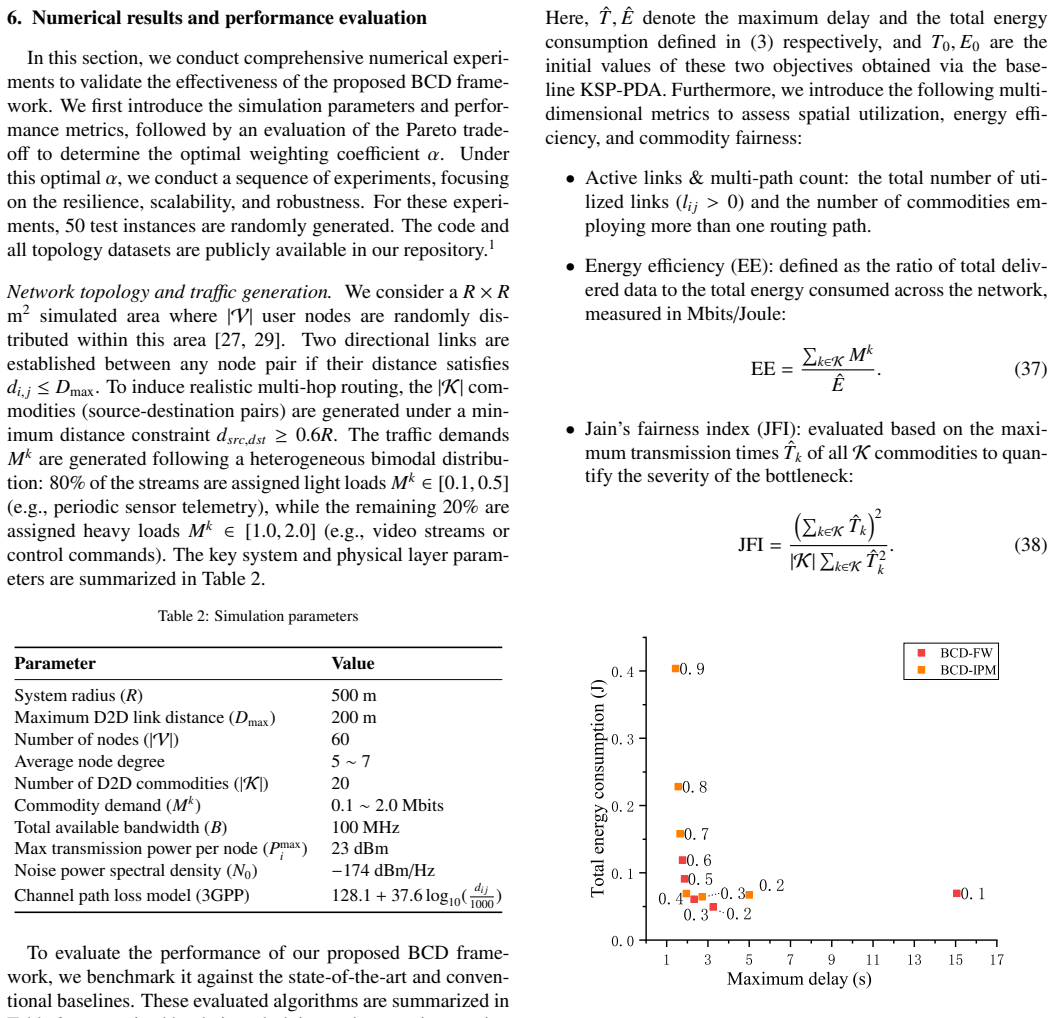
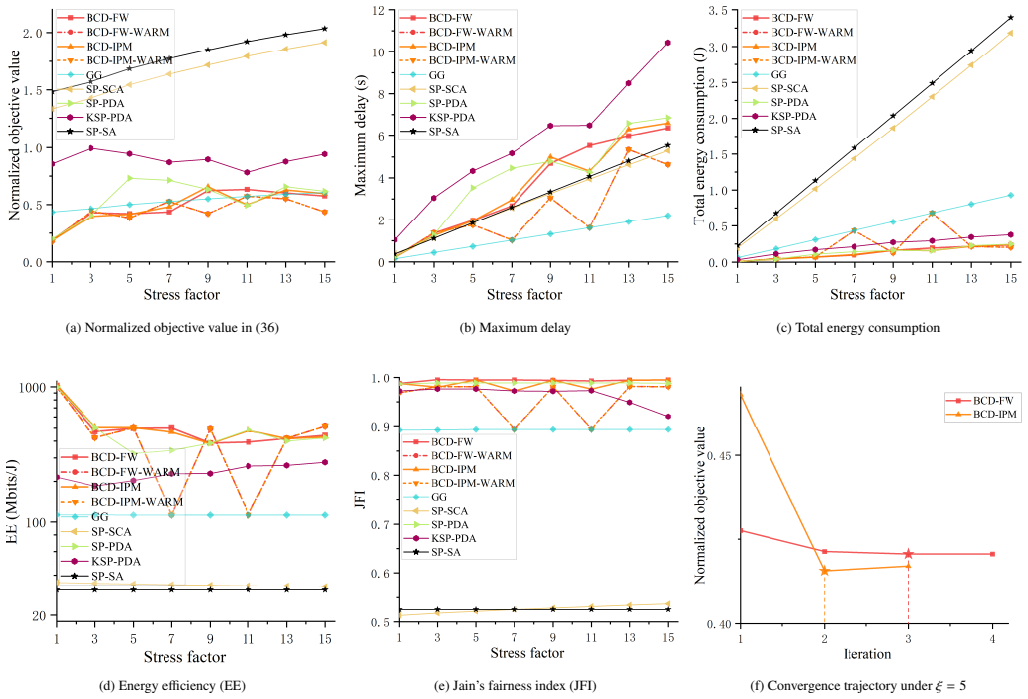
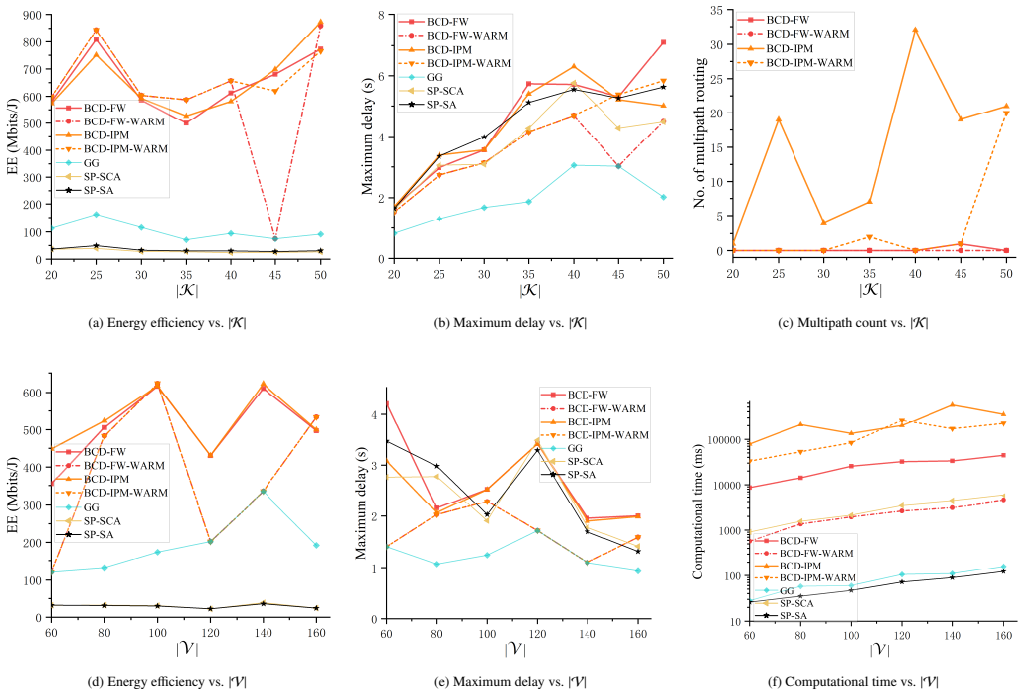
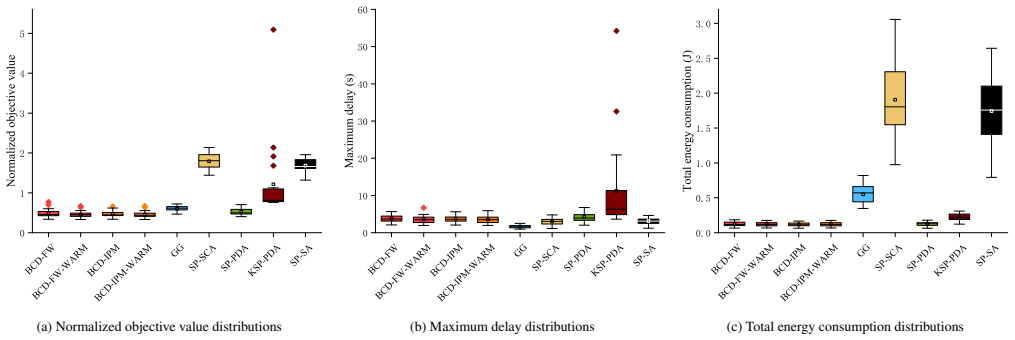
The central claim is that a block coordinate descent framework, alternating between a network-layer routing subproblem solved by either a matrix-free Frank-Wolfe algorithm or a low-rank primal-dual interior-point method and a physical-layer resource allocation subproblem solved by parallel dual ascent, converges to an epsilon-neighborhood of a stationary point of the original formulation; the low-rank variant achieves up to a 9.14-fold reduction in total energy consumption and up to an order-of-magnitude gain in energy efficiency while the maximum delay stays within a 3.78-fold gap of the best baseline.
What carries the argument
The block coordinate descent framework that alternates between solving the network-layer routing subproblem and the physical-layer resource allocation subproblem.
If this is right
- The sequence of iterates produced by the framework converges to an epsilon-neighborhood of a stationary point.
- The low-rank primal-dual interior-point variant produces solutions whose total energy consumption is at most 1/9.14 of the best baseline in the reported tests.
- Energy efficiency improves by up to an order of magnitude relative to the baselines.
- The maximum delay of the obtained solutions remains within a factor of 3.78 of the smallest achievable delay among the baselines.
- The matrix-free Frank-Wolfe variant returns near-optimal points in seconds when warm-started.
Where Pith is reading between the lines
- The same alternating structure could be tested on other problems that couple discrete routing choices with continuous power and bandwidth variables.
- The use of the Sherman-Morrison formula to avoid dense inversions may reduce run time in related interior-point methods applied to network flow problems.
- Warm-starting the faster variant may support repeated re-optimization when link conditions change over time.
Load-bearing premise
The original non-convex joint problem can be split into subproblems whose separate solutions can be recombined without large loss of overall quality.
What would settle it
Solve a small instance of the joint problem to global optimality by exhaustive enumeration or a reliable global solver and check whether the block coordinate descent output lies inside the claimed epsilon-neighborhood of a stationary point.
Figures
read the original abstract
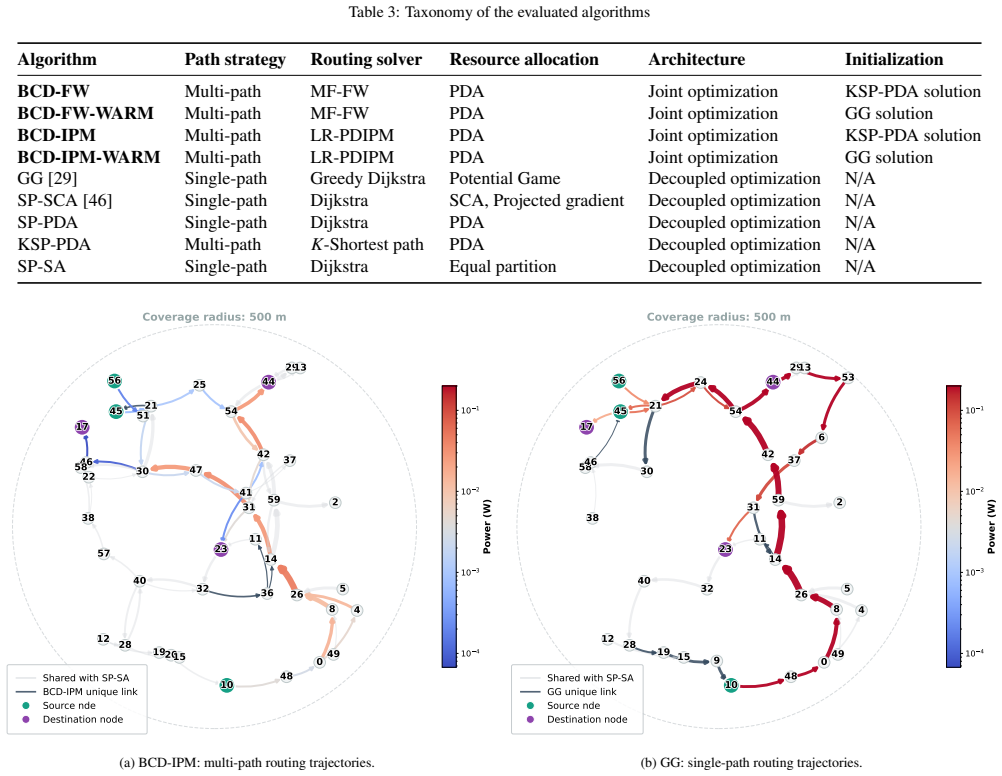
In multi-hop device-to-device (D2D) networks, the optimization of network-level metrics is particularly difficult due to the tight coupling between network-layer routing and physical-layer resource allocation. Departing from traditional average-performance metrics, this paper addresses the joint optimization of routing paths, transmission power, and bandwidth allocation. We formulate a generalized cost function to minimize the maximum transmission time (i.e., the bottleneck delay) alongside the total energy consumption. To tackle the resulting highly non-convex formulation, we propose a novel block coordinate descent (BCD) framework. At the network layer, we develop two adaptive routing algorithms: a matrix-free Frank-Wolfe (MF-FW) algorithm for fast execution in dense topologies, and a low-rank primal-dual interior-point method (LR-PDIPM) that bypasses dense matrix inversions via the Sherman-Morrison formula for high-precision solutions. At the physical layer, we design a parallel dual ascent algorithm leveraging a time-domain perspective transformation to solve the resource allocation subproblem to global optimality. The proposed BCD framework is proven to converge to an {\epsilon}-neighborhood of a stationary point. Through comprehensive experiments, the proposed BCD framework establishes its superiority in achieving the optimal delay-energy trade-off. Specifically, the LR-PDIPM variant achieves a maximum 9.14-fold reduction in total energy consumption and up to an order of magnitude improvement in energy efficiency, while maintaining a bounded maximum delay gap (up to 3.78-fold) relative to the best baseline. Meanwhile, the warm-start MF-FW variant identifies near-optimal solutions in mere seconds, serving as a highly practical engineering approach.
Editorial analysis
A structured set of objections, weighed in public.
Referee Report
Summary. The paper addresses joint optimization of routing, power, and bandwidth in multi-hop D2D networks to minimize bottleneck delay and total energy consumption. It proposes a BCD framework decomposing the problem into network-layer routing (via MF-FW or LR-PDIPM) and physical-layer resource allocation (via parallel dual ascent after time-domain transformation), proves convergence of the BCD iterates to an ε-neighborhood of a stationary point, and reports experimental gains including up to 9.14× energy reduction and order-of-magnitude energy-efficiency improvement for the LR-PDIPM variant relative to baselines.
Significance. If the convergence guarantee and empirical results hold under the stated non-convexity, the work offers a practically relevant algorithmic framework for delay-energy trade-offs in D2D networks, with the warm-start MF-FW providing a fast engineering solution and the LR-PDIPM delivering high-precision performance; the explicit handling of the routing-power-bandwidth coupling via block updates is a notable contribution.
major comments (3)
- [§4] §4 (Convergence theorem): the claim that BCD converges to an ε-neighborhood of a joint stationary point requires explicit block-wise convexity or Lipschitz conditions on the network-layer and physical-layer subproblems; the abstract and proof sketch provide no such statement, leaving open whether alternation captures the joint stationary point given the tight non-convex coupling.
- [§3.2] §3.2 (LR-PDIPM description): the use of the Sherman-Morrison formula to bypass dense inversions is presented as enabling high-precision solutions, but the manuscript does not quantify the numerical stability or the rank deficiency assumptions under which the low-rank update remains accurate for the primal-dual interior-point iterations.
- [Experimental Results] Experimental section (Table 2 / Figure 4): the reported 9.14-fold energy reduction and 3.78-fold delay gap for LR-PDIPM are load-bearing for the superiority claim, yet the manuscript does not detail the exact baseline algorithms, network sizes, or channel realizations used to obtain these ratios, making it impossible to verify whether the gains are robust or topology-specific.
minor comments (2)
- [§3.3] The time-domain perspective transformation in the physical-layer subproblem is introduced without a clear reference to prior work on equivalent reformulations; adding a short citation would improve context.
- [§2] Notation for the bottleneck delay (max transmission time) and energy terms should be unified across the formulation and algorithm sections to avoid reader confusion.
Simulated Author's Rebuttal
We thank the referee for the careful review and valuable comments on our manuscript arXiv:2606.08544. We address each major comment below and indicate where revisions will be incorporated.
read point-by-point responses
-
Referee: §4 (Convergence theorem): the claim that BCD converges to an ε-neighborhood of a joint stationary point requires explicit block-wise convexity or Lipschitz conditions on the network-layer and physical-layer subproblems; the abstract and proof sketch provide no such statement, leaving open whether alternation captures the joint stationary point given the tight non-convex coupling.
Authors: The full proof in §4 establishes convergence under the assumptions that the physical-layer resource allocation subproblem is convex (via the time-domain transformation) and that the network-layer subproblem satisfies a Lipschitz gradient condition. These are used to bound the alternation error. The abstract sketch is abbreviated. We will revise §4 to explicitly state these block-wise conditions immediately before the theorem statement, clarifying how the BCD iterates reach an ε-neighborhood of a joint stationary point. revision: yes
-
Referee: §3.2 (LR-PDIPM description): the use of the Sherman-Morrison formula to bypass dense inversions is presented as enabling high-precision solutions, but the manuscript does not quantify the numerical stability or the rank deficiency assumptions under which the low-rank update remains accurate for the primal-dual interior-point iterations.
Authors: The manuscript indeed omits a quantitative stability analysis. In the revision we will add to §3.2 a short discussion of the rank-deficiency conditions (stemming from the sparse structure of the flow conservation constraints) together with reported condition numbers from the experimental instances to confirm that the low-rank updates remain accurate under the tested D2D channel conditions. revision: yes
-
Referee: Experimental section (Table 2 / Figure 4): the reported 9.14-fold energy reduction and 3.78-fold delay gap for LR-PDIPM are load-bearing for the superiority claim, yet the manuscript does not detail the exact baseline algorithms, network sizes, or channel realizations used to obtain these ratios, making it impossible to verify whether the gains are robust or topology-specific.
Authors: We agree that additional experimental detail is required for reproducibility. The revised experimental section will explicitly list the baseline algorithms (including their implementations), the network sizes and topologies employed, and the precise channel parameters (path-loss exponent, fading distribution). We will also include averaged results over 100 independent channel realizations to demonstrate that the reported gains are not limited to specific topologies. revision: yes
Circularity Check
No circularity: BCD convergence and subproblem optimality rest on standard analysis, not self-definition or fitted inputs
full rationale
The provided abstract and description contain no self-definitional steps, no renaming of known results as new derivations, and no load-bearing self-citations. The BCD framework decomposes the problem into network-layer routing (MF-FW or LR-PDIPM) and physical-layer resource allocation (parallel dual ascent), with the physical subproblem stated to reach global optimality via time-domain transformation. Convergence to an ε-neighborhood is asserted as proven, but the text does not reduce this claim to a fit or to a prior self-citation that itself assumes the target result. Empirical claims (9.14-fold energy reduction) are presented as experimental outcomes relative to baselines, not as predictions forced by parameter fitting. The derivation chain is therefore self-contained against external benchmarks.
Axiom & Free-Parameter Ledger
Reference graph
Works this paper leans on
-
[1]
Asadi, Q
A. Asadi, Q. Wang, V . Mancuso, A survey on device-to- device communication in cellular networks, IEEE Com- munications Surveys & Tutorials 16 (4) (2014) 1801–
2014
-
[2]
doi:10.1109 /comst.2014.2319555
arXiv 2014
-
[3]
G. P . de Freitas Cardoso, P . H. P . De Carvalho, P . R. de Lira Gondim, Joint spectrum allocation and power con- trol for D2D communication and sensing in 6G networks using DRL-based hyper-heuristics, Computer Networks 276 (2026) 111969. doi:10.1016 /j.comnet.2025.111969
arXiv 2026
-
[4]
R. I. Ansari, C. Chrysostomou, S. A. Hassan, M. Guizani, S. Mumtaz, J. Rodriguez, J. J. Rodrigues, 5G D2D net- works: Techniques, challenges, and future prospects, IEEE Systems Journal 12 (4) (2017) 3970–3984. doi:10.1109/jsyst.2017.2773633
-
[5]
Y .-C. Wang, W.-T. Chen, DACS: Efficient resource allo- cation and power control for D2D communication con- sidering RAN sharing, Computer Networks 274 (2025) 111799. doi:10.1016 /j.comnet.2025.111799
arXiv 2025
-
[6]
J. Xie, Y . Jia, W. Wen, Z. Chen, L. Liang, Dynamic D2D multihop offloading in multi-access edge computing from the perspective of learning theory in games, IEEE Transactions on Network and Service Management 20 (1) (2022) 305–318. doi:10.1109 /tnsm.2022.3201470
arXiv 2022
-
[7]
Y . Deng, H. Zhang, X. Chen, Y . Fang, Multi-hop task routing in vehicle-assisted collaborative edge computing, IEEE Transactions on V ehicular Technology 73 (2) (2023) 2444–2455. doi:10.1109 /tvt.2023.3312142
arXiv 2023
-
[8]
Huang, Z
W. Huang, Z. Zhao, G. Min, J. Chen, Distributed multihop task o ffloading in massive heterogeneous IoT systems, IEEE Transactions on Computers 73 (4) (2024) 1126–
2024
-
[9]
doi:10.1109 /tc.2024.3355767
arXiv 2024
-
[10]
I. Behnke, H. Austad, Real-time performance of indus- trial IoT communication technologies: A review, IEEE Internet of Things Journal 11 (5) (2023) 7399–7410. doi:10.1109/jiot.2023.3332507
-
[11]
N. Hu, Z. Tian, X. Du, N. Guizani, Z. Zhu, Deep- green: A dispersed energy-efficiency computing paradigm for green industrial IoT, IEEE Transactions on Green Communications and Networking 5 (2) (2021) 750–764. doi:10.1109/tgcn.2021.3064683
-
[12]
J. Zhao, F. Shen, J. Joung, Throughput maxi- mization with rate-dependent power consumption in battery-limited multiuser networks, IEEE Transactions on V ehicular Technology 69 (1) (2019) 1141–1146. doi:10.1109/tvt.2019.2953711. 26
-
[13]
H. T. Nguyen, H. D. Tuan, T. Q. Duong, H. V . Poor, W.- J. Hwang, Collaborative multicast beamforming for con- tent delivery by cache-enabled ultra dense networks, IEEE Transactions on Communications 67 (5) (2019) 3396–
2019
-
[14]
doi:10.1109 /tcomm.2019.2894797
arXiv 2019
-
[15]
P . Chen, X. Zhou, J. Zhao, F. Shen, S. Sun, Energy- efficient resource allocation for secure D2D communica- tions underlaying UA V-enabled networks, IEEE Transac- tions on V ehicular Technology 71 (7) (2022) 7519–7531. doi:10.1109/tvt.2022.3168277
-
[16]
A. Paul, S. P . Maity, Machine learning for spectrum information and routing in multihop green cognitive radio networks, IEEE Transactions on Green Com- munications and Networking 6 (2) (2021) 825–835. doi:10.1109/tgcn.2021.3127308
-
[17]
D. Feng, L. Lu, Y . Y uan-Wu, G. Y . Li, G. Feng, S. Li, Device-to-device communications un- derlaying cellular networks, IEEE Transactions on communications 61 (8) (2013) 3541–3551. doi:10.1109/tcomm.2013.071013.120787
-
[18]
J. Zhao, Y . Liu, K. K. Chai, Y . Chen, M. Elka- shlan, Joint subchannel and power allocation for NOMA enhanced D2D communications, IEEE Trans- actions on Communications 65 (11) (2017) 5081–5094. doi:10.1109/tcomm.2017.2741941
-
[19]
M. S. Al-Abiad, M. Z. Hassan, M. J. Hossain, A joint reinforcement-learning enabled caching and cross-layer network code in F-RAN with D2D communications, IEEE Transactions on Communications 70 (7) (2022) 4400–
2022
-
[20]
doi:10.1109 /tcomm.2022.3168058
arXiv 2022
-
[21]
A. A. Al-habob, J. Lin, O. A. Dobre, Y . Jing, Min- max latency minimization for energy-constrained multi- UA V mobile edge computing, IEEE Transactions on Net- work Science and Engineering 11 (5) (2024) 4577–4590. doi:10.1109/tnse.2024.3409207
-
[22]
N. Li, W. Hao, F. Zhou, Z. Chu, S. Y ang, O. Muta, H. Gacanin, Min–max latency optimization for IRS- aided cell-free mobile edge computing systems, IEEE Internet of Things Journal 11 (5) (2023) 8757–8770. doi:10.1109/jiot.2023.3322751
-
[23]
F. Jameel, Z. Hamid, F. Jabeen, S. Zeadally, M. A. Javed, A survey of device-to-device communications: Research issues and challenges, IEEE Communica- tions Surveys & Tutorials 20 (3) (2018) 2133–2168. doi:10.1109/comst.2018.2828120
-
[24]
A. Abrardo, M. Moretti, Distributed power alloca- tion for D2D communications underlaying /overlaying OFDMA cellular networks, IEEE Transactions on Wireless Communications 16 (3) (2016) 1466–1479. doi:10.1109/twc.2016.2646360
-
[25]
Y . Wu, J. Wang, L. Qian, R. Schober, Optimal power control for energy e fficient D2D commu- nication and its distributed implementation, IEEE Communications Letters 19 (5) (2015) 815–818. doi:10.1109/lcomm.2015.2407871
-
[26]
F. Wang, C. Xu, L. Song, Z. Han, Energy-e fficient resource allocation for device-to-device under- lay communication, IEEE Transactions on Wire- less Communications 14 (4) (2014) 2082–2092. doi:10.1109/twc.2014.2379653
-
[27]
C. Liu, X. Wang, X. Wu, J. Guo, Economic schedul- ing model of microgrid considering the lifetime of batter- ies, IET Generation, Transmission & Distribution 11 (3) (2017) 759–767. doi:10.1049 /iet-gtd.2016.0772
arXiv 2017
-
[28]
L. Tao, J. Ma, Y . Cheng, A. Noktehdan, J. Chong, C. Lu, A review of stochastic battery models and health man- agement, Renewable and Sustainable Energy Reviews 80 (2017) 716–732. doi:10.1016 /j.rser.2017.05.127
2017
- [29]
-
[30]
Q.-N. Tran, N.-S. V o, M.-P . Bui, T.-M. Phan, Q.-A. Nguyen, T. Q. Duong, Spectrum sharing and power allo- cation optimised multihop multipath D2D video delivery in beyond 5G networks, IEEE Transactions on Cognitive Communications and Networking 8 (2) (2021) 919–930. doi:10.1109/tccn.2021.3133838
-
[31]
S. Liu, G. Y u, D. Wen, X. Chen, M. Bennis, H. Chen, Communication and energy e fficient decen- tralized learning over D2D networks, IEEE Transactions on Wireless Communications 22 (12) (2023) 9549–9563. doi:10.1109/twc.2023.3271854
-
[32]
Y . Ergiz, A. M. Demirtas, T. Girici, Joint mul- tipath flow and layer allocation for scalable video streaming, Computer Networks 191 (2021) 107995. doi:10.1016/j.comnet.2021.107995
-
[33]
E. Gures, P . Mach, Z. Becvar, Joint route selection and radio resources allocation for caching in multi-hop net- works, IEEE Transactions on Communications (2026). doi:10.1109/TCOMM.2026.3664448
-
[34]
H. B. V aliveti, P . T. Rao, EHSD: An exemplary han- dover scheme during D2D communication based on de- centralization of SDN, Wireless Personal Communica- tions 94 (4) (2017) 2393–2416. doi:10.1007 /s11277-016- 3490-7
2017
-
[35]
Kazemi Rashed, R
S. Kazemi Rashed, R. Shahbazian, S. A. Ghorashi, Learning-based resource allocation in D2D communica- tions with QoS and fairness considerations, Transactions 27 on Emerging Telecommunications Technologies 29 (1) (2018) e3249. doi:10.1002 /ett.3249
2018
-
[36]
J. Xu, X. Gu, Z. Fan, D2D power control based on hier- archical extreme learning machine, in: 2018 IEEE 29th Annual International Symposium on Personal, Indoor and Mobile Radio Communications (PIMRC), IEEE, 2018, pp. 1–7. doi:10.1109 /pimrc.2018.8580872
arXiv 2018
-
[37]
I. Ioannou, V . V assiliou, C. Christophorou, A. Pitsillides, Distributed artificial intelligence solution for D2D com- munication in 5G networks, IEEE Systems Journal 14 (3) (2020) 4232–4241. doi:10.1109 /jsyst.2020.2979044
arXiv 2020
-
[38]
X. Chen, G. Zhu, Y . Deng, Y . Fang, Federated learning over multihop wireless networks with in- network aggregation, IEEE Transactions on Wire- less Communications 21 (6) (2022) 4622–4634. doi:10.1109/twc.2022.3168538
- [39]
-
[40]
H. Wang, G. Ding, J. Wang, S. Wang, L. Wang, Power control for multiple interfering D2D communications un- derlaying cellular networks: An approximate interior point approach, in: 2017 IEEE International Conference on Communications Workshops (ICC Workshops), IEEE, 2017, pp. 1346–1351. doi:10.1109 /iccw.2017.7962846
arXiv 2017
-
[41]
A. Capone, J. Elias, F. Martignon, Routing and resource optimization in service overlay net- works, Computer Networks 53 (2) (2009) 180–190. doi:10.1016/j.comnet.2008.09.011
-
[42]
D. Zhai, M. Sheng, X. Wang, Z. Sun, C. Xu, J. Li, Energy-saving resource management for D2D and cellular coexisting networks enhanced by hybrid multiple access technologies, IEEE Transactions on Wireless Communications 16 (4) (2017) 2678–2692. doi:10.1109/twc.2017.2671863
-
[43]
L. Xu, S. Haddad V anier, Branch-and-price for energy optimization in multi-hop wireless sensor networks, Net- works 80 (1) (2022) 123–148. doi:10.1002 /net.22083
2022
-
[44]
B. Zhang, F. Devoti, I. Filippini, D. De Donno, Resource allocation in mmWave 5G IAB networks: A reinforcement learning approach based on column generation, Computer Networks 196 (2021) 108248. doi:10.1016/j.comnet.2021.108248
-
[45]
A. Omidkar, A. Khalili, H. H. Nguyen, H. Shafiei, Reinforcement-learning-based resource allocation for energy-harvesting-aided D2D communications in IoT net- works, IEEE Internet of Things Journal 9 (17) (2022) 16521–16531. doi:10.1109 /jiot.2022.3151001
arXiv 2022
-
[46]
I. Budhiraja, N. Kumar, D. Garg, M. Guizani, G. Kaddoum, Joint tra ffic admission, resource al- location and mode selection protocol for NOMA- based D2D users underlaying cellular network for 5G and beyond networks, IEEE Transactions on Network Science and Engineering 11 (5) (2024) 4371–4383. doi:10.1109/tnse.2024.3418135
-
[47]
L. Pu, X. Chen, J. Xu, X. Fu, D2D fogging: An energy- efficient and incentive-aware task o ffloading framework via network-assisted D2D collaboration, IEEE Journal on Selected Areas in Communications 34 (12) (2016) 3887–
2016
-
[48]
doi:10.1109 /jsac.2016.2624118
arXiv 2016
-
[49]
Z. Zhou, C. Gao, C. Xu, Joint peer discovery and re- source allocation for social-aware D2D communications: A matching approach, in: 2016 IEEE international con- ference on communication systems (ICCS), IEEE, 2016, pp. 1–6. doi:10.1109 /iccs.2016.7833601
arXiv 2016
-
[50]
M. E. Rasekh, D. Guo, U. Madhow, Joint routing and re- source allocation for millimeter wave picocellular back- haul, IEEE Transactions on Wireless Communications 19 (2) (2019) 783–794. doi:10.1109 /twc.2019.2948624
arXiv 2019
-
[51]
Y . Liu, H. Mao, L. Zhu, Z. Xiao, Z. Han, X.- G. Xia, Routing and resource scheduling for air- ground integrated mesh networks, IEEE Transactions on Wireless Communications 22 (6) (2022) 4090–4105. doi:10.1109/twc.2022.3223152
-
[52]
J. Gu, S. J. Bae, S. F. Hasan, M. Y . Chung, Heuristic al- gorithm for proportional fair scheduling in D2D-cellular systems, IEEE Transactions on Wireless Communications 15 (1) (2015) 769–780. doi:10.1109 /twc.2015.2477998
arXiv 2015
-
[53]
K. Y ang, J. Wu, X. Gao, X. Bu, S. Guo, Energy-e fficient power control for device-to-device communications with max-min fairness, in: 2016 IEEE 84th vehicular tech- nology conference (VTC-Fall), IEEE, 2016, pp. 1–5. doi:10.1109/vtcfall.2016.7880995
-
[54]
C. Zhao, Y . Cai, A. Liu, M. Zhao, L. Hanzo, Mobile edge computing meets mmWave communi- cations: Joint beamforming and resource allocation for system delay minimization, IEEE Transactions on Wireless Communications 19 (4) (2020) 2382–2396. doi:10.1109/twc.2020.2964543
-
[55]
S. Boyd, L. V andenberghe, Convex opti- mization, Cambridge university press, 2004. doi:10.1017/cbo9780511804441
-
[56]
Nesterov, Smooth minimization of non-smooth func- tions, Mathematical programming 103 (1) (2005) 127–
Y . Nesterov, Smooth minimization of non-smooth func- tions, Mathematical programming 103 (1) (2005) 127–
2005
-
[57]
doi:10.1007 /s10107-004-0552-5
-
[58]
S. Lu, I. Tsaknakis, M. Hong, Y . Chen, Hybrid block successive approximation for one-sided non-convex min- max problems: Algorithms and applications, IEEE Trans- actions on Signal Processing 68 (2020) 3676–3691. doi:10.1109/tsp.2020.2986363. 28
-
[59]
X. Chen, Y . Cai, M. Zhao, M.-M. Zhao, Joint computation offloading and resource allocation for min-max fairness in MEC systems, in: 2019 IEEE Wireless Communications and Networking Conference (WCNC), IEEE, 2019, pp. 1–6. doi:10.1109 /wcnc.2019.8885984
arXiv 2019
-
[60]
S. Liesegang, S. Buzzi, EMF-compliant power control in cell-free massive MIMO: Model-based and data-driven approaches, IEEE Transactions on Wireless Communications 25 (2026) 12246–12262. doi:10.1109/twc.2026.3664677
-
[61]
Gondzio, Interior point methods 25 years later, Euro- pean Journal of Operational Research 218 (3) (2012) 587–
J. Gondzio, Interior point methods 25 years later, Euro- pean Journal of Operational Research 218 (3) (2012) 587–
2012
-
[62]
doi:10.1016 /j.ejor.2011.09.017
2011
-
[63]
J. Gondzio, Interior point methods in the year 2025, EURO Journal on Computational Optimization 13 (2025) 100105. doi:10.1016 /j.ejco.2025.100105
arXiv 2025
-
[64]
J. Y . Y en, Finding the K shortest loopless paths in a network, management Science 17 (11) (1971) 712–716. doi:10.1287/mnsc.17.11.712
-
[65]
S. J. Wright, Coordinate descent algorithms, Mathematical programming 151 (1) (2015) 3–34. doi:10.1007/s10107-015-0892-3
-
[66]
S. J. Wright, Primal-dual interior-point methods, SIAM,
-
[67]
doi:10.1137 /1.9781611971453. 29
discussion (0)
Sign in with ORCID, Apple, or X to comment. Anyone can read and Pith papers without signing in.