REVIEW 3 major objections 5 minor 8 references
Exponential Tethers for Accelerated Space Elevator Deployment
T0 review · 3 major / 5 minor · reviewed 2026-08-11 · deepseek-v4-flash
Pith's one-line read The paper claims that using an exponential taper profile for a space elevator tether enables a reel-to-reel construction method that lifts tether material faster than climber-based methods, making a 51 GPa tether competitive with a 65 GPa…
desk verdict A promising concept paper with one mislabeled headline claim—worth refereeing after the conclusion is corrected. read the letter →
The pith
A machine-rendered reading of the paper's core claim, the machinery that carries it, and where it could break.
The reading
What carries the argument
The exponential tether, whose cross-section varies as $A(r)=A_0 e^{\gamma r}$ with distance $r$ from the planet's center. Its defining property is that a translation by distance $d$ multiplies the cross-section by the constant $e^{\gamma d}$ everywhere, so the taper profile is unchanged. That property turns a tether into its own lifting mechanism: material fed in at the anchor travels up the tether while the tether itself is being reeled at the counterweight, and the stress analysis reduces to a first-order equation for stress $\sigma$ along the tether. The analysis also introduces the critical strength $\sigma_c = 63$ GPa for Earth, below which inverse taper (negative $\gamma$) is impossible and reel-to-reel buildup cannot run.
What would settle it
Run a full dynamic simulation of a reel-to-reel elevator with a free counterweight and finite tether stiffness; if at any point during reeling the local stress exceeds the material strength (for example, 51 GPa in the headline comparison) or the tether loses tension at the anchor, the central claim fails. A simpler laboratory analogue would be a scale-model descending and ascending tapered string under gravity with a moving boundary, checking whether the exponential profile is actually preserved.
Extended reading notes
Core claim
The central discovery is that an exponential tether profile, with cross-section $A(r)=A_0 e^{\gamma r}$, is invariant under translation up to a constant multiplier, so reeling material in at one end and out at the other grows the elevator without changing its taper. This makes it possible to construct a space elevator by continuously feeding tether material from the ground and spooling it at the counterweight, with the lifted material contributing its own strength to support the material below it. Analyzing the growth rates, the paper finds reel-to-reel buildup is fastest for strengths above 72 GPa, roughly matches climber-based buildup at 65 GPa, and that redeploy-and-splice extends competitive buildup to weaker tethers down to around 42 GPa. The conclusion draws the practical consequence: if carbon nanotube materials fall short of expected strengths, exponential tethers may keep a space elevator feasible.
Load-bearing premise
The analysis treats the tether as inextensible and static with the counterweight fixed at constant altitude while reeling, so if elasticity or dynamic motion changes the stress distribution, the claimed buildup rates may not be attainable.
Editorial extensions
If this is right
- For tethers stronger than about 72 GPa, reel-to-reel buildup gives the shortest doubling times of any method considered.
- At 51 GPa, redeploy-and-splice achieves the same buildup rate as the standard climber method at 65 GPa, lowering the strength threshold for a viable elevator.
- The breeder elevator can clone an existing elevator in roughly four to five anchor-to-counterweight reeling times, expected under four months with the paper's baseline parameters.
- Because the final ribbon is pulled up from the ground rather than spliced at altitude, the resulting tether has no high-altitude ribbon splices, which may allow a lower safety factor and easier ground repairs.
- Exponential tethers can also deliver construction material to other space projects more efficiently than climbers, since reeling lifts material that is itself load-bearing.
Reading between the lines
- Editorial inference: The translation-invariance property should apply to any body with a stable synchronous orbit, not just Earth, so the same reel-to-reel strategy could be adapted to lunar or planetary elevators with a rescaled critical strength.
- Editorial inference: If dynamic simulations confirm that counterweight motion can be controlled during reeling, the construction time savings would compound because the elevator spends less time at small cross-section, reducing its exposure to debris and wind damage.
- Editorial inference: The paper's implicit assumption that exponential and uniform-stress tethers use the same maximum stress deserves testing; if exponential tethers can tolerate lower safety factors, their effective advantage over climber-based buildup grows further.
- Editorial inference: The redeploy-and-splice and pull-down variants suggest a staged construction sequence: start with a weaker exponential tether, use redeploy-and-splice to build up to a strength threshold, then switch to reel-to-reel for final buildup—a hybrid the paper only sketches.
Signed reviews
Editorial analysis
A structured set of objections, weighed in public.
Referee Report
Summary. This paper introduces exponential taper profiles for space elevator tethers and argues that, because translating an exponential tether merely scales its cross-section, tether material can be lifted by reeling it in at the counterweight and paying it out at the anchor. The author derives the stress/tension equations for exponential tethers, computes a critical strength σc = 63.0 GPa below which inverse taper is impossible, and describes several buildup schemes: reel-to-reel, pull-down, breeder, and redeploy-and-splice. Growth rates are compared to Edwards's climber-based method, with the central quantitative claim that a 51 GPa tether can be built up as fast as a 65 GPa tether using the currently accepted climber method.
Significance. The paper's core insight — that exponential taper makes the tether shape invariant under translation, enabling reel-to-reel material transport — is elegant and well motivated. The derivations are from first principles, contain no fitted parameters, and the comparison with climber methods uses independent formulas. The author is explicit about the main simplifications: no elasticity, no dynamics, and a fixed counterweight altitude. If the conclusions survive correction of the 51 GPa misattribution, the paper offers a potentially significant acceleration of space elevator construction and a route to using weaker tether materials. The quantitative growth-rate analysis provides a useful baseline for future, more detailed engineering studies.
major comments (3)
- [Conclusion (contrast §2.1 and §3.3)] The concluding sentence 'With the reel-to-reel technique, a 51 GPa tether can be built up as fast as a 65 GPa tether with the currently accepted climber based method' is not supported by the paper's own analysis. Section 2.1 states that reel-to-reel buildup requires inverse taper and therefore requires the tether strength to exceed the critical strength σc = 63.0 GPa (Eq. 7). Section 3.3 attributes the 51 GPa equivalence explicitly to the redeploy-and-splice method: 'The redeploy and splice method does as well at 51 GPa as the climber method does at 65 GPa.' The conclusion therefore misattributes the result to the wrong buildup technique. This must be corrected before the paper can be accepted, because it directly affects the paper's headline practical message.
- [§3.2 (and §2.1.2)] The reel-to-reel growth rate Γ = -γv is derived under the assumption that the counterweight stays at a fixed altitude during buildup, with the special mass condition M_c = -ρA(r_c)/γ. The author acknowledges in §2.1.2 that the counterweight altitude may have to change as material is reeled in. Because the counterweight mass and tension change with time, a moving counterweight will alter the stress distribution and could change the allowable taper ratio. The paper should provide a sensitivity analysis or a bound quantifying the effect of counterweight motion on the doubling times reported in Figure 4, rather than only flagging the issue in the text.
- [§1 (model assumptions) and Conclusion] The self-similarity property that underlies the entire buildup method is derived for an inextensible, static tether. The reel-to-reel process is intrinsically dynamic, and an elastic tether will experience longitudinal deformation and stress waves during reeling. The author correctly states in the Conclusion that 'the analysis ignores the effects of elasticity, and does not take dynamic effects into account,' but this caveat is not carried into the abstract or the headline numerical comparisons. Because the growth-rate claims are quantitative, the paper should either (a) add a prominent disclaimer that the quoted doubling times are idealized static estimates, or (b) present a first-order dynamic/elastic analysis to justify their robustness.
minor comments (5)
- [Title] The title contains a typographical spacing in 'Deploy ment'; the body text uses 'Deployment' correctly.
- [§2.1.1] The claim that there is 'no high altitude ribbon splicing, unlike climber based buildup' should be qualified, because §2.4's redeploy-and-splice method involves splicing at the counterweight; perhaps the author means no splicing along the length during normal reel-to-reel operation.
- [§3.1] The comparison with Edwards's numbers is left as 'the reason for this mismatch is not clear'; the author should either reproduce Edwards's calculation or state more explicitly what input parameters differ.
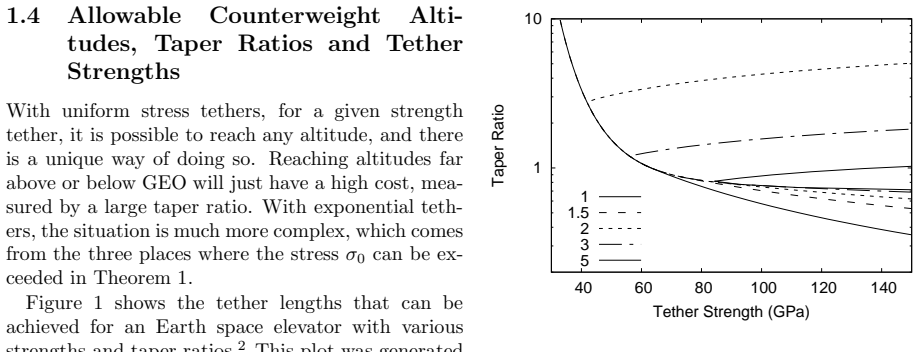
- [Figure 4] The curves in Figure 4 are not directly labeled; adding a legend or labels keyed to the text would improve readability, especially because the log-scale axis is used for the doubling time.
- [References] Reference [6] gives a URL for Cline's work that may be ephemeral; consider citing an archived version or a stable mirror.
Circularity Check
No circular derivation: all quantitative results follow from stated equilibrium mechanics; the conclusion's 51 GPa attribution is a non-circular internal inconsistency.
full rationale
The derivation is self-contained. The exponential profile A(r)=A0 e^{γr} and its translation property are definitions, not fitted results. Reel-to-reel growth rate -γv follows directly from that translation property, while the feasibility conditions in Sections 2.1 and 3.2 come from integrating the equilibrium equation dT/dr = -ρA g with stated boundary conditions (zero anchor tension, counterweight mass chosen as -ρA(rc)/γ). The climber comparison uses Eq. (9), which is independently derived from a climber spacing/payload model and Edwards' published parameters; no parameter is adjusted to force the 51 vs 65 GPa comparison. Eq. (7) for the 63 GPa critical strength is likewise a direct integral of the equilibrium equation. The only flagged issue is a consistency error, not circularity: the conclusion attributes the "51 GPa ... as fast as a 65 GPa" result to "the reel-to-reel technique," whereas Section 3.3 explicitly assigns that result to redeploy and splice ("The redeploy and splice method does as well at 51 GPa as the climber method does at 65 GPa") and Section 2.1 requires reel-to-reel strengths above the 63 GPa critical strength. This mislabeling does not arise from using the redeploy-and-splice result as an input to the reel-to-reel derivation; the redeploy-and-splice growth rate Eq. (10) is computed independently. Theorem 1 is stated without proof, but the numerical comparisons rely on direct integration rather than the theorem. The acknowledged neglect of elasticity and dynamics is a stated limitation, not a circular dependency.
Assumptions & free parameters
free parameters (3)
- Tether density =
1300 kg/m^3
- Reeling/climber speed =
200 km/h
- Climber spacing =
3 days (and other intervals)
assumptions (5)
- domain assumption The tether is inextensible.
- domain assumption The tether lies in the equatorial plane.
- domain assumption The tether is in static equilibrium.
- ad hoc to paper The exponential taper profile is the design choice for buildup.
- domain assumption The climber-based uniform-stress elevator is the appropriate baseline.
Cite this review
Pith. "Pith review of Exponential Tethers for Accelerated Space Elevator Deployment." pith.science (2026). https://pith.science/paper/JWOYP2M4
@misc{pith2026241217198,
  author       = {Pith},
  title        = {Pith review of: Exponential Tethers for Accelerated Space Elevator Deployment},
  year         = {2026},
  howpublished = {\url{https://pith.science/paper/JWOYP2M4}},
  note         = {Machine review of arXiv:2412.17198}
}
read the original abstract
An exponential space elevator is a space elevator with a tether cross-section that varies exponentially with altitude. With such an elevator it is possible to reel in tether material at one end of the elevator while reeling out at the other end, without changing the overall taper profile. I show how to use this property to build up or clone a space elevator much more efficiently than with standard climber-based methods.
Figures


Figures from the paper (1 more)

Reference graph
Works this paper leans on
-
[1]
write newline
" write newline "" initialize.prev.this.status FUNCTION begin.bib preamble empty 'skip preamble write newline if " thebibliography " longest.label * " " * write newline " [1] #1 " write newline " url@rmstyle " write newline " " write newline " [2] #2 " write newline " =0pt " write newline " " ALTinterwordstretchfactor * " " * write newline " = 2 plus " wr...
-
[2]
Y. Artsutanov, ``V kosmos na electrovoze (into space with the help of an electric locomotive),'' Komsomolskaya Pravda, 1960
work page 1960
-
[3]
Lvov, ``Sky-hook: Old idea,'' Nature, vol
V. Lvov, ``Sky-hook: Old idea,'' Nature, vol. 158, no. 3803, pp. 946--947, Nov. 1967
work page 1967
-
[4]
J. Pearson, ``The orbital tower: a spacecraft launcher using the Earth's rotational energy.'' Acta Astronautica, vol. 2, pp. 785--799, 1975
work page 1975
-
[5]
A. C. Clarke, The Fountains of Paradise. 1em plus 0.5em minus 0.4em Warner Books, 1978
work page 1978
-
[6]
B. Edwards and E. Westling, The Space Elevator. 1em plus 0.5em minus 0.4em Spageo Inc., 2002
work page 2002
-
[7]
J. Cline, ``Comments on Edwards tether,'' http://www.kestsgeo.com/pages/cobetse.html, (mirrored at Cline's request at\\ http://www.gassend.com/spaceelevator/cline/), 2002
work page 2002
-
[8]
E. A. Westling, ``Space elevator budget and economics,'' Sept. 2003, talk at the 2003 Space Elevator Conference
work page 2003
Reviewed August 11, 2026 · model on record in the stance chip above.
Discussion (0). Continue with ORCID to comment.