REVIEW 2 major objections 6 minor 30 references
Six universal ML force fields keep lunar minerals stable in short MD runs, but Fe and Ti environments need more care.
Reviewed by Pith at T0; open to challenge. T0 means a machine referee read the full paper against a public rubric. the ladder, T0–T4 →
T0 review · grok-4.5
2026-07-13 01:03 UTC pith:JWRTJLMC
load-bearing objection Useful first head-to-head of six foundation MLIPs on the four main lunar minerals, with honest scope and a public repo; short fixed-cell NVT vs static refs is the real limit, not a hidden flaw. the 2 major comments →
Benchmarking Universal Machine Learning Force Fields for Molecular Dynamics of Lunar Regolith Minerals
The pith
A machine-rendered reading of the paper's core claim, the machinery that carries it, and where it could break.
Core claim
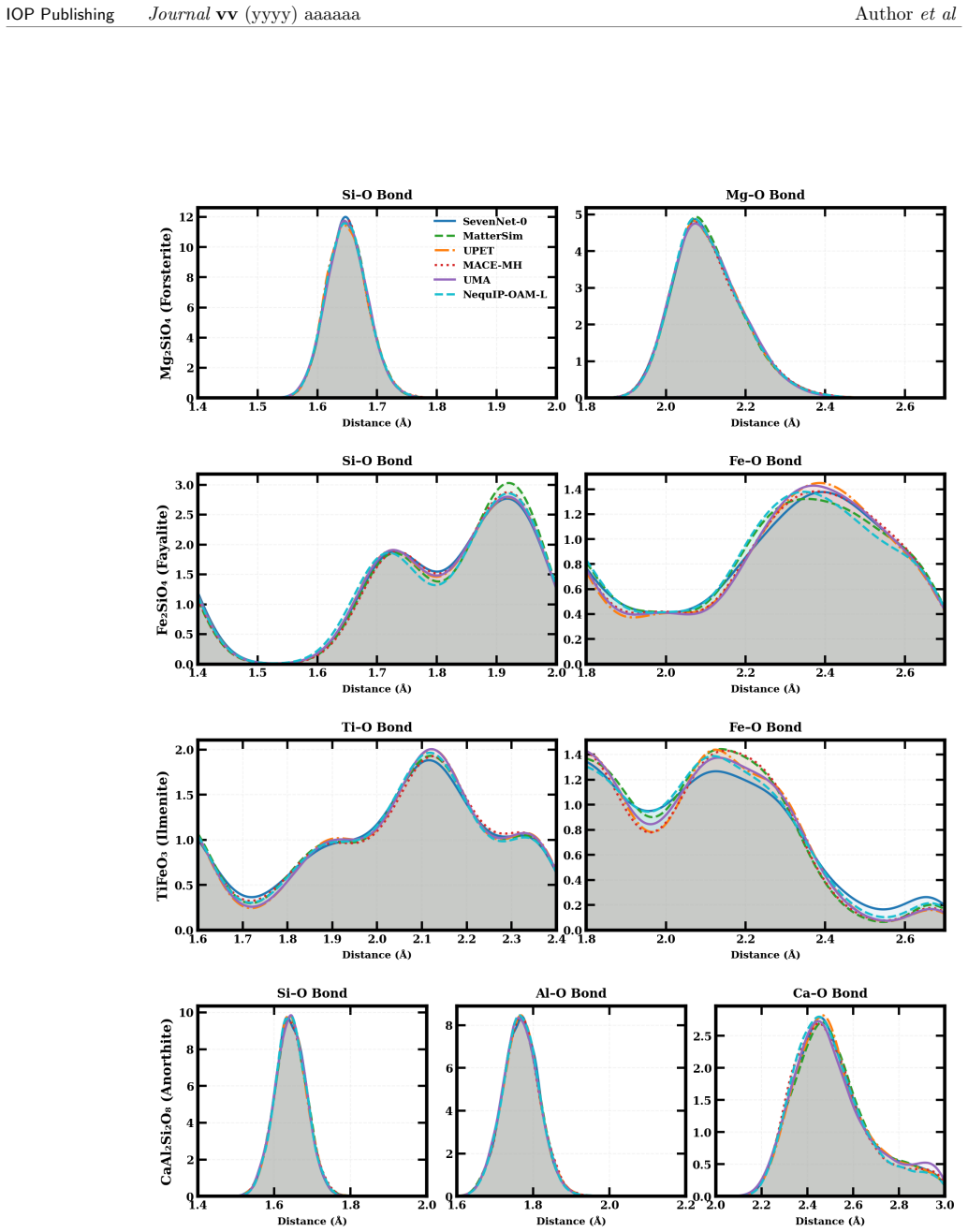
Across six foundation models, short NVT MD trajectories of four representative lunar minerals remain stable at 300 K; Si–O, Mg–O, Al–O and Ca–O first-shell distances and angles stay close to crystallographic ranges, while Fe–O and Ti–O distributions are systematically broader, and hydroxylated surfaces yield consistent O–H distances, establishing an initial transferability baseline for lunar-mineral simulations.
What carries the argument
A uniform six-model NVT MD protocol on fixed crystallographic supercells of forsterite, fayalite, ilmenite and anorthite, scored by temperature stability, first-shell bond statistics, bond-angle distributions and partial radial distribution functions against static crystallographic references, plus hydroxylated-surface O–H checks and single-GPU throughput/memory profiling.
Load-bearing premise
That one-picosecond fixed-cell runs at room temperature, compared only to static crystal structures rather than finite-temperature first-principles dynamics or experiment, are enough to judge model transferability and to attribute the extra Fe and Ti fluctuations to artificial softening of the potentials.
What would settle it
Run the same four minerals with each model for nanoseconds or longer, or against finite-temperature AIMD/DFT references that include magnetic and correlation effects for Fe and Ti; if the Fe–O and Ti–O shells then collapse to the same width as the Si–O shells, or if the crystals become unstable, the present transferability claim fails.
If this is right
- Ordered Mg- and Ca-bearing lunar silicates can already be screened with these foundation models without material-specific reparameterization.
- Fe- and Ti-bearing phases require targeted fine-tuning on lunar-relevant ground-truth data before redox or space-weathering simulations are trusted.
- Consistent O–H distances make the models usable starting points for high-throughput hydroxyl-stability and volatile-retention screens.
- SevenNet-0, MatterSim and UPET currently offer the highest practical throughput for short MD screening on a single high-end GPU.
- The same protocol supplies a reusable baseline for later extensions to defects, amorphous surfaces, impacts and polar-sample chemistry.
Where Pith is reading between the lines
- If the broader Fe–O/Ti–O fluctuations really come from missing spin or correlation physics, foundation-model developers may need explicit magnetic or DFT+U training data before multi-element lunar regolith models become reliable.
- The clear performance ranking suggests that mixed-model workflows—fast screening with SevenNet-0/MatterSim followed by higher-cost refinement—could become standard for large-scale ISRU or space-weathering campaigns.
- Because O–H consistency holds even on Fe- and Ti-bearing surfaces, the next decisive test is whether the same models preserve proton-transfer barriers and water-formation pathways under solar-wind conditions.
Editorial analysis
A structured set of objections, weighed in public.
Referee Report
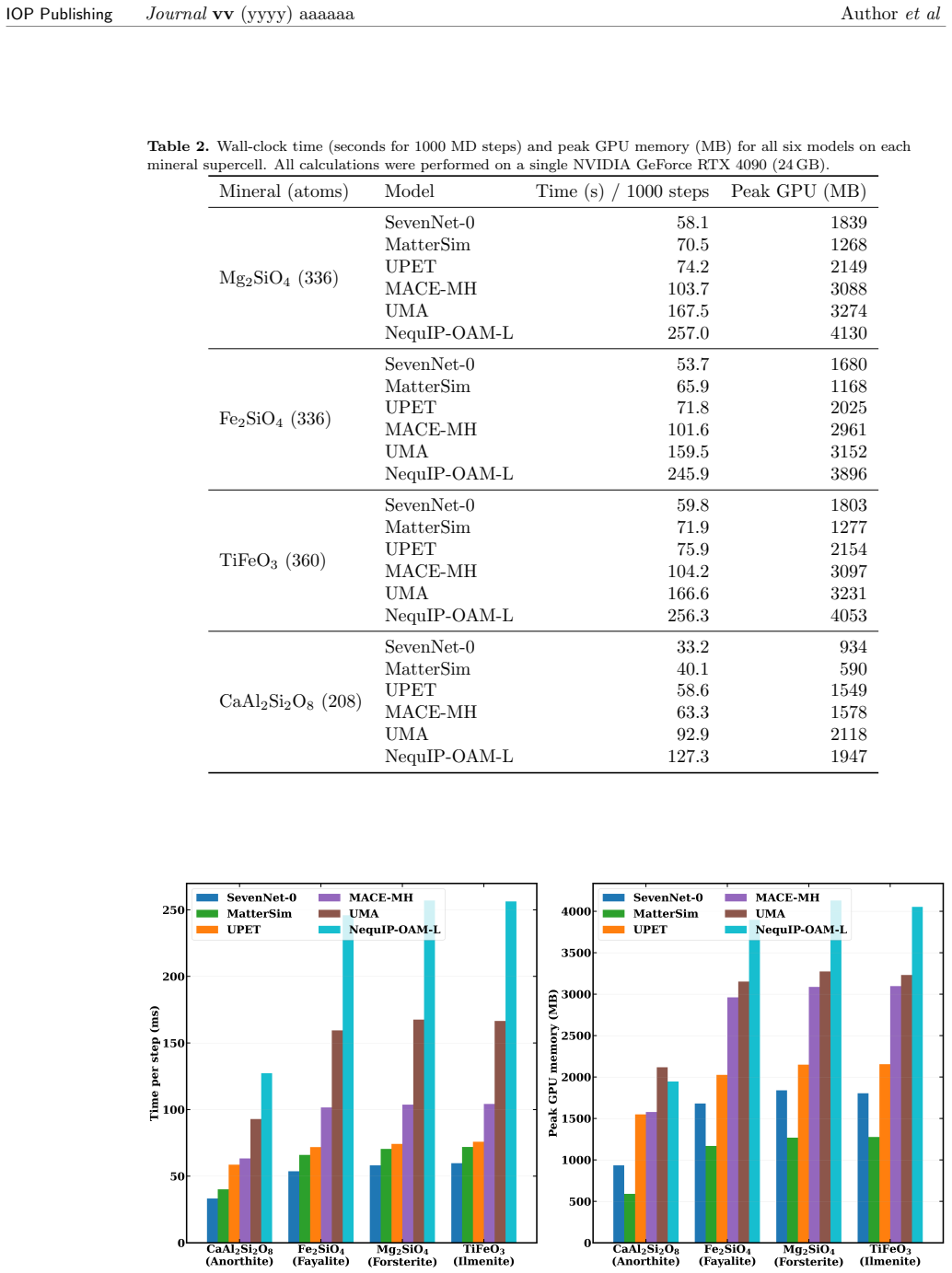
Summary. This manuscript benchmarks six universal machine-learning interatomic potentials (MACE-MH, MatterSim, SevenNet-0, UPET, UMA, NequIP-OAM-L) on short NVT molecular-dynamics trajectories of four lunar-relevant minerals (forsterite, fayalite, ilmenite, anorthite) plus simple hydroxylated surfaces. Structural fidelity is assessed via temperature stability, first-shell bond distances and angles, and partial RDFs against static crystallographic ranges (Table 1, Figs. 2–5); O–H distances on hydroxylated slabs are also compared (Fig. 6); and wall-clock time and peak GPU memory are reported on an RTX 4090 (Table 2, Fig. 7). All 24 model–mineral combinations remain stable over 1 ps at 300 K. Si–O, Mg–O, Al–O and Ca–O environments are reproduced reasonably well, while Fe–O and Ti–O distributions are broader; O–H distances are consistent across models. The authors frame the work as an initial transferability baseline and explicitly call for ab initio validation and fine-tuning before redox or volatile-reaction applications.
Significance. If the reported stability, structural statistics and performance ranking hold, the paper supplies a timely, reproducible baseline for applying foundation MLIPs to lunar regolith mineralogy—an area previously limited by sparse reactive force-field parameterizations. The multi-model head-to-head design, public repository of structures and scripts, and explicit GPU throughput/memory numbers are concrete strengths that lower the barrier for subsequent fine-tuning and larger-scale space-weathering or ISRU simulations. The scoped claim (short-timescale ordered crystals plus simple OH surfaces) is appropriate for an initial benchmark and is useful to the planetary-materials and computational-materials communities even without new reaction pathways.
major comments (2)
- §3.3 and Table 1: The attribution of broader Fe–O/Ti–O standard deviations to “artificial softening” of the potential around transition metals (lack of spin-dependent features, shallower minima relative to DFT+U) is presented as the likely explanation, yet the only references are static crystallographic first-shell ranges, not finite-temperature AIMD or experiment. The paper already notes this limitation in §4; the Discussion should either (i) soften the causal language to “consistent with possible softening, pending AIMD comparison” or (ii) add a short AIMD or literature thermal-broadening comparison for at least one Fe/Ti phase so the claim is not left as an untested inference.
- Methods 2.3–2.4 and §3.1: The central stability/transferability claim rests on 1 ps fixed-cell NVT trajectories after FIRE relaxation to 0.05 eV/Å. That protocol is adequate for an initial screen, but the manuscript should state more explicitly in the Abstract/Conclusions that the benchmark does not yet constrain thermal expansion, equation of state, defect energetics, or reaction barriers—quantities that matter for the space-weathering and ISRU applications listed in the Abstract. A single clarifying sentence would prevent over-reading of the present results.
minor comments (6)
- Abstract and Introduction: “remains elucidated” appears to be a wording error; “remains to be elucidated” or “remains unclear” is intended.
- Figure 1 caption lists forsterite/fayalite order inconsistently with the panel labels (a–d); align caption order with the figure layout.
- Table 1 vs. Methods 2.4: Bond-distance cutoffs used for analysis (e.g., Mg/Fe–O 2.8 Å in text, 2.7 Å in Fig. 4 caption) should be made fully consistent across Methods, figure captions and table footnotes.
- Figure 3 caption states bin width 0.03 Å while Methods 2.4 states 0.02 Å; reconcile.
- §2.2: Brief one-line notes on the training-data coverage of UMA and NequIP-OAM-L (analogous to the MPtrj/OMAT notes for the other models) would help readers interpret the Fe/Ti performance differences.
- Performance section: Peak-memory entries that are “unavailable” for some backends are mentioned in Methods but not flagged in Table 2; a footnote would avoid confusion.
Circularity Check
Empirical head-to-head MLIP benchmark against external crystallographic structures and GPU timings; no fitted inputs renamed as predictions and no load-bearing self-citation chain.
full rationale
The paper is a transferability and performance benchmark, not a derivation of a physical law or a fitted predictive model. Six foundation MLIPs are applied as black-box force calculators to four lunar mineral supercells (and simple hydroxylated slabs) under fixed-cell NVT MD at 300 K. Structural fidelity is assessed by comparing MD bond distances, angles, and partial RDFs to static first-shell ranges recomputed from independent crystallographic supercells (Hazen, Smyth, Wechsler & Prewitt, Wainwright & Starkey) and to Materials Project structures. Stability is reported as the absence of atom ejection or bond divergence over 1 ps; O–H distributions are reported as observed consistency across models; wall-clock time and peak GPU memory are measured on an RTX 4090. No free parameters are fitted to the lunar-mineral data and then re-presented as predictions. Self-citations to the authors’ prior ReaxFF lunar MD papers appear only as motivation for the application domain and do not underwrite the numerical results. The authors themselves scope the work as an “initial benchmark” and flag the need for ab initio validation and fine-tuning of Fe/Ti environments. Consequently the derivation chain is self-contained against external references and contains no circular reduction.
Axiom & Free-Parameter Ledger
free parameters (4)
- species-pair bond cutoffs =
Si–O 2.0 Å; Mg/Fe–O 2.8 Å; Ti–O 2.6 Å; Al–O 2.4 Å; Ca–O 3.2 Å
- FIRE force convergence threshold =
0.05 eV/Å
- NVT trajectory length and timestep =
Δt = 1.0 fs, 1000 steps
- surface protonation geometry =
0.98 Å initial O–H; 1.0 Å height cutoff
axioms (4)
- domain assumption Static crystallographic first-shell distance ranges are valid external references against which finite-temperature MD means and widths can be judged.
- ad hoc to paper Successful completion of 1 ps NVT without atom ejection or bond divergence constitutes a meaningful stability and transferability check for lunar compositions.
- domain assumption Broader Fe–O and Ti–O distributions relative to Si–O primarily reflect artificial softening of the ML potential energy surface rather than physical thermal or magnetic effects.
- domain assumption The six chosen foundation models (MACE-MH, MatterSim, SevenNet-0, UPET, UMA, NequIP-OAM-L) are representative of the current generation of universal MLIPs.
read the original abstract
Universal machine-learning interatomic potentials provide a promising route for accelerating molecular dynamics simulations of materials, but their transferability to lunar regolith-relevant silicates, oxides, and hydrogen-bearing surface species remains elucidated. Here, we benchmark six foundation models, MACE-MH, MatterSim, SevenNet-0, UPET, UMA, and NequIP-OAM-L, using NVT molecular dynamics simulations of four representative lunar minerals: forsterite, fayalite, ilmenite, and anorthite. Structural fidelity is evaluated using temperature stability, bond-distance statistics, bond-angle distributions, and partial radial distribution functions, with comparison to crystallographic reference data. The models reproduce Si--O, Mg--O, Al--O, and Ca--O local environments reasonably well, while Fe--O and Ti--O coordination environments show broader distributions and larger short-timescale fluctuations, highlighting the need for further validation and fine tuning with additional ground truth data for Fe- and Ti-bearing lunar phases. Hydroxylated surface tests show consistent O--H bond-distance distributions across models and minerals, suggesting that these foundation models may provide useful starting points for screening surface hydroxyl stability and volatile-related processes. Performance benchmarks on a single NVIDIA RTX 4090 show that SevenNet-0, MatterSim, and UPET provide the highest throughput among the six tested models, MACE-MH remains practical at intermediate cost, and UMA and NequIP-OAM-L extend the comparison to newer foundation potentials at higher runtime cost and memory demand. These results provide an initial benchmark for applying universal foundation models to lunar mineral simulations and identify key directions for future ab initio validation, model fine-tuning, and applications to lunar volatile evolution, space weathering, ISRU, and polar sample return studies.
Figures




Reference graph
Works this paper leans on
-
[1]
I. Batatia et al. A foundation model for atomistic materials chemistry.arXiv preprint arXiv:2401.00096, 2024
Pith/arXiv arXiv 2024
-
[2]
Batzner, A
S. Batzner, A. Musaelian, L. Sun, M. Geiger, J. P. Mailoa, M. Kornbluth, N. Molinari, T. E. Smidt, and B. Kozinsky. E(3)-equivariant graph neural networks for data-efficient and accurate interatomic potentials.Nat. Commun., 13:2453, 2022
2022
-
[3]
Chen and S
C. Chen and S. P. Ong. A universal graph deep learning interatomic potential for the periodic table.Nat. Comput. Sci., 2:718–728, 2022
2022
-
[4]
B. Deng, Y. Choi, P. Zhong, J. Riebesell, S. Anand, Z. Li, K. Jun, K. A. Persson, and G. Ceder. Systematic softening in universal machine learning interatomic potentials.npj Computational Materials, 11(1):9, 2025
2025
-
[5]
V. L. Deringer, A. P. Bart´ ok, N. Bernstein, D. M. Wilkins, M. Ceriotti, and G. Cs´ anyi. Gaussian process regression for materials and molecules.Chem. Rev., 121:10073–10141, 2021
2021
-
[6]
Georgiou, Z
A. Georgiou, Z. Huang, L. H. Yeo, W. Farrell, S. Verkercke, J. R. Lewis, C. Dong, and L. S. Morrissey. Effect of solar wind and micrometeoroid impact on the lunar water cycle: A molecular dynamics study.Journal of Geophysical Research: Planets, 130(4):e2024JE008687, 2025
2025
-
[7]
Gu´ enol´ e, W
J. Gu´ enol´ e, W. G. N¨ ohring, A. Vaid, F. Houll´ e, Z. Xie, A. Prakash, and E. Bitzek. Assessment and optimization of the fast inertial relaxation engine (fire) for energy minimization in atomistic simulations and its implementation in lammps.Computational Materials Science, 175:109584, 2020
2020
-
[8]
R. M. Hazen. Effects of temperature and pressure on the crystal structure of forsterite.Am. Mineral., 61:1280–1293, 1976
1976
-
[9]
Huang and M
Z. Huang and M. Hirabayashi. Coupled space weathering: Nanophase iron formation by micrometeoroid impact and solar wind sputtering.Geophysical Research Letters, 53(7):e2025GL118718, 2026
2026
-
[10]
Huang and M
Z. Huang and M. Hirabayashi. Revealing exotic nanophase iron in lunar samples through impact-driven spatial fingerprints.The Planetary Science Journal, 7(3):62, 2026
2026
-
[11]
Huang, M
Z. Huang, M. Hirabayashi, and T. M. Orlando. Micrometeoroid impacts: Dual pathways for iron reduction and oxidation on lunar and asteroidal surfaces.The Astrophysical Journal, 994(2):240, 2025
2025
-
[12]
Huang, K.-i
Z. Huang, K.-i. Nomura, L. S. Morrissey, and J. Wang. Molecular dynamics simulation of solar wind implantation in the permanently shadowed regions on the lunar surface.Geophysical Research Letters, 49(18):e2022GL099333, 2022
2022
-
[13]
Huang, K.-i
Z. Huang, K.-i. Nomura, A. Nakano, and J. Wang. Molecular dynamics simulations of dielectric breakdown of lunar regolith: Implications for water ice formation on lunar surface. Geophysical Research Letters, 48(3):e2020GL091681, 2021
2021
-
[14]
Huang, K.-i
Z. Huang, K.-i. Nomura, and J. Wang. Molecular dynamics simulations of water formation and retention by micrometeoroid impact on lunar surface.Geophysical Research Letters, 48(15):e2021GL093509, 2021. 13 IOP PublishingJournalvv(yyyy) aaaaaa Authoret al
2021
-
[15]
A. Jain, S. P. Ong, G. Hautier, W. Chen, W. D. Richards, S. Dacek, S. Cholia, D. Gunter, D. Skinner, G. Ceder, and K. A. Persson. Commentary: The Materials Project: A materials genome approach to accelerating materials innovation.APL Mater., 1:011002, 2013
2013
-
[16]
S. R. Kavanagh and M. G. . Harvard. Nequip & allegro foundation potentials, Aug. 2025
2025
-
[17]
W. S. Kiefer, R. J. Macke, D. T. Britt, A. J. Irving, and G. J. Consolmagno. The density and porosity of lunar rocks.Geophys. Res. Lett., 39:L07201, 2012
2012
-
[18]
A. H. Larsen et al. The atomic simulation environment — a Python library for working with atoms.J. Phys.: Condens. Matter, 29:273002, 2017
2017
-
[19]
Mazitov, F
A. Mazitov, F. Bigi, M. Kellner, P. Pegolo, D. Tisi, G. Fraux, S. Pozdnyakov, P. Loche, and M. Ceriotti. Pet-mad as a lightweight universal interatomic potential for advanced materials modeling.Nature Communications, 16(1):10653, 2025
2025
-
[20]
Y. Park, J. Kim, S. Hwang, and S. Han. Scalable parallel algorithm for graph neural network interatomic potentials in molecular dynamics simulations.J. Chem. Theory Comput., 20:4857–4872, 2024
2024
-
[21]
D. Shoji. Reactive molecular dynamics simulations of iron reduction on lunar and asteroidal surfaces by micrometeoroids and solar wind.The Astrophysical Journal, 985(1):143, 2025
2025
-
[22]
D. Shoji. Molecular dynamics simulations of solar-wind induced h2o formation and retention in vesicles of lunar soil.Scientific Reports, 16(1):4531, 2026
2026
-
[23]
J. R. Smyth. High temperature crystal chemistry of fayalite.Am. Mineral., 60:1092–1097, 1975
1975
-
[24]
C. W. Tan, M. L. Descoteaux, M. Kotak, G. de Miranda Nascimento, S. R. Kavanagh, L. Zichi, M. Wang, A. Saluja, Y. R. Hu, T. Smidt, et al. High-performance training and inference for deep equivariant interatomic potentials.Digital Discovery, 5(4):1558–1567, 2026
2026
-
[25]
A. C. Van Duin, S. Dasgupta, F. Lorant, and W. A. Goddard. Reaxff: a reactive force field for hydrocarbons.The Journal of Physical Chemistry A, 105(41):9396–9409, 2001
2001
-
[26]
J. E. Wainwright and J. Starkey. A refinement of the structure of anorthite.Z. Kristallogr., 133:75–84, 1971
1971
-
[27]
B. A. Wechsler and C. T. Prewitt. Crystal structure of ilmenite (FeTiO 3) at high temperature and high pressure.Am. Mineral., 69:176–185, 1984
1984
-
[28]
B. Wood, M. Dzamba, X. Fu, M. Gao, M. Shuaibi, L. Barroso-Luque, K. Abdelmaqsoud, V. Gharakhanyan, J. Kitchin, D. Levine, et al. Uma: A family of universal models for atoms. Advances in Neural Information Processing Systems, 38:129391–129427, 2026
2026
-
[29]
H. Yang, C. Hu, Y. Zhou, X. Liu, Y. Shi, J. Li, G. Li, Z. Chen, S. Chen, C. Zeni, M. Horton, R. Pinsler, A. Fowler, J. Zhu, T. E. Markland, J. Gillan, and Z. Liu. Mattersim: A deep learning atomistic model across elements, temperatures and pressures.arXiv preprint arXiv:2405.04967, 2024
Pith/arXiv arXiv 2024
-
[30]
Zhang, W
P. Zhang, W. Dai, R. Niu, G. Zhang, G. Liu, X. Liu, Z. Bo, Z. Wang, H. Zheng, C. Liu, et al. Overview of the lunar in situ resource utilization techniques for future lunar missions.Space: Science & Technology, 3:0037, 2023. 14
2023
discussion (0)
Sign in with ORCID, Apple, or X to comment. Anyone can read and Pith papers without signing in.