REVIEW 3 major objections 6 minor 45 references
Parse Graph-Based Visual-Language Interaction for Human Pose Estimation
T0 review · 3 major / 6 minor · reviewed 2026-08-04 · deepseek-v4-flash
Pith's one-line read This paper claims that fusing visual and language features through hierarchical parse graphs, with high-level nodes guiding updates of low-level nodes, preserves occluded-joint responses and improves pose estimation accuracy on human and an
desk verdict Modest gains and a plausible fusion module, but the parse-graph hierarchy is asserted, not demonstrated. read the letter →
The pith
A machine-rendered reading of the paper's core claim, the machinery that carries it, and where it could break.
The reading
What carries the argument
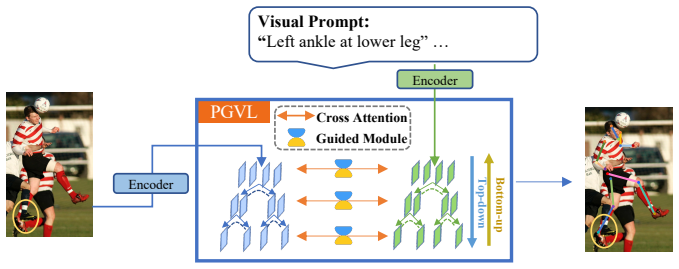
The parse graph of a feature map: visual and language tokens are split along channels into a tree, with the root at level n and leaves at level 0, controlled by a parameter G where each g_k is the number of children a node at level k produces. Low levels focus on local features; high levels on global context. The Guided Module (GM) is the load-bearing part: after children receive cross-attention and context information, they are concatenated, and the parent node and root node each query that concatenation with attention; the two query results are summed and replace the parent feature, so high-semantic nodes guide low-semantic updates. Repeating leaf-to-root produces new fused tokens for both
What would settle it
Run a controlled comparison that keeps total parameters and compute fixed and replaces the hand-chosen channel split G with several random channel partitions of equal sizes; if random partitions reproduce the MPII val gains, the hierarchy itself is not the cause. Or take a per-joint breakdown on OCHuman: if occluded joints gain no more than visible joints, the occlusion-specific claim is not supported.
Extended reading notes
Core claim
PGVL's central claim is that existing visual-language fusion for pose estimation fails under occlusion because global integration dilutes the weak responses of occluded regions and misaligns joints. The remedy is to decompose each modality's feature map along channels into a parse graph whose low-level nodes retain local detail and whose high-level nodes carry global context. Cross-attention runs between corresponding nodes of the vision and language graphs from leaf to root, and a Guided Module (GM) lets root and parent nodes query the concatenated children, so high-semantic nodes steer the updates of low-semantic nodes that already received cross-modal information. The paper reports that t
Load-bearing premise
The method assumes that splitting a feature map along channels into groups produces nodes that genuinely carry local detail versus global context; if the split is arbitrary, the parse graph is just a partition and the gains could come from added cross-attention capacity rather than from hierarchical parsing.
Editorial extensions
If this is right
- Occluded human joints can be localized from local visual responses instead of being washed out by global fusion; the reported MPII 91.7 and OCHuman 62.8 results support this.
- Directional language descriptions carry usable signal: removing left/right words from joint prompts costs 0.2 PCKh on MPII.
- The same hierarchical fusion transfers to animals: AP-10K reaches 82.1 MAP and Animal-Pose 79.3 MAP, beating prompt-based contrastive learning by 4.3 and 5.0 points.
- PGVL works as a plug-in fusion module: adding it to an existing multi-person method gains +0.3 AP and +0.6 AP50 on OCHuman, and to a top-down animal method gains +1.0 AP on AP-10K.
- Each component contributes to the reported result: removing the Guided Module costs 0.4 PCKh, removing cross-attention 0.2, and removing context relations 0.1.
Reading between the lines
- If the channel split G is semantically meaningful, a reader could test it directly by replacing the hand-chosen split with random equal-size channel partitions under identical parameter counts; equal results would suggest the gains come from added attention capacity rather than hierarchy.
- The occlusion-specific story implies gains should concentrate on occluded joints; a per-joint breakdown on OCHuman or a synthetic occlusion benchmark would show whether the 0.4 PCKh ablation gain from GM is driven by hard cases.
- The level-wise alignment visualizations suggest PGVL could serve as a weak correspondence mechanism, for example generating pseudo-labels for invisible joints in unlabeled images.
- If language priors are the active ingredient, then automatically generated or dataset-specific descriptions should work as well as hand-written templates, which would widen the method to settings without curated prompts.
Editorial analysis
A structured set of objections, weighed in public.
Referee Report
Summary. This paper proposes PGVL, a parse-graph-based visual-language interaction module for human pose estimation. Visual and language tokens are decomposed along channels according to a hand-chosen tree structure G into hierarchical node features; context relations within each modality and cross-modal attention between corresponding nodes are computed level by level, and a Guided Module (GM) uses higher-level nodes to filter/update lower-level nodes that have undergone cross-attention. The processed tokens are used with a visual-language matching loss (VLML) and a standard heatmap regression head. The method is evaluated on MPII, CrowdPose, OCHuman, AP-10K, and Animal-Pose, reporting gains over ViTPose, HRNet, RMPG, PGBS, LAMP, and CLAMP, plus ablations showing contributions from context, cross-attention, GM, and directional prompts.
Significance. If the empirical claims hold, the work provides a consistent, plug-in capable multimodal fusion module with modest gains on five datasets and a clear ablation breakdown. The paper's strengths include the controlled plug-in experiments in Table 7, where adding PGVL improves both LAMP and CLAMP, and the identification of the Guided Module as the largest single contributor. The main weaknesses are that the paper's stated mechanism—channel groups as a semantic hierarchy—is not verified, the experimental protocol lacks variance reporting, and some benchmark comparisons mix several design changes at once. The contribution is incremental but potentially publishable if these issues are addressed.
major comments (3)
- [§3.3, Eqs. (4)–(10)] The semantic hierarchy that motivates the method is asserted, not supported. Because every node has spatial size S and attention is applied over the full spatial dimension at all levels (Eqs. 6–10), splitting along channels does not create nodes that 'focus on local features' in any spatial sense. The claim that low-level nodes 'maximize maintenance of responses in occluded areas' is therefore not structurally implied. Please provide evidence that the channel groups correspond to distinct semantic levels (e.g., per-group spatial attention maps, channel probing, or a comparison against random channel partitions with the same G and parameter count). If the groups are arbitrary, the parse-graph interpretation should be revised or softened.
- [§4.4, Tables 8–9] Ablation differences are small (0.1–0.4 PCKh) and no error bars or repeated runs are reported. On the MPII val set such differences can be within training variance, and Table 9 shows the final configuration (G={2,2,2}, D={512,256}) was selected after checking several variants. Report mean±std over at least three seeds for the main ablations and for the final configuration, and discuss how validation-based selection of D/G affects the reported benchmark numbers.
- [§4.3, Tables 4–5 and Table 7] The headline comparisons to CLAMP mix multiple changes simultaneously: visual-backbone pretraining (ImageNet vs CLIP), network architecture, and PGVL. The cleanest isolation of PGVL is Table 7, which is valuable, but the abstract and Section 4.3 emphasize gains of 4.3 and 5.0 MAP against CLAMP without controlling for these factors. Add same-backbone and same-pretraining comparisons in the main tables, or explicitly state that the gains are for the full network rather than for PGVL alone. Also specify the backbones/pretraining of RMPG and PGBS in Table 1 to make that comparison interpretable.
minor comments (6)
- [Abstract] Grammar errors should be corrected: 'It ensuring effective fusion' and 'Next stage.' are incomplete sentences.
- [§3.3, Eqs. (6)–(7)] It is not specified how the output of Attention(Concat(T), Concat(T), Concat(T)) is split back into per-node context features C. Please clarify the reshaping/slicing operation.
- [Table 9] The table layout is confusing: the row 'Fuse only' appears to span several columns, and the 'Cross-Attention' comparison row should be clearly separated from the PGVL variants.
- [§4.2 vs §4.4] Section 4.2 defines the channel-semantic-space set as D, but Section 4.4 refers to 'C={512}'. Use a single notation consistently.
- [Figure 5] The caption says the panels show 'in sequence' but the sequence of levels (1, 2, 3) is not clearly labeled in the figure itself. Please add explicit level labels.
- [References] Cross-attention in Eqs. (9)–(10) is the standard Transformer attention [27]; citing [14] (ViLBERT) for the operation is imprecise.
Circularity Check
No circular derivation: PGVL is fully specified in Equations 4-15 and tested by ablations against a no-PGVL baseline; self-citations are motivational/baseline only.
full rationale
The paper's central claim is that PGVL improves pose estimation via parse-graph-guided visual-language fusion. The PGVL module is defined self-contained in Section 3.3: Eqs. 4-5 define channel decomposition into nodes; Eqs. 6-8 define context self-attention; Eqs. 9-10 define cross-modal attention; Eqs. 11-15 define the Guided Module as an attention query operation over child, parent, and root features. No equation uses the target PCKh/MAP metric as an input, and no fitted parameter is renamed as a prediction. Ablations (Table 8) compare the full model against removing context relations, cross-attention, and GM, and against a 'Base (w/o PGVL)' baseline; Table 9 varies hyperparameters G and D, which are architectural choices rather than fitted outputs. The parse-graph-of-feature-map idea is credited to the authors' earlier RMPG [7] and PGBS [8], but those citations are used for motivation and as baselines; the mechanism is re-derived in this paper and tested on MPII, CrowdPose, OCHuman, AP-10K, and Animal-Pose, so the result does not reduce to a self-citation. The skeptical concern that the channel split's semantic hierarchy is asserted rather than demonstrated is a correctness/verifiability issue, not circularity: even if the hierarchical labels were unjustified, the architecture and ablations remain independent of the claimed conclusions. No specific circular reduction can be quoted from the paper.
Assumptions & free parameters
free parameters (2)
- G (parse graph decomposition structure) =
{2,2,2} for most experiments; {2,2} and {2,2,2} variants in Table 9
- D (channel numbers for semantic spaces) =
{512} default; {512,256} for AP-10K and Animal-Pose; variants in Table 9
assumptions (3)
- domain assumption Parse graph energy model (Zhu & Mumford) provides a valid conceptual basis for the hierarchical decomposition used in the method.
- domain assumption CLIP text and image encoders provide a shared embedding space in which joint-name prompts and image patches are comparable.
- ad hoc to paper Splitting a feature map along channels into a balanced tree (controlled by G) yields nodes that correspond to semantically meaningful local and global parts.
Cite this review
Pith. "Pith review of Parse Graph-Based Visual-Language Interaction for Human Pose Estimation." pith.science (2026). https://pith.science/paper/JX2ITWX5
@misc{pith2026250907385,
  author       = {Pith},
  title        = {Pith review of: Parse Graph-Based Visual-Language Interaction for Human Pose Estimation},
  year         = {2026},
  howpublished = {\url{https://pith.science/paper/JX2ITWX5}},
  note         = {Machine review of arXiv:2509.07385}
}
read the original abstract
Parse graphs boost human pose estimation (HPE) by integrating context and hierarchies, yet prior work mostly focuses on single modality modeling, ignoring the potential of multimodal fusion. Notably, language offers rich HPE priors like spatial relations for occluded scenes, but existing visual-language fusion via global feature integration weakens occluded region responses and causes alignment and location failures. To address this issue, we propose Parse Graph-based Visual-Language interaction (PGVL) with a core novel Guided Module (GM). In PGVL, low-level nodes focus on local features, maximizing the maintenance of responses in occluded areas and high-level nodes integrate global features to infer occluded or invisible parts. GM enables high semantic nodes to guide the feature update of low semantic nodes that have undergone cross attention. It ensuring effective fusion of diverse information. PGVL includes top-down decomposition and bottom-up composition. In the first stage, modality specific parse graphs are constructed. Next stage. recursive bidirectional cross-attention is used, purified by GM. We also design network based on PGVL. The PGVL and our network is validated on major pose estimation datasets. We will release the code soon.
Figures


Figures from the paper (5 more)


Reference graph
Works this paper leans on
-
[1]
S. Du, Z. Zhang, T. Ikenaga, Anatpose: Bidirectionally learning anatomy-aware heatmaps for human pose estimation, Pattern Recogn. 155 (2024) 110654
work page 2024
-
[2]
C. Wang, F. Zhang, X. Zhu, S. S. Ge, Low-resolution human pose estimation, Pattern Recogn. 126 (2022) 108579
work page 2022
-
[3]
L. Tian, P. Wang, G. Liang, C. Shen, An adversarial human pose estimation net- work injected with graph structure, Pattern Recogn. 115 (2021) 107863
work page 2021
- [4]
-
[5]
Z. Wu, Y . Ding, L. Wan, T. Li, F. Nian, Local and global self-attention en- hanced graph convolutional network for skeleton-based action recognition, Pat- tern Recogn. 159 (2025) 111106. 20
work page 2025
-
[6]
S.-C. Zhu, D. Mumford, et al., A stochastic grammar of images, Found. Trends® Comput. Graph. Vision (FTCGV) 2 (4) (2007) 259–362
work page 2007
- [7]
-
[8]
S. Liu, X. Xie, G. Shi, Human pose estimation via parse graph of body structure, IEEE Trans. Circuits Syst. Video Technol. (2024)
work page 2024
Show all 45 references
-
[9]
Lupyan, D
G. Lupyan, D. H. Rakison, J. L. McClelland, Language is not just for talking: Redundant labels facilitate learning of novel categories, Psychol. Sci. 18 (12) (2007) 1077–1083
2007
-
[10]
Boutonnet, B
B. Boutonnet, B. Dering, N. Viñas-Guasch, G. Thierry, Seeing objects through the language glass, J. Cogn. Neurosci. 25 (10) (2013) 1702–1710
2013
-
[11]
Boutonnet, G
B. Boutonnet, G. Lupyan, Words jump-start vision: A label advantage in object recognition, J. Neurosci. 35 (25) (2015) 9329–9335
2015
-
[12]
S. Hu, C. Zheng, Z. Zhou, C. Chen, G. Sukthankar, Lamp: Leveraging language prompts for multi-person pose estimation, in: Proc. IEEE/RSJ Int. Conf. Intell. Robots Syst. (IROS), IEEE, 2023, pp. 3759–3766
2023
-
[13]
Zhang, W
X. Zhang, W. Wang, Z. Chen, Y . Xu, J. Zhang, D. Tao, Clamp: Prompt-based con- trastive learning for connecting language and animal pose, in: Proc. IEEE/CVF Conf. Comput. Vis. Pattern Recognit. (CVPR), 2023, pp. 23272–23281
2023
-
[14]
J. Lu, D. Batra, D. Parikh, S. Lee, Vilbert: Pretraining task-agnostic visiolin- guistic representations for vision-and-language tasks, in: Advances in Neural Inf. Process. Syst. (NIPS), V ol. 32, 2019
2019
-
[15]
De Bem, A
R. De Bem, A. Arnab, S. Golodetz, M. Sapienza, P. Torr, Deep fully-connected part-based models for human pose estimation, in: Proc. Asian Conf. Mach. Learn. (ACML), PMLR, 2018, pp. 327–342. 21
2018
-
[16]
W. Tang, P. Yu, Y . Wu, Deeply learned compositional models for human pose estimation, in: Proc. Eur. Conf. Comput. Vis. (ECCV), 2018, pp. 190–206
2018
-
[17]
Zhang, C
X. Zhang, C. Li, W. Hu, X. Tong, S. Maybank, Y . Zhang, Human pose estimation and tracking via parsing a tree structure based human model, IEEE Trans. Syst. Man Cybern. Syst. 44 (5) (2013) 580–592
2013
-
[18]
Jun, J.-H
J. Jun, J.-H. Lee, C.-S. Kim, Human pose estimation using skeletal heatmaps, in: Proc. Asia-Pacific Signal Inf. Process. Assoc. Annual Summit Conf. (APSIPA ASC), IEEE, 2020, pp. 1287–1292
2020
-
[19]
Anderson, Q
P. Anderson, Q. Wu, D. Teney, J. Bruce, M. Johnson, N. Sünderhauf, I. Reid, S. Gould, A. Van Den Hengel, Vision-and-language navigation: Interpret- ing visually-grounded navigation instructions in real environments, in: Proc. IEEE/CVF Conf. Comput. Vis. Pattern Recognit. (CVPR...
2018
-
[20]
Antol, A
S. Antol, A. Agrawal, J. Lu, M. Mitchell, D. Batra, C. L. Zitnick, D. Parikh, Vqa: Visual question answering, in: Proc. IEEE/CVF Conf. Comput. Vis. Pattern Recognit. (CVPR), 2015, pp. 2425–2433
2015
-
[21]
J. Li, J. Zhang, D. Tao, Referring image matting, in: Proc. IEEE/CVF Conf. Comput. Vis. Pattern Recognit. (CVPR), 2023, pp. 22448–22457
2023
-
[22]
T. Qiao, J. Zhang, D. Xu, D. Tao, Mirrorgan: Learning text-to-image genera- tion by redescription, in: Proc. IEEE/CVF Conf. Comput. Vis. Pattern Recognit. (CVPR), 2019, pp. 1505–1514
2019
-
[23]
Fürst, E
A. Fürst, E. Rumetshofer, J. Lehner, V . T. Tran, F. Tang, H. Ramsauer, D. Kreil, M. Kopp, G. Klambauer, A. Bitto, et al., Cloob: Modern hopfield networks with infoloob outperform clip, Advances in Neural Inf. Process. Syst. (NIPS) 35 (2022) 20450–20468
2022
-
[24]
C. Jia, Y . Yang, Y . Xia, Y .-T. Chen, Z. Parekh, H. Pham, Q. Le, Y .-H. Sung, Z. Li, T. Duerig, Scaling up visual and vision-language representation learning with noisy text supervision, in: Proc. Int. Conf. Mach. Learn. (ICML), PMLR, 2021, pp. 4904–4916. 22
2021
-
[25]
Radford, J
A. Radford, J. W. Kim, C. Hallacy, A. Ramesh, G. Goh, S. Agarwal, G. Sastry, A. Askell, P. Mishkin, J. Clark, et al., Learning transferable visual models from natural language supervision, in: Proc. Int. Conf. Mach. Learn. (ICML), PMLR, 2021, pp. 8748–8763
2021
-
[26]
Zhang, M
H. Zhang, M. C. Leong, L. Li, W. Lin, Pevl: Pose-enhanced vision-language model for fine-grained human action recognition, in: Proc. IEEE/CVF Conf. Comput. Vis. Pattern Recognit. (CVPR), 2024, pp. 18857–18867
2024
-
[27]
Vaswani, N
A. Vaswani, N. Shazeer, N. Parmar, J. Uszkoreit, L. Jones, A. N. Gomez, Ł. Kaiser, I. Polosukhin, Attention is all you need, in: Advances in Neural Inf. Process. Syst. (NIPS), 2017
2017
-
[28]
Newell, K
A. Newell, K. Yang, J. Deng, Stacked hourglass networks for human pose esti- mation, in: Proc. Eur. Conf. Comput. Vis. (ECCV), Springer, 2016, pp. 483–499
2016
-
[29]
W. Yang, S. Li, W. Ouyang, H. Li, X. Wang, Learning feature pyramids for human pose estimation, in: Proc. IEEE/CVF Int. Conf. Comput. Vis. (ICCV), 2017, pp. 1281–1290
2017
-
[30]
B. Xiao, H. Wu, Y . Wei, Simple baselines for human pose estimation and tracking, in: Proc. Eur. Conf. Comput. Vis. (ECCV), 2018, pp. 466–481
2018
-
[31]
K. Sun, B. Xiao, D. Liu, J. Wang, Deep high-resolution representation learn- ing for human pose estimation, in: Proc. IEEE/CVF Conf. Comput. Vis. Pattern Recognit. (CVPR), 2019, pp. 5693–5703
2019
-
[32]
Y . Xu, J. Zhang, Q. Zhang, D. Tao, Vitpose: simple vision transformer baselines for human pose estimation, in: Advances in Neural Inf. Process. Syst. (NIPS), 2022, pp. 38571–38584
2022
-
[33]
Khirodkar, V
R. Khirodkar, V . Chari, A. Agrawal, A. Tyagi, Multi-instance pose networks: Rethinking top-down pose estimation, in: Proc. IEEE/CVF Int. Conf. Comput. Vis. (ICCV), 2021, pp. 3122–3131. 23
2021
-
[34]
P. Lu, T. Jiang, Y . Li, X. Li, K. Chen, W. Yang, Rtmo: towards high-performance one-stage real-time multi-person pose estimation, in: Proc. IEEE/CVF Conf. Comput. Vis. Pattern Recognit. (CVPR), 2024, pp. 1491–1500
2024
-
[35]
Z. Geng, K. Sun, B. Xiao, Z. Zhang, J. Wang, Bottom-up human pose estimation via disentangled keypoint regression, in: Proc. IEEE/CVF Conf. Comput. Vis. Pattern Recognit. (CVPR), 2021, pp. 14676–14686
2021
-
[36]
Redmon, A
J. Redmon, A. Farhadi, Yolov3: An incremental improvement, arXiv:1804.02767 (2018)
2018 arXiv
-
[37]
Andriluka, L
M. Andriluka, L. Pishchulin, P. Gehler, B. Schiele, 2d human pose estimation: New benchmark and state of the art analysis, in: Proc. IEEE/CVF Conf. Comput. Vis. Pattern Recognit. (CVPR), 2014, pp. 3686–3693
2014
-
[38]
J. Li, C. Wang, H. Zhu, Y . Mao, H.-S. Fang, C. Lu, Crowdpose: Efficient crowded scenes pose estimation and a new benchmark, in: Proc. IEEE/CVF Conf. Comput. Vis. Pattern Recognit. (CVPR), 2019, pp. 10863–10872
2019
-
[39]
Zhang, R
S.-H. Zhang, R. Li, X. Dong, P. Rosin, Z. Cai, X. Han, D. Yang, H. Huang, S.-M. Hu, Pose2seg: Detection free human instance segmentation, in: Proc. IEEE/CVF Conf. Comput. Vis. Pattern Recognit. (CVPR), 2019, pp. 889–898
2019
-
[40]
H. Yu, Y . Xu, J. Zhang, W. Zhao, Z. Guan, D. Tao, Ap-10k: A benchmark for animal pose estimation in the wild, arXiv preprint arXiv:2108.12617 (2021)
2021 arXiv
-
[41]
J. Cao, H. Tang, H.-S. Fang, X. Shen, C. Lu, Y .-W. Tai, Cross-domain adaptation for animal pose estimation, in: Proc. IEEE/CVF Int. Conf. Comput. Vis. (ICCV), 2019, pp. 9498–9507
2019
-
[42]
T.-Y . Lin, M. Maire, S. Belongie, J. Hays, P. Perona, D. Ramanan, P. Dollár, C. L. Zitnick, Microsoft coco: Common objects in context, in: Proc. Eur. Conf. Comput. Vis. (ECCV), Springer, 2014, pp. 740–755
2014
-
[43]
J. Deng, W. Dong, R. Socher, L.-J. Li, K. Li, L. Fei-Fei, Imagenet: A large-scale hierarchical image database, in: Proc. IEEE/CVF Conf. Comput. Vis. Pattern Recognit. (CVPR), Ieee, 2009, pp. 248–255. 24
2009
-
[44]
Loshchilov, F
I. Loshchilov, F. Hutter, Decoupled weight decay regularization, arXiv preprint arXiv:1711.05101 (2017)
2017 arXiv
-
[45]
Y . Yuan, R. Fu, L. Huang, W. Lin, C. Zhang, X. Chen, J. Wang, Hrformer: high- resolution transformer for dense prediction, in: Advances in Neural Inf. Process. Syst. (NIPS), 2021, pp. 7281–7293. 25
2021
Reviewed August 4, 2026 · model on record in the stance chip above.
Discussion (0). Sign in to comment.