REVIEW 5 minor 47 references
Signatures of merging Dirac points in optics and transport
T0 review · 0 major / 5 minor · reviewed 2026-08-14 · deepseek-v4-flash
Pith's one-line read In the clean limit, the optical and transport response of two merging Dirac points reduces to universal functions of energy normalized to the gap, interpolating between Dirac and semi-Dirac regimes, with a ratio that directly measures the…
desk verdict A clean analytic derivation of universal scaling functions for merging Dirac point optics and transport; conditional on the continuum model, but internally consistent and worth a serious referee. read the letter →
The pith
A machine-rendered reading of the paper's core claim, the machinery that carries it, and where it could break.
The reading
What carries the argument
The load-bearing object is the continuum Hamiltonian of Eq. (1), whose off-diagonal coupling $(\hbar^2 k_x^2/2m-\Delta)+i\hbar v k_y$ produces two Dirac nodes at $k_x=\pm\sqrt{2m\Delta}/\hbar$ when $\Delta>0$ and a semi-Dirac point when $\Delta=0$. The argument is carried by a change of variables from $(k_x,k_y)$ to polar-like coordinates $(\epsilon,\phi)$, with $\epsilon^2=(\hbar^2 k_x^2/2m)^2+(\hbar v k_y)^2$ and $E=\sqrt{\Delta^2+\epsilon^2-2\Delta\epsilon\cos\phi}$; this turns the Kubo formula into single angular integrals whose integrands resemble elliptic integrals. In the clean limit the spectral functions become delta functions, and the remaining angular integrals define the four universal functions $F_{xx}$, $F_{yy}$, $G_{xx}$, and $G_{yy}$ in Eqs. (18)-(21). Their small- and large-argument asymptotics are evaluated analytically, with numerical constants expressed through the Gauss constant $G\approx0.8346$.
What would settle it
Compute the clean-limit Kubo optical conductivity of the tight-binding lattice model that reduces to Eq. (1) near merger and compare $\sqrt{\sigma_{xx}(\Omega)\sigma_{yy}(\Omega)}$ with the universal function of $\Omega/2\Delta$; if the product depends on $m$, $v$, or $\Delta$ beyond the stated prefactors, or if the $\Omega=2\Delta$ van Hove feature in $\sigma_{yy}$ is absent, the universal-form claim is falsified.
Extended reading notes
Core claim
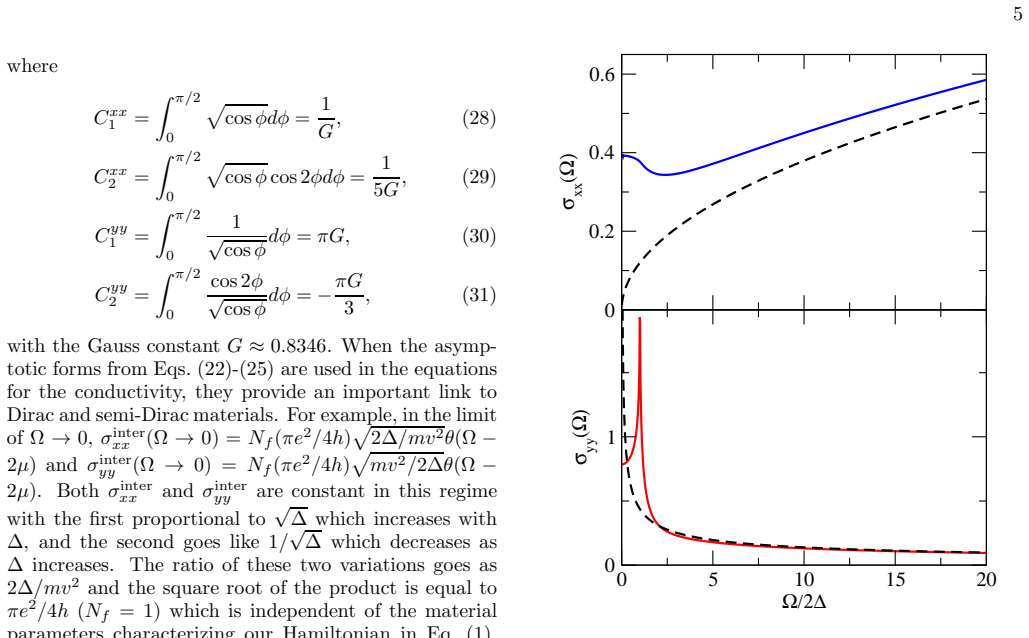
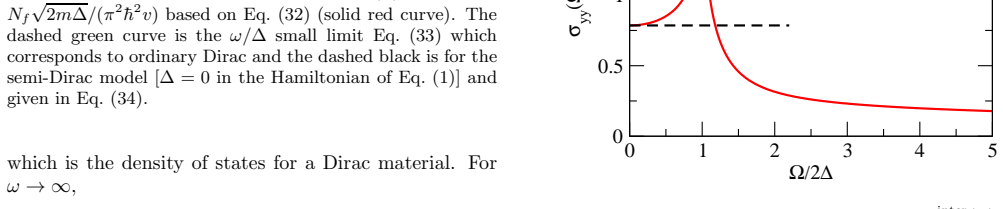
The central claim is that in the clean limit the Kubo conductivities of the merging-Dirac Hamiltonian, Eq. (1), factorize into material-dependent prefactors times four universal functions $F_{xx}(\Omega/2\Delta)$, $F_{yy}(\Omega/2\Delta)$, $G_{xx}(\mu/\Delta)$, and $G_{yy}(\mu/\Delta)$ defined by Eqs. (18)-(21). In the small-argument limit these functions give isotropic Dirac answers, including $\sigma_{xx}^{\mathrm{inter}}(0)=\frac{\pi e^2}{4h}\sqrt{2\Delta/(mv^2)}$ and $\sigma_{yy}^{\mathrm{inter}}(0)=\frac{\pi e^2}{4h}\sqrt{mv^2/(2\Delta)}$, so the product equals $(\pi e^2/4h)^2$ and the ratio equals $2\Delta/(mv^2)$. In the large-argument limit the functions cross over to semi-Dirac power laws, with $\sigma_{xx}$ growing as $\sqrt{\Omega}$ and $\sigma_{yy}$ falling as $1/\sqrt{\Omega}$ for interband transitions, and analogous $G_{xx}\propto\mu^{3/2}$ and $G_{yy}\propto\mu^{1/2}$ behavior for the Drude weight. In between, $\sigma_{yy}$ exhibits a van Hove singularity at $\Omega=2\Delta$ while $\sigma_{xx}$ only changes slope, and these crossover features track the finite value of the gap as the system evolves from Dirac to semi-Dirac. The transport section shows the same universal functions control the dc conductivity, thermal conductivity, and Lorenz number, with $L_{xx}$ rising from $2.4L_0$ toward $3.3L_0$ and $L_{yy}$ falling toward $1.67L_0$ as temperature grows, purely from bandstructure.
Load-bearing premise
The load-bearing premise is that the two-band continuum Hamiltonian of Eq. (1) faithfully describes a real merging-Dirac-point system; additional bands, trigonal warping, or electron-electron interactions near the saddle point would break the universal predictions.
Editorial extensions
If this is right
- A measurement of the zero-frequency interband conductivities in the two directions yields the ratio $\sigma_{xx}(0)/\sigma_{yy}(0)=2\Delta/(mv^2)$, so the optics directly report the gap relative to the kinetic scale $mv^2$.
- The product $\sigma_{xx}\sigma_{yy}$ is, in each limit, a parameter-free constant, so anisotropic samples can be used to test universality without knowing $m$, $v$, or $\Delta$.
- The predicted van Hove singularity in $\sigma_{yy}$ at $\Omega=2\Delta$, and the change of slope in $\sigma_{xx}$, give spectroscopic markers for locating the saddle point and following the merger as $\Delta$ is tuned.
- The Drude spectral weight crosses from linear-in-$\mu$ Dirac behavior to $\mu^{3/2}$ ($xx$) and $\mu^{1/2}$ ($yy$) semi-Dirac behavior, so the doping dependence of the optical weight is a separate probe of the transition.
- Because the Lorenz number becomes temperature- and direction-dependent already in the clean limit, deviations from the Wiedemann-Franz law are expected in merging-Dirac systems even without interactions or phonons.
Reading between the lines
- Beyond the paper's text: a polarization-resolved conductivity measurement, rather than two separate aligned measurements, should encode the same anisotropy ratio $2\Delta/(mv^2)$, allowing the gap to be extracted from a single spectrum.
- Testable extension the paper leaves open: calculating the same conductivities with a finite impurity rate $\Gamma$ would show how much of the universal factorization and the ratio survives disorder; the clean-limit delta-function reduction is the special case.
- Neighbouring platform: because the same merging Hamiltonian describes photonic crystals and optical lattices, the $\Omega=2\Delta$ van Hove feature in $\sigma_{yy}$ could be searched for in tunable microwave or atomic experiments, where the role of $\Delta$ is controlled by lattice distortion.
Signed reviews
Editorial analysis
A structured set of objections, weighed in public.
Referee Report
Summary. The paper considers the two-dimensional continuum Hamiltonian of Montambaux et al. describing the merging of two Dirac points, with parameters Δ, m, and v. For this model, the authors derive in the clean limit universal functions Fxx, Fyy, Gxx, and Gyy that control the interband and intraband optical conductivities and the transport coefficients as functions of Ω/2Δ and μ/Δ. They provide analytic small- and large-argument expansions, showing that the small-argument limits reduce to anisotropic Dirac behavior, the large-argument limits to semi-Dirac behavior, and that in each limit the square root of the product of the xx and yy conductivities is independent of material parameters. They also compute the temperature-dependent dc conductivity, thermal conductivity, and Lorenz number, and identify the van Hove singularity at Ω=2Δ, the ratio σ_xx(0)/σ_yy(0)=2Δ/mv^2, and the deviations from the asymptotic limits as signatures of the merging transition.
Significance. These results, if correct, are significant because they turn a numerical Kubo calculation for a widely used model into closed-form universal functions and analytic limits with no fitted parameters, making contact with both graphene and semi-Dirac limits. The derivation is internally consistent; the universal constants reproduce the graphene value πe^2/4h in the product and the previously known semi-Dirac asymptotics. The paper includes parameter-free predictions (the conductivity ratio, the parameter-independent product, and the van Hove singularity position) that can be checked in systems described by Eq. (1). The main caveat is the stated scope: the results are conditional on the two-band clean-limit continuum Hamiltonian, and no material-specific validity or cutoff analysis is given; this is a scope condition rather than an internal flaw.
minor comments (5)
- [Section VI, paragraph 2] The value 'Cxx_- = 0.902' is inconsistent with the integrals in Eqs. (26)-(29); for G≈0.8346, Cxx_- = 4/(5G) ≈ 0.958, which is the value used in the Fig. 3 dashed curve (0.12√(Ω/2Δ)). Please correct this numerical value.
- [Section VI, paragraph 1] The sentence 'the ratio σinter_xx(0)/σinter_xx(0) goes like 2Δ/mv^2' contains a typo; the denominator should be σinter_yy(0).
- [Section III, paragraph 1] The algebra taking Eqs. (6)-(11) to (18)-(21) is described only as 'considerable, but standard'; given that the θ(2Δ−Ω) and θ(Δ−μ) structures are central to the universal functions, an appendix with the intermediate δ-function manipulations would substantially aid verification.
- [Figure 3 caption] The notation 'Nf (e2/h)2 sqrt(2Δ/mv^2)' is easy to misread as (e^2/h)^2; please write the intended factor as 'Nf (e^2/h) 2√(2Δ/mv^2)' or use clearer spacing.
- [Abstract and Fig. 1 caption] Minor language issues remain, for example 'linear the y-direction' in the abstract and 'and the red, blocked transitions' in the Fig. 1 caption; these should be corrected in a final proof.
Circularity Check
No circularity: the universal-function derivation is self-contained from the model Hamiltonian, and the semi-Dirac self-citation is only a consistency benchmark.
full rationale
The paper's central claim is an analytic derivation, not a fit or a renamed input. Starting from the stated Hamiltonian of Eq. (1) and the Kubo formula of Eq. (2), the authors transform to scaled variables, take the clean limit, and reduce the conductivity integrals to the universal functions Fxx, Fyy, Gxx, and Gyy defined in Eqs. (18)-(21). No parameter is fitted to any subset of data and then 'predicted' elsewhere; the material parameters m, v, and Delta appear only as explicit prefactors and inside the dimensionless variables Omega/2Delta and mu/Delta. The asymptotic forms in Eqs. (22)-(25) are obtained by evaluating those same integrals analytically, and the claimed ratio sigma_xx(0)/sigma_yy(0) = 2Delta/(m v^2) follows from the small-argument limits rather than being imposed by construction. The one self-citation, Ref. 37 for semi-Dirac optical limits, is used as a large-argument benchmark, but the corresponding semi-Dirac limits are also recovered from the paper's own asymptotic formulas, so the citation is not load-bearing. The only substantive caveat is that Eq. (1) is assumed to model a real merging-Dirac-point system, which is a model-validity scope condition rather than circular reasoning. Accordingly, no circular step is present.
Assumptions & free parameters
assumptions (4)
- domain assumption The Montambaux model Hamiltonian of Eq. (1) describes merging Dirac points in a two-dimensional crystal.
- standard math The Kubo formula of Eq. (2) gives the optical conductivity.
- domain assumption In the clean limit, the spectral function becomes a Dirac delta function (Gamma goes to 0).
- domain assumption In the transport section, the chemical potential is set to zero (charge neutrality).
Cite this review
Pith. "Pith review of Signatures of merging Dirac points in optics and transport." pith.science (2026). https://pith.science/paper/JXBUFLT7
@misc{pith2026190802796,
  author       = {Pith},
  title        = {Pith review of: Signatures of merging Dirac points in optics and transport},
  year         = {2026},
  howpublished = {\url{https://pith.science/paper/JXBUFLT7}},
  note         = {Machine review of arXiv:1908.02796}
}
abstract
We consider the optical and transport properties in a model two-dimensional Hamiltonian which describes the merging of two Dirac points. At low energy, in the presence of an energy gap parameter $\Delta$, there are two distinct Dirac points with linear dispersion, these are connected by a saddle point at higher energy. As $\Delta$ goes to zero, the two Dirac points merge and the resulting dispersion exhibits semi-Dirac behaviour which is quadratic in the $x$-direction ("nonrelativistic") and linear the $y$-direction ("relativistic").In the clean limit for each direction ($x,y$) the contribution of the intraband and interband optical transitions are both given by universal functions of photon energy $\Omega$ and chemical potential $\mu$ normalized to the energy gap. We provide analytic formulas for both small and large $\Omega/2\Delta$ and $\mu/\Delta$ limits. These define, respectively, Dirac and semi-Dirac-like regions. For $\Omega/2\Delta$ and $\mu/\Delta$ of order one, there are deviations from these asymptotic behaviors. Considering optics and also transport, such as dc conductivity, thermal conductivity and the Lorenz number, such deviations provide signatures of the evolution from the Dirac to the semi-Dirac regime as the gap $\Delta$ is varied.
Figures


Figures from the paper (7 more)



Reference graph
Works this paper leans on
-
[1]
author author A. H. \ Castro Neto , author F. Guinea , author N. M. R. \ Peres , author K. S. \ Novoselov , \ and\ author A. K. \ Geim ,\ title title The electronic properties of graphene , \ 10.1103/RevModPhys.81.109 journal journal Rev. Mod. Phys. \ volume 81 ,\ pages 109--162 ( year 2009 ) NoStop
-
[2]
author author M. Z. \ Hasan \ and\ author C. L. \ Kane ,\ title title Colloquium: Topological insulators , \ 10.1103/RevModPhys.82.3045 journal journal Rev. Mod. Phys. \ volume 82 ,\ pages 3045--3067 ( year 2010 ) NoStop
-
[3]
author author Xiao-Liang \ Qi \ and\ author Shou-Cheng \ Zhang ,\ title title Topological insulators and superconductors , \ 10.1103/RevModPhys.83.1057 journal journal Rev. Mod. Phys. \ volume 83 ,\ pages 1057--1110 ( year 2011 ) NoStop
-
[4]
author author N. P. \ Armitage , author E. J. \ Mele , \ and\ author Ashvin \ Vishwanath ,\ title title Weyl and Dirac semimetals in three-dimensional solids , \ 10.1103/RevModPhys.90.015001 journal journal Rev. Mod. Phys. \ volume 90 ,\ pages 015001 ( year 2018 ) NoStop
-
[5]
author author B. Yan \ and\ author C. Felser ,\ title title Topological Materials: Weyl semimetals , \ @noop journal journal Annual Review of Condens. Matter Physics \ volume 8 ,\ pages 337 ( year 2017 ) NoStop
work page 2017
-
[6]
author author T. O. \ Wehling , author A. M. \ Black-Schaffer , \ and\ author A. V. \ Balatsky ,\ title title Dirac Materials , \ @noop journal journal Advances in Physics \ volume 63 ,\ pages 1 ( year 2014 ) NoStop
work page 2014
-
[7]
author author Ching-Kai \ Chiu , author Jeffrey C. Y. \ Teo , author Andreas P. \ Schnyder , \ and\ author Shinsei \ Ryu ,\ title title Classification of topological quantum matter with symmetries , \ 10.1103/RevModPhys.88.035005 journal journal Rev. Mod. Phys. \ volume 88 ,\ pages 035005 ( year 2016 ) NoStop
-
[8]
author author D. N. \ Basov \ and\ author T. Timusk ,\ title title Electrodynamics of high- T _ c superconductors , \ 10.1103/RevModPhys.77.721 journal journal Rev. Mod. Phys. \ volume 77 ,\ pages 721--779 ( year 2005 ) NoStop
Show all 47 references
-
[9]
author author J. P. \ Carbotte , author T. Timusk , \ and\ author J. Hwang ,\ title title Bosons in high-temperature superconductors: an experimental survey , \ @noop journal journal Rep. Prog. Phys. \ volume 74 ,\ pages 066501 ( year 2011 ) NoStop
2011
-
[10]
author author Z. Q. \ Li , author E. A. \ Henriksen , author Z. Jiang , author Z. Hao , author M. C. \ Martin , author P. Kim , author H. L. \ Stormer , \ and\ author D. N. \ Basov ,\ title title Dirac charge dynamics in graphene by infrared dynamics , \ @noop journal journal ...
2008
-
[11]
author author J. P. \ Carbotte , author E. J. \ Nicol , \ and\ author S. G. \ Sharapov ,\ title title Effect of electron-phonon interaction on spectroscopies in graphene , \ 10.1103/PhysRevB.81.045419 journal journal Phys. Rev. B \ volume 81 ,\ pages 045419 ( year 2010 ) NoStop
-
[12]
author author A. A. \ Schafgans , author K. W. \ Post , author A. A. \ Taskin , author Yoichi \ Ando , author Xiao-Liang \ Qi , author B. C. \ Chapler , \ and\ author D. N. \ Basov ,\ title title Landau level spectroscopy of surface states in the topological insulator Bi _ 0.9...
-
[13]
author author R. Y. \ Chen , author S. J. \ Zhang , author J. A. \ Schneeloch , author C. Zhang , author Q. Li , author G. D. \ Gu , \ and\ author N. L. \ Wang ,\ title title Optical spectroscopy study of the three-dimensional Dirac semimetal ZrTe _ 5 , \ 10.1103/PhysRevB.92.0...
-
[14]
Xu , author Y
author author B. Xu , author Y. M. \ Dai , author L. X. \ Zhao , author K. Wang , author R. Yang , author W. Zhang , author J. Y. \ Liu , author H. Xiao , author G. F. \ Chen , author A. J. \ Taylor , author D. A. \ Yarotski , author R. P. \ Prasankumar , \ and\ author X. G. \...
-
[15]
Neubauer , author J
author author D. Neubauer , author J. P. \ Carbotte , author A. A. \ Nateprov , author A. L\"ohle , author M. Dressel , \ and\ author A. V. \ Pronin ,\ title title Interband optical conductivity of the [001]-oriented Dirac semimetal Cd _ 3 As _ 2 , \ 10.1103/PhysRevB.93.121202...
-
[16]
author author C. J. \ Tabert \ and\ author J. P. \ Carbotte ,\ title title Optical conductivity of Weyl semimetals and signatures of the gapped semimetal phase transition , \ 10.1103/PhysRevB.93.085442 journal journal Phys. Rev. B \ volume 93 ,\ pages 085442 ( year 2016 ) NoStop
-
[17]
author author C. J. \ Tabert , author J. P. \ Carbotte , \ and\ author E. J. \ Nicol ,\ title title Optical and transport properties in three-dimensional Dirac and Weyl semimetals , \ 10.1103/PhysRevB.93.085426 journal journal Phys. Rev. B \ volume 93 ,\ pages 085426 ( year 20...
-
[18]
author author J. P. \ Carbotte ,\ title title Dirac cone tilt on interband optical background of type-I and type-II Weyl semimetals , \ 10.1103/PhysRevB.94.165111 journal journal Phys. Rev. B \ volume 94 ,\ pages 165111 ( year 2016 ) NoStop
-
[19]
author author Seongjin \ Ahn , author E. J. \ Mele , \ and\ author Hongki \ Min ,\ title title Optical conductivity of multi-Weyl semimetals , \ 10.1103/PhysRevB.95.161112 journal journal Phys. Rev. B \ volume 95 ,\ pages 161112 ( year 2017 ) NoStop
-
[20]
Wunsch , author F
author author B. Wunsch , author F. Guinea , \ and\ author F. Sols ,\ title title Dirac point engineering and topological phase transitions in honeycomb optical lattice , \ @noop journal journal New J. Phys. \ volume 10 ,\ pages 103027 ( year 2008 ) NoStop
2008
-
[21]
author author Yasumasa \ Hasegawa , author Rikio \ Konno , author Hiroki \ Nakano , \ and\ author Mahito \ Kohmoto ,\ title title Zero modes of tight-binding electrons on the honeycomb lattice , \ 10.1103/PhysRevB.74.033413 journal journal Phys. Rev. B \ volume 74 ,\ pages 033...
-
[22]
Montambaux , author F
author author G. Montambaux , author F. Pi\'echon , author J.-N. \ Fuchs , \ and\ author M. O. \ Goerbig ,\ title title Merging of Dirac points in a two-dimensional crystal , \ 10.1103/PhysRevB.80.153412 journal journal Phys. Rev. B \ volume 80 ,\ pages 153412 ( year 2009 a ) NoStop
-
[23]
Montambaux , author F
author author G. Montambaux , author F. Pi\'echon , author J.-N. \ Fuchs , \ and\ author M. O. \ Goerbig ,\ title title A universal Hamiltonian for motion and merging of Dirac points in a two-dimensional crystal , \ @noop journal journal Eur. Phys. J. B \ volume 72 ,\ pages 50...
2009
-
[24]
author author Lih-King \ Lim , author Jean-No\"el \ Fuchs , \ and\ author Gilles \ Montambaux ,\ title title Bloch-Zener Oscillations across a Merging Transition of Dirac Points , \ 10.1103/PhysRevLett.108.175303 journal journal Phys. Rev. Lett. \ volume 108 ,\ pages 175303 ( ...
-
[25]
author author Jean-No\"el \ Fuchs , author Lih-King \ Lim , \ and\ author Gilles \ Montambaux ,\ title title Interband tunneling near the merging transition of Dirac cones , \ 10.1103/PhysRevA.86.063613 journal journal Phys. Rev. A \ volume 86 ,\ pages 063613 ( year 2012 ) NoStop
-
[26]
de Gail , author J.-N
author author R. de Gail , author J.-N. \ Fuchs , author M. O. \ Goerbig , author F. Piechon , \ and\ author G. Montambaux ,\ title title Manipulation of Dirac points in graphene-like crystals , \ @noop journal journal Physica B Condens. Matt. \ volume 407 ,\ pages 1948 ( year...
1948
-
[27]
author author Cl\'ement \ Dutreix , author Liviu \ Bilteanu , author Anu \ Jagannathan , \ and\ author Cristina \ Bena ,\ title title Friedel oscillations at the Dirac cone merging point in anisotropic graphene and graphenelike materials , \ 10.1103/PhysRevB.87.245413 journal ...
-
[28]
Delplace \ and\ author G
author author P. Delplace \ and\ author G. Montambaux ,\ title title Semi-Dirac point in the Hofstadter spectrum , \ 10.1103/PhysRevB.82.035438 journal journal Phys. Rev. B \ volume 82 ,\ pages 035438 ( year 2010 ) NoStop
2010 doi
-
[29]
author author P. K. \ Pyatkovskiy \ and\ author Tapash \ Chakraborty ,\ title title Dynamical polarization and plasmons in a two-dimensional system with merging Dirac points , \ 10.1103/PhysRevB.93.085145 journal journal Phys. Rev. B \ volume 93 ,\ pages 085145 ( year 2016 ) NoStop
-
[30]
author author P. V. \ Sriluckshmy , author Kush \ Saha , \ and\ author Roderich \ Moessner ,\ title title Interplay between topology and disorder in a two-dimensional semi-Dirac material , \ 10.1103/PhysRevB.97.024204 journal journal Phys. Rev. B \ volume 97 ,\ pages 024204 ( ...
-
[31]
author author Francisco \ Pe\ na Benitez , author Kush \ Saha , \ and\ author Piotr \ Sur\'owka ,\ title title Berry curvature and Hall viscosities in an anisotropic Dirac semimetal , \ 10.1103/PhysRevB.99.045141 journal journal Phys. Rev. B \ volume 99 ,\ pages 045141 ( year ...
-
[32]
Tarruell , author I
author author I. Tarruell , author I. Greif , author T. Uehlinger , author G. Jotzu , \ and\ author T. Easlinger ,\ title title Creating, moving and merging Dirac points with a Fermi gas in a tunable honeycomb lattice , \ @noop journal journal Nature \ volume 483 ,\ pages 302 ...
2012
-
[33]
author author Matthieu \ Bellec , author Ulrich \ Kuhl , author Gilles \ Montambaux , \ and\ author Fabrice \ Mortessagne ,\ title title Topological Transition of Dirac Points in a Microwave Experiment , \ 10.1103/PhysRevLett.110.033902 journal journal Phys. Rev. Lett. \ volum...
-
[34]
Adroguer , author D
author author P. Adroguer , author D. Carpentier , author G. Montambaux , \ and\ author E. Orignac ,\ title title Diffusion of Dirac fermions across a topological merging transition in two dimensions , \ 10.1103/PhysRevB.93.125113 journal journal Phys. Rev. B \ volume 93 ,\ pa...
-
[35]
Ziegler \ and\ author A
author author K. Ziegler \ and\ author A. Sinner ,\ title title Lattice symmetries, spectral topology and opto-electronic properties of graphene-like materials , \ @noop journal journal Euro Phys. Lett. \ volume 119 ,\ pages 27001 ( year 2017 ) NoStop
2017
-
[36]
author author Alestin \ Mawrie \ and\ author Bhaskaran \ Muralidharan ,\ title title Direction-dependent giant optical conductivity in two-dimensional semi-Dirac materials , \ 10.1103/PhysRevB.99.075415 journal journal Phys. Rev. B \ volume 99 ,\ pages 075415 ( year 2019 ) NoStop
-
[37]
author author J. P. \ Carbotte , author K. R. \ Bryenton , \ and\ author E. J. \ Nicol ,\ title title Optical properties of a semi-Dirac material , \ 10.1103/PhysRevB.99.115406 journal journal Phys. Rev. B \ volume 99 ,\ pages 115406 ( year 2019 ) NoStop
-
[38]
\ Pickett ,\ title title Half-Metallic Semi-Dirac-Point Generated by Quantum Confinement in TiO _ 2 / VO _ 2 Nanostructures , \ 10.1103/PhysRevLett.102.166803 journal journal Phys
author author Victor \ Pardo \ and\ author Warren E. \ Pickett ,\ title title Half-Metallic Semi-Dirac-Point Generated by Quantum Confinement in TiO _ 2 / VO _ 2 Nanostructures , \ 10.1103/PhysRevLett.102.166803 journal journal Phys. Rev. Lett. \ volume 102 ,\ pages 166803 ( y...
-
[39]
Banerjee , author R
author author S. Banerjee , author R. R. P. \ Singh , author V. Pardo , \ and\ author W. E. \ Pickett ,\ title title Tight-Binding Modeling and Low-Energy Behavior of the Semi-Dirac Point , \ 10.1103/PhysRevLett.103.016402 journal journal Phys. Rev. Lett. \ volume 103 ,\ pages...
-
[40]
author author Victor \ Pardo \ and\ author Warren E. \ Pickett ,\ title title Metal-insulator transition through a semi-dirac point in oxide nanostructures: vo _ 2 (001) layers confined within tio _ 2 , \ 10.1103/PhysRevB.81.035111 journal journal Phys. Rev. B \ volume 81 ,\ p...
-
[41]
Banerjee \ and\ author W
author author S. Banerjee \ and\ author W. E. \ Pickett ,\ title title Phenomenology of a semi-Dirac semi-Weyl semimetal , \ 10.1103/PhysRevB.86.075124 journal journal Phys. Rev. B \ volume 86 ,\ pages 075124 ( year 2012 ) NoStop
2012 doi
-
[42]
Express \ volume 22 ,\ pages 1906--1917 ( year 2014 ) NoStop
author author Ying \ Wu ,\ title title A semi-dirac point and an electromagnetic topological transition in a dielectric photonic crystal , \ 10.1364/OE.22.001906 journal journal Opt. Express \ volume 22 ,\ pages 1906--1917 ( year 2014 ) NoStop
1906 doi
-
[43]
author author Petra \ Dietl , author Fr\'ed\'eric \ Pi\'echon , \ and\ author Gilles \ Montambaux ,\ title title New Magnetic Field Dependence of Landau Levels in a Graphenelike Structure , \ 10.1103/PhysRevLett.100.236405 journal journal Phys. Rev. Lett. \ volume 100 ,\ pages...
-
[44]
author author C. J. \ Tabert \ and\ author E. J. \ Nicol ,\ title title Dynamical conductivity of AA -stacked bilayer graphene , \ 10.1103/PhysRevB.86.075439 journal journal Phys. Rev. B \ volume 86 ,\ pages 075439 ( year 2012 ) NoStop
-
[45]
Stille , author C
author author L. Stille , author C. J. \ Tabert , \ and\ author E. J. \ Nicol ,\ title title Optical signatures of the tunable band gap and valley-spin coupling in silicene , \ 10.1103/PhysRevB.86.195405 journal journal Phys. Rev. B \ volume 86 ,\ pages 195405 ( year 2012 ) NoStop
-
[46]
author author K. R. \ Bryenton ,\ @noop title Optical Properties of the -T _3 semi-Dirac Model , \ ( year 2018 ),\ note University of Guelph, M.Sc. thesis NoStop
2018
-
[47]
author author Ali \ Lavasani , author Daniel \ Bulmash , \ and\ author Sankar \ Das Sarma ,\ title title Wiedemann-Franz law and Fermi liquids , \ 10.1103/PhysRevB.99.085104 journal journal Phys. Rev. B \ volume 99 ,\ pages 085104 ( year 2019 ) NoStop
Reviewed August 14, 2026 · model on record in the stance chip above.
Discussion (0). Continue with ORCID to comment.