Spin-orbit coupling renormalization of the natural optical activity of Pb5Ge3O11 from first-principles
Pith reviewed 2026-06-26 20:11 UTC · model grok-4.3
The pith
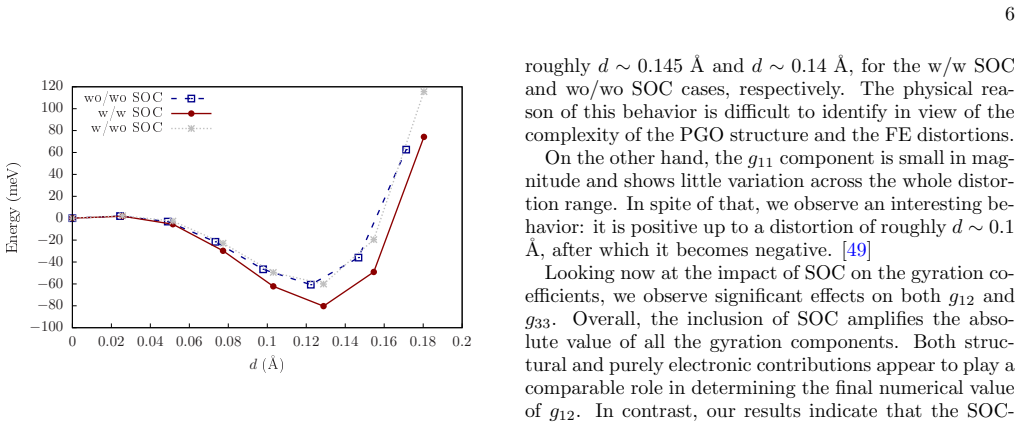
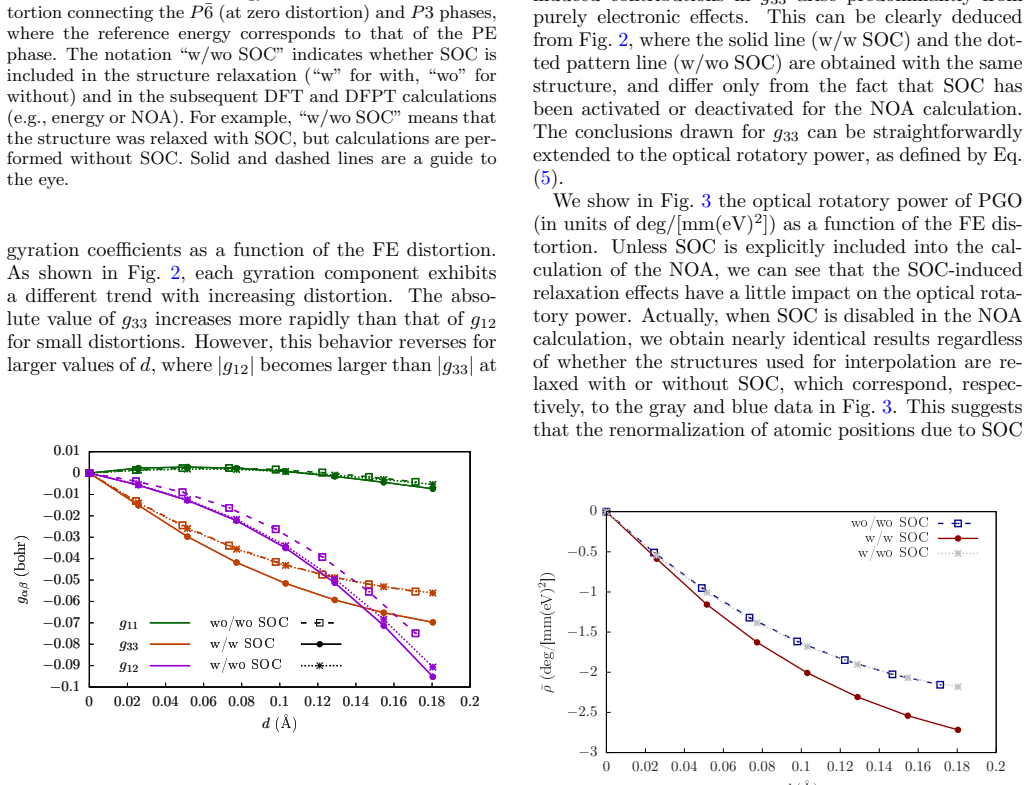
Spin-orbit coupling renormalizes natural optical activity in Pb5Ge3O11 mainly through electronic contributions.
A machine-rendered reading of the paper's core claim, the machinery that carries it, and where it could break.
Core claim
Within the long-wavelength DFPT framework, the new gyration-coefficient expression that includes SOC shows that spin-orbit coupling plays an equally crucial role in the natural optical activity of Pb5Ge3O11, acting largely through purely electronic contributions while SOC-induced structural relaxation effects remain minor.
What carries the argument
New analytical expression for gyration coefficients inside long-wavelength density-functional perturbation theory that includes spin-orbit coupling and reduces the number of required response functions.
If this is right
- Natural optical activity calculations in materials containing heavy elements must include SOC on equal footing with structural degrees of freedom.
- The optical rotation changes across the ferroelectric double-well are driven more by direct electronic SOC effects than by lattice relaxation.
- The reduced-response-function formulation makes SOC-inclusive optical activity studies computationally feasible for larger unit cells or more complex crystals.
- SOC renormalization of optical activity is expected to be generic in other gyroelectric or chiral ferroelectrics with significant atomic numbers.
Where Pith is reading between the lines
- The same SOC-inclusive gyration expression could be used to predict optical activity in related lead germanate compounds or in other materials where SOC is known to affect ferroelectric properties.
- If electronic SOC terms prove dominant in additional systems, optical rotation measurements might serve as a sensitive probe of spin-orbit physics without requiring separate structural characterization.
Load-bearing premise
The underlying long-wavelength density-functional perturbation theory framework stays valid and accurate once the new analytical expression for gyration coefficients that includes spin-orbit coupling is added.
What would settle it
A quantitative mismatch between the computed optical rotation (with versus without SOC) and measured gyration coefficients or optical activity data for Pb5Ge3O11 across the ferroelectric transition would falsify the claim that electronic SOC contributions dominate.
Figures
read the original abstract
We present a first-principles study of the natural optical activity of the gyroelectric Pb$_5$Ge$_3$O$_{11}$ crystal, explicitly accounting for spin-orbit coupling (SOC) effects. We derive a new analytical expression for the gyration coefficients within the recent framework of long-wavelength density-functional perturbation theory [Phys. Rev. Lett. \textbf{131}, 086902 (2023)], which significantly improves computational efficiency by reducing the number of required response functions and includes spin-orbit coupling effects. We use this implementation to investigate the evolution of Pb$_5$Ge$_3$O$_{11}$'s optical rotation across the ferroelectric double-well, from the paraelectric $P\bar{6}$ phase to the ferroelectric $P3$ phase. Our results demonstrate that, in addition to the substantial renormalization of the double-well energy, spin-orbit coupling contributions play an equally crucial role in the natural optical activity, largely through purely electronic contributions, while SOC-induced structural relaxation effects are minor.
Editorial analysis
A structured set of objections, weighed in public.
Referee Report
Summary. The manuscript derives a new analytical expression for gyration coefficients in the long-wavelength DFPT framework that incorporates spin-orbit coupling (SOC), reducing the number of required response functions. It applies this to Pb5Ge3O11, computing the evolution of natural optical activity from the paraelectric P-6 phase to the ferroelectric P3 phase and concluding that SOC renormalizes the optical rotation on equal footing with other electronic effects, with purely electronic SOC contributions dominating over SOC-induced structural relaxations.
Significance. If the central derivation holds, the work supplies an efficient first-principles route to gyration tensors in materials containing heavy elements and quantifies the relative importance of electronic versus structural SOC channels in a concrete ferroelectric gyroelectric crystal.
major comments (2)
- [Derivation of gyration expression (referenced to PRL 131, 086902)] The manuscript provides no explicit verification that the new SOC-inclusive analytical expression for the gyration coefficients reduces to the SOC-free limit of the 2023 PRL framework when SOC is switched off. Such a limit check (analytic or numerical) is required to establish that the reported SOC-driven changes in optical rotation are not artifacts of an algebraic or response-function omission.
- [Results section on optical rotation across the double well] No convergence tests, error estimates, or direct comparison between the new analytic gyration formula and finite-difference benchmarks are described for the SOC case, leaving the quantitative claim that SOC contributions are 'equally crucial' without a demonstrated uncertainty bound.
minor comments (1)
- [Abstract] The abstract states that the new expression 'significantly improves computational efficiency' but does not quantify the reduction in response functions or wall-time relative to the prior implementation.
Simulated Author's Rebuttal
We thank the referee for their careful reading of the manuscript and for the constructive comments. We address each major comment below.
read point-by-point responses
-
Referee: The manuscript provides no explicit verification that the new SOC-inclusive analytical expression for the gyration coefficients reduces to the SOC-free limit of the 2023 PRL framework when SOC is switched off. Such a limit check (analytic or numerical) is required to establish that the reported SOC-driven changes in optical rotation are not artifacts of an algebraic or response-function omission.
Authors: We agree that an explicit verification strengthens the presentation. In the revised manuscript we will add both an analytic demonstration (by direct substitution of vanishing SOC matrix elements into the new expression, recovering the PRL 131, 086902 formula term by term) and a numerical check (gyration coefficients computed with the SOC terms artificially disabled). These additions will confirm that the reported SOC-induced changes arise from the physics rather than from an algebraic inconsistency. revision: yes
-
Referee: No convergence tests, error estimates, or direct comparison between the new analytic gyration formula and finite-difference benchmarks are described for the SOC case, leaving the quantitative claim that SOC contributions are 'equally crucial' without a demonstrated uncertainty bound.
Authors: We acknowledge the absence of these controls in the current version. The revised manuscript will include (i) systematic convergence tests with respect to plane-wave cutoff, k-point density, and smearing parameters for the SOC-inclusive gyration coefficients, (ii) estimated numerical uncertainties, and (iii) a direct comparison of the analytic DFPT results against finite-difference evaluations of the gyration tensor for selected structures in the double well. These additions will place quantitative bounds on the claimed importance of the electronic SOC channel. revision: yes
Circularity Check
Minor self-citation to external 2023 PRL framework; new gyration expression and SOC analysis remain independent
full rationale
The paper cites the 2023 PRL long-wavelength DFPT framework as the base for deriving a new analytical expression for gyration coefficients that incorporates SOC. This is a standard external reference providing the response-function machinery, with the present work adding the SOC extension and applying it to Pb5Ge3O11. No quoted equation or step reduces a reported prediction (e.g., optical rotation changes across the double well) to a fitted parameter or to the input data by construction. The central claims about electronic vs. structural SOC contributions are obtained from explicit first-principles calculations rather than tautological redefinitions or self-citation chains. A score of 2 reflects the presence of one self-citation that is not load-bearing for the final numerical results.
Axiom & Free-Parameter Ledger
axioms (1)
- domain assumption The long-wavelength density-functional perturbation theory framework from Phys. Rev. Lett. 131, 086902 (2023) is valid and can be extended to include spin-orbit coupling for gyration coefficients.
Reference graph
Works this paper leans on
-
[1]
and ferroelectric domain walls [7–9], piezoelectricity [10], dielectric response [11], optical and electro-optical [12, 13] properties. In addition to extensive experimen- tal studies, first-principles calculations based on density functional theory (DFT) have recently been employed [6, 14] to shed light on the microscopic origins of its structural phase ...
Pith/arXiv arXiv 2026
-
[2]
w/wo SOC
that describe the implementation of natural optical 3 activity as currently available inabinit[33, 38]. The NOA tensor is recast as a third-order derivative of the total energy, ηαβγ =− 4π Ω ImE EαEβ γ ,(7) where Ω is the volume of the unit cell and EEαEβ γ = ∂ ∂qγ d2E dE −q α dE q β ! q=0 .(8) Here,E q represents a spatially modulated electric field as i...
-
[3]
engineering is a promising avenue for future work. Beyond renormalizing the ferroelectric double-well as re- ported in Ref. [14], our work shows that SOC also plays a fundamental role in the optical activity of PGO, where the main SOC-induced effects are electronic in origin, while SOC-driven structural relaxation effects are minor. The two studies togeth...
-
[4]
Iwasaki, K
H. Iwasaki, K. Sugii, T. Yamada, and N. Niizeki, 5PbO·3GeO2 crystal; a new ferroelectric, Appl. Phys. Lett.18, 444 (1971)
1971
-
[5]
Nanamatsu, H
S. Nanamatsu, H. Sugiyama, K. Doi, and Y. Kondo, Fer- roelectricity in Pb 5Ge3O11, J. Phys. Soc. Japan31, 616 (1971)
1971
-
[6]
Bousquet, M
E. Bousquet, M. Fava, Z. Romestan, F. G´ omez-Ortiz, E. E. McCabe, and A. H. Romero, Structural chirality and related properties in the periodic inorganic solids: Review and perspectives, J. Phys. Condens. Matter (2025)
2025
-
[7]
Ivanov, A
S. Ivanov, A. Stash, and T. Sorokin, New investigations of the crystal structure of lead germanate Pb 5Ge3O11, Crystallogr. Rep.67, 334 (2022)
2022
-
[8]
M. I. Kay, R. E. Newnham, and R. W. W. and, The crystal structure of the ferroelectric phase of Pb5Ge3O11, Ferroelectrics9, 1 (1975)
1975
-
[9]
M. Fava, W. Lafargue-Dit-Hauret, A. H. Romero, and E. Bousquet, Ferroelectricity and chirality in the Pb5Ge3O11 crystal, Phys. Rev. B109, 024113 (2024)
2024
-
[10]
Conroy, D
M. Conroy, D. R. Sm˚ abr˚ aten, C. Ophus, K. Shapovalov, Q. M. Ramasse, K. A. Hunnestad, S. M. Selbach, U. As- chauer, K. Moore, J. M. Gregg, U. Bangert, M. Stengel, A. Gruverman, and D. Meier, Observation of antiferro- electric domain walls in a uniaxial hyperferroelectric, Ad- vanced Materials36, 2405150 (2024). 11
2024
-
[11]
O. Bak, T. S. Holstad, Y. Tan, H. Lu, D. M. Evans, K. A. Hunnestad, B. Wang, J. P. V. McConville, P. Becker, L. Bohat ˜Aœ, I. Lukyanchuk, V. M. Vinokur, A. T. J. van Helvoort, J. M. Gregg, L.-Q. Chen, D. Meier, and A. Gruverman, Observation of unconventional dynamics of domain walls in uniaxial ferroelectric lead germanate, Adv. Funct. Mater.30, 2000284 (2020)
2020
-
[12]
Tikhonov, J
Y. Tikhonov, J. R. Maguire, C. J. McCluskey, J. P. V. McConville, A. Kumar, H. Lu, D. Meier, A. Razum- naya, J. M. Gregg, A. Gruverman, V. M. Vinokur, and I. Luk’yanchuk, Polarization topology at the nominally charged domain walls in uniaxial ferroelectrics, Adv. Mater.34, 2203028 (2022)
2022
-
[13]
Yamada, H
T. Yamada, H. Iwasaki, and N. Niizeki, Elastic and piezo- electric properties of ferroelectric 5PbO·3GeO 2 crystals, J. Appl. Phys.43, 771 (1972)
1972
-
[14]
T. Li, S. T. Hsu, B. Ulrich, H. Ying, L. Stecker, D. Evans, Y. Ono, J.-s. Maa, and J. J. Lee, Fabrication and charac- terization of a Pb5Ge3O11 one-transistor-memory device, Appl. Phys. Lett.79, 1661 (2001)
2001
-
[15]
O. G. Vlokh, L. A. Lazko, and Y. I. Shopa, Electrooptic and electrogyration properties of the solid solutions on the basis of lead germanate, inVolume 65, Number 1 16. Mai(De Gruyter, Berlin, Boston, 1981) pp. 371–378
1981
-
[16]
Adamenko, I
D. Adamenko, I. Klymiv, V. M. Duda, R. Vlokh, and O. Vlokh, Electrogyration and faraday rotation in pure and Cr-doped lead germanate crystals, J. Phys. Condens. Matter.20, 075201 (2008)
2008
-
[17]
M. Fava, W. Lafargue-Dit-Hauret, A. H. Romero, and E. Bousquet, Large and tunable spin-orbit effect of 6por- bitals through structural cavities in crystals, Phys. Rev. B108, L201112 (2023)
2023
-
[18]
Aizu, Reversal in optical rotatory power— ”gyroelectric” crystals and ”hypergyroelectric” crystals, Phys
K. Aizu, Reversal in optical rotatory power— ”gyroelectric” crystals and ”hypergyroelectric” crystals, Phys. Rev.133, A1584 (1964)
1964
-
[19]
V. A. Kizel’, Y. I. Krasilov, and V. I. Burkov, Experimen- tal studies of gyrotropy of crystals, Soviet Phys. Uspekhi 17, 745 (1975)
1975
-
[20]
Konak, V
C. Konak, V. Kopsky, and F. Smutny, Gyrotropic phase transitions, J. Phys. C: Solid State Phys.11, 2493 (1978)
1978
-
[21]
V. K. Wadhawan, Gyrotropy: an implicit form of ferroic- ity, Acta Crystallogr. Sec. A35, 629 (1979)
1979
-
[22]
V. K. Wadhawan, Ferroelasticity and related properties of crystals, Phase Transitions3, 3 (1982)
1982
-
[23]
Hayashida, K
T. Hayashida, K. Matsumoto, and T. Kimura, Large elec- trogyration effect in ferroaxial nitio3 at near infrared wavelengths, Adv. Opt. Mater.n/a, 2500364 (2025)
2025
-
[24]
Landau and E
L. Landau and E. Lifshitz,Electrodynamics of continuous media, Vol. 8 (Pergamon Press, New York, 1984)
1984
-
[25]
Koˇ n´ ak, J
ˇC. Koˇ n´ ak, J. Fousek, and H. K¨ ursten, Induced and spon- taneous optical activity in pb5ge3o11 single crystals, Fer- roelectrics21, 347 (1978)
1978
-
[26]
Iwasaki, K
H. Iwasaki, K. Sugii, N. Niizeki, and H. T. and, Switching of optical rotatory power in ferroelectric 5PbO·3GeO 2 single crystal, Ferroelectrics3, 157 (1972)
1972
-
[27]
Zhong, Z
H. Zhong, Z. H. Levine, D. C. Allan, and J. W. Wilkins, Optical activity of selenium: A nearly first-principles cal- culation, Phys. Rev. Lett.69, 379 (1992)
1992
-
[28]
Zhong, Z
H. Zhong, Z. H. Levine, D. C. Allan, and J. W. Wilkins, Band-theoretic calculations of the optical-activity ten- sor ofα-quartz and trigonal Se, Phys. Rev. B48, 1384 (1993)
1993
-
[29]
Malashevich and I
A. Malashevich and I. Souza, Band theory of spatial dis- persion in magnetoelectrics, Phys. Rev. B82, 245118 (2010)
2010
-
[30]
Souza, Multipole theory of op- tical spatial dispersion in crystals, SciPost Phys.14, 118 (2023)
´Oscar Pozo Oca˜ na and I. Souza, Multipole theory of op- tical spatial dispersion in crystals, SciPost Phys.14, 118 (2023)
2023
-
[31]
Wang and Y
X. Wang and Y. Yan, Optical activity of solids from first principles, Phys. Rev. B107, 045201 (2023)
2023
-
[32]
A. Urru, I. Souza, O. P. Oca˜ na, S. S. Tsirkin, and D. Van- derbilt, Optical spatial dispersion via wannier interpola- tion, Phys. Rev. B112, 045201 (2025)
2025
-
[33]
Wang and Y
X. Wang and Y. Yan, Ab initio theory of optical activity inα-quartz in theGW-Bethe-Salpeter-Equation Frame- work, Phys. Rev. Lett.136, 186901 (2026)
2026
-
[34]
Zabalo and M
A. Zabalo and M. Stengel, Natural optical activity from density-functional perturbation theory, Phys. Rev. Lett. 131, 086902 (2023)
2023
-
[35]
M. J. Verstraete, J. Abreu, G. E. Allemand, B. Amadon, G. Antonius, M. Azizi, L. Baguet, C. Barat, L. Bastogne, R. B´ ejaud, J.-M. Beuken, J. Bieder,et al., Abinit 2025: New capabilities for the predictive modeling of solids and nanomaterials, The Journal of Chemical Physics163, 164126 (2025)
2025
-
[36]
Gonze, B
X. Gonze, B. Amadon, G. Antonius, F. Arnardi, L. Baguet, J.-M. Beuken, J. Bieder, F. Bottin, J. Bouchet, E. Bousquet,et al., The Abinit project: Im- pact, environment and recent developments, Comput. Phys. Commun.248, 107042 (2020)
2020
-
[37]
V. M. Agranovich and V. Ginzburg,Crystal optics with spatial dispersion, and excitons(Springer-Verlag, New York, 1984)
1984
-
[38]
Jerphagnon and D
J. Jerphagnon and D. S. Chemla, Optical activity of crys- tals, J. Chem. Phys.65, 1522 (1976)
1976
-
[39]
Ivchenko, S
E. Ivchenko, S. Permogorov, and A. Sel’kin, Optical ac- tivity of CdS crystals in exciton spectral region, Solid State Commun.28, 345 (1978)
1978
-
[40]
Because birefrin- gence is typically orders of magnitude stronger than NOA, isolating the latter is challenging
Moreover, unless light propagates parallel to the optic axis, optical rotation acquires contributions from both the NOA and the birefringence [34]. Because birefrin- gence is typically orders of magnitude stronger than NOA, isolating the latter is challenging. Therefore, op- tical activity measurements in PGO are generally per- formed with light propagati...
-
[41]
Gonze, B
X. Gonze, B. Amadon, P.-M. Anglade, J.-M. Beuken, F. Bottin, P. Boulanger, F. Bruneval, D. Caliste, R. Cara- cas, M. Cˆ ot´ e,et al., ABINIT: First-principles approach to material and nanosystem properties, Comput. Phys. Commun.180, 2582 (2009)
2009
-
[42]
Royo and M
M. Royo and M. Stengel, First-principles theory of spatial dispersion: Dynamical quadrupoles and flexoelectricity, Phys. Rev. X9, 021050 (2019)
2019
-
[43]
cross-gap
Note that ˆH kγ k = ˆH kγ k and we can set ˆHEα k = ˆV Eα in all of our equations, since ˆH Eα k is a purely “cross-gap” operator
-
[44]
Yafet, g factors and spin-lattice relaxation of conduc- tion electrons (Academic Press, 1963) pp
Y. Yafet, g factors and spin-lattice relaxation of conduc- tion electrons (Academic Press, 1963) pp. 1–98
1963
-
[45]
Zhong, J
S. Zhong, J. E. Moore, and I. Souza, Gyrotropic magnetic effect and the magnetic moment on the fermi surface, Phys. Rev. Lett.116, 077201 (2016)
2016
-
[46]
A. M. Essin, A. M. Turner, J. E. Moore, and D. Vander- bilt, Orbital magnetoelectric coupling in band insulators, Phys. Rev. B81, 205104 (2010)
2010
-
[47]
Ricci, S
F. Ricci, S. Prokhorenko, M. Torrent, M. J. Verstraete, 12 and E. Bousquet, Density functional perturbation theory within noncollinear magnetism, Phys. Rev. B99, 184404 (2019)
2019
-
[48]
Note, however, that the magnetic field perturbation now acts on both the orbital and spin degrees of freedom
-
[49]
van Setten, M
M. van Setten, M. Giantomassi, E. Bousquet, M. Ver- straete, D. Hamann, X. Gonze, and G.-M. Rignanese, The PseudoDojo: Training and grading a 85 element op- timized norm-conserving pseudopotential table, Comput. Phys. Commun.226, 39 (2018)
2018
-
[50]
J. P. Perdew, A. Ruzsinszky, G. I. Csonka, O. A. Vydrov, G. E. Scuseria, L. A. Constantin, X. Zhou, and K. Burke, Restoring the density-gradient expansion for exchange in solids and surfaces, Phys. Rev. Lett.100, 136406 (2008)
2008
-
[51]
Iwata, Neutron diffraction study of the structure of paraelectric phase of Pb 5Ge3O11, J
Y. Iwata, Neutron diffraction study of the structure of paraelectric phase of Pb 5Ge3O11, J. Phys. Soc. Jpn.43, 961 (1977)
1977
-
[52]
As a consequence, the observed sign reversal might be an artifact of the chosen path, instead of a physically meaningful phenomenon
Recall that the distortion path under consideration does not correspond to the system’s minimum energy path, as we are linearly interpolating between the initial (PE) and final (FE) configurations. As a consequence, the observed sign reversal might be an artifact of the chosen path, instead of a physically meaningful phenomenon
-
[53]
Y. V. Shaldin, A. A. Bush, S. Matyjasik, and M. K. Rabadanov, Characteristic of spontaneous polarization in Pb5Ge3O11 crystals, Crystallography Reports50, 836 (2005)
2005
-
[54]
Sugii, H
K. Sugii, H. Iwasaki, and S. Miyazawa, Crystal growth and some properties of 5pbo·3geo2 single crystals, Mater. Res. Bull.6, 503 (1971)
1971
-
[55]
J. P. Perdew and Y. Wang, Accurate and simple ana- lytic representation of the electron-gas correlation energy, Phys. Rev. B45, 13244 (1992)
1992
-
[56]
Iwasaki, S
H. Iwasaki, S. Miyazawa, H. Koizumi, K. Sugii, and N. Niizeki, Ferroelectric and optical proper- ties of Pb 5Ge3O11 and its isomorphous compound Pb5Ge2SiO11, J. Appl. Phys.43, 4907 (1972)
1972
-
[57]
[53, 55], and thus should be regarded as approximate ref- erences only
Experimental values atT= 0 K in Table IV were ob- tained by graphical extrapolation of the data in Refs. [53, 55], and thus should be regarded as approximate ref- erences only
-
[58]
Adamenko and R
D. Adamenko and R. Vlokh, Critical exponents of the order parameter of diffuse ferroelectric phase transitions in the solid solutions based on lead germanate: stud- ies of optical rotation, Condens. Matter Phys.25, 43703 (2022)
2022
-
[59]
J¨ ager, N
F. J¨ ager, N. A. Spaldin, and S. Bhowal, Universal re- sponses in nonmagnetic polar metals, Phys. Rev. Res.6, 013251 (2024)
2024
-
[60]
W. Luo, A. Zabalo, G. Ren, G.-Y. Jung, M. Stengel, R. Mishra, J. Ravichandran, and L. Bellaiche, Strain- induced gyrotropic effects in ferroelectric BaTiS 3, Phys. Rev. B113, L100101 (2026)
2026
-
[61]
Baroni, S
S. Baroni, S. de Gironcoli, A. Dal Corso, and P. Gi- annozzi, Phonons and related crystal properties from density-functional perturbation theory, Rev. Mod. Phys. 73, 515 (2001)
2001
-
[62]
C. E. Dreyer, M. Stengel, and D. Vanderbilt, Current- density implementation for calculating flexoelectric coef- ficients, Phys. Rev. B98, 075153 (2018)
2018
-
[63]
Royo and M
M. Royo and M. Stengel, Dynamical response of non- collinear spin systems at constrained magnetic moments, Phys. Rev. X16, 011049 (2026)
2026
discussion (0)
Sign in with ORCID, Apple, or X to comment. Anyone can read and Pith papers without signing in.