Check, Please: Verifiably Fair Clustering
Pith reviewed 2026-05-13 03:23 UTC · model grok-4.3
The pith
A new fairness notion for clustering can be checked efficiently while approximating full proportional representation guarantees.
A machine-rendered reading of the paper's core claim, the machinery that carries it, and where it could break.
Core claim
We introduce Default Coalitions mPJR+ (DC-mPJR+) as a new proportionality concept that offers representation guarantees to a restricted set of coalitions around unselected centers, and as a result admits an O(mn log n + mnk) verification algorithm. DC-mPJR+ is satisfied by SEAR and any solution satisfying γ-DC-mPJR+ also satisfies (γ + 2)-mPJR+.
What carries the argument
Default Coalitions mPJR+ (DC-mPJR+), which restricts the coalitions that receive representation guarantees to those around unselected centers and thereby enables polynomial-time verification while preserving an approximation to full mPJR+.
If this is right
- Verifying the original mPJR property is coNP-hard.
- The stronger mPJR+ property can be defined but its direct verification requires repeated submodular minimization and is impractical at scale.
- DC-mPJR+ is satisfied by the SEAR algorithm.
- Any clustering meeting γ-DC-mPJR+ automatically meets (γ + 2)-mPJR+.
- The O(mn log n + mnk) algorithm makes routine auditing of proportional representation feasible on moderate-sized datasets.
Where Pith is reading between the lines
- Clustering pipelines could embed the verification routine to flag unfair outputs before deployment.
- Algorithm designers might target DC-mPJR+ directly when designing new fair clustering methods.
- The +2 additive gap leaves open the possibility of tighter proxies that still remain efficiently checkable.
- On real data the method could be used to audit whether k-means solutions happen to deliver proportional representation without requiring changes to the underlying optimizer.
Load-bearing premise
That checking only coalitions around unselected centers still captures enough global fairness to serve as a meaningful proxy, as measured by the (γ + 2) approximation to mPJR+.
What would settle it
A concrete clustering instance and value of γ where the output satisfies γ-DC-mPJR+ yet violates (γ + 2)-mPJR+.
Figures
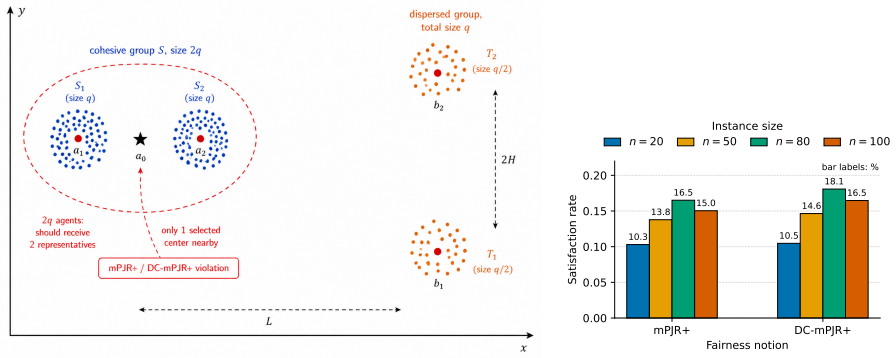
read the original abstract
Popular centroid-based clustering methods are typically optimized for global objectives, and may fail to adequately represent large groups of datapoints. Thus, one needs proportionality notions suited for metric settings. Ideally, such notions should admit polynomial-time algorithms for (a) finding proportional outcomes, and (b) checking if a given outcome is proportional; the latter enables evaluation of traditional algorithms without proportionality guarantees (e.g., $k$-means). A promising approach imports proportionality notions from multiwinner voting with approval ballots. In particular, mPJR, the metric version of the well-known Proportional Justified Representation (PJR) axiom, satisfies (a), but whether it satisfies (b) was open. In this work, we study the computational complexity of auditing proportional representation in clustering. In the approval setting, PJR is coNP-complete to verify; however, it admits a strengthening PJR+, which satisfies (a) and (b). We show these results translate to the metric setting: mPJR is coNP-complete to verify, we define mPJR+, a metric analog of PJR+, and argue mPJR+ satisfies (a) and (b). However, auditing mPJR+ relies on repeated submodular minimization, rendering it impractical at scale, and a natural combinatorial approach is infeasible. As a partial remedy, we propose an mPJR+ verification algorithm exponential in $k$ but quasilinear in the number of datapoints. Motivated by these hardness results, we introduce DC-mPJR+: a proportionality concept offering representation guarantees to a restricted set of coalitions around unselected centers, admitting an $O(mn \log n + mnk)$ verification algorithm. DC-mPJR+ outcomes can be computed efficiently, and any $\gamma$-DC-mPJR+ solution satisfies $(\gamma + 2)$-mPJR+.
Editorial analysis
A structured set of objections, weighed in public.
Referee Report
Summary. The paper proves that verifying mPJR (Proportionally Representative Fairness) in centroid-based clustering is coNP-hard. It introduces mPJR+ as a metric analog of PJR+ but shows its verification is impractical due to repeated submodular minimization. It then defines DC-mPJR+ (Default Coalitions mPJR+), which restricts proportionality guarantees to coalitions around unselected centers and admits an O(mn log n + mnk) verification algorithm. The paper shows that the SEAR algorithm satisfies DC-mPJR+ and that any solution satisfying γ-DC-mPJR+ also satisfies (γ + 2)-mPJR+.
Significance. If the results hold, the work supplies a computationally tractable auditing tool for proportional fairness in clustering while preserving a concrete approximation guarantee to the stronger mPJR notion. This directly addresses the practical gap between theoretical fairness concepts and verifiable outputs of standard algorithms such as k-means. The explicit complexity bound and the SEAR satisfaction result are concrete strengths that could enable routine fairness checks.
minor comments (2)
- The abstract states the O(mn log n + mnk) verification complexity; the main text should explicitly define the parameters m, n, and k at the first use of this bound and include a brief derivation sketch or reference to the relevant lemma.
- The relationship 'any γ-DC-mPJR+ solution satisfies (γ + 2)-mPJR+' is central; ensure the proof in the relevant section is self-contained and does not rely on external results without clear citation.
Simulated Author's Rebuttal
We thank the referee for the positive assessment of our work and the recommendation for minor revision. We appreciate the recognition that DC-mPJR+ provides a practical, verifiable auditing tool while preserving an approximation to the stronger mPJR notion.
Circularity Check
No significant circularity
full rationale
The paper defines new concepts (mPJR+, DC-mPJR+) from first principles as restricted variants of prior proportionality notions, then derives the verification algorithm complexity and the (γ+2) approximation bound directly from those definitions and the structure of default coalitions. No step reduces a claimed result to a fitted parameter, self-referential equation, or load-bearing self-citation; the +2 factor is explicitly derived as the cost of the restriction rather than assumed. The work is self-contained against external benchmarks with independent proofs of hardness, satisfiability by SEAR, and algorithmic runtime.
Axiom & Free-Parameter Ledger
axioms (1)
- domain assumption Clustering occurs in a metric space where distances satisfy triangle inequality
invented entities (1)
-
DC-mPJR+
no independent evidence
discussion (0)
Sign in with ORCID, Apple, or X to comment. Anyone can read and Pith papers without signing in.