REVIEW 4 major objections 4 minor 43 references
Constrained Pareto Set Identification with Bandit Feedback
T0 review · 4 major / 4 minor · reviewed 2026-08-07 · deepseek-v4-flash
Pith's one-line read This paper introduces constrained Pareto Set Identification with explainability, a new bandit pure-exploration problem where the learner must find the Pareto-optimal arms among those satisfying known linear feasibility constraints and…
desk verdict A solid new problem and algorithm for constrained Pareto set identification, but the 'near-optimal' claim is proven only under a norm-equivalence condition and the upper bound has an unmatched additive term. read the letter →
The pith
A machine-rendered reading of the paper's core claim, the machinery that carries it, and where it could break.
The reading
What carries the argument
The central object is e-cAPE, a top-two confidence-bound algorithm. It maintains, for every pair of arms (i,j), upper and lower confidence bounds on M(i,j) = max_c [mu_i^c - mu_j^c] and m(i,j) = min_c [mu_j^c - mu_i^c], which capture Pareto dominance, and confidence bounds on eta_i, the distance of arm i's mean to the polyhedron P, which captures feasibility. The stopping rule monitors two statistics: Z1(t), which certifies that the empirical feasible Pareto set O_t is truly feasible and that its arms are not dominated by each other, and Z2(t), which certifies that every arm outside O_t is either infeasible or dominated by an arm in F_t union G_t. The sampling rule pulls a leader b_t that minimizes the current stopping statistic and a challenger c_t that is closest to dominating b_t, thereby focusing samples on the arms that most delay a valid explanation. The complexity C*_M(nu) is the minimum over all valid partitions (S,I) of the sum of inverse squared gaps that appear in the analysis of the stopping time.
What would settle it
Build an instance where condition (53) fails, for example one suboptimal arm dominated by two Pareto-optimal arms with incomparable margins in dimension 2, so that the Euclidean perturbation norm ||s_i||_2 exceeds the sup-norm gap Delta_i by a factor near sqrt(2); then run any delta-correct algorithm, including e-cAPE, as delta tends to 0 and measure the ratio of expected stopping time to C*_M(nu) log(1/delta). The paper's unrestricted near-optimality claim predicts a limiting ratio of at least 1/8, while a ratio below that would show the lower bound does not hold for general instances.
Extended reading notes
Core claim
The core discovery is that explainable constrained Pareto set identification has a well-defined, instance-dependent sample complexity given by C*_M(nu) = min_{(S,I) in M} C(nu,S,I), where C sums inverse squared feasibility distances 1/$eta_i^{2}$ and Pareto gaps 1/$Delta_i^{2}$ over arms that must be certified feasible, infeasible, or dominated; e-cAPE achieves this complexity up to a logarithmic factor. The paper proves that e-cAPE is delta-correct (Theorem 4.4) with the stated sample-complexity bound, and that on a restricted family of Gaussian instances any delta-correct algorithm needs at least C*_M(nu) log(1/delta)/8 samples in the limit delta->0 (Theorem 4.5), so e-cAPE is near-optimal on those instances. The efficiency comes from balancing feasibility detection and Pareto identification through confidence bounds, and from the freedom to choose the easiest valid explanation for each rejected arm.
Load-bearing premise
The near-optimality proof assumes that the Euclidean perturbation cost used in the lower-bound construction equals the sup-norm Pareto gaps used in the upper-bound complexity, an equality that holds exactly only on the restricted instance family of Appendix E.4, condition (53).
Editorial extensions
If this is right
- The leading sample-complexity term of e-cAPE, C*_M(nu), is never larger than the two-stage baseline's H_PSI(nu) + H_F(nu), so the explainable formulation is not more expensive than first certifying feasibility and then Pareto optimality.
- When feasibility distances eta_i are large, e-cAPE's guarantee reduces to the unconstrained Pareto Set Identification bound of Auer et al. (2016) and Kone et al. (2023); when Pareto gaps are large, it reduces to the feasibility-detection bound of Katz-Samuels & Scott (2018).
- With law-of-the-iterated-logarithm confidence bounds, e-cAPE satisfies a high-probability bound of the form O(C_M(nu) log(Kd log(C_M(nu))/delta)).
- On the Gaussian families constructed in Appendix E.4 under condition (53), any delta-correct algorithm needs at least C*_M(nu)/8 * log(1/delta) samples as delta->0, so e-cAPE is near-optimal there.
- The racing algorithm for e-cPSI is strictly suboptimal in the worst case: when all arms are feasible and only one is Pareto-optimal, racing pays an extra 1/eta_1^2 feasibility cost that e-cAPE avoids.
Reading between the lines
- The algorithm's efficiency engine is the minimum over valid explanations: an arm near the feasibility boundary that is also dominated can be certified as dominated at the cheaper of the two costs, which is likely why e-cAPE wins on the clinical-trial instances where the 75mg arm is both boundary-near and suboptimal.
- The near-optimality claim is only proven for instances satisfying condition (53); a natural, testable extension is a matching lower bound for general instances, which would probably require a complexity measure using sup-norm Pareto gaps rather than Euclidean perturbation costs.
- The same confidence-bound machinery could handle time-varying or random polyhedra—for instance, when feasibility constraints are estimated from the data themselves—by recomputing eta_i(t) and the Pareto gaps online at each round.
- The empirical result that e-cAPE sometimes beats the asymptotically optimal Game-cPSI even for the non-explainable task suggests that the moderate-confidence regime, not the delta->0 limit, is where the explainable formulation's flexibility pays off; this could be tested systematically across a broader benchmark.
Editorial analysis
A structured set of objections, weighed in public.
Referee Report
Summary. The paper introduces constrained Pareto Set Identification (cPSI) and an explainable variant (e-cPSI) in a fixed-confidence multivariate bandit setting, where the learner must identify the Pareto set of arms whose means lie in a known polyhedron. The main algorithmic contribution is e-cAPE, a confidence-bound-based algorithm that combines feasibility detection with Pareto-set identification. Theorem 4.4 states that e-cAPE is delta-correct with an expected sample complexity of O(C*_M(nu) log(K C*_M(nu)/delta)) plus an additive feasibility term H(nu,F^c). Theorem 4.5 / Theorem E.1 gives a lower bound of Omega(C*_M(nu) log(1/delta)) on a restricted family of Gaussian instances, on which the algorithm is claimed to be near-optimal. The paper also sketches an asymptotically optimal game-based algorithm for cPSI and reports empirical comparisons on clinical-trial-inspired datasets.
Significance. If the results hold as stated, the paper extends pure-exploration Pareto-set identification to feasibility-constrained problems and introduces a useful 'explainability' requirement in which every rejected arm must be classified as infeasible or dominated. The correctness proof of the stopping rule (Lemma 4.3 and Appendix C.1) is careful, and the algorithm is concrete and reproducible. The lower-bound construction via change of measure is a standard and appropriate technique, and the empirical evaluation includes meaningful baselines (two-stage, racing, uniform). The strengths are the explicit finite-confidence algorithm, a nontrivial complexity measure C*_M(nu), and the attempt to match it with a lower bound. However, the advertised 'near-optimal' claim is currently stronger than what the theorems establish: the lower bound is proved only on a specially constructed family, and the upper-bound proof has a constant-factor inconsistency. The central algorithmic idea is defensible, but the paper's headline claim needs qualification and the lower-bound proof needs to be made self-contained.
major comments (4)
- [Theorem 4.4 and Appendix C.2.2] The stated upper bound is inconsistent with its proof. In the proof, after Lemma D.1 the authors define \tilde C(\nu,S,I) = 64 C(\nu,S,I) \alpha and obtain T^*(S,I) = 2\tilde C \log(\tilde C(4k_1Kd/\delta)^{1/\alpha}), which gives a prefactor 128 \alpha C(\nu,S,I) and a log argument 64 \alpha C(\nu,S,I). However, Theorem 4.4 states 128 C^*_M(\nu) \log(64 C^*_M(\nu)(4k_1Kd/\delta)^{1/\alpha}) with no \alpha in either place. In addition, the proof line 'a=64 \sigma^2 C(\nu,S,I)\alpha' appears to contain a spurious \sigma^2, since \sigma^2 is already absorbed in C. The theorem should be corrected to match the derivation.
- [Abstract, Section 1.2, Theorem 4.5, Appendix E.4] The abstract and the conclusion state that the paper proves near-optimality of the sample complexity of e-cAPE, but the formal lower bound is only proved on a restricted family. Theorem 4.5 states 'There exists a class eD such that ...', and Appendix E.4 constructs eD. Moreover, the constructed family has no feasible suboptimal arms (for these instances every feasible arm is Pareto-optimal, so SubOpt is empty), and for Pareto-optimal arms the Euclidean quantity e\delta_i^+ equals 2\alpha while the sup-norm gap \delta_i^+ equals \alpha, so even condition (53) is not literally satisfied. The lower bound therefore exercises only the O^* and I terms of C^*_M(\nu), not the S terms. The unqualified 'near-optimal' claim in the abstract, contributions, and conclusion should be replaced by a statement that e-cAPE is near-optimal on the constructed classes, and the gap with the general lower bound of Proposition 3.4 should be acknowledged.
- [Appendix E.3, after Eq. (52)] The lower-bound proof contains an unproved step for the gap \delta_i^-(S) of an optimal arm. The text says 'As justified in Remark 18 of Auer et al. (2016), \delta_i^-(S), can be compensated by both \delta_i^+(S) and \Delta_j^* for some arms j\in SubOpt (in our case). So we focus on matching the gaps in \delta_i^+'. This is a load-bearing claim because C(\nu,S,I) uses \Delta_i(O^*\cup S)=\min(\delta_i^+, \delta_i^-(S)). The lower bound derived in Section E.2 only gives a bound involving \min(e\delta_i^+, \eta_i), not \min(\Delta_i(O^*\cup S), \eta_i). To make Theorem E.1 self-contained, the authors must either prove the compensation argument explicitly or restrict the statement of the lower bound to instances in which \delta_i^-(S) is vacuous or otherwise dominated by the terms that are matched.
- [Theorem 4.4, displayed bound and definition of H(nu,F^c)] The additive term 4H(\nu,F^c) is not matched by the lower bound, and its definition is notationally confusing. The theorem defines H(\nu,F^c) as a sum over F^c \cup O^*, not over F^c. More importantly, the proof obtains E[\tau] \le T^*(S,I) + \Lambda_\alpha with T^*(S,I)=2\tilde C\log(\tilde C b)+4H(\nu,I), and then uses H(\nu,I) \le H(\nu,F^c). Since the lower bound has no analogous additive term and the lower-bound family has no feasible suboptimal arms, finite-confidence near-optimality in the regime of fixed moderate \delta is not established; the paper should state precisely that the matching is asymptotic in \delta \to 0 or require a lower bound that includes the feasibility term.
minor comments (4)
- [Theorem E.1 statement] The statement reads 'E_\nu [\tau] min_{(S',I') \in M} C(\nu,S',I') g(\delta)/4' with no inequality; it should be 'E_\nu[\tau] \ge \min_{(S',I')} C(\nu,S',I') g(\delta)/4'.
- [Theorem 4.4, definition of H(\nu,F^c)] The expression '\log(5d/d)' appears to be a typo: the proof uses quantities such as f(T,5^{-d}d) and f(T,\delta\cdot d/5^d), so the correct term should presumably be \log(5^d/d), not \log(5d/d).
- [Appendix E.4] The construction says 'd \ge 1 (arbitrary)' but then uses coordinates 1 and 2; the statement should say d \ge 2.
- [Section 4.1, Algorithm 1] In Algorithm 1, the description of the leader b_t as the minimizer of (Z^F_1(t) if Z^{PS}_1(t) \ge Z^F_1(t), and Z^{PS}_1(t) otherwise) is terse; a parenthetical restating that this is min(Z^F_1(t), Z^{PS}_1(t)) would improve readability.
Circularity Check
No load-bearing circularity: C*_M appears in both bounds but the lower bound is an independent change-of-measure argument; the near-optimality claim is qualified by condition (53), not circularly derived.
full rationale
The core derivation is not circular. The upper bound (Theorem 4.4, Appendix C.2) directly analyzes e-cAPE: on the good event, Proposition C.3 shows each non-stopped round samples an under-explored arm in W_t(S,I), and the sum of inverse-squared gaps yields O(C*_M(ν) log(KC*_M(ν)/δ)) + 4H(ν,F^c) + Λ_α. The lower bound (Theorem 4.5, Appendix E) uses the change-of-distribution Lemma E.2 and the δ-correctness definition only; it never assumes e-cAPE's sampling rule. It lower-bounds E[N_{τ,i}] by 2/η_i^2, 2/||s_i||_2^2, or 2/min(η_i, eδ+_i)^2 on alternative Gaussian instances, then maps these to C(ν,S,I). Thus the appearance of C*_M on both sides is a genuine matching on the constructed family, not a fitted parameter renamed as a prediction. The only self-citation, to the authors' prior APE work (Kone et al. 2023), supplies the confidence-region design template and standard PSI gap definitions; Lemma 4.3 and Theorem 4.4 are proved from scratch in Appendices C.1-C.2, so this citation is not load-bearing. The skeptic's concern is a qualification gap rather than circularity: Appendix E.3 admits that outside condition (53) the Euclidean quantities in (46) and (50) can exceed the sup-norm gaps by up to √d or √|Ω_i|, and Theorem 4.4's additive feasibility term 4H(ν,F^c) is not matched by the lower bound. Theorem 4.5 is therefore stated only for the restricted family eD, so the abstract's unqualified 'near-optimal' overreaches. The proof also depends on Auer et al.'s Remark 18 to compensate δ^-_i(S) gaps without a self-contained argument. These are missing or overstated support, not self-referential reductions.
Assumptions & free parameters
free parameters (2)
- k1 =
k1 > 1 + 1/(α-1)
- α =
α > 2
assumptions (5)
- domain assumption Arms are independent with i.i.d. samples; each arm is marginally σ-subGaussian and norm-σ_u-subGaussian (or multivariate Gaussian with identity covariance for lower bounds).
- domain assumption The feasibility polyhedron P = {x : Ax ≤ b} is known to the learner.
- standard math Time-uniform confidence inequalities for subGaussian and norm-subGaussian vector means (Garivier 2013; Kaufmann & Koolen 2021; ε-net covering arguments).
- standard math Change-of-distribution lemma for bandits (Kaufmann et al. 2016, Lemma E.2).
- standard math Convex quadratic programs can be solved in polynomial time (Ye & Tse 1989), and the valid-map enumeration of Crepon et al. (2024) bounds the number of subproblems in the best-response computation.
Cite this review
Pith. "Pith review of Constrained Pareto Set Identification with Bandit Feedback." pith.science (2026). https://pith.science/paper/JZ4EBQQQ
@misc{pith2026250608127,
  author       = {Pith},
  title        = {Pith review of: Constrained Pareto Set Identification with Bandit Feedback},
  year         = {2026},
  howpublished = {\url{https://pith.science/paper/JZ4EBQQQ}},
  note         = {Machine review of arXiv:2506.08127}
}
abstract
In this paper, we address the problem of identifying the Pareto Set under feasibility constraints in a multivariate bandit setting. Specifically, given a $K$-armed bandit with unknown means $\mu_1, \dots, \mu_K \in \mathbb{R}^d$, the goal is to identify the set of arms whose mean is not uniformly worse than that of another arm (i.e., not smaller for all objectives), while satisfying some known set of linear constraints, expressing, for example, some minimal performance on each objective. Our focus lies in fixed-confidence identification, for which we introduce an algorithm that significantly outperforms racing-like algorithms and the intuitive two-stage approach that first identifies feasible arms and then their Pareto Set. We further prove an information-theoretic lower bound on the sample complexity of any algorithm for constrained Pareto Set identification, showing that the sample complexity of our approach is near-optimal. Our theoretical results are supported by an extensive empirical evaluation on a series of benchmarks.
Figures


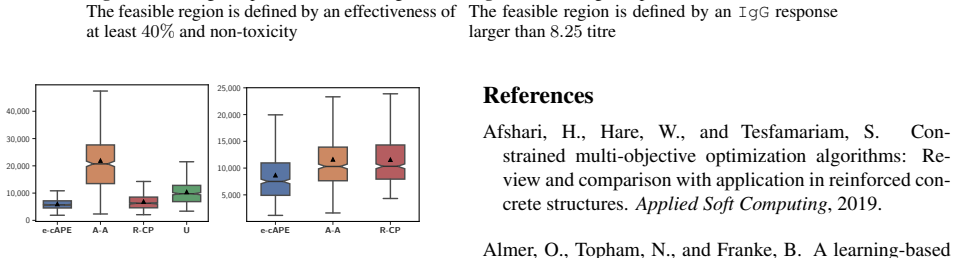
Figures from the paper (3 more)


Reference graph
Works this paper leans on
-
[1]
write newline
" write newline "" before.all 'output.state := FUNCTION n.dashify 't := "" t empty not t #1 #1 substring "-" = t #1 #2 substring "--" = not "--" * t #2 global.max substring 't := t #1 #1 substring "-" = "-" * t #2 global.max substring 't := while if t #1 #1 substring * t #2 global.max substring 't := if while FUNCTION format.date year duplicate empty "emp...
-
[2]
Afshari, H., Hare, W., and Tesfamariam, S. Constrained multi-objective optimization algorithms: Review and comparison with application in reinforced concrete structures. Applied Soft Computing, 2019
work page 2019
-
[3]
A learning-based approach to the automated design of mpsoc networks
Almer, O., Topham, N., and Franke, B. A learning-based approach to the automated design of mpsoc networks. In Proceedings of the 24th International Conference on Architecture of Computing Systems. Springer-Verlag, 2011
work page 2011
-
[4]
Linear stochastic bandits under safety constraints
Amani, S., Alizadeh, M., and Thrampoulidis, C. Linear stochastic bandits under safety constraints. In Advances in Neural Information Processing Systems, 2019
work page 2019
-
[5]
Audibert, J.-Y. and Bubeck, S. Best arm identification in multi-armed bandits. In COLT - 23th Conference on Learning Theory , 2010
work page 2010
-
[6]
Pareto front identification from stochastic bandit feedback
Auer, P., Chiang, C.-K., Ortner, R., and Drugan, M.-M. Pareto front identification from stochastic bandit feedback. In Proceedings of the 19th International Conference on Artificial Intelligence and Statistics. PMLR , 2016
work page 2016
-
[7]
Sequential learning of the P areto front for multi-objective bandits
C repon, E., Garivier, A., and M Koolen, W. Sequential learning of the P areto front for multi-objective bandits. In Proceedings of The 27th International Conference on Artificial Intelligence and Statistics, Proceedings of Machine Learning Research. PMLR, 2024
work page 2024
-
[8]
De Rooij, S., Van Erven, T., Gr\" u nwald, P. D., and Koolen, W. M. Follow the leader if you can, hedge if you must. J. Mach. Learn. Res., 2014
work page 2014
Show all 43 references
-
[9]
and Koolen, W
Degenne, R. and Koolen, W. Pure exploration with multiple correct answers. In Advances in Neural Information Processing Systems. Curran Associates, Inc., 2019
2019
-
[10]
Gamification of pure exploration for linear bandits
Degenne, R., M \' e nard, P., Shang, X., and Valko, M. Gamification of pure exploration for linear bandits. In International Conference on Machine Learning (ICML) , 2020
2020
-
[11]
and Nowe, A
Drugan, M.-M. and Nowe, A. Designing multi-objective multi-armed bandits algorithms: A study. In The 2013 International Joint Conference on Neural Networks (IJCNN), 2013
2013
-
[12]
Action elimination and stopping conditions for the multi-armed bandit and reinforcement learning problems
Even-Dar, E., Mannor, S., and Mansour, Y. Action elimination and stopping conditions for the multi-armed bandit and reinforcement learning problems. Journal of Machine Learning Research, 2006
2006
-
[13]
Informational confidence bounds for self-normalized averages and applications
Garivier, A. Informational confidence bounds for self-normalized averages and applications. In 2013 IEEE Information Theory Workshop (ITW). IEEE, September 2013
2013
-
[14]
and Kaufmann, E
Garivier, A. and Kaufmann, E. Optimal best arm identification with fixed confidence. In 29th Annual Conference on Learning Theory. PMLR, 2016
2016
-
[15]
Exploring multi-objective exercise recommendations in online education systems
Huang, Z., Liu, Q., Zhai, C., Yin, Y., Chen, E., Gao, W., and Hu, G. Exploring multi-objective exercise recommendations in online education systems. In Proceedings of the 28th ACM International Conference on Information and Knowledge Management. Association for Computing Machi...
2019
-
[16]
and Nowak, R
Jamieson, K. and Nowak, R. Best-arm identification algorithms for multi-armed bandits in the fixed confidence setting. In 2014 48th Annual Conference on Information Sciences and Systems ( CISS ) , 2014
2014
-
[17]
lil' ucb : An optimal exploration algorithm for multi-armed bandits
Jamieson, K., Malloy, M., Nowak, R., and Bubeck, S. lil' ucb : An optimal exploration algorithm for multi-armed bandits. In Proceedings of The 27th Conference on Learning Theory. PMLR, 2014
2014
-
[18]
and Turnbull, B
Jennison, C. and Turnbull, B. W. Group sequential tests for bivariate response: interim analyses of clinical trials with both efficacy and safety endpoints. Biometrics, 1993
1993
-
[19]
PAC subset selection in stochastic multi-armed bandits
Kalyanakrishnan, S., Tewari, A., Auer, P., and Stone, P. PAC subset selection in stochastic multi-armed bandits. In Proceedings of the 29th International Coference on International Conference on Machine Learning. Omnipress, 2012
2012
-
[20]
M., Y ld r m, Y
Karag \"o zl \"u , E. M., Y ld r m, Y. C., Ararat, C., and Tekin, C. Learning the P areto set under incomplete preferences: Pure exploration in vector bandits. In Proceedings of The 27th International Conference on Artificial Intelligence and Statistics, Proceedings of Machine...
2024
-
[21]
and Scott, C
Katz-Samuels, J. and Scott, C. Feasible arm identification. In Proceedings of the 35th International Conference on Machine Learning. PMLR , 2018
2018
-
[22]
and Scott, C
Katz-Samuels, J. and Scott, C. Top feasible arm identification. In Proceedings of the Twenty-Second International Conference on Artificial Intelligence and Statistics. PMLR , 2019
2019
-
[23]
Analysis of bayesian and frequentist strategies for sequential resource allocation
Kaufmann, E. Analysis of bayesian and frequentist strategies for sequential resource allocation . Thesis, T \'e l \'e com ParisTech , 2014
2014
-
[24]
and Koolen, W.-M
Kaufmann, E. and Koolen, W.-M. Mixture martingales revisited with applications to sequential tests and confidence intervals. Journal of Machine Learning Research, 2021
2021
-
[25]
On the complexity of best-arm identification in multi-armed bandit models
Kaufmann, E., Capp \'e , O., and Garivier, A. On the complexity of best-arm identification in multi-armed bandit models. Journal of Machine Learning Research, 2016
2016
-
[26]
Adaptive algorithms for relaxed pareto set identification
Kone, C., Kaufmann, E., and Richert, L. Adaptive algorithms for relaxed pareto set identification. In Thirty-seventh Conference on Neural Information Processing Systems, 2023
2023
-
[27]
Pareto set identification with posterior sampling, 2024 a
Kone, C., Jourdan, M., and Kaufmann, E. Pareto set identification with posterior sampling, 2024 a
2024
-
[28]
Bandit pareto set identification in a multi-output linear model
Kone, C., Kaufmann, E., and Richert, L. Bandit pareto set identification in a multi-output linear model. In Seventeenth European Workshop on Reinforcement Learning, 2024 b
2024
-
[29]
Z., Luo, Q., Mallipeddi, R., Suganthan, P
Kumar, A., Wu, G., Ali, M. Z., Luo, Q., Mallipeddi, R., Suganthan, P. N., and Das, S. A benchmark-suite of real-world constrained multi-objective optimization problems and some baseline results. Swarm and Evolutionary Computation, 2021
2021
-
[30]
and Szepesvári, C
Lattimore, T. and Szepesvári, C. Bandit Algorithms. Cambridge University Press, 2020
2020
-
[31]
Constrained multi-objective bayesian optimization through optimistic constraints estimation, 2024
Li, D., Zhang, F., Liu, C., and Chen, Y. Constrained multi-objective bayesian optimization through optimistic constraints estimation, 2024
2024
-
[32]
A pareto-efficient algorithm for multiple objective optimization in e-commerce recommendation
Lin, X., Chen, H., Pei, C., Sun, F., Xiao, X., Sun, H., Zhang, Y., Ou, W., and Jiang, P. A pareto-efficient algorithm for multiple objective optimization in e-commerce recommendation. In Proceedings of the 13th ACM Conference on Recommender Systems, RecSys '19. Association for...
2019
-
[33]
Efficacy and safety of secukinumab in patients with rheumatoid arthritis: a phase ii, dose-finding, double-blind, randomised, placebo controlled study
Mark C, G., Patrick, D., Hanno B, R., Jerzy, S., Eva, D., Vadim, M., Jacob A, A., Sang-Heon, L., Christine E, C., Herbert, K., Takashi, I., Sophie, H., and Shephard, M. Efficacy and safety of secukinumab in patients with rheumatoid arthritis: a phase ii, dose-finding, double-b...
2013
-
[34]
Bandit based optimization of multiple objectives on a music streaming platform
Mehrotra, R., Xue, N., and Lalmas, M. Bandit based optimization of multiple objectives on a music streaming platform. KDD '20. Association for Computing Machinery, 2020
2020
-
[35]
Gradient ascent for active exploration in bandit problems, 2019
M\'enard, P. Gradient ascent for active exploration in bandit problems, 2019
2019
-
[36]
Munro, A.-P.-S., Janani, L., Cornelius, V., and et al. Safety and immunogenicity of seven COVID -19 vaccines as a third dose (booster) following two doses of ChAdOx 1 nCov -19 or BNT 162b2 in the UK ( COV - BOOST ): a blinded, multicentre, randomised, controlled, phase 2 trial...
2021
-
[37]
Dealing with misspecification in fixed-confidence linear top-m identification
R\' e da, C., Tirinzoni, A., and Degenne, R. Dealing with misspecification in fixed-confidence linear top-m identification. In Advances in Neural Information Processing Systems. Curran Associates, Inc., 2021
2021
-
[38]
and Vershynin, R
Rudelson, M. and Vershynin, R. Hanson-wright inequality and sub-gaussian concentration, 2013
2013
-
[39]
Fast pure exploration via frank-wolfe
Wang, P.-A., Tzeng, R.-C., and Proutiere, A. Fast pure exploration via frank-wolfe. In Advances in Neural Information Processing Systems. Curran Associates, Inc., 2021
2021
-
[40]
and Tse, E
Ye, Y. and Tse, E. An extension of karmarkar projective algorithm for convex quadratic programming. Math. Program., July 1989
1989
-
[41]
Information-directed selection for top-two algorithms
You, W., Qin, C., Wang, Z., and Yang, S. Information-directed selection for top-two algorithms. In Proceedings of Thirty Sixth Conference on Learning Theory, Proceedings of Machine Learning Research. PMLR, 2023
2023
-
[42]
Active learning for multi-objective optimization
Zuluaga, M., Sergent, G., Krause, A., and Püschel, M. Active learning for multi-objective optimization. In Proceedings of the 30th International Conference on Machine Learning. PMLR , 2013
2013
-
[43]
e-pal: An active learning approach to the multi-objective optimization problem
Zuluaga, M., Krause, A., and P \"u schel, M. e-pal: An active learning approach to the multi-objective optimization problem. Journal of Machine Learning Research, 2016
2016
Reviewed August 7, 2026 · model on record in the stance chip above.
Discussion (0). Sign in to comment.