REVIEW 3 major objections 6 minor
Classical Tensor Network and Quantum Fourier Transform Approaches for Large-Scale Carr-Madan Option Pricing
T0 review · 3 major / 6 minor · reviewed 2026-07-31 · grok-4.5
Pith's one-line read A compressed tensor-train form of the quantum Fourier transform prices European calls on huge grids without building the full FFT vectors.
desk verdict Solid end-to-end SFFT Carr–Madan with honest FFT/SFFT/QFT scaling numbers on 1D BS; the high-dimensional framing is ahead of the evidence. read the letter →
The pith
A machine-rendered reading of the paper's core claim, the machinery that carries it, and where it could break.
The reading
What carries the argument
The Superfast Fourier Transform (SFFT): a low-rank Tensor Train Operator for the reduced QFT circuit (without bit-reversal), applied by TT contraction of cost O(n r_SFFT² r²) to the tensorized Carr–Madan input, together with exact rank-one TT factors for the exponential damping and phase terms.
What would settle it
Re-run the SFFT Carr–Madan pipeline on the same Black–Scholes parameters while forcing the TT rank of ψ or of the SFFT operator to grow with n (or switch to a model whose characteristic function is known to be high-rank under binary encoding); if memory and core runtime then track classical FFT instead of saturating, the claimed subexponential advantage fails.
Extended reading notes
Core claim
Carr–Madan European call pricing can be executed entirely inside Tensor Trains by applying the Superfast Fourier Transform (a compressed Tensor Train Operator of the reduced QFT) to a TT representation of the damped characteristic-function data, so option prices on grids of size 2^n are obtained without ever storing O(2^n) vectors or operators, while accuracy stays comparable to classical FFT and both the TT method and hardware QFT avoid the exponential scaling of dense Fourier pricing.
Load-bearing premise
The method stays cheap only if the characteristic-function data and the intermediate pricing tensors keep small, saturating Tensor Train ranks as the grid is refined—shown here for one-dimensional Black–Scholes, not yet for the jump, stochastic-volatility, or multi-asset cases that motivate the work.
Editorial extensions
If this is right
- Large strike–frequency grids that are memory-infeasible for dense FFT become routine once the pricing tensors admit modest TT ranks.
- The same SFFT operator can be built once offline and reused across many strikes, maturities, or parameter sweeps.
- Classical tensor-network Fourier pricing and QFT-based quantum pricing become directly comparable inside one Carr–Madan discretization.
- Hardware QFT wall-clock for the transform alone scales only polynomially in qubits, while classical FFT scales with the full grid size.
- Future multi-asset or path-dependent Fourier pricers can target the same compressed-transform pattern rather than low-rank structure only in payoffs or Greeks.
Reading between the lines
- If TT ranks stay modest for characteristic functions of Lévy or stochastic-volatility models, the same pipeline would undercut FFT memory for the settings where closed-form densities are unavailable and Fourier methods are most needed.
- Precomputing a library of SFFT operators at fixed accuracy would remove the main offline bottleneck the authors report, making the core contraction the only online cost.
- The phase-reconstruction step required by quantum measurement (taking square roots of probabilities) is a structural accuracy ceiling classical SFFT does not face; hybrid workflows may therefore keep the transform classical even when state preparation is quantum.
- Binary tensorization of the frequency grid is doing the real compression work; other Fourier option methods (COS, PROJ) could be tensorized the same way if their kernels separate under the same encoding.
Signed reviews
Editorial analysis
A structured set of objections, weighed in public.
Referee Report
Summary. The paper reformulates the Carr–Madan Fourier pricing method in Tensor Train format by applying the Superfast Fourier Transform (SFFT), a low-rank TT operator realization of the reduced Quantum Fourier Transform, so that the damped characteristic-function integrand, rank-one damping factors, and inverse DFT are handled without materializing the full 2^n grid. It places this classical TN algorithm alongside a QFT-based Carr–Madan pipeline (following Ewen) and reports memory, runtime, and NRMSE for European calls under Black–Scholes, plus inverse-QFT execution statistics on IBM hardware and accuracy on statevector simulation. For the BS benchmark the TT ranks saturate (max rank ~120 after n≈12), memory plateaus relative to dense FFT, core SFFT runtime crosses FFT near n≈16 (full workflow near n≈23), and NRMSE reaches ~3.1×10^{-13} versus FFT ~4.4×10^{-15}; both SFFT and QFT avoid explicit exponential storage of the Fourier operator.
Significance. If the efficiency story transfers beyond the reported setting, the work would usefully unify classical FFT pricing, tensor-network compression of the Fourier operator itself (rather than only of pricing surfaces), and QFT-based quantum pricing under one Carr–Madan discretization. Strengths that should be credited: a clear, reproducible pipeline (TT-cross for ψ, analytic rank-one dampings, Zip-Up SFFT-TTO); an external analytical BS benchmark rather than self-consistency checks; concrete hardware circuit-depth/CZ/timing data; and an explicit core-vs-preprocessing runtime split that makes the asymptotic claim falsifiable. The main significance is therefore methodological and comparative for large 1D Fourier grids; claims of a scalable route to jump/SV or multi-asset pricing remain aspirational until supported by evidence.
major comments (3)
- [Abstract; Introduction; Experimental Evaluation; Conclusion] Abstract, Introduction, and Conclusion frame the method as addressing large-scale / high-dimensional pricing and motivate jumps, stochastic volatility, and multi-asset settings (Heston, Merton, Variance Gamma; cf. Kastoryano–Pancotti). All numerical evidence (Figs. 2–4, NRMSE, rank saturation ~120) is for non-dividend 1D Black–Scholes only. The load-bearing efficiency claim—memory plateau and O(n r_SFFT² r²) core cost—requires that the binary-tensorized ψ and post-SFFT TT keep small, non-growing max rank as n grows. That is demonstrated for BS but not for any CF the introduction cites as motivation. Either add at least one non-BS CF experiment (e.g. Heston or VG) with rank/NRMSE/runtime plots, or substantially narrow the abstract/conclusion language to what is shown (fine 1D Fourier grids under BS).
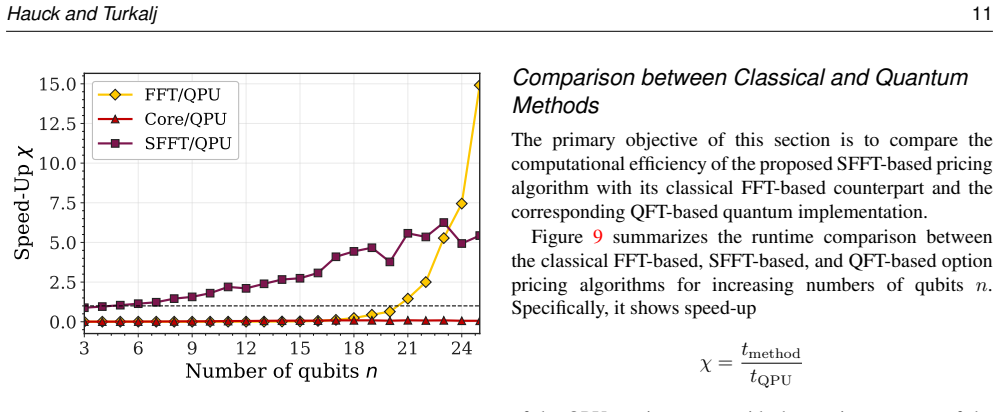
- [QFT-based Option Pricing; Comparison between Classical and Quantum Methods; Fig. 9] The QFT vs SFFT/FFT comparison in “Comparison between Classical and Quantum Methods” and Fig. 9 measures QPU time as post-transpiled inverse-QFT execution only (state preparation, transpilation, queueing excluded), while full SFFT includes construction and FFT is end-to-end. The paper notes this, but the speed-up narrative and abstract claim of a “direct comparison” still risk overstating quantum advantage relative to classical kernels. Please report, side-by-side, (i) inverse-QFT-only vs SFFT-core and (ii) a full pricing workflow estimate including a concrete state-preparation cost model (or explicitly label Fig. 9 as kernel-only and remove workflow-level superiority language).
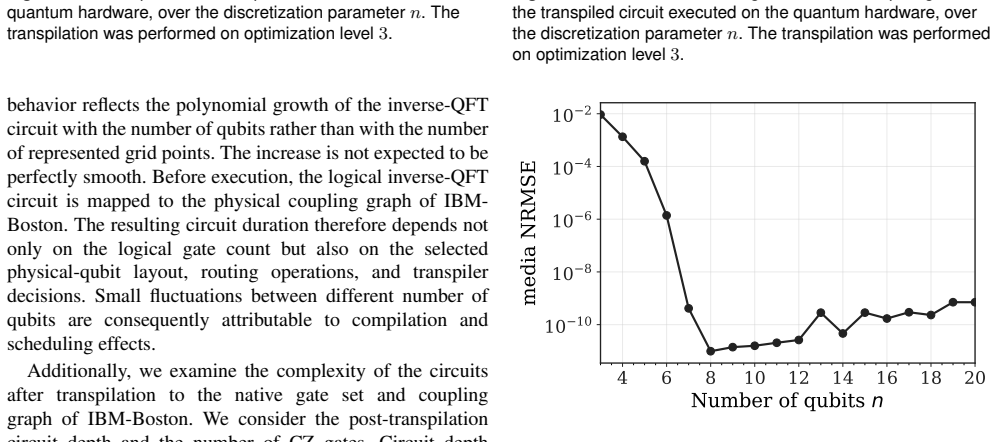
- [QFT-based Option Pricing, Eqs. (16)–(20); Fig. 8] Eqs. (16)–(20): price recovery from computational-basis shots uses e^{iπl} ỹ_l ≈ |ỹ_l|=√p_l. This is stated as accurate when the discretization is good, but residual phase/imaginary error is a second error source beyond sampling. Classical FFT/SFFT reach ~10^{-15}–10^{-13} NRMSE while the statevector floor is higher (~10^{-12}–10^{-9}, Fig. 8). Quantify the phase-approximation error (e.g. max |Im(e^{iπl} ỹ_l)| or price error with exact complex amplitudes vs √p_l) on the same grids so readers can separate discretization, reconstruction, and shot noise—especially before any hardware pricing claims.
minor comments (6)
- [Experimental Evaluation; title page] Several figure cross-references are broken or placeholder: “see Appendix??”, “Figure X”, and incomplete author/email fields (“tbf”). Fix before production.
- [Experimental Evaluation] Damping is described as “varied over set to a value of α=2.5” (typo/grammar). State the fixed α used for classical runs and how the five α values in the simulator median NRMSE were chosen.
- [European Option Pricing…; Experimental Evaluation] Grid definitions: Δk=N^{-1/2} and b=log(S0)-NΔk/2 should be written with clear math formatting; confirm consistency with Δv Δk=π/N from the discretization section.
- [Superfast Fourier Transform] SFFT construction via Zip-Up is deferred; a brief complexity/rank bound or pointer to Hauck et al. / Dolgov et al. with the truncation tolerance used in experiments would aid reproducibility.
- [Figures 2–4] Fig. 2–4 axis labels appear as Unicode entity strings in the manuscript source; ensure vectorized figures render cleanly.
- [Introduction] Related TN Fourier pricing (Glau et al.; Sakurai et al.; Kastoryano–Pancotti) is cited; a short explicit contrast—compressing the DFT operator vs compressing the pricing function/surface—would sharpen the novelty claim.
Circularity Check
No significant circularity: Carr–Madan/SFFT pricing is benchmarked against closed-form Black–Scholes and classical FFT, not against quantities defined from its own fits.
full rationale
The paper’s load-bearing chain is standard and externally checked. Carr–Madan damping and DFT discretization are classical; the SFFT is a known compressed TT realization of the reduced QFT (Dolgov et al.; Zip-Up), applied to tensorized ψ and rank-one exponential factors without defining prices in terms of the method’s outputs. Accuracy is measured by NRMSE against the analytical Black–Scholes call (Eq. 1 / Eq. 27), and efficiency is compared to dense FFT memory/runtime and to QFT simulator/hardware timings—not to a fitted target recovered as a ‘prediction.’ Damping α and grids are numerical choices, not recovered quantities. Self-citations (e.g. Hauck et al. on SFFT ranks; Ewen on QFT pricing) supply background or prior technique, not a uniqueness theorem that forces the main claim. Rank saturation and crossovers are empirical observations on the BS benchmark, not tautologies. No Eq.-X-equals-Eq.-Y-by-construction loop on the central accuracy or scaling claims.
Assumptions & free parameters
free parameters (5)
- Carr–Madan damping α =
2.5
- Fourier/log-strike grid (n, Δk, k0/b) =
n varied; Δk=N^{-1/2}
- TT rank truncation / TT-cross accuracy
- Quantum shot count S =
default 4096 on IBM
- Moneyness evaluation window =
K in [50,150] for S0=100
assumptions (5)
- domain assumption European call value equals discounted risk-neutral expectation; Carr–Madan damped Fourier representation (8)–(5) holds when E[S_T^{α+1}]<∞.
- standard math Discrete unitary DFT (9) with ΔvΔk=π/N approximates the inverse Fourier integral via the chosen rectangular rule (11)–(13).
- domain assumption Reduced QFT operator Q_n admits a compact TT operator (SFFT) with small ranks; bit-reversal can be absorbed into index handling.
- ad hoc to paper For QFT pricing, e^{iπl} ỹ_l ≈ |ỹ_l|=√p_l when discretization is accurate, so prices can be read from measurement probabilities.
- domain assumption Black–Scholes closed form is the ground-truth benchmark for NRMSE.
invented entities (1)
-
SFFT-based Carr–Madan pricing algorithm (TT pipeline for ψ, rank-1 dampings, SFFT-TTO apply)
independent evidence
Cite this review
Pith. "Pith review of Classical Tensor Network and Quantum Fourier Transform Approaches for Large-Scale Carr-Madan Option Pricing." pith.science (2026). https://pith.science/paper/JZLPGTFI
@misc{pith2026260728435,
  author       = {Pith},
  title        = {Pith review of: Classical Tensor Network and Quantum Fourier Transform Approaches for Large-Scale Carr-Madan Option Pricing},
  year         = {2026},
  howpublished = {\url{https://pith.science/paper/JZLPGTFI}},
  note         = {Machine review of arXiv:2607.28435}
}
read the original abstract
Fourier-based methods are among the most widely used techniques for pricing European options when the characteristic function of the underlying asset process is available. Their applicability to increasingly fine discretizations, however, is limited by the rapidly growing memory requirements of classical Fourier transforms, which become a computational bottleneck for large-scale pricing problems. In this work, we overcome this limitation by reformulating the Carr-Madan pricing framework using tensor networks. Specifically, we employ the Superfast Fourier Transform (SFFT), a compressed Tensor Train representation of the Quantum Fourier Transform (QFT), and apply it directly to tensorized option pricing without ever explicitly constructing exponentially large vectors or Fourier operators. This formulation also enables a direct comparison between the classical tensor network algorithm and its quantum counterpart through QFT-based option pricing on quantum simulators and quantum hardware. Numerical experiments for European call options demonstrate that the proposed SFFT method maintains pricing accuracy while substantially reducing memory requirements and achieving subexponential computational scaling compared with conventional FFT-based pricing. The accompanying quantum simulations and hardware executions enable a direct comparison between the classical tensor network formulation and its QFT-based quantum counterpart, showing that both approaches avoid the exponential scaling of conventional Fourier implementations and provide complementary perspectives on large-scale option pricing. Together, these results establish a unified framework connecting classical Fourier pricing, tensor network algorithms, and quantum computing approaches, demonstrating how tensorized Fourier methods can provide scalable alternatives for high-dimensional financial computations.
Figures


Figures from the paper (4 more)


Reviewed July 31, 2026 · model on record in the stance chip above.
Discussion (0). Continue with ORCID to comment.