REVIEW 3 major objections 4 minor 57 references
Simultaneous Wireless Information and Power Transfer for Decode-and-Forward Multi-Hop Relay Systems in Energy-Constrained IoT Networks
T0 review · 3 major / 4 minor · reviewed 2026-08-14 · deepseek-v4-flash
Pith's one-line read A multi-hop relay network with decode-and-forward SWIPT has closed-form optimal power-splitting ratios, giving the minimum source power and maximum end-to-end rate as explicit formulas.
desk verdict The closed forms for E0 and R telescope correctly, but the printed PS-ratio formulas drop the noise variances and are infeasible for unequal sigma^2; fixable but load-bearing. read the letter →
The pith
A machine-rendered reading of the paper's core claim, the machinery that carries it, and where it could break.
The reading
What carries the argument
The load-bearing device is the change of variables $A_k=\prod_{j=1}^k \rho_j$, with $A_0=1$ and $A_{K+1}=0$, together with $Q=1/E_0$ for the power-minimization problem and an auxiliary SNR variable $\hat\gamma$ for the rate-maximization problem. In these variables the non-convex product constraints become a chain of linear inequalities, $A_{k-1}-A_k \ge Q\sigma_k^2\beta_k\bar\gamma_k/\Gamma_k$ (or the same with $\hat\gamma$ in place of $\bar\gamma_k$), so each problem becomes convex with a single active constraint chain. Karush–Kuhn–Tucker analysis then forces all dual variables to be equal, a telescoping sum collapses to unity, and the closed-form objectives and recursive PS ratios follow. The machinery is doing the work of removing the coupling between successive hops' split ratios.
What would settle it
For the mathematical claim itself, run a dense grid search over $\rho$ for a small instance, say $K=2$ with fixed positive thresholds and randomly drawn channel gains, and compare the numerical optimum of problem (6) with $E_0^\star=\sum_{k=1}^{K+1}\bar\gamma_k\sigma_k^2\beta_k/\Gamma_k$; any mismatch would refute Theorem 1. To test the model's applicability, repeat the comparison after adding a fixed per-relay circuit power $P_c>0$ and a saturating energy-harvesting efficiency; a mismatch there would show the closed forms describe the idealized model rather than a real relay's energy budget.
Extended reading notes
Core claim
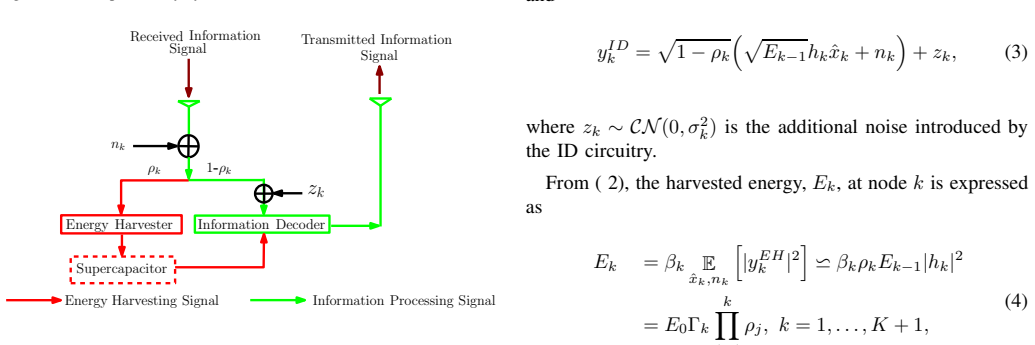
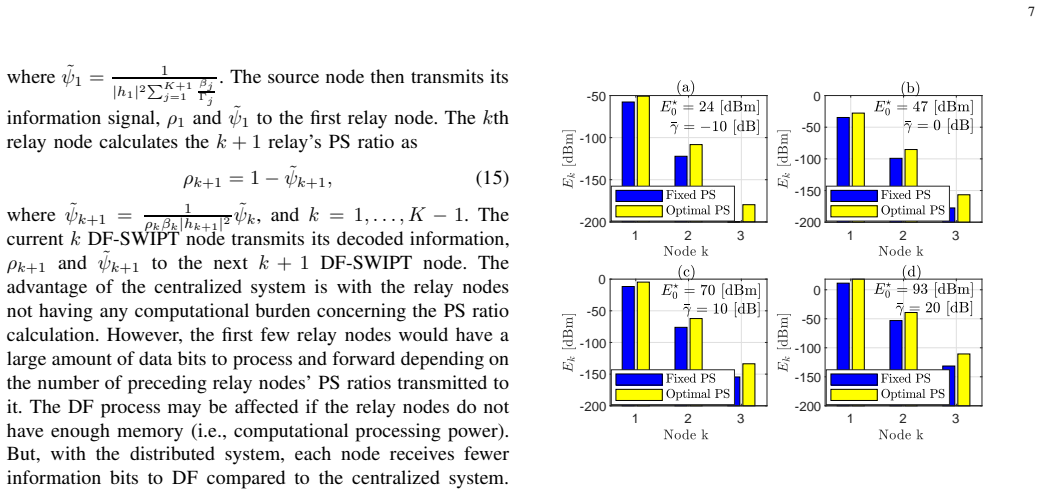
The paper's central claim is that, under the modeled SWIPT system, the globally optimal power-splitting ratios and the optimal objective values are available in closed form for both problems. For a source and destination separated by $K$ decode-and-forward relays with no direct link, each relay splits its received signal with ratio $\rho_k$: fraction $\rho_k$ goes to energy harvesting and $1-\rho_k$ to information decoding. The paper proves Theorem 1: the minimum source power meeting per-hop SNR constraints $\bar\gamma_k$ is $E_0^\star=\sum_{k=1}^{K+1}\bar\gamma_k\sigma_k^2\beta_k/\Gamma_k$, where $\Gamma_k=\prod_{j=1}^k \beta_j|h_j|^2$ accumulates the energy-conversion efficiencies and channel gains hop by hop. It proves Theorem 2: with fixed source power $E_0$, the maximum of the minimum hop rate is $R^\star=\log_2(1+\hat\gamma^\star)$ with $\hat\gamma^\star=E_0/\sum_{k=1}^{K+1}\sigma_k^2\beta_k/\Gamma_k$. In both cases the optimal split at relay $k$ is $\rho_k^\star=1-\big(\prod_{j=1}^{k-1}\rho_j^\star\big)^{-1}\big(\beta_k/\Gamma_k\big)\big/\sum_{j=1}^{K+1}\beta_j/\Gamma_j$; in the threshold version the numerator and denominator instead carry the extra factors $\bar\gamma_k$ and $\bar\gamma_j$, and the last node sets $\rho_{K+1}^\star=0$. The paper also claims that with a common SNR threshold the two problems coincide, giving $E_0/\hat\gamma=\sum_{k=1}^{K+1}\sigma_k^2\beta_k/\Gamma_k$, and that this yields a closed-form hop-count estimate for a homogeneous network.
Load-bearing premise
The load-bearing premise is that every relay's harvested energy is exactly a fixed fraction of the received radio-frequency energy, with no energy spent on decoding or circuit operation, so all harvested energy is available to forward the next hop; if relays need a minimum operating power, have nonlinear harvester efficiency, or consume circuit power, the closed-form formulas describe a different system.
Editorial extensions
If this is right
- Minimum source power for a DF-SWIPT multi-hop link is a closed-form weighted sum of the per-hop SNR thresholds, so a source can provision power without solving an optimization problem or knowing the relays' PS ratios.
- The maximum-minimum end-to-end rate under a fixed source power is known directly from $R^\star=\log_2(1+\hat\gamma^\star)$, and the optimal operating point equalizes all hop SNRs to $\hat\gamma^\star$.
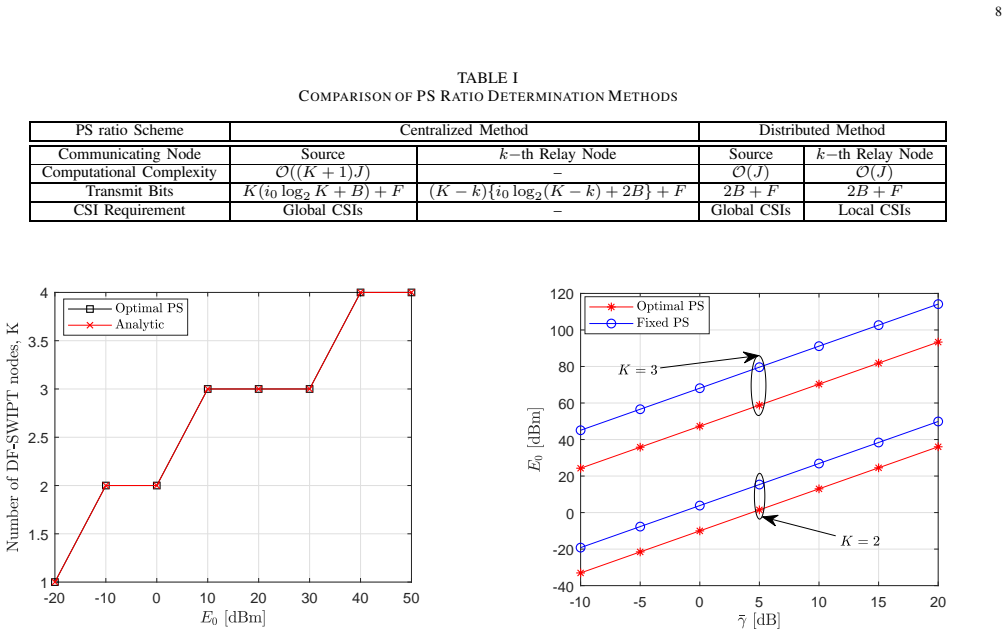
- When all nodes share the same SNR target, source-power minimization and rate maximization are two sides of one equation, $E_0/\hat\gamma=\sum_{k=1}^{K+1}\sigma_k^2\beta_k/\Gamma_k$, so either quantity can be traded against the other without new computation.
- In a homogeneous network with equal distances, the same relation yields a closed-form estimate of the maximum number of relays a given source power and QoS target can support, which can be embedded in routing decisions.
- The centralized and distributed PS-ratio computation schemes both use only the closed-form expression; the distributed scheme lets each relay compute the next relay's split with local CSI and two scalar values.
Reading between the lines
- The formulas assume zero circuit power at each relay, so they should be read as an upper bound on what a real energy-harvesting relay chain can do; adding a fixed per-relay power draw $P_c$ would shrink the feasible region and require new optimization, though the same $A_k$ change of variables may still be useful.
- The recursive form of $\rho_k^\star$ suggests a natural online protocol: relay $k$ only needs the scalar $\prod_{j<k}\rho_j^\star$ or an equivalent accumulated term from its predecessor, so the optimal splitting can be tracked hop by hop as channels change, extending the paper's distributed implementation beyond static CSI.
- A testable prediction is that under nonlinear energy-harvesting efficiency (saturation at high input power), the optimal split will direct more signal to information decoding than the linear model predicts; the closed forms provide the linear baseline for measuring that shift.
- The paper explicitly frames its result for single-antenna half-duplex PS-SWIPT relays with a supercapacitor and lists AF relaying, time switching, and multi-antenna nodes as extensions, so the closed forms should not be read beyond that scope.
Signed reviews
Editorial analysis
A structured set of objections, weighed in public.
Referee Report
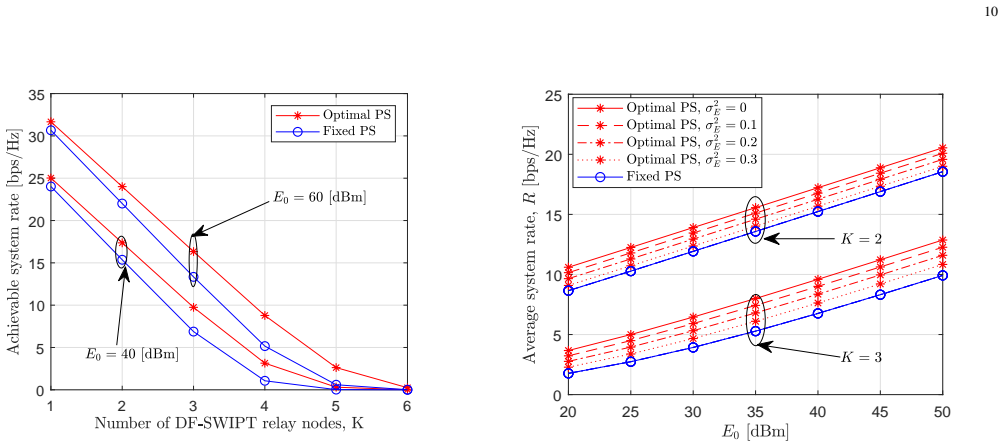
Summary. This paper studies a single-antenna multi-hop decode-and-forward relay chain in which each relay uses power splitting, harvesting energy from a fraction ρ_k of the received signal and using that energy to decode and forward, while the destination is modeled as node K+1 with ρ_{K+1}=0. The authors formulate two optimization problems: minimizing the source transmit power E0 subject to per-hop SNR thresholds γ̄_k, and maximizing the minimum achievable rate subject to a fixed source power. They claim globally optimal closed-form solutions in Theorems 1 and 2, an equivalence between the two problems when all thresholds are equal, a closed-form estimate for the maximum number of relays, and centralized and distributed methods for computing the PS ratios. The paper also reports simulations comparing the proposed scheme with a fixed PS ratio of 0.5 under perfect and imperfect channel state information.
Significance. For the idealized model, the closed-form expressions for E0* in Theorem 1 and R* in Theorem 2 are correct and can be verified by telescoping the active constraints; this part of the paper is a genuine low-complexity design contribution. The derivations are self-contained and contain no fitted parameters, and the formulas are falsifiable statements about the modeled system. However, the companion closed-form PS-ratio formulas are not correct as stated when the noise variances σ_k^2 differ across nodes, and the printed proof of Theorem 2 in Appendix B has internal sign and algebra errors. The numerical section uses identical noise variances for all nodes, which masks the error. With corrected PS ratios and a repaired proof, the paper would be a solid contribution to low-complexity SWIPT relaying; as stated, the central optimality claim for the PS ratios does not hold for the general problem.
major comments (3)
- [Section III-A, Theorem 1, Eq. (28)] The optimal PS ratio formula in Theorem 1 and Eq. (28) omits the noise variances σ_k^2. In the transformed problem (16), all constraints are active at the optimum, so A_{k-1}^* - A_k^* = (σ_k^2 β_k γ̄_k / Γ_k) / (Σ_{j=1}^{K+1} σ_j^2 β_j γ̄_j / Γ_j). Therefore the correct ratio is ρ_k^* = 1 - (1/∏_{j=1}^{k-1} ρ_j^*) (σ_k^2 β_k γ̄_k / Γ_k) / (Σ_j σ_j^2 β_j γ̄_j / Γ_j). The printed formula replaces the σ_k^2 factor in the numerator and the σ_j^2 factors in the denominator sum by 1, which is only valid when all σ_k^2 are equal. A concrete counterexample: take K=2, β_k=|h_k|^2=γ̄_k=1, and σ^2=(1,100,1). Then E0*=102, and the printed formulas give ρ_1=2/3 and ρ_2=1/2. The hop-2 SNR is E0 ρ_1 (1-ρ_2)/σ_2^2 = 102 × (2/3) × (1/2) / 100 = 0.34, which is below the required threshold γ̄_2=1. Thus the printed “globally optimal” PS vector is not even feasible for the modeled problem, contradicting the central claim of Theorem 1.
- [Section III-B, Theorem 2, Eq. (39)] The same omission of σ_k^2 appears in the rate-maximization PS ratios. With γ̂^* = E0 / (Σ_j σ_j^2 β_j / Γ_j) from Eq. (38), the tight constraint at hop k forces A_{k-1}^* - A_k^* = (σ_k^2 β_k / Γ_k) / (Σ_j σ_j^2 β_j / Γ_j), so the correct optimal ratio is ρ_k^* = 1 - (1/∏_{j=1}^{k-1} ρ_j^*) (σ_k^2 β_k / Γ_k) / (Σ_j σ_j^2 β_j / Γ_j). The printed expression in Theorem 2 and Eq. (39), which uses β_k/Γ_k over Σ_j β_j/Γ_j, is feasible only when all σ_k^2 are identical. Since the PS ratios are part of the claimed optimal solution, Theorem 2 as stated is not correct for the general model with unequal noise variances.
- [Appendix B, Eqs. (30)-(36)] The printed proof of Theorem 2 is internally inconsistent. The Lagrangian in Eq. (30) has a plus sign on the γ̂ constraint term, so the stationarity condition in Eq. (31) becomes 1 + λ_0 Σ_k σ_k^2 β_k / (E0 Γ_k) = 0, forcing λ_0 to be negative. This is incompatible with the λ_k ≥ 0 convention used in Appendix A and with the complementary-slackness step in Eq. (35). In addition, Eq. (36) incorrectly places γ̂ inside the denominator; solving Eq. (34) directly gives λ_0^* = -E0 / (Σ_k σ_k^2 β_k / Γ_k), with no γ̂ in the expression. These errors mean the proof as printed does not establish Theorem 2, although the final γ̂^* formula can be recovered by summing the tight constraints.
minor comments (4)
- [Section IV, simulation parameters] The text says “antenna noise variance σ_1^2 = ... = -80 dBm,” but in Section II σ_k^2 is the information-decoding circuit noise variance while δ_k^2 is the antenna noise variance; the notation should be corrected to avoid the impression that the antenna noise is being set to the ID noise value.
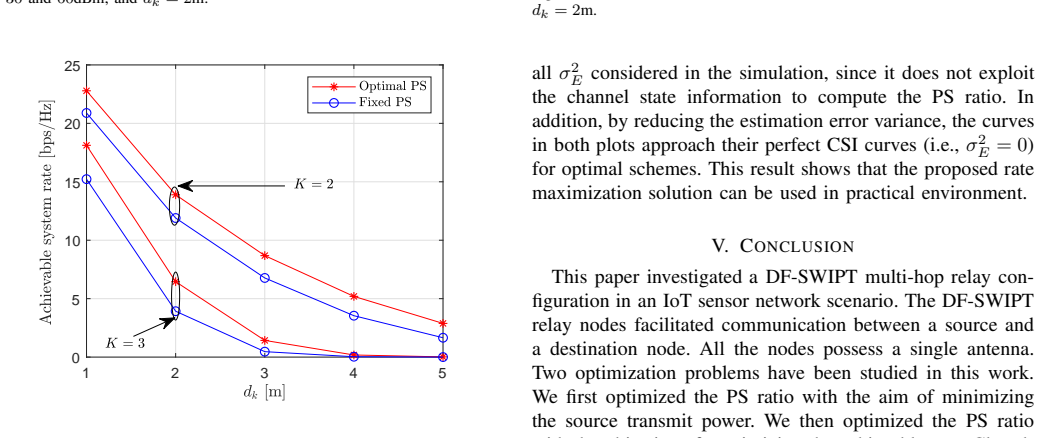
- [Appendix C, Eq. (40)] The derivation of the relay-node count approximation replaces E[1/Γ_k] by 1/E[Γ_k] without comment. In Rayleigh fading, E[1/|h|^2] is not finite, so this substitution is not a standard expectation calculation; please state explicitly that this is a heuristic mean-gain approximation and, if possible, provide a bound or simulation-based validation.
- [Section II, Eq. (5)] The approximation in Eq. (5) drops the antenna noise δ_k^2 in the SINR expression assuming δ_k^2 ≪ σ_k^2; this assumption should be restated in the simulation section where the noise parameter is set, so that the reader can verify consistency.
- [Appendix B, Fig. 14] The verbal explanation accompanying Fig. 14 says a node's rate increases by reducing its ρ̄_k, but for intermediate relays changing ρ_k also affects the energy available to all later hops; the figure should be labeled as a schematic of the equalization argument rather than a proof of monotonicity in the multi-hop setting.
Circularity Check
No significant circularity: the closed-form optima are derived from the stated system model and constraints, not fitted or imported from self-citations.
full rationale
The derivation chain is self-contained. The paper defines the harvested-energy and SNR expressions in (4)-(5), formulates the source-power-minimization and rate-maximization problems in (6) and (10), and then solves them by a change of variables A_k = prod_{j<=k} rho_j, Q = 1/E0, followed by KKT analysis in Appendices A and B. The claimed closed forms for E0*, R*, and the recursive PS ratios follow from the active constraints and complementary slackness; no parameter is fitted to any data subset and no external uniqueness theorem is invoked to force the chosen form. Cited prior works, including the authors' own [1], [21], [23], and [50], are used for background, modeling assumptions (e.g., neglecting antenna noise), or performance comparison, and they are not load-bearing for the optimality claims. The recursive appearance of previous PS ratios in rho_k is a sequential construction starting from rho_1, not a self-referential definition that circularly presupposes the result. Therefore no exhibited reduction of any claimed derivation to its own inputs is present, and the paper does not become circular through its self-citations.
Assumptions & free parameters
assumptions (5)
- standard math KKT conditions give global optima for the transformed convex problems.
- domain assumption Antenna noise delta_k^2 is negligible compared to the ID circuit noise sigma_k^2, simplifying the rate expression in eq. (5).
- domain assumption The harvested energy expression ignores the noise contribution and assumes linear energy conversion efficiency beta_k.
- domain assumption The node-count formula assumes a homogeneous network with equal beta, sigma, distance, and pathloss across hops, plus E[|h|^2] = 1/2.
- ad hoc to paper The node-count derivation replaces E[1/Gamma_k] by 1/E[Gamma_k].
Cite this review
Pith. "Pith review of Simultaneous Wireless Information and Power Transfer for Decode-and-Forward Multi-Hop Relay Systems in Energy-Constrained IoT Networks." pith.science (2026). https://pith.science/paper/JZQLX3Y7
@misc{pith2026190809270,
  author       = {Pith},
  title        = {Pith review of: Simultaneous Wireless Information and Power Transfer for Decode-and-Forward Multi-Hop Relay Systems in Energy-Constrained IoT Networks},
  year         = {2026},
  howpublished = {\url{https://pith.science/paper/JZQLX3Y7}},
  note         = {Machine review of arXiv:1908.09270}
}
read the original abstract
This paper studies a multi-hop decode-and-forward (DF) simultaneous wireless information and power transfer (SWIPT) system where a source sends data to a destination with the aid of multi-hop relays which do not depend on an external energy source. To this end, we apply power splitting (PS) based SWIPT relaying protocol so that the relays can harvest energy from the received signals from the previous hop to reliably forward the information of the source to the destination. We aim to solve two optimization problems relevant to our system model. First, we minimize the transmit power at the source under the individual quality-of-service (QoS) threshold constraints of the relays and the destination nodes by optimizing PS ratios at the relays. The second is to maximize the minimum system achievable rate by optimizing the PS ratio at each relay. Based on convex optimization techniques, the globally optimal PS ratio solution is obtained in closed-form for both problems. By setting the QoS threshold constraint the same for each node for the source transmit power problem, we discovered that either the minimum source transmit power or the maximum system throughput can be found using the same approach. Numerical results demonstrate the superiority of the proposed optimal SWIPT PS design over conventional fixed PS ratio schemes.
Figures

Figures from the paper (7 more)



Reference graph
Works this paper leans on
-
[1]
Transmit power min imization for a multi-hop SWIPT decode-and-forward sensor network,
D. K. P . Asiedu, H. Lee, and K.-J. Lee, “Transmit power min imization for a multi-hop SWIPT decode-and-forward sensor network,” in Proc. IEEE V eh. Tech. Conf., Jun. 2019
work page 2019
-
[2]
Internet of things in industrie s: A survey,
L. Da Xu, W. He, and S. Li, “Internet of things in industrie s: A survey,” IEEE Trans. Industrial Info. , vol. 10, pp. 2233–2243, Nov. 2014
work page 2014
-
[3]
Resilient IoT architec tures over dynamic sensor networks with adaptive components,
S. M. Oteafy and H. S. Hassanein, “Resilient IoT architec tures over dynamic sensor networks with adaptive components,” IEEE Internet Things J. , vol. 4, pp. 474–483, Apr. 2017
work page 2017
-
[4]
Healing multimoda l confident information coverage holes in NB-IoT-enabled networks,
X. Deng, Z. Tang, L. Yi, and L. T. Y ang, “Healing multimoda l confident information coverage holes in NB-IoT-enabled networks,” IEEE Internet Things J. , vol. 5, no. 3, pp. 1463–1473, 2018
work page 2018
-
[5]
ISI: Integrate sensor networks to internet with icn,
S. S. Adhatarao, M. Arumaithurai, D. Kutscher, and X. Fu, “ISI: Integrate sensor networks to internet with icn,” IEEE Internet Things J., vol. 5, pp. 491–499, Apr. 2018
work page 2018
-
[6]
D. Ciuonzo, G. Romano, and P . S. Rossi, “Channel-aware de cision fusion in distributed MIMO wireless sensor networks: Decod e-and- fuse vs. decode-then-fuse,” IEEE Trans. Wireless Commun. , vol. 11, pp. 2976–2985, Jun. 2012
work page 2012
-
[7]
Massive MIMO channel -aware decision fusion,
D. Ciuonzo, P . S. Rossi, and S. Dey, “Massive MIMO channel -aware decision fusion,” IEEE Trans. Sig. Process. , vol. 63, no. 3, pp. 604–619, 2014
work page 2014
-
[8]
P . S. Rossi, D. Ciuonzo, K. Kansanen, and T. Ekman, “Perfo rmance analysis of energy detection for MIMO decision fusion in wir eless sensor networks over arbitrary fading channels,” IEEE Trans. Wireless Commun., vol. 15, no. 11, pp. 7794–7806, 2016
work page 2016
Show all 57 references
-
[9]
C. S. Raghavendra, K. M. Sivalingam, and T. Znati, Wireless sensor networks. Springer, Dec. 2006. 14
2006
-
[10]
Wireless sensor n etwork survey,
J. Yick, B. Mukherjee, and D. Ghosal, “Wireless sensor n etwork survey,” Comp. Net. , vol. 52, pp. 2292–2330, Aug. 2008
2008
-
[11]
A survey of network lifetime maximization techniques in wireless sens or networks,
H. Y etgin, K. T. K. Cheung, M. El-Hajjar, and L. H. Hanzo, “A survey of network lifetime maximization techniques in wireless sens or networks,” IEEE Commun. Surveys Tut. , vol. 19, pp. 828–854, Jan. 2017
2017
-
[12]
Performance ana lysis of SNR- based incremental hybrid decode-amplify-forward coopera tive relaying protocol,
Z. Bai, J. Jia, C.-X. Wang, and D. Y uan, “Performance ana lysis of SNR- based incremental hybrid decode-amplify-forward coopera tive relaying protocol,” IEEE Trans. Commun. , vol. 63, pp. 2094–2106, Jun. 2015
2015
-
[13]
Two-way OFDM-based nonlin ear amplify-and-forward relay systems,
D. E. Simmons and J. P . Coon, “Two-way OFDM-based nonlin ear amplify-and-forward relay systems,” IEEE Trans. V eh. Tech. , vol. 65, pp. 3808–3812, May 2016
2016
-
[14]
Simu lta- neous information and energy flow for IoT relay systems with c rowd harvesting,
W. Guo, S. Zhou, Y . Chen, S. Wang, X. Chu, and Z. Niu, “Simu lta- neous information and energy flow for IoT relay systems with c rowd harvesting,” IEEE Commun. Mag. , vol. 54, pp. 143–149, Nov. 2016
2016
-
[15]
Designs of MIMO amplify- and-forward wireless relaying networks: practical challenges and solu tions based on MSE decomposition,
C. Song, K.-J. Lee, and I. Lee, “Designs of MIMO amplify- and-forward wireless relaying networks: practical challenges and solu tions based on MSE decomposition,” IEEE Access , vol. 5, pp. 9223–9234, Jun. 2017
2017
-
[16]
Wireless powered communic ation: Opportunities and challenges,
S. Bi, C. K. Ho, and R. Zhang, “Wireless powered communic ation: Opportunities and challenges,” IEEE Commun. Mag. , vol. 53, pp. 117– 125, Apr. 2015
2015
-
[17]
Wireless networks with RF energy harvesting: A contemporary survey,
X. Lu, P . Wang, D. Niyato, D. I. Kim, and Z. Han, “Wireless networks with RF energy harvesting: A contemporary survey,” IEEE Commun. Surveys Tut., vol. 17, pp. 757–789, May 2015
2015
-
[18]
Energy harvesting wireless communications: A re view of recent advances,
S. Ulukus, A. Y ener, E. Erkip, O. Simeone, M. Zorzi, P . Gr over, and K. Huang, “Energy harvesting wireless communications: A re view of recent advances,” IEEE J. on Sel. Areas in Commun. , vol. 33, pp. 360– 381, Mar. 2015
2015
-
[19]
Application of smart antenna technologies i n simulta- neous wireless information and power transfer,
Z. Ding, C. Zhong, D. W. K. Ng, M. Peng, H. A. Suraweera, R. Schober, and H. V . Poor, “Application of smart antenna technologies i n simulta- neous wireless information and power transfer,” IEEE Commun. Mag. , vol. 53, pp. 86–93, Apr. 2015
2015
-
[20]
Energy-ef ficient power allocation for decode-and-forward OFDM relay links,
G. Zhou, T. Wang, Y . Wu, G. Zheng, and G. Y ang, “Energy-ef ficient power allocation for decode-and-forward OFDM relay links, ” in Mobile and Wireless Tech. 2016 , vol. 391, pp. 13–24, Springer, May 2016
2016
-
[21]
Simultaneous wireless information and power transfer for cooperative relay netwo rks with battery,
S. Mahama, D. K. P . Asiedu, and K.-J. Lee, “Simultaneous wireless information and power transfer for cooperative relay netwo rks with battery,” IEEE Access , vol. 5, pp. 13171–13178, Jul. 2017
2017
-
[22]
Energy efficiency optimization for CoMP-SWIPT heterogeneous netw orks,
J. Tang, A. Shojaeifard, D. K. So, K.-K. Wong, and N. Zhao , “Energy efficiency optimization for CoMP-SWIPT heterogeneous netw orks,” IEEE Trans. Commun. , vol. 66, pp. 6368–6383, Dec 2018
2018
-
[23]
Op timal power splitting for simultaneous wireless information and power transfer in amplify-and-forward multiple-relay systems,
D. K. P . Asiedu, S. Mahama, S.-W. Jeon, and K.-J. Lee, “Op timal power splitting for simultaneous wireless information and power transfer in amplify-and-forward multiple-relay systems,” IEEE Access , vol. 6, pp. 3459–3468, Feb. 2018
2018
-
[24]
Sum-rate maxi mization for multiuser MIMO wireless powered communication network s,
H. Lee, K.-J. Lee, H.-B. Kong, and I. Lee, “Sum-rate maxi mization for multiuser MIMO wireless powered communication network s,” IEEE Trans. V eh. Tech., vol. 65, pp. 9420–9424, Nov. 2016
2016
-
[25]
Energy-efficient coope ration in cognitive wireless powered networks,
S. Yin, Z. Qu, Z. Wang, and L. Li, “Energy-efficient coope ration in cognitive wireless powered networks,” IEEE Commun. Lett. , vol. 21, pp. 128–131, Jan. 2017
2017
-
[26]
Joint transceiver optimization for MISO SWIPT systems with time switching,
H. Lee, K.-J. Lee, H. Kim, and I. Lee, “Joint transceiver optimization for MISO SWIPT systems with time switching,” IEEE Trans. Wireless Commun., vol. 17, pp. 3298–3312, May 2018
2018
-
[27]
Green transmission for C-RAN based on SWIPT in 5G: a review,
F. Mukhlif, K. A. B. Noordin, A. M. Mansoor, and Z. M. Kasi run, “Green transmission for C-RAN based on SWIPT in 5G: a review, ” Wireless Net., pp. 1–29, May 2018
2018
-
[28]
A technical review of simultaneous wireless information and power transfer (S WIPT),
F. Jameel, M. A. A. Haider, A. A. Butt, et al. , “A technical review of simultaneous wireless information and power transfer (S WIPT),” in Proc. IEEE Int. Symp. on Recent Adv. in Electrical Eng. , pp. 1–6, Oct. 2017
2017
-
[29]
Simultaneous wireless information and power transf er (SWIPT): Recent advances and future challenges,
T. D. P . Perera, D. N. K. Jayakody, S. K. Sharma, S. Chatzi notas, and J. Li, “Simultaneous wireless information and power transf er (SWIPT): Recent advances and future challenges,” IEEE Commun. Surveys Tut. , vol. 20, pp. 263 – 302, Dec. 2017
2017
-
[30]
Toward the evolution of wireless powered communication networks for the future internet of t hings,
P . Ramezani and A. Jamalipour, “Toward the evolution of wireless powered communication networks for the future internet of t hings,” IEEE Net. , vol. 31, pp. 62–69, Nov. 2017
2017
-
[31]
Wireless power ed commu- nication networks: architectures, protocol designs, and s tandardization [guest editorial],
D. Niyato, D. I. Kim, Z. Han, and M. Maso, “Wireless power ed commu- nication networks: architectures, protocol designs, and s tandardization [guest editorial],” IEEE Wireless Commun. , vol. 23, pp. 8–9, Apr. 2016
2016
-
[32]
Improving the performance of cell-edge users in MISO-NOMA systems using T AS and SWIPT-based cooperative transmissions,
T. N. Do, D. B. da Costa, T. Q. Duong, and B. An, “Improving the performance of cell-edge users in MISO-NOMA systems using T AS and SWIPT-based cooperative transmissions,” IEEE Trans. Green Commun. Net., vol. 2, pp. 49–62, Nov. 2017
2017
-
[33]
Joint resource allocation in SWIPT-based mult iantenna decode- and-forward relay networks,
Y . Liu, “Joint resource allocation in SWIPT-based mult iantenna decode- and-forward relay networks,” IEEE Trans. V eh. Tech., vol. 66, pp. 9192– 9200, Oct. 2017
2017
-
[34]
Multi-hop cooperative relaying with energy harvesting from cochannel interferen ces,
E. Chen, M. Xia, D. B. da Costa, and S. A¨ ıssa, “Multi-hop cooperative relaying with energy harvesting from cochannel interferen ces,” IEEE Commun. Lett. , vol. 21, pp. 1199–1202, May 2017
2017
-
[35]
End-to -end throughput maximization for underlay multi-hop cognitive radio net- works with RF energy harvesting,
C. Xu, M. Zheng, W. Liang, H. Y u, and Y .-C. Liang, “End-to -end throughput maximization for underlay multi-hop cognitive radio net- works with RF energy harvesting,” IEEE Trans. Wireless Commun. , vol. 16, pp. 3561–3572, Jun. 2017
2017
-
[36]
Multi-hop relaying using energy harvesting,
M. Mao, N. Cao, Y . Chen, and Y . Zhou, “Multi-hop relaying using energy harvesting,” IEEE Wireless Commun. Lett. , vol. 4, pp. 565–568, Oct. 2015
2015
-
[37]
Joint source and relay beam- forming design in wireless multi-hop sensor networks with S WIPT,
X. Liu, Z. Wen, D. Liu, J. Zou, and S. Li, “Joint source and relay beam- forming design in wireless multi-hop sensor networks with S WIPT,” Sensors, vol. 19, p. 182, Jan. 2019
2019
-
[38]
A co mprehen- sive survey on hierarchical-based routing protocols for mo bile wireless sensor networks: review, taxonomy, and future directions,
N. Sabor, S. Sasaki, M. Abo-Zahhad, and S. M. Ahmed, “A co mprehen- sive survey on hierarchical-based routing protocols for mo bile wireless sensor networks: review, taxonomy, and future directions, ” Wireless Commun. and Mobile Comp. , vol. 2017, Jan. 2017
2017
-
[39]
Mac protocols with wake- up radio for wireless sensor networks: A review,
F. Z. Djiroun and D. Djenouri, “Mac protocols with wake- up radio for wireless sensor networks: A review,” IEEE Commun. Surveys Tut. , vol. 19, pp. 587–618, Jan. 2017
2017
-
[40]
Review on clustering, coverag e and con- nectivity in underwater wireless sensor networks: a commun ication techniques perspective,
D. Sandeep and V . Kumar, “Review on clustering, coverag e and con- nectivity in underwater wireless sensor networks: a commun ication techniques perspective,” IEEE Access , vol. 5, pp. 11176–11199, Jun. 2017
2017
-
[41]
Homogeneous vs heterogene ous clustered sensor networks: a comparative study,
V . Mhatre and C. Rosenberg, “Homogeneous vs heterogene ous clustered sensor networks: a comparative study,” in Proc. Int. Conf. Commun. , vol. 6, pp. 3646–3651, IEEE, Jun. 2004
2004
-
[42]
Distributed opportunistic transm ission for wire- less sensor networks,
Q. Zhao and L. Tong, “Distributed opportunistic transm ission for wire- less sensor networks,” in Proc. IEEE Int. Conf. Acoustics, Speech, and Sig. Process., vol. 3, pp. iii–833, May 2004
2004
-
[43]
Impact of imperfect channel state informa tion on the per- formance of wireless sensor networks,
G. Taricco, “Impact of imperfect channel state informa tion on the per- formance of wireless sensor networks,” in Proc. IEEE Global Commun. Conf., pp. 2228–2233, Dec. 2012
2012
-
[44]
Efficient sensor selection scheme s for wireless sensor networks in microgrid,
X. Wang and Q. Liang, “Efficient sensor selection scheme s for wireless sensor networks in microgrid,” IEEE Sys. J. , vol. 12, pp. 539–547, Mar. 2018
2018
-
[45]
Effective ca pacity of two-hop wireless communication systems.,
D. Qiao, M. C. Gursoy, and S. V elipasalar, “Effective ca pacity of two-hop wireless communication systems.,” IEEE Trans. Info. Theory , vol. 59, pp. 873–885, Feb. 2013
2013
-
[46]
Multihop capability analysis in wireless information and power transfer multirelay coop erative net- works,
Q. Wu, X. Zhou, Q. Cao, and H. Fang, “Multihop capability analysis in wireless information and power transfer multirelay coop erative net- works,” Wireless Commun. and Mobile Comp. , vol. 2018, Jan. 2018
2018
-
[47]
MIMO broadcasting for simultaneo us wire- less information and power transfer,
R. Zhang and C. K. Ho, “MIMO broadcasting for simultaneo us wire- less information and power transfer,” IEEE Trans. Wireless Commun. , vol. 12, pp. 1989–2001, May 2013
1989
-
[48]
Retrodirective multi-us er wireless power transfer with massive MIMO,
S. Lee, Y . Zeng, and R. Zhang, “Retrodirective multi-us er wireless power transfer with massive MIMO,” IEEE Wireless Commun. Lett. , Sept. 2017
2017
-
[49]
Wireless information and power transfer: A dynamic power splitting approach,
L. Liu, R. Zhang, and K.-C. Chua, “Wireless information and power transfer: A dynamic power splitting approach,” IEEE Trans. Commun. , vol. 61, pp. 3990–4001, Sep. 2013
2013
-
[50]
Wireless informat ion and power exchange for energy-constrained device-to-device c ommunica- tions,
H. Lee, K.-J. Lee, H. Kim, and I. Lee, “Wireless informat ion and power exchange for energy-constrained device-to-device c ommunica- tions,” IEEE Internet Things J. , vol. 5, pp. 3175–3185, Aug. 2018
2018
-
[51]
Capacity and power allocation for fading MIMO channels with channel estimation error,
T. Y oo and A. Goldsmith, “Capacity and power allocation for fading MIMO channels with channel estimation error,” IEEE Trans. Info. Theory, vol. 52, pp. 2203–2214, May 2006
2006
-
[52]
Transceiver design based on block wise uniform channel decomposition for coded MIMO systems,
K.-J. Lee and I. Lee, “Transceiver design based on block wise uniform channel decomposition for coded MIMO systems,” IEEE Trans. Wireless Commun., vol. 8, pp. 4241–4251, Aug. 2009
2009
-
[53]
Robust beamforming for wireless in formation and power transmission,
Z. Xiang and M. Tao, “Robust beamforming for wireless in formation and power transmission,” IEEE Wireless Commun. Lett., vol. 1, pp. 372– 375, Aug. 2012
2012
-
[54]
Wireless information and power transfer for mu ltirelay-assisted cooperative communication,
Y . Liu, “Wireless information and power transfer for mu ltirelay-assisted cooperative communication,” IEEE Commun. Lett., vol. 20, pp. 784–787, Apr. 2016
2016
-
[55]
Resour ce allocation techniques for wireless powered communication networks wi th energy storage constraint,
H. Lee, K.-J. Lee, H. Kim, B. Clerckx, and I. Lee, “Resour ce allocation techniques for wireless powered communication networks wi th energy storage constraint,” IEEE Trans. Wireless Commun. , vol. 15, pp. 2619– 2628, Apr. 2016
2016
-
[56]
Bird, Engineering mathematics
J. Bird, Engineering mathematics. Routledge, 7 ed., Apr. 2014
2014
-
[57]
K. A. Stroud and D. J. Booth, Engineering mathematics . Macmillan International Higher Education, 7 ed., Mar. 2013
2013
Reviewed August 14, 2026 · model on record in the stance chip above.
Discussion (0). Continue with ORCID to comment.