REVIEW 3 major objections 5 minor 11 references
Multi Part Deployment of Neural Network
T0 review · 3 major / 5 minor · reviewed 2026-08-07 · deepseek-v4-flash
Pith's one-line read This paper argues that a neural network can be split across ordinary servers at the neuron level and trained or served as one shared model, cutting the need for a monolithic GPU cluster.
desk verdict A clear but unvalidated system sketch whose core NFS shared-model mechanism is unworkable; not a research contribution. read the letter →
The pith
A machine-rendered reading of the paper's core claim, the machinery that carries it, and where it could break.
The reading
What carries the argument
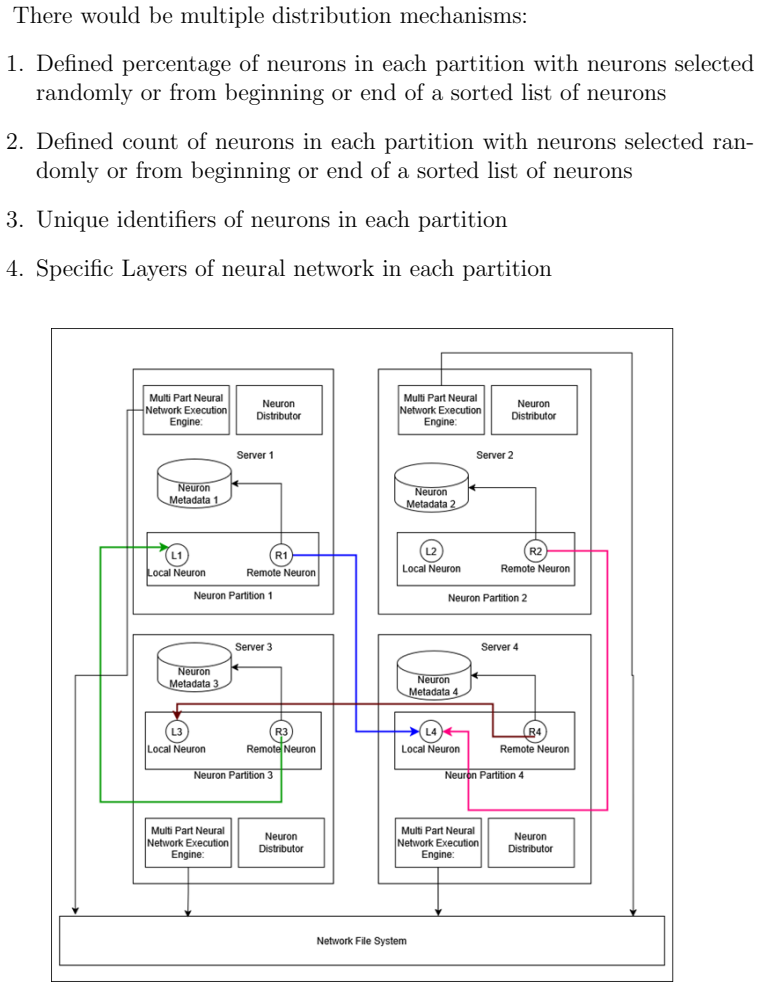
The Multi-Part Neural Network Execution Engine, running on every server, is the component that carries the argument: it consults a local Neuron Metadata store to classify each neuron as local or remote, and for remote neurons it extracts the server address, credentials, neuron identifier, and connection weight, then issues a remote procedure call to the server that hosts the neuron. The second load-bearing piece is the single shared model file on a network file system, which is supposed to make concurrent updates from all servers converge to one model without an explicit merge step. The Neuron Distributor supplies the allocation policies, by count, percentage, identifier, or layer, that decide which neurons live where.
What would settle it
Split a small network across two servers that share a model file, train for a fixed number of steps, and compare the model checkpoints and validation accuracy with a single-server baseline; if the two servers ever hold different model states, or if per-step time grows roughly with the number of cross-server neuron calls, the architecture's consistency and cost claims fail.
Extended reading notes
Core claim
The paper's central claim is that a deep neural network can be partitioned at the level of individual neurons across multiple cloud servers, with every server executing its local neurons and calling remote neurons through metadata-driven remote procedure calls, while all servers write to a single shared model file on a network file system. According to the authors, this arrangement keeps one consistent model, preserves computational accuracy, and reduces the need for high-performance centralized GPU compute during both training and deployment. The proposed system components are the Neuron Metadata store, the Multi-Part Neural Network Execution Engine, the Neuron Distributor, and the shared NFS-backed model.
Load-bearing premise
Everything depends on many servers writing to the same model file over a network at once and still staying consistent and fast; if those writes conflict, diverge, or become a bottleneck, the promised seamless shared model no longer exists.
Editorial extensions
If this is right
- A very large model could be trained on a pool of mid-range cloud servers rather than one GPU supercomputer, lowering infrastructure cost.
- Because each server stores metadata only for its own neuron connections, adding a new partition would not require duplicating the whole network.
- Operators could choose a partition scheme by count, percentage, identifier, or layer, giving flexibility in balancing load across servers.
- Since all servers write to one shared model file, the system would keep a single model at all times with no separate merge step.
- Inference could also become distributed: a request entering at any server can reach remote neurons through metadata-driven calls.
Reading between the lines
- A direct testable extension would be to run a two-server split of a standard model over NFS and compare per-step time and final accuracy with a single-server run; the paper describes the architecture without reporting such measurements.
- The design implies that communication cost scales with the number of cross-server neuron connections, so layer-wise partitions, which minimize cross-server edges, would likely outperform random neuron splits in practice.
- If the shared-file assumption holds, the same machinery could serve inference horizontally, with any entry server routing requests through metadata to the right neurons and the cluster behaving like one logical model.
Editorial analysis
A structured set of objections, weighed in public.
Referee Report
Summary. This paper proposes a distributed system architecture for deep neural networks in which a network is partitioned across multiple servers at the neuron level, with inter-server connections resolved through metadata and remote procedure calls, and with all servers sharing a single model file on a network file system (NFS). It claims that this architecture enables cost-effective, scalable deployment of deep learning models in cloud environments without reliance on monolithic GPU clusters. The paper describes the proposed components (local and remote neurons, neuron metadata, a Multi-Part Neural Network Execution Engine, shared storage, a single shared model, and a Neuron Distributor) but provides no equations, experiments, benchmarks, or implementation results.
Significance. The paper identifies a real infrastructure challenge, namely the high cost of training and deploying very large neural networks, and it proposes a conceptually simple way to spread a model across commodity servers. If the proposed architecture actually worked, it would be a significant contribution to practical distributed deep learning. However, the manuscript is only a high-level sketch: it provides no working system, no measurements, and no comparison with existing model-parallel or data-parallel approaches, and its core synchronization mechanism (concurrent writes to a single NFS file) is not substantiated. The paper therefore does not currently establish its central claim of cost-effective and scalable deployment.
major comments (3)
- [3.5 and 3.6] The claim that all servers writing to the same model on a shared NFS file 'ensures consistency' is not supported by any described mechanism. Standard NFS semantics do not provide atomic fine-grained concurrent updates to a single file; concurrent writes from multiple servers would race, potentially corrupting the model or losing updates. No locking, versioning, conflict-resolution, or consistency protocol is described, yet this single shared model is the mechanism that the abstract's claim of 'consistency during parallel updates' rests on. Without a concrete consistency protocol, the central architectural claim is unsupported.
- [3, 'Reduction to Practice'] The section asserts that the invention 'has been practically realized' but then only lists architectural components. There is no demonstration of a working system, no training or inference results, no accuracy measurements, and no performance data. Consequently, the Introduction's promise of 'maintaining computational accuracy' and the Abstract's claim of 'cost-effective, scalable deployment' are assertions without empirical or analytical support.
- [3.4 and 3.7] The execution engine invokes a remote procedure call for every remote neuron encountered during forward and backward passes. For a network with billions of neurons, this would cause enormous per-activation network overhead, and the paper provides no analysis of latency, bandwidth, or convergence impact. The proposed design is not compared to existing distributed training frameworks (e.g., data parallelism or pipeline/model parallelism), and the arbitrary partitioning strategies in Section 3.7 (random selection, start-of-list, end-of-list) could alter the computational graph in ways that affect training correctness, yet no experiment or theoretical argument addresses this.
minor comments (5)
- [Abstract and Section 1] The references to IBM's '530 billion neurons' and Google's '500 billion parameters' are given without citations or context; these figures are not used in the rest of the paper.
- [Figure 1] Figure 1 is only a caption ('Component-Diagram') with no visible figure content in the manuscript; the diagram is missing or not described.
- [Section 3.1-3.2] The capitalization of 'Neurons' is inconsistent; the terms 'Local Neurons' and 'remote Neuron' appear with different capitalization conventions within the same paragraph.
- [Section 3.3] The relationship between the local metadata storage and the shared model on NFS is not clarified; it is unclear whether the metadata is duplicated on every server or only the model weights are shared.
- [References] The reference list contains seven items, several of which are about edge deployment or hardware acceleration, but none of these are discussed or compared in the body of the paper; a related-work discussion is missing.
Circularity Check
No circularity: the paper is a conceptual architecture proposal with no derived quantities, fitted parameters, or self-citation chain.
full rationale
The paper proposes a distributed deployment architecture and describes its components (local/remote neurons, metadata, execution engine, shared NFS storage, single model, neuron distributor). It makes no quantitative prediction and fits no parameter, so there is no derivation chain whose output could be equivalent to its input. The central claim that the architecture enables cost-effective scalable deployment is an unsupported assertion, not a circular one; the same holds for the shared single-model NFS write path, which is presented without consistency or performance analysis. The references are external prior work and are not invoked as load-bearing proof of the present proposal; there is no self-citation, no imported uniqueness theorem, and no ansatz smuggled in through citation. The absence of experiments or formal guarantees is a correctness or evidence gap, not a circularity, so the appropriate finding is no significant circularity with score 0.
Assumptions & free parameters
assumptions (3)
- domain assumption A shared model on a network file system can be written by all servers during training without corruption or performance collapse.
- domain assumption Remote neuron calls have acceptable latency and throughput for training.
- domain assumption Partitioning by neuron is a practical unit for distributed training.
Cite this review
Pith. "Pith review of Multi Part Deployment of Neural Network." pith.science (2026). https://pith.science/paper/JZVNT7WQ
@misc{pith2026250601387,
  author       = {Pith},
  title        = {Pith review of: Multi Part Deployment of Neural Network},
  year         = {2026},
  howpublished = {\url{https://pith.science/paper/JZVNT7WQ}},
  note         = {Machine review of arXiv:2506.01387}
}
read the original abstract
The increasing scale of modern neural networks, exemplified by architectures from IBM (530 billion neurons) and Google (500 billion parameters), presents significant challenges in terms of computational cost and infrastructure requirements. As deep neural networks continue to grow, traditional training paradigms relying on monolithic GPU clusters become increasingly unsustainable. This paper proposes a distributed system architecture that partitions a neural network across multiple servers, each responsible for a subset of neurons. Neurons are classified as local or remote, with inter-server connections managed via a metadata-driven lookup mechanism. A Multi-Part Neural Network Execution Engine facilitates seamless execution and training across distributed partitions by dynamically resolving and invoking remote neurons using stored metadata. All servers share a unified model through a network file system (NFS), ensuring consistency during parallel updates. A Neuron Distributor module enables flexible partitioning strategies based on neuron count, percentage, identifiers, or network layers. This architecture enables cost-effective, scalable deployment of deep learning models on cloud infrastructure, reducing dependency on high-performance centralized compute resources.
Figures
Reference graph
Works this paper leans on
-
[1]
Defined percentage of neurons in each partition with neurons selected randomly or from beginning or end of a sorted list of neurons
-
[2]
Defined count of neurons in each partition with neurons selected ran- domly or from beginning or end of a sorted list of neurons
-
[3]
Unique identifiers of neurons in each partition
-
[4]
Specific Layers of neural network in each partition Figure 1: Component-Diagram 5 4 Conclusion The increasing size and complexity of neural networks have made tradi- tional, centralized training methods increasingly impractical due to high computational costs and infrastructure demands. This work introduces a dis- tributed architecture that effectively pa...
-
[5]
Partitioning and Deployment of Deep Neural Networks on Edge Clusters
A.Parthasarathy, B.Krishnamachari, Partitioning and Deploy- ment of Deep Neural Networks on Edge Clusters ,arXiv preprint arXiv:2304.11941,2023.[Online]. Available: https://arxiv.org/pdf/ 2304.11941
work page Pith review arXiv 2023
-
[6]
X. Geng, Z. Wang, C. Chen, Q. Xu, K. Xu, C. Jin, M. Gupta, X. Yang, Z. Chen, M.M. Sabry Aly, J. Lin, M. Wu, X. Li, From Algorithm to Hardware: A Survey on Efficient and Safe Deployment of Deep Neu- 6 ral Networks ,arXiv preprint arXiv:2405.06038,2024.[Online]. Available: https://arxiv.org/pdf/2405.06038
arXiv 2024
-
[7]
A Deep Neural Network Deployment Based on Resistive Memory Accelerator Simulation
T.R. Maram, R. Barnwal, Bindu. B, A Deep Neural Network Deploy- ment Based on Resistive Memory Accelerator Simulation,arXiv preprint arXiv:2304.11337,2023.[Online]. Available: https://arxiv.org/pdf/ 2304.11337
work page Pith review arXiv 2023
-
[8]
A. Burrello, F. Carlucci, G. Pollo, X. Wang, M. Poncino, E. Macii, L. Benini, D.J. Pagliari, Optimization and Deployment of Deep Neu- ral Networks for PPG-based Blood Pressure Estimation Targeting Low- power Wearables,arXiv preprint arXiv:2409.07485,2024.[Online]. Avail- able: https://arxiv.org/pdf/2409.07485
work page Pith review arXiv 2024
Show all 11 references
-
[9]
Risso, F
M. Risso, F. Daghero, B.A. Motetti, D.J. Pagliari, E. Macii, M. Poncino, A. Burrello, Optimized Deployment of Deep Neural Net- works for Visual Pose Estimation on Nano-drones ,arXiv preprint arXiv:2402.15273,2025.[Online]. Available: https://arxiv.org/pdf/ 2402.15273
2025 arXiv
-
[10]
Dzaferagic, M
M. Dzaferagic, M. Ruffini, D. Kilper, Modular and Integrated AI Control Framework across Fiber and Wireless Networks for 6G , arXiv preprint arXiv:2502.15731,2025. [Online]. Available: https://arxiv.org/html/ 2502.15731
2025 arXiv
-
[11]
Y. Yang, Q. Peng, J. Wang, Y. Wen, W. Zhang, LLM-based Multi- Agent Systems: Techniques and Business Perspectives ,arXiv preprint arXiv:2411.14033,2024.[Online]. Available: https://arxiv.org/html/ 2411.14033 7
2024 arXiv
Reviewed August 7, 2026 · model on record in the stance chip above.
Discussion (0). Sign in to comment.