REVIEW 4 major objections 4 minor 14 references
RSFR: A Coarse-to-Fine Reconstruction Framework for Diffusion Tensor Cardiac MRI with Semantic-Aware Refinement
T0 review · 4 major / 4 minor · reviewed 2026-08-16 · deepseek-v4-flash
Pith's one-line read The paper claims that deriving semantic priors from a coarse Mamba reconstruction rather than from undersampled input lets a refinement network improve both cardiac DWI fidelity and diffusion tensor accuracy.
desk verdict A solid, well-engineered cDTI reconstruction paper whose central semantic-prior mechanism is never directly validated because SAM mask quality is never measured. read the letter →
The pith
A machine-rendered reading of the paper's core claim, the machinery that carries it, and where it could break.
The reading
What carries the argument
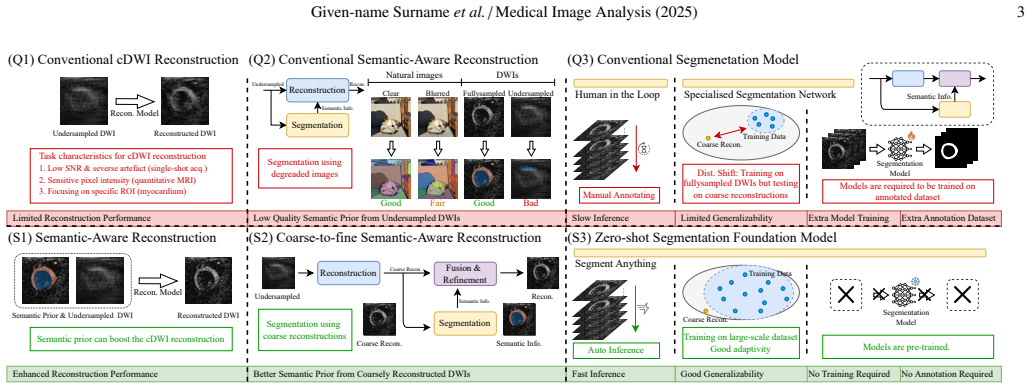
The load-bearing machinery is the coarse-to-fine equation $\bar{x}=H_R(A^H y)$, $F_{seg}=H_S(\bar{x})$, $\hat{x}=H_{FR}(\bar{x},F_{seg})$, in which the semantic prior is deliberately obtained from the coarse reconstruction rather than from the undersampled input. $H_R$ and $H_{FR}$ are U-shaped Vision Mamba networks built from Visual State Space blocks that use a cross-scan mechanism to flatten image patches into four directed sequences, giving global context with linear complexity. $H_S$ is the frozen Segment Anything Model with ViT-H weights, whose top three highest-scoring masks are used without training or manual annotation. The Semantic Feature Integration module concatenates reconstruction and mask features, aligns them with convolution, instance normalization, and GeLU, and applies channel-wise attention so the refinement can selectively enhance myocardial regions and suppress background.
What would settle it
Measure Dice overlap between SAM's top-three masks and manual myocardium segmentations on the coarse reconstructions, then rerun refinement with deliberately misplaced masks; if overlap is low or misplaced masks do not degrade SSIM and DT MAE, the semantic prior is not what carries the improvement.
Extended reading notes
Core claim
The paper's discovery, stated on its own terms, is that semantic-aware coarse-to-fine reconstruction improves cardiac DWI fidelity and quantitative tensor accuracy. The pipeline is written as $\bar{x}=H_R(A^H y)$, $F_{seg}=H_S(\bar{x})$, $\hat{x}=H_{FR}(\bar{x},F_{seg})$: a Mamba-based reconstruction model produces a coarse image, a frozen SAM produces top-three masks from that coarse image, and a second Mamba-based model fuses reconstruction and mask features through Semantic Feature Integration modules. On a 457-case dataset spanning healthy hearts and six disease groups, RSFR achieves the best SSIM and PSNR at all tested acceleration factors and the lowest MAE for global mean MD, FA, and HA gradient in nearly all comparisons, with the largest visible gap at acceleration factor 8. The authors take this as evidence that semantic priors extracted from a coarse reconstruction suppress non-myocardial contributions while preserving the subtle intensity differences that tensor estimation depends on.
Load-bearing premise
RSFR's reported gains rest on the assumption that SAM's zero-shot masks, taken from the coarse reconstruction, actually locate the myocardium; the paper never measures mask accuracy against manual segmentations, and its own ablation shows hand-drawn reference masks outperform SAM masks at acceleration factor 8.
Editorial extensions
If this is right
- At acceleration factor 8, RSFR reports SSIM 0.754 and PSNR 24.25, the best among compared methods, with sharper myocardial walls and lower residual errors.
- Global mean MD, FA, and HA gradient show lower MAE under RSFR than the compared methods in nearly all settings, with narrower interquartile ranges for FA.
- Removing the segmentation stage worsens SSIM at every acceleration factor, so the semantic prior is a necessary part of the reported gain.
- Because SAM requires no task-specific training or annotations, the framework can be applied to new scanners or protocols without building a segmentation dataset.
Reading between the lines
- The ablation gap between SAM masks and reference masks at AF8 implies RSFR's current semantic prior is not the ceiling; a mask that localizes the myocardium more precisely could improve high-acceleration DTI further.
- The paper's observed link between PSNR/SSIM and DT MAE, alongside a weak link with LPIPS, suggests that for quantitative MRI, perceptual metrics may reward clinically misleading reconstructions; fidelity-based selection is safer for tensor estimation.
- The same coarse-to-fine semantic prior design should transfer to other quantitative MRI settings, such as T1/T2 mapping or brain diffusion, where ROI-specific intensity accuracy matters, but this would need separate validation because SAM's masks may be less reliable in more complex anatomy.
- A direct test of the mechanism would be to compare the top-three SAM masks with the single highest-confidence mask or confidence-weighted masks; improved results would show mask selection, not fusion, is the current bottleneck.
Signed reviews
Editorial analysis
A structured set of objections, weighed in public.
Referee Report
Summary. The paper proposes RSFR, a coarse-to-fine reconstruction framework for cardiac diffusion-weighted MRI that combines a Mamba-based coarse reconstruction backbone, zero-shot semantic priors from the Segment Anything Model (SAM), and a fusion-and-refinement subnetwork with a Semantic Feature Integration module. The method is evaluated on 457 retrospectively acquired cardiac DTI cases at acceleration factors ×2, ×4, and ×8, with comparisons against six baseline/SOTA methods using DWI quality metrics (SSIM, PSNR, LPIPS) and downstream diffusion-tensor parameters (MD, FA, HA). Ablations address the segmentation model choice and the reconstruction backbone. The central claim is that RSFR achieves state-of-the-art reconstruction fidelity and the most accurate DT parameter estimation under high undersampling.
Significance. If the empirical claims are correct, RSFR offers a practical semantic-aware pipeline for cardiac DTI reconstruction that improves both image fidelity and tensor-parameter accuracy while requiring no manual annotations at inference. The evaluation is substantial: 457 cases spanning multiple pathologies, three undersampling factors, six comparators, per-case standard deviations, and Mann-Whitney significance tests for the image-domain metrics. The ablation design, including the w/ Ref. Mask arm, is informative. However, the strength of the DT-parameter claim is currently limited by the absence of significance testing, and the central semantic-prior mechanism lacks direct validation against ground-truth myocardium masks.
major comments (4)
- [§4.4.2, Fig. 4] The central claim that RSFR achieves the lowest MAE for MD, FA, and HA is not supported by any statistical test or measure of variability; the text reports comparisons of point estimates only, and no error bars, confidence intervals, or p-values are provided for the DT metrics. Because quantitative accuracy is the primary clinical motivation and the test set has only 23 cases, this is a load-bearing omission. The authors should report per-case distributions and pairwise significance tests (e.g., Mann-Whitney or Wilcoxon) for the DT metrics, analogous to the stars in Table 1.
- [§3.3, Fig. 7] The semantic-prior mechanism is not validated. The paper never measures the accuracy of SAM's zero-shot masks against the manual myocardium segmentations that are clearly available, since those manual masks are used in the w/ Ref. Mask ablation of Fig. 7. The ablation shows that w/ Ref. Mask achieves the best SSIM at all AFs and the best FA MAE at AF×8, which is exactly the pattern expected if SAM masks are suboptimal. Without reporting mask overlap (e.g., Dice) and analyzing the effect of mask errors on the refined reconstruction, the claim that semantic guidance drives the improvement remains unverified; the gains could come from the additional refinement subnetwork alone.
- [§4.4, §4.2] The comparison against SOTA methods is incomplete because the paper does not state whether the baseline methods (D5C5, DAGAN, STGAN, UNet, SwinMR, MambaMIR) were retrained on the same 434-case training set with the same undersampling simulation, or whether pre-trained weights were used. This is essential for a fair comparison; if baselines were not trained on the same data distribution, the reported performance differences could reflect training conditions rather than algorithmic superiority. The implementation details section only describes the RSFR training protocol and omits any information about baseline training or checkpoint sources.
- [§3.3, §4.2] The SAM inference procedure is not described with sufficient specificity for reproducibility. SAM typically requires input prompts and is designed for RGB images, but the paper does not state how prompts were generated, whether the DWI images were converted to three channels, how the 'top three predictions with the highest scores' were selected, or what thresholds or post-processing were applied to the masks. Since SAM is a core component of the proposed mechanism, these details should be provided.
minor comments (4)
- [§2.2] Two references are incomplete: 'MambaIRv2 ?' and 'CU-Mamba ?' appear in the related-work section without citation keys or bibliographic entries.
- [§3.1, §3.3] The notation for the coarse reconstruction is inconsistent: Eq. (2) uses \bar{x}, while §3.3 refers to it as \hat{x}_coarse; Eq. (1) also uses \hat{x} for the generic inverse-problem solution, which later denotes the final refined output.
- [§6] The final sentence of the conclusion contains a redundant phrase: 'RSFR has represented a significant advancement in cDTI reconstruction, positioning RSFR as a significant advancement in cDTI reconstruction' should be simplified.
- [General] The paper would benefit from a data and code availability statement, particularly because the post-processing pipeline is described as relying on the open-source INDI tool but no link is provided for the RSFR implementation itself.
Circularity Check
No circularity: empirical benchmarks against external baselines; self-citations are not load-bearing.
full rationale
The paper's central claims are empirical and are benchmarked against external and independently published methods (D5C5, DAGAN, STGAN, UNet, SwinMR, MambaMIR) on a held-out test set, using pixel-level metrics (PSNR, SSIM, LPIPS) and downstream DTI parameter errors (MD, FA, HA) computed against reference data. No parameter is fitted to the test data, and no reported quantity is defined in terms of the outcome it is claimed to predict. The pipeline in Eq. (2) is a compositional feed-forward architecture (coarse reconstruction, frozen SAM segmentation, fusion-and-refinement), not an identity or a self-referential reduction: SAM is a fixed external model, and the two trainable networks are optimized with supervised losses in Eq. (3). Self-citations appear (SwinMR, MambaMIR, prior cDTI work from the group), but they serve as baselines, architectural inspiration, or clinical motivation; the reported improvements are not entailed by those citations and are instead established by the paper's own controlled experiments and ablations. The concern that SAM mask quality is never directly validated against manual segmentations is a correctness/robustness limitation, not a circularity: it does not make the derivation equivalent to its inputs by construction. No load-bearing step reduces to a fit, a renamed known result, or an imported uniqueness theorem, so the appropriate finding is no significant circularity.
Assumptions & free parameters
free parameters (4)
- Loss weighting coefficients alpha, beta, gamma
- SAM top-3 mask selection =
top three highest-scoring predictions
- Backbone architecture configuration =
8 residual Mamba blocks, initial channels 180, scaling {1,2,2,2}
- Training schedule and optimizer choices =
Adam, lr 2e-4, halved every 20k steps after 50k, batch size 8, 100k steps
assumptions (5)
- standard math Eq. (1) models MRI acquisition as y = Ax + noise and reconstruction as a regularized inverse problem, including the data-consistency structure of the DL model.
- domain assumption Retrospective Cartesian undersampling with fastMRI-style masks at AF x2/x4/x8 faithfully emulates the acceleration conditions relevant to single-shot cDTI scans.
- ad hoc to paper SAM pretrained on natural images produces myocardial semantic priors from coarse cardiac DWI reconstructions that are useful for reconstruction.
- domain assumption Diffusion tensors and DT parameters are estimated reliably from reconstructed DWIs using the INDI protocol (manual discarding, groupwise registration, segmentation, least-squares fitting).
- domain assumption The fully-sampled scanner-reconstructed magnitude images serve as ground truth references for both image-fidelity and DTI-accuracy metrics.
Cite this review
Pith. "Pith review of RSFR: A Coarse-to-Fine Reconstruction Framework for Diffusion Tensor Cardiac MRI with Semantic-Aware Refinement." pith.science (2026). https://pith.science/paper/K23EAF5K
@misc{pith2026250418520,
  author       = {Pith},
  title        = {Pith review of: RSFR: A Coarse-to-Fine Reconstruction Framework for Diffusion Tensor Cardiac MRI with Semantic-Aware Refinement},
  year         = {2026},
  howpublished = {\url{https://pith.science/paper/K23EAF5K}},
  note         = {Machine review of arXiv:2504.18520}
}
read the original abstract
Cardiac diffusion tensor imaging (DTI) offers unique insights into cardiomyocyte arrangements, bridging the gap between microscopic and macroscopic cardiac function. However, its clinical utility is limited by technical challenges, including a low signal-to-noise ratio, aliasing artefacts, and the need for accurate quantitative fidelity. To address these limitations, we introduce RSFR (Reconstruction, Segmentation, Fusion & Refinement), a novel framework for cardiac diffusion-weighted image reconstruction. RSFR employs a coarse-to-fine strategy, leveraging zero-shot semantic priors via the Segment Anything Model and a robust Vision Mamba-based reconstruction backbone. Our framework integrates semantic features effectively to mitigate artefacts and enhance fidelity, achieving state-of-the-art reconstruction quality and accurate DT parameter estimation under high undersampling rates. Extensive experiments and ablation studies demonstrate the superior performance of RSFR compared to existing methods, highlighting its robustness, scalability, and potential for clinical translation in quantitative cardiac DTI.
Figures


Figures from the paper (4 more)


Reference graph
Works this paper leans on
-
[6]
Restore anything pipeline: Segment anything meets image restoration. arXiv:2305.13093. Jin, Z., Chen, S., Chen, Y ., Xu, Z., Feng, H.,
-
[7]
Let segment anything help image dehaze. ArXiv:2306.15870. Khalique, Z., Ferreira, P.F., Scott, A.D., Nielles-Vallespin, S., Firmin, D.N., Pennell, D.J.,
-
[8]
Segment anything, in: Proceedings of the IEEE /CVF International Conference on Computer Vision (ICCV), pp. 4015–4026. Liu, X., Zhang, C., Zhang, L., 2024a. Vision mamba: A comprehensive survey and taxonomy. arXiv e-prints , arXiv:2405.04404arXiv:2405.04404. Liu, Y ., Tian, Y ., Zhao, Y ., Yu, H., Xie, L., Wang, Y ., Ye, Q., Liu, Y ., 2024b. VMamba: Visual...
-
[11]
A dive into SAM prior in image restoration. ArXiv:2305.13620. Yang, G., Yu, S., Dong, H., Slabaugh, G., Dragotti, P.L., Ye, X., Liu, F., Arridge, S., Keegan, J., Guo, Y ., Firmin, D.,
-
[13]
Distilling semantic priors from SAM to efficient image restoration models, in: 2024 IEEE /CVF Conference on Computer Vision and Pattern Recognition (CVPR), IEEE, Seattle, W A, USA. pp. 25409–25419. Zhu, L., Liao, B., Zhang, Q., Wang, X., Liu, W., Wang, X.,
work page 2024
-
[14]
arXiv e-prints , arXiv:2401.09417arXiv:2401.09417
Vi- sion Mamba: Efficient visual representation learning with bidirectional state space model. arXiv e-prints , arXiv:2401.09417arXiv:2401.09417
-
[66]
Low-rank based motion correction followed by automatic frame selection in DT-CMR
Wang, F., Ferreira, P.F., Munoz, C., Wen, K., Luo, Y ., Huang, J., Wu, Y ., Pen- nell, D.J., Scott, A.D., Nielles-Vallespin, S., et al., 2024a. Low-rank based motion correction followed by automatic frame selection in dt-cmr. arXiv preprint arXiv:2406.13708 . Wang, F., Luo, Y ., Wen, K., Huang, J., Ferreira, P.F., Luo, Y ., Wu, Y ., Munoz, C., Pennell, D....
work page Pith review arXiv 2024
-
[2015]
U-Net: Convolutional networks for biomedical image segmentation, in: Medical Image Computing and Computer-Assisted Intervention – MICCAI 2015, Springer International Publishing, Cham. pp. 234–241. Schlemper, J., Caballero, J., Hajnal, J.V ., Price, A., Rueckert, D.,
work page 2015
Show all 14 references
-
[2018]
arXiv e-prints , arXiv:1811.08839arXiv:1811.08839
fastMRI: An open dataset and benchmarks for accelerated MRI. arXiv e-prints , arXiv:1811.08839arXiv:1811.08839. Zhang, Q., Liu, X., Li, W., Chen, H., Liu, J., Hu, J., Xiong, Z., Yuan, C., Wang, Y .,
-
[2021]
IEEE Transactions on Medical Imaging 40, 3249–3260
On hallucina- tions in tomographic image reconstruction. IEEE Transactions on Medical Imaging 40, 3249–3260. doi: 10.1109/TMI.2021.3077857. Blau, Y ., Michaeli, T.,
2021
-
[2023]
arXiv e-prints , arXiv:2312.00752arXiv:2312.00752
Mamba: Linear-time sequence modeling with selective state spaces. arXiv e-prints , arXiv:2312.00752arXiv:2312.00752. Guo, H., Li, J., Dai, T., Ouyang, Z., Ren, X., Xia, S.T.,
-
[2024]
arXiv e-prints , arXiv:2402.15648arXiv:2402.15648
MambaIR: A simple baseline for image restoration with state-space model. arXiv e-prints , arXiv:2402.15648arXiv:2402.15648. Huang, J., Fang, Y ., Wu, Y ., Wu, H., Gao, Z., Li, Y ., Ser, J.D., Xia, J., Yang, G., 2022a. Swin transformer for fast MRI. Neurocomputing 493, 281–304....
-
[2025]
Medical Image Analysis 99, 103334
Enhanc- ing global sensitivity and uncertainty quantification in medical image re- construction with monte carlo arbitrary-masked Mamba. Medical Image Analysis 99, 103334. doi: https://doi.org/10.1016/j.media.2024. 103334. Jiang, J., Holz, C.,
2024 doi
-
[5658]
Publisher: Nature Publishing Group. Huang, J., Wu, Y ., Wang, F., Fang, Y ., Nan, Y ., Alkan, C., Abraham, D., Liao, C., Xu, L., Gao, Z., Wu, W., Zhu, L., Chen, Z., Lally, P., Bangerter, N., Setsompop, K., Guo, Y ., Rueckert, D., Wang, G., Yang, G., 2024b. Data- and physics-dr...
2025
Reviewed August 16, 2026 · model on record in the stance chip above.
Discussion (0). Continue with ORCID to comment.