REVIEW 4 major objections 5 minor 32 references
Spam Review Detection with Graph Convolutional Networks
T0 review · 4 major / 5 minor · reviewed 2026-08-14 · deepseek-v4-flash
Pith's one-line read The paper claims that graph convolutional networks combining local user-item context with a global comment-similarity graph detect more spam comments on Xianyu than the deployed text-classification baseline.
desk verdict A credible deployed GCN-based spam detector with consistent offline and online gains, but the global-context contribution rests on an unvalidated similarity graph and the evaluation lacks error bars. read the letter →
The pith
A machine-rendered reading of the paper's core claim, the machinery that carries it, and where it could break.
The reading
What carries the argument
The load-bearing mechanism is the dual-graph embedding: a heterogeneous Xianyu Graph for local context and a homogeneous Comment Graph for global context. The pivotal operation is the edge aggregation: at each layer a comment's hidden state is the concatenation of its own previous state and the states of its user and item endpoints, while user and item nodes attend over the comments connected to them. A time-related sampling strategy chooses the closest comments in time to the target comment instead of random neighbors, making mini-batch training feasible. A one-layer inductive GCN then performs Laplacian smoothing over the Comment Graph, which the paper shows increases the linear separability of spam and non-spam embeddings on a training subset.
What would settle it
Rerun GAS with a Comment Graph whose edges are replaced by random edges of the same degree under the same training setup; if recall at 90% precision does not drop well below 71.02%, the reported global-context gain is not explained by semantic smoothing. A complementary check is to have human annotators judge whether linked comments are semantically equivalent spam variants, and to compare that agreement with the model's gain.
Extended reading notes
Core claim
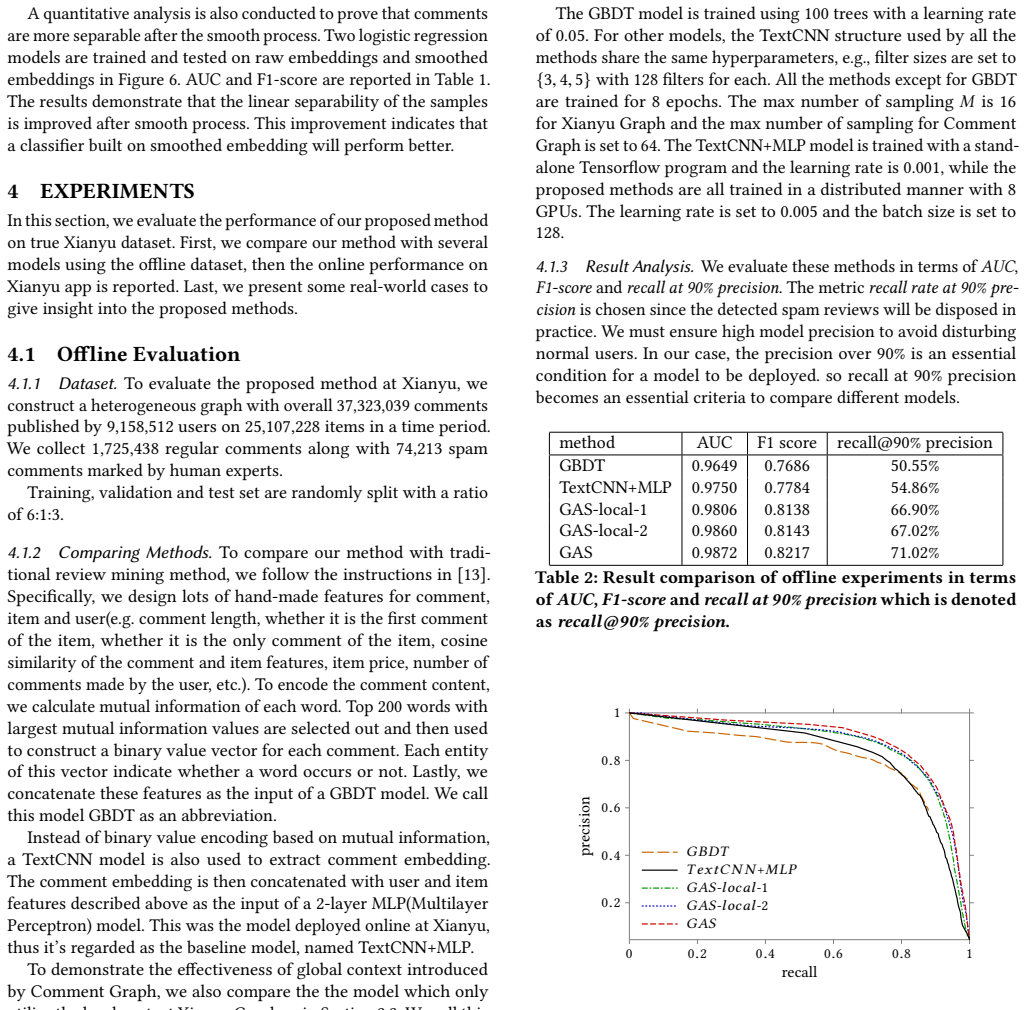
The central claim is that spam detection on Xianyu should be treated as edge classification on a heterogeneous graph, with a second homogeneous graph supplying global context. In the Xianyu Graph, each comment is an attributed edge from a user node to an item node; GAS extends GCN layers by aggregating user, item, and comment embeddings with attention and by initializing comment embeddings from TextCNN. On top of this, a Comment Graph connects comments with similar content, built by removing duplicates, embedding sentences with an external method, and running approximate KNN while deleting same-user and same-item pairs. A one-layer inductive GCN over this graph smooths comment embeddings, and the final classifier concatenates user, item, comment, and smoothed embeddings. The paper reports that this design lifts recall at 90% precision from 54.86% (TextCNN+MLP) to 66.90% (local graph only, one layer) to 71.02% (full GAS), with the extra gains attributed to the Comment Graph grouping spam variants that local context misses.
Load-bearing premise
The claimed global-context gain depends on the Comment Graph being a faithful similarity structure: the sentence embeddings and approximate KNN must link semantically equivalent but deformed spam comments, and if these links are missing or noisy, the smoothing that produces GAS's improvement over the local-only model gives way.
Editorial extensions
If this is right
- If GAS is correct, marketplace comment systems with a similar bipartite structure should be able to raise spam recall at a fixed precision by adding graph context to any text classifier.
- The comparison of GAS-local-1 with TextCNN+MLP implies that most of the practical gain comes from one-hop local context, not from additional graph layers.
- The comparison of GAS with GAS-local-2 implies that a dedicated global similarity graph captures global context more effectively than adding propagation layers to the local graph.
- The time-related sampling with padding means the model can be trained and served at million-comment daily scale with bounded memory and training time.
Reading between the lines
- A testable extension is to rebuild the Comment Graph with alternative similarity measures, such as character-level embeddings or a supervised spam-similarity model, and check whether recall at 90% precision tracks link quality.
- The result suggests a general recipe for adversarial spam: instead of normalizing deformed text, link deformed variants through their neighborhood structure and smooth over that structure; this recipe could transfer to email or social-media spam.
- If the Comment Graph is the source of the extra recall, the system's vulnerability is the graph construction: an adversary who can make spam variants semantically dissimilar to all known spam would reduce or remove the global-context gain.
- Because the authors remove duplicate comments and same-user/same-item pairs when building the Comment Graph, a natural follow-up is to quantify how much each filtering step contributes to precision versus recall.
Editorial analysis
A structured set of objections, weighed in public.
Referee Report
Summary. The paper addresses spam advertisement detection at Xianyu, a large second-hand goods platform. It models comments as edges in a bipartite user-item graph (the Xianyu Graph) and additionally constructs a homogeneous Comment Graph linking comments with similar content. The proposed GAS model combines a heterogeneous graph convolutional network on the Xianyu Graph with an inductive GCN on the Comment Graph, and classifies a comment from the concatenation of user, item, comment, and global-context embeddings. Offline experiments on a dataset of over 37 million comments report that GAS improves recall at 90% precision from 54.86% for the deployed TextCNN+MLP baseline to 71.02%, with a 30-day online deployment showing consistently higher daily detected spam counts. The paper also describes a distributed TensorFlow implementation and a time-related neighbor sampling strategy.
Significance. If the claims hold, this is a valuable industrial demonstration: a GCN-based spam-detection system deployed at million-scale daily volume, with a concrete mechanism for handling adversarially deformed comments. The paper's strengths are its large-scale offline evaluation, the deployed online comparison over 30 days, and the case studies that give qualitative support to the local-context mechanism. The central claim is internally consistent and the methodology is broadly standard. However, the global-context contribution, which is the main claimed novelty over GAS-local-2, rests on a Comment Graph that is never directly validated, and the experimental evidence does not fully isolate that component: the online comparison omits GAS-local-2, offline results are single-run point estimates, and key graph-construction parameters are unspecified. These are evidential and reproducibility gaps rather than fatal flaws, so the paper warrants a major revision rather than rejection.
major comments (4)
- [§3.4 and Table 2] The 4-point recall@90% improvement of GAS over GAS-local-2 is attributed to smoothing over the Comment Graph, yet the graph itself is never validated. The paper should provide edge-level evidence, for example precision/recall of KNN edges against labeled spam pairs or held-out deformed variants such as 'vx'/'wx'/'v', to show that the graph links deformed spam comments rather than only near-duplicates. The separability analysis in Table 1 measures the smoothed embedding space on a training subset and does not establish the fidelity of the graph edges.
- [§3.4] The Comment Graph construction is not reproducible as written: the number of nearest neighbors K for the approximate KNN algorithm is not stated, and the Arora et al. sentence-embedding pipeline (tokenization, pretrained vectors, and weighting parameters) is unspecified for Chinese text. Because this graph is load-bearing for the global-context claim, the authors should report these settings or provide an ablation showing that the result is insensitive to them.
- [§4.1.3 and Table 2] All offline results are single-run point estimates without confidence intervals or significance tests. The key comparison, GAS versus GAS-local-2, differs by 71.02% versus 67.02% recall@90% and F1 0.8217 versus 0.8143 on a single random split; without multiple seeds, bootstrap intervals, or a paired significance test, the statistical reliability of the global-context gain is unestablished.
- [§4.2 and Figure 8] The online comparison deploys TextCNN+MLP, GAS-local-1, and GAS, but not GAS-local-2. Since GAS differs from GAS-local-1 by both the second propagation layer on the Xianyu Graph and the Comment Graph, the reported online improvement does not isolate the global-context contribution. A deployment of GAS-local-2 or an equivalent ablation is needed to support the statement that the online performance demonstrates the effectiveness of the global context introduced by the Comment Graph.
minor comments (5)
- [Abstract and §1] There are grammatical and typographical errors, for example 'Xianyu, ... suffering from spam reviews' and 'we focus on spam advertisements detection in this work,.'
- [Figure 8 caption] The caption mentions GBDT, but GBDT is not plotted in Figure 8; the legend shows only TextCNN+MLP, GAS-local-1, and GAS.
- [References] Reference [1] is incomplete (no venue or publication details), and Reference [3] lists the author as 'Charikar Moses' rather than 'Moses Charikar'.
- [§4.1.3] The phrase 'we detect extra 4% spam comments' should be stated as percentage points rather than percent relative improvement, to avoid ambiguity.
- [§3.3.3] The time-related sampling strategy is presented as more reasonable than random sampling, but no ablation compares it with random sampling or reports sensitivity to M; since M is a free parameter in the headline model, such an experiment would strengthen the claim.
Circularity Check
No significant circularity: GAS is evaluated on a held-out test split against a deployed baseline, and no predicted quantity is defined from fitted constants or self-citation.
full rationale
The paper's central claim—that GAS improves spam detection over TextCNN+MLP and GAS-local—is supported by a supervised holdout evaluation (random 6:1:3 split; Table 2 and Figure 7). No target metric is defined in terms of estimated parameters or graph construction choices. The Comment Graph in Section 3.4 is built from Arora et al. sentence embeddings and approximate KNN without using label information, so the smoothing that distinguishes GAS from GAS-local-2 is not a fit to the evaluation labels. Table 1's separability check is a diagnostic on training-subset embeddings, not a parameter-fitted prediction entering the main comparison. The paper cites no prior work by its own authors as load-bearing evidence; references are standard external methods (TextCNN, GraphSAGE, GCN, KNN graph construction). Possible weaknesses—unvalidated KNN edges, unspecified embedding preprocessing, and online comparison against GAS-local-1 rather than GAS-local-2—are correctness/reproducibility concerns, not circularity. The derivation chain is therefore self-contained against external benchmarks.
Assumptions & free parameters
free parameters (5)
- Number of propagation layers on Xianyu Graph =
2 for GAS (1 for GAS-local-1)
- Max neighbor sampling M on Xianyu Graph =
16
- Max neighbor sampling on Comment Graph =
64
- TextCNN filter sizes and count =
{3, 4, 5} with 128 filters each
- Approximate KNN graph parameters =
Not reported
assumptions (4)
- domain assumption Nodes with the same label tend to be grouped in the graph, so Laplacian smoothing over the Comment Graph makes spam easier to classify.
- domain assumption The sentence embeddings of [1] produce similarities that correctly group deformed and paraphrased spam comments.
- domain assumption Comment data is adequately represented as a bipartite graph where each comment is an edge between a user and an item, and edge classification captures the spam task.
- ad hoc to paper Time-closest comments are more informative neighbors than random ones for the comment being classified.
Cite this review
Pith. "Pith review of Spam Review Detection with Graph Convolutional Networks." pith.science (2026). https://pith.science/paper/K264U5BC
@misc{pith2026190810679,
  author       = {Pith},
  title        = {Pith review of: Spam Review Detection with Graph Convolutional Networks},
  year         = {2026},
  howpublished = {\url{https://pith.science/paper/K264U5BC}},
  note         = {Machine review of arXiv:1908.10679}
}
read the original abstract
Customers make a lot of reviews on online shopping websites every day, e.g., Amazon and Taobao. Reviews affect the buying decisions of customers, meanwhile, attract lots of spammers aiming at misleading buyers. Xianyu, the largest second-hand goods app in China, suffering from spam reviews. The anti-spam system of Xianyu faces two major challenges: scalability of the data and adversarial actions taken by spammers. In this paper, we present our technical solutions to address these challenges. We propose a large-scale anti-spam method based on graph convolutional networks (GCN) for detecting spam advertisements at Xianyu, named GCN-based Anti-Spam (GAS) model. In this model, a heterogeneous graph and a homogeneous graph are integrated to capture the local context and global context of a comment. Offline experiments show that the proposed method is superior to our baseline model in which the information of reviews, features of users and items being reviewed are utilized. Furthermore, we deploy our system to process million-scale data daily at Xianyu. The online performance also demonstrates the effectiveness of the proposed method.
Figures


Figures from the paper (5 more)




Reference graph
Works this paper leans on
-
[1]
Sanjeev Arora, Yingyu Liang, and Tengyu Ma. 2017. A Simple but Tough-to-Beat Baseline for Sentence Embeddings. (2017)
work page 2017
-
[2]
Edward Choi, Mohammad Taha Bahadori, Le Song, Walter F Stewart, and Jimeng Sun. 2017. GRAM: graph-based attention model for healthcare representation learning. In Proceedings of the 23rd ACM International Conference on Knowledge Discovery and Data Mining, SIGKDD . ACM, 787–795
work page 2017
-
[3]
Wei Dong, Charikar Moses, and Kai Li. 2011. Efficient k-nearest neighbor graph construction for generic similarity measures. In Proceedings of the 20th interna- tional conference on World wide web, WWW . ACM, 577–586
work page 2011
-
[4]
Mihajlo Grbovic and Haibin Cheng. 2018. Real-time Personalization using Embed- dings for Search Ranking at Airbnb. In Proceedings of the 24th ACM International Conference on Knowledge Discovery and Data Mining, SIGKDD . ACM, 311–320
work page 2018
-
[5]
Aditya Grover and Jure Leskovec. 2016. node2vec: Scalable feature learning for networks. In Proceedings of the 22nd ACM international conference on Knowledge discovery and data mining, SIGKDD . ACM, 855–864
work page 2016
-
[6]
Will Hamilton, Zhitao Ying, and Jure Leskovec. 2017. Inductive representation learning on large graphs. In Advances in Neural Information Processing Systems, NIPS. 1024–1034
work page 2017
-
[7]
Nitin Jindal and Bing Liu. 2008. Opinion spam and analysis. In Proceedings of the 2008 International Conference on Web Search and Data Mining, WSDM . ACM, 219–230
work page 2008
-
[8]
Yoon Kim. 2014. Convolutional Neural Networks for Sentence Classification. In Proceedings of the 2014 Conference on Empirical Methods in Natural Language Processing, EMNLP. Association for Computational Linguistics, 1746–1751
work page 2014
Show all 32 references
-
[9]
Thomas N Kipf and Max Welling. 2017. Semi-supervised classification with graph convolutional networks. In 5th International Conference on Learning Representa- tions, ICLR
2017
-
[10]
Jon M Kleinberg. 1999. Hubs, authorities, and communities. ACM computing surveys CSUR 31, 4es (1999), 5
1999
-
[11]
Qimai Li, Zhichao Han, and Xiao-Ming Wu. 2018. Deeper Insights into Graph Convolutional Networks for Semi-Supervised Learning. In Proceedings of the Thirty-Second AAAI Conference on Artificial Intelligence, AAAI . 3538–3545
2018
-
[12]
Lizi Liao, Xiangnan He, Hanwang Zhang, and Tat-Seng Chua. 2018. Attributed social network embedding. IEEE Transactions on Knowledge and Data Engineering, TKDE 30, 12 (2018), 2257–2270
2018
-
[13]
Bing Liu and Lei Zhang. 2012. A survey of opinion mining and sentiment analysis. In Mining text data. Springer, 415–463
2012
-
[14]
Ziqi Liu, Chaochao Chen, Xinxing Yang, Jun Zhou, Xiaolong Li, and Le Song
-
[15]
Marcin Luckner, Michał Gad, and Paweł Sobkowiak. 2014. Stable web spam detection using features based on lexical items. Computers and Security 46 (2014), 79–93
2014
-
[16]
Tomas Mikolov, Ilya Sutskever, Kai Chen, Greg S Corrado, and Jeff Dean. 2013. Distributed representations of words and phrases and their compositionality. In Advances in neural information processing systems, NIPS . 3111–3119
2013
-
[17]
Myle Ott, Yejin Choi, Claire Cardie, and Jeffrey T Hancock. 2011. Finding decep- tive opinion spam by any stretch of the imagination. In Proceedings of the 49th Annual Meeting of the Association for Computational Linguistics, ACL . 309–319
2011
-
[18]
Bryan Perozzi, Rami Al-Rfou, and Steven Skiena. 2014. Deepwalk: Online learning of social representations. In Proceedings of the 20th ACM international conference on Knowledge discovery and data mining, SIGKDD . ACM, 701–710
2014
-
[19]
Amani K Samha, Yuefeng Li, and Jinglan Zhang. 2014. Aspect-based opinion extraction from customer reviews. arXiv preprint arXiv:1404.1982 (2014)
2014 arXiv
-
[20]
Chao Shang, Qinqing Liu, Ko-Shin Chen, Jiangwen Sun, Jin Lu, Jinfeng Yi, and Jinbo Bi. 2018. Edge Attention-based Multi-Relational Graph Convolutional Networks. arXiv preprint arXiv:1802.04944 (2018)
2018 arXiv
-
[21]
Saeedreza Shehnepoor, Mostafa Salehi, Reza Farahbakhsh, and Noel Crespi. 2017. NetSpam: a network-based spam detection framework for reviews in online social media. IEEE Transactions on Information Forensics and Security 12, 7 (2017), 1585–1595
2017
-
[22]
Amira Soliman and Sarunas Girdzijauskas. 2017. Adaptive graph-based algo- rithms for spam detection in social networks. In 5th International Conference on Network Systems, NETYS. 338–354
2017
-
[23]
Yizhou Sun and Jiawei Han. 2012. Mining heterogeneous information networks: principles and methodologies. Synthesis Lectures on Data Mining and Knowledge Discovery 3, 2 (2012), 1–159
2012
-
[24]
Ashish Vaswani, Noam Shazeer, Niki Parmar, Jakob Uszkoreit, Llion Jones, Aidan N Gomez, Łukasz Kaiser, and Illia Polosukhin. 2017. Attention is all you need. In Advances in Neural Information Processing Systems, NIPS . 5998–6008
2017
-
[25]
Petar Veličković, Guillem Cucurull, Arantxa Casanova, Adriana Romero, Pietro Liò, and Yoshua Bengio. 2018. Graph Attention Networks. International Confer- ence on Learning Representations, ICLR (2018)
2018
-
[26]
Guan Wang, Sihong Xie, Bing Liu, and Philip S Yu. 2012. Identify online store review spammers via social review graph.ACM Transactions on Intelligent Systems and Technology TIST (2012)
2012
-
[27]
Jizhe Wang, Pipei Huang, Huan Zhao, Zhibo Zhang, Binqiang Zhao, and Dik Lun Lee. 2018. Billion-scale Commodity Embedding for E-commerce Recommendation in Alibaba. In Proceedings of the 24th ACM International Conference on Knowledge Discovery and Data Mining, SIGKDD . ACM, 839–848
2018
-
[28]
Keyulu Xu, Weihua Hu, Jure Leskovec, and Stefanie Jegelka. 2018. How Powerful are Graph Neural Networks?. In International Conference on Learning Representa- tions, ICLR
2018
-
[29]
Keyulu Xu, Chengtao Li, Yonglong Tian, Tomohiro Sonobe, Ken-ichi Kawarabayashi, and Stefanie Jegelka. 2018. Representation Learning on Graphs with Jumping Knowledge Networks. In Proceedings of the 35th International Conference on Machine Learning,ICML . 5449–5458
2018
-
[30]
Rex Ying, Ruining He, Kaifeng Chen, Pong Eksombatchai, William L Hamilton, and Jure Leskovec. 2018. Graph Convolutional Neural Networks for Web-Scale Recommender Systems. In Proceedings of the 24th ACM International Conference on Knowledge Discovery and Data Mining, SIGKDD . 974–983
2018
-
[31]
Huan Zhao, Quanming Yao, Jianda Li, Yangqiu Song, and Dik Lun Lee. 2017. Meta- graph based recommendation fusion over heterogeneous information networks. In Proceedings of the 23rd ACM International Conference on Knowledge Discovery and Data Mining, SIGKDD . ACM, 635–644. 10
2017
-
[2018]
In Proceedings of the 27th ACM International Conference on Information and Knowledge Management, CIKM
Heterogeneous Graph Neural Networks for Malicious Account Detection. In Proceedings of the 27th ACM International Conference on Information and Knowledge Management, CIKM. ACM, 2077–2085
Reviewed August 14, 2026 · model on record in the stance chip above.
Discussion (0). Continue with ORCID to comment.