REVIEW 4 major objections 4 minor 24 references
Threaded rings that swim in excitable media
T0 review · 4 major / 4 minor · reviewed 2026-08-14 · deepseek-v4-flash
Pith's one-line read A scroll ring threaded by a pair of counter-rotating filaments swims sideways through a thin excitable medium at about 0.07 wavelengths per spiral period.
desk verdict First experimental non-trivial filament topology in an excitable medium, plus a genuinely new swimming motion in simulation; referee it, but ask for a sharper uniqueness argument on the experimental image. read the letter →
The pith
A machine-rendered reading of the paper's core claim, the machinery that carries it, and where it could break.
The reading
What carries the argument
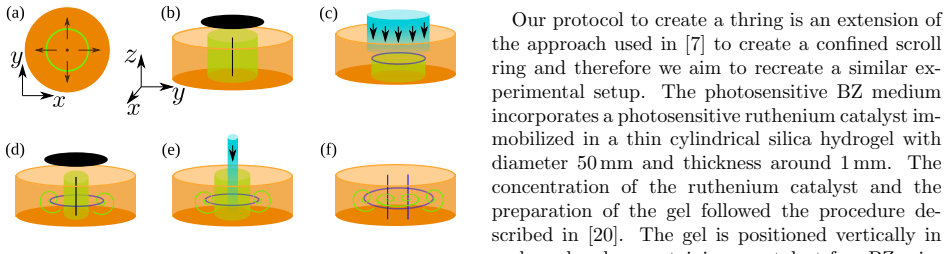
Two linked objects carry the argument. The first is the thring itself: a closed scroll-ring filament threaded by a pair of counter-rotating filaments that are perpendicular to the ring plane and end on opposite boundaries of a thin medium, making the link topologically nontrivial. The second is the frustrated-repulsion mechanism: the ring constrains the two spiral cores to remain within roughly a wavelength of each other, blocking the repulsion that would otherwise separate them and halt their motion, so the parallel velocity of the core pair propels the whole structure. In the numerics, filaments are located as isosurfaces of the vorticity $B=\nabla u\times\nabla v$, and the swimming trajectory is tracked through the $|B|^4$-weighted centre of mass; the experimental counterpart is the light-templating protocol that cuts excitation waves to assemble the linked filaments in the BZ gel.
What would settle it
Compute the projected mean-concentration image that a thin BZ simulation would produce for several different filament arrangements and compare it with the experimental image; if any unthreaded or differently threaded arrangement reproduces the 'smiling face' pattern, the experimental identification of a thring is not established. A three-dimensional reconstruction of the filaments in an experimental gel, tracking two distinct cores crossing the ring interior and ending on opposite faces, would settle the topological claim directly.
Extended reading notes
Core claim
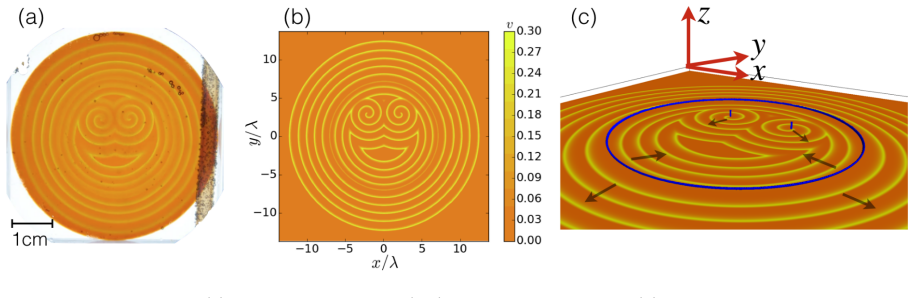
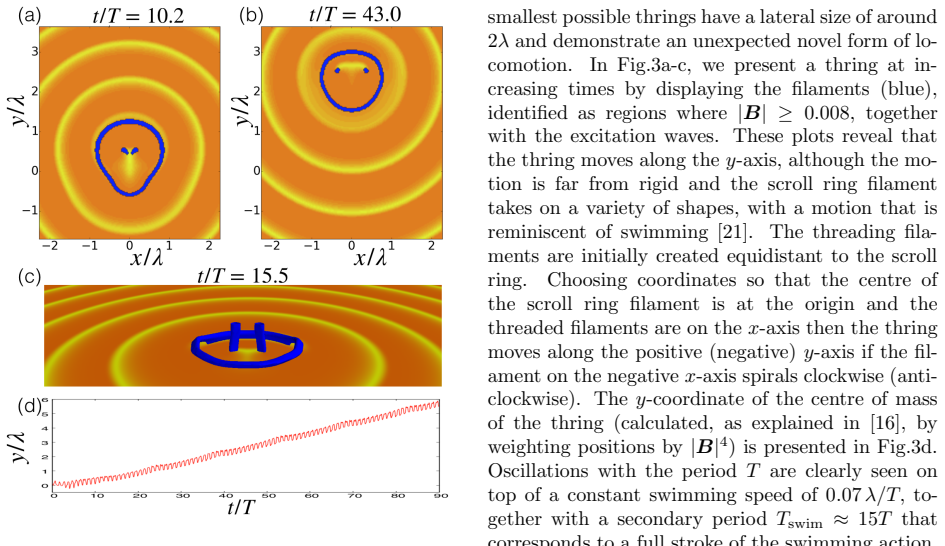
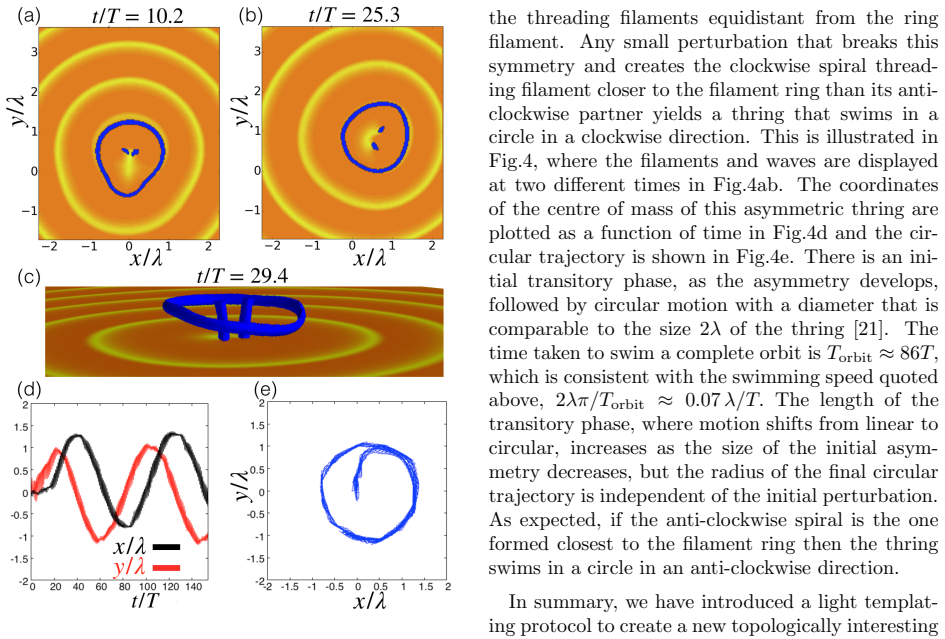
The central claim is that threading a scroll ring with a linked pair of counter-rotating filaments produces a new mode of locomotion in a thin excitable medium: the thring swims in the plane of the ring rather than sitting still or merely contracting. In simulations of the modified Oregonator equations for the photosensitive BZ medium, a symmetric thring moves at constant speed $0.07\lambda/T$ along an axis perpendicular to the line joining the threading filaments, with a period-$T$ oscillation and a full swimming stroke every $T_{\mathrm{swim}}\approx 15T$. The mechanism the paper identifies is that the ring holds the two spiral cores close together and frustrates their mutual repulsion, so the parallel component of the core velocity persists and produces sustained propulsion; without the ring the pair quickly reverses and stalls after moving less than $0.1\lambda$. If the symmetry is broken by placing one threading filament closer to the ring, the thring swims in a circle with diameter comparable to its size and an orbit time of about $86T$. The paper also reports the first experimental realization of a thring in a thin photosensitive BZ gel, created by a sequence of light cuts, and identifies the observed 'smiling face' projection as the signature of the threaded topology.
Load-bearing premise
The experimental confirmation that the protocol creates a thring depends on reading the two-dimensional 'smiling face' wave pattern as uniquely diagnostic of the threaded-filament topology, rather than on directly tracking the three filaments in the gel.
Editorial extensions
If this is right
- A symmetric small thring with lateral size about $2\lambda$ swims at a constant speed of roughly $0.07\lambda/T$, with the centre of mass oscillating once per spiral period and a full swimming stroke every $15T$.
- The swimming requires a thin medium: the gel thickness must be about $\lambda/2$, and in a medium as thick as $\lambda$ the ring cannot bind the threading filaments, so swimming halts as the ring grows.
- The threading filaments barely move while the ring contracts; in the experimental thring this contraction is eventually asymmetric and breaks the ring against the boundary after roughly 50 spiral periods.
- Because the same swimming motion appears in a generic cardiac-tissue excitable model, thring dynamics should occur in any excitable medium with the right thin geometry and the linked filament topology.
Reading between the lines
- Beyond the paper: if thring swimming is universal in thin excitable media, a threaded scroll ring in cardiac tissue would appear as a re-entrant source that drifts sideways, and the predicted drift speed of about $0.07\lambda/T$ could be sought in tissue-level simulations or optical-mapping experiments.
- Beyond the paper: the circular trajectory of asymmetric thrings, with a radius that does not depend on the size of the perturbation, hints that a controlled light gradient could steer a thring along a chosen path in a BZ chip; the paper does not explore steering.
- Beyond the paper: because the swimming speed is set by core-repulsion geometry rather than by chemical details, comparing thring speeds across different excitable media would give a direct quantitative probe of the same frustrated-repulsion mechanism.
Signed reviews
Editorial analysis
A structured set of objections, weighed in public.
Referee Report
Summary. This manuscript introduces the 'thring', a novel filament topology in which a scroll ring is threaded by a pair of counter-rotating filaments that span the thin direction of an excitable medium and end on the boundaries. The central numerical result, obtained with the modified Oregonator model, is that small thrings (transverse size ~2λ) swim in the plane of the ring at a speed of about 0.07λ/T, with asymmetric variants swimming in circles. The same behavior is reproduced in the FitzHugh-Nagumo model, leading the authors to claim that swimming thrings are a universal phenomenon in excitable media. The paper also proposes a light-templating protocol for the photosensitive Belousov-Zhabotinsky reaction and reports experimental images, interpreted as confirmation that the protocol yields a thring. The experimental realization uses a ring of diameter about 24λ, far larger than the 2λ swimming regime, so the swimming itself remains a numerical prediction.
Significance. If the numerical result holds, it constitutes a novel and mechanistically interesting form of self-locomotion in excitable media, arising from the interplay of filament topology and confinement, with potential relevance to cardiac tissue. A clear strength is that no parameters are fitted to produce the swimming: the Oregonator parameters are taken from earlier work, and the swimming speed and trajectory are emergent outputs of the simulations. The ring-removal control supports the proposed mechanism, and the FitzHugh-Nagumo reproduction provides cross-model evidence. The experimental protocol is concrete and was repeated successfully in ten runs. The principal weakness is that the experimental identification of the thring rests on a two-dimensional projection of the wave pattern, without a test of alternative filament configurations, and the quantitative swimming speed is extracted from a single trajectory without error bars or resolution checks.
major comments (4)
- [Experimental identification, Fig. 2a] The conclusion that the protocol 'indeed yields a thring' is drawn from agreement between the experimental 2D projection and a simulation initialized with the desired topology. Because the camera integrates the catalyst concentration through the ~λ/2 thickness, the image does not resolve the 3D filament curves. Alternative configurations—an unthreaded ring with the two spiral cores on opposite faces, a single vertical filament whose two boundary ends are misread as a pair, or two vertical filaments placed outside the ring—are not compared against the data. The paper should either provide a discriminating quantitative comparison with such alternatives or explicitly restate the experimental result as 'consistent with' rather than 'indeed yields' a thring. This is load-bearing because the manuscript claims the first experimental example of non-trivial filament topology.
- [Fig. 3d and swimming speed] The quantitative central claim of 0.07λ/T is extracted from a single simulation trajectory. No ensemble of runs, no measure of run-to-run variability, and no check of sensitivity to numerical resolution or domain size are reported; the secondary stroke period Tswim ≈ 15T is likewise from one realization. Since this number is the quantitative core of the paper and is later used to argue consistency with the circular trajectory via 2λπ/Torbit ≈ 0.07λ/T, the authors should report at least a few independent realizations with perturbed initial conditions and state whether 0.07λ/T is stable under resolution and size changes.
- [Supplemental Material, Fig. S2 (FitzHugh-Nagumo)] The universality claim rests on one parameter set of the FitzHugh-Nagumo model in one domain geometry, and in the Oregonator model on one parameter set taken from [7]. No parameter variation is reported for either model. 'A new universal phenomenon in excitable media' overstates the evidence at this stage; a more measured statement such as 'observed in two standard excitable-media models' would be appropriate unless additional parameter or model variation is supplied.
- [Size requirements, text near Fig. 4 and Fig. S1] The assertion that swimming requires filament separation <λ, distance from each filament to the ring <λ, and medium thickness ≈λ/2, with a lower bound set by mutual annihilation, is supported only by a few selected simulations. Because the experimental outlook is explicitly tied to reaching this regime, the authors should either present a systematic scan in ring size, filament separation, or thickness, or explicitly mark these thresholds as preliminary estimates rather than established bounds.
minor comments (4)
- [Fig. 2a] The experimental panel has no scale bar and no arrows indicating wave-propagation direction, which makes the visual comparison with Fig. 2b-c harder to assess; adding these would improve reproducibility of the claimed agreement.
- [Experimental protocol] The statement that the defect wave frequency increases with laser exposure time is not quantified; a calibration curve or at least a range of exposure times would aid readers who wish to reproduce the protocol.
- [Text near Eq. (1)] The sentence 'The experimental results are well-described by numerical simulations' is not supported by any quantitative comparison metric; a correlation coefficient or a representative overlay would strengthen the claim.
- [Introduction] There is a typo in 'ventricular arryhthmia' (first paragraph); it should read 'arrhythmia'.
Circularity Check
No circularity: the swimming dynamics are measured simulation outputs, not built into the model or fitted parameters.
full rationale
The paper's central numerical claim, that a thring swims at about 0.07 lambda/T, is an observed output of reaction-diffusion simulations using fixed model parameters taken from prior experimental work (Azhand, Totz and Engel, EPL 108, 10004 (2014)), not a parameter fitted to the swimming motion. The swimming speed is read off from the simulated center-of-mass trajectory, and the qualitative mechanism is a post hoc explanation supported by a control simulation with the ring removed and by an independent FitzHugh-Nagumo simulation. The only self-citations are to earlier numerical methods and filament-visualization conventions, such as weighting the center of mass by |B|^4 [16]; these are diagnostic tools rather than inputs that force the swimming result. The experimental identification of the thring from the projected wave pattern is a validation limitation (a 2D projection is not a uniqueness proof of the 3D filament topology), but that is a correctness risk, not a circular derivation: the paper does not define the thring in terms of the projected image, nor does it derive the swimming from the same image. No equation is shown to reduce to its own input, and no fitted quantity is renamed as a prediction. Thus there is no significant circularity.
Assumptions & free parameters
assumptions (4)
- domain assumption The modified Oregonator reaction-diffusion equations (1) accurately model the photosensitive BZ medium in the thin-gel geometry.
- domain assumption No-flux (Neumann) boundary conditions at all medium boundaries are appropriate for the gel-chamber setup.
- domain assumption The vorticity field B = ∇u × ∇v is localized on filaments and can be used to visualize them at isosurface |B| = 0.008.
- standard math The topological unlinking argument: threading filaments cannot be unlinked from the ring without breaking and remaining attached to opposite boundaries.
Cite this review
Pith. "Pith review of Threaded rings that swim in excitable media." pith.science (2026). https://pith.science/paper/K27W2DNS
@misc{pith2026190808751,
  author       = {Pith},
  title        = {Pith review of: Threaded rings that swim in excitable media},
  year         = {2026},
  howpublished = {\url{https://pith.science/paper/K27W2DNS}},
  note         = {Machine review of arXiv:1908.08751}
}
read the original abstract
Cardiac tissue and the Belousov-Zhabotinsky reaction provide two notable examples of excitable media that support scroll waves, in which a filament core is the source of spiral waves of excitation. Here we consider a novel topological configuration in which a closed filament loop, known as a scroll ring, is threaded by a pair of counter-rotating filaments that are perpendicular to the plane of the ring and end on the boundary of a thin medium. We simulate the dynamics of this threaded ring (thring) in the photosensitive Belousov-Zhabotinsky excitable medium, using the modified Oregonator reaction-diffusion equations. These computations reveal that the threading topology induces an exotic motion in which the thring swims in the plane of the ring. We propose a light templating protocol to create a thring in the photosensitive Belousov-Zhabotinsky medium and provide experimental confirmation that this protocol indeed yields a thring.
Figures
Figures from the paper (1 more)
Reference graph
Works this paper leans on
-
[7]
in a thin photosensitive BZ medium have shown that such confinement not only prevents the trans- lational motion of the scroll ring but also signifi- cantly changes other aspects of its dynamics, yield- ing a stable ring radius in the confined medium in contrast to an expanding ring in the correspond- ing bulk system. The experimental results are well- descr...
work page Pith review arXiv 1908
-
[1]
Winfree, The Geometry of Biological Time , Springer-Verlag, 2001
A.T. Winfree, The Geometry of Biological Time , Springer-Verlag, 2001
work page 2001
- [2]
-
[3]
I.R. Epstein and J.A. Pojman, An Introduction to Nonlinear Chemical Dynamics , OUP, 1998
work page 1998
-
[4]
Burton et al., Nature Photonics 9, 813 (2015)
Rebecca A.B. Burton et al., Nature Photonics 9, 813 (2015)
work page 2015
-
[5]
Tobias Bruegmann et al., J. Clin. Invest. 126, 3894 (2016)
work page 2016
- [6]
- [8]
Show all 24 references
-
[9]
J.F. Totz, H. Engel and O. Steinbock, New J. Phys. 17, 093043 (2015)
2015
-
[10]
Cherry and F.H
E.M. Cherry and F.H. Fenton, J. Theor. Biol. 285, 164 (2011)
2011
-
[11]
Winfree and S.H
A.T. Winfree and S.H. Strogatz, Nature 311, 611 (1984)
1984
-
[12]
Winfree, SIAM Review 32, 1 (1990)
A.T. Winfree, SIAM Review 32, 1 (1990)
1990
-
[13]
Sutcliffe and A.T
P.M. Sutcliffe and A.T. Winfree, Phys. Rev. E 68, 016218 (2003)
2003
-
[14]
Maucher and P.M
F. Maucher and P.M. Sutcliffe, Phys. Rev. Lett. 116, 178101 (2016)
2016
-
[15]
Maucher and P.M
F. Maucher and P.M. Sutcliffe, Phys. Rev. E 96, 012218 (2017)
2017
-
[16]
Maucher and P.M
F. Maucher and P.M. Sutcliffe, J. Phys. A 51, 055102 (2018)
2018
-
[17]
Maucher and P.M
F. Maucher and P.M. Sutcliffe, Nonlinearity 32, 942 (2019)
2019
-
[18]
Binysh, C.A
J. Binysh, C.A. Whitfield and G.P. Alexander, Phys. Rev. E 99, 012211 (2019)
2019
-
[19]
Bruns and J.F
C.J. Bruns and J.F. Stoddart, The Nature of the Mechanical Bond, John Wiley & Sons, 2017
2017
-
[20]
H.J. Krug, L. Pohlmann and L.J. Kuhnert, J. Phys. Chem. 94, 4862 (1990)
1990
-
[21]
Brandtst¨ adter, M
H. Brandtst¨ adter, M. Braune, I. Schebesch, H. En- gel, Chem. Phys. Lett. 323, 145 (2000)
2000
-
[22]
See Supplemental Material for details of the numer- ical method, additional simulations, videos and ad- ditional experimental details
-
[23]
Winfree, Physica D 84, 126 (1995)
A.T. Winfree, Physica D 84, 126 (1995)
1995
-
[24]
Ruiz-Villarreal, M
M. Ruiz-Villarreal, M. G´ omez-Gesteira, C. Souto, A.P. Mu˜ nuzuri, and V. P´ erez-Villar,Phys. Rev. E 54, 2999 (1996). 6 SUPPLEMENT AL MA TERIAL ADDITIONAL EXPERIMENT AL DET AILS The camera used to capture the images from the experiment was a Canon EOS 1300D 18 megapixel digi...
1996
Reviewed August 14, 2026 · model on record in the stance chip above.
Discussion (0). Continue with ORCID to comment.