REVIEW 3 major objections 4 minor 1 cited by
Non-relativistic susceptibility and a dark matter application
T0 review · 3 major / 4 minor · reviewed 2026-08-14 · deepseek-v4-flash
Pith's one-line read This paper argues that in a stop-like dark matter model, the susceptibility correction $\hat p_2$ does not efficiently regularize the late-time freeze-out abundance when $2\Delta M < \Delta E$, so the viable domain remains controlled by…
desk verdict New lattice measurement of p̂2 and a plausible negative result for its role in freeze-out; the quantitative uncertainty is real but does not overturn the main conclusion. read the letter →
The pith
A machine-rendered reading of the paper's core claim, the machinery that carries it, and where it could break.
The reading
What carries the argument
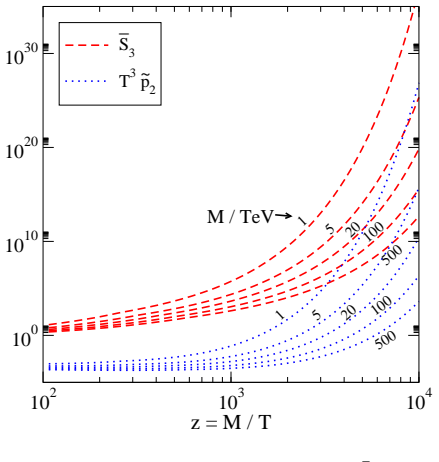
The central object is the susceptibility-normalized coefficient $\hat p_2$, defined through $p_2 = \hat p_2 n_{\rm eq}^2 T$, which closes the modified Lee-Weinberg equation by expressing the chemical potential in terms of the density through $e^{\beta\mu} n_{\rm eq} = 2n/(1+\sqrt{1+8\hat p_2 n})$. Analytically it is estimated as $T^3\hat p_2 \simeq (2/N_c^2)(\pi T/M)^{3/2}(e^{\beta\Delta E}-1)$, assuming one Coulomb-like bound state of the stop-antistop system with binding energy $\Delta E = \alpha^2 M/4$. Non-perturbatively it is measured from the disconnected heavy-propagator correlator in eq. (5.1), using non-relativistic lattice QCD; the connected part cancels, and the gauge-field lines linking the two propagators are what carry the bound-state physics. The comparison between the two estimates, with vacuum-like coupling at low temperature and thermal coupling at high temperature, is what licenses using the analytic form in cosmology.
What would settle it
Compute $T^3\hat p_2$ at the couplings and values of $z = M/T$ relevant to cosmology, either through the full three-loop perturbative evaluation of eq. (4.7) or through lattice simulations at smaller coupling; if for $M \sim 1\text{--}20$ TeV and $z \sim 10^3$ it exceeds $10^{11}$, then $8\hat p_2 n$ can reach order unity at the yields of interest and the regularization would be effective, contrary to the paper's conclusion.
Extended reading notes
Core claim
The paper's central claim is that the coefficient $\hat p_2$, defined through $p_2 = \hat p_2 \, n_{\rm eq}^2 T$ and entering the number density through $e^{\beta\mu} n_{\rm eq} = 2n/(1+\sqrt{1+8\hat p_2 n})$, does not provide an efficient regularization of the late-time abundance in the stop-like model. The mechanism is quantitative: for $\hat p_2$ to matter one needs $8\hat p_2 n \gtrsim 1$, which for $Y \simeq 10^{-13}$ requires $T^3\hat p_2 \gg 10^{11}$; such values are reached only at $z \equiv M/T$ so large that the Sommerfeld factor $\bar S_3$ has already exceeded $10^{10}$ and pulled the yield down. The authors establish this with three ingredients: an order-of-magnitude estimate of $\hat p_2$ from a Coulomb-like ground state, a lattice measurement in large-coupling QCD that agrees with the estimate, and an explicit integration of the modified rate equation for $M = 1\ldots 500$ TeV. The stated conclusion is that in practice the regularization by $\hat p_2$ is insufficient to make the system viable if $2\Delta M < \Delta E$, leaving $\Delta M$ as the only possible equilibrium regulator.
Load-bearing premise
The load-bearing premise is that a single Coulomb-like ground state with binding energy $\Delta E = \alpha^2 M/4$ dominates the susceptibility, making the estimate exponentially sensitive to the coupling; the lattice test is performed at large coupling and moderate $M/T$, far from the small-coupling cosmological regime, so a much larger true $\hat p_2$ could overturn the conclusion.
Editorial extensions
If this is right
- If the paper is right, models with strongly interacting mediators must satisfy $2\Delta M > \Delta E$ to avoid unacceptably large late-time annihilation, since $\hat p_2$ cannot do the job.
- The viable dark matter mass range extends at least to the multi-TeV domain, as previously found, but only when such a mass splitting is present.
- At late times the ratio $\bar S_3/(T^3\hat p_2) \simeq (M\alpha/T)^3 \gg 1$, so the suppression mechanism is generic rather than accidental in this model.
- The lattice test at large coupling supports using the analytic $\hat p_2$ estimate at small coupling, meaning the negative conclusion is not an artifact of the extrapolation, within the uncertainty of the estimate.
Reading between the lines
- If additional bound states or excited states contribute to $\hat p_2$ more than assumed, the estimate could be systematically low; a full three-loop calculation and lower-coupling lattice data would be the direct test.
- The same ratio $\bar S_3/(T^3\hat p_2)\sim (M\alpha/T)^3$ suggests that in models with weaker Sommerfeld enhancement or stronger binding, $\hat p_2$ could still provide the regularizing effect the authors find absent here.
- The lattice method for measuring the disconnected correlator could be applied to other non-relativistic dark sectors, giving a non-perturbative route to chemical equilibration rates that does not require enumerating bound states.
Signed reviews
Editorial analysis
A structured set of objections, weighed in public.
Referee Report
Summary. The paper studies the susceptibility coefficient p̂2 that enters the modified Lee-Weinberg equation (1.2) when chemical potentials are eliminated in favour of the number density. Section 2 derives the Saha-type relation (2.12) from a fugacity expansion truncated at two-particle states. Section 3 gives an order-of-magnitude estimate, Eq. (3.9), in which the two-particle spectral sum is replaced by a single Coulomb-like ground state with binding energy ΔE = α²M/4, while octet and excited states are neglected. Section 4 formulates p̂2 as a non-perturbative lattice observable, Eq. (4.7), and Section 5 presents a single NRQCD lattice measurement at M_kin = 14Λ, comparing it with the analytic estimate at both vacuum and thermal coupling choices. Section 6 applies the same analytic p̂2 to a Majorana singlet dark matter model with a strongly interacting stop-like mediator, integrating Eq. (1.2) down to late times. The principal conclusion is that the susceptibility-induced regularization is ineffective: the combination 8 p̂2 n remains far below unity in the regime where the abundance Y ≈ 10⁻¹³ is set, so the viable parameter space continues to be controlled by the mass splitting ΔM rather than by p̂2. The paper closes by noting that the analytic value of p̂2 is only an order-of-magnitude estimate and that a full perturbative calculation would be of three-loop order.
Significance. The paper addresses a genuinely open technical question in thermal dark matter computations: whether the Saha-type susceptibility, which is in principle present in Eq. (1.2), can regularize the late-time growth of Sommerfeld-enhanced annihilation. The authors provide a concrete non-perturbative lattice definition of the susceptibility, Eq. (5.1), and take the first step toward measuring it with NRQCD, which is a meaningful methodological contribution. They also formulate a general low-temperature ratio S̄3/(T³ p̂2) ≃ (Mα/T)³ that gives a plausible reason for the inefficiency of the p̂2 regularization, and they explicitly flag the limitations of their estimate in Section 7. If the central conclusion holds, it rules out a potentially attractive solution to the overclose problem of coannihilating dark matter and sharpens the role of the mass-splitting regulator. The main limitation is that the central claim relies on an order-of-magnitude analytic estimate that is exponentially sensitive to α and is validated by only one lattice point with statistical-only errors and up to ~50% systematic uncertainty; the general ratio argument mitigates but does not fully remove this concern.
major comments (3)
- [Sec. 3, Eq. (3.9); Sec. 6, Eq. (6.4)] The central no-regularization conclusion rests on the single-ground-state estimate (3.9). The authors correctly stress that this is an order-of-magnitude estimate and that it is exponentially sensitive to α, but the manuscript does not quantify how much T³ p̂2 could change if a more complete treatment of the two-particle spectral sum were adopted, including excited Coulomb states, octet degrees of freedom, or a modestly different effective binding energy. Since the integration in Section 6 uses this same estimate, the agreement shown in Fig. 1 does not independently validate the late-time comparison on which the conclusion is based. I request a robustness scan: for the target yield Y ≈ 10⁻¹³ and the criterion 8 p̂2 n ≫ 1 from Eq. (6.4), please determine how large T³ p̂2 would need to be at the relevant z for the p̂2 regularization to affect the final abundance, and then state whether any plausible modification of Eq. (3.9) — for example, a multiplicity factor of 10–100 or a shift in ΔE within the uncertainty of α — can achieve that value before S̄3 drives Y below the observed value.
- [Sec. 5, Fig. 1] The lattice test is limited to a single rest mass M_kin = 14Λ, in a regime where α ≳ 0.3, far from the cosmological value α ≈ 0.1 used in Section 6. The errors quoted are statistical only, and the authors themselves note that systematic uncertainties could be as large as ~50%. Moreover, the two analytic curves labeled 'vacuum coupling' and 'thermal coupling' are scaled versions of the same estimate (3.9), so the comparison in Fig. 1 is a test of the temperature dependence of a single-parameter form rather than an independent probe of the absolute normalization of T³ p̂2. I ask the authors to state explicitly how the central claim would be affected if T³ p̂2 were larger than Eq. (3.9) by a factor of 10 or 100 at the z values of interest (z ≈ 10³–10⁴), and to separate, in Fig. 1 or its caption, the systematic uncertainty in the lattice point from the spread between the two coupling prescriptions.
- [Sec. 7] The general argument that S̄3/(T³ p̂2) ≃ (Mα/T)³ ≫ 1 is presented as the reason why p̂2 cannot compensate for S̄3. This ratio is derived from the same ground-state approximations, Eqs. (6.2) and (6.3), that underlie the quantitative estimate, so it inherits the uncertainties listed above. If the true bound-state spectrum supplies a large multiplicity factor to p̂2 but a smaller one to S̄3, the ratio could be shifted substantially. Please clarify to what extent this argument is parametric (i.e., would remain valid for any spectral sum with the same leading exponential behaviour) and to what extent it depends on the single-ground-state approximation.
minor comments (4)
- [Sec. 7] The word 'estime' in the final paragraph should be 'estimate'.
- [Sec. 3, Eq. (3.9)] The notation d²_s appears without explicit definition of the spin degeneracy factor in Eq. (3.8); please spell out that d_s ≡ 2s + 1 at the first use of c_{θ,η} → d²_s.
- [Sec. 5, Fig. 1] The caption states that 'the errors of the lattice results are statistical only', but the figure does not show error bars. I recommend adding explicit error bars (or the systematic band) to the figure, since the quoted ~50% uncertainty is essential to the calibration claim.
- [Sec. 6, Eq. (6.4)] The combination 8 p̂2 n is introduced abruptly; a sentence explaining that this is the quantity controlling the correction term in Eq. (2.12) would improve readability.
Circularity Check
No significant circularity: p̂₂ is derived, lattice-checked, and used in explicit equations; no prediction reduces to its inputs.
full rationale
The central object p̂₂ is defined through the susceptibility (eqs. (2.10)/(2.11)), estimated from a fugacity expansion in Sec. 3, and measured non-perturbatively on the lattice via eq. (5.1); the analytic estimate is compared with, not fitted to, the lattice data (Fig. 1). The dark-matter conclusion follows by combining explicit formulas (eqs. (6.2)–(6.4)): the criterion 8p̂₂n ≫ 1 is evaluated with the analytic p̂₂ and the Sommerfeld factor taken from prior work, with no free parameter tuned to the final yield. The use of same-author results for the Sommerfeld factor and lattice setup is normal scientific continuity; those results do not presuppose the no-stabilization conclusion. The paper itself flags the order-of-magnitude character of eq. (3.9) in Sec. 7, which is a robustness caveat, not a circular step. No equation reduces to its inputs by construction.
Assumptions & free parameters
free parameters (2)
- coupling renormalization scale =
vacuum scale e^{-γ_E}/a at low T, thermal scale μ~πT at high T, crossover at z≈250-600
- binding energy ΔE =
α²M/4
assumptions (5)
- domain assumption The system is dilute (T ≪ M), so a Boltzmann/fugacity expansion truncated at p2 is valid.
- domain assumption The dark matter model consists of a Majorana singlet fermion and a strongly interacting scalar mediator with a specified mass splitting ΔM.
- ad hoc to paper The susceptibility is dominated by a single Coulomb-like ground state in the (1,1) sector; octet and higher bound states are exponentially suppressed.
- domain assumption Kinetic and ionization equilibrium are maintained in the dark sector down to the temperatures considered.
- ad hoc to paper The lattice study at large coupling can validate the analytic estimate for small coupling.
Cite this review
Pith. "Pith review of Non-relativistic susceptibility and a dark matter application." pith.science (2026). https://pith.science/paper/K2MAHA4M
@misc{pith2026190807541,
  author       = {Pith},
  title        = {Pith review of: Non-relativistic susceptibility and a dark matter application},
  year         = {2026},
  howpublished = {\url{https://pith.science/paper/K2MAHA4M}},
  note         = {Machine review of arXiv:1908.07541}
}
read the original abstract
When thermal rate equations are derived for the evolution of slow variables, it is often practical to parametrize the right-hand side with chemical potentials. To close the system, the chemical potentials are subsequently re-expressed in terms of the slow variables, which involves the consideration of a "susceptibility". Here we study a non-relativistic situation in which chemical potentials are large compared with the temperature, as is relevant for late-time pair annihilations in dark matter freeze-out. An order-of-magnitude estimate and a lattice simulation are presented for a susceptibility dominated by bound states of stop-like mediators. After this "calibration", the formalism is applied to a model with Majorana singlet dark matter, confirming that masses up to the multi-TeV domain are viable in the presence of sufficient (though not beyond a limit) mass degeneracy in the dark sector.
Figures


Forward citations
Cited by 1 Pith paper
-
Effective field theories for dark matter pairs in the early universe: Debye mass effects
Debye mass resummation reduces bound-state dark matter depletion by up to a factor of two relative to fixed-order NLO, changing relic abundance predictions by a few percent.
Reference graph
Works this paper leans on
-
[1]
Lee and S
B.W. Lee and S. Weinberg, Cosmological Lower Bound on Heavy Neutrino Masses , Phys. Rev. Lett. 39 (1977) 165
1977
-
[2]
J. Bernstein, L.S. Brown and G. Feinberg, The Cosmological Heavy Neutrino Problem Revisited, Phys. Rev. D 32 (1985) 3261
work page 1985
-
[3]
K. Griest and D. Seckel, Three exceptions in the calculation of relic abundances, Phys. Rev. D 43 (1991) 3191
work page 1991
-
[4]
W. Detmold, M. McCullough and A. Pochinsky, Dark Nuclei I: Cosmology and Indirect Detection, Phys. Rev. D 90 (2014) 115013 [1406.2276]
arXiv 2014
-
[5]
B. von Harling and K. Petraki, Bound-state formation for thermal relic dark matter and uni tarity, JCAP 12 (2014) 033 [1407.7874]
arXiv 2014
- [6]
-
[7]
Heavy quark chemical equilibration rate as a transport coefficient
D. B¨ odeker and M. Laine, Heavy quark chemical equilibration rate as a transport coeffi cient, JHEP 07 (2012) 130 [1205.4987]
work page Pith review arXiv 2012
- [8]
Show all 28 references
-
[9]
Kim and M
S. Kim and M. Laine, Rapid thermal co-annihilation through bound states in QCD, JHEP 07 (2016) 143 [1602.08105]
2016 arXiv
-
[10]
Binder, L
T. Binder, L. Covi and K. Mukaida, Dark Matter Sommerfeld-enhanced annihilation and Bound- state decay at finite temperature, Phys. Rev. D 98 (2018) 115023 [1808.06472]
2018 arXiv
-
[11]
B¨ odeker and M
D. B¨ odeker and M. Laine, Kubo relations and radiative corrections for lepton number washout, JCAP 05 (2014) 041 [1403.2755]
2014 arXiv
-
[12]
B¨ odeker and M
D. B¨ odeker and M. Sangel, Order g2 susceptibilities in the symmetric phase of the Standard Model, JCAP 04 (2015) 040 [1501.03151]
2015 arXiv
-
[13]
Kim and M
S. Kim and M. Laine, Studies of a thermally averaged p-wave Sommerfeld factor, Phys. Lett. B 795 (2019) 469 [1904.07882]
2019 arXiv
-
[14]
Edwards, B
R.G. Edwards, B. Joo and H.W. Lin, Tuning for Three-flavors of Anisotropic Clover Fermions with Stout-link Smearing, Phys. Rev. D 78 (2008) 054501 [0803.3960]. 12
2008 arXiv
-
[15]
Lin et al
H.W. Lin et al. [Hadron Spectrum Collaboration], First results from 2+1 dynamical quark flavors on an anisotropic lattice: Light-hadron spectroscopy and s etting the strange-quark mass, Phys. Rev. D 79 (2009) 034502 [0810.3588]
2009 arXiv
-
[16]
Allton et al., 2+1 flavour thermal studies on an anisotropic lattice, PoS LATTICE 2013 (2014) 151 [1401.2116]
C. Allton et al., 2+1 flavour thermal studies on an anisotropic lattice, PoS LATTICE 2013 (2014) 151 [1401.2116]
2014 arXiv
-
[17]
Aarts et al , The bottomonium spectrum at finite temperature from N f = 2 + 1 lattice QCD, JHEP 07 (2014) 097 [1402.6210]
G. Aarts et al , The bottomonium spectrum at finite temperature from N f = 2 + 1 lattice QCD, JHEP 07 (2014) 097 [1402.6210]
2014 arXiv
-
[18]
Schr¨ oder, The Static potential in QCD to two loops, Phys
Y. Schr¨ oder, The Static potential in QCD to two loops, Phys. Lett. B 447 (1999) 321 [hep-ph/9812205]
1999 arXiv
-
[19]
Lee, A.V
R.N. Lee, A.V. Smirnov, V.A. Smirnov and M. Steinhauser, Analytic three-loop static potential, Phys. Rev. D 94 (2016) 054029 [1608.02603]
2016 arXiv
-
[20]
Garny, A
M. Garny, A. Ibarra and S. Vogl, Signatures of Majorana dark matter with t-channel mediators, Int. J. Mod. Phys. D 24 (2015) 1530019 [1503.01500]
2015 arXiv
-
[21]
Garny, J
M. Garny, J. Heisig, M. Hufnagel and B. L¨ ulf, Top-philic dark matter within and beyond the WIMP paradigm, Phys. Rev. D 97 (2018) 075002 [1802.00814]
2018 arXiv
-
[22]
Liew and F
S.P. Liew and F. Luo, Effects of QCD bound states on dark matter relic abundance, JHEP 02 (2017) 091 [1611.08133]
2017 arXiv
-
[23]
Mitridate, M
A. Mitridate, M. Redi, J. Smirnov and A. Strumia, Cosmological Implications of Dark Matter Bound States, JCAP 05 (2017) 006 [1702.01141]
2017 arXiv
-
[24]
Keung, I
W.Y. Keung, I. Low and Y. Zhang, A Reappraisal on Dark Matter Co-annihilating with a Top/Bottom Partner, Phys. Rev. D 96 (2017) 015008 [1703.02977]
2017 arXiv
-
[25]
Biondini and M
S. Biondini and M. Laine, Thermal dark matter co-annihilating with a strongly intera cting scalar, JHEP 04 (2018) 072 [1801.05821]
2018 arXiv
-
[26]
Harz and K
J. Harz and K. Petraki, Radiative bound-state formation in unbroken perturbative non-Abelian theories and implications for dark matter, JHEP 07 (2018) 096 [1805.01200]
2018 arXiv
-
[27]
Biondini and S
S. Biondini and S. Vogl, Coloured coannihilations: Dark matter phenomenology meet s non- relativistic EFTs, JHEP 02 (2019) 016 [1811.02581]
2019 arXiv
-
[28]
Fukuda, F
H. Fukuda, F. Luo and S. Shirai, How Heavy can Neutralino Dark Matter be?, JHEP 04 (2019) 107 [1812.02066]. 13
2019 arXiv
Reviewed August 14, 2026 · model on record in the stance chip above.
Discussion (0). Continue with ORCID to comment.