REVIEW 3 major objections 4 minor 66 references
Neural Message Passing on Structural Interaction Graphs for Fully-Inductive Graph Neural Networks
T0 review · 3 major / 4 minor · reviewed 2026-08-14 · deepseek-v4-flash
Pith's one-line read The paper claims that any attributed graph can be lifted to a structural interaction graph over its feature dimensions, and that a relational message-passing network trained once on one graph yields fixed-dimension node representations…
desk verdict A genuinely new lifting of attributed graphs to feature-interaction graphs, with a clean KGFM equivalence; the empirical claims are slightly ahead of the evidence, but this deserves serious referee time. read the letter →
The pith
A machine-rendered reading of the paper's core claim, the machinery that carries it, and where it could break.
The reading
What carries the argument
The structural interaction graph (SIG) is a tensor of Gram matrices $\bar A^{(k)} = (\bar X^{(k)})^\top \bar X^{(k)}$ over feature-dimension nodes, where $\bar X^{(k)}$ is the per-node mean of pairwise feature interactions on edges after $k$ propagation steps; the directed variant produces four channel-pair slices per order. A relational message-passing update $\Theta^{(t+1)} = \Theta^{(t)} W_{\mathrm{self}} + \sum_k \bar A^{(k)} \Theta^{(t)} W_k$, with all parameters acting on the fixed hidden width $d_h$, produces feature embeddings, and $H = X\Theta^{(T)}$ is the fixed-dimension node representation. The Gram matrices encode feature alignment, the stacking over orders encodes multi-hop connectivity, and node permutations cancel in the Gram product, giving the equivariance that makes the object transferable.
What would settle it
Construct two graphs that have identical SIG tensors but different raw feature values with different task-relevant meanings, then check whether a Sigil model pretrained on one performs on the other at chance; if it does not transfer, the Gram-based summary has lost information the downstream task needs. A more specific test is to apply a feature-wise transformation on the target graph that leaves all pairwise alignment magnitudes unchanged and see whether link-prediction rankings change, since the SIG is meant to be the complete transferable description of the feature space.
Extended reading notes
Core claim
The central claim is that pairwise Gram matrices of mean-aggregated edge features, computed after $k$-hop propagations, form a sufficient transferable description of a graph's feature space, and that relational message passing on the resulting tensor gives node representations whose dimension does not depend on the input graph. When the input features are one-hot relation indicators, the construction recovers exactly the relation graph of knowledge graph foundation models, making those models a discrete special case and adding multi-hop interaction orders they do not encode. A single model pretrained on Cora is reported to be the strongest fully-inductive link predictor on every attributed benchmark tested, to reproduce knowledge-graph reasoning results at order zero, and to yield a node encoder that ranks best or second-best on 10 of 26 node-classification benchmarks.
Load-bearing premise
The load-bearing premise is that the pairwise alignment statistics of propagated feature values, summarized in the Gram matrices, preserve enough task-relevant information for downstream prediction, because once the original features are mapped through the SIG the individual coordinates are no longer accessible.
Editorial extensions
If this is right
- A single Sigil model pretrained on one attributed graph predicts links on any other attributed graph without retraining; the paper reports it as the strongest fully-inductive link predictor on all seven attributed benchmarks and competitive on four non-attributed ones.
- Knowledge graph foundation models become a special case of the construction: with one-hot relation features at order zero the SIG equals the relation graph, and higher orders add multi-hop relation interactions those models lack.
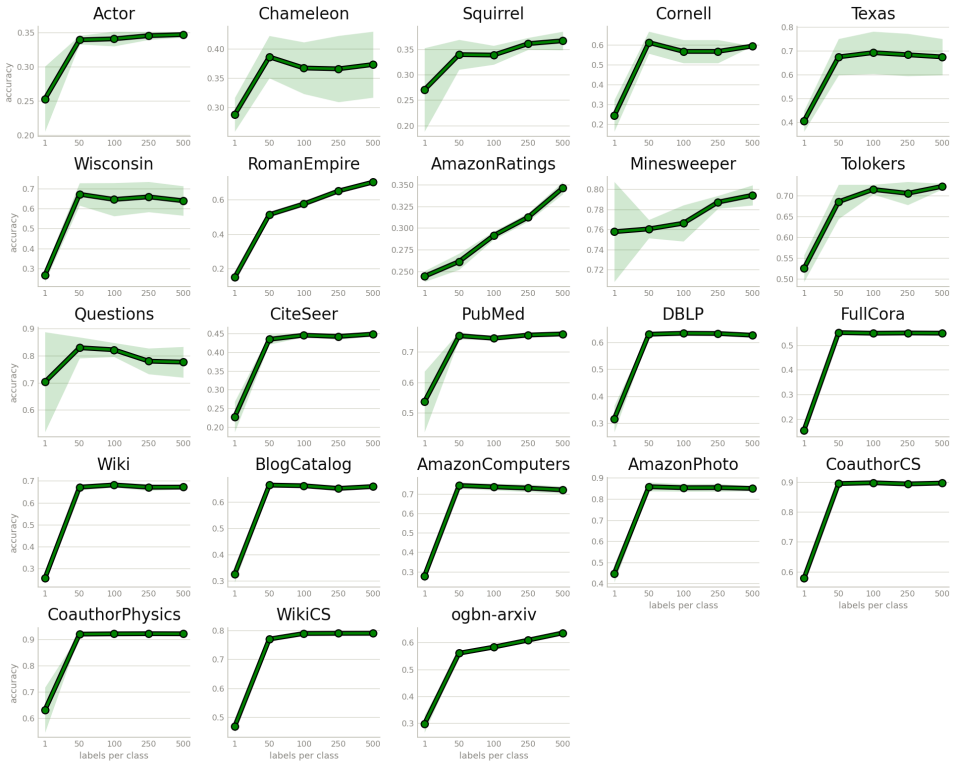
- Node classification on graphs with arbitrary label sets reduces to fitting a small decoder on fixed-width Sigil embeddings; this is competitive but not state of the art, with an average accuracy of 66.10 against 71.78 for the strongest specialized model.
- Because the encoder parameters never depend on the input feature count, the same checkpoint can be deployed on any graph, making zero-shot deployment a matter of computing the SIG and running message passing.
Reading between the lines
- Beyond the paper: the SIG construction could be applied to edge features or temporal snapshots directly, which would give zero-shot transfer to graphs that have no node features at all, a regime the paper approaches only by synthesizing DeepWalk features.
- Beyond the paper: the fixed-width compression is a deliberate bottleneck, so tasks that hinge on raw feature identity are the predictable failure mode; adding a compact per-feature descriptor alongside the alignment matrices is a testable repair.
- Beyond the paper: the order-$K$ sweep behaves like a tunable receptive field with no per-graph training, so the optimal order could itself be predicted from local graph statistics, turning a design choice into a learnable property.
Signed reviews
Editorial analysis
A structured set of objections, weighed in public.
Referee Report
Summary. The paper proposes SIGIL, a framework that lifts any attributed graph G=(V,E,X) to a structural interaction graph (SIG) whose nodes are the d feature dimensions and whose typed, weighted edges are Gram matrices of propagated feature alignments across orders k=0..K. A relational message-passing network embeds each feature dimension into a fixed d_h-dimensional space, and the original node features are transformed by H=XΘ(T) to a fixed-width representation. The paper proves feature-dimension and node-permutation equivariance (Lemma 1, Proposition 1) and shows that for one-hot relation features the SIG recovers ULTRA's relation graph (Theorem 1). It evaluates the resulting Sigil-lp on 11 link-prediction benchmarks, on ULTRA's KG reasoning suite, and Sigil-nc on 26 node-classification datasets.
Significance. The SIG construction is transparent, deterministic, and parameter-free at the graph-lifting stage, and Theorem 1's exact recovery of ULTRA's relation graph is a clean, testable equivalence rather than a fitted approximation. The equivariance results (Lemma 1, Proposition 1) are coherent and correctly stated. If the empirical claims are confirmed after fixing the evaluation issues, the framework would meaningfully unify relation-graph KGFMs with continuous-feature GFM designs. However, the advertised 'any downstream graph' guarantee is not supported as stated, and the empirical evidence is mixed, so the paper needs revision rather than acceptance in its current form.
major comments (3)
- [§5.1, Table 1] Table 1 lists Cora as an attributed target, but the dagger marks Sigil-lp as pretrained on Cora. Because Cora is the pretraining graph, the result on Cora is not a zero-shot transfer result, and the sentence in §5.1 that Sigil-lp is 'the strongest fully-inductive method on every dataset, including the six it has never seen' and the abstract's 'strongest fully-inductive link predictor on every attributed benchmark' are overstated. Please exclude Cora from the zero-shot target set (or label it a sanity check) and re-state the claim as holding for the six unseen attributed benchmarks. In addition, TFMLinker is not reported on the attributed block, so the attributed comparison is effectively against UniLP alone; this should be acknowledged in the claim.
- [§3.1, Eq. (4); §5.3] The SIG is defined entirely by the Gram matrices A-bar^(k). If two feature dimensions have identical rows in every slice, Eq. (7) produces identical embeddings for them, so H = XΘ(T) contains only their summed contribution; the model cannot separate such features. The paper explicitly concedes in §5.3 that 'compressing arbitrary feature spaces into a fixed d_h leaves the original coordinates individually inaccessible to the decoder,' and the 66.10 vs 71.78 node-classification gap in Table 3 is consistent with this loss. The abstract claims transferability to 'any downstream graph,' but no condition is stated under which a task is compatible with Gram-alignment features, nor is it proved that the tested tasks satisfy such a condition. Either a formal compatibility statement should be added, or the transfer claim must be weakened. This is the main theoretical gap.
- [§5.3, Table 3] The text says Sigil-nc 'is competitive with node-classification specific GFMs' and 'ranks best or second-best on 10 of 26 datasets,' but the aggregate is 66.10% versus 71.78% for RGVT and 71.57% for TAG, and RGVT reaches top-2 on 22 of 26 datasets. Since RGVT is pretrained on ogbn-arxiv while Sigil-nc is pretrained on Cora (footnote to Table 3), the comparison is also not controlled for pretraining data. Please add per-dataset or paired statistical tests and either weaken the 'competitive' claim or include a Sigil-nc variant pretrained on the same source graph as the strongest baseline.
minor comments (4)
- [§5.1, non-attributed results] The sentence 'it is the tightest of the three on Sigil-lp wins on C.ele, is second on USAir and very competitive on NS' is grammatically broken; please rephrase.
- [Title and abstract] The method name is written 'SIGIL' in the title and 'Sigil' throughout the abstract and body; please standardize the capitalization.
- [Table 2 and Appendix E] The claim that 'Sigil(0) reproduces ULTRA' is stated after numbers that differ by up to 2.1 MRR in the aggregate, and Appendix E shows larger per-dataset gaps (e.g., WN v1: 18.9 vs 64.8 MRR). Please qualify the reproduction claim and discuss the per-dataset variance.
- [Appendix F, Figure 4a] The phrase 'which is an expected results and a key limitation for the GFM settings in advance' contains grammar errors; please revise.
Circularity Check
No circularity found: the SIG construction is a deterministic function of the input, and the KGFM recovery is an algebraic identity, not a fitted prediction.
full rationale
The derivation is self-contained. The SIG is a deterministic, parameter-free function of the input graph and features (Eqs. 2-6), and the relational message passing in Eq. 7 acts only on the fixed hidden width d_h, so the resulting representation H = XΘ(T) is a function of the input by construction. The fixed-dimension transfer claim is an empirical claim evaluated on unseen graphs, feature spaces, and label spaces, not a quantity fitted to the target result. The KGFM recovery in Theorem 1 is an exact algebraic identity between the SIG slices and ULTRA's relation-graph adjacencies (M_h^T M_h, M_t^T M_t, M_h^T M_t, M_t^T M_h), so the later reproduction of ULTRA in Section 5.2 is an implementation consistency check rather than a fitted prediction. There are no load-bearing self-citations and no uniqueness theorem imported from the authors' prior work. The acknowledged limitation that Gram-alignment compression leaves individual feature coordinates inaccessible to the decoder (Section 5.3, Appendix F) is an expressivity or correctness concern, not a circularity, because the derivation does not assume the very transferability it claims to establish. Overall, the paper's central construction does not reduce to its own inputs by definition, and the empirical evaluation is externally measured against independent baselines.
Assumptions & free parameters
free parameters (3)
- SIG order K =
0 for link prediction main results; 3 for node classification; swept over 0, 1, 2 for KG reasoning
- Interaction operator g =
Absdiff in main results; Hadamard product ablated
- PCA dimension cap =
1024
assumptions (4)
- domain assumption The interaction operator g is coordinate-wise so that applying the same feature permutation to both inputs permutes the output identically.
- domain assumption The SIG node embedding initialization Θ(0) is equivariant to feature permutations.
- domain assumption The Gram alignment matrices over propagated feature views are a sufficient representation of the original features for the downstream task.
- domain assumption For featureless graphs, DeepWalk embeddings computed on training edges are valid node features.
Cite this review
Pith. "Pith review of Neural Message Passing on Structural Interaction Graphs for Fully-Inductive Graph Neural Networks." pith.science (2026). https://pith.science/paper/K2W7NYGI
@misc{pith2026260808567,
  author       = {Pith},
  title        = {Pith review of: Neural Message Passing on Structural Interaction Graphs for Fully-Inductive Graph Neural Networks},
  year         = {2026},
  howpublished = {\url{https://pith.science/paper/K2W7NYGI}},
  note         = {Machine review of arXiv:2608.08567}
}
read the original abstract
A central obstacle in building graph foundation models is the input heterogeneity in terms of feature space dimensionality, semantics, and structure. Such heterogeneity limits the capability of graph neural networks to generalize to new graphs with unseen feature spaces. We address the transferability challenge with SIGIL, a framework that maps any attributed graph to a unified representation space of fixed dimension. Given a graph, SIGIL lifts it to a structural interaction graph, where nodes are the input feature dimensions and weighted, typed edges encode feature alignment across multiple orders of the graph's connectivity. A relational message-passing network embeds each feature dimension into a shared space, transforming the original node features, of arbitrary dimensionality, into representations transferable to any downstream graph. By construction, SIGIL is equivariant to permutations of nodes, feature dimensions, and labels. Additionally, when the input features are one-hot indicators of discrete relations, SIGIL recovers and strictly generalizes existing foundation models for knowledge graph reasoning. A single SIGIL model, pretrained on one graph, delivers strong fully-inductive link prediction. Also, SIGIL can be used to implement existing knowledge graph foundation models. As such, SIGIL unifies several existing regimes in graph foundation model design under a single framework
Figures


Figures from the paper (2 more)

Reference graph
Works this paper leans on
-
[1]
The Twelfth International Conference on Learning Representations , year=
Towards Foundation Models for Knowledge Graph Reasoning , author=. The Twelfth International Conference on Learning Representations , year=
-
[2]
International Conference on Learning Representations , year =
Fully-inductive Node Classification on Arbitrary Graphs , author =. International Conference on Learning Representations , year =
-
[3]
Equivariance Everywhere All At Once: A Recipe for Graph Foundation Models , author=. 2025 , eprint=
work page 2025
-
[4]
International Conference on Learning Representations , year=
Semi-Supervised Classification with Graph Convolutional Networks , author=. International Conference on Learning Representations , year=
-
[5]
and Ying, Rex and Leskovec, Jure , title =
Hamilton, William L. and Ying, Rex and Leskovec, Jure , title =. NIPS , year =
-
[6]
Veli. Graph Attention Networks. International Conference on Learning Representations , year=
-
[7]
Proceedings of the 34th International Conference on Machine Learning , pages =
Neural Message Passing for Quantum Chemistry , author =. Proceedings of the 34th International Conference on Machine Learning , pages =. 2017 , editor =
2017
-
[8]
Advances in neural information processing systems , volume=
Neural bellman-ford networks: A general graph neural network framework for link prediction , author=. Advances in neural information processing systems , volume=
Show all 66 references
-
[9]
Advances in neural information processing systems , volume=
A* net: A scalable path-based reasoning approach for knowledge graphs , author=. Advances in neural information processing systems , volume=
-
[10]
The Third Learning on Graphs Conference , year=
TRIX: A More Expressive Model for Zero-shot Domain Transfer in Knowledge Graphs , author=. The Third Learning on Graphs Conference , year=
-
[11]
Proceedings of the 29th ACM SIGKDD Conference on Knowledge Discovery and Data Mining , pages =
Zhang, Yongqi and Zhou, Zhanke and Yao, Quanming and Chu, Xiaowen and Han, Bo , title =. Proceedings of the 29th ACM SIGKDD Conference on Knowledge Discovery and Data Mining , pages =. 2023 , isbn =. doi:10.1145/3580305.3599404 , abstract =
2023
-
[12]
Proceedings of the ACM web conference 2022 , pages=
Knowledge graph reasoning with relational digraph , author=. Proceedings of the ACM web conference 2022 , pages=
2022
-
[13]
Advances in Neural Information Processing Systems , volume=
A theory of link prediction via relational weisfeiler-leman on knowledge graphs , author=. Advances in Neural Information Processing Systems , volume=
-
[14]
International conference on learning representations , volume=
One for all: Towards training one graph model for all classification tasks , author=. International conference on learning representations , volume=
-
[15]
Findings of the Association for Computational Linguistics: EMNLP 2024 , pages=
Opengraph: Towards open graph foundation models , author=. Findings of the Association for Computational Linguistics: EMNLP 2024 , pages=
2024
-
[16]
The Fourteenth International Conference on Learning Representations , year=
Bridging Input Feature Spaces Towards Graph Foundation Models , author=. The Fourteenth International Conference on Learning Representations , year=
-
[17]
Advances in Neural Information Processing Systems , volume=
Equivariance everywhere all at once: A recipe for graph foundation models , author=. Advances in Neural Information Processing Systems , volume=
-
[18]
Zero-shot generalization of gnns over distinct attribute domains , author=
-
[19]
Forty-first International Conference on Machine Learning , year=
Position: Graph foundation models are already here , author=. Forty-first International Conference on Machine Learning , year=
-
[20]
2023 IEEE 39th international conference on data engineering (ICDE) , pages=
Relational message passing for fully inductive knowledge graph completion , author=. 2023 IEEE 39th international conference on data engineering (ICDE) , pages=. 2023 , organization=
2023
-
[21]
Proceedings of the Forty-second International Conference on Machine Learning , year =
How Expressive are Knowledge Graph Foundation Models? , author =. Proceedings of the Forty-second International Conference on Machine Learning , year =
-
[22]
International conference on machine learning , pages=
Ingram: Inductive knowledge graph embedding via relation graphs , author=. International conference on machine learning , pages=. 2023 , organization=
2023
-
[23]
European semantic web conference , pages=
Modeling relational data with graph convolutional networks , author=. European semantic web conference , pages=. 2018 , organization=
2018
-
[24]
arXiv preprint arXiv:2604.19028 , year=
Learning Posterior Predictive Distributions for Node Classification from Synthetic Graph Priors , author=. arXiv preprint arXiv:2604.19028 , year=
-
[25]
Forty-third International Conference on Machine Learning , year=
View Space: Learning Representation across Arbitrary Graphs , author=. Forty-third International Conference on Machine Learning , year=
-
[26]
New Perspectives in Graph Machine Learning , year=
Of Graphs and Tables: Zero-Shot Node Classification with Tabular Foundation Models , author=. New Perspectives in Graph Machine Learning , year=
-
[27]
arXiv preprint arXiv:2206.04798 , year=
A*Net: A Scalable Path-based Reasoning Approach for Knowledge Graphs , author=. arXiv preprint arXiv:2206.04798 , year=
-
[28]
Thirty-seventh Conference on Neural Information Processing Systems , year=
A Theory of Link Prediction via Relational Weisfeiler-Leman on Knowledge Graphs , author=. Thirty-seventh Conference on Neural Information Processing Systems , year=
-
[29]
Advances in Neural Information Processing Systems , volume=
Labeling trick: A theory of using graph neural networks for multi-node representation learning , author=. Advances in Neural Information Processing Systems , volume=
-
[30]
Advances in Neural Information Processing Systems , volume=
Distance encoding: Design provably more powerful neural networks for graph representation learning , author=. Advances in Neural Information Processing Systems , volume=
-
[31]
International conference on machine learning , pages=
Inductive relation prediction by subgraph reasoning , author=. International conference on machine learning , pages=. 2020 , organization=
2020
-
[32]
arXiv preprint arXiv:2408.10700 , year=
AnyGraph: Graph Foundation Model in the Wild , author=. arXiv preprint arXiv:2408.10700 , year=
-
[33]
Forty-Second International Conference on Machine Learning , year=
Zero-Shot Generalization of GNNs over Distinct Attribute Domains , author=. Forty-Second International Conference on Machine Learning , year=
-
[34]
2024 , eprint=
Towards Foundation Models on Graphs: An Analysis on Cross-Dataset Transfer of Pretrained GNNs , author=. 2024 , eprint=
2024
-
[35]
Eremeev, Dmitry and Platonov, Oleg and Bazhenov, Gleb and Babenko, Artem and Prokhorenkova, Liudmila , booktitle=
-
[36]
arXiv preprint arXiv:2302.01313 , year=
Double equivariance for inductive link prediction for both new nodes and new relation types , author=. arXiv preprint arXiv:2302.01313 , year=
-
[37]
and Salakhutdinov, Ruslan , title =
Yang, Zhilin and Cohen, William W. and Salakhutdinov, Ruslan , title =. Proceedings of the 33rd International Conference on International Conference on Machine Learning - Volume 48 , pages =. 2016 , publisher =
2016
-
[38]
ICLR , year=
Graph Neural Networks for Link Prediction with Subgraph Sketching , author=. ICLR , year=
-
[39]
The Twelfth International Conference on Learning Representations , year=
Neural Common Neighbor with Completion for Link Prediction , author=. The Twelfth International Conference on Learning Representations , year=
-
[40]
DeepWalk: online learning of social representations , url=
Perozzi, Bryan and Al-Rfou, Rami and Skiena, Steven , year=. DeepWalk: online learning of social representations , url=. doi:10.1145/2623330.2623732 , booktitle=
-
[41]
and Saverese, Pedro H.P
Ribeiro, Leonardo F.R. and Saverese, Pedro H.P. and Figueiredo, Daniel R. , year=. <i>struc2vec</i>: Learning Node Representations from Structural Identity , url=. doi:10.1145/3097983.3098061 , booktitle=
-
[42]
International Conference on Learning Representations , year=
Geom-GCN: Geometric Graph Convolutional Networks , author=. International Conference on Learning Representations , year=
-
[43]
and Liu, Juncheng , year=
Yang, Renchi and Shi, Jieming and Xiao, Xiaokui and Yang, Yin and Bhowmick, Sourav S. and Liu, Juncheng , year=. PANE: scalable and effective attributed network embedding , volume=. The VLDB Journal , publisher=. doi:10.1007/s00778-023-00790-4 , number=
-
[44]
2021 , eprint=
Multi-scale Attributed Node Embedding , author=. 2021 , eprint=
2021
-
[45]
The Eleventh International Conference on Learning Representations , year=
A critical look at evaluation of GNNs under heterophily: Are we really making progress? , author=. The Eleventh International Conference on Learning Representations , year=
-
[46]
2019 , eprint=
Pitfalls of Graph Neural Network Evaluation , author=. 2019 , eprint=
2019
-
[47]
2019 , eprint=
Fast Graph Representation Learning with PyTorch Geometric , author=. 2019 , eprint=
2019
-
[48]
Link Prediction Based on Graph Neural Networks , url =
Zhang, Muhan and Chen, Yixin , booktitle =. Link Prediction Based on Graph Neural Networks , url =
-
[49]
, journal =
Dong, Kaiwen and Mao, Haitao and Guo, Zhichun and Chawla, Nitesh V. , journal =. Universal
-
[50]
2026 , eprint=
TFMLinker: Universal Link Predictor by Graph In-Context Learning with Tabular Foundation Models , author=. 2026 , eprint=
2026
-
[51]
The Fourteenth International Conference on Learning Representations , year=
Compactness and Consistency: A Conjoint Framework for Deep Graph Clustering , author=. The Fourteenth International Conference on Learning Representations , year=
-
[52]
The Thirty-eighth Annual Conference on Neural Information Processing Systems , year=
Pure Message Passing Can Estimate Common Neighbor for Link Prediction , author=. The Thirty-eighth Annual Conference on Neural Information Processing Systems , year=
-
[53]
International Conference on Learning Representations , year=
Deep Gaussian Embedding of Graphs: Unsupervised Inductive Learning via Ranking , author=. International Conference on Learning Representations , year=
-
[54]
arXiv preprint arXiv:2005.00687 , year=
Open Graph Benchmark: Datasets for Machine Learning on Graphs , author=. arXiv preprint arXiv:2005.00687 , year=
2005 arXiv
-
[55]
2022 , eprint=
Wiki-CS: A Wikipedia-Based Benchmark for Graph Neural Networks , author=. 2022 , eprint=
2022
-
[56]
Advances in Neural Information Processing Systems , year =
Principal Neighbourhood Aggregation for Graph Nets , author =. Advances in Neural Information Processing Systems , year =
-
[57]
Observed versus latent features for knowledge base and text inference
Toutanova, Kristina and Chen, Danqi. Observed versus latent features for knowledge base and text inference. Proceedings of the 3rd Workshop on Continuous Vector Space Models and their Compositionality. 2015. doi:10.18653/v1/W15-4007
2015 doi
-
[58]
C o DE x: A C omprehensive K nowledge G raph C ompletion B enchmark
Safavi, Tara and Koutra, Danai. C o DE x: A C omprehensive K nowledge G raph C ompletion B enchmark. Proceedings of the 2020 Conference on Empirical Methods in Natural Language Processing (EMNLP). 2020. doi:10.18653/v1/2020.emnlp-main.669
2020 doi
-
[59]
Dettmers, Tim and Minervini, Pasquale and Stenetorp, Pontus and Riedel, Sebastian , title =. Proceedings of the Thirty-Second AAAI Conference on Artificial Intelligence and Thirtieth Innovative Applications of Artificial Intelligence Conference and Eighth AAAI Symposium on Edu...
2018
-
[60]
Proceedings of the 37th International Conference on Machine Learning , pages =
Inductive Relation Prediction by Subgraph Reasoning , author =. Proceedings of the 37th International Conference on Machine Learning , pages =. 2020 , editor =
2020
-
[61]
2023 , eprint=
A Multi-Task Perspective for Link Prediction with New Relation Types and Nodes , author=. 2023 , eprint=
2023
-
[62]
2023 , editor =
Lee, Jaejun and Chung, Chanyoung and Whang, Joyce Jiyoung , booktitle =. 2023 , editor =
2023
-
[63]
2022 , eprint=
An Open Challenge for Inductive Link Prediction on Knowledge Graphs , author=. 2022 , eprint=
2022
-
[64]
Proceedings of the Twenty-Sixth International Joint Conference on Artificial Intelligence,
Takuo Hamaguchi and Hidekazu Oiwa and Masashi Shimbo and Yuji Matsumoto , title =. Proceedings of the Twenty-Sixth International Joint Conference on Artificial Intelligence,. 2017 , doi =
2017
-
[65]
INDIGO: GNN-Based Inductive Knowledge Graph Completion Using Pair-Wise Encoding , url =
Liu, Shuwen and Grau, Bernardo and Horrocks, Ian and Kostylev, Egor , booktitle =. INDIGO: GNN-Based Inductive Knowledge Graph Completion Using Pair-Wise Encoding , url =
-
[66]
Advances in Neural Information Processing Systems , pages=
Link prediction based on graph neural networks , author=. Advances in Neural Information Processing Systems , pages=
Reviewed August 14, 2026 · model on record in the stance chip above.
Discussion (0). Continue with ORCID to comment.