REVIEW 2 major objections 4 minor 1 cited by
Selling Information in Games with Externalities
T0 review · 2 major / 4 minor · reviewed 2026-08-16 · deepseek-v4-flash
Pith's one-line read An information seller facing a competitor should screen buyers with all-or-nothing messages, and once competition crosses a threshold, the optimal menu is to sell no information at all.
desk verdict Promising extension of Bergemann–Bonatti–Smolin, but a wrong conditional probability in the cost derivation invalidates the central menu characterization. read the letter →
The pith
A machine-rendered reading of the paper's core claim, the machinery that carries it, and where it could break.
The reading
What carries the argument
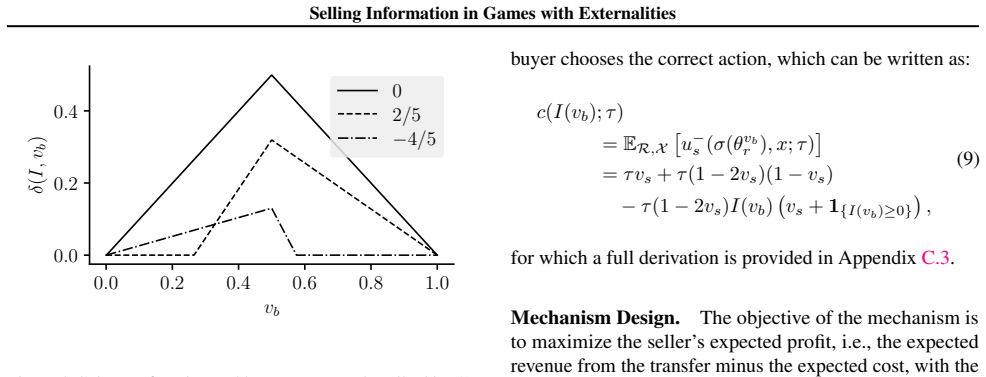
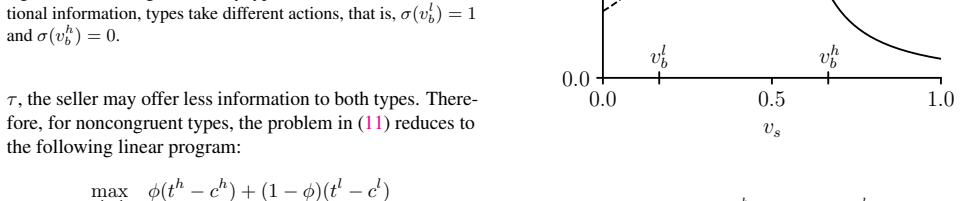
The load-bearing object is the informativeness parameter $I(v_b)=P(m_0|X=0;v_b)-P(m_1|X=1;v_b)$, which collapses each communication rule to a single number in $[-1,1]$: $I=0$ is full revelation, $I=\pm 1$ are no-information messages, and intermediate values are partially informative. With this parameter, the buyer's gain is $\delta(I,v_b)=1-(v_b\vee(1-v_b))-I(1\{I\ge 0\}-v_b)$ and the seller's externality cost is the closed form in equation (9). The mechanism design problem then becomes a one-dimensional screening problem: choose a non-decreasing $I(v_b)$ with $\int I \, dv_b = 0$ and transfers given by the envelope formula, maximizing virtual surplus with virtual values $\pi^-(v_b)=p(v_b)(\tau v_s(1-2v_s)+v_b)+F(v_b)$ and $\pi^+(v_b)=p(v_b)(\tau(1-v_s)(1-2v_s)+v_b-1)+F(v_b)$. These virtual values carry the argument: pointwise maximization yields $I^*(v_b)\in\{-1,0,1\}$, and the integral constraint forces the threshold structure and the no-information result.
What would settle it
Recalculate the expected externality in Appendix C.3 using the posterior $p(x|m,s_s;v_s)$ instead of the prior $v_s$ for the message that recommends each action. If the resulting cost function differs from equation (9), then the binary-type boundaries $\tau_l$, $\tau_h$, the virtual values in Corollary 4.7, and the no-information threshold $\tau'$ in Corollary 4.9 all change, and the all-or-nothing menu is not the robust conclusion.
Extended reading notes
Core claim
The central claim is a complete solution to a versioning problem, that is, designing a menu of differently noisy messages and prices, in which the seller's profit is the price paid by the buyer minus the externality cost of making a competitor better informed. The seller's cost is the expected loss incurred when the message leads the buyer to take the correct action; in this binary model it takes the closed form $c(I(v_b);\tau)=\tau v_s + \tau(1-2v_s)(1-v_s) - \tau(1-2v_s)I(v_b)(v_s+1\{I(v_b)\ge 0\})$, where $I$ is the informativeness of the communication rule. Subject to the buyer's participation, truthfulness, and obedience constraints, the optimal menu maximizes expected profit. For two buyer types the solution is a set of threshold rules in the competition intensity $\tau$ and the seller's belief $v_s$; for continuous regular type distributions the menu contains only fully informative rules ($I=0$) and no-information rules ($I=\pm 1$), and when $\tau\ge \tau'=(1-2v_s)^{-2}$ the seller reveals nothing. The paper reads this as: information can be sold profitably to a competitor when rivalry is mild, but fierce competition makes information sales collapse, and the seller cannot use misleading messages to extract profit at the expense of efficiency.
Load-bearing premise
The load-bearing premise is that the seller's expected externality cost from a message is computed with the seller's prior belief $v_s$ rather than the belief updated on the actual message; recompute it with the message-conditioned posterior and every downstream threshold changes.
Editorial extensions
If this is right
- For any regular continuous type distribution, the optimal menu is a step function: each buyer type is offered either the fully informative rule or a no-information rule; partially informative messages never appear in the optimum.
- When competition intensity $\tau$ reaches $\tau'=(1-2v_s)^{-2}$, the seller reveals nothing to any type, so data sales between competitors vanish entirely.
- Because obedience requires the buyer to be willing to follow the recommended action, the seller cannot design messages that steer the buyer into the wrong action to reduce the externality; this bounds the seller's ability to profit at the expense of social welfare.
- For mild competition, the seller earns strictly positive profit from selling information, so monetary transfers can create information sharing between competing firms where voluntary sharing would not occur.
- Relative to sharing nothing or sharing for free, the optimal menu gives both buyer and seller more surplus, so product versioning is mutually beneficial.
Reading between the lines
- Editorial inference: the all-or-nothing menu implies an observable signature in data markets—when proxies for rivalry intensity cross the threshold, inter-firm data transactions should stop abruptly rather than taper off gradually.
- Editorial inference: since the no-information threshold depends only on the seller's belief $v_s$, two sellers with identical costs but different beliefs will make opposite sharing decisions; this comparative static is testable in laboratory markets.
- Editorial inference: if the message-conditioned posterior replaces the prior in the externality cost, partially informative menus may reappear even under regular distributions, so the no-partial-information result is tied to that modeling choice.
Signed reviews
Editorial analysis
A structured set of objections, weighed in public.
Referee Report
Summary. The paper models a monopolist who sells information to a competitor in a binary-state, binary-action game with utility (1). The seller commits to a menu of direct communication rules and prices, the buyer reports a private belief type, and the seller's profit subtracts an expected externality cost from the buyer's improved actions. The authors characterize incentive-compatible menus, solve the two-type case in closed form, reduce the continuous-type problem to virtual-surplus maximization, and claim (Corollary 4.9) that for regular distributions the optimal menu contains no partially informative rules and that above a competition threshold no information is sold. The contribution is positioned as an extension of Bergemann et al. (2018) to competition between buyer and seller.
Significance. If the quantitative results were correct, the paper would be a valuable extension of the information-sales literature to competitive settings. The framework is clean, the reduction to direct communication rules and the use of the envelope theorem are methodologically sound, and the paper is transparent about code availability. The qualitative claim that fiercer competition can make information sales unprofitable is intuitive and likely robust. However, the central quantitative contribution rests on an incorrect derivation of the seller's externality cost; as written, the closed-form menus, thresholds, and virtual values are unsupported. The paper should not be accepted in its current form.
major comments (2)
- [Appendix C.3 and Eq. (9)] The derivation of the seller's cost is incorrect. In C.3 the conditional expectation is written as E_X[u_s^-|m] = τ v_s 1{θ_m≥1/2} + τ(1-v_s)1{θ_m<1/2}, which replaces P(X=0|m) with the unconditional prior v_s. After conditioning on the message and integrating over messages, the correct expected externality is c(I;τ) = τ[P(X=0,m_0)+P(X=1,m_1)] = τ[v_s I_0 + (1-v_s) I_1]. Using the communication-rule parametrization from Proposition 4.1, this equals τ[1-(1-v_s)I] for I≥0 and τ[1+v_s I] for I≤0. Eq. (9) instead yields τ(1-2v_s+2v_s^2) at full information (I=0) and τ(4v_s^2-v_s) at I=1; the latter is negative for v_s=0.2, which is impossible for an expected externality. Since Eq. (9) feeds directly into the objective (10a) and the virtual values (14), the binary-type thresholds τ_l and τ_h, Corollaries 4.7 and 4.9, and the associated figures are all derived from an incorrect cost and are not supported as stated.
- [Corollary 4.9] The claimed closed form λ* = (π_-(1/2)+π_+(1/2))/2 is not valid for general regular type distributions. If I*=-1 on an initial interval [0,a] and I*=1 on a terminal interval [b,1], the integral constraint (13b) only imposes a = 1-b, not a = b = 1/2. The thresholds solve π_-(a)=λ and π_+(b)=λ, and for a general symmetric F these equations do not imply p(a)=p(1/2). For the uniform distribution the formula happens to be correct because the density is constant, but for, e.g., a symmetric Beta(2,2) distribution the solution has p(a)≠p(1/2) and λ differs from the stated midpoint expression. Corollary 4.9 should be restricted to the uniform case or replaced by the correct threshold characterization.
minor comments (4)
- [Eq. (14)] In Corollary 4.7 the displayed expression for J(I,v_b) uses F(v_s)/p(v_s), but the derivation in Appendix C.3 and the virtual values that follow use F(v_b)/p(v_b); this appears to be a typo that should be corrected.
- [Appendix C.3] The displayed computation of P(m_1;v_s) contains a typo: it should read P(m_1;v_s) = v_s(1-I_0) + (1-v_s)I_1 rather than the expression printed with I_1 in both terms.
- [Proof of Proposition 4.1 and Figure 3] The ceiling function h(I) in Appendix B is stated as h(I)=1 for I≤0 and h(I)=1-I for I>0, but the parametrization used in Corollary 4.2 and throughout the paper corresponds to I_0=1 for I≥0 and I_0=1+I for I≤0. The proof and the figure labeling should be made consistent with the parametrization used in the main results.
- [Eq. (3)] The tie-breaking at v_b=1/2 is left implicit in σ(z)=1{z<1/2}; this does not affect the results but should be stated explicitly for completeness.
Circularity Check
No significant circularity: the derivation chain is self-contained, with self-citations appearing only in related work.
full rationale
The paper's core derivation is not circular. The buyer's gain δ(I,vb) is derived in Corollary 4.2 from the dominant-strategy characterization (3), the direct-communication-rule reduction (Proposition 3.2), and the ceiling result (Proposition 4.1); it is not imported as an input. The seller's cost function (9) is derived in Appendix C.3 from the seller's utility (1) and the message structure; even if that derivation is mathematically flawed (it appears to condition on the seller's prior vs rather than a message-conditioned posterior, and the printed coefficient of 1{I(vb)≥0} differs from the paper's own intermediate algebra), this is a correctness or modeling defect, not a circular equivalence: the cost is not defined in terms of the menu it is used to predict. Proposition 4.5 is attributed to Bergemann et al. (2018), but the paper supplies its own proof in Appendices C.1 and C.2, so the result is not supported by an unverified citation. The self-citations (Falconer et al. 2024, 2025; Pinson et al. 2022) occur only in the related-work discussion of analytics markets and play no role in the mechanism design theorems. The closed-form λ* in Corollary 4.9, λ* = (π−(1/2)+π+(1/2))/2, is an analytic claim about the dual variable; if it is invalid for skewed regular distributions, that is a mathematical correctness issue, not a reduction of the conclusion to its assumptions. No fitted parameter is relabeled as a prediction, no uniqueness theorem is imported from the authors' prior work, and no ansatz is smuggled in by citation. The main characterization (Corollary 4.9) is a consequence of the model's equations, so the derivation is self-contained against the external benchmark of Bergemann et al. (2018).
Assumptions & free parameters
free parameters (2)
- competition intensity tau
- seller's belief v_s
assumptions (4)
- domain assumption Private signals are independent across players conditional on the state: p(s_b, s_s|x) = p(s_b|x)p(s_s|x).
- ad hoc to paper The cost of a message is computed with the seller's prior belief v_s instead of the posterior p(x|m,s_s;v_s).
- domain assumption Regularity: virtual values pi-(v_b) and pi+(v_b) are non-decreasing in v_b.
- standard math Boundary types v_b in {0,1} place zero value on information, giving Delta(0)=Delta(1)=0 in the envelope proof.
Cite this review
Pith. "Pith review of Selling Information in Games with Externalities." pith.science (2026). https://pith.science/paper/K375BM26
@misc{pith2026250500405,
  author       = {Pith},
  title        = {Pith review of: Selling Information in Games with Externalities},
  year         = {2026},
  howpublished = {\url{https://pith.science/paper/K375BM26}},
  note         = {Machine review of arXiv:2505.00405}
}
read the original abstract
A competitive market is modeled as a game of incomplete information. One player observes some payoff-relevant state and can sell (possibly noisy) messages thereof to the other, whose willingness to pay is contingent on their own beliefs. We frame the decision of what information to sell, and at what price, as a product versioning problem. The optimal menu screens buyer types to maximize profit, which is the payment minus the externality induced by selling information to a competitor, that is, the cost of refining a competitor's beliefs. For a class of games with binary actions and states, we derive the following insights: (i) payments are necessary to provide incentives for information sharing amongst competing firms; (ii) the optimal menu benefits both the buyer and the seller; (iii) the seller cannot steer the buyer's actions at the expense of social welfare; (iv) as such, as competition grows fiercer it can be optimal to sell no information at all.
Figures



Figures from the paper (8 more)




Forward citations
Cited by 1 Pith paper
-
Data Sharing with a Generative AI Competitor
In a two-stage data-sharing game, the unique equilibrium is either that the firm shares just enough data to stop the platform buying expert data, or that the firm shares an amount that maximizes its payoff while the p...
Reference graph
Works this paper leans on
-
[1]
write newline
" write newline "" before.all 'output.state := FUNCTION n.dashify 't := "" t empty not t #1 #1 substring "-" = t #1 #2 substring "--" = not "--" * t #2 global.max substring 't := t #1 #1 substring "-" = "-" * t #2 global.max substring 't := while if t #1 #1 substring * t #2 global.max substring 't := if while FUNCTION format.date year duplicate empty "emp...
-
[2]
Too much data: Prices and inefficiencies in data markets
Acemoglu, D., Makhdoumi, A., Malekian, A., and Ozdaglar, A. Too much data: Prices and inefficiencies in data markets. American Economic Journal: Microeconomics, 14 0 (4): 0 218--256, 2022
work page 2022
-
[3]
Admati, A. R. and Pfleiderer, P. A monopolistic market for information. Journal of Economic Theory, 39 0 (2): 0 400--438, 1986
work page 1986
-
[4]
Admati, A. R. and Pfleiderer, P. Selling and trading on information in financial markets. The American Economic Review, 78 0 (2): 0 96--103, 1988
work page 1988
-
[5]
Admati, A. R. and Pfleiderer, P. Direct and indirect sale of information. Econometrica: Journal of the Econometric Society, pp.\ 901--928, 1990
work page 1990
-
[6]
A marketplace for data: An algorithmic solution
Agarwal, A., Dahleh, M., and Sarkar, T. A marketplace for data: An algorithmic solution. In Proceedings of the 2019 ACM Conference on Economics and Computation, pp.\ 701--726, 2019
work page 2019
-
[7]
Towards data auctions with externalities
Agarwal, A., Dahleh, M., Horel, T., and Rui, M. Towards data auctions with externalities. Games and Economic Behavior, 148: 0 323--356, 2024
work page 2024
-
[8]
Monotonicity and implementability
Ashlagi, I., Braverman, M., Hassidim, A., and Monderer, D. Monotonicity and implementability. Econometrica, 78 0 (5): 0 1749--1772, 2010
work page 2010
Show all 65 references
-
[9]
Aumann, R. J. Correlated equilibrium as an expression of bayesian rationality. Econometrica: Journal of the Econometric Society, pp.\ 1--18, 1987
1987
-
[10]
Optimal mechanisms for selling information
Babaioff, M., Kleinberg, R., and Paes Leme, R. Optimal mechanisms for selling information. In Proceedings of the 13th ACM Conference on Electronic Commerce, pp.\ 92--109, 2012
2012
-
[11]
and Bonatti, A
Bergemann, D. and Bonatti, A. Markets for information: An introduction. Annual Review of Economics, 11: 0 85--107, 2019
2019
-
[12]
and Morris, S
Bergemann, D. and Morris, S. Bayes correlated equilibrium and the comparison of information structures in games. Theoretical Economics, 11 0 (2): 0 487--522, 2016
2016
-
[13]
and Morris, S
Bergemann, D. and Morris, S. Information design: A unified perspective. Journal of Economic Literature, 57 0 (1): 0 44--95, 2019
2019
-
[14]
The design and price of information
Bergemann, D., Bonatti, A., and Smolin, A. The design and price of information. American economic review, 108 0 (1): 0 1--48, 2018
2018
-
[15]
Is selling complete information (approximately) optimal? In Proceedings of the 23rd ACM Conference on Economics and Computation, pp.\ 608--663, 2022
Bergemann, D., Cai, Y., Velegkas, G., and Zhao, M. Is selling complete information (approximately) optimal? In Proceedings of the 23rd ACM Conference on Economics and Computation, pp.\ 608--663, 2022
2022
-
[16]
Information sale and competition
Bimpikis, K., Crapis, D., and Tahbaz-Salehi, A. Information sale and competition. Management Science, 65 0 (6): 0 2646--2664, 2019
2019
-
[17]
Comparison of experiments
Blackwell, D. Comparison of experiments. In Proceedings of the second Berkeley symposium on mathematical statistics and probability, volume 2, pp.\ 93--103. University of California Press, 1951
1951
-
[18]
Equivalent comparisons of experiments
Blackwell, D. Equivalent comparisons of experiments. The annals of mathematical statistics, pp.\ 265--272, 1953
1953
-
[19]
Selling information in competitive environments
Bonatti, A., Dahleh, M., Horel, T., and Nouripour, A. Selling information in competitive environments. Journal of Economic Theory, 216: 0 105779, 2024
2024
-
[20]
Convex optimization
Boyd, S. Convex optimization. Cambridge UP, 2004
2004
-
[21]
and Velegkas, G
Cai, Y. and Velegkas, G. How to sell information optimally: An algorithmic study. arXiv preprint arXiv:2011.14570, 2020
2011 arXiv
-
[22]
Selling information while being an interested party
Castiglioni, M., Bacchiocchi, F., Marchesi, A., Romano, G., and Gatti, N. Selling information while being an interested party. arXiv preprint arXiv:2301.13790, 2023
2023 arXiv
-
[23]
Clarke, R. N. Collusion and the incentives for information sharing. The Bell Journal of Economics, pp.\ 383--394, 1983
1983
-
[24]
Crawford, V. P. and Sobel, J. Strategic information transmission. Econometrica: Journal of the Econometric Society, pp.\ 1431--1451, 1982
1982
-
[25]
and McLean, R
Cr \'e mer, J. and McLean, R. P. Full extraction of the surplus in bayesian and dominant strategy auctions. Econometrica: Journal of the Econometric Society, pp.\ 1247--1257, 1988
1988
-
[26]
A., Tahbaz-Salehi, A., Tsitsiklis, J
Dahleh, M. A., Tahbaz-Salehi, A., Tsitsiklis, J. N., and Zoumpoulis, S. I. Coordination with local information. Operations Research, 64 0 (3): 0 622--637, 2016
2016
-
[27]
Digital markets act: Commission welcomes political agreement on rules ensuring fair and open digital markets, 2021
European Commission . Digital markets act: Commission welcomes political agreement on rules ensuring fair and open digital markets, 2021. URL https://ec.europa.eu/commission/presscorner/detail/en/ip_21_3143. [Accessed: 2025-02-14]
2021
-
[28]
Bayesian regression markets
Falconer, T., Kazempour, J., and Pinson, P. Bayesian regression markets. Journal of Machine Learning Research, 25 0 (180): 0 1--38, 2024. URL http://jmlr.org/papers/v25/23-1385.html
2024
-
[29]
Towards replication-robust data markets, 2025
Falconer, T., Kazempour, J., and Pinson, P. Towards replication-robust data markets, 2025. URL https://arxiv.org/abs/2310.06000
2025 arXiv
-
[30]
I., Makhdoumi, A., and Malekian, A
Fallah, A., Jordan, M. I., Makhdoumi, A., and Malekian, A. The limits of price discrimination under privacy constraints. arXiv preprint arXiv:2402.08223, 2024 a
2024 arXiv
-
[31]
I., Makhdoumi, A., and Malekian, A
Fallah, A., Jordan, M. I., Makhdoumi, A., and Malekian, A. On three-layer data markets. arXiv preprint arXiv:2402.09697, 2024 b
2024
-
[32]
Optimal and differentially private data acquisition: Central and local mechanisms
Fallah, A., Makhdoumi, A., Malekian, A., and Ozdaglar, A. Optimal and differentially private data acquisition: Central and local mechanisms. Operations Research, 72 0 (3): 0 1105--1123, 2024 c
2024
-
[33]
Uncovering value of correlated data: trading data based on iterative combinatorial auction
Feng, Z., Chen, J., and Zhu, Y. Uncovering value of correlated data: trading data based on iterative combinatorial auction. In 2021 IEEE 18th International Conference on Mobile Ad Hoc and Smart Systems (MASS), pp.\ 260--268. IEEE, 2021
2021
-
[34]
What is the philosophy of information? Metaphilosophy, 33 0 (1-2): 0 123--145, 2002
Floridi, L. What is the philosophy of information? Metaphilosophy, 33 0 (1-2): 0 123--145, 2002
2002
-
[35]
Philosophical conceptions of information
Floridi, L. Philosophical conceptions of information. In Formal theories of information: From Shannon to semantic information theory and general concepts of information, pp.\ 13--53. Springer, 2009
2009
-
[36]
Information sharing in oligopoly
Gal-Or, E. Information sharing in oligopoly. Econometrica: Journal of the Econometric Society, pp.\ 329--343, 1985
1985
-
[37]
and Tennenholtz, M
Gradwohl, R. and Tennenholtz, M. Selling data to a competitor. arXiv preprint arXiv:2302.00285, 2023
2023 arXiv
-
[38]
Public information, private information, and the multiplicity of equilibria in coordination games
Hellwig, C. Public information, private information, and the multiplicity of equilibria in coordination games. Journal of Economic Theory, 107 0 (2): 0 191--222, 2002
2002
-
[39]
Stability in competition
Hotelling, H. Stability in competition. The Economic Journal, 39 0 (153): 0 41--57, 1929. ISSN 00130133, 14680297. URL http://www.jstor.org/stable/2224214
1929
-
[40]
Selling wind
Kakhbod, A., Ozdaglar, A., and Schneider, I. Selling wind. The Energy Journal, 42 0 (1): 0 1--38, 2021
2021
-
[41]
Bayesian persuasion and information design
Kamenica, E. Bayesian persuasion and information design. Annual Review of Economics, 11: 0 249--272, 2019
2019
-
[42]
and Gentzkow, M
Kamenica, E. and Gentzkow, M. Bayesian persuasion. American Economic Review, 101 0 (6): 0 2590--2615, 2011
2011
-
[43]
Auctioning data for learning
Koutsopoulos, I., Gionis, A., and Halkidi, M. Auctioning data for learning. In 2015 IEEE International Conference on Data Mining Workshop (ICDMW), pp.\ 706--713. IEEE, 2015
2015
-
[44]
On information design in games
Mathevet, L., Perego, J., and Taneva, I. On information design in games. Journal of Political Economy, 128 0 (4): 0 1370--1404, 2020
2020
-
[45]
and Segal, I
Milgrom, P. and Segal, I. Envelope theorems for arbitrary choice sets. Econometrica, 70 0 (2): 0 583--601, 2002
2002
-
[46]
Milgrom, P. R. Good news and bad news: Representation theorems and applications. The Bell Journal of Economics, pp.\ 380--391, 1981
1981
-
[47]
Murphy, A. H. What is a good forecast? an essay on the nature of goodness in weather forecasting. Weather and forecasting, 8 0 (2): 0 281--293, 1993
1993
-
[48]
Myerson, R. B. Optimal auction design. Mathematics of operations research, 6 0 (1): 0 58--73, 1981
1981
-
[49]
Myerson, R. B. Multistage games with communication. Econometrica: Journal of the Econometric Society, pp.\ 323--358, 1986
1986
-
[50]
Myerson, R. B. and Satterthwaite, M. A. Efficient mechanisms for bilateral trading. Journal of economic theory, 29 0 (2): 0 265--281, 1983
1983
-
[51]
and Sonnenschein, H
Novshek, W. and Sonnenschein, H. Fulfilled expectations cournot duopoly with information acquisition and release. The Bell Journal of Economics, pp.\ 214--218, 1982
1982
-
[52]
Regression markets and application to energy forecasting
Pinson, P., Han, L., and Kazempour, J. Regression markets and application to energy forecasting. Top, 30 0 (3): 0 533--573, 2022
2022
-
[53]
A general model of information sharing in oligopoly
Raith, M. A general model of information sharing in oligopoly. Journal of economic theory, 71 0 (1): 0 260--288, 1996
1996
-
[54]
and Jordan, M
Rasouli, M. and Jordan, M. I. Data sharing markets. arXiv preprint arXiv:2107.08630, 2021
2021 arXiv
-
[55]
S., Jiang, Y., and Parkes, D
Ravindranath, S. S., Jiang, Y., and Parkes, D. C. Data market design through deep learning. Advances in Neural Information Processing Systems, 36, 2024
2024
-
[56]
A necessary and sufficient condition for rationalizability in a quasi-linear context
Rochet, J.-C. A necessary and sufficient condition for rationalizability in a quasi-linear context. Journal of mathematical Economics, 16 0 (2): 0 191--200, 1987
1987
-
[57]
Strategic incentives and the optimal sale of information
Rodr \' guez Olivera, R. Strategic incentives and the optimal sale of information. American Economic Journal: Microeconomics, 16 0 (2): 0 296--353, 2024
2024
-
[58]
Exchange of cost information in oligopoly
Shapiro, C. Exchange of cost information in oligopoly. The review of economic studies, 53 0 (3): 0 433--446, 1986
1986
-
[59]
Job market signaling
Spence, M. Job market signaling. In Uncertainty in economics, pp.\ 281--306. Elsevier, 1978
1978
-
[60]
Information design
Taneva, I. Information design. American Economic Journal: Microeconomics, 11 0 (4): 0 151--185, 2019
2019
-
[61]
The world's most valuable resource is no longer oil, but data
The Economist . The world's most valuable resource is no longer oil, but data. The Economist, 2017. URL https://www.economist.com/leaders/2017/05/06/the-worlds-most-valuable-resource-is-no-longer-oil-but-data. [Accessed: 2024-12-25]
2017
-
[62]
Ironing without control
Toikka, J. Ironing without control. Journal of Economic Theory, 146 0 (6): 0 2510--2526, 2011
2011
-
[63]
Duopoly information equilibrium: Cournot and bertrand
Vives, X. Duopoly information equilibrium: Cournot and bertrand. Journal of economic theory, 34 0 (1): 0 71--94, 1984
1984
-
[64]
A survey on federated learning
Zhang, C., Xie, Y., Bai, H., Yu, B., Li, W., and Gao, Y. A survey on federated learning. Knowledge-Based Systems, 216: 0 106775, 2021
2021
-
[65]
Information sharing in oligopoly: The truth-telling problem
Ziv, A. Information sharing in oligopoly: The truth-telling problem. The RAND Journal of Economics, pp.\ 455--465, 1993
1993
Reviewed August 16, 2026 · model on record in the stance chip above.
Discussion (0). Continue with ORCID to comment.