REVIEW 2 major objections 6 minor 18 references
Mosaic: Runtime-Efficient Multi-Agent Embodied Planning
T0 review · 2 major / 6 minor · reviewed 2026-07-13 · grok-4.5
Pith's one-line read Failed actions dominate multi-agent latency; lightweight relative memory plus step-level ILP cut them enough to deliver 27–32% faster runs.
desk verdict Solid systems paper: agent-centric relative memory + per-step ILP cuts failed actions and delivers consistent 25–32% latency wins over LLaMAR on two simulators. read the letter →
The pith
A machine-rendered reading of the paper's core claim, the machinery that carries it, and where it could break.
The reading
What carries the argument
Agent-centric Semantic Memory (ASM) stores objects in relative coordinates (distance and heading) that update with motion and transfer across agents by geometric transform; Integer Linear Programming then selects one action per agent from LLM candidates at every step under feasibility and coordination constraints plus a cost that penalizes spatial-temporal waste and load imbalance.
What would settle it
On the same AI2-THOR and SAR tasks, replace Mosaic’s ASM-plus-ILP stack with the strongest baseline while holding the LLM fixed: if the claimed 7–12 point drop in failure rate and the accompanying 27–32% runtime reduction disappear, the central claim is false.
Extended reading notes
Core claim
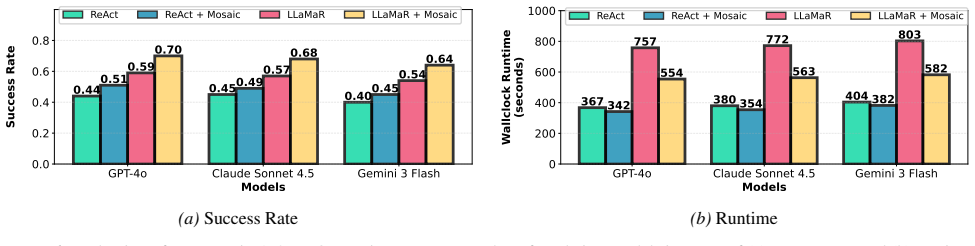
The dominant source of runtime latency in LLM multi-agent embodied planning is failed actions caused by inaccurate state tracking under partial observability and by inefficient coordination; Mosaic shows that an agent-centric relative-coordinate memory plus per-step integer-linear-program action allocation can cut those failures enough to deliver 27–32% faster execution, 30–33% fewer LLM calls, 25–31% fewer agent steps and 4–10 percentage-point higher success rates versus the strongest multi-call baseline.
Load-bearing premise
Agents have reasonably accurate pose estimates so that relative coordinates stay trustworthy; large localization error or severe sensor drift would corrupt the memory and the actions chosen from it.
Editorial analysis
A structured set of objections, weighed in public.
Referee Report
Summary. The paper argues that LLM-based multi-agent embodied planning is bottlenecked by failed actions arising from (i) inaccurate state tracking under partial observability and (ii) coarse or reactive multi-agent coordination. It proposes MOSAIC, combining Agent-centric Semantic Memory (ASM)—task-relevant objects stored in relative (r, φ) coordinates with geometric cross-agent transforms and semantic tiering—and a per-timestep Integer Linear Program that selects one action per agent from LLM-generated candidates under eligibility, exclusivity, collision, joint-staffing, and load-balance constraints, plus a spatiotemporal cost (Eqs. 1–2). Instantiated on centralized Plan–Act–Verify pipelines, MOSAIC is evaluated on AI2-THOR and SAR against ACT/CoT/ReAct/SmartLLM/CoELA/LLaMAR, with component ablations (ASM, FC, CFM, full ILP), agent-count scaling, model generality, noise regimes, candidate-count and penalty-weight sweeps, and qualitative traces. Headline results: 27–32% faster execution, 30–33% fewer LLM calls, 25–31% fewer agent steps, and +4–10 pp success vs. LLaMAR, driven by a 7–12 pp drop in failed actions.
Significance. If the measured gains hold under the paper’s stated scope (simulators, reliable localization, fixed action vocabulary), the work is a clear practical advance for multi-agent LLM planning: it isolates failed actions as the dominant latency source and shows that lightweight relative-coordinate memory plus action-level ILP are effective, plug-and-play remedies. Strengths include head-to-head tables against strong multi-call baselines, systematic ablations (Table 2, Table 6), ILP overhead quantified at 1–2% of runtime (Table 3), model-agnostic checks (GPT-4o/Claude/Gemini), noise sensitivity (Appendix D.4), and qualitative failure-mode contrasts. Free parameters (λ_load, K, λ_p) are ablated rather than hidden. The contribution is empirical and systems-oriented rather than theoretical, but the combination of ASM and step-level constrained allocation is well motivated and carefully measured for the multi-agent embodied setting.
major comments (2)
- §3.2 (cross-agent transfer formulas for rb,o, ϕb,o) and Limitations §F: the central claim that ASM enables coordination via geometric transforms assumes agents maintain accurate relative poses to one another and to objects. The manuscript states that memory “stores relative distances between agents,” but does not specify the observation/communication mechanism that supplies (ra,b, ϕa,b) under partial observability without a global map (centralized shared pose vs. explicit ranging). Appendix D.4 quantifies sensor noise on object localization, not inter-agent pose error. A short clarification of how inter-agent relative state is obtained (and a one-line sensitivity note if poses are shared by the centralized controller) would make the load-bearing transferability claim fully checkable.
- §3.3 / Appendix G: the LLM-ACTOR prompt already enumerates the same feasibility constraints the ILP enforces (eligibility, exclusivity, collision, joint-staffing, temporal penalties). Table 6 shows FC and CFM still help over LLaMAR, so the ILP is not vacuous, but the paper should state more explicitly what residual conflicts remain after constraint-aware prompting and thus what fraction of the 7–12 pp failure reduction is attributable to hard ILP filtering versus improved candidate quality. Without that split, the “constraint-guided coordination” claim is slightly over-attributed to the solver alone.
minor comments (6)
- Table 2 subscripts mix absolute pp for effectiveness and percent for efficiency; a one-line note in the caption would prevent misreading of “+0.10” vs “−26.9%.”
- §3.2: the discretization of ra,o / ϕa,o into semantic tiers is said to be “interface-only,” but the exact tier boundaries (1–2 steps = “just ahead,” >10 = “far,” etc.) are only illustrated, not listed; a small table or appendix list would aid reproducibility.
- Eq. (1)–(2) and Table 7: default λ_p values are given, but λ_load’s interaction with Cload’s cap of 3 is only briefly mentioned; a sentence on sensitivity when all agents start with zero ACTIONCOUNT would help.
- Figure 1 and qualitative Appendix E are effective; ensuring color patches remain distinguishable in grayscale print would improve accessibility.
- Related Work §2 / Appendix A: LIP-LLM and Wu et al. (2024b) are correctly distinguished as episode-level allocation; a single sentence on whether any concurrent action-level ILP multi-agent LLM planner was omitted would close the comparison.
- Minor typos: “MOSAICmaintains” spacing inconsistencies in the abstract/intro; “Placehodler” in Appendix G prompts.
Circularity Check
No significant circularity: Mosaic is an empirical systems paper whose headline gains are measured against external simulators and independent baselines, not derived quantities that reduce to fitted inputs by construction.
full rationale
The paper's load-bearing claims are empirical performance deltas (27–32% faster runtime, 30–33% fewer LLM calls, 25–31% fewer agent steps, +4–10 pp success vs LLaMAR) obtained by running ASM+ILP on AI2-THOR and SAR against ACT/CoT/ReAct/SmartLLM/CoELA/LLaMAR. There is no first-principles derivation that claims to predict a quantity from parameters fitted to the same quantity; hyperparameters (λ_load, K candidates, penalty weights λ_p) are ablated in Appendix D.5 rather than tuned to force the headline numbers. Related-work citations (including LLaMAR, ReAct, TAMP, etc.) supply baselines and architectural context, not uniqueness theorems or ansatzes that force Mosaic's design by self-citation. Agent-centric relative coordinates and ILP feasibility/cost constraints are constructive engineering choices evaluated by external metrics (success, failure rate, wall-clock, LLM calls), not renamings of known results presented as predictions. Limitations §F and the noise study (Appendix D.4) explicitly scope the localization assumption rather than smuggling it into a circular proof. Score 0 is therefore the correct, proportionate finding.
Assumptions & free parameters
free parameters (4)
- λ_load (load-balance weight) =
1
- K (action candidates per agent) =
3
- penalty weights λ_p (cyclic, failure, oscillation, backtracking, stagnation) =
(2,2,1,1,2)
- planning-step budget =
100
assumptions (4)
- domain assumption Agents possess sufficiently accurate pose estimates for relative-coordinate updates to remain useful.
- domain assumption The multi-agent problem is a POMDP without explicit transition or reward models; LLMs supply candidate actions.
- ad hoc to paper Feasibility constraints (eligibility, exclusivity, collision, joint-staffing) capture the dominant physical and coordination failures of the target domains.
- standard math Integer linear programs with a few dozen binary variables can be solved fast enough for online use.
invented entities (2)
-
Agent-centric Semantic Memory (ASM)
independent evidence
-
Per-timestep multi-agent ILP action allocator with the listed feasibility constraints and spatiotemporal cost
independent evidence
Cite this review
Pith. "Pith review of Mosaic: Runtime-Efficient Multi-Agent Embodied Planning." pith.science (2026). https://pith.science/paper/K3FDKRNF
@misc{pith2026260709603,
  author       = {Pith},
  title        = {Pith review of: Mosaic: Runtime-Efficient Multi-Agent Embodied Planning},
  year         = {2026},
  howpublished = {\url{https://pith.science/paper/K3FDKRNF}},
  note         = {Machine review of arXiv:2607.09603}
}
read the original abstract
LLM-based multi-agent embodied planning remains impractical due to prohibitively high execution latency. We identify failed actions as the dominant bottleneck, stemming from two core challenges: inaccurate state tracking under partial observability and inefficient coordination that produces redundant or conflicting actions. We introduce Mosaic, a runtime-efficient multi-agent planning framework that addresses both challenges. Mosaic maintains accurate yet lightweight state tracking through agent-centric semantic memory that stores objects in relative coordinates, enabling geometric transformations and coordination. It ensures efficient coordination through Integer Linear Programming that allocates actions at every planning step, enforcing physical feasibility and inter-agent coordination constraints. Across AI2-THOR and search-and-rescue benchmarks, Mosaic achieves 27-32% faster execution, 30-33% fewer LLM calls, 25-31% fewer steps, and 4-10% points higher success rates. These results demonstrate that efficient memory and constraint-guided coordination are critical for scalable, low-latency multi-agent planning.
Figures


Figures from the paper (5 more)




Reference graph
Works this paper leans on
-
[1]
3, 15 Anthropic. Claude sonnet 4.5 system card. System card, Anthropic, September 2025. URL https://assets.anthropic. com/m/12f214efcc2f457a/original/ Claude-Sonnet-4-5-System-Card.pdf . 6 Anwar, A., Welsh, J., Biswas, J., Pouya, S., and Chang, Y . Remembr: Building and reasoning over long-horizon spatio-temporal memory for robot navigation. In2025 IEEE I...
arXiv 2025
-
[2]
S., Gandhi, D., Gupta, S., Gupta, A., and Salakhutdinov, R
3, 14 Chaplot, D. S., Gandhi, D., Gupta, S., Gupta, A., and Salakhutdinov, R. Learning to explore using active neural slam.arXiv preprint arXiv:2004.05155, 2020. 3, 14 Chen, J., Hu, X., Liu, S., Huang, S., Tu, W.-W., He, Z., and Wen, L. LLMArena: Assessing capabilities of large language models in dynamic multi-agent environments. InProceedings of the 62nd...
arXiv 2004
-
[3]
com/deepmind-media/Model-Cards/ Gemini-3-Flash-Model-Card.pdf
URL https://storage.googleapis. com/deepmind-media/Model-Cards/ Gemini-3-Flash-Model-Card.pdf. 6 Fang, K., Toshev, A., Fei-Fei, L., and Savarese, S. Scene memory transformer for embodied agents in long-horizon tasks. InProceedings of the IEEE/CVF conference on computer vision and pattern recognition, pp. 538–547,
-
[4]
2, 3, 14 10 MOSAIC: Runtime-Efficient Multi-Agent Embodied Planning Faroni, M., Umbrico, A., Beschi, M., Orlandini, A., Cesta, A., and Pedrocchi, N. Optimal task and motion planning and execution for multiagent systems in dynamic envi- ronments.IEEE Transactions on Cybernetics, 2024. 3, 15 Garrett, C. R., Chitnis, R., Holladay, R., Kim, B., Silver, T., Ka...
arXiv 2024
-
[5]
P., Perelman, A., Ramesh, A., Clark, A., Ostrow, A., Welihinda, A., Hayes, A., Radford, A., et al
3, 15 Hurst, A., Lerer, A., Goucher, A. P., Perelman, A., Ramesh, A., Clark, A., Ostrow, A., Welihinda, A., Hayes, A., Radford, A., et al. Gpt-4o system card.arXiv preprint 2410.21276, 2024. 6 Ji, Z., Wu, D., Ma, P., Li, Z., and Wang, S. Testing and understanding erroneous planning in llm agents through synthesized user inputs.arXiv preprint arXiv:2404.17833,
arXiv 2024
-
[6]
3, 15 Kaelbling, L. P. and Lozano-P´erez, T. Hierarchical task and motion planning in the now. In2011 IEEE international conference on robotics and automation, pp. 1470–1477. IEEE, 2011. 3, 15 Kannan, S. S., Venkatesh, V . L., and Min, B.-C. Smart- llm: Smart multi-agent robot task planning using large language models. In2024 IEEE/RSJ International Con- f...
2011
-
[7]
AI2-THOR: An Interactive 3D Environment for Visual AI.arXiv preprint 1712.05474, 2017
3, 4, 6, 15 Kolve, E., Mottaghi, R., Han, W., VanderBilt, E., Weihs, L., Herrasti, A., Gordon, D., Zhu, Y ., Gupta, A., and Farhadi, A. AI2-THOR: An Interactive 3D Environment for Visual AI.arXiv preprint 1712.05474, 2017. 2 Lei, M., Cai, H., Cui, Z., Tan, L., Hong, J., Hu, G., Zhu, S., Wu, Y ., Jiang, S., Wang, G., et al. Robomemory: A brain- inspired mu...
arXiv 2017
-
[8]
and Montana, G
14 Pesce, E. and Montana, G. Improving coordination in small- scale multi-agent deep reinforcement learning through memory-driven communication.Machine Learning,
Show all 18 references
-
[9]
Scaling large language model-based multi-agent collab- oration
14 Qian, C., Xie, Z., Wang, Y ., Liu, W., Zhu, K., Xia, H., Dang, Y ., Du, Z., Chen, W., Yang, C., Liu, Z., and Sun, M. Scaling large language model-based multi-agent collab- oration. InInternational Conference on Representation Learning, 2025. 1 Radford, A., Kim, J. W., Halla...
2025
-
[10]
Decentralized monte carlo tree search for partially observable multi-agent pathfinding
14 Skrynnik, A., Andreychuk, A., Yakovlev, K., and Panov, A. Decentralized monte carlo tree search for partially observable multi-agent pathfinding. InProceedings of the AAAI Conference on Artificial Intelligence, 2024. 1 Stechly, K., Valmeekam, K., and Kambhampati, S. Chain o...
2024 arXiv
-
[11]
just ahead
3, 14 Ying, L., Jha, K., Aarya, S., Tenenbaum, J. B., Torralba, A., and Shu, T. Goma: Proactive embodied cooperative communication via goal-oriented mental alignment. In 2024 IEEE/RSJ International Conference on Intelligent Robots and Systems (IROS), 2024. 14 Zhang, G., Fu, M....
2024 arXiv
-
[12]
No agent has PickupObject candidates if they’re already holding something
Each agent has 3-5 diverse candidate actions 2. No agent has PickupObject candidates if they’re already holding something
-
[13]
No agent has PutObject candidates if they’re holding "nothing"
-
[14]
Candidate actions distribute work across different objects (minimize same-object conflicts)
-
[15]
No conflicting candidates (e.g., one agent opening while another closes same object)
-
[16]
Heavy objects have coordination candidates OR no manipulation candidates
-
[17]
Candidates avoid cyclic patterns, failure loops, and oscillation
-
[18]
Book 1 - Alice: Far left (4 moves), Bob: Just ahead (1 move)
Candidates allow for load balancing across agents * NOTE: DO NOT OUTPUT ANYTHING EXTRA OTHER THAN WHAT HAS BEEN SPECIFIED Let’s work this out in a step by step way to be sure we have the right answer. We also incorporate a dedicated prompt component that instructs the LLM to r...
Reviewed July 13, 2026 · model on record in the stance chip above.
Discussion (0). Sign in to comment.