REVIEW 2 major objections 4 minor 129 references
Kibble-Zurek scaling of the superfluid-supersolid transition in an elongated dipolar gas
T0 review · 2 major / 4 minor · reviewed 2026-08-12 · deepseek-v4-flash
Pith's one-line read Simulations show Kibble-Zurek scaling governs the superfluid-to-supersolid transition in an elongated dipolar gas, with critical exponents matching mean-field theory.
desk verdict Solid numerical KZM study of the dipolar superfluid-supersolid transition, but the headline critical exponents are internally inconsistent with the paper's own scaling relations. read the letter →
The pith
A machine-rendered reading of the paper's core claim, the machinery that carries it, and where it could break.
The reading
What carries the argument
The load-bearing object is the Kibble-Zurek scaling ansatz for a linear quench: as the control parameter approaches its critical value, the relaxation time $\tau$ and correlation length $\xi$ diverge as power laws, giving a freeze-out time $\hat{\tau}\propto \tau_Q^{z\nu/(1+z\nu)}$ and a frozen length $\hat{\xi}\propto \tau_Q^{\nu/(1+z\nu)}$. In this system the underlying critical softening is the roton minimum of the Bogoliubov excitation spectrum, which closes as $\epsilon_{\mathrm{rot}}\propto\sqrt{a_s-a_c}$; the dynamics are generated with the extended Gross-Pitaevskii equation reduced to one dimension through a variational transverse profile. The paper identifies the freeze-out time with the delay before the superfluid fraction drops below 0.98 and the correlation length with the Gaussian envelope width of the density-density correlation function at that time.
What would settle it
A direct test would repeat the same linear quenches in full three-dimensional simulations or in a uniform ring-trap experiment with $^{164}$Dy and measure the freeze-out delay and correlation length at the critical crossing over the same quench-rate range. If the power laws depart from $\hat{\tau}\propto\tau_Q^{0.35}$ and $X\propto\tau_Q^{0.34}$ beyond the quoted fit errors—for instance by showing exponential Berezinskii-Kosterlitz-Thouless scaling at slow rates—the central claim would be falsified. A complementary check is to measure how the roton gap closes as a function of $a_s$ in the full model and confirm independently that $z\nu=1/2$ and $z=1$.
Extended reading notes
Core claim
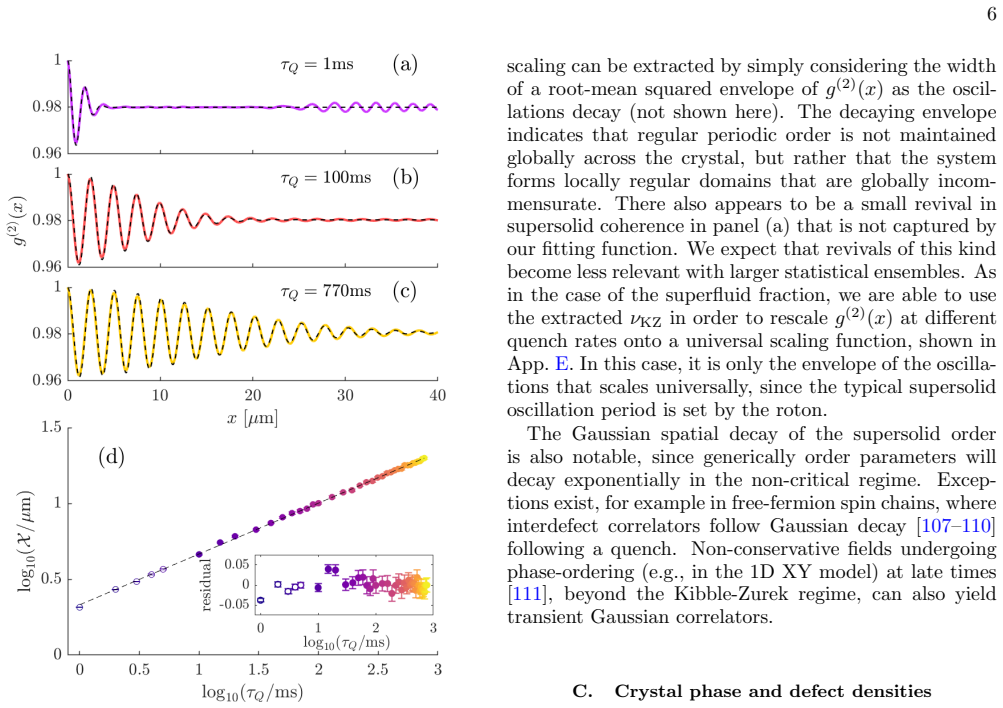
The paper simulates linear ramps of the s-wave scattering length from the uniform superfluid into the supersolid phase in an elongated tube of dipolar atoms, using the reduced extended Gross-Pitaevskii equation with stochastic initial noise and many independent realizations. It claims that the delay in the onset of density modulation after crossing the critical point—the Kibble-Zurek freeze-out time—and the width of the density-density correlation function at that moment both obey clean power laws in the quench time, $\hat{\tau} \propto \tau_Q^{0.352(3)}$ and $X \propto \tau_Q^{0.335(3)}$, over roughly three decades of quench rates. From these exponents the paper extracts $\nu = 0.57(1)$ and $z = 1.05(2)$, compatible with the Bogoliubov mean-field values $\nu = 1/2$, $z = 1$, and it finds that the number of crystal-phase defects at freeze-out also follows a power law when the phase jumps defining a defect are sufficiently large. The authors take this as evidence for a continuous transition whose universality class is near mean-field and not that of the (1+1)-dimensional XY model.
Load-bearing premise
The central assumption is that the reduced quasi-one-dimensional extended Gross-Pitaevskii equation, with its fixed variational transverse profile and approximate quantum-fluctuation term, faithfully represents the real three-dimensional many-body dynamics of the dipolar gas across the transition.
Editorial extensions
If this is right
- The freeze-out time and correlation length of supersolid formation are predictable for any linear quench rate in this regime, up to the fast-quench breakdown where domains approach the lattice spacing.
- The transition is consistent with a continuous second-order transition with near-mean-field exponents, which would rule out the (1+1)-dimensional XY/BKT universality class for these parameters.
- Defects of the supersolid crystal appear as local jumps of the crystal phase; for jumps larger than $\pi/2$ their count follows the predicted KZM power law and their statistics are Poissonian, so defect counting is a viable experimental probe.
- Experimental verification needs only the onset of density modulation, not long-lived supersolid coherence, which relaxes the lifetime requirement for ring-trap experiments.
- Very fast quenches break the scale separation between domain size and crystal periodicity, producing a saturation that is itself a universal breakdown of Kibble-Zurek scaling.
Reading between the lines
- If the near-mean-field exponents survive a fully self-consistent many-body treatment, the transition may behave as if it were above its upper critical dimension; an exact many-body calculation of $\nu$ and $z$ for the same Hamiltonian would settle that without relying on the quasi-1D mean-field reduction.
- The two correlation-length measures in the paper—the density-envelope exponent 0.335 and the crystal-phase width exponent 0.275—may indicate separate density and phase coherence lengths; tracking both after the freeze-out time would clarify whether one or two order parameters are needed.
- Because only the onset of supersolid formation is required, the same protocol could be applied to shorter-lived supersolids and ring traps, and a reverse quench that melts the supersolid should show symmetric freeze-out if the mechanism is Kibble-Zurek rather than coarsening.
Editorial analysis
A structured set of objections, weighed in public.
Referee Report
Summary. The manuscript reports a truncated-Wigner extended Gross-Pitaevskii study of linear quenches of the s-wave scattering length across the continuous superfluid-to-supersolid transition of an elongated 164Dy gas. The authors define a freeze-out time from the delay in the drop of the superfluid fraction, extract a frozen correlation length from a fit to the density-density correlation function, and count crystal-phase defects. They find power-law scalings τ̂ ∝ τ_Q^{0.352(3)}, X ∝ τ_Q^{0.335(3)}, and a defect-count exponent of 0.37(2), and from these they quote critical exponents ν = 0.57(1) and z = 1.05(2), comparing them with Bogoliubov mean-field predictions ν = 1/2, z = 1. The paper also includes checks with quantum-only noise, larger system sizes, and full 3D simulations.
Significance. The topic is timely and the study is in a regime of current experimental interest. The main strengths are the extended dynamical range of τ_Q, the ensemble averaging over hundreds of realizations, and the explicit checks in Appendices A–C that the exponents are robust to the noise model, system size, and, within larger error bars, the dimensionality of the simulation. If the reported scalings survive a corrected analysis, this would be one of the first quantitative Kibble-Zurek exponent extractions for a dipolar supersolid transition and would provide a useful benchmark for experiments. However, the headline exponent extraction contains an internal inconsistency that must be resolved before the quantitative claims can be accepted.
major comments (2)
- [§III D and Eq. (1)] The quoted exponents ν = 0.57(1) and z = 1.05(2) are not consistent with the inputs stated in the text. With ζ_KZ = 0.352(3) and ν_KZ = 0.335(3), Eq. (1) gives z = ζ_KZ/ν_KZ = 1.05(2) and ν = ν_KZ/(1 − ζ_KZ) = 0.335/(1 − 0.352) = 0.517(5). The difference from the reported 0.57 is about ten standard errors, far outside the quoted uncertainty. Because Sec. III D explicitly states that the extraction uses the results of Secs. III A and III B, this is an arithmetic inconsistency in the central result rather than an alternative fitting choice. The abstract, Sec. III D, and Sec. IV should be revised to report the corrected exponents and the correspondingly adjusted comparison with mean-field predictions.
- [§III C and Eq. (11)] The paper presents three mutually inconsistent estimates of the KZM correlation-length exponent for the same quenches: ν_KZ = 0.335(3) from g(2) in Sec. III B, 0.275(3) from the half-width of C(x) in Sec. III C, and 0.37(2) from the defect count with Δϕ > π/2 in Sec. III C. Equation (11) predicts that the defect-density exponent equals ν_KZ, and the three values are all presented as probes of the same frozen correlation scale; the spread between C(x) and g(2) is roughly 14σ on the quoted errors. The manuscript acknowledges these discrepancies only qualitatively. The authors should either provide a quantitative account of the systematic differences or present the headline exponents with error bars that reflect this systematic spread.
minor comments (4)
- [Sec. I] The sentence 'Sections III D-III C presents our observations' appears to be a typo; it should read 'Sections III A-III D present' or similar, with the sections in the correct order.
- [Fig. 12 caption] The caption contains the incomplete phrase 'A giving an approximate scaling'; a verb is missing and the sentence should be rewritten.
- [Appendix E] The text refers to a rescaling of 'the g(1) correlator', but the quantity plotted and discussed in Sec. III B and in Fig. 15 is g(2); please correct the label to avoid confusion.
- [Figs. 3–6] The open-symbol convention for quenches that extend past the supersolid phase boundary is used consistently, but the figures would be easier to read if the caption or the main text stated explicitly that open markers correspond to the modified fast-quench protocol described in Sec. III A.
Circularity Check
No circularity: measured KZM exponents are inverted with Eq. (1) and compared with an independently computed Bogoliubov spectrum. The reported nu=0.57(1) is internally inconsistent with the paper's own stated inputs, but that is an arithmetic/attribution issue, not a circular reduction.
full rationale
The paper's central derivation is self-contained. Sec. III A reports the measured freeze-out scaling tau_hat ~ tau_Q^{0.352(3)}, and Sec. III B reports the correlation-length scaling X ~ tau_Q^{0.335(3)}. Sec. III D converts these into critical exponents using the standard KZM relations in Eq. (1), which is an inversion of measured power laws, not a fit to the theory being tested. The comparison with Bogoliubov mean-field theory is independent: the roton-gap scaling epsilon_rot ~ sqrt(as - ac) is stated as 'verified here in the inset to Fig. 8(a)' from the dispersion relation Eq. (15), and the dynamical exponent z=1 follows from linearization of the dispersion around the roton momentum in Eq. (17). These Bogoliubov predictions do not use the quench-simulation exponents. Self-citations such as Refs. [15, 73-75] supply the reduced model and phase-diagram framework, but the central scaling exponents are new dynamical measurements compared against parameter-free theoretical predictions, so the load-bearing argument does not reduce to a self-citation. The App. E data collapses use the already-extracted exponents and are consistency checks, not independent predictions. A separate, non-circularity concern: using the paper's own stated inputs, Eqs. (1) with zeta=0.352(3) and nu_KZ=0.335(3) give nu = nu_KZ/(1-zeta) = 0.517(7), not the reported 0.57(1); the reported value matches the Sec. III C defect-density exponent 0.37(2) via 0.37/(1-0.352)=0.57. This is an internal inconsistency in the headline numeric result, but it is not a reduction of a claimed prediction to its inputs, so it does not raise the circularity score.
Assumptions & free parameters
free parameters (5)
- threshold f_s = 0.98 for freeze-out time =
0.98
- variational parameters l = 1.08 um, eta = 4.25 =
1.08 um, 4.25
- empirical fit function parameters {A, K, X} for g(2) =
varies per fit
- defect threshold Delta phi > pi/2 =
pi/2
- thermal noise temperature T = 20 nK =
20 nK
assumptions (5)
- domain assumption Extended Gross-Pitaevskii equation (eGPE) with LHY correction is a valid model for the dipolar gas dynamics.
- domain assumption The separability ansatz Psi(r,t) = phi(y,z) psi(x,t) is valid for the elongated tube geometry.
- domain assumption Kibble-Zurek scaling relations (tau_hat ~ tau_Q^{z nu/(1+z nu)} and xi_hat ~ tau_Q^{nu/(1+z nu)}) hold for this transition.
- domain assumption The transition at n_bar = 2500 um^-1 is continuous.
- ad hoc to paper The g(2) correlation function can be fitted to a Gaussian envelope to extract the correlation length.
Cite this review
Pith. "Pith review of Kibble-Zurek scaling of the superfluid-supersolid transition in an elongated dipolar gas." pith.science (2026). https://pith.science/paper/K3I3MLVO
@misc{pith2026241118395,
  author       = {Pith},
  title        = {Pith review of: Kibble-Zurek scaling of the superfluid-supersolid transition in an elongated dipolar gas},
  year         = {2026},
  howpublished = {\url{https://pith.science/paper/K3I3MLVO}},
  note         = {Machine review of arXiv:2411.18395}
}
abstract
We simulate interaction quenches crossing from a superfluid to a supersolid state in a dipolar quantum gas of ${}^{164}\mathrm{Dy}$ atoms, trapped in an elongated tube with periodic boundary conditions, via the extended Gross-Pitaevskii equation. A freeze-out time is observed through a delay in supersolid formation after crossing the critical point. We compute the density-density correlations at the freeze-out time and extract the frozen correlation length for the solid order. An analysis of the freeze-out time and correlation length versus the interaction quench rate allows us to extract universal exponents corresponding to the relaxation time and correlation length based on predictions of the Kibble-Zurek mechanism. Over several orders of magnitude, clear power-law scaling is observed for both the freeze-out time and the correlation length, and the corresponding exponents are compatible with predictions based on the excitation spectrum calculated via Bogoliubov theory. Defects due to independent local breaking of translational symmetry, contributing to globally incommensurate supersolid order, are identified, and their number at the freeze-out time is found to also scale as a power law. Our results support the hypothesis of a continuous transition whose universality class remains to be determined but appears to differ from that of the (1+1)D XY model.
Figures


Figures from the paper (9 more)


Reference graph
Works this paper leans on
-
[1]
Penrose and L
O. Penrose and L. Onsager, Bose-Einstein condensation and liquid helium, Phys. Rev. 104, 576 (1956)
1956
-
[2]
E. P. Gross, Unified theory of interacting bosons, Phys. Rev. 106, 161 (1957)
1957
-
[3]
Gross, Classical theory of boson wave fields, Annals of Physics 4, 57 (1958)
E. Gross, Classical theory of boson wave fields, Annals of Physics 4, 57 (1958)
1958
-
[4]
Andreev and I
A. Andreev and I. Lifshitz, Quantum theory of defects in crystals, J. Exp. Theo. Phys. 56, 2057 (1969)
1969
-
[5]
A. J. Leggett, Can a solid be ”superfluid”?, Phys. Rev. Lett. 25, 1543 (1970)
1970
-
[7]
J.-R. Li, J. Lee, W. Huang, S. Burchesky, B. Shteynas, F. C ¸ . Top, A. O. Jamison, and W. Ketterle, A stripe phase with supersolid properties in spin–orbit-coupled Bose–Einstein condensates, Nature 543, 91 (2017)
2017
-
[8]
Putra, F
A. Putra, F. Salces-C´ arcoba, Y. Yue, S. Sugawa, and I. B. Spielman, Spatial coherence of spin-orbit-coupled Bose gases, Phys. Rev. Lett. 124, 053605 (2020)
2020
-
[9]
Tanzi, E
L. Tanzi, E. Lucioni, F. Fam` a, J. Catani, A. Fioretti, C. Gabbanini, R. N. Bisset, L. Santos, and G. Modugno, Observation of a dipolar quantum gas with metastable supersolid properties, Phys. Rev. Lett. 122, 130405 (2019)
2019
Show all 129 references
-
[10]
B¨ ottcher, J.-N
F. B¨ ottcher, J.-N. Schmidt, M. Wenzel, J. Hertkorn, M. Guo, T. Langen, and T. Pfau, Transient super- solid properties in an array of dipolar quantum droplets, Phys. Rev. X 9, 011051 (2019)
2019
-
[11]
Chomaz, D
L. Chomaz, D. Petter, P. Ilzh¨ ofer, G. Natale, A. Traut- mann, C. Politi, G. Durastante, R. M. W. van Bijnen, A. Patscheider, M. Sohmen, M. J. Mark, and F. Fer- laino, Long-lived and transient supersolid behaviors in dipolar quantum gases, Phys. Rev. X 9, 021012 (2019). 16
2019
-
[12]
Sohmen, C
M. Sohmen, C. Politi, L. Klaus, L. Chomaz, M. J. Mark, M. A. Norcia, and F. Ferlaino, Birth, life, and death of a dipolar supersolid, Phys. Rev. Lett. 126, 233401 (2021)
2021
-
[13]
Bland, E
T. Bland, E. Poli, C. Politi, L. Klaus, M. A. Nor- cia, F. Ferlaino, L. Santos, and R. N. Bisset, Two- dimensional supersolid formation in dipolar conden- sates, Phys. Rev. Lett. 128, 195302 (2022)
2022
-
[14]
S. M. Roccuzzo and F. Ancilotto, Supersolid behavior of a dipolar Bose-Einstein condensate confined in a tube, Phys. Rev. A 99, 041601 (2019)
2019
-
[15]
P. B. Blakie, D. Baillie, L. Chomaz, and F. Ferlaino, Supersolidity in an elongated dipolar condensate, Phys. Rev. Res. 2, 043318 (2020)
2020
-
[16]
J. C. Smith, D. Baillie, and P. B. Blakie, Supersolidity and crystallization of a dipolar Bose gas in an infinite tube, Phys. Rev. A 107, 033301 (2023)
2023
-
[17]
Zhang, F
Y.-C. Zhang, F. Maucher, and T. Pohl, Supersolidity around a critical point in dipolar Bose-Einstein conden- sates, Phys. Rev. Lett. 123, 015301 (2019)
2019
-
[18]
Zhang, T
Y.-C. Zhang, T. Pohl, and F. Maucher, Phases of su- persolids in confined dipolar Bose-Einstein condensates, Phys. Rev. A 104, 013310 (2021)
2021
-
[19]
B. T. E. Ripley, D. Baillie, and P. B. Blakie, Two- dimensional supersolidity in a planar dipolar Bose gas, Phys. Rev. A 108, 053321 (2023)
2023
-
[20]
Zhang, T
Y.-C. Zhang, T. Pohl, and F. Maucher, Metastable pat- terns in one- and two-component dipolar Bose-Einstein condensates, Phys. Rev. Res. 6, 023023 (2024)
2024
-
[21]
M. E. Fisher, Renormalization of critical exponents by hidden variables, Phys. Rev. 176, 257 (1968)
1968
-
[22]
´Odor, Universality classes in nonequilibrium lattice systems, Rev
G. ´Odor, Universality classes in nonequilibrium lattice systems, Rev. Mod. Phys. 76, 663 (2004)
2004
-
[23]
Zinn-Justin, Quantum field theory and critical phe- nomena, 4th ed., International Series of Monographs on Physics (Clarendon Press, Oxford, England, 2002)
J. Zinn-Justin, Quantum field theory and critical phe- nomena, 4th ed., International Series of Monographs on Physics (Clarendon Press, Oxford, England, 2002)
2002
-
[24]
T. W. B. Kibble, Topology of cosmic domains and strings, J. Phys. A: Math. Theor. 9, 1387 (1976)
1976
-
[25]
T. W. B. Kibble, Some implications of a cosmological phase transition, Physics Reports 67, 183 (1980)
1980
-
[26]
W. H. Zurek, Cosmological experiments in superfluid helium?, Nature 317, 505 (1985)
1985
-
[27]
W. H. Zurek, Cosmological experiments in condensed matter systems, Physics Reports 276, 177 (1996)
1996
-
[28]
del Campo and W
A. del Campo and W. H. Zurek, Universality of phase transition dynamics: Topological defects from symme- try breaking, Int. J. Mod. Phys. A 29, 1430018 (2014)
2014
-
[29]
T. W. B. Kibble, Phase-transition dynamics in the lab and the universe, Physics Today 60, 47 (2007)
2007
-
[30]
Uhlmann, R
M. Uhlmann, R. Sch¨ utzhold, and U. R. Fischer, Vor- tex quantum creation and winding number scaling in a quenched spinor bose gas, Phys. Rev. Lett. 99, 120407 (2007)
2007
-
[31]
W. H. Zurek, Causality in condensates: Gray solitons as relics of BEC formation, Phys. Rev. Lett. 102, 105702 (2009)
2009
-
[32]
Damski and W
B. Damski and W. H. Zurek, Soliton creation during a Bose-Einstein condensation, Phys. Rev. Lett. 104, 160404 (2010)
2010
-
[33]
del Campo, A
A. del Campo, A. Retzker, and M. B. Plenio, The in- homogeneous Kibble–Zurek mechanism: vortex nucle- ation during Bose–Einstein condensation, New Journal of Physics 13, 083022 (2011)
2011
-
[34]
A. Das, J. Sabbatini, and W. H. Zurek, Winding up superfluid in a torus via Bose Einstein condensation, Scientific Reports 2, 352 (2012)
2012
-
[35]
del Campo, T
A. del Campo, T. W. B. Kibble, and W. H. Zurek, Causality and non-equilibrium second-order phase tran- sitions in inhomogeneous systems, Journal of Physics: Condensed Matter 25, 404210 (2013)
2013
-
[36]
Su, S.-C
S.-W. Su, S.-C. Gou, A. Bradley, O. Fialko, and J. Brand, Kibble-Zurek scaling and its breakdown for spontaneous generation of Josephson vortices in Bose- Einstein condensates, Phys. Rev. Lett. 110, 215302 (2013)
2013
-
[37]
Beugnon and N
J. Beugnon and N. Navon, Exploring the Kibble–Zurek mechanism with homogeneous Bose gases, J. Phys. B: At. Mol. Opt. Phys. 50, 022002 (2017)
2017
-
[38]
Liu and Y
S. Liu and Y. Zhang, Quench dynamics in a trapped Bose-Einstein condensate with spin-orbit coupling, Phys. Rev. A 99, 053609 (2019)
2019
-
[39]
Comaron, F
P. Comaron, F. Larcher, F. Dalfovo, and N. P. Proukakis, Quench dynamics of an ultracold two- dimensional Bose gas, Phys. Rev. A 100, 033618 (2019)
2019
-
[40]
Jiang, S
X. Jiang, S. Wu, Q. Ye, and C. Lee, Universality of miscible–immiscible phase separation dynamics in two- component Bose–Einstein condensates, New Journal of Physics 21, 023014 (2019)
2019
-
[41]
I.-K. Liu, J. Dziarmaga, S.-C. Gou, F. Dalfovo, and N. P. Proukakis, Kibble-Zurek dynamics in a trapped ultracold Bose gas, Phys. Rev. Res. 2, 033183 (2020)
2020
-
[42]
Thudiyangal and A
M. Thudiyangal and A. del Campo, Universal vortex statistics and stochastic geometry of Bose-Einstein con- densation, Phys. Rev. Res. 6, 033152 (2024)
2024
-
[43]
N. P. Proukakis, Universality of Bose–Einstein conden- sation and quenched formation dynamics, in Encyclo- pedia of Condensed Matter Physics (Elsevier, 2024) pp. 84–123
2024
-
[44]
M. T. Wheeler, H. Salman, and M. O. Borgh, Dynamics of a nonequilibrium discontinuous quantum phase tran- sition in a spinor bose–einstein condensate, Commun. Phys. 8 (2025)
2025
-
[45]
C. N. Weiler, T. W. Neely, D. R. Scherer, A. S. Bradley, M. J. Davis, and B. P. Anderson, Spontaneous vortices in the formation of Bose–Einstein condensates, Nature 455, 948 (2008)
2008
-
[46]
Lamporesi, S
G. Lamporesi, S. Donadello, S. Serafini, F. Dalfovo, and G. Ferrari, Spontaneous creation of Kibble–Zurek soli- tons in a Bose–Einstein condensate, Nature Physics 9, 656 (2013)
2013
-
[47]
Corman, L
L. Corman, L. Chomaz, T. Bienaim´ e, R. Desbuquois, C. Weitenberg, S. Nascimb` ene, J. Dalibard, and J. Beugnon, Quench-induced supercurrents in an annu- lar Bose gas, Phys. Rev. Lett. 113, 135302 (2014)
2014
-
[48]
Navon, A
N. Navon, A. L. Gaunt, R. P. Smith, and Z. Hadzibabic, Critical dynamics of spontaneous symmetry breaking in a homogeneous Bose gas, Science 347, 167 (2015)
2015
-
[49]
Chomaz, L
L. Chomaz, L. Corman, T. Bienaim´ e, R. Desbuquois, C. Weitenberg, S. Nascimb` ene, J. Beugnon, and J. Dal- ibard, Emergence of coherence via transverse condensa- tion in a uniform quasi-two-dimensional Bose gas, Na- ture Communications 6, 6162 (2015)
2015
-
[50]
Donadello, S
S. Donadello, S. Serafini, T. Bienaim´ e, F. Dalfovo, G. Lamporesi, and G. Ferrari, Creation and counting of defects in a temperature-quenched Bose-Einstein con- densate, Phys. Rev. A 94, 023628 (2016). 17
2016
-
[51]
L. W. Clark, L. Feng, and C. Chin, Universal space-time scaling symmetry in the dynamics of bosons across a quantum phase transition, Science 354, 606 (2016)
2016
-
[52]
I. K. Liu, S. Donadello, G. Lamporesi, G. Ferrari, S. C. Gou, F. Dalfovo, and N. P. Proukakis, Dynamical equili- bration across a quenched phase transition in a trapped quantum gas, Commun. Phys. 1, 24 (2018)
2018
-
[53]
B. Ko, J. W. Park, and Y. Shin, Kibble–Zurek univer- sality in a strongly interacting Fermi superfluid, Nature Physics 15, 1227 (2019)
2019
-
[54]
J. Goo, Y. Lim, and Y. Shin, Defect saturation in a rapidly quenched Bose gas, Phys. Rev. Lett. 127, 115701 (2021)
2021
-
[55]
Liu, X.-C
X.-P. Liu, X.-C. Yao, Y. Deng, Y.-X. Wang, X.-Q. Wang, X. Li, Q. Chen, Y.-A. Chen, and J.-W. Pan, Dy- namic formation of quasicondensate and spontaneous vortices in a strongly interacting Fermi gas, Phys. Rev. Res. 3, 043115 (2021)
2021
-
[56]
J. Goo, Y. Lee, Y. Lim, D. Bae, T. Rabga, and Y. Shin, Universal early coarsening of quenched Bose gases, Phys. Rev. Lett. 128, 135701 (2022)
2022
-
[57]
Rabga, Y
T. Rabga, Y. Lee, D. Bae, M. Kim, and Y. Shin, Varia- tions of the Kibble-Zurek scaling exponents of trapped Bose gases, Phys. Rev. A 108, 023315 (2023)
2023
-
[58]
D. G. Allman, P. Sabharwal, and K. C. Wright, Quench- induced spontaneous currents in rings of ultracold fermionic atoms, Phys. Rev. A 109, 053320 (2024)
2024
-
[59]
W. H. Zurek, U. Dorner, and P. Zoller, Dynamics of a quantum phase transition, Phys. Rev. Lett. 95, 105701 (2005)
2005
-
[60]
Polkovnikov, Universal adiabatic dynamics in the vicinity of a quantum critical point, Phys
A. Polkovnikov, Universal adiabatic dynamics in the vicinity of a quantum critical point, Phys. Rev. B 72, 161201 (2005)
2005
-
[61]
L. E. Sadler, J. M. Higbie, S. R. Leslie, M. Vengalat- tore, and D. M. Stamper-Kurn, Spontaneous symme- try breaking in a quenched ferromagnetic spinor Bose– Einstein condensate, Nature 443, 312 (2006)
2006
-
[62]
D. Chen, M. White, C. Borries, and B. DeMarco, Quan- tum quench of an atomic mott insulator, Phys. Rev. Lett. 106, 235304 (2011)
2011
-
[63]
Anquez, B
M. Anquez, B. A. Robbins, H. M. Bharath, M. Bogus- lawski, T. M. Hoang, and M. S. Chapman, Quantum Kibble-Zurek mechanism in a spin-1 Bose-Einstein con- densate, Phys. Rev. Lett. 116, 155301 (2016)
2016
-
[64]
L. Feng, L. W. Clark, A. Gaj, and C. Chin, Coher- ent inflationary dynamics for Bose–Einstein condensates crossing a quantum critical point, Nature Physics 14, 269 (2017)
2017
-
[65]
Y. Chen, M. Horikoshi, K. Yoshioka, and M. Kuwata- Gonokami, Dynamical critical behavior of an attractive Bose-Einstein condensate phase transition, Phys. Rev. Lett. 122, 040406 (2019)
2019
-
[66]
C.-R. Yi, S. Liu, R.-H. Jiao, J.-Y. Zhang, Y.-S. Zhang, and S. Chen, Exploring inhomogeneous Kibble-Zurek mechanism in a spin-orbit coupled Bose-Einstein con- densate, Phys. Rev. Lett. 125, 260603 (2020)
2020
-
[67]
K. Lee, S. Kim, T. Kim, and Y. Shin, Universal Kibble– Zurek scaling in an atomic Fermi superfluid, Nature Physics 20, 1570 (2024)
2024
-
[68]
Ferrier-Barbut, H
I. Ferrier-Barbut, H. Kadau, M. Schmitt, M. Wenzel, and T. Pfau, Observation of quantum droplets in a strongly dipolar Bose gas, Phys. Rev. Lett. 116, 215301 (2016)
2016
-
[69]
W¨ achtler and L
F. W¨ achtler and L. Santos, Quantum filaments in dipo- lar Bose-Einstein condensates, Phys. Rev. A 93, 061603 (2016)
2016
-
[70]
Chomaz, S
L. Chomaz, S. Baier, D. Petter, M. J. Mark, F. W¨ achtler, L. Santos, and F. Ferlaino, Quantum- fluctuation-driven crossover from a dilute Bose-Einstein condensate to a macrodroplet in a dipolar quantum fluid, Phys. Rev. X 6, 041039 (2016)
2016
-
[71]
Sch¨ utzhold, M
R. Sch¨ utzhold, M. Uhlmann, Y. Xu, and U. R. Fischer, Mean-field expansion in Bose–Einstein condensates with finite-range interactions, International Journal of Mod- ern Physics B 20, 3555–3565 (2006)
2006
-
[72]
A. R. P. Lima and A. Pelster, Quantum fluctuations in dipolar Bose gases, Phys. Rev. A 84, 041604 (2011)
2011
-
[73]
P. B. Blakie, D. Baillie, and S. Pal, Variational the- ory for the ground state and collective excitations of an elongated dipolar condensate, Communications in The- oretical Physics 72, 085501 (2020)
2020
-
[74]
S. Pal, D. Baillie, and P. B. Blakie, Excitations and number fluctuations in an elongated dipolar Bose- Einstein condensate, Phys. Rev. A 102, 043306 (2020)
2020
-
[75]
e2i¯kR ei(ϕ(x)+ϕ(x′)) + ei¯ks ei(ϕ(x)−ϕ(x′)) + h.c. # , (D4) since the exponential prefactors will not change from trial to trial. ⟨n(x)n(x′)⟩ = ¯n2 + λ2 4
for a more in-depth discussion of the emergence of this Higgs mode. In all quenches, there is a final trend towards the ground state superfluid fraction of approxi- mately f s = 0.323, settling slightly above this value with some oscillations remaining, indicating some residua...
2023
-
[76]
P. B. Blakie, L. Chomaz, D. Baillie, and F. Fer- laino, Compressibility and speeds of sound across the superfluid-to-supersolid phase transition of an elongated dipolar gas, Phys. Rev. Res. 5, 033161 (2023)
2023
-
[77]
A. J. Leggett, On the superfluid fraction of an arbi- trary many-body system at T=0, Journal of Statistical Physics 93, 927–941 (1998)
1998
-
[78]
Ala˜ na, N
A. Ala˜ na, N. Antolini, G. Biagioni, I. n. L. Egusquiza, and M. Modugno, Crossing the superfluid-supersolid transition of an elongated dipolar condensate, Phys. Rev. A 106, 043313 (2022)
2022
-
[79]
Biagioni, N
G. Biagioni, N. Antolini, A. Ala˜ na, M. Modugno, A. Fioretti, C. Gabbanini, L. Tanzi, and G. Mod- ugno, Dimensional crossover in the superfluid-supersolid quantum phase transition, Physical Review X 12 (2022)
2022
-
[80]
Ala˜ na, I
A. Ala˜ na, I. L. Egusquiza, and M. Modugno, Supersolid formation in a dipolar condensate by roton instability, Physical Review A 108 (2023)
2023
-
[81]
Ala˜ na, Supersolid-formation-time shortcut and exci- tation reduction by manipulating the dynamical insta- bility, Phys
A. Ala˜ na, Supersolid-formation-time shortcut and exci- tation reduction by manipulating the dynamical insta- bility, Phys. Rev. A 109, 023308 (2024)
2024
-
[82]
Sabbatini, W
J. Sabbatini, W. H. Zurek, and M. J. Davis, Phase sep- aration and pattern formation in a binary bose-einstein condensate, Phys. Rev. Lett. 107, 230402 (2011)
2011
-
[83]
Pitaevskii and S
L. Pitaevskii and S. Stringari, Bose-Einstein Condensa- tion and Superfluidity (Oxford University Press, 2016)
2016
-
[84]
Boninsegni and N
M. Boninsegni and N. V. Prokof’ev, Colloquium: Su- persolids: What and where are they?, Rev. Mod. Phys. 84, 759 (2012)
2012
-
[85]
We therefore suggest that care must be taken when us- ing a function like C(x) to determine KZM scaling re- sults, especially at quench rates where ξ begins to ap- proach Luc, and perhaps greater statistics are needed for proper convergence of this measure
-
[86]
Uhlmann, R
M. Uhlmann, R. Sch¨ utzhold, and U. R. Fischer, o(n) symmetry-breaking quantum quench: Topological de- fects versus quasiparticles, Phys. Rev. D 81, 025017 (2010)
2010
-
[87]
Uhlmann, R
M. Uhlmann, R. Sch¨ utzhold, and U. R Fischer, System size scaling of topological defect creation in a second- order dynamical quantum phase transition, New Jour- nal of Physics 12, 095020 (2010). 18
2010
-
[88]
Bland, Q
T. Bland, Q. Marolleau, P. Comaron, B. Malomed, and N. Proukakis, Persistent current formation in double- ring geometries, J. Phys. B: At. Mol. Opt. Phys 53, 115301 (2020)
2020
-
[89]
Zeng, C.-Y
H.-B. Zeng, C.-Y. Xia, and A. del Campo, Univer- sal breakdown of Kibble-Zurek scaling in fast quenches across a phase transition, Phys. Rev. Lett. 130, 060402 (2023)
2023
-
[90]
del Campo, F
A. del Campo, F. J. G´ omez-Ruiz, Z.-H. Li, C.-Y. Xia, H.-B. Zeng, and H.-Q. Zhang, Universal statistics of vor- tices in a newborn holographic superconductor: beyond the kibble-zurek mechanism, Journal of High Energy Physics 2021 (2021)
2021
-
[91]
Balducci, M
F. Balducci, M. Beau, J. Yang, A. Gambassi, and A. del Campo, Large deviations beyond the kibble-zurek mech- anism, Phys. Rev. Lett. 131, 230401 (2023)
2023
-
[92]
del Campo, Universal statistics of topological defects formed in a quantum phase transition, Phys
A. del Campo, Universal statistics of topological defects formed in a quantum phase transition, Phys. Rev. Lett. 121, 200601 (2018)
2018
-
[93]
F. J. G´ omez-Ruiz, J. J. Mayo, and A. del Campo, Full counting statistics of topological defects after crossing a phase transition, Phys. Rev. Lett. 124, 240602 (2020)
2020
-
[94]
J.-M. Cui, F. J. G´ omez-Ruiz, Y.-F. Huang, C.-F. Li, G.-C. Guo, and A. del Campo, Experimentally test- ing quantum critical dynamics beyond the kibble–zurek mechanism, Communications Physics 3 (2020)
2020
-
[95]
Bando, Y
Y. Bando, Y. Susa, H. Oshiyama, N. Shibata, M. Ohzeki, F. J. G´ omez-Ruiz, D. A. Lidar, S. Suzuki, A. del Campo, and H. Nishimori, Probing the uni- versality of topological defect formation in a quantum annealer: Kibble-zurek mechanism and beyond, Phys. Rev. Res. 2, 033369 (2020)
2020
-
[96]
Sachdev, Quantum Phase Transitions, 2nd ed
S. Sachdev, Quantum Phase Transitions, 2nd ed. (Cam- bridge University Press, 2011)
2011
-
[97]
P. C. Hohenberg and B. I. Halperin, Theory of dynamic critical phenomena, Rev. Mod. Phys. 49, 435 (1977)
1977
-
[98]
M. J. Steel, M. K. Olsen, L. I. Plimak, P. D. Drummond, S. M. Tan, M. J. Collett, D. F. Walls, and R. Graham, Dynamical quantum noise in trapped bose-einstein con- densates, Phys. Rev. A 58, 4824 (1998)
1998
-
[99]
Sinatra, C
A. Sinatra, C. Lobo, and Y. Castin, The truncated wigner method for bose-condensed gases: limits of va- lidity and applications, Journal of Physics B: Atomic, Molecular and Optical Physics 35, 3599–3631 (2002)
2002
-
[100]
Blakie, A
P. Blakie, A. Bradley, M. Davis, R. Ballagh, and C. Gar- diner, Dynamics and statistical mechanics of ultra-cold Bose gases using c-field techniques, Advances in Physics 57, 363 (2008)
2008
-
[101]
Jeli´ c and L
A. Jeli´ c and L. F. Cugliandolo, Quench dynamics of the 2d XY model, J. Stat. Mech. 2011, P02032 (2011)
2011
-
[102]
Dziarmaga and W
J. Dziarmaga and W. H. Zurek, Quench in the 1d Bose- Hubbard model: Topological defects and excitations from the Kosterlitz-Thouless phase transition dynam- ics, Scientific Reports 4, 5950 (2014)
2014
-
[103]
Gardas, J
B. Gardas, J. Dziarmaga, and W. H. Zurek, Dynamics of the quantum phase transition in the one-dimensional Bose-Hubbard model: Excitations and correlations in- duced by a quench, Phys. Rev. B 95, 104306 (2017)
2017
-
[104]
Z. Zuo, S. Yin, X. Cao, and F. Zhong, Scaling theory of the Kosterlitz-Thouless phase transition, Phys. Rev. B 104, 214108 (2021)
2021
-
[105]
M. P. A. Fisher, P. B. Weichman, G. Grinstein, and D. S. Fisher, Boson localization and the superfluid- insulator transition, Phys. Rev. B 40, 546 (1989)
1989
-
[106]
Huang, R
Q. Huang, R. Yao, L. Liang, S. Wang, Q. Zheng, D. Li, W. Xiong, X. Zhou, W. Chen, X. Chen, and J. Hu, Observation of many-body quantum phase transitions beyond the Kibble-Zurek mechanism, Phys. Rev. Lett. 127, 200601 (2021)
2021
-
[107]
van Otterlo, K.-H
A. van Otterlo, K.-H. Wagenblast, R. Baltin, C. Bruder, R. Fazio, and G. Sch¨ on, Quantum phase transitions of interacting bosons and the supersolid phase, Phys. Rev. B 52, 16176 (1995)
1995
-
[108]
Roychowdhury, R
K. Roychowdhury, R. Moessner, and A. Das, Dynamics and correlations at a quantum phase transition beyond kibble-zurek, Phys. Rev. B 104, 014406 (2021)
2021
-
[109]
R. J. Nowak and J. Dziarmaga, Quantum kibble-zurek mechanism: Kink correlations after a quench in the quantum ising chain, Phys. Rev. B 104, 075448 (2021)
2021
-
[110]
Kou and P
H.-C. Kou and P. Li, Interferometry based on the quan- tum kibble-zurek mechanism, Phys. Rev. B 106, 184301 (2022)
2022
-
[111]
Kou and P
H.-C. Kou and P. Li, Varying quench dynamics in the transverse ising chain: The kibble-zurek, saturated, and presaturated regimes, Phys. Rev. B 108, 214307 (2023)
2023
-
[112]
Bray, Theory of phase-ordering kinetics, Advances in Physics 43, 357–459 (1994)
A. Bray, Theory of phase-ordering kinetics, Advances in Physics 43, 357–459 (1994)
1994
-
[113]
Mukherjee, A
V. Mukherjee, A. Dutta, and D. Sen, Defect generation in a spin- 1 2 transverse xy chain under repeated quench- ing of the transverse field, Phys. Rev. B 77, 214427 (2008)
2008
-
[114]
Divakaran and A
U. Divakaran and A. Dutta, Reverse quenching in a one-dimensional kitaev model, Phys. Rev. B 79, 224408 (2009)
2009
-
[115]
H. T. Quan and W. H. Zurek, Testing quantum adia- baticity with quench echo, New Journal of Physics 12, 093025 (2010)
2010
-
[116]
Bloch, Superfluidity in a ring, Phys
F. Bloch, Superfluidity in a ring, Phys. Rev. A 7, 2187 (1973)
1973
-
[117]
Amico, A
L. Amico, A. Osterloh, and F. Cataliotti, Quantum many particle systems in ring-shaped optical lattices, Phys. Rev. Lett. 95, 063201 (2005)
2005
-
[118]
Amico, D
L. Amico, D. Anderson, M. Boshier, J.-P. Brantut, L.-C. Kwek, A. Minguzzi, and W. von Klitzing, Colloquium: Atomtronic circuits: From many-body physics to quan- tum technologies, Rev. Mod. Phys. 94, 041001 (2022)
2022
-
[119]
C. Ryu, M. F. Andersen, P. Clad´ e, V. Natarajan, K. Helmerson, and W. D. Phillips, Observation of per- sistent flow of a Bose-Einstein condensate in a toroidal trap, Phys. Rev. Lett. 99, 260401 (2007)
2007
-
[120]
Ramanathan, K
A. Ramanathan, K. C. Wright, S. R. Muniz, M. Ze- lan, W. T. Hill, C. J. Lobb, K. Helmerson, W. D. Phillips, and G. K. Campbell, Superflow in a toroidal Bose-Einstein condensate: An atom circuit with a tun- able weak link, Phys. Rev. Lett. 106, 130401 (2011)
2011
-
[121]
K. C. Wright, R. B. Blakestad, C. J. Lobb, W. D. Phillips, and G. K. Campbell, Driving phase slips in a superfluid atom circuit with a rotating weak link, Phys. Rev. Lett. 110, 025302 (2013)
2013
-
[122]
Eckel, J
S. Eckel, J. G. Lee, F. Jendrzejewski, N. Murray, C. W. Clark, C. J. Lobb, W. D. Phillips, M. Edwards, and G. K. Campbell, Hysteresis in a quantized superfluid ‘atomtronic’ circuit, Nature 506, 200 (2014)
2014
-
[123]
Henderson, C
K. Henderson, C. Ryu, C. MacCormick, and M. G. Boshier, Experimental demonstration of painting arbi- trary and dynamic potentials for Bose–Einstein conden- sates, New J. Phys. 11, 043030 (2009). 19
2009
-
[124]
B. E. Sherlock, M. Gildemeister, E. Owen, E. Nugent, and C. J. Foot, Time-averaged adiabatic ring potential for ultracold atoms, Phys. Rev. A 83, 043408 (2011)
2011
-
[125]
Moulder, S
S. Moulder, S. Beattie, R. P. Smith, N. Tammuz, and Z. Hadzibabic, Quantized supercurrent decay in an annular Bose-Einstein condensate, Phys. Rev. A 86, 013629 (2012)
2012
-
[126]
C. Ryu, P. W. Blackburn, A. A. Blinova, and M. G. Boshier, Experimental realization of Josephson junc- tions for an atom squid, Phys. Rev. Lett. 111, 205301 (2013)
2013
-
[127]
Beattie, S
S. Beattie, S. Moulder, R. J. Fletcher, and Z. Hadz- ibabic, Persistent currents in spinor condensates, Phys. Rev. Lett. 110, 025301 (2013)
2013
-
[128]
G. E. Marti, R. Olf, and D. M. Stamper-Kurn, Col- lective excitation interferometry with a toroidal Bose- Einstein condensate, Phys. Rev. A 91, 013602 (2015)
2015
-
[129]
Nilsson Tengstrand, D
M. Nilsson Tengstrand, D. Boholm, R. Sachdeva, J. Bengtsson, and S. M. Reimann, Persistent currents in toroidal dipolar supersolids, Phys. Rev. A 103, 013313 (2021)
2021
-
[130]
Nilsson Tengstrand, P
M. Nilsson Tengstrand, P. St¨ urmer, J. Ribbing, and S. M. Reimann, Toroidal dipolar supersolid with a ro- tating weak link, Phys. Rev. A 107, 063316 (2023)
2023
Reviewed August 12, 2026 · model on record in the stance chip above.
Discussion (0). Continue with ORCID to comment.