REVIEW 4 major objections 3 minor 1 cited by
Particle dynamics and optical appearance of charged spherically symmetric black holes in bumblebee gravity
T0 review · 4 major / 3 minor · reviewed 2026-08-15 · deepseek-v4-flash
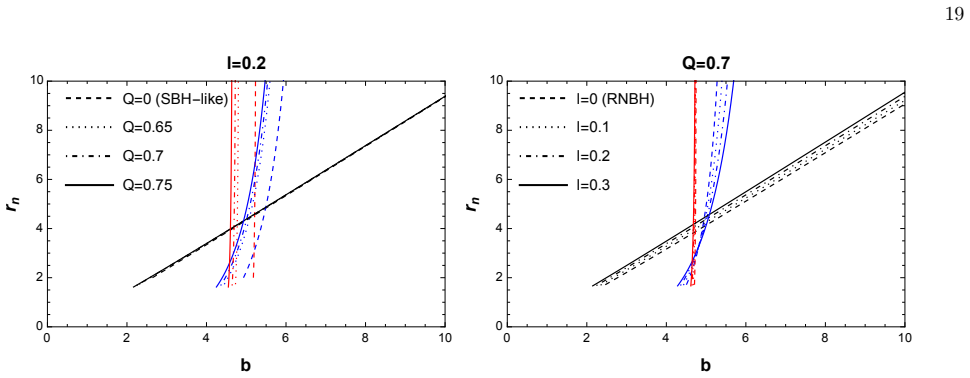
Pith's one-line read For charged spherically symmetric black holes in bumblebee gravity, the photon sphere and shadow radius shrink as the Lorentz-violation parameter l or the charge Q grows, and the paper shows how this appears in the black hole image.
desk verdict A competent, standard geodesics-plus-images study of a charged bumblebee metric taken from Liu et al.; the algebra checks out, but the shadow constraints ignore the non-asymptotically flat spatial metric and the EHT bound is under-specified. read the letter →
The pith
A machine-rendered reading of the paper's core claim, the machinery that carries it, and where it could break.
The reading
What carries the argument
The central object is the effective potential $V_{\rm eff}(r)=A(r)(L^2/r^2-\epsilon)/(1+l)$ that governs both timelike and null radial motion in the bumblebee metric. Imposing the photon-sphere conditions $V_{\rm eff}=1/(b^2(1+l))$ and $V_{\rm eff}'=0$ fixes the photon sphere radius and critical impact parameter, while the transfer-function mapping $r_m(b)$ and the orbit count $n(\phi)=\phi/(2\pi)$ classify photon trajectories into direct emission, lensed rings, and photon rings; the observed intensity is then the redshift-weighted sum $I_{\rm obs}(b)=\sum_r A(r_m(b))^2 I_{\rm em}(r_m(b))$. This machinery turns the metric parameters $l$ and $Q$ into concrete image features such as ring thickness and peak brightness.
What would settle it
Substitute the line element (9)–(10) and potential (11) into the field equations (3)–(7) for generic $l$ and $Q$ and check whether the equations are identically satisfied; a nonzero remainder at any radius would falsify the solution, and with it the shadow and image predictions. A separate observational check would be a higher-resolution measurement of the Sgr A* shadow that can resolve the predicted gap between the BCBH and Reissner–Nordström shadow radii.
Extended reading notes
Core claim
For the static spherically symmetric charged solution of bumblebee gravity with metric functions $A(r)=1-2M/r+2(1+l)Q^2/((2+l)r^2)$ and $B(r)=(1+l)/A(r)$, the paper derives closed expressions for the photon sphere radius $r_{\rm ph}$ and the critical impact parameter $b_{\rm ph}$ and shows that both decrease monotonically as the Lorentz-violation parameter $l$ or the charge $Q$ increases. Because the shadow radius $R_{\rm sh}$ equals $b_{\rm ph}$ for a distant observer, the shadow is always smaller than those of the Reissner–Nordström and Schwarzschild-like black holes with the same mass. The same monotonicity holds for the ISCO radius of massive particles, and the Keplerian frequency at fixed radius falls as $l$ or $Q$ grows. Applying the Sgr A* shadow-radius measurement yields upper bounds on $l$ and $Q$. In the simulated images from three thin-disk emission models, the observed intensity is dominated by direct emission; the lensed and photon rings widen with $l$ and their intensity peaks fall with $Q$, giving a parameter-dependent optical appearance that differs from the general-relativistic cases.
Load-bearing premise
The load-bearing premise is that the metric (9)–(11), taken from the charged bumblebee solution, really is the gravitational field generated by the action (1)–(2), and that applying the shadow formula at infinity needs no additional correction for the spacetime's non-asymptotic flatness.
Editorial extensions
If this is right
- A larger $l$ or $Q$ means the event horizon, ISCO, photon sphere, and shadow all sit closer to the central mass, so a shadow that is small relative to the estimated mass is a potential sign of Lorentz violation.
- The upper bounds on $l$ and $Q$ from Sgr A* shadow data limit how much Lorentz violation these black holes can carry while remaining consistent with current observations.
- Because direct emission supplies most of the observed brightness, the $l$-dependent widening of the photon and lensed rings will be visible mainly through the ring structure rather than through the total flux.
- For a fixed $l$, increasing the charge lowers the peak observed intensity of the rings, so charge leaves a dimming signature in the black hole image.
- If a candidate black hole is identified with a specific $l$ and $Q$, the predicted shadow radius and intensity profile provide an observational template for distinguishing it from a Reissner–Nordström or Schwarzschild-like black hole.
Reading between the lines
- Beyond the paper, the same effective-potential machinery could be turned on rotating bumblebee black holes; if the $l$-driven widening of photon and lensed rings survives spin, it could be separated from the spin-induced asymmetry in general-relativistic images.
- The three emission profiles are toy models; repeating the image calculation for magnetized or geometrically thick disks would show whether direct-emission dominance and the $l$-dependent ring widening are robust enough for real observations.
- Because the paper gives the Keplerian frequency for circular orbits, a measured quasi-periodic oscillation from an accretion disk near a candidate black hole could provide an independent handle on $l$ and $Q$.
- The Sgr A* bound on $l$ and $Q$ suggests a direct extension: combine shadow-size constraints from several sources with independent mass estimates to narrow the allowed parameter region.
Signed reviews
Editorial analysis
A structured set of objections, weighed in public.
Referee Report
Summary. The manuscript studies test-particle dynamics and the optical appearance of static spherically symmetric charged black holes in bumblebee gravity, working with the metric of Liu et al. [40]. It derives effective potentials, ISCO radii, Keplerian frequencies, photon-sphere and shadow radii, uses Sgr A* EHT shadow data to constrain the Lorentz-violation parameter l and charge Q, and computes images under three thin-disk emission models. The central claims are that l and Q decrease the ISCO radius, photon-sphere radius, and shadow radius below the Reissner-Nordstrom and Schwarzschild-like values, and that the images show wider lensed/photon rings and lower intensity peaks as these parameters increase.
Significance. If the adopted solution is a genuine configuration of bumblebee gravity, the paper provides concrete, falsifiable links between Lorentz-violation parameters and EHT-observable shadow sizes and image morphology. The geodesic algebra is internally consistent and reduces correctly to standard limits in the checked cases (r_ISCO=6M, r_ph=3M, and Omega=sqrt(M/r^3) at Q=0), and the EHT data are used as a posterior constraint rather than as an input for constructing the predictions. The main risk is that the spacetime metric is imported from an external reference without verification; this is a correctness risk rather than circularity.
major comments (4)
- [Sec. II, Eqs. (9)-(11)] All subsequent results are computed from a metric imported from Ref. [40], but the paper does not state the bumblebee field configuration B^mu, the potential V(X), or show that Eqs. (9)-(11) satisfy the coupled field equations (3), (6), and (7) for l different from zero. Since the bumblebee-gravity interpretation of the ISCO, shadow, and image predictions rests entirely on this solution, please provide the missing configuration or an explicit statement of the equations in [40] that establish the solution, and discuss whether the non-asymptotically flat spatial metric (B(infinity)=1+l) affects the identification of M and the shadow-radius comparison.
- [Sec. III.A, Eq. (26) and Fig. 5] The Abstract and Section V state that r_ISCO decreases as l increases, but for Q=0 Eq. (26) reduces to r_ISCO=6M with no l dependence; the claim should be qualified as holding for Q>0, or the statement should be corrected.
- [Sec. III.B, Tables I-II] The EHT constraint calculation is under-specified: the paper does not state the adopted Sgr A* shadow-radius value, the 1-sigma interval, or the inequality used to produce Tables I-II, and the tables report only upper bounds with no lower bounds. Please specify the observational input and the exact condition used to generate the tables.
- [Eq. (34)] As typeset, the shadow-radius formula does not appear to reduce to b_ph=3*sqrt(3)M in the Schwarzschild limit l=0, Q=0; the displayed expression seems to give sqrt(3)M, which is inconsistent with the numerical values in Tables III-IV. Please rewrite Eq. (34) and verify its Schwarzschild and Reissner-Nordstrom limits.
minor comments (3)
- [Eqs. (17)-(18)] The symbol E is reused for the conserved energy of Eq. (14) and for the newly defined effective energy E^2/(1+l); please use distinct notations to avoid confusion.
- [Figs. 16-21] The captions do not label the individual panels; since each figure contains up to four panels, please identify the panels explicitly in the captions.
- [After Eq. (12)] The parameter domain is not fully stated: the paper gives Q^2 <= (2+l)/(2(1+l)) but does not explicitly state the assumed range of l (for example l >= 0) used in all figures and tables.
Circularity Check
No significant circularity: the central geodesic, shadow, and image results are derived from an external metric solution, and the EHT data are used only to constrain free parameters, not to construct the predictions.
full rationale
The derivation chain is self-contained once the metric is accepted as input. The metric functions A(r) and B(r) in Eqs. (9)-(11) are taken from Liu et al. [40], an external reference with no author overlap with the present work, so the spacetime is an independent input rather than a self-citation. All subsequent results—timelike effective potential, ISCO radius, Keplerian frequency, photon sphere, shadow radius, photon trajectories, transfer functions, and image intensities—are computed by standard geodesic algebra from that metric, not by fitting to the quantities being predicted. The EHT Sgr A* shadow-radius data are used only to constrain the allowed ranges of l and Q (Tables I-II), and the representative values used in the image simulations (e.g., l=0.2, Q=0.7) are selected inside the allowed region rather than tuned to reproduce the advertised optical appearance; the optical-appearance conclusions are therefore not statistically forced by the observational input. No definitional equivalence, fitted-input-called-prediction step, uniqueness theorem imported from the authors' own prior work, or renaming of known results is present. The only substantive concern is whether the adopted metric genuinely solves the full bumblebee field equations for l≠0, especially given the non-asymptotically flat limit B(∞)=1+l; that is a correctness or validity risk about an external solution, not a circularity of the present derivation. Accordingly, the appropriate finding is no significant circularity.
Assumptions & free parameters
free parameters (2)
- Lorentz-violation parameter l =
l=0.2 used in main imaging; EHT upper bound 0.8549 for Q=0.7
- Charge parameter Q =
Q=0.7 used in main imaging; EHT upper bound 0.7639 for l=0.2
assumptions (4)
- domain assumption The bumblebee gravity action with the non-minimally coupled electromagnetic field (Eqs. 1-2) admits the static spherically symmetric solution (Eqs. 9-11) as the exact charged black hole spacetime.
- domain assumption Test particles and photons follow geodesics of the metric, with the standard conserved energy and angular momentum defined from the Lagrangian in Eq. (13).
- domain assumption The Sgr A* shadow radius reported by the EHT applies to a static, spherically symmetric, non-spinning black hole model, and its 1-sigma interval directly constrains l and Q.
- ad hoc to paper The three thin-disk emission profiles (Eqs. 45-47) are representative of real accretion flows, with isotropic emission from a geometrically thin equatorial disk.
Cite this review
Pith. "Pith review of Particle dynamics and optical appearance of charged spherically symmetric black holes in bumblebee gravity." pith.science (2026). https://pith.science/paper/K3M2G7YR
@misc{pith2026250617566,
  author       = {Pith},
  title        = {Pith review of: Particle dynamics and optical appearance of charged spherically symmetric black holes in bumblebee gravity},
  year         = {2026},
  howpublished = {\url{https://pith.science/paper/K3M2G7YR}},
  note         = {Machine review of arXiv:2506.17566}
}
read the original abstract
In this paper, we study the particle dynamics, shadow, and optical appearance of charged black holes (BHs) in bumblebee gravity. Firstly, we find that the Lorentz-violation parameter l and charge parameter Q have opposite effects on the peak of the effective potential by analyzing timelike geodesics, and the radius of the innermost stable circular orbit (ISCO) decreases as the BH parameters l and Q increase. We also explore the behaviors of particle energy, angular momentum, and Keplerian frequency. Secondly, for null geodesics, both the photon sphere radius and the shadow radius decrease with increasing l and Q, and are consistently smaller than those of the Reissner-Nordstrom black hole (RNBH) and Schwarzschild-like BH. And based on observational data reported by the Event Horizon Telescope (EHT) Collaboration, we constrain the parameters l and Q by using the shadow radius data of Sgr A*. Thirdly, we explore the observation characteristics of charged BHs under three thin disk accretion models. The results show that, compared to RNBH, the increase of l leads to a greater thickness of the photon rings and lensed rings. However, due to their extremely narrow ranges, the contributions are small, and the observed intensities are mainly contributed by the direct emissions. Moreover, when the parameter l is fixed, the peaks of the observed intensities of rings decrease with increasing Q for the same emission model, and it is always lower than the corresponding value for Schwarzschild-like BH. These findings contribute to distinguishing bumblebee charged black holes (BCBHs) from other types of BHs based on their optical appearance.
Figures


Figures from the paper (18 more)




Forward citations
Cited by 1 Pith paper
-
Boson Stars in Bumblebee Gravity and Their Gravitational Waveforms from Extreme-Mass-Ratio Inspirals
In bumblebee gravity, the Lorentz-violating parameter ℓ makes mini-boson stars more compact for positive ℓ and produces LISA-detectable, sustained EMRI waveforms for penetrating orbits.
Reference graph
Works this paper leans on
- [40]
-
[1]
Abbott et al
B.P. Abbott et al. [LIGO Scientific and Virgo Collaborations]. Phys. Rev. Lett. 116, 061102 (2016)
2016
-
[2]
Akiyama et al
K. Akiyama et al. [Event Horizon Telescope Collaboration]. Astrophys. J. Lett. 875, L1 (2019)
2019
-
[3]
Akiyama et al
K. Akiyama et al. [Event Horizon Telescope Collaboration]. Astrophys. J. Lett. 875, L4 (2019)
2019
-
[4]
Akiyama et al
K. Akiyama et al. [Event Horizon Telescope Collaboration]. Astrophys. J. Lett. 875, L6 (2019)
2019
-
[5]
Akiyama et al
K. Akiyama et al. [Event Horizon Telescope Collaboration]. Astrophys. J. Lett. 930, L12 (2022)
2022
-
[6]
Akiyama et al
K. Akiyama et al. [Event Horizon Telescope Collaboration]. Astrophys. J. Lett. 930, L14 (2022)
2022
-
[7]
Akiyama, et al
K. Akiyama, et al. [Event Horizon Telescope Collaboration]. Astrophys. J. Lett. 930 (2022) L17
2022
Show all 113 references
-
[8]
Gambini and J
R. Gambini and J. Pullin. Phys. Rev. D 59, 124021 (1999)
1999
-
[9]
Bojowald, H
M. Bojowald, H. A. Morales-Tecotl and H. Sahlmann. Phys. Rev. D 71, 084012 (2005)
2005
-
[10]
Alfaro, H
J. Alfaro, H. A. Morales-Tecotl, and L. F. Urrutia. Phys. Rev. D 65, 103509 (2002)
2002
-
[11]
S. M. Carroll, J. A. Harvey, V. A. Kostelecky, C. D. Lane, and T. Okamoto. Phys. Rev. Lett. 87, 141601 (2001)
2001
-
[12]
Mocioiu, M
I. Mocioiu, M. Pospelov, R. Roiban. Phys. Lett. B 489, 390 (2000)
2000
-
[13]
A. F. Ferrari, M. Gomes, J. R. Nascimento, E. Passos, A. Yu. Petrov, A. J. da Silva. Phys. Lett. B 652, 174 (2007)
2007
-
[14]
V. A. Kostelecky and S. Samuel. Phys. Rev. D 39, 683 (1989)
1989
-
[15]
Bluhm and V
R. Bluhm and V. A. Kostelecky, Phys. Rev. D 71, 065008 (2005)
2005
-
[16]
V. A. Kostelecky, S. Samuel. Phys. Rev. Lett. 63, 224 (1989)
1989
-
[17]
V. A. Kostelecky, Phys. Rev. D 69, 105009 (2004)
2004
-
[18]
Casana, A
R. Casana, A. Cavalcante, F. P. Poulis, E. B. Santos, Phys. Rev. D 97, 104001 (2018)
2018
-
[19]
J. D. Tasson, Rept. Prog. Phys. 77, 062901 (2014)
2014
-
[20]
Amelino-Camelia, J
G. Amelino-Camelia, J. R. Ellis, N. E. Mavromatos, D. V. Nanopoulos, and S. Sarkar, Nature 393, 763 (1998)
1998
-
[21]
Piran and D
T. Piran and D. D. Ofengeim, Phys. Rev. D 109, L081501 (2024)
2024
-
[22]
Cao et al
Z. Cao et al. (LHAASO), Phys. Rev. Lett. 133, 071501 (2024)
2024
-
[23]
Colladay and V
D. Colladay and V. A. Kostelecky, Phys. Rev. D 55, 6760 (1997)
1997
-
[24]
Colladay and V
D. Colladay and V. A. Kostelecky, Phys. Rev. D 58, 116002 (1998)
1998
-
[25]
Colladay and V
D. Colladay and V. A. Kostelecky, Phys. Lett. B, 511, 209 (2001)
2001
-
[26]
V. A. Kostelecky and R. Lehnert, Phys. Rev. D 63, 065008 (2001)
2001
-
[27]
V. A. Kostelecky and M. Mewes, Phys. Rev. Lett. 87, 251304 (2001)
2001
-
[28]
Colladay and P
D. Colladay and P. McDonald, Phys. Rev. D 79, 125019 (2009)
2009
-
[29]
M. S. Berger, V. A. Kostelecky, and Z. Liu, Phys. Rev. D 93, 036005 (2016)
2016
-
[30]
A. A. Andrianov and R. Soldati, Phys. Lett. B 435, 449 (1998)
1998
-
[31]
V. A. Kostelecky and S. Samuel, Phys. Rev. D 40, 1886 (1989)
1989
-
[32]
Q. G. Bailey and V. A. Kostelecky, Phys. Rev. D 74, 045001 (2006)
2006
-
[33]
R. V. Maluf, V. Santos, W. T. Cruz, and C. A. S. Almeida, Phys. Rev. D 88, 025005 (2013)
2013
-
[34]
Li and A
Z. Li and A. Ovgun, Phys. Rev. D 101, 024040 (2020)
2020
-
[35]
C. A. Escobar and A. Martın-Ruiz, Phys. Rev. D 95, 095006 (2017)
2017
-
[36]
R. V. Maluf, J. E. G. Silva, and C. A. S. Almeida, Phys. Lett. B 749, 304 (2015)
2015
-
[37]
S. M. Carroll, T. R. Dulaney, M. I. Gresham, and H. Tam, Phys. Rev. D 79, 065011 (2009)
2009
-
[38]
A. V. Kostelecky and J. D. Tasson, Phys. Rev. D 83, 016013 (2011)
2011
-
[39]
R. V. Maluf and J. C. S. Neves, Phys. Rev. D 103, 044002 (2021). 25
2021
-
[41]
C. Ding, C. Liu, R. Casana, and A. Cavalcante, Eur. Phys. J. C 80, 178 (2020)
2020
-
[42]
Gullu, A
I. Gullu, A. Ovgun. Ann. Phys. 436, 168721 (2022)
2022
-
[43]
C. Ding, X. Chen, X. Fu. Nucl. Phys. B 975, 115688 (2022)
2022
-
[44]
Ovgun, K
A. Ovgun, K. Jusufi, and I. Sakallı, Phys. Rev. D 99, 024042 (2019)
2019
-
[45]
Karmakar, D.J
R. Karmakar, D.J. Gogoi, U.D Goswami, Physics of the Dark Universe, 2023, 41: 101249
2023
-
[46]
Z.F. Mai, R. Xu, D. Liang, and L. Shao, Phys. Rev. D 108, 024004 (2023)
2023
-
[47]
An, Phys
Y.S. An, Phys. Dark Univ. 45, 101520 (2024)
2024
-
[48]
Kanzi and I
S. Kanzi and I. Sakallı, Nucl. Phys. B 946, 114703 (2019)
2019
-
[49]
Oliveira, D
R. Oliveira, D. M. Dantas, and C. A. S. Almeida, EPL 135, 10003 (2021)
2021
-
[50]
Zhang, M
X. Zhang, M. Wang, and J. Jing, Sci. China Phys. Mech. Astron. 66, 100411 (2023)
2023
-
[51]
Gogoi, U.D
D.J. Gogoi, U.D. Goswami, Journal of Cosmology and Astroparticle Physics, 2022 (06): 029
2022
-
[52]
K. M. Amarilo, M. B. F. Filho, A. A. A. Filho, and J. A. A. S. Reis, Phys. Lett. B, 855, 138785 (2024)
2024
-
[53]
S.K. Jha, A. Rahaman. Eur. Phys. J. C 81, 345 (2021)
2021
-
[54]
Wang, S.-W
H.M. Wang, S.-W. Wei. Eur. Phys. J. Plus 137, 571 (2022)
2022
-
[55]
Ovgun, K
A. Ovgun, K. Jusufi, and I. Sakalli, Annals Phys. 399, 193 (2018)
2018
-
[56]
S.K. Jha, H. Barman, A. Rahaman, Journal of Cosmology and Astroparticle Physics, 2021 (04): 036
2021
-
[57]
Kanzi, I
S. Kanzi, I. Sakalli. Eur. Phys. J. C 81, 501 (2021)
2021
-
[58]
Uniyal, S
A. Uniyal, S. Kanzi, I. Sakalli. Eur. Phys. J. C 83, 668 (2023)
2023
- [59]
- [60]
-
[61]
Schmidt, Physical Review D, 2008, 78(4): 043002
F. Schmidt, Physical Review D, 2008, 78(4): 043002
2008
-
[62]
Kuang, Z.Y
X.M. Kuang, Z.Y. Tang, B. Wang, et al. Physical Review D, 2022, 106(6): 064012
2022
-
[63]
Zhang, R
Z. Zhang, R. Zhang, Classical and Quantum Gravity, 42 (2025) 115006
2025
-
[64]
Zhang, Classical and Quantum Gravity, 2021, 39(1): 015003
Z. Zhang, Classical and Quantum Gravity, 2021, 39(1): 015003
2021
-
[65]
Guo, K.J
S. Guo, K.J. He, G.R. Li, G.P. Li. Class. Quantum Gravity 38, 165013 (2021)
2021
-
[66]
Sui, X.X
X.J.Gao, T.T. Sui, X.X. Zeng et al. Eur. Phys. J. C 83, 1052 (2023)
2023
-
[67]
Chandrasekhar, K.S
S. Chandrasekhar, K.S. Thorne, Today 37, 5-26 (1984)
1984
-
[68]
Podolsky, Gen
J. Podolsky, Gen. Relativ. Gravit. 31, 1703-1725 (1999)
1999
-
[69]
Stuchlak, P
Z. Stuchlak, P. Slany, Phys. Rev. D 69, 064001 (2004)
2004
-
[70]
Abdujabbarov, B
A. Abdujabbarov, B. Ahmedov, Phys. Rev. D 81, 044022 (2010)
2010
-
[71]
Chandler, M.H
J. Chandler, M.H. Emam, Phys. Rev. D 91, 125024 (2015)
2015
-
[72]
Konoplya, Z
R.A. Konoplya, Z. Stuchlak, Phys Lett. B 771, 597-602 (2017)
2017
-
[73]
Witzany and G
V. Witzany and G. A. Piovano, Phys. Rev. Lett. 132.17, 171401 (2024)
2024
-
[74]
Hackmann and C
E. Hackmann and C. Lammerzahl, Phys. Rev. Lett. 100, 171101 (2008)
2008
-
[75]
Hoseini, R
B. Hoseini, R. Saffari and S. Soroushfar, Eur. Phys. J. Plus 136. 5, 489 (2021)
2021
-
[76]
J. C. Drawer and S. Grunau, Eur. Phys. J. C 80. 6, 536 (2020)
2020
-
[77]
Liu and B
Y. Liu and B. Sun, Chin. Phys. C 48. 4, 045107 (2024)
2024
-
[78]
Y. C. Ko, D. S. Lee and C. Y. Lin, Phys. Rev. D 109.8, 084043 (2024)
2024
-
[79]
Chen and S
K. Chen and S. W. Wei, Phys. Rev. D 110.2, 024041 (2024)
2024
-
[80]
Y. Z. Li, X. M. Kuang and Y. Sang, Eur. Phys. J. C 84.5, 529 (2024)
2024
-
[81]
Shaymatov, M
S. Shaymatov, M. Jamil, K. Jusufi and K. Bamba, Eur. Phys. J. C 82, no.7, 636 (2022)
2022
-
[82]
Shaymatov, B
S. Shaymatov, B. Ahmedov and M. Jamil, Eur. Phys. J. C 81, no.7, 588 (2021). 26
2021
-
[83]
Al-Badawi and M
A. Al-Badawi and M. Q. Owaidat, General Relativity and Gravitation 55:131 (2023)
2023
-
[84]
Gralla, D.E
S.E. Gralla, D.E. Holz, R.M. Wald. Phys. Rev. D 100, 024018 (2019)
2019
-
[85]
Cunha, C.A.R
P.V.P. Cunha, C.A.R. Herdeiro. Gen. Relativ. Gravit. 50, 42 (2018)
2018
-
[86]
Cunha, C.A.R
P.V.P. Cunha, C.A.R. Herdeiro, M.J. Rodriguez. Phys. Rev. D vol. 97, 084020 (2018)
2018
-
[87]
Takahashi
R. Takahashi. The Astrophysical Journal 611, 996-1004 (2004)
2004
-
[88]
Qin, S.B
X. Qin, S.B. Chen, J.L. Jing. Class. Quantum Gravity 38, 115008 (2021)
2021
-
[89]
Bardeen, Timelike and null geodesics in the kerr metric, in Black Holes (Les Astres Occlus), edited by C
J.M. Bardeen, Timelike and null geodesics in the kerr metric, in Black Holes (Les Astres Occlus), edited by C. DeWitt, B.S. DeWitt (Gordon and Breach Science Publishers, Inc., New York, 1973)
1973
-
[90]
He et al
K.J. He et al. Chinese Phys. C 46, 085106 (2022)
2022
-
[91]
S. Hu, C. Deng, D. Li, X. Wu and E. Liang. Eur. Phys. J. C 82, 10, 885 (2022)
2022
-
[92]
Jusufi, M
K. Jusufi, M. Jamil, T. Zhu. Eur. Phys. J. C 80, 354 (2020)
2020
-
[93]
Cunha, C.A.R
P.V.P. Cunha, C.A.R. Herdeiro, E. Radu, H.F. Runarsson. Phys. Rev. Lett. 115, 211102 (2015)
2015
-
[94]
Bambi, K
C. Bambi, K. Freese, S. Vagnozzi, L. Visinelli. Phys. Rev. D 100, 044057 (2019)
2019
-
[95]
Sui, Q.M
T.T. Sui, Q.M. Fu, W.D. Guo. Physics Letters B 845, 10, 138135 (2023)
2023
-
[96]
S. Wen, W. Hong, J. Tao. Eur. Phys. J. C 83, 277 (2023)
2023
-
[97]
A. C. Lehum, J. R. Nascimento, A. Y. Petrov, and P. J. Porfirio (2024), 2402.17605
2024 arXiv
-
[98]
Perlick, O.Y
V. Perlick, O.Y. Tsupko. Phys. Rep. 947, (2022)
2022
-
[99]
K. S. Virbhadra. Phys. Rev. D 106, no.6, 064038 (2022)
2022
-
[100]
X. J. Gao, J. M. Chen, H. Zhang, Y. Yin and Y. P. Hu. Phys. Lett. B 822, 136683 (2021)
2021
-
[101]
F. H. Zuluaga, L. A. Sanchez. Eur. Phys. J. C 81,9, 840 (2021)
2021
-
[102]
R. C. Pantig, A. Ovgun. Journal of Cosmology and Astroparticle Physics 08, 08, 056 (2022)
2022
-
[103]
Kazempour, Y.C
S. Kazempour, Y.C. Zou, A.R. Akbarieh. Eur. Phys. J. C 82, 3, 190 (2022)
2022
-
[104]
Mizuno, Z
Y. Mizuno, Z. Younsi, C.M. Fromm, et al. Nat.Astron. 2, 585-590 (2018)
2018
-
[105]
D. Psaltis. Gen. Relativ. Grav. 51, 137 (2019)
2019
-
[106]
Stepanian, S
A. Stepanian, S. Khlghatyan, V.G. Gurzadyan. Eur. Phys. J. Plus 136,127(2021)
2021
-
[107]
Younsi, D
Z. Younsi, D. Psaltis, F. Ozel. Astrophys. J. 942,47 (2023)
2023
-
[108]
R.K.Walia, S.G.Ghosh, S.D. Maharaj. Astrophys. J. 939, 2, 77 (2022)
2022
-
[109]
Vagnozzi, R
S. Vagnozzi, R. Roy, Y.D. Tsai, et al. Classical and Quantum Gravity 40, 16, 165007 (2023)
2023
-
[110]
Khodadi, G
M. Khodadi, G. Lambiase, Physical Review D, 2022, 106(10): 104050
2022
-
[111]
Walia, Journal of Cosmology and Astroparticle Physics, 2023, (03): 029
R.K. Walia, Journal of Cosmology and Astroparticle Physics, 2023, (03): 029
2023
-
[112]
Ghorani, B
E. Ghorani, B. Puli¸ ce, F. Atamurotov, et al. The European Physical Journal C, 2023, 83(4): 318
2023
-
[113]
Guo, G.R
S. Guo, G.R. Li, E.W. Liang. Physical Review D, 105; 023024 (2022)
2022
Reviewed August 15, 2026 · model on record in the stance chip above.
Discussion (0). Continue with ORCID to comment.