REVIEW 2 major objections 6 minor 1 cited by
Coarse graining of stochastic differential equations: averaging and projection method
T0 review · 2 major / 6 minor · reviewed 2026-08-15 · deepseek-v4-flash
Pith's one-line read Under the assumptions of Theorem 5.3, the projection-method reduced dynamics has the same long-time statistics as the slow variables of the full SDE, and its equality with averaging holds only under explicit conditions.
desk verdict A useful, honest clarification of when projection-type coarse graining and averaging disagree, with sufficient-condition results that are checkable in principle but hard to verify in practice; the explicit errors in the counterexample section are sloppy but not load-bearing. read the letter →
The pith
A machine-rendered reading of the paper's core claim, the machinery that carries it, and where it could break.
The reading
What carries the argument
The load-bearing object is the Gyöngy SDE (8), $$dX^G(t)=f_G(t,X^G(t))\,dt+\$alpha_G^{{1/2}}$(t,X^G(t))\,dU_t,$$ whose drift and diffusion are obtained by integrating the original coefficients against the conditional density $\rho_t(y|x)$ of the full system. Because $\rho_t(y|x)$ evolves in time, (8) is a non-autonomous SDE; the projection method $X^P$ is exactly the autonomous limit obtained by replacing $\rho_t(y|x)$ with the equilibrium conditional density $\rho(y|x)$. The argument runs through the theory of evolution systems of measures: condition [C3]---the obtuse-angle condition on the commutator $[\sigma^{[i]}\cdot\nabla, B\cdot\nabla]$ of the drift and diffusion vector fields---ensures uniqueness of the evolution system of measures for the non-autonomous dynamics, so its long-time limit is the invariant measure of the limit autonomous equation, which is the projection dynamics. A second structural identity, Proposition 4.1, characterizes when the invariant measure of the frozen fast dynamics equals the equilibrium conditional density in terms of the kernels of the dual generators $L'_x$ and $L'_y$.
What would settle it
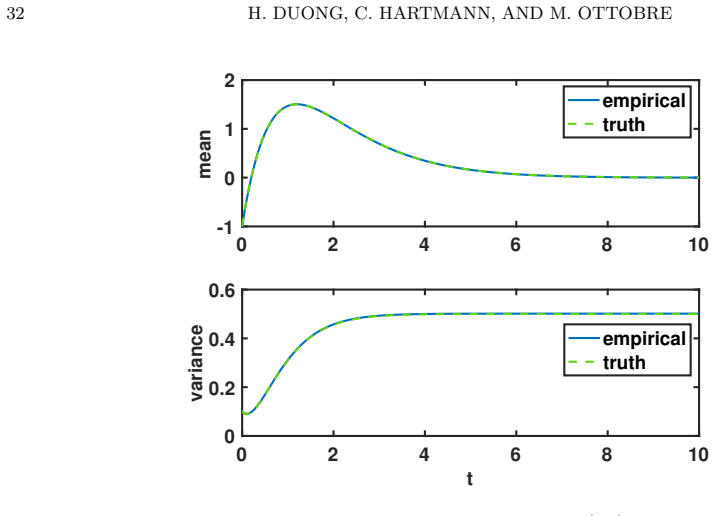
Take the uniform-elliptic modification of Example 2.1, i.e. add an independent noise term $\sqrt{2}\,dU_t$ to the slow equation (66), so the joint law is Gaussian with an explicit invariant measure. Compute the projection-method coefficients and the Gyöngy coefficients from the Gaussian conditional densities, check the obtuse-angle inequality of condition [C3] directly, and compare the invariant measure of the projected dynamics with the marginal $\bar\rho=N(0,1/2)$; a mismatch while [C3] holds would refute Theorem 5.3, and a match in a regime where [C3] fails would show the condition is too strong.
Extended reading notes
Core claim
The central discovery is that the autonomous SDE produced by the projection method, $$dX^P(t)=f_P(X^P(t))\,dt+\$alpha_P^{{1/2}}$(X^P(t))\,dU_t, \quad f_P(x)=\int f(x,y)\rho(y|x)\,dy,\quad \alpha_P(x)=\int \$\alpha$\$\alpha$^T(x,y)\rho(y|x)\,dy,$$ inherits its long-time behaviour from the Gyöngy SDE whose coefficients use the time-dependent conditional density $\rho_t(y|x)$ instead of the equilibrium conditional density $\rho(y|x)$. Theorem 5.3 states that if the original system has smooth, uniformly elliptic, ergodic coefficients, the Gyöngy SDE is well posed, and its non-autonomous coefficients satisfy Assumption A1---uniform ellipticity, a Lyapunov condition, the obtuse-angle commutator condition [C3], and convergence to the autonomous coefficients---then $X^P$ admits a unique invariant measure, equal to the marginal $\bar\rho$ of the invariant measure $\rho$ of the full system, so $\lim_{t\to\infty}\mathbb{E}h(X^P(t))=\int h(x)\bar\rho(x)\,dx$ for bounded continuous $h$. The proof does not rely on reversibility or an explicit formula for $\rho$, and it makes rigorous the relation between the projection method and Gyöngy's exact marginal-mimicking method.
Load-bearing premise
The time-dependent Gyöngy coefficients must satisfy the obtuse-angle commutator condition [C3], and because these coefficients are defined through the conditional density $\rho_t(y|x)$, which is usually not known explicitly, the condition is hard to check; the paper states this difficulty explicitly in Note 5.4 and leaves it to future work.
Editorial extensions
If this is right
- If the conditions of Theorem 5.3 hold, practitioners can use the projection-method SDE to compute long-time averages of the slow variables without simulating the fast variables, with the guarantee that the limiting statistics coincide with the marginal $\bar\rho$ of the full invariant measure.
- In the scale-separation limit, the equality of projection and averaging holds precisely when $\lim_{\varepsilon\to0}\rho_\varepsilon(y|x)\to\rho^{(x)}(y)$, which the paper shows is equivalent to the marginal of the invariant measure remaining strictly positive in the limit and to the kernel condition of Proposition 4.1 being satisfied.
- When the slow equation has degenerate noise, as in the Ornstein-Uhlenbeck example (66)-(67), the projection method can produce a zero-drift, zero-noise dynamics with a continuum of invariant measures, whereas averaging produces a nontrivial OU process; the two methods are then not only different, the projection method fails to capture the correct long-time behaviour.
- For reversible (gradient) systems the two methods coincide because the frozen invariant measure equals the equilibrium conditional law; the paper's examples show that non-reversibility alone does not determine whether they coincide.
Reading between the lines
- Editorial inference: the commutator condition [C3] reduces in one dimension to the monotonicity test $\partial_x f_G(t,x)\le -\lambda_0$, suggesting a cheap practical diagnostic---compute the conditional-drift derivative and check for contraction before trusting the projected reduced model.
- Editorial inference: the formal expansion in Section 4.2 ties the validity of the $\varepsilon\to0$ limit to the strict positivity of the limiting marginal; when the slow marginal degenerates (as in Example 4.5), the equilibrium conditional density cannot converge to the frozen measure, so a practical rule emerges: expect projection and averaging to disagree whenever the slow-variable invariant me
- Editorial inference: the same two-parameter-semigroup framework could be applied to other conditional-expectation reductions, such as nonlinear reaction coordinates, by substituting the reaction-coordinate conditional law for $\rho_t(y|x)$.
- Editorial inference: the degenerate-noise failure of the projection method indicates that the method should be applied only when the resolved variables carry their own noise; adding a small ellipticity to the slow equation and letting it vanish may provide a selection criterion among the many invariant measures, a possibility the paper does not explore.
Signed reviews
Editorial analysis
A structured set of objections, weighed in public.
Referee Report
Summary. The paper studies coarse-graining of stochastic differential equations by comparing the classical averaging principle with the projection method (PM), which constructs an effective dynamics by conditional expectation with respect to the equilibrium conditional distribution of the unresolved variables. The authors link the PM to Gyöngy's mimicking-marginals method, prove that the PM generator leaves the marginal of the original invariant measure infinitesimally invariant (Proposition 3.1), give necessary and sufficient conditions for the equilibrium conditional distribution to coincide with the frozen-process invariant measure (Proposition 4.1), and state a theorem (Theorem 5.3) under which the Gyöngy dynamics and the PM dynamics have the same long-time behavior, so that the PM samples the correct marginal. The comparison between PM and averaging is illustrated by examples and counterexamples, including a formal asymptotic expansion of the conditional distribution in the slow-fast limit. The main theorem relies on a non-autonomous SDE result (Theorem 5.1) adapted from the authors' prior work [CCDO21] and [ALL13].
Significance. If the main results hold, the paper provides a reversibility-independent justification of the projection method and clarifies its relationship to Gyöngy's exact mimicking construction. Proposition 3.1 and Proposition 4.1 are clean and useful, and the counterexample in Section 5.3 is instructive. The formal expansion in Section 4.2 is also a helpful heuristic. However, the central Theorem 5.3 is conditional on the obtuse angle condition [C3] imposed on the implicitly defined Gyöngy coefficients, and the paper does not exhibit any non-trivial system for which this condition is verified; Note 5.4 explicitly defers this check to future work. This substantially limits the practical applicability of the main theorem. In addition, several displayed formulas in the examples are incorrect. With corrections and a more honest framing of the theorem's scope, the paper could be a valuable contribution to the coarse-graining literature.
major comments (2)
- [§5.2, Theorem 5.3 and Assumption A1 [C3], with Note 5.4] The central theorem is gated by the obtuse angle condition [C3], which is imposed on the Stratonovich vector fields of the Gyöngy SDE (8). Since those fields are defined through the time-dependent conditional density ρ_t(y|x), which is explicit only in Gaussian or linear settings, [C3] is not checkable for typical systems. Note 5.4 concedes that checking Assumption iii) 'might be difficult' and defers it to future work. The paper provides no non-trivial class of systems for which [C3] is certified; the only sufficient condition mentioned (the two-dimensional case with α=σ, where [C3] reduces to ∂_x f_G ≤ −λ_0) is not applied to any example. The introduction's claim that the PM works for 'a large class of SDEs' is therefore not substantiated by the results. The authors should either add a non-trivial class of systems where [C3] is verified, or explicitly state in the abstract and introduction that Theorem 5.3 is conditional and that no instance of its hypotheses is provided.
- [§4.2, formal asymptotic expansion and the limit (29)] The paper claims to provide sufficient conditions under which the PM and averaging coincide in the limit of time-scale separation, but the derivation of the limit (29) is formal. The text states: 'To turn the above formal expansion into an actual proof one needs to combine these results on Poisson equations together with a more careful study of the difference ρε − ρ(x)(y) − ερ1(x,y), which needs to be shown to converge to zero as ε → 0. While not too difficult, this is not within the scope of this paper.' Thus the rigorous comparison of PM and averaging in the slow-fast regime is not established. Since this comparison is one of the paper's two advertised contributions, the formal status of this part should be clearly flagged in the abstract and introduction; as written, the reader may overestimate the strength of the results.
minor comments (6)
- [Example 2.1, equation (26)] The conditional variance in equation (26) is incorrect. For the joint Gaussian invariant measure with covariance matrix (25), the conditional variance of Y given X=x is 1 − (ε/(1+ε))^2 / (ε/(1+ε)) = 1/(1+ε), not (1−ε)/(1+ε). For ε=1, the stated formula gives variance zero, contradicting the direct computation in Section 5.3 where the correct value is 1/2.
- [Example 4.6] The conditional variance formula is incorrect. Given the stated covariance matrix Σε, the conditional variance is 1 − ε^2/((1+ε)(1+2ε)) = (1+3ε+ε^2)/(1+3ε+2ε^2), not (1−ε^2)/(1+3ε+4ε^2). The qualitative conclusion that ρε(·|x) converges to N(0,1) as ε→0 remains correct with the corrected formula, but the displayed expression should be fixed.
- [Example 4.4] The 'for instance' construction of the vector field A is incorrect: the condition is ∇_x V = ∇_y A, so the correct formula is A(x,y) = ∫_0^y ∂_x V(x,w) dw, not ∫_0^y ∂_y V(x,w) dw as written.
- [Note 4.2] The bullet list in Note 4.2 is malformed: bullets appear mid-sentence ('• As a direct consequence of Proposition 4.1, • if α12(x,y)=0 ... • states that L′ρ=0'). Please reformat so that the text reads as complete, coherent sentences.
- [Title/Abstract] The abstract displays 'A VERAGING' instead of 'AVERAGING' in the title; this typo should be corrected.
- [Example 4.6, pathwise convergence claim] The claim that 'it follows by Itô's formula and a standard Gronwall estimate that ... the projected dynamics converges pathwise' is not proved or even sketched. A brief indication of the estimate would strengthen the example.
Circularity Check
No significant circularity: Theorem 5.3 chains external Gyöngy results and published non-autonomous SDE theory; its restrictive hypothesis [C3] is an unverified condition, not an assumed conclusion.
full rationale
The paper's central claim, Theorem 5.3, is conditional and its proof is a legitimate chaining of external results. Proposition 3.2, which identifies the law of the Gyöngy SDE (8) with the x-marginal of the full system, is an adaptation of Gyöngy's published theorem, not a restatement of the target conclusion. Theorem 5.1, which transfers the long-time behaviour of the non-autonomous Gyöngy dynamics to its autonomous limit (the projection dynamics XP), is taken from and proved via [ALL13] and [CCDO21]; those are published, parameter-free theorems whose assumptions do not include the conclusion that XP has invariant measure \bar\rho. The target invariant measure is not assumed in Assumption A1: condition [C4] only assumes convergence of the time-dependent coefficients to their limits, and the identification of that limit with the invariant measure is then derived. The difficulty in checking [C3] (the obtuse angle condition for the implicitly defined Gyöngy coefficients) is explicitly acknowledged in Note 5.4 and deferred to future work; this makes the theorem conditional but does not make it circular. Proposition 3.1, showing that \bar\rho is infinitesimally invariant for the projected generator, is a direct computation from the definition of the conditional-expectation coefficients, not a predictive claim obtained by fitting. No parameter fitting, no renaming of known results, and no self-citation chain substituting for proof appear. The paper is self-contained in the sense that every claimed implication is either proved in the text or supported by independently published theorems with stated assumptions.
Assumptions & free parameters
assumptions (6)
- domain assumption The full system (1) is uniformly elliptic (equation (3)) and has smooth coefficients.
- domain assumption System (1) admits a unique weak solution and a unique invariant measure rho with density.
- domain assumption The Gyongy SDE (8) admits a unique weak solution with absolutely continuous law.
- domain assumption The coefficients of (8) satisfy Assumption A1, including the obtuse angle condition [C3] and the convergence condition [C4].
- domain assumption The frozen process (19) admits a unique invariant measure rho^(x) and converges to it.
- standard math Boundary terms in the integration by parts for L'_y vanish (Proposition 3.2 assumption ii).
Cite this review
Pith. "Pith review of Coarse graining of stochastic differential equations: averaging and projection method." pith.science (2026). https://pith.science/paper/K44RJYJA
@misc{pith2026250614939,
  author       = {Pith},
  title        = {Pith review of: Coarse graining of stochastic differential equations: averaging and projection method},
  year         = {2026},
  howpublished = {\url{https://pith.science/paper/K44RJYJA}},
  note         = {Machine review of arXiv:2506.14939}
}
read the original abstract
We study coarse-graining methods for stochastic differential equations. In particular we consider averaging and a type of projection operator method, sometimes referred to as effective dynamic via conditional expectations. The projection method (PM) we consider is related to the ``mimicking marginals'' coarse graining approach proposed by Gy\"ongy. The first contribution of this paper is to provide further theoretical background for the PM and a rigorous link to the Gy\"ongy method. Moreover, we compare PM and averaging. While averaging applies to systems with time scale separation, the PM can in principle be applied irrespective of this. However it is often assumed that the two methods coincide in presence of scale separation. The second contribution of this paper is to make this statement precise, provide sufficient conditions under which these two methods coincide and then show -- via examples and counterexamples -- that this needs not be the case.
Figures


Figures from the paper (1 more)

Forward citations
Cited by 1 Pith paper
-
Model Reduction of Multivariate Geometric Brownian Motions and Localization in a Two-State Quantum System
A hybrid invariant-manifold and fluctuation-dissipation reduction is shown to produce a one-dimensional additive-noise surrogate that preserves the localization dynamics of a two-state quantum geometric Brownian motion.
Reference graph
Works this paper leans on
-
[1]
Hypercontractivity and asymptotic behavior in nonautonomous kolmogorov equations
Luciana Angiuli, Luca Lorenzi, and Alessandra Lunardi. Hypercontractivity and asymptotic behavior in nonautonomous kolmogorov equations. Communications in Partial Differential Equations , 38(12):2049--2080, 2013
work page 2013
-
[2]
Sheldon Axler. Linear algebra done right . Springer Science & Business Media, 1997
work page 1997
-
[3]
A non-linear kinetic model of self-propelled particles with multiple equilibria
Paolo Butt \`a , Franco Flandoli, Michela Ottobre, and Boguslaw Zegarlinski. A non-linear kinetic model of self-propelled particles with multiple equilibria. arXiv preprint arXiv:1804.01247 , 2018
work page Pith review arXiv 2018
-
[4]
Global regularity and bounds for solutions of parabolic equations for probability measures
Vladimir I Bogachev, MICHAEL Rockner, and Stanislav V Shaposhnikov. Global regularity and bounds for solutions of parabolic equations for probability measures. Theory of Probability & Its Applications , 50(4):561--581, 2006
work page 2006
-
[5]
Mimicking an it\^ o process by a solution of a stochastic differential equation
Gerard Brunick and Steven Shreve. Mimicking an it\^ o process by a solution of a stochastic differential equation. The Annals of Applied Probability , 23:1584--1628, 2010
work page 2010
-
[6]
Thomas Cass, Dan Crisan, Paul Dobson, and Michela Ottobre. Long-time behaviour of degenerate diffusions: Ufg-type sdes and time-inhomogeneous hypoelliptic processes. Electron. J. Probab. , 26:1--72, 2021
work page 2021
-
[7]
Dan Crisan, Paul Dobson, Ben Goddard, Michela Ottobre, and Iain Souttar. Poisson equations with locally-lipschitz coefficients and uniform in time averaging for stochastic differential equations via strong exponential stability. arXiv preprint arXiv:2204.02679 , 2022
arXiv 2022
-
[8]
Dan Crisan, Paul Dobson, and Michela Ottobre. Uniform in time estimates for the weak error of the euler method for sdes and a pathwise approach to derivative estimates for diffusion semigroups. Transactions of the American Mathematical Society , 374(5):3289--3330, 2021
work page 2021
Show all 53 references
-
[9]
Optimal prediction and the mori--zwanzig representation of irreversible processes
Alexandre J Chorin, Ole H Hald, and Raz Kupferman. Optimal prediction and the mori--zwanzig representation of irreversible processes. Proceedings of the National Academy of Sciences , 97(7):2968--2973, 2000
2000
-
[10]
Optimal prediction with memory
Alexandre J Chorin, Ole H Hald, and Raz Kupferman. Optimal prediction with memory. Physica D: Nonlinear Phenomena , 166(3-4):239--257, 2002
2002
-
[11]
Prediction from partial data, renormalization, and averaging
Alexandre J Chorin, Ole H Hald, and Raz Kupferman. Prediction from partial data, renormalization, and averaging. Journal of Scientific Computing , 28(2-3):245--261, 2006
2006
-
[12]
Optimal prediction for hamiltonian partial differential equations
Alexandre J Chorin, Raz Kupferman, and Doron Levy. Optimal prediction for hamiltonian partial differential equations. Journal of Computational Physics , 162(1):267--297, 2000
2000
-
[13]
Pointwise gradient bounds for degenerate semigroups (of ufg type)
Dan Crisan and Michela Ottobre. Pointwise gradient bounds for degenerate semigroups (of ufg type). Proceedings of the Royal Society A: Mathematical, Physical and Engineering Sciences , 472(2195):20160442, 2016
2016
-
[14]
Global existence of smooth solutions for the vlasov-fokker-planck equation in 1 and 2 space dimensions
Pierre Degond. Global existence of smooth solutions for the vlasov-fokker-planck equation in 1 and 2 space dimensions. Annales scientifiques de l' \'E cole Normale Sup \'e rieure , 19(4):519--542, 1986
1986
-
[15]
Quantification of coarse-graining error in langevin and overdamped langevin dynamics
Manh Hong Duong, Agnes Lamacz, Mark A Peletier, Andr \'e Schlichting, and Upanshu Sharma. Quantification of coarse-graining error in langevin and overdamped langevin dynamics. Nonlinearity , 31(10):4517, 2018
2018
-
[16]
Ornstein--uhlenbeck operators with time periodic coefficients
Giuseppe Da Prato and Alessandra Lunardi. Ornstein--uhlenbeck operators with time periodic coefficients. Journal of Evolution Equations , 7(4):587--614, 2007
2007
-
[17]
Analysis of multiscale methods for stochastic differential equations
Weinan E, Di Liu, and Eric Vanden-Eijnden. Analysis of multiscale methods for stochastic differential equations. Communications on Pure and Applied Mathematics , 58(11):1544--1585, 2005
2005
-
[18]
Extracting macroscopic dynamics: model problems and algorithms
Dror Givon, Raz Kupferman, and Andrew Stuart. Extracting macroscopic dynamics: model problems and algorithms. Nonlinearity , 17(6):R55, 2004
2004
-
[19]
Mimicking the one-dimensional marginal distributions of processes having an It \^o differential
Istv \'a n Gy \"o ngy. Mimicking the one-dimensional marginal distributions of processes having an It \^o differential. Probability theory and related fields , 71(4):501--516, 1986
1986
-
[20]
Accelerating diffusions
Chii-Ruey Hwang, Shu-Yin Hwang-Ma, and Shuenn-Jyi Sheu. Accelerating diffusions. The Annals of Applied Probability , 15(2), 2005
2005
-
[21]
Coarse graining of nonreversible stochastic differential equations: Quantitative results and connections to averaging
Carsten Hartmann, Lara Neureither, and Upanshu Sharma. Coarse graining of nonreversible stochastic differential equations: Quantitative results and connections to averaging. SIAM Journal on Mathematical Analysis , 52(3):2689--2733, 2020
2020
-
[22]
Adaptive dimensionality reduction of stochastic differential equations for protein dynamics
Jes \'u s A Izaguirre and Christopher R Sweet. Adaptive dimensionality reduction of stochastic differential equations for protein dynamics. In Proc. second international workshop on model reduction in reacting flows , 2009
2009
-
[23]
Stochastic modelling: replacing fast degrees of freedom by noise
Wolfram Just, Holger Kantz, Christian R \"o denbeck, and Mario Helm. Stochastic modelling: replacing fast degrees of freedom by noise. Journal of Physics A: Mathematical and General , 34(15):3199, 2001
2001
-
[24]
R. Z. Khasminskij. On the principle of averaging the it \^o 's stochastic differential equations. Kybernetika , 4:260--279, 1968
1968
-
[25]
Statistical mechanics of fluid mixtures
John G Kirkwood. Statistical mechanics of fluid mixtures. The Journal of chemical physics , 3(5):300--313, 1935
1935
-
[26]
Fast chaos versus white noise: entropy analysis and a fokker--planck model for the slow dynamics
Holger Kantz, Wolfram Just, Nil \"u fer Baba, Katrin Gelfert, and Anja Riegert. Fast chaos versus white noise: entropy analysis and a fokker--planck model for the slow dynamics. Physica D: Nonlinear Phenomena , 187(1-4):200--213, 2004
2004
-
[27]
Nonautonomous kolmogorov parabolic equations with unbounded coefficients
Markus Kunze, Luca Lorenzi, and Alessandra Lunardi. Nonautonomous kolmogorov parabolic equations with unbounded coefficients. Transactions of the american mathematical society , 362(1):169--198, 2010
2010
-
[28]
Brownian motion and stochastic calculus , volume 113
Ioannis Karatzas and Steven Shreve. Brownian motion and stochastic calculus , volume 113. springer, 2014
2014
-
[29]
Fractional kinetics in kac--zwanzig heat bath models
Raz Kupferman. Fractional kinetics in kac--zwanzig heat bath models. Journal of statistical physics , 114:291--326, 2004
2004
-
[30]
Analytical methods for Markov semigroups
Luca Lorenzi and Marcello Bertoldi. Analytical methods for Markov semigroups . Chapman and Hall/CRC, 2006
2006
-
[31]
Effective dynamics using conditional expectations
Fr \'e d \'e ric Legoll and Tony Lelievre. Effective dynamics using conditional expectations. Nonlinearity , 23(9):2131, 2010
2010
-
[32]
Some remarks on free energy and coarse-graining
Fr \'e d \'e ric Legoll and Tony Lelievre. Some remarks on free energy and coarse-graining. In Numerical Analysis of Multiscale Computations: Proceedings of a Winter Workshop at the Banff International Research Station 2009 , pages 279--329. Springer, 2011
2009
-
[33]
Pathwise estimates for an effective dynamics
Fr \'e d \'e ric Legoll, Tony Lelievre, and Stefano Olla. Pathwise estimates for an effective dynamics. Stochastic Processes and their Applications , 127(9):2841--2863, 2017
2017
-
[34]
Effective dynamics for non-reversible stochastic differential equations: a quantitative study
Frederic Legoll, Tony Lelievre, and Upanshu Sharma. Effective dynamics for non-reversible stochastic differential equations: a quantitative study. Nonlinearity , 32(12):4779--4816, 2019
2019
-
[35]
A mathematical theory of optimal milestoning (with a detour via exact milestoning)
Ling Lin, Jianfeng Lu, and Eric Vanden-Eijnden. A mathematical theory of optimal milestoning (with a detour via exact milestoning). Commun Pure Appl. Math. , 71(6):1149--1177, 2018
2018
-
[36]
Optimal non-reversible linear drift for the convergence to equilibrium of a diffusion
Tony Lelievre, Francis Nier, and Grigorios A Pavliotis. Optimal non-reversible linear drift for the convergence to equilibrium of a diffusion. Journal of Statistical Physics , 152(2):237--274, 2013
2013
-
[37]
Pathwise estimates for effective dynamics: the case of nonlinear vectorial reaction coordinates
Tony Leli \`e vre and Wei Zhang. Pathwise estimates for effective dynamics: the case of nonlinear vectorial reaction coordinates. Multiscale Modeling & Simulation , 17(3):1019--1051, 2019
2019
-
[38]
G. M. Moy, J. J. Hope, and C. M. Savage. Born and markov approximations for atom lasers. Phys. Rev. A , 59:667--675, Jan 1999
1999
-
[39]
A continued-fraction representation of the time-correlation functions
Hazime Mori. A continued-fraction representation of the time-correlation functions. Progress of Theoretical Physics , 34(3):399--416, 1965
1965
-
[40]
A mathematical framework for stochastic climate models
Andrew J Majda, Ilya Timofeyev, and Eric Vanden Eijnden. A mathematical framework for stochastic climate models. Communications on Pure and Applied Mathematics: A Journal Issued by the Courant Institute of Mathematical Sciences , 54(8):891--974, 2001
2001
-
[41]
Spectral properties of effective dynamics from conditional expectations
Feliks N \"u ske, P \'e ter Koltai, Lorenzo Boninsegna, and Cecilia Clementi. Spectral properties of effective dynamics from conditional expectations. Entropy , 23(2):134, 2021
2021
-
[42]
Asymptotic analysis for the generalized langevin equation
Michela Ottobre and Grigorios A Pavliotis. Asymptotic analysis for the generalized langevin equation. Nonlinearity , 24(5):1629, 2011
2011
-
[43]
Stochastic processes and applications
Grigorios A Pavliotis. Stochastic processes and applications. Texts in applied mathematics , 60, 2014
2014
-
[44]
K. B. Petersen and M. S. Pedersen. The matrix cookbook, 2012. Version 20121115
2012
-
[45]
Multiscale methods: averaging and homogenization , volume 53
Grigorios A Pavliotis and Andrew Stuart. Multiscale methods: averaging and homogenization , volume 53. Springer Science & Business Media, 2008
2008
-
[46]
The time-dependent born-oppenheimer approximation
Gianluca Panati, Herbert Spohn, and Stefan Teufel. The time-dependent born-oppenheimer approximation. ESAIM: Mathematical Modelling and Numerical Analysis , 41(2):297--314, 2007
2007
-
[47]
On poisson equation and diffusion approximation 2
E Pardoux and A Yu Veretennikov. On poisson equation and diffusion approximation 2. The Annals of Probability , 31(3):1166--1192, 2003
2003
-
[48]
Conditions for uniform in time convergence: applications to averaging, numerical discretisations and mean-field systems
Katharina Schuh and Iain Souttar. Conditions for uniform in time convergence: applications to averaging, numerical discretisations and mean-field systems. arXiv preprint arXiv:2412.05239 , 2024
2024 arXiv
-
[49]
Longtime convergence of the temperature-accelerated molecular dynamics method
Gabriel Stoltz and Eric Vanden-Eijnden. Longtime convergence of the temperature-accelerated molecular dynamics method. Nonlinearity , 31(8):3748, 2018
2018
-
[50]
Topics in propagation of chaos
Alain-Sol Sznitman. Topics in propagation of chaos. Ecole d? \'e t \'e de probabilit \'e s de Saint-Flour XIX?1989 , 1464:165--251, 1991
1989
-
[51]
A. Yu. Veretennikov. On the averaging principle of averaging for systems of stochastic differential equations. Mathematics of the USSR-Sbornik , 69(1):271, 1991
1991
-
[52]
Numerically optimal runge--kutta pairs with interpolants
James H Verner. Numerically optimal runge--kutta pairs with interpolants. Numerical Algorithms , 53(2):383--396, 2010
2010
-
[53]
Effective dynamics along given reaction coordinates, and reaction rate theory
Wei Zhang, Carsten Hartmann, and Christof Sch \"u tte. Effective dynamics along given reaction coordinates, and reaction rate theory. Faraday discussions , 195:365--394, 2016
2016
Reviewed August 15, 2026 · model on record in the stance chip above.
Discussion (0). Continue with ORCID to comment.