REVIEW 3 major objections 4 minor 48 references
Attosecond tunneling time measurements through momentum squeezing in strong field ionization
T0 review · 3 major / 4 minor · reviewed 2026-08-15 · deepseek-v4-flash
Pith's one-line read This paper claims that the time an electron spends tunneling out of an atom is imprinted in the width of its photoelectron momentum distribution, so tunneling durations can be read directly from momentum images.
desk verdict The paper proposes a direct readout of tunneling times from transverse momentum widths, with strong TDSE support, but the central SFA derivation is omitted and needs to be shown. read the letter →
The pith
A machine-rendered reading of the paper's core claim, the machinery that carries it, and where it could break.
The reading
What carries the argument
The load-bearing object is the complex saddle-point time $t_\star=t_0+i\tau$, which encodes tunneling as an excursion into imaginary time. Expanding the strong-field-approximation wavefunction around the most probable momentum in cylindrical coordinates produces the Gaussian factorization of Eqs. (1a)-(1c), and a transcendental equation links $\tau$ to the instantaneous adiabaticity parameter $\gamma(t_0)=\omega\sqrt{2I_p}/F(t_0)$. The same $\tau$ emerges from the WKB wavefunction of a static barrier as the traversal time, so the transverse momentum squeezing is identified as the universal observable signature of the tunneling duration.
What would settle it
Measure photoelectron momentum distributions from a noble gas at high angular resolution and extract $\tau$ independently from the $p_z$ and the in-plane widths; the two values must lie on the curve of Eq. (1c) after the known Coulomb shift, otherwise the Gaussian-width interpretation fails. A cleaner test uses an atom with a short-range potential, where Coulomb corrections are absent, and checks that the extracted $\tau$ follows the predictions of Eq. (4) across intensity and angle; a mismatch would rule out the protocol.
Extended reading notes
Core claim
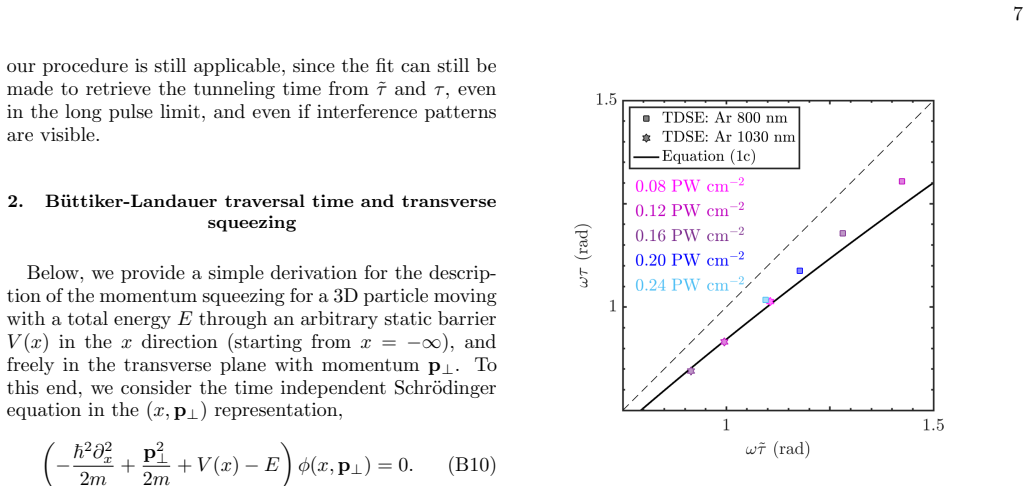
The central claim is that the photoelectron momentum distribution from strong-field ionization by a circularly polarized pulse factorizes as $D(p,p_z;\theta)=D_z(p_z;\theta)D_p(p;\theta)$, with $D_z(p_z;\theta)\propto \exp(-m\tau(\theta)p_z^2/\hbar)$ and an analogous Gaussian along $p$ whose inverse width $\tilde{\tau}(\theta)$ is a known function of $\tau$, the laser frequency, and the adiabaticity parameter. The tunneling duration $\tau(\theta)$ is therefore observable as the inverse width of the momentum-space Gaussian once the emission angle is converted into an exit time via $\theta=\omega t_0$. The same Gaussian squeezing follows from a WKB treatment of a static three-dimensional barrier, where the width is controlled by the traversal time $\tau=\int_{x_{\mathrm{in}}}^{x_0} dx/\sqrt{2[V(x)-E]/m}$, showing that the effect is a general property of multidimensional tunneling rather than an artifact of the strong-field approximation. Numerical solutions of the time-dependent Schrödinger equation and re-analysis of experimental momentum distributions support the protocol, yielding durations of hundreds of attoseconds that increase as the instantaneous laser field decreases.
Load-bearing premise
The protocol assumes that the Gaussian width measured at the detector is the unmodified imprint of the tunneling duration, meaning that post-barrier Coulomb attraction, focal-volume intensity averaging, and detector resolution do not appreciably reshape the transverse momentum distribution; the paper's own supplementary analysis shows that Coulomb effects shift extracted times by tens of attoseconds along the propagation axis at large angles and that the angle-to-time mapping would be modified there.
Editorial extensions
If this is right
- Tunneling durations can be read from a single photoelectron momentum image by fitting Gaussian widths, with a time resolution of roughly $\delta\tau[\mathrm{asec}]\approx 0.01\,\delta\theta[\mathrm{deg}]\,\lambda[\mathrm{nm}]$.
- The photoemission direction acts as a clock hand through $\theta=\omega t_0$, so no separate reference clock is needed to time the tunnel exit.
- Because the Coulomb potential shifts the $p_z$-derived times more than the in-plane times, in-plane extraction is the more reliable route, and the Coulomb bias shrinks at higher ionization potentials or longer wavelengths.
- In the long-pulse limit, above-threshold-ionization interference peaks modulate but do not change the Gaussian widths, so the protocol is not restricted to few-cycle pulses.
- The extracted finite durations of hundreds of attoseconds reconcile the attoclock debate by showing where the tunneling time is recorded and why earlier near-zero readings arose.
Reading between the lines
- The transverse-squeezing relation should apply to tunneling in other multidimensional settings, such as field emission from surfaces, where the transverse momentum width of emitted electrons could serve as a built-in clock.
- An experiment that simultaneously measures both widths at a single angle, with high statistics, could check the ratio $\tilde{\tau}/\tau$ against Eq. (1c) and thereby isolate any post-barrier distortion source.
- The protocol might extend to elliptical polarization or aligned molecules, where the barrier is anisotropic; the momentum width could then map the orientation-dependent barrier shape rather than a single duration.
- Since the dispersion of $\tau$ across momentum components is below 1% in typical conditions, higher-order fits to the non-Gaussian wings of the distribution could in principle retrieve a distribution of tunneling times rather than a single most-probable value.
Signed reviews
Editorial analysis
A structured set of objections, weighed in public.
Referee Report
Summary. The manuscript claims that in strong-field ionization by a circularly polarized infrared pulse, the transverse photoelectron momentum distribution carries the tunneling duration in its width: along the light-propagation axis it is Gaussian in p_z with width set by the tunneling time tau(theta), and along the polarization-plane radius it is Gaussian in p around the most probable momentum with a modified width given by Eq. (1c). The paper derives these forms from the strong-field approximation and a WKB traversal-time argument, validates them against 3D TDSE simulations for hydrogen, a short-range model atom, and a model argon atom, and applies the p_z form to published argon experimental data to extract tunneling times of a few hundred attoseconds. It also proposes an angular resolution estimate and discusses the effect of the Coulomb potential, admitting that it up-shifts extracted times by tens of attoseconds along p_z.
Significance. If the central Gaussian-width identity holds, the paper offers a simple, parameter-free protocol for reading tunneling and exit times from photoelectron momentum distributions, with an estimated resolution of ~16 as at 800 nm and 2-degree angular resolution. The strengths are that the central relation has no fitted constants, is tested on several potentials and against one published experimental distribution, and the paper includes a resolution formula and an explicit long-pulse analysis. The main caveat is that the derivation of the Gaussian form from the saddle-point equations is not shown, and the admitted Coulomb systematics are of the same order as the claimed accuracy, so the quantitative claim is currently supported more by numerical agreement than by a complete analytic derivation.
major comments (3)
- The central result is obtained by substituting the saddle-point conditions into the SFA wave packet and expanding around (p0,0), but the manuscript only states that this happens 'after several steps of mathematical (and somehow tedious) rewriting' and does not show the expansion of the prefactor C(p,t*) in Eq. (B3) or of the real-time action contribution. Since C contains the initial-state momentum dependence through |p+A(t*)|, and the action S(p,t*) contributes p_z-dependent phase factors, the statement that D_z(p_z;theta) is Gaussian with width exactly m tau(theta)/hbar requires that these contributions either cancel or are negligible. Because Eq. (1a) is used to convert the published argon widths into tunneling times in Fig. 3, this omitted step is load-bearing for the absolute calibration. Please provide the complete saddle-point expansion, including the p_z dependence of the prefactor and the real-time phase, and state the approximations and their validity range.
- The supplementary material states that the Coulomb potential up-shifts the extracted times by tens of attoseconds along p_z and would modify Eq. (2) at large angles, yet the experimental retrieval in Fig. 3 uses exactly the p_z channel. The text says the Coulomb effect 'does not hamper the validity of our SFA-based interpretations,' but an up-shift of tens of attoseconds is of the same order as the claimed precision and as the differences between the experimental points and Eq. (4). Please quantify the Coulomb correction for the argon conditions used in Fig. 3, or restrict the quantitative claims to the p channel where the Coulomb effect is stated to be smaller, or provide a systematic correction procedure.
- The figure caption reads 'using Eq. 1b' while the text explicitly says the argon extraction uses Eq. (1a); since Eqs. (1a) and (1b) correspond to different momentum channels, this inconsistency must be resolved.
minor comments (4)
- The long-pulse analysis in Eq. (B8) keeps C(p,t*) inside the interference sum but the subsequent claim that the ATI peaks are 'modulated by the distribution (1b)' ignores possible p-dependence of C(p,t*) in the interference sum; please add a sentence explaining why C does not affect the width.
- The sentence 'the less straightforward tau-dependency of the PMD width along p ... boils down to a bijective one-to-one map' is grammatically awkward; please rephrase for clarity.
- There are several small language issues: 'gaz' should be 'gas', 'conforts' should be 'confirms', and 'envelop' should be 'envelope' in the methods and figure captions.
- Reference [39] is cited in the text alongside [38] for the Ammosov-Delone-Krainov rate, but [39] is the experimental Arissian et al. paper; please verify the citation numbering.
Circularity Check
No significant circularity: the tunneling-time/width relation is derived from the SFA saddle-point expansion and tested against independent TDSE and published experimental data.
full rationale
The paper's central relation—Eqs. (1a)-(1c), connecting transverse PMD widths to the tunneling duration—is derived within the SFA saddle-point approximation rather than fitted. In SM B.1, tau is defined as the saddle-point imaginary time at the distribution maximum via Eq. (B5d), and the subsequent expansion of the action produces an explicit exponential term -F^2/omega^2 tau sigma_z^2, which is -tau p_z^2 after rescaling sigma_z = omega p_z/F. The Gaussian width is therefore a mathematical consequence of the model, not an input parameter renamed as a prediction. The protocol then extracts widths from TDSE simulations and from the published Ar PMDs of Ref. [39], both of which are external to the derivation. The TDSE simulations do not assume the SFA Gaussian form, so agreement with Eq. (4) provides independent support. The experimental data are likewise used as an external benchmark. The only self-citation, Ref. [44], supports the minor and explicitly verified point that initial-state symmetry plays a small role for Ar ('we verified with SFA-based simulations'); it is not load-bearing for the main derivation or the angle-to-time mapping. No external uniqueness theorem is imported from the authors' prior work, and no fitted parameter is presented as a prediction. The SM's phrase 'after several steps of mathematical (and somehow tedious) rewriting' indicates an omitted algebraic derivation, but an omitted expansion is a completeness issue, not circularity. Accordingly, the paper is self-contained against external benchmarks and merits a circularity score of 0.
Assumptions & free parameters
free parameters (2)
- Amplitude A of short-range potential =
set to yield ground-state energy -0.5 a.u.
- Regularization parameter b of soft-Coulomb potential =
set to yield ground-state energy -0.58 a.u.
assumptions (6)
- standard math SFA saddle-point approximation of the ionization amplitude
- domain assumption Slowly varying envelope approximation F(t0+i*tau) approximately F(t0)
- domain assumption Single-active-electron model potentials
- domain assumption Identification of SFA imaginary time tau with Buttiker-Landauer traversal time
- domain assumption Neglect of Stark shift and dressing effects
- domain assumption Gaussian truncation of the wavepacket around the most probable momentum
Cite this review
Pith. "Pith review of Attosecond tunneling time measurements through momentum squeezing in strong field ionization." pith.science (2026). https://pith.science/paper/K457UOT6
@misc{pith2026250617483,
  author       = {Pith},
  title        = {Pith review of: Attosecond tunneling time measurements through momentum squeezing in strong field ionization},
  year         = {2026},
  howpublished = {\url{https://pith.science/paper/K457UOT6}},
  note         = {Machine review of arXiv:2506.17483}
}
read the original abstract
Tunneling of a particle through a potential barrier is a fundamental physical process and a major thought-provoking outcome of quantum physics. It is at the basis of multiple scientific and technological advances and strongly influences both the structuring and the dynamics of matter at the microscopic scale. Without a classical counterpart, it defies our intuitive perception and understanding of the motion of a particle. Thus, the temporal characterization of tunneling, typically in terms of the time spent "under the barrier", referred to as tunneling time, raises several debates and questions on its interpretation and measurability. Here we show that an electron wavepacket tunneling out of an atom through the potential barrier induced by a strong electric field, carries in its momentum profile the value of the corresponding tunneling time, in a self-probing manner. In a revisited interpretation of the attoclock setup, we view a circularly polarized light pulse as a temporal prism which maps the barrier configuration, and hence the tunneling dynamics, onto different photoelectron ejection directions. From our simulations, we find that tunneling times in the infrared regime are of the order of hundreds of attoseconds, in agreement with previous theories.
Figures


Figures from the paper (3 more)


Reference graph
Works this paper leans on
-
[1]
Derivation of the main results a. PMD in the strong-field approximation The objective is to characterize the tunneling dynam- ics in circularly polarized strong field ionization with a single tunneling time for each photoemission directionθ. The starting point is the strong-field approximation [25] which assigns the following ansatz to the continuum elec-...
-
[2]
B¨ uttiker-Landauer traversal time and transverse squeezing Below, we provide a simple derivation for the descrip- tion of the momentum squeezing for a 3D particle moving with a total energyEthrough an arbitrary static barrier V(x) in thexdirection (starting fromx=−∞), and freely in the transverse plane with momentump ⊥. To this end, we consider the time ...
-
[3]
Imprint of the Coulomb potential in the tunneling times In Figs. 4 and 5, we tested the role of the laser wave- length, either 800 or 1030 nm, on the tunneling duration extracted from the PMD compared to the analytic ex- pression of Eq. (1c) and found a better agreement as the Keldysh parameter is smaller for longer wavelength at the same intensity. We al...
- [4]
-
[5]
L’Huillier and P
A. L’Huillier and P. Balcou, Phys. Rev. Lett.70, 774 (1993)
1993
-
[6]
Trixler, Current Organic Chemistry17, 1758 (2013)
F. Trixler, Current Organic Chemistry17, 1758 (2013)
work page 2013
-
[7]
R. Wild, M. N¨ otzold, M. Simpson, T. D. Tran, and R. Wester, Nature615, 425 (2023)
work page 2023
-
[8]
B¨ uttiker and R
M. B¨ uttiker and R. Landauer, Phys. Rev. Lett.49, 1739 (1982)
1982
Show all 48 references
-
[9]
Sokolovski, Phys
D. Sokolovski, Phys. Rev. A52, R5 (1995)
1995
-
[10]
Yamada, Phys
N. Yamada, Phys. Rev. Lett.93, 170401 (2004)
2004
-
[11]
Ramos, D
R. Ramos, D. Spierings, I. Racicot, and A. M. Steinberg, Nature583, 529 (2020)
2020
-
[12]
Sokolovski, Phys
D. Sokolovski, Phys. Rev. Lett.79, 4946 (1997)
1997
-
[13]
Sokolovski and E
D. Sokolovski and E. Akhmatskaya, Communications Physics1, 47 (2018)
2018
-
[14]
U. S. Sainadh, H. Xu, X. Wang, A. Atia-Tul-Noor, W. C. Wallace, N. Douguet, A. Bray, I. Ivanov, K. Bartschat, A. Kheifets, R. T. Sang, and I. V. Litvinyuk, Nature 568, 75 (2019)
2019
-
[15]
U. S. Sainadh, R. T. Sang, and I. V. Litvinyuk, Journal of Physics: Photonics2, 042002 (2020)
2020
-
[16]
Hofmann, A
C. Hofmann, A. Bray, W. Koch, H. Ni, and N. I. Shvetsov-Shilovski, The European Physical Journal D 75, 208 (2021)
2021
-
[17]
Eckle, A
P. Eckle, A. N. Pfeiffer, C. Cirelli, A. Staudte, R. D¨ orner, H. G. Muller, M. B¨ uttiker, and U. Keller, Science322, 1525 (2008)
2008
-
[18]
Torlina, F
L. Torlina, F. Morales, J. Kaushal, I. Ivanov, A. Kheifets, A. Zielinski, A. Scrinzi, H. G. Muller, S. Sukiasyan, M. Ivanov, and O. Smirnova, Nature Physics11, 503 (2015)
2015
-
[19]
D. Ren, C. Chen, X. Li, X. Zhao, S. Wang, M. Li, X. Zhao, P. Ma, C. Wang, Y. Yang, Y. Chen, S. Luo, and D. Ding, Phys. Rev. Res.5, L032044 (2023)
2023
-
[20]
B¨ uttiker, Phys
M. B¨ uttiker, Phys. Rev. B27, 6178 (1983)
1983
-
[21]
P. A. Martin and M. S. de Bianchi, Journal of Physics A: Mathematical and General25, 3627 (1992). 9 FIG. 6. Tunneling time as a function of the angle at 800 nm for different laser intensities obtained from three-dimensional (3D) simulations. The solid lines are the theoretical...
1992
-
[22]
D. C. Spierings and A. M. Steinberg, Phys. Rev. Lett. 127, 133001 (2021)
2021
-
[23]
Fortun, C
A. Fortun, C. Cabrera-Guti´ errez, G. Condon, E. Michon, J. Billy, and D. Gu´ ery-Odelin, Phys. Rev. Lett.117, 010401 (2016)
2016
-
[24]
Balcou and L
P. Balcou and L. Dutriaux, Phys. Rev. Lett.78, 851 (1997)
1997
-
[25]
Strickland and G
D. Strickland and G. Mourou, Optics Communications 55, 447 (1985)
1985
-
[26]
J. L. Krause, K. J. Schafer, and K. C. Kulander, Phys. Rev. Lett.68, 3535 (1992)
1992
-
[27]
P. B. Corkum, Phys. Rev. Lett.71, 1994 (1993)
1993
-
[28]
Lewenstein, P
M. Lewenstein, P. Balcou, M. Y. Ivanov, A. L’Huillier, and P. B. Corkum, Phys. Rev. A49, 2117 (1994)
1994
-
[29]
Pedatzur, G
O. Pedatzur, G. Orenstein, V. Serbinenko, H. Soifer, B. D. Bruner, A. J. Uzan, D. S. Brambila, A. G. Harvey, L. Torlina, F. Morales, O. Smirnova, and N. Dudovich, Nature Physics11, 815 (2015)
2015
-
[30]
Eckart, M
S. Eckart, M. Kunitski, M. Richter, A. Hartung, J. Rist, F. Trinter, K. Fehre, N. Schlott, K. Henrichs, L. P. H. Schmidt, T. Jahnke, M. Sch¨ offler, K. Liu, I. Barth, J. Kaushal, F. Morales, M. Ivanov, O. Smirnova, and R. D¨ orner, Nature Physics14, 701 (2018)
2018
-
[31]
Eckart, K
S. Eckart, K. Fehre, N. Eicke, A. Hartung, J. Rist, D. Tra- bert, N. Strenger, A. Pier, L. P. H. Schmidt, T. Jahnke, M. S. Sch¨ offler, M. Lein, M. Kunitski, and R. D¨ orner, Phys. Rev. Lett.121, 163202 (2018)
2018
-
[32]
H. Ni, U. Saalmann, and J.-M. Rost, Phys. Rev. Lett. 117, 023002 (2016)
2016
-
[33]
Teeny, C
N. Teeny, C. H. Keitel, and H. Bauke, Phys. Rev. A94, 022104 (2016)
2016
-
[34]
X. Wang, J. Tian, and J. H. Eberly, Journal of Physics B: Atomic, Molecular and Optical Physics51, 084002 (2018)
2018
-
[35]
A. M. Perelomov, V. S. Popov, and M. V. Terent’ev, Sov. Phys. JETP23, 924 (1966)
1966
-
[36]
A. M. Perelomov, V. S. Popov, and M. V. Terent’ev, Sov. Phys. JETP24, 207 (1967)
1967
-
[37]
A. M. Perelomov and V. S. Popov, Sov. Phys. JETP25, 336 (1967)
1967
-
[38]
Barth and O
I. Barth and O. Smirnova, Phys. Rev. A84, 063415 (2011). 10
2011
-
[39]
Messiah, Quantum Mechanics Volume II (Elsevier Science B.V., 1961)
A. Messiah, Quantum Mechanics Volume II (Elsevier Science B.V., 1961)
1961
-
[40]
L. V. Keldysh, Sov. Phys. JETP20, 1307 (1965)
1965
-
[41]
M. V. Ammosov, N. B. Delone, and V. P. Krainov, Sov. Phys. JETP64, 1191 (1986)
1986
-
[42]
Arissian, C
L. Arissian, C. Smeenk, F. Turner, C. Trallero, A. V. Sokolov, D. M. Villeneuve, A. Staudte, and P. B. Corkum, Phys. Rev. Lett.105, 133002 (2010)
2010
-
[43]
G. L. Yudin and M. Y. Ivanov, Phys. Rev. A64, 013409 (2001)
2001
-
[44]
Li, M.-M
M. Li, M.-M. Liu, J.-W. Geng, M. Han, X. Sun, Y. Shao, Y. Deng, C. Wu, L.-Y. Peng, Q. Gong, and Y. Liu, Phys. Rev. A95, 053425 (2017)
2017
-
[45]
W. H. Press, S. A. Teukolsky, W. T. Vetterling, and B. P. Flannery, Numerical Recipes in C: The Art of Scientific Computing (Cambridge University Press, 1992)
1992
-
[46]
Robert, McLachlan, Communications in Computa- tional Physics31, 987 (2022)
I. Robert, McLachlan, Communications in Computa- tional Physics31, 987 (2022)
2022
-
[47]
Dubois, C
J. Dubois, C. L´ evˆ eque, J. Caillat, R. Ta¨ ıeb, U. Saalmann, and J.-M. Rost, Phys. Rev. A109, 013112 (2024)
2024
-
[48]
Labeye, F
M. Labeye, F. Risoud, A. Maquet, J. Caillat, and R. Ta¨ ıeb, Journal of Physics B: Atomic, Molecular and Optical Physics51, 094001 (2018)
2018
Reviewed August 15, 2026 · model on record in the stance chip above.
Discussion (0). Continue with ORCID to comment.