REVIEW 3 major objections 6 minor 64 references
Bosonic Peierls state emerging from the one-dimensional Ising-Kondo interaction
T0 review · 3 major / 6 minor · reviewed 2026-08-12 · deepseek-v4-flash
Pith's one-line read Bosons without a Fermi surface can still form a Peierls-like state: the bosonic Ising-Kondo lattice develops a long-range spin-density wave with $k_{\max}=\pi\rho$.
desk verdict A plausible but numerically thin bosonic Peierls claim that deserves a serious referee, not yet a settled result. read the letter →
The pith
A machine-rendered reading of the paper's core claim, the machinery that carries it, and where it could break.
The reading
What carries the argument
The load-bearing object is the spin structure factor $S(k)=\frac{1}{L}\sum_{l,j}\langle \hat{s}_l^z \hat{s}_j^z\rangle e^{i(l-j)k}$ and its thermodynamic limit $S(k)/L$: a nonzero limit of $S(k_{\max})/L$ at nonzero $k_{\max}$ is the paper's operational definition of a spin-density wave, and the identity $k_{\max}=\pi\rho$ is what makes the order Peierls-like. Supporting machinery includes the second-order effective spin Hamiltonian (9) derived in the strong-coupling limit, whose coupling constant $\mathcal{J}$ changes sign and thereby selects antiferromagnetic (spin-density-wave) versus ferromagnetic order, and the weak-coupling effective Hamiltonian whose RKKY-type coupling $R_l$ is strictly positive for all $l$, which favors ferromagnetism and defines the small-$J$ side of the phase diagram.
What would settle it
Repeat the spin structure factor calculation on chains longer than $L=32$ (for example $L=40$ to $L=64$) with periodic boundary conditions and a higher single-site boson cutoff; if the peak at $k_{\max}=\pi\rho$ extrapolates to zero or drifts away from $\pi\rho$ in the thermodynamic limit at intermediate $J$, the claimed bosonic Peierls state is an artifact. In the proposed cold-atom ladder, a direct falsifier is the absence of the $\pi\rho$ peak in site-resolved spin correlations at intermediate Kondo coupling and strong $U$.
Extended reading notes
Core claim
The central discovery is that the ground state of the bosonic Ising-Kondo lattice (Hamiltonian (1)) contains a long-range spin-density-wave phase in the intermediate-coupling, strong-$U$ regime. Using density-matrix renormalization group calculations on chains up to $L=32$, the paper shows that the scaled spin structure factor $S(k_{\max})/L$ has a peak that survives the $L\to\infty$ extrapolation, and that $k_{\max}$ remains pinned to $\pi\rho$ as $J$ and $U$ are varied as long as the phase persists. In this phase the ground state is twofold degenerate with a finite excitation gap at commensurate filling, and superfluid correlations decay exponentially; at incommensurate filling the state remains gapped but compressible. The result is supported by perturbative effective spin Hamiltonians in the weak-coupling and strong-coupling limits, which yield the paramagnetic and ferromagnetic phases and delimit where the spin-density wave should appear. The paper thus claims that the Peierls relation $k_{\max}=2k_F=\pi\rho$ survives in a system with no Fermi surface.
Load-bearing premise
The claim depends on the extrapolation that the peak in $S(k)/L$ at $k_{\max}=\pi\rho$ stays nonzero as the chain length grows beyond the 32 sites used in the DMRG simulations, rather than being a finite-size or open-boundary artifact.
Editorial extensions
If this is right
- The bosonic Peierls state occupies a finite region of the $J$-$U$, $J$-$\rho$, and $U$-$\rho$ phase diagrams, sandwiched between paramagnetic order at small $J$ and ferromagnetic order at large $J$; its region widens as $U$ grows and is largest near unit filling.
- Once the state forms, its ordering wave vector is locked to $k_{\max}=\pi\rho$, independent of $J$ and $U$, so measuring the peak position of the spin structure factor directly measures the boson density.
- At commensurate filling the spin-density-wave state is a gapped, twofold-degenerate insulator with exponentially decaying superfluid correlations; at incommensurate filling it stays gapped but has a vanishingly small charge gap, so it is not a supersolid.
- The same physics can be reached with ultracold bosonic atoms in a double-well ladder geometry, where the bosonic Ising-Kondo Hamiltonian emerges from density-density couplings and rung tunneling between two chains, with all parameters independently tunable.
Reading between the lines
- Beyond the paper, a direct check of the central claim is to compute the real-space spin correlation $s^{(2)}(r)$ on chains longer than $L=32$ and look for a plateau at large $r$; a non-saturating or oscillating tail would indicate that the $S(k)$ peak is a finite-size or boundary effect.
- Beyond the paper, the density-pinning relation $k_{\max}=\pi\rho$ suggests a common ordering criterion for bosonic and fermionic Ising-Kondo lattices independent of particle statistics; testing both with the same finite-size scaling would show whether a generalized nesting condition based on density alone is at work.
- Beyond the paper, the proposed cold-atom ladder realizes the model with independently tunable parameters, so measuring the spin structure factor at intermediate coupling should show the $\pi\rho$ peak; its absence at that parameter point would falsify the claimed phase boundary.
- Beyond the paper, the extrapolated critical values such as $U_c\approx 37$ at $\rho=0.75$ and $U_c\approx 7.5$ at unit filling are quantitative predictions that could be tested by scanning $U$ through the critical value and watching $S(k_{\max})/L$ turn from zero to nonzero.
Editorial analysis
A structured set of objections, weighed in public.
Referee Report
Summary. The paper considers the one-dimensional Ising-Kondo lattice model with spinful bosons (Eq. (1)), where itinerant spin-1/2 bosons hop with amplitude t, interact via Hubbard U, and are coupled through longitudinal Kondo exchange J to localized Ising moments in a transverse field h. The authors combine second-order perturbation theory in the weak- and strong-coupling limits (Sec. III) with DMRG calculations on open chains up to L=32 (Sec. IV). They claim that at intermediate J and sufficiently large U the ground state is a bosonic analogue of a Peierls state: a twofold-degenerate, gapped spin-density-wave phase whose ordering wave vector obeys kmax=πρ (Eq. (15)), together with paramagnetic and ferromagnetic phases. They also report that at commensurate filling the phase has no off-diagonal long-range order, and they propose an experimental implementation in a double-well ladder geometry (Sec. V).
Significance. The claimed phenomenon is conceptually attractive and, if confirmed, would extend Peierls-type density-wave physics to bosonic systems without a Fermi surface, connecting to the existing literature on bosons on dynamical lattices (Refs. [7-10]). The paper contains several genuine strengths: the strong-coupling effective Hamiltonian (Eqs. (9)-(11)) is derived explicitly in the appendix; the phase diagrams in Fig. 5 are broad; the experimental ladder mapping in Eq. (16) is concrete; and the kmax=πρ relation is a sharp, falsifiable prediction. However, the central SDW phase is supported almost entirely by one DMRG extrapolation protocol: four open-boundary sizes, linear in 1/L, no error bars. The perturbation theory in Sec. III produces ferromagnetic or commensurate (k=π) order, not the incommensurate SDW, so the numerical extrapolation carries the full weight of the main claim. No code or raw data are provided. For these reasons I cannot currently recommend acceptance, but the concerns are addressable with additional numerical diagnostics.
major comments (3)
- [Sec. IV, Figs. 1(b), 2 and 5] The thermodynamic-limit existence of the bosonic Peierls phase rests on the extrapolation of S(kmax)/L to L→∞ from four open-boundary sizes (L=20,24,28,32). Because the perturbation theory in Sec. III yields only FM or commensurate AFM, this extrapolation is the only support for an incommensurate kmax=πρ. In a quasi-long-range-ordered state, S(kmax)/L ~ L^{-η}; with a small exponent the four points can mimic a linear-in-1/L curve with a spurious nonzero intercept, and open-boundary Friedel oscillations at k=πρ can produce the same finite-size peak. Note also that the extrapolated Smax in Fig. 2(b) is only about 2×10^{-3} (versus about 0.1 in the FM phase), so even small systematic extrapolation errors are proportionally large. Please provide real-space spin-correlation plateaus, or an iDMRG/periodic-boundary cross-check, and compare linear fits with power-law fits, with error estimates. Without this, the claim of true long-range SDW order is not established.
- [Sec. IIIB and Sec. IV (last paragraph)] The strong-coupling effective spin Hamiltonian in Eq. (9) and the stability conditions in Eqs. (12)-(13) produce only ferromagnetic and commensurate antiferromagnetic (kmax=π) orders. The paper explicitly leaves the microscopic origin of the incommensurate SDW beyond its scope, and the weak-coupling RKKY expansion is acknowledged to be divergent (Sec. IIIA). This is not by itself an error, but it means that at incommensurate fillings the central claim has no analytic cross-check. Either extend the effective model (for example to longer-range or density-dependent exchange couplings) or clearly present the SDW as a numerical discovery; in the latter case the numerical evidence requested above becomes decisive.
- [Sec. IV, Eq. (15) and Fig. 3] The defining Peierls feature is the relation kmax=|πρ+2nπ|, which the text calls 'perfectly satisfied.' However, Fig. 3 shows only a coarse density scan with no error bars on the extrapolated peak positions. Please report the extrapolated kmax (with uncertainties) for a fine grid of densities, including incommensurate fillings where the peak may be broad, so the functional dependence on ρ can be verified quantitatively.
minor comments (6)
- [Throughout] The manuscript contains numerous typographical errors ('weather' in the Introduction, 'absense', 'sspin', 'frist Brillion zone', and 'hoping' in the Fig. 11 caption, among others); a careful proofreading pass is needed.
- [Sec. IIIA, Eq. (3)] Equation (3) is garbled: it introduces operators c_{i,τ} even though the boson operators in Eq. (1) are b_{i,σ}, and the factors of 1/2 are inconsistent. Please rewrite the definition of s_{z,0} using the b operators and define Ξ^k_l clearly.
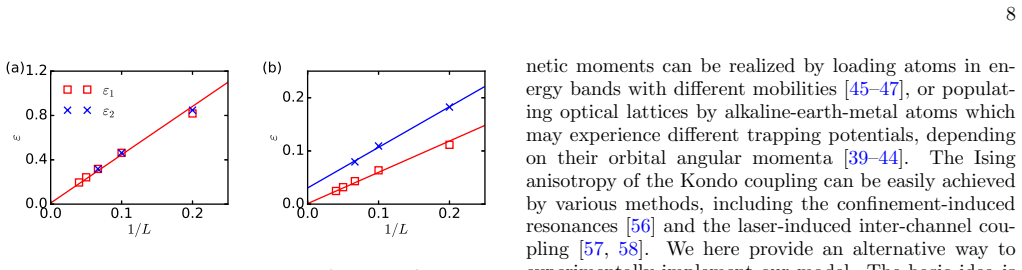
- [Sec. IV, Figs. 8-9] The claim that the SDW phase has a 'nonzero excitation gap' should be made precise: Fig. 8(b) actually shows ε1→0 as L→∞ (the twofold degeneracy) and a finite ε2. The text should distinguish the symmetry-breaking degeneracy from the quasiparticle gap above the degenerate manifold.
- [Sec. IV, Fig. 7] The term 'long-range feature' for the superfluid correlation should be replaced by a precise statement: in 1D the expected off-diagonal correlations are algebraic (quasi-long-range) rather than true long-range order, unless the authors fit and demonstrate otherwise. This also affects the comparison with a supersolid.
- [Sec. IIIB and Fig. 5(b)] The strong-coupling perturbation theory is developed for commensurate filling with ρ/2 integer or half-integer, but the phase diagram in Fig. 5(b) covers continuous ρ. Please state explicitly where the perturbative AFM/FM boundaries are expected to apply and where they are only heuristic.
- [Sec. II (numerical parameters)] The statement that ncutoff=4 is 'enough to determine the phase boundaries' is not supported by any convergence data. A brief ncutoff study (e.g., ncutoff=4,5,6 at representative points in the SDW and FM phases) would strengthen reproducibility, particularly because the text allows for cutoff effects in the weak-interaction region.
Circularity Check
No significant circularity: the bosonic Peierls/SDW phase is extracted from the model Hamiltonian by DMRG and perturbation theory, and the kmax=pi*rho relation is an observed output rather than an input.
full rationale
The paper's central claim—a gapped long-range SDW with kmax = pi*rho in the bosonic Ising–Kondo lattice—is an output of the calculation, not a restatement of an input. The Hamiltonian (1) is the only starting point; the spin structure factor S(k)/L is computed directly from that Hamiltonian, and the peak position and thermodynamic-limit intercept are read from the data rather than imposed. The strong-coupling perturbation theory (Sec. III B, Eq. (9)) is derived from the same Hamiltonian and yields only commensurate AFM (kmax = pi) or FM; it does not contain or assume kmax = pi*rho, so the incommensurate SDW is not planted by the analytics. Equation (15) is a numerical observation ('we find that the relation kmax = |pi*rho + 2n*pi| is perfectly satisfied provided that the SDW phase is reached'), not a fitted parameter renamed as a prediction; rho = N/L is a control parameter and kmax is measured independently from S(k). The only self-citation, Ref. 31 (the authors' prior fermionic IKL paper), is used as motivation or contrast ('for the 1D fermionic IKL with a two-point Fermi surface, a density-wave instability can occur at strong Kondo coupling [31]') and is not load-bearing for the bosonic phase diagram; no uniqueness theorem or ansatz is imported from it. The paper explicitly admits that the microscopic origin of the bosonic kmax = 2kF relation is left open ('the exploration of which is beyond the scope of this paper and we leave to future work', Sec. IV); this is an incompleteness, not a circular reduction, because the numerical evidence stands independently of that explanation. Concerns about the open-boundary four-point extrapolation, the absence of error bars, and the possibility that quasi-long-range correlations mimic a nonzero intercept are correctness and robustness risks for the DMRG phase claim, but they are not cases in which a prediction equals its inputs by construction. No circular step is identified.
Assumptions & free parameters
free parameters (2)
- Single-site boson number cutoff ncutoff =
4
- DMRG bond dimension (kept states) =
800
assumptions (4)
- domain assumption The exact ground state of Hamiltonian (1) is accurately approximated by DMRG with L<=32, 800 kept states, 40 sweeps, and ncutoff=4.
- domain assumption S(k)/L for L=20, 24, 28, 32 can be linearly extrapolated in 1/L to the thermodynamic limit.
- standard math Second-order perturbation theory in t/J and t/U gives the effective spin Hamiltonian (9) in the strong-coupling limit.
- ad hoc to paper The weak-coupling perturbation expansion in J, though divergent, still indicates the qualitative ferromagnetic ordering tendency.
Cite this review
Pith. "Pith review of Bosonic Peierls state emerging from the one-dimensional Ising-Kondo interaction." pith.science (2026). https://pith.science/paper/K4PBWLWF
@misc{pith2026241116357,
  author       = {Pith},
  title        = {Pith review of: Bosonic Peierls state emerging from the one-dimensional Ising-Kondo interaction},
  year         = {2026},
  howpublished = {\url{https://pith.science/paper/K4PBWLWF}},
  note         = {Machine review of arXiv:2411.16357}
}
read the original abstract
As an important effect induced by the particle-lattice interaction, the Peierls transition, a hot topic in condensed matter physics, is usually believed to occur in the one-dimensional fermionic systems. We here study a bosonic version of the one-dimensional Ising-Kondo lattice model, which describes itinerant bosons interact with the localized magnetic moments via only longitudinal Kondo exchange.\ We show that, by means of perturbation analysis and numerical density-matrix renormalization group method, a bosonic analog of the Peierls state can occur in proper parameters regimes. The Peierls state here is characterized by the formation of a long-range spin-density-wave order, the periodicity of which is set by the density of the itinerant bosons. The ground-state phase diagram is mapped out by extrapolating the finite-size results to thermodynamic limit. Apart from the bosonic Peierls state, we also reveal the presence of some other magnetic orders, including a paramagnetic phase and a ferromagnetic phase. We finally propose a possible experimental scheme with ultracold atoms in optical lattices. Our results broaden the frontiers of the current understanding of the one-dimensional particle-lattice interaction system.
Figures


Figures from the paper (6 more)




Reference graph
Works this paper leans on
-
[1]
5s (2)(r) 0 1 2 (a) 0 1 2 3 4 5 6 r −8 −6 −4 −2 0 2 4 6 8s (3)(r) ×10 −7 −3 −2 −1 0 1 2 3 4 5 6×10 −2 (b) FIG. 9: (a) The two-body spin correlation s(2)(r) and (b) the three-body spin correlation s(3)(r) with J = 10.0, U = 80.0, ρ = 0.8, and L = 15. netic moments can be realized by loading atoms in en- ergy bands with different mobilities [45–47], or popu...
-
[2]
A. Altland and B. Simons, Condensed Matter Field The- ory (Cambridge University Press, Cambridge, England, 2006)
work page 2006
-
[3]
E. B. Herbold and V. F. Nesterenko, Shock wave struc- ture in a strongly nonlinear lattice with viscous dissipa- tion, Phys. Rev. E 75, 021304 (2007)
work page 2007
- [4]
-
[5]
D. Frydel and Y. Levin, Soft-particle lattice gas in one dimension: One- and two-component cases, Phys. Rev. E 98, 062123 (2018)
work page 2018
-
[7]
R. Peierls, Quantum Theory of Solids, International Se- 11 ries of Monographs on Physics (Clarendon Press, Oxford, 1955)
work page 1955
-
[8]
D. Gonz´ alez-Cuadra, P. R. Grzybowski, A. Dauphin, and M. Lewenstein, Strongly Correlated Bosons on a Dynam- ical Lattice, Phys. Rev. Lett. 121, 090402 (2018)
work page 2018
-
[9]
D. Gonz´ alez-Cuadra, A. Bermudez, P. R. Grzybowski, M. Lewenstein, and A. Dauphin, Intertwined topological phases induced by emergent symmetry protection, Na- ture Communications 10, 2694 (2019)
work page 2019
Show all 64 references
-
[10]
Gonz´ alez-Cuadra, A
D. Gonz´ alez-Cuadra, A. Dauphin, P. R. Grzybowski, and M. Lewenstein, A. Bermudez, Dynamical Solitons and Boson Fractionalization in Cold-Atom Topological Insu- lators, Phys. Rev. Lett. 125, 265301 (2020)
2020
-
[11]
Rylands, Y
C. Rylands, Y. Guo, B. L. Lev, J. Keeling, and V. Galit- ski, Photon-Mediated Peierls Transition of a 1D Gas in a Multimode Optical Cavity, Phys. Rev. Lett. 125, 010404 (2020)
2020
-
[12]
A. C. Hewson, The Kondo Problem to Heavy Fermions (Cambridge University Press, Cambridge, England 1993)
1993
-
[13]
Coleman and A
P. Coleman and A. H. Nevidomskyy, Frustration and the Kondo effect in heavy fermion materials, Journal of Low Temperature Physics 161, 182 (2010)
2010
-
[14]
Steglich and S
F. Steglich and S. Wirth, Foundations of heavy- fermion superconductivity: lattice Kondo effect and Mott physics, Rep. Prog. Phys. 79, 084502 (2016)
2016
-
[15]
C. L. Seaman, M. B. Maple, B. W. Lee, S. Ghamaty, M. S. Torikachvili, J.-S. Kang, L. Z. Liu, J. W. Allen, and D. L. Cox, Evidence for non-Fermi liquid behavior in the Kondo alloy Y 1−xUxPd3, Phys. Rev. Lett. 67, 2882 (1991)
1991
-
[16]
Miranda, V
E. Miranda, V. Dobrosavljevi´ c, and G. Kotliar, Disorder- Driven Non-Fermi-Liquid Behavior in Kondo Alloys, Phys. Rev. Lett. 78, 290 (1997)
1997
-
[17]
Principi, G
A. Principi, G. Vignale, and E. Rossi, Kondo effect and non-Fermi-liquid behavior in Dirac and Weyl semimetals, Phys. Rev. B 92, 041107(R) (2015)
2015
-
[18]
A. F. Otte, M. Ternes, K. von Bergmann, S. Loth, H. Brune, C. P. Lutz, C. F. Hirjibehedin, and A. J. Heinrich, The role of magnetic anisotropy in the Kondo effect, Nat. Phys. 4, 847 (2008)
2008
-
[19]
Misiorny, I
M. Misiorny, I. Weymann, and J. Barna´ s, Influ- ence of magnetic anisotropy on the Kondo effect and spin-polarized transport through magnetic molecules, adatoms, and quantum dots, Phys. Rev. B 84, 035445 (2011)
2011
-
[20]
Misiorny, M
M. Misiorny, M. Hell, and M. R. Wegewijs, Spintronic magnetic anisotropy, Nat. Phys. 9, 801 (2013)
2013
-
[21]
A. E. Sikkema, W. J. L. Buyers, I. Affleck, and J. Gan, Ising-Kondo lattice with transverse field: A possible f- moment Hamiltonian for URu2Si2, Phys. Rev. B54, 9322 (1996)
1996
-
[22]
Ishizuka and Y
H. Ishizuka and Y. Motome, Partial Disorder in an Ising- Spin Kondo Lattice Model on a Triangular Lattice, Phys. Rev. Lett. 108, 257205 (2012)
2012
-
[23]
Ishizuka and Y
H. Ishizuka and Y. Motome, Thermally induced phases in an Ising Kondo lattice model on a triangular lattice: Par- tial disorder and Kosterlitz-Thouless state, Phys. Rev. B 87, 155156 (2013)
2013
-
[24]
Ishizuka and Y
H. Ishizuka and Y. Motome, Loop liquid in an Ising-spin Kondo lattice model on a kagome lattice, Phys. Rev. B 88, 081105(R) (2013)
2013
-
[25]
Ishizuka and Y
H. Ishizuka and Y. Motome, Exotic magnetic phases in an Ising-spin Kondo lattice model on a kagome lattice, Phys. Rev. B 91, 085110 (2015)
2015
-
[26]
J. Shin, Z. Schlesinger, and B. S. Shastry, Kondo-Ising and tight-binding models for TmB 4, Phys. Rev. B 95, 205140 (2017)
2017
-
[27]
Tsuda, C
S. Tsuda, C. L. Yang, Y. Shimura, K. Umeo, H. Fukuoka, Y. Yamane, T. Onimaru, T. Takabatake, N. Kikugawa, T. Terashima, H. T. Hirose, S. Uji, S. Kittaka, and T. Sakakibara, Metamagnetic crossover in the quasikagome Ising Kondo-lattice compound CeIrSn, Phys. Rev. B 98, 155147 (2018)
2018
-
[28]
Li, J.-Q
B. Li, J.-Q. Yan, D. M. Pajerowski, E. Gordon, A.-M. Nedi´ c, Y. Sizyuk, L. Ke, P. P. Orth, D. Vaknin, and R. J. McQueeney, Competing Magnetic Interactions in the An- tiferromagnetic Topological Insulator MnBi 2Te4, Phys. Rev. Lett. 124, 167204 (2020)
2020
-
[29]
W.-W. Yang, J. Zhao, H.-G. Luo, and Y. Zhong, Exactly solvable Kondo lattice model in the anisotropic limit, Phys. Rev. B 100, 045148 (2019)
2019
-
[30]
W.-W. Yang, Y. Zhong, and H.-G. Luo, Hexagonal Ising- Kondo lattice: An implication for intrinsic antiferromag- netic topological insulator, Phys. Rev. B 102, 195141 (2020)
2020
-
[31]
Yang, Y.-X
W.-W. Yang, Y.-X. Li, Y. Zhong, and H.-G. Luo, Doping a Mott insulator in an Ising-Kondo lattice: Strange metal and Mott criticality, Phys. Rev. B 104, 165146 (2021)
2021
-
[32]
X. Zhou, J. Fan, and S. Jia, Magnetic order and strongly correlated effects in the one-dimensional Ising-Kondo lat- tice, Phys. Rev. B 109, 195112 (2024)
2024
-
[33]
Sch¨ afer, T
F. Sch¨ afer, T. Fukuhara, S. Sugawa, Y. Takasu, and Y. Takahashi, Tools for quantum simulation with ultracold atoms in optical lattices, Nat. Rev. Phys. 2, 411 (2020)
2020
-
[34]
B. Yang, H. Sun, C.-J. Huang, H.-Y. Wang, Y. Deng, H.-N. Dai, Z.-S. Yuan, and J.-W. Pan, Cooling and en- tangling ultracold atoms in optical lattices, Science 369, 550 (2020)
2020
-
[35]
Y. Guo, R. M. Kroeze, B. P. Marsh, S. Gopalakrishnan, J. Keeling, and B. L. Lev, An optical lattice with sound, Nature 599, 211 (2021)
2021
-
[36]
Choi, Quantum simulations with ultracold atoms in optical lattices: past, present and future, Journal of the Korean Physical Society 82, 875 (2023)
J.-y. Choi, Quantum simulations with ultracold atoms in optical lattices: past, present and future, Journal of the Korean Physical Society 82, 875 (2023)
2023
-
[37]
Malz and J
D. Malz and J. I. Cirac, Few-Body Analog Quantum Sim- ulation with Rydberg-Dressed Atoms in Optical Lattices, PRX Quantum 4, 020301 (2023)
2023
-
[38]
M¨ uller, S
T. M¨ uller, S. F¨ olling, A. Widera, and I. Bloch, State Preparation and Dynamics of Ultracold Atoms in Higher Lattice Orbitals, Phys. Rev. Lett. 99, 200405 (2007)
2007
-
[39]
Wirth, M
G. Wirth, M. ¨Olschl¨ ager, and A. Hemmerich, Evidence for orbital superfluidity in the P-band of a bipartite op- tical square lattice, Nat. Phys. 7, 147 (2011)
2011
-
[40]
Zhong, Y
Y. Zhong, Y. Liu, and H.-G. Luo, Simulating heavy fermion physics in optical lattice: Periodic Anderson model with harmonic trapping potential, Frontiers of Physics 12, 127502 (2017)
2017
-
[41]
Riegger, N
L. Riegger, N. Darkwah Oppong, M. H¨ ofer, D. R. Fer- nandes, I. Bloch, and S. F¨ olling, Localized Magnetic Mo- ments with Tunable Spin Exchange in a Gas of Ultracold Fermions, Phys. Rev. Lett. 120, 143601 (2018)
2018
-
[42]
Kan´ asz-Nagy, Y
M. Kan´ asz-Nagy, Y. Ashida, T. Shi, C. P. Moca, T. N. Ikeda, S. F¨ olling, J. I. Cirac, Gergely Zar´ and, and E. A. Demler, Exploring the anisotropic Kondo model in and out of equilibrium with alkaline-earth atoms, Phys. Rev. B 97, 155156 (2018). 12
2018
-
[43]
X. Zhou, S. Jin, and J. Schmiedmayer, Shortcut loading a Bose–Einstein condensate into an optical lattice, New J. Phys. 20 055005 (2018)
2018
-
[44]
Zhang, Y
R. Zhang, Y. Cheng, P. Zhang, and H. Zhai, Controlling the interaction of ultracold alkaline-earth atoms, Nat. Rev. Phys. 2, 213 (2020)
2020
-
[45]
K. Ono, Y. Amano, T. Higomoto, Y. Saito, and Y. Taka- hashi, Observation of spin-exchange dynamics between itinerant and localized 171Yb atoms, Phys. Rev. A 103, L041303 (2021)
2021
-
[46]
Duan, Controlling ultracold atoms in multi-band optical lattices for simulation of Kondo physics, Euro- phys
L.-M. Duan, Controlling ultracold atoms in multi-band optical lattices for simulation of Kondo physics, Euro- phys. Lett. 67, 721 (2004)
2004
-
[47]
Foss-Feig and A
M. Foss-Feig and A. M. Rey, Phase diagram of the bosonic Kondo-Hubbard model, Phys. Rev. A 84, 053619 (2011)
2011
-
[48]
Flottat, F
T. Flottat, F. H´ ebert, V. G. Rousseau, R. T. Scalet- tar, and G. G. Batrouni, Bosonic Kondo-Hubbard model, Phys. Rev. B 92, 035101 (2015)
2015
-
[49]
S. R. White, Density matrix formulation for quan- tum renormalization groups, Phys. Rev. Lett. 69, 2863 (1992)
1992
-
[50]
Schollw¨ ok, The density-matrix renormalization group, Rev
U. Schollw¨ ok, The density-matrix renormalization group, Rev. Mod. Phys. 77, 259 (2005)
2005
-
[51]
Gagge and J
A. Gagge and J. Larson, Superradiance, bosonic Peierls distortion, and lattice gauge theory in a generalized Rabi- Hubbard chain, Phys. Rev. A 102, 063711 (2020)
2020
-
[52]
Auerbach, Interacting Electrons and Quantum Mag- netism (Springer-Verlag, New York, 1994)
A. Auerbach, Interacting Electrons and Quantum Mag- netism (Springer-Verlag, New York, 1994)
1994
-
[53]
Y. Chen, Z. Yu, and H. Zhai, Superradiance of Degen- erate Fermi Gases in a Cavity, Phys. Rev. Lett. 112, 143004 (2014)
2014
-
[54]
Fradkin, Field Theories of Condensed Matter Physics (Cambridge University Press, Cambridge, 2013)
E. Fradkin, Field Theories of Condensed Matter Physics (Cambridge University Press, Cambridge, 2013)
2013
-
[55]
Jeckelmann, C
E. Jeckelmann, C. Zhang, and S. R. White, Metal- insulator transition in the one-dimensional Holstein model at half filling, Phys. Rev. B 60, 7950 (1999)
1999
-
[56]
Chanda, L
T. Chanda, L. Barbiero, M. Lewenstein, M. J. Mark, and J. Zakrzewski, Recent progress on quantum simulations of non-standard Bose-Hubbard models, arXiv:2405.07775 (2024)
2024 arXiv
-
[57]
Zhang, D
R. Zhang, D. Zhang, Y. Cheng, W. Chen, P. Zhang, and H. Zhai, Kondo effect in alkaline-earth-metal atomic gases with confinement-induced resonances, Phys. Rev. A 93, 043601 (2016)
2016
-
[58]
Nakagawa and N
M. Nakagawa and N. Kawakami, Laser-Induced Kondo Effect in Ultracold Alkaline-Earth Fermions, Phys. Rev. Lett. 115, 165303 (2015)
2015
-
[59]
T.-S. Deng, W. Zhang, and W. Yi, Tuning Feshbach res- onances in cold atomic gases with interchannel coupling, Phys. Rev. A 96, 050701(R) (2017)
2017
-
[60]
Sebby-Strabley, M
J. Sebby-Strabley, M. Anderlini, P. S. Jessen, and J. V. Porto, Lattice of double wells for manipulating pairs of cold atoms, Phys. Rev. A 73, 033605 (2006)
2006
-
[61]
Atala, M
M. Atala, M. Aidelsburger,Mi. Lohse, J. T. Barreiro, B. Paredes and I. Bloch, Observation of chiral currents with ultracold atoms in bosonic ladders, Nat. Phys. 10, 588 (2014)
2014
-
[62]
K¨ ohler, K
T. K¨ ohler, K. G´ oral, and P. S. Julienne, Production of cold molecules via magnetically tunable Feshbach reso- nances, Rev. Mod. Phys. 78, 1311 (2006)
2006
-
[63]
Gaenko, A
A. Gaenko, A. Antipov, G. Carcassi, T. Chen, X. Chen, Q. Dong, L. Gamper, J. Gukelberger, R. Igarashi, S. Iskakov, M. Konz, J. LeBlanc, R. Levy, P. Ma, J. Paki, H. Shinaoka, S. T¨ odo, M. Troyer, and E. Gull, Updated core libraries of the ALPS project, Comp. Phys. Comm. 213, 2...
2017
-
[64]
Bauer, L
B. Bauer, L. D. Carr, H. G. Evertz, A. Feiguin, J. Freire, S. Fuchs, L. Gamper, J. Gukelberger, E. Gull, S. Guertler, A. Hehn, R. Igarashi et al., The ALPS project release 2.0: open source software for strongly correlated systems, Journ. of Stat. Mech.: Theor. and Exp. 2011, P...
2011
-
[65]
A. B. Kuklov and B. V. Svistunov, Counterflow Superflu- idity of Two-SpeciesUltracold Atoms in a Commensurate Optical Lattice, Phys. Rev. Lett. 90, 100401 (2003)
2003
Reviewed August 12, 2026 · model on record in the stance chip above.
Discussion (0). Continue with ORCID to comment.