REVIEW 4 major objections 6 minor 34 references
Matter power spectrum in a power-law $f(G)$ gravity
T0 review · 4 major / 6 minor · reviewed 2026-08-06 · deepseek-v4-flash
Pith's one-line read For a power-law $f(G)$ gravity model, this paper claims the matter power spectrum is not scale invariant, unlike in General Relativity: solving the coupled matter and Gauss-Bonnet perturbation equations in a dust-dominated universe…
desk verdict First f(G) matter-power-spectrum computation in this pipeline, but undefined parameters and an omitted derivation make the central numerical result uncheckable in the current form. read the letter →
The pith
A machine-rendered reading of the paper's core claim, the machinery that carries it, and where it could break.
The reading
What carries the argument
The machinery is the coupled linear perturbation system in redshift space, equations (48)-(49), for the matter density contrast $\Delta_m$ and the Gauss-Bonnet density perturbation $G$, together with the dimensionless background variables $x$, $y$, and $\Omega_d$ from the dynamical-system reduction of the $f(G)$ field equations. The paper solves the background equations (34), (36), and (37) first, then feeds those solutions into the perturbation system to obtain $\Delta_m(z)$; the power spectrum is then formed as $P(k)=|\Delta(k)|^2$ at $z=0$. The five initial-condition sets at $z_{in}=2000$ are the input that converts the differential system into concrete spectra, and they are what allow the paper to test how the shape of $P(k)$ responds to different starting amplitudes and velocities.
What would settle it
Re-derive equations (48)-(49) from (44)-(45) with explicit definitions of $m$ and $q$ and repeat the stated integration: if the corrected equations produce a $k$-independent spectrum for $n\neq1$, or if the $n=1$ run does not return a flat $P(k)$, the reported scale dependence is not established. A quick numerical check is to verify that the $n=1$ curve is exactly flat in the same solver that produces the $n\neq1$ curves.
Extended reading notes
Core claim
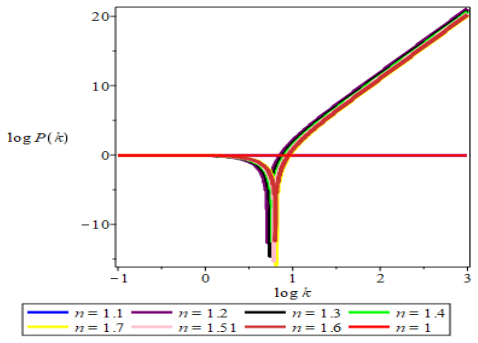
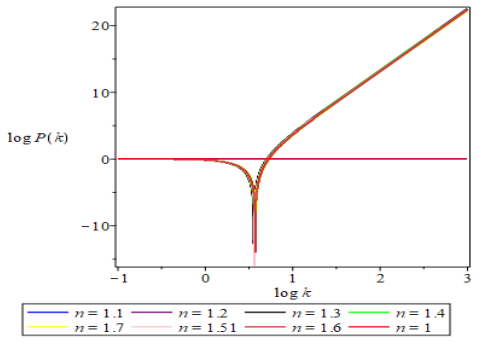
For the power-law model $f(G)=\beta H_0^{4-4n}G^n$ in a dust-dominated flat FRW universe, the paper claims that the linear matter density contrast $\Delta_m$ is coupled to the Gauss-Bonnet perturbation $G$ through equations (48)-(49), and that the resulting power spectrum $P_{f(G)}(k)=|\Delta(k)|^2$ evaluated today depends on wavenumber $k$. The central reported behavior is that the spectra decay below the scale-invariant GR line and then evolve above it as $k$ increases; the separation between curves for different $n$ grows as $n$ moves closer to $1$, while $n=1$ exactly reproduces the GR result. This non-scale-invariance is the paper's main discovery, and it is obtained without the quasi-static approximation, by integrating the perturbation system with five different sets of initial conditions at $z_{in}=2000$.
Load-bearing premise
The calculation stands on the assumption that equations (48) and (49) are the correct redshift-space reduction of the covariant perturbation equations (44) and (45), even though the symbols $m$ and $q$ appearing in them are never defined and the reduction is not shown.
Editorial extensions
If this is right
- For $n=1$ the model reduces to General Relativity and the power spectrum is scale invariant, so the GR limit is built into the calculation.
- For $n\neq1$, a scale-invariant input perturbation at $z_{in}=2000$ does not stay scale invariant by $z=0$; the clustering amplitude acquires a $k$-dependence.
- The matter density contrast is coupled to the Gauss-Bonnet perturbation, so the modified-gravity sector directly shapes the matter power spectrum rather than only changing the background expansion.
- Across the five initial-condition sets the reported spectra do not oscillate, which the paper takes as agreement with earlier $f(R)$ and modified-gravity power-spectrum studies.
- The spread of the curves near $n=1$ gives a target for future observational constraints on the power-law index $n$.
Reading between the lines
- If the reported $k$-dependence survives a full treatment with radiation, baryons, and a transfer function, power-law $f(G)$ models with $n\neq1$ would predict an effective tilt in the matter power spectrum that galaxy surveys could in principle measure.
- Because the paper does not state the values of $m$ and $q$ used in the numerical integration, the concrete numbers behind the figures are not reproducible from the text; pinning those definitions down is the natural first step before comparing with data.
- A testable extension is to run the same system with a logarithmic grid in $k$ and check whether the dip-and-rise feature converges; if it is an artifact of the initial-condition amplitudes, it should weaken as the initial velocity perturbations are varied systematically.
- The paper only considers dust, so an immediate extension is to include radiation and see whether the scale dependence persists through matter-radiation equality, where the initial conditions are set.
Editorial analysis
A structured set of objections, weighed in public.
Referee Report
Summary. Using a power-law f(G)=βG^n model, the authors build a dynamical-system description of the background, write covariant first-order density perturbation equations in the 1+3 formalism, convert them to redshift space, solve them numerically for five sets of initial conditions at z_in=2000, and compute the matter power spectrum P(k)=|Δ(k)|^2 at z=0. The reported result is that P(k) is not scale invariant for n≠1, with the curves separating most clearly as n approaches 1, whereas n=1 is claimed to recover the scale-invariant GR case.
Significance. If correct, the claim that a power-law f(G) model breaks scale invariance of the matter power spectrum even from scale-invariant initial conditions would be an interesting, testable prediction. The paper includes useful checks, such as multiple initial-condition sets and the n=1 GR limit. However, the central result is carried entirely by Eqs. (48)–(49), whose reduction from the covariant equations is omitted and which contain undefined symbols m and q. As it stands, the numerical spectra in Figures 1–6 cannot be verified or reproduced, so the significance of the claimed result cannot be assessed.
major comments (4)
- [§3, Eqs. (48)–(49)] The central numerical system is not reproducible: the symbols m and q appearing in Eq. (48) are never defined in Sections 2–4, and the algebraic reduction from Eqs. (44)–(47) to Eqs. (48)–(49) is not shown. Since m appears in the exponents (1+z)^{-6/m} and (1+z)^{-3/(2m)} and in the coefficient of G' in Eq. (49), while q appears in the coefficients of G' and G in Eq. (48), the k-dependent coefficients used in the figures are not fixed by the derivation. Without definitions of these symbols, the reported power spectra cannot be checked.
- [§3, Eq. (49)] For w=0, Eq. (47) has a vanishing right-hand side, so the Gauss-Bonnet perturbation satisfies \ddot G=0. Using the stated redshift transformation and the dust background relation H'/H=3/[2(1+z)], this gives G''=-3/[2(1+z)]G'. Eq. (49) instead states G''=-[3/(2m)+1]/(1+z)G', which agrees only if m=3 is silently assumed. The text does not state this assumption, and Eq. (48) uses m in additional places. The system actually solved is therefore not established as the dust limit of the covariant equations.
- [§4 and §5.1] The initial conditions are imposed by setting the same amplitude for Δ_d, Δ'_d, G and G' for every k at z_in=2000, so the input spectrum is flat (scale invariant) by construction. In Eq. (48) the only explicit k dependence is the k^2/a^2 term; the claim that the output P(k) is not scale invariant is therefore substantially a consequence of that standard gradient term, rather than a demonstration that power-law f(G) itself generates scale dependence. To support the abstract's claim, the authors would need to compare with the GR limit under an identical numerical treatment.
- [§4, Figures 1–6] The numerical implementation is not described: the values of β and H0, the range and sampling of k, the integration scheme, and the handling of the (n-1) denominators in Eq. (48) are not given. In particular, n=1 is claimed to recover GR, but Eq. (48) contains 1/(n-1) terms; a limiting procedure is required and is not explained. Consequently Figures 1–6 cannot be reproduced from the text.
minor comments (6)
- [§2.1, Eq. (13)] The matter continuity equation is written as \dot ρ_m + 3H(1+3w_m)ρ_m = 0, which appears to be a typo; the standard form is \dot ρ_m + 3H(1+w_m)ρ_m = 0.
- [§5.1] The text says 'fig. (5) for set IV', but the fifth set was labeled Set V in Section 4; the figure numbering/caption should be corrected.
- [Figure 6 caption] The caption states initial conditions at z0 rather than z_in=2000, inconsistent with the other figures and with the description in Section 5.1.
- [§1 and Abstract] There are several typographical errors, including 'decerelation', 'We derive' in the abstract, and inconsistent capitalization in the initial-condition set labels.
- [§5.2] The conclusion that the results 'support the ΛCDM and GR predictions' is not supported by any quantitative comparison with data or with a reference spectrum; this statement should be softened or substantiated.
- [References] Reference [28] is incomplete: it gives only an arXiv identifier without an author list, title, or year.
Circularity Check
No circularity: the matter power spectrum is computed by solving the stated perturbation equations for chosen power-law f(G) inputs, with no fitted target data and no load-bearing self-citation chain.
full rationale
The paper does not fit any observational dataset and does not tune model parameters to reproduce the claimed power spectrum. The power-law index n, the amplitude beta, and the five initial-condition sets are stated model and input choices. The reported scale dependence is generated by solving the coupled linear system (48)-(49), which contains an explicit k^2/a^2 term and k-independent coefficients from the Gauss-Bonnet sector; hence the conclusion that the matter power spectrum is not scale invariant is a computed consequence of the equations, not an input restated as an output. The self-citations [17], [23], and [33] are contextual references to prior covariant perturbation studies and power-spectrum conventions and are not used to authorize the central result; the initial-condition convention is attributed to the independent reference [24]. None of the enumerated circularity patterns is present: no quantity is defined in terms of the claimed output, no parameter is fitted and then renamed as a prediction, no uniqueness theorem is imported from the authors' prior work, and no known result is merely renamed. I note separately, as a reproducibility and correctness concern rather than a circularity, that Eqs. (48) and (49) introduce symbols m and q without defining them, and the w=0 reduction from Eq. (47) to Eq. (49) is not demonstrated in the text; this prevents the reader from fully checking the derivation, but it does not make the derivation circular. The paper is therefore self-contained against the benchmarks it claims: it solves its stated equations and compares the result with the GR limit n=1.
Assumptions & free parameters
free parameters (3)
- n (power-law index) =
varied; no best-fit value given
- Initial condition amplitudes for Δ_d, Δ'_d, G, G' =
Five ad hoc sets, e.g. Δ_d(z_in)=10^-5, Δ'_d(z_in)=10^-8
- m and q =
Undefined
assumptions (5)
- standard math The 1+3 covariant formalism and harmonic/scalar decomposition are valid for cosmological perturbations.
- domain assumption The universe is a flat FRW geometry with dust plus radiation and a Gauss-Bonnet curvature fluid.
- domain assumption Scale-invariant initial conditions at z=2000 are physically appropriate.
- ad hoc to paper The redshift-space perturbation equations (48)-(49) are correct reductions of (44)-(45).
- ad hoc to paper Every plotted mode uses the same initial amplitude, so the input spectrum is flat in k.
Cite this review
Pith. "Pith review of Matter power spectrum in a power-law $f(G)$ gravity." pith.science (2026). https://pith.science/paper/K4UU7XTU
@misc{pith2026250709610,
  author       = {Pith},
  title        = {Pith review of: Matter power spectrum in a power-law $f(G)$ gravity},
  year         = {2026},
  howpublished = {\url{https://pith.science/paper/K4UU7XTU}},
  note         = {Machine review of arXiv:2507.09610}
}
abstract
Cosmological models based on $f(G)$ gravity are efficient in fitting different observational datasets at both background and perturbation levels. This motivates the current study to take into account dynamical system analysis to investigate the matter power spectrum within the framework of modified Gauss-Bonnet gravity. After defining the dimensionless dynamical system variables for a power-law $f(G)$ model, We derive the full system of equations governing the energy density perturbations for both matter and Gauss-Bonnet fluids using the $1+3$ covariant formalism. After solving the energy density perturbation equations, we compute the matter power spectrum. The importance of studying first order perturbations for the defined $f(G)$ model and the relevance of different initial conditions in computing the matter power spectrum are also stressed. It is reported that matter power spectrum for $f(G)$ gravity, for a particular functional form of $f(G)$ model considered is not scale invariant as the case for General Relativity.
Figures


Figures from the paper (3 more)


Reference graph
Works this paper leans on
- [1]
-
[2]
Dodelson S and Knox L 2000 Physical Review Letters 84 3523
work page 2000
-
[3]
Cornish N J, Spergel D N, Starkman G D and Komatsu E 2004 Physical Review Letters 92 201302
work page 2004
-
[4]
2007 The astrophysical journal supplement series 170 377 16
Spergel D N, Bean R, Doré O, Nolta M, Bennett C, Dunkley J, H inshaw G, Jarosik N e, Komatsu E, Page L et al. 2007 The astrophysical journal supplement series 170 377 16
work page 2007
-
[5]
2004 Physical review D 69 103501
Tegmark M, Strauss M A, Blanton M R, Abazajian K, Dodelson S, Sandvik H, Wang X, Weinberg D H, Zehavi I, Bahcall N A et al. 2004 Physical review D 69 103501
work page 2004
-
[6]
Singh G, Hulke N and Singh A 2020 Indian Journal of Physics 94 127– 141
work page 2020
-
[7]
De Felice A and Tsujikawa S 2010 Living Reviews in Relativity [electronic only] 13 Article–No
work page 2010
-
[8]
Sotiriou T P and Faraoni V 2010 Reviews of Modern Physics 82 451–497
work page 2010
Show all 34 references
-
[9]
Gomez F, Minning P and Salgado P 2011 Physical Review D—Particles, Fields, Gravitation, and Cosmology 84 063506
2011
-
[10]
Bajardi F, Vernieri D and Capozziello S 2021 Journal of Cosmology and Astroparticle Physics 2021 057
2021
-
[11]
Tseytlin A A 1997 Nuclear Physics B 501 41–52
1997
-
[12]
Garcia N M, Harko T, Lobo F S and Mimoso J P 2011 Physical Review D—Particles, Fields, Gravitation, and Cosmology 83 104032
2011
-
[13]
Li B, Barrow J D and Mota D F 2007 Physical Review D—Particles, Fields, Gravitation, and Cosmology 76 044027
2007
-
[14]
de Martino I, De Laurentis M and Capozziello S 2020 Physical Review D 102 063508
2020
-
[15]
Benetti M, Santos da Costa S, Capozziello S, Alcaniz J S a nd De Lau- rentis M 2018 International Journal of Modern Physics D 27 1850084
2018
-
[16]
De la Cruz-Dombriz A and Sáez-Gómez D 2012 Classical and Quantum Gravity 29 245014
2012
-
[17]
Munyeshyaka A, Ntahompagaze J, Mutabazi T and Mbonye M 2 024 The European Physical Journal C 84 51
-
[18]
Bamba K, Lopez-Revelles A, Myrzakulov R, Odintsov S and Sebastiani L 2012 Classical and Quantum Gravity 30 015008
2012
-
[19]
Bamba K, Geng C Q and Lee C C 2011 International Journal of Modern Physics D 20 1339–1345 17
2011
-
[20]
Wainwright J and Ellis G F R 1997 Dynamical systems in cosmology
1997
-
[21]
Böhmer C G and Chan N 2017 Dynamical systems in cosmology Dy- namical and Complex Systems (World Scientific) pp 121–156
2017
-
[22]
Singh A 2025 The European Physical Journal C 85 1–12
2025
-
[23]
Ntahompagaze J, Abebe A and Mbonye M R 2022 International Journal of Modern Physics D 31 2250071
2022
-
[24]
Abebe A, de la Cruz-Dombriz A and Dunsby P K 2013 Physical Review D—Particles, Fields, Gravitation, and Cosmology 88 044050
2013
-
[25]
Venikoudis S, Fasoulakos K and Fronimos F 2022 International Journal of Modern Physics D 31 2250038
2022
-
[26]
Bamba K, Odintsov S D, Sebastiani L and Zerbini S 2010 The European Physical Journal C 67 295–310
2010
-
[27]
Carloni S, Dunsby P K, Capozziello S and Troisi A 2005 Classical and Quantum Gravity 22 4839
2005
-
[28]
Khyllep W arXiv preprint arXiv:2207.02610
-
[29]
Fedeli C, Dolag K and Moscardini L 2012 Monthly Notices of the Royal Astronomical Society 419 1588–1602
2012
-
[30]
Gourgoulhon E 2007 arXiv preprint gr-qc/0703035
2007 arXiv
-
[31]
Park C 2018 arXiv preprint arXiv:1810.06293
2018 arXiv
-
[32]
Abebe A, Abdelwahab M, De la Cruz-Dombriz A and Dunsby P K 2012 Classical and quantum gravity 29 135011
2012
-
[33]
Munyeshyaka A, Ntahompagaze J and Mutabazi T 2021 International Journal of Modern Physics D 30 2150053
2021
-
[34]
2006 Physical Review D—Particles, Fields, Gravitation, and Cos mology 74 123507 18
Tegmark M, Eisenstein D J, Strauss M A, Weinberg D H, Blan ton M R, Frieman J A, Fukugita M, Gunn J E, Hamilton A J, Knapp G R et al. 2006 Physical Review D—Particles, Fields, Gravitation, and Cos mology 74 123507 18
2006
Reviewed August 6, 2026 · model on record in the stance chip above.
Discussion (0). Continue with ORCID to comment.