REVIEW 3 major objections 4 minor 83 references
Multi-phonon interactions between nitrogen-vacancy centers and nanomechanical resonators
T0 review · 3 major / 4 minor · reviewed 2026-08-14 · deepseek-v4-flash
Pith's one-line read A strongly driven nitrogen-vacancy center and a nanomechanical resonator can exchange phonons in bundles, with analytic n-phonon coupling rates reaching $2\pi \times 10$ kHz.
desk verdict Good idea, broken derivation: Eq. (14) does not follow from the paper's own perturbative calculation. read the letter →
The pith
A machine-rendered reading of the paper's core claim, the machinery that carries it, and where it could break.
The reading
What carries the argument
The load-bearing object is the effective n-phonon Jaynes-Cummings-type Hamiltonian together with its closed-form coupling rate. The derivation starts from the strongly driven Jaynes-Cummings model, dresses the spin with the pump, and uses leading-order perturbation theory restricted to the near-degenerate manifold $\{|+,0\rangle, |-,n\rangle, |+,m\rangle, |-,m\rangle\}$ with $m=1,\dots,n-1$. Each intermediate state contributes an energy denominator of the form $n/(2m\Omega)$ or $n/(2(n-m)\Omega)$, and the product gives the analytic rate $\lambda^{(n)}$. This effective coupling is the object that converts ordinary single-phonon exchange into an n-phonon transition that can dominate the dynamics, and it is also the basis for the numerical simulations of Fock-state, cat-state, and correlation dynamics.
What would settle it
Take the full driven Jaynes-Cummings Hamiltonian with the parameters used for the two-, three-, and four-phonon resonances, simulate the populations without any perturbation truncation, and compare them with the effective-model predictions: a visible discrepancy in the n-phonon Rabi frequency or population, or an avoided-crossing gap that disagrees with the analytic rate, would falsify the central claim.
Extended reading notes
Core claim
The central logical move is to show that a linear spin-mechanical coupling, once the spin is strongly driven, behaves as an n-phonon nonlinearity. In the Mollow scheme, the driven Jaynes-Cummings Hamiltonian is transformed to the dressed basis of the strong pump; when the pump is tuned so that $2\Omega=n\Delta_a$, the effective Hamiltonian becomes $H_{\mathrm{eff}}^{M}=\Delta_a \hat a^\dagger \hat a+\Omega \tilde\sigma_z+\lambda^{(n)}(\hat a^n\tilde\sigma^\dagger+\hat a^{\dagger n}\tilde\sigma)$, with $\lambda^{(n)}\approx(-1)^{n-1}\lambda^n/[2((n-1)!)^2](n^2/(4\Omega))^{n-1}$. The same structure appears in the Lamb-Dicke scheme with coupling $\Omega/n!(2\lambda/\omega_r)^n$, derived both by perturbation theory and by an equivalent unitary transformation. The authors then use this effective model to predict a one-swap route to n-phonon Fock states (three-phonon probability up to 0.7, four-phonon above 0.5), a dissipative jump between two Schr\"odinger cat states, and n-phonon correlation functions that show either bunched super-Poisson or antibunched sub-Poisson statistics depending on the engineered spin decay rate.
Load-bearing premise
The whole scheme rests on the assumption that the small off-resonant spin-mechanical coupling can be treated as a weak perturbation and all effects beyond the leading n-phonon term ignored; if higher-order corrections or leaks into other mechanical levels are not negligible, the resonance condition and coupling rates will shift.
Editorial extensions
If this is right
- A single coherent swap on the n-phonon sideband can populate the mechanical Fock state $|n\rangle$ with high probability, unlike methods that must repeat the swap n times.
- The second-sideband coupling of roughly $2\pi\times 10$ kHz exceeds typical NV dephasing rates in the dressed-state picture, so coherent multi-phonon oscillations should be observable under the stated parameters.
- At the resonance condition $2\Omega=n\Delta_a$, an avoided crossing appears between the ground state and the n-phonon state, and its size is set by the analytic rate $\lambda^{(n)}$.
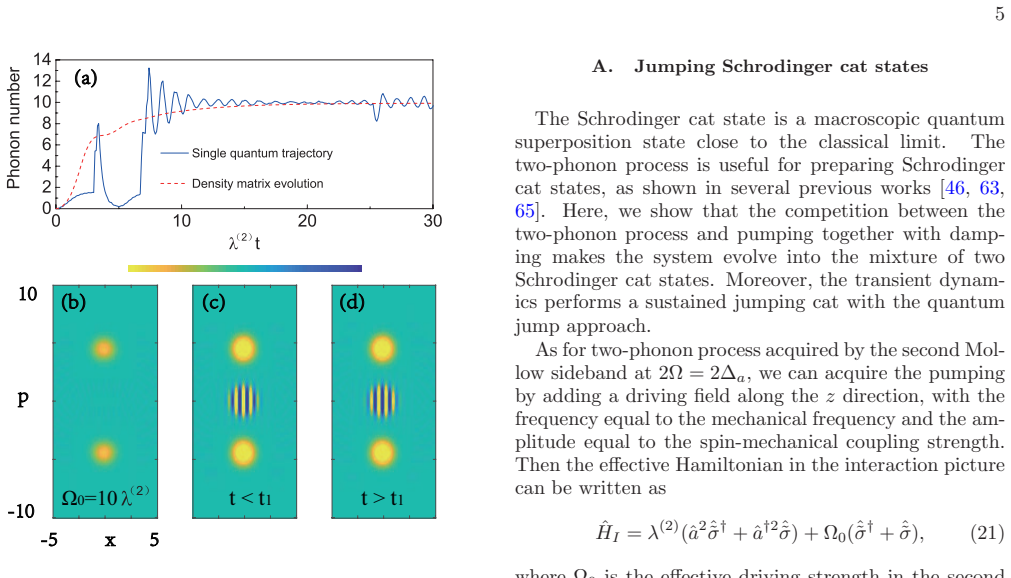
- With a two-phonon interaction plus a resonant pump, dissipation drives the mechanical mode into a bimodal steady state whose individual quantum trajectories jump between two Schr\"odinger cat states of opposite parity.
- The generalized correlation function $g_n^{(2)}(\tau)$ shows super-Poisson bunching for a short-lived spin and sub-Poisson antibunching for a long-lived spin, indicating that phonons are released in correlated bundles.
Reading between the lines
- If the analytic rate survives full benchmarking against the untruncated driven Jaynes-Cummings model, the same dressed-state sideband engineering should transfer to other spin-mechanical platforms with a similar SU(2) spin structure, including other color centers in diamond.
- The paper's noise analysis treats static magnetic-field drift only; a natural testable extension is to examine time-dependent magnetic noise and whether dynamical-decoupling sequences can preserve the n-phonon resonance.
- Because the effective coupling scales as $\lambda(\lambda^2/\Omega)^{n-1}$, the hierarchy between sidebands can be tuned in situ, which suggests the possibility of engineering effective phonon-phonon nonlinearities or a tunable Fock-state blockade beyond what the paper explicitly discusses.
- The predicted dissipative cat state could be distinguished from a classical mixture by measuring the Wigner function's central interference fringes, providing a concrete experimental signature of the claimed multi-phonon coherence.
Signed reviews
Editorial analysis
A structured set of objections, weighed in public.
Referee Report
Summary. The manuscript proposes a hybrid system in which a single nitrogen-vacancy center coupled to a nanomechanical resonator is driven by microwave fields to engineer multi-phonon interactions. In the Mollow regime the authors derive an effective n-phonon Jaynes-Cummings Hamiltonian, Eq. (11), with the analytic coupling rate Eq. (14), and claim that the second sideband can reach 2π×10 kHz and the third 2π×1 kHz. In the Lamb-Dicke regime they recover the standard sideband coupling Ω/n!(2λ/ω_r)^n, Eq. (20). Based on these effective Hamiltonians, the paper studies dissipative preparation of Schrödinger-cat-like states, one-swap preparation of multi-phonon Fock states, and n-phonon correlation functions. Feasibility is discussed using realistic NV-mechanical parameters, and one noise-sensitivity simulation of the full driven Jaynes-Cummings model is presented in Fig. 7.
Significance. The proposal is well motivated and the parameter estimates are grounded in existing NV-mechanical experiments. If the effective coupling formula survives a corrected derivation, the applications would be useful: direct n-phonon Fock-state swap operations and dissipative cat-state preparation are both appealing, and the claimed enhancement over direct high-order spin-mechanical couplings is significant. The Lamb-Dicke part appears standard. However, the central Mollow-sideband result is not established by the derivation as written: the stated perturbation theory leads to an exact cancellation at n=2 and to sign-opposite energy denominators for general n. Because Eq. (14) sets the coupling rates used in Figs. 4-6 and in the quoted kHz numbers, the quantitative claims are conditional on a substantially revised derivation and on benchmark simulations against the full Hamiltonian.
major comments (3)
- [III.A, Eqs. (10)-(14)] Equation (14) does not follow from the Rayleigh-Schrödinger calculation described in the text. For n=2 at the resonance 2Ω=2Δ_a, the two second-order paths |+,0>→|-,1>→|-,2> and |+,0>→|+,1>→|-,2> have intermediate energy denominators +1/Ω and −1/Ω, respectively; their amplitudes cancel exactly, so the leading matrix element in the stated subspace {|+,0>,|-,2>,|+,1>,|-,1>} is zero, not −λ²/(2Ω). More generally, 1/(E_i−E_{+,m}) is negative while 1/(E_i−E_{-,m}) is positive, so writing both as n/(2mΩ) and n/(2(n−m)Ω) in Eq. (14) is inconsistent with the perturbation expansion; the statement that "each intermediate state provides a negative sign" does not repair this. Even if Eq. (13) is corrected to read λ(n)=⟨+,0|V_corr|−,n⟩/√n! so that the phonon matrix elements are cancelled, the sign problem remains. Consequently the rates 2π×10 kHz and 2π×1 kHz and the effective-model simulations in Figs. 4-6 rest on an unverified formula. The authors should provide a correct derivation, for instance by a polaron or Schrieffer-Wolff transformation that first eliminates the σ̃_z(a+a†) term, or they should extract λ^(n) numerically from the full Hamiltonian (8).
- [V, Fig. 7] The only full-model check, Fig. 7, does not validate the central effective coupling. It simulates Eq. (8) with an added static-noise term and plots the two-phonon population, but it does not compare the oscillation period or amplitude with the prediction of Eq. (14), nor does it overlay the dynamics of the effective model (11) for the same parameters. Given the truncation of the perturbative subspace and the sign issue in Eq. (14), a direct benchmark of P_2(t) from Eq. (8) against Eq. (11) at the parameters of Fig. 5(b) is needed, and a similar check should be provided for n=3 or n=4 before the predicted Fock-state and cat-state dynamics can be accepted.
- [III.A after Eq. (12)] The assertion that the leading energy shift is only λ²/4Ω and that the resonance condition is therefore approximately satisfied is insufficient for the long integration times used in Figs. 4-6. Off-resonant transitions out of the subspace {|+,m>,|-,m>: m=0..n} can act as an effective decay or a frequency shift on timescales of several Rabi periods of λ^(n); this should be quantified, for example by comparing the population dynamics of the full model (8) with the effective model (11) over the same time window.
minor comments (4)
- [Eq. (13)] The typesetting of Eq. (13) is confusing: "λ(n)=⟨+,0|Vcorr|−,n⟩ (√n)!" appears to be missing a division sign, and the intended normalization should be stated explicitly, presumably division by √n! to cancel the phonon matrix elements.
- [III.A, Eq. (14)] The text says "each intermediate state provides a negative sign" but Eq. (14) uses positive energy denominators; if a phase convention or an absolute-value convention is intended, it should be defined and justified.
- [IV.A, Eq. (24)] The dark-state condition is written as H_I|ψ_d⟩=0, but the mechanical state is then denoted |ψ_a⟩ and the spin component is not specified; the full spin-mechanical dark state and the mechanical state should be distinguished clearly.
- [IV.A, Eqs. (25)-(26)] The normalization factors are miswritten: N_e^{-1/2}=2[1+exp(-2|β|²)] is not the inverse square root of the normalization constant; the intended expressions should be 1/√(2(1±exp(-2|β|²))).
Circularity Check
No significant circularity: the effective n-phonon coupling is derived by perturbation theory from a microscopic Hamiltonian, with no fitted-input predictions or load-bearing self-citation.
full rationale
The central derivation is self-contained. The Mollow-regime effective coupling is computed by Rayleigh-Schrödinger perturbation theory from the microscopically motivated driven-JC Hamiltonian, Eq. (10): 'the n-phonon coupling rate is given by λ(n) = ⟨+, 0| V̂corr |− , n⟩/(√n)!' (Eq. 13), and Eq. (14) is the resulting analytical expression, not a fit to any simulation or experimental datum. The resonance condition 2Ω = nΔa is a design choice, and the numerical figures solve the effective master equations using this analytically obtained rate rather than extracting it from data. Parameter values (λ ∼ 2π×150 kHz, nth ∼ 40, γs, γm) are external experimental inputs, not fitted outputs. The Lamb-Dicke formula Ω/n! (2λ/ωr)^n follows from the same perturbation treatment and a Schrieffer-Wolff transformation of Eq. (17), again without fitting. The paper's self-citations appear in background and feasibility contexts, not as the load-bearing justification for the effective Hamiltonian. Whether the RS calculation in Sec. III.A is correct at n=2 (the cancellation issue) is a derivation-validity question, not a circularity: the claimed λ(n) is not defined in terms of the Fock-state or cat-state predictions, nor is any predicted quantity used as an input to obtain Eq. (14). Therefore no circular step is present.
Assumptions & free parameters
free parameters (5)
- lambda (spin-mechanical coupling) =
2π × 150 kHz (small cantilever); kHz scale for diamond resonator
- Omega_x (dressing Rabi frequency) =
2π × 25 MHz (Fig. 7)
- Delta (dressing detuning) =
2π × 250 MHz (Fig. 7)
- Omega/Delta_a operating ratios =
5λ/10λ, 5λ/5λ, 7.5λ/5λ, 6λ/3λ for n=1,2,3,4
- Dissipation rates (γs, γm, nth) =
γs=10^-3λ, γm=5×10^-5λ, nth=40 (Fig. 5); γs=10^2λ^(2), (nth+1)γm=10λ^(2) (Fig. 6)
assumptions (5)
- domain assumption The NV center is modeled as a S=1 triplet ground state with Hamiltonian D S_z^2 plus Zeeman coupling, ignoring higher electronic levels and other mechanical modes.
- domain assumption The magnetic tip field is expanded to first order in displacement, yielding Hint = λ(a+a†)S_z.
- domain assumption Rotating-wave, large-detuning (Δ≫Ω_x), strong-driving (Ω≫λ), and off-resonant-sideband approximations reduce the full Hamiltonian to the driven Jaynes-Cummings or Lamb-Dicke models.
- domain assumption Leading-order Rayleigh-Schrödinger perturbation theory in the n-phonon subspace is sufficient; higher-order corrections and level shifts are negligible.
- domain assumption The mechanical mode can be actively cooled close to its ground state, so the D[a†] heating term can be dropped in the cat-state and correlation calculations.
Cite this review
Pith. "Pith review of Multi-phonon interactions between nitrogen-vacancy centers and nanomechanical resonators." pith.science (2026). https://pith.science/paper/K5HP4HYA
@misc{pith2026190803727,
  author       = {Pith},
  title        = {Pith review of: Multi-phonon interactions between nitrogen-vacancy centers and nanomechanical resonators},
  year         = {2026},
  howpublished = {\url{https://pith.science/paper/K5HP4HYA}},
  note         = {Machine review of arXiv:1908.03727}
}
abstract
We investigate the multi-phonon interactions in a hybrid system composed of a nitrogen-vacancy center and a mechanical resonator.We show that, through appropriate sideband engineering analogy to the Mollow or Lamb-Dicke dynamics, the enhanced nonlinear interactions can dominate the coupled system. As an example, we show the preparation of nonclassical states of the mechanical motion and explore the quantum correlation of $n$-phonon with the engineered dissipation,based on the large multi-phonon coupling strength attainable in this sideband structure. This work takes full advantage of the structure and coherence features of defect centers in diamond, and may be useful for quantum information processing.
Figures


Figures from the paper (3 more)


Reference graph
Works this paper leans on
-
[1]
Poot and H
M. Poot and H. S. van der Zant, Mechanical systems in the quantum regime, Phys. Rep. 511, 273 (2012)
2012
-
[2]
≅_ ! _ ! ≅_ ! _ ! (a) (b) FIG
reads ˆH M tot = ∆ aˆa†ˆa +λ(ˆaˆσ† + ˆa† ˆσ) + Ω(ˆσ + ˆσ†), (9) with ∆ a =ωr −ωL. ≅_ ! _ ! ≅_ ! _ ! (a) (b) FIG. 3. (Color online) (a) The curve of the energy eigenvalue s with the pumping Ω increasing from 0 to 20 λ . The result is calculated from Eq. ( 9) at ∆ a = 5λ . This plot only contains the second to the ninth energy eigenvalues. (b) Enlarged vie ...
-
[3]
The dark state condition is ˆHI |ψd⟩ = 0, (23) where the mechanical dark state |ψa⟩ satisfies the equa- tion ˆa2|ψa⟩ = −Ω 0/λ(2)|ψa⟩. (24) 6 It’s proved that the solutions are two states with opposite parity known as Schrodinger cat states |ψa⟩0 =N −1/ 2 e (|β⟩ + | −β⟩) (25) |ψa⟩1 =N −1/ 2 o (|β⟩ − | −β⟩), (26) with β = √ −Ω 0/λ(2), N −1/ 2 e = 2[1 + exp( ...
-
[4]
R. G. Knobel and A. N. Cleland, Nanometre-scale dis- placement sensing using a single electron transistor, Nature 424, 291 (2003)
work page 2003
-
[5]
Manenti, A
R. Manenti, A. F. Kockum, A. Patterson, T. Behrle, J. Rahamim, G. Tancredi, F. Nori, and P. J. Leek, Circuit quantum acoustodynamics with surface acoustic waves, Nat. Commun. 8, 975 (2017)
2017
-
[6]
( 27), with a free energy term ( δωbd/2)ˆσz added to the Hamiltonian ( 8)
and Eq. ( 27), with a free energy term ( δωbd/2)ˆσz added to the Hamiltonian ( 8). We find that the perturba- tions induced by the static drift in the magnetic field are negligible forδn ≤ 5λ, but the result significantly changes with respect to noise strength δn = 8λ. Moreover, the perturbations can be further suppressed by increasing the detuning ∆. So the...
-
[7]
M. V. Gustafsson, T. Aref, A. F. Kockum, M. K. Ekstr¨ om, G. Johansson, and P. Delsing, Prop- agating phonons coupled to an artificial atom, Science 346, 207 (2014)
work page 2014
-
[8]
In the rotating frame with respect to the driv- ing frequency ωL, the Hamiltonian Eq
can be further simplified. In the rotating frame with respect to the driv- ing frequency ωL, the Hamiltonian Eq. (
Show all 83 references
-
[9]
Aspelmeyer, T
M. Aspelmeyer, T. J. Kippenberg, and F. Marquardt, Cavity optomechanics, Rev. Mod. Phys. 86, 1391 (2014)
2014
-
[10]
A. N. Cleland and R. M. L., Fabrication of high frequency nanometer scale mechanical resonators from bulk si crys- tals, Appl. Phys. Lett. 69, 2653 (1996)
1996
-
[11]
and Eq. (27). Here the system is initialized in the state |0, +⟩. The coupling strength is given by Eq. ( 14). Fig. 5(a) plots the probability of the resonator being in the states |0⟩ and |1⟩ on one-phonon resonance, with the coupling rate λ(1) = 0.5λ. We find that the probabil...
-
[12]
K. J. Satzinger, Y. P. Zhong, H.-S. Chang, G. A. Peairs, A. Bienfait, M.-H. Chou, A. Y. Cleland, C. r. Conner, ´E. Dumur, J. Grebel, I. Gutierrez, B. H. November, R. G. Povey, S. J. Whiteley, D. D. Awschalom, D. I. Schuster, and A. N. Cleland, Quantum control of surface acoust...
2018
-
[13]
Metcalfe, S
M. Metcalfe, S. M. Carr, A. Muller, G. S. Solomon, and J. Lawall, Resolved sideband emission of InAs / GaAs quantum dots strained by surface acoustic waves, Phys. Rev. Lett. 105, 037401 (2010)
2010
-
[14]
Lemonde, S
M.-A. Lemonde, S. Meesala, A. Sipahigil, M. J. A. Schuetz, M. D. Lukin, M. Loncar, and P. Rabl, Phonon networks with silicon-vacancy centers in diamond waveg- uides, Phys. Rev. Lett. 120, 213603 (2018)
2018
-
[15]
Li, X.-X
P.-B. Li, X.-X. Li, and F. Nori, Band-gap-engineered spin-phonon, and spin-spin interactions with defect centers in diamond coupled to phononic crystals, arXiv:1901.04650 [quant-ph]. 9
1901 arXiv
-
[16]
Jiang, S
Y. Jiang, S. Maayani, T. Carmon, F. Nori, and H. Jing, Nonreciprocal phonon laser, Phys. Rev. Applied 10, 064037 (2018)
2018
-
[17]
M. D. LaHaye, J. Suh, P. M. Echternach, K. C. Schwab, and M. L. Roukes, Nanomechanical measurements of a superconducting qubit, Nature 459, 960 (2009)
2009
-
[18]
and Eq. ( 28). For short lifetime, the phonon field is bunched and has a super- Poisson distribution of single phonons and phonon pairs. This limit may allow the creation of phonon laser with n-phonon released. On the other hand, in the long life- time limit, we observe the phe...
-
[19]
Y. Chu, P. Kharel, W. H. Renninger, L. D. Burkhart, L. Frunzio, P. T. Rakich, and R. J. Schoelkopf, Quantum acoustics with superconducting qubits, Science 358, 199 (2017)
2017
-
[20]
Yeo, P.-L
I. Yeo, P.-L. de Assis, A. Gloppe, E. Dupont-Ferrier, P. Verlot, N. S. Malik, E. Dupuy, J. Claudon, J.-M. G´ erard, A. Auff ˙ aves, G. Nogues, S. Seidelin, J.-P. Poizat, O. Arcizet, and M. Richard, Strain-mediated coupling in a quantum dotmechanical oscillator hybrid system, Na...
2013
-
[21]
M. W. Doherty, N. B. Manson, P. Delaney, F. Jelezko, J. Wrachtrup, and L. C. L. Hollenberg, The nitrogen-vacancy colour centre in diamond, Phys. Rep. 528, 1 (2013)
2013
-
[22]
D. Lee, K. W. Lee, J. V. Cady, P. Ovartchaiyapong, and A. C. B. Jayich, Topical review: Spins and mechanics in diamond, J. Opt. 19, 033001 (2017)
2017
-
[23]
Treutlein, C
P. Treutlein, C. Genes, K. Hammerer, M. Poggio, and P. Rabl, Hybrid Mechanical Systems (Springer, 2014) pp. 327–351
2014
-
[24]
C. Hepp, T. M¨ uller, V. Waselowski, J. N. Becker, B. Pin- gault, H. Sternschulte, D. Steinm¨ uller-Nethl, A. Gali, J. R. Maze, M. Atat¨ ure, and C. Becher, Electronic struc- ture of the silicon vacancy color center in diamond, Phys. Rev. Lett. 112, 036405 (2014)
2014
-
[25]
M. K. Bhaskar, D. D. Sukachev, A. Sipahigil, R. E. Evans, M. J. Burek, C. T. Nguyen, L. J. Rogers, P. Siyu- shev, M. H. Metsch, H. Park, F. Jelezko, M. Lonˇ car, and M. D. Lukin, Quantum nonlinear optics with a germanium-vacancy color center in a nanoscale diamond waveguide, P...
2017
-
[26]
Wilson-Rae, P
I. Wilson-Rae, P. Zoller, and A. Imamo¯ glu, Laser cool- ing of a nanomechanical resonator mode to its quantum ground state, Phys. Rev. Lett. 92, 075507 (2004)
2004
-
[27]
A. D. O’Connell, M. Hofheinz, M. Ansmann, R. C. Bial- czak, M. Lenander, E. Lucero, M. Neeley, D. Sank, H. Wang, M. Weides, J. Wenner, J. M. Mar- tinis, and A. N. Cleland, Quantum ground state and single-phonon control of a mechanical resonator, Nature 464, 697 (2010)
2010
-
[28]
J. D. Teufel, T. Donner, D. Li, J. W. Harlow, M. S. Allman, K. Cicak, A. J. Sirois, J. D. Whittaker, K. W. Lehnert, and R. W. Simmonds, Sideband cooling of micromechanical motion to the quantum ground state, Nature 475, 359 (2011)
2011
-
[29]
J. Chan, T. P. M. Alegre, A. H. Safavi-Naeini, J. T. Hill, A. Krause, S. Grblacher, M. Aspelmeyer, and O. Painter, Laser cooling of a nanomechanical oscillator into its quantum ground state, Nature 478, 89 (2011)
2011
-
[30]
P. Rabl, P. Cappellaro, M. G. Dutt, L. Jiang, J. Maze, and M. D. Lukin, Strong magnetic coupling between an electronic spin qubit and a mechanical resonator, Phys. Rev. B 79, 041302 (2009)
2009
-
[31]
Rabl, Cooling of mechanical motion with a two-level system: The high-temperature regime, Phys
P. Rabl, Cooling of mechanical motion with a two-level system: The high-temperature regime, Phys. Rev. B 82, 165320 (2010)
2010
-
[32]
K. V. Kepesidis, S. D. Bennett, S. Portolan, M. D. Lukin, and P. Rabl, Phonon cooling and lasing with nitrogen-vacancy centers in diamond, Phys. Rev. B 88, 064105 (2013)
2013
-
[33]
Liao, Q.-Q
J.-Q. Liao, Q.-Q. Wu, and F. Nori, Entangling two macroscopic mechanical mirrors in a two-cavity optome- chanical system, Phys. Rev. A 89, 014302 (2014)
2014
-
[34]
Wang, X.-Y
M. Wang, X.-Y. L¨ u, Y.-D. Wang, J. Q. You, and Y. Wu, Macroscopic quantum entanglement in modulated op- tomechanics, Phys. Rev. A 94, 053807 (2016)
2016
-
[35]
C. F. Ockeloen-Korppi, E. Damsk¨ agg, J.-M. Pirkkalainen, M. Asjad, A. A. Clerk, F. Massel, M. J. Woolley, and M. A. Sillanp¨ a¨ a, Stabilized entanglement of massive mechanical oscillators, Nature 556, 478482 (2018)
2018
-
[36]
J¨ ahne, C
K. J¨ ahne, C. Genes, K. Hammerer, M. Wallquist, E. S. Polzik, and P. Zoller, Cavity-assisted squeezing of a me- chanical oscillator, Phys. Rev. A 79, 063819 (2009)
2009
-
[37]
L¨ u, J.-Q
X.-Y. L¨ u, J.-Q. Liao, L. Tian, and F. Nori, Steady-stat e mechanical squeezing in an optomechanical system via duffing nonlinearity, Phys. Rev. A 91, 013834 (2015)
2015
-
[38]
Monroe, D
C. Monroe, D. Meekhof, B. King, and D. J. Wineland, A schr¨ odinger cat superposition state of an atom, Science 272, 1131 (1996)
1996
-
[39]
Y. Chu, P. Kharel, T. Yoon, L. Frunzio, P. T. Rakich, and R. J. Schoelkopf, Creation and control of multi- phonon fock states in a bulk acoustic-wave resonator, Nature 563, 666670 (2018)
2018
-
[40]
Childress, M
L. Childress, M. V. Gurudev Dutt, J. M. Taylor, A. S. Zibrov, F. Jelezko, J. Wrachtrup, P. R. Hemmer, and M. D. Lukin, Coherent dynamics of coupled electron and nuclear spin qubits in diamond, Science 314, 281 (2006)
2006
-
[41]
Hanson and D
R. Hanson and D. D. Awschalom, Coherent ma- nipulation of single spins in semiconductors, Nature 453, 10431049 (2008)
2008
-
[42]
Balasubramanian, P
G. Balasubramanian, P. Neumann, D. Twitchen, M. Markham, R. Kolesov, N. Mizuochi, J. Isoya, J. Achard, J. Beck, J. Tissler, V. Jacques, P. R. Hemmer, F. Jelezko, and J. Wrachtrup, Ultralong spin coherence time in isotopically engineered diamond, Nat. Mater. 8, 383 (2009)
2009
-
[43]
Bar-Gill, L
N. Bar-Gill, L. Pham, A. Jarmola, D. Budker, and R. Walsworth, Solid-state electronic spin coherence time approaching one second, Nat. Commun. 4, 1743 (2013)
2013
-
[44]
P. Rabl, S. J. Kolkowitz, F. H. L. Koppens, J. G. E. Har- ris, P. Zoller, and M. D. Lukin, A quantum spin trans- ducer based on nanoelectromechanical resonator arrays, Nat. Phys. 6, 602608 (2010)
2010
-
[45]
Li, Z.-L
P.-B. Li, Z.-L. Xiang, P. Rabl, and F. Nori, Hy- brid quantum device with nitrogen-vacancy cen- ters in diamond coupled to carbon nanotubes, Phys. Rev. Lett. 117, 015502 (2016)
2016
-
[46]
Z.-q. Yin, T. Li, X. Zhang, and L. M. Duan, Large quantum superpositions of a levitated nan- odiamond through spin-optomechanical coupling, Phys. Rev. A 88, 033614 (2013)
2013
-
[47]
Arcizet, V
O. Arcizet, V. Jacques, A. Siria, P. Poncharal, P. Vincent, and S. Seidelin, A single nitrogen- vacancy defect coupled to a nanomechanical oscillator, Nat. Phys. 7, 879883 (2011) . 10
2011
-
[48]
Kolkowitz, A
S. Kolkowitz, A. C. Bleszynski Jayich, Q. P. Unterreith - meier, S. D. Bennett, P. Rabl, J. G. E. Harris, and M. D. Lukin, Coherent sensing of a mechanical resonator with a single-spin qubit, Science 335, 1603 (2012)
2012
-
[49]
D. A. Golter, T. Oo, M. Amezcua, I. Lekavicius, K. A. Stewart, and H. Wang, Coupling a surface acoustic wave to an electron spin in diamond via a dark state, Phys. Rev. X 6, 041060 (2016)
2016
-
[50]
D. A. Golter, T. Oo, M. Amezcua, K. A. Stew- art, and H. Wang, Optomechanical quantum con- trol of a nitrogen-vacancy center in diamond, Phys. Rev. Lett. 116, 143602 (2016)
2016
-
[51]
M. C. Kuzyk and H. Wang, Scaling phononic quantum networks of solid-state spins with closed mechanical sub- systems, Phys. Rev. X 8, 041027 (2018)
2018
-
[52]
S´ anchez Mu˜ noz, A
C. S´ anchez Mu˜ noz, A. Lara, J. Puebla, and F. Nori, Hybrid systems for the generation of nonclassi- cal mechanical states via quadratic interactions, Phys. Rev. Lett. 121, 123604 (2018)
2018
-
[53]
Li, Y.-C
P.-B. Li, Y.-C. Liu, S.-Y. Gao, Z.-L. Xiang, P. Rabl, Y.-F. Xiao, and F.-L. Li, Hybrid quantum device based on nv centers in diamond nanomechanical resonators plus superconducting waveguide cavities, Phys. Rev. Applied 4, 044003 (2015)
2015
-
[54]
Li and F
P.-B. Li and F. Nori, Hybrid quantum system with nitrogen-vacancy centers in diamond coupled to surface-phonon polaritons in piezomagnetic superlat- tices, Phys. Rev. Applied 10, 024011 (2018)
2018
-
[55]
Y. Zhou, B. Li, X.-X. Li, F.-L. Li, and P.-B. Li, Preparing multiparticle entangled states of nitrogen- vacancy centers via adiabatic ground-state transitions, Phys. Rev. A 98, 052346 (2018)
2018
-
[56]
Zhou, S.-L
Y. Zhou, S.-L. Ma, B. Li, X.-X. Li, F.-L. Li, and P.-B. Li, Simulating the lipkin-meshkov-glick model in a hybrid quantum system, Phys. Rev. A 96, 062333 (2017)
2017
-
[57]
P. Cao, R. Betzholz, S. Zhang, and J. Cai, Entan- gling distant solid-state spins via thermal phonons, Phys. Rev. B 96, 245418 (2017)
2017
-
[58]
T. Li, A. Miranowicz, X. Hu, K. Xia, and F. Nori, Quantum memory and gates using a Λ-type quantum emitter coupled to a chiral waveguide, Phys. Rev. A 97, 062318 (2018)
2018
-
[59]
Zheng, T.-S
L.-L. Zheng, T.-S. Yin, Q. Bin, X.-Y. L¨ u, and Y. Wu, Single-photon-induced phonon block- ade in a hybrid spin-optomechanical system, Phys. Rev. A 99, 013804 (2019)
2019
-
[60]
Cai, Z.-W
K. Cai, Z.-W. Pan, R.-X. Wang, D. Ruan, Z.-Q. Yin, and G.-L. Long, Single phonon source based on a giant polariton nonlinear effect, Opt. Lett. 43, 1163 (2018)
2018
-
[61]
Mollow, Power spectrum of light scattered by two-lev el systems, Phys
B. Mollow, Power spectrum of light scattered by two-lev el systems, Phys. Rev. 188, 1969 (1969)
1969
-
[62]
Zakrzewski, M
J. Zakrzewski, M. Lewenstein, and T. W. Mossberg, The- ory of dressed-state lasers. i. effective hamiltonians and stability properties, Phys. Rev. A 44, 7717 (1991)
1991
-
[63]
Leibfried, R
D. Leibfried, R. Blatt, C. Monroe, and D. Wineland, Quantum dynamics of single trapped ions, Rev. Mod. Phys. 75, 281 (2003)
2003
-
[64]
C. S. Mu˜ noz, E. del Valle, A. G. Tudela, K. Mller, S. Lichtmannecker, M. Kaniber, C. Tejedor, J. J. Fin- ley, and F. P. Laussy, Emitters of n-photon bundles, Nat. Photonic. 8, 550555 (2014)
2014
-
[65]
C. S. Mu˜ noz, F. P. Laussy, E. del Valle, C. Tejedor, and A. Gonz´ alez-Tudela, Filtering multiphoton emission from state-of-the-art cavity quantum electrodynamics, Optica 5, 14 (2018)
2018
-
[66]
Bin, X.-Y
Q. Bin, X.-Y. L, F. P. Laussy, F. Nori, and Y. Wu, N-phonon bundle emission via the anti-stokes process, arXiv:1907.12714 [quant-ph]
1907 arXiv
-
[67]
B. R. Mollow, Stimulated emission and ab- sorption near resonance for driven systems, Phys. Rev. A 5, 2217 (1972)
1972
-
[68]
Hubaˇ c and S
I. Hubaˇ c and S. Wilson, Brillouin-Wigner Methods for Many-Body Systems (Springer, 2010) pp. 133–189
2010
-
[69]
H. Tan, F. Bariani, G. Li, and P. Meystre, Generation of macroscopic quantum superposi- tions of optomechanical oscillators by dissipation, Phys. Rev. A 88, 023817 (2013)
2013
-
[70]
Giovannetti, S
V. Giovannetti, S. Lloyd, and L. Maccone, Quantum- enhanced measurements: Beating the standard quantum limit, Science 306, 1330 (2004)
2004
-
[71]
Gilles, B
L. Gilles, B. M. Garraway, and P. L. Knight, Generation of nonclassical light by dissipative two-photon processes , Phys. Rev. A 49, 2785 (1994)
1994
-
[72]
H. J. Carmichael, Statistical Methods in Quantum Optics 1 (Springer, 1999)
1999
-
[73]
M. B. Plenio and P. L. Knight, The quantum-jump approach to dissipative dynamics in quantum optics, Rev. Mod. Phys. 70, 101 (1998)
1998
-
[74]
Tamarat, N
P. Tamarat, N. B. Manson, J. P. Harrison, R. L. McMurtrie, A. Nizovtsev, C. Santori, R. G. Beau- soleil, P. Neumann, T. Gaebel, F. Jelezko, P. Hemmer, and J. Wrachtrup, Spin-flip and spin-conserving optical transitions of the nitrogen-vacancy centre in diamond, New. J. Phys 10,...
2008
-
[75]
R. J. Glauber, The quantum theory of optical coherence, Phys. Rev. 130, 2529 (1963)
1963
-
[76]
J. A. Sidles, J. L. Garbini, K. J. Bruland, D. Rugar, O. Z¨ uger, S. Hoen, and C. S. Yan- noni, Magnetic resonance force microscopy, Rev. Mod. Phys. 67, 249 (1995)
1995
-
[77]
H. J. Mamin, M. Poggio, C. L. Degen, and D. Rugar, Nu- clear magnetic resonance imaging with 90-nm resolution, Nat. Nanotechnol. 2, 301 (2007)
2007
-
[78]
Y. Tao, J. M. Boss, B. A. Moores, and C. L. Degen, Single-crystal diamond nanomechanical res- onators with quality factors exceeding one million, Nat. Commun. 5, 3638 (2014)
2014
-
[79]
Ovartchaiyapong, L
P. Ovartchaiyapong, L. M. A. Pascal, B. A. My- ers, P. Lauria, and A. C. B. Jayich, High qual- ity factor single-crystal diamond mechanical resonators, Appl. Phys. Lett. 101, 163505 (2012)
2012
-
[80]
Takahashi, R
S. Takahashi, R. Hanson, J. van Tol, M. S. Sher- win, and D. D. Awschalom, Quenching spin deco- herence in diamond through spin bath polarization, Phys. Rev. Lett. 101, 047601 (2008)
2008
-
[81]
E. R. MacQuarrie, T. A. Gosavi, S. A. Bhave, and G. D. Fuchs, Continuous dynamical decoupling of a single di- amond nitrogen-vacancy center spin with a mechanical resonator, Phys. Rev. B 92, 224419 (2015)
2015
-
[82]
Hason, V
R. Hason, V. V. Dobrovitski, A. E. Feiguin, O. Gy- wat, and D. D. Awschalom, Coherent dynamics of a single spin interacting with an adjustable spin bath, Science 320, 352 (2008)
2008
-
[83]
J. Du, X. Rong, N. Zhao, Y. Wang, J. Yang, and R. B. Liu, Preserving electron spin coherence in solids by opti- mal dynamical decoupling, Nature 461, 1265 (2009)
2009
Reviewed August 14, 2026 · model on record in the stance chip above.
Discussion (0). Continue with ORCID to comment.