REVIEW 4 major objections 7 minor 67 references
Biologically-inspired Salience Affected Artificial Neural Network (SANN)
T0 review · 4 major / 7 minor · reviewed 2026-08-14 · deepseek-v4-flash
Pith's one-line read A single salience pass beats 145 extra training epochs
desk verdict A clearly-described proof of concept for one-time salience tagging, but the core confidence-gain claim rests on an uncalibrated sigmoid output that the update rule inflates by construction. read the letter →
The pith
A machine-rendered reading of the paper's core claim, the machinery that carries it, and where it could break.
The reading
What carries the argument
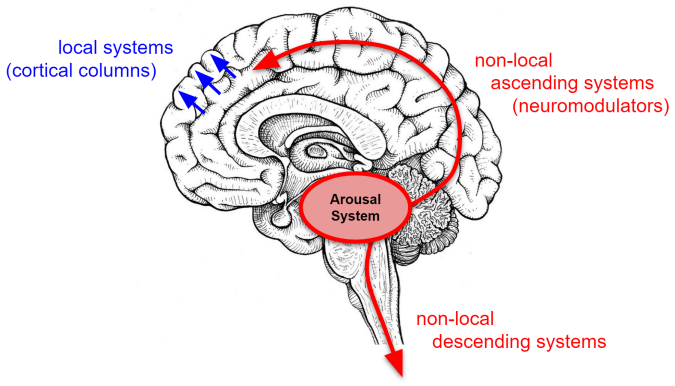
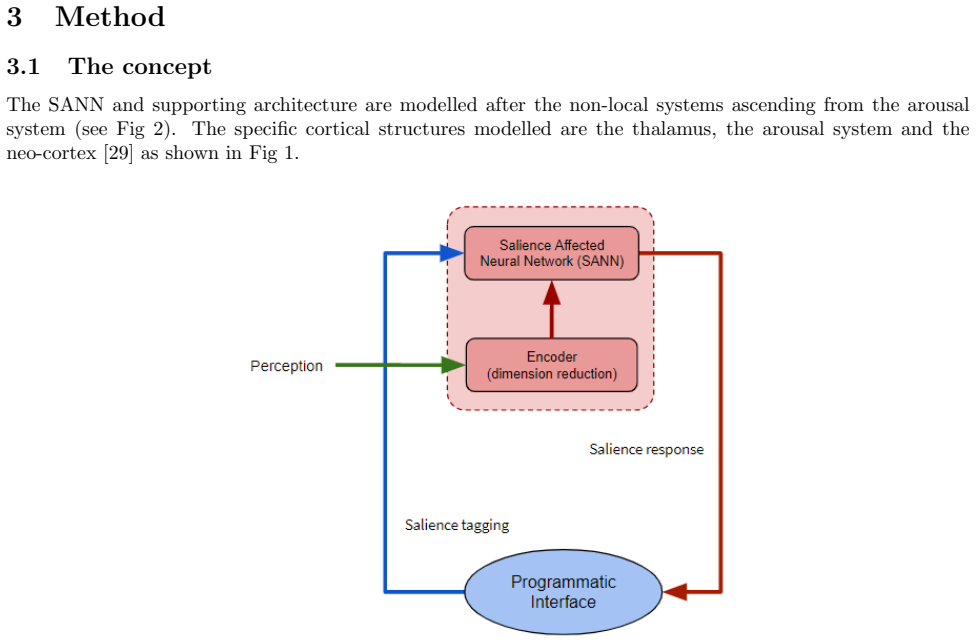
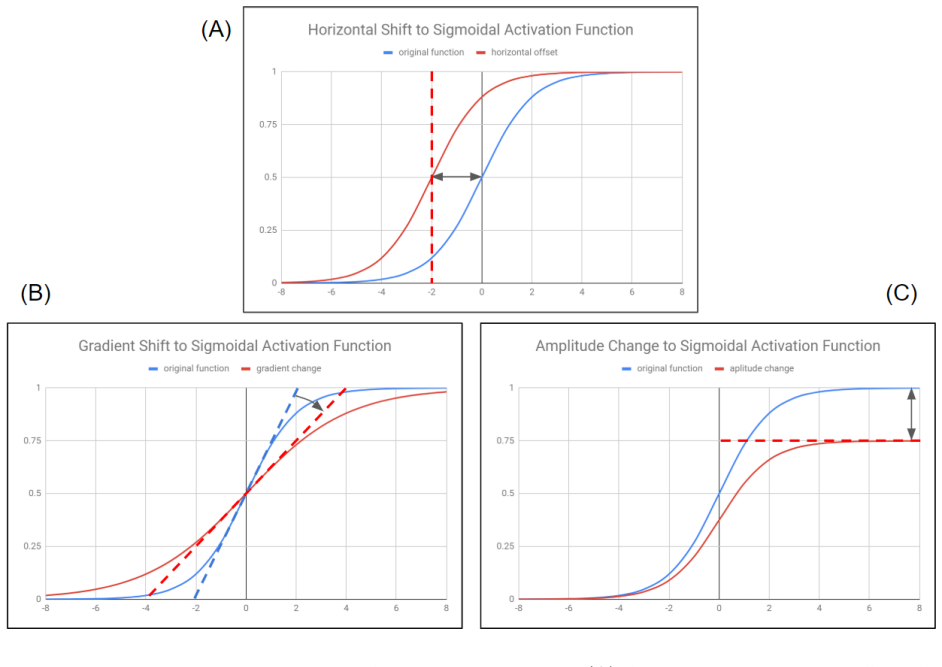
The load-bearing object is the per-node salience value $S_i$, a scalar in $[-1,1]$ initialized to zero. During one-time salience training, $S_i$ is updated by Eq. (1) proportional to the node's activation $\alpha_i$, and the same activation-weighted salience magnitude multiplies every incoming weight by Eq. (2). At inference, the salience response is $R=\sum_i S_i \alpha_i$, and the paper explores three salience-induced changes to the sigmoid activation function: horizontal offset, gradient change, and amplitude change. This combination lets a single global neurotransmitter-like signal act on exactly the pattern of nodes active at tagging time.
What would settle it
Train the same SANN to 355 epochs, then measure the reported confidence gain using a calibrated confidence metric such as expected calibration error or reliability diagrams instead of raw sigmoid output. If the raw-output gain disappears once outputs are calibrated, the claim that salience training improves classification confidence is an artifact of the uncalibrated measure, not a property of the network.
Extended reading notes
Core claim
The central discovery is that a single salience-training update, applied after a network has already reached 100% classification accuracy, improves classification confidence without retraining. Formally, each node carries a salience value $S_i$ in $[-1,1]$, updated as $S_i(N)=S_i+(1-S_i)\alpha_i N$, and each incoming weight is multiplied by $(1+|S_i \alpha_i \theta|)$; choosing the positive sign models dopamine and the negative sign models norepinephrine. After 355 epochs of baseline training, one such update produced a median class confidence higher than that reached after 500 epochs of standard training, with tagged images seeing the largest gains and non-tagged images in the same class also improving. The salience response $R=\sum_i S_i \alpha_i$ is recovered during inference, with mean inference time increasing by only 4.3%.
Load-bearing premise
The argument rests on treating the raw sigmoid output of the classifier as true classification confidence; the paper itself notes in Section 3.2.6 that calibrated confidence is left to future work. If the reported gains are only changes in uncalibrated output magnitude, the central claim loses its meaning.
Editorial extensions
If this is right
- One-time salience training after 355 epochs yields a higher median class confidence than 500 epochs of standard classification training.
- Higher salience intensity (1x, 2x, and 3x baseline) produces a strong positive correlation with classification confidence across the network.
- Negative salience produces a perfectly symmetric effect, with the salience response sign inverted.
- Positive and negative salience can be embedded sequentially into the same network and coexist as distinct salience responses.
- Calculating the salience response during inference adds only about 4.3% to mean classification time.
Reading between the lines
- Because Eq. (2) multiplies every active weight by a factor greater than one, part of the reported confidence gain may be a mechanical amplification of raw output magnitudes; a calibrated-confidence test would separate genuine sharpening from this arithmetic effect.
- The same tagging mechanism could be dropped into deep convolutional or recurrent networks, but weight amplification there may interact with batch normalization and residual connections, so it should be tested on at least one such architecture.
- The class-level improvement suggests a single tagged exemplar might raise confidence on never-tagged members of the same class; measuring this on held-out class members would show whether tagging improves generalization or only memorizes the tagged pattern.
- The salience response acts as a fast associative readout, so a testable application is using it to filter candidates in approximate nearest-neighbour search, measuring recall against raw SANN response time.
Signed reviews
Editorial analysis
A structured set of objections, weighed in public.
Referee Report
Summary. The paper introduces the Salience Affected Artificial Neural Network (SANN), in which each node carries a scalar salience state in [-1,1] intended to model the diffuse action of dopamine (positive) and norepinephrine (negative). After a network has been trained to classify images, a one-time salience tagging pass updates active weights using Eq. (2) and optionally modifies activation functions via Eqs. (4)-(6); during inference the network produces a salience response and a sigmoid-output 'classification confidence'. Experiments on a small animal-silhouette dataset report that one-time salience training raises the raw sigmoid outputs for tagged images, their class, and even untagged images, and that computing the salience response adds only about 4.3% to inference time. The authors frame the work explicitly as a proof of concept.
Significance. If the central claim were established, the contribution would be a simple, inexpensive mechanism for attaching a one-pass salience tag to an already-trained classifier and recovering a salience-modulated confidence signal. The paper is transparent about its scope, lists limitations, and makes source code publicly available, which are clear strengths. However, the main reported improvement is largely a mechanical consequence of the weight-update rule: Eq. (2) multiplies active weights by a factor exceeding one, and raw sigmoid output is monotonic in the logit, so the reported gains in confidence are consistent with a trivial scaling artifact. The absence of calibrated confidence, a magnitude-matched control, and any statistical testing prevents the paper from supporting its strongest claims. The research is a reasonable proof-of-concept sketch, but the evidence as presented does not yet distinguish salience-specific effects from output inflation.
major comments (4)
- [Section 3.2.6, Section 6, Eq. (2)] Section 3.2.6 defines classification confidence as the raw output of the Sigmoid classifier and explicitly defers calibrated confidence to future work, and Section 6 states that salience tagging has a positive impact on classification confidence across the entire SANN after one-time salience training. This claim is not supported as stated because Eq. (2) multiplies each active weight by (1+|S_i alpha_i theta|) > 1 for any nonzero salience and the sigmoid is monotonic, so any positive salience tag inflates the output magnitude for the tagged pattern by construction. The box plots in Figs. 11 and 14 are therefore consistent with a scaling of active weights rather than a salience-specific improvement. The authors should provide a magnitude-matched control (e.g., scaling all active weights by a constant factor with no salience structure) or use calibrated confidence (e.g., temperature scaling as in reference [49]) to show that the effect is not merely output inflation.
- [Section 5.4, Fig. 12] Section 5.4 reports a strong positive correlation between salience intensity and classification confidence. This correlation is a direct mathematical consequence of the update rules: Eq. (1) increases S_i with N, and Eq. (2) multiplies weights by a factor increasing in |S_i|. No correlation coefficient, confidence interval, or significance test is reported, so this observation provides no independent evidence for a salience-specific benefit beyond what is built into the equations.
- [Section 4.2, Section 5.3] The experimental results in Sections 5.3 and 5.4 are based on a single training run without multiple seeds, confidence intervals, or significance tests. For example, Section 5.3 bullet 2 claims that one-time salience training produced a median class confidence higher than standard training after 500 epochs, but this is a comparison of single box plots and the difference could be within run-to-run variation. Moreover, Section 4.2 describes training the SANN to 100% accuracy without mentioning a held-out test set, and the dataset appears to contain only 12 images; the reported confidence values may therefore reflect memorization of the training data rather than any generalizable improvement.
- [Section 3.2.4, Eqs. (5) and (6)] Equations (5) and (6) are not valid over the allowed salience range [-1,1]. Eq. (5) contains sqrt(0.5 - S_i), which is undefined for S_i > 0.5, and Eq. (6) yields negative outputs for S_i > 0.5, so the activation values would leave the [0,1] range. Since Section 5.7 reports improvements from these activation-function variants, the results for the gradient-change and amplitude-change modifications are not mathematically well-founded as stated.
minor comments (7)
- [Section 6] Section 6 contains several typos, including 'aSalience Affected Artificial Neural Network' and 'one-tine salience training'.
- [Section 3.2.1, Section 3.2.7] The phrase 'the activation of the node a the time' appears in Sections 3.2.1 and 3.2.7; 'a' should be 'at'.
- [Section 2] Section 2 refers to 'dopanine' instead of 'dopamine'.
- [Section 5.5] The statement that negative salience produces a 'perfectly symmetrical effect' is not justified: while Eq. (2) uses the absolute value of S_i so the weight update is sign-symmetric, Eq. (4) shifts the sigmoid in opposite directions for positive and negative S_i, so the activation-function effects are not obviously symmetric.
- [Fig. 11 caption] The caption of Fig. 11 contains the redundant phrase 'confidences of class classification confidences'.
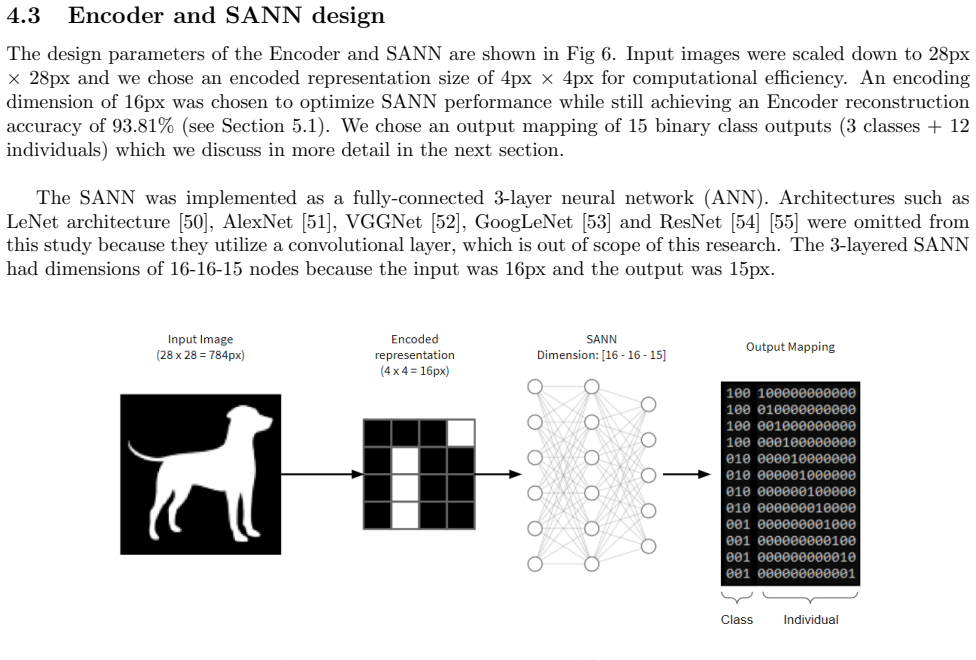
- [Section 4.3] Section 4.3 says 'an encoded representation size of 4px × 4px' and later 'an encoding dimension of 16px'; the final term should be '16' because it is a vector dimension, not a pixel dimension.
- [Reference [29]] Reference [29] is cited for the animal silhouette dataset, but the dataset is not described or linked; if it is not publicly documented elsewhere, a description or URL should be provided.
Circularity Check
The reported confidence gain is a rescaling artifact: Eq. 2 multiplies active weights by a factor greater than one, while Section 3.2.6 defines confidence as the raw sigmoid output, so the central claim follows from the update rule by construction.
-
self definitional
[Section 3.2.3 (Eq. 2), Section 3.2.6, Section 5.3, Section 5.4]
"Wi,j(S) =Wi,j× (1 +|Siαiθ|) (2) ... We calculated the classification confidence as the associated confidence Pˆ of the class prediction Yˆ. This could be extended in future research to a calibrated confidence as described by Guo [49]."
Confidence is defined as the raw sigmoid output, and Eq. 2 multiplies every active incoming weight by (1+|Si αi θ|)>1 during one-time salience training. Since the sigmoid output is monotone in the pre-activation, this multiplicative scaling directly inflates the measured confidence for the tagged pattern and can raise it for the whole class. The Section 5.3 observation that salience tagging improves confidence, and the Section 5.4 observation that larger salience intensity gives larger confidence gains, are therefore arithmetical consequences of the chosen update rule and metric, not independent predictions. A magnitude-matched control or calibrated probabilities would be needed to establish the claimed effect as salience-specific.
-
self definitional
[Section 3.2.4 (Eq. 4), Section 5.7]
"y(x) = 1/(1 +e−(x+Si)) (4) ... The results show that allowing the salience to impact the activation functions of every node in the network proportional to their activation results in an improvement in the classification confidence across the entire network."
Eq. 4 shifts the sigmoid activation by the salience value S_i; for a positive S_i, the output of the sigmoid increases at every positive pre-activation. The paper measures confidence as the raw sigmoid output, so the improvement reported in Section 5.7 is the direct evaluation of the same activation function that defines the perturbation. The claimed biological effect is thus built into the mathematical definition of the salience-modified activation function rather than being an emergent or independent result.
full rationale
The paper is not circular in its self-citation usage: references [29], [56], and [67] supply a dataset, code, and an earlier preprint, but the key conclusions do not rest on an unverified self-citation chain or on a uniqueness theorem imported from the authors' prior work. The serious circularity is in the central quantitative claim. Section 3.2.6 defines classification confidence as the raw sigmoid output and explicitly defers calibrated confidence to future work. Sections 3.2.3 and 3.2.4 then define salience as a multiplicative strengthening of active weights (Eq. 2) and as a shift/scaling of the same sigmoid activation functions (Eqs. 4-6). Because the metric is the sigmoid output itself, improving 'confidence' for the tagged pattern is essentially the intended operation of the salience update, and the intensity sweep in Section 5.4 merely varies the magnitude of that operation. The paper is transparent about the lack of calibration, but that transparency does not remove the definitional dependence: the strongest claim, 'salience tagging has a positive impact on classification confidence,' reduces to the fact that multiplying or shifting the relevant activations raises the raw output. The performance benchmark in Section 5.8 and the salience response mechanism are independent and not circular. Overall score 6 reflects partial circularity: the central positive claim is forced by the definitions, while other contributions retain independent content.
Assumptions & free parameters
free parameters (4)
- theta (weight update constant)
- Salience intensity N =
1x, 2x, 3x baseline
- Encoder latent dimension =
16
- gamma (desire-to-act constant)
assumptions (4)
- domain assumption Neuromodulators strengthen active synapses in proportion to the product of synaptic activity and neuromodulator concentration, applied to all active nodes at once.
- ad hoc to paper Salience can be represented by a single scalar per node in the interval [-1,1], with sign encoding dopamine versus norepinephrine.
- domain assumption Raw sigmoid classifier output is a meaningful measure of classification confidence.
- domain assumption Results on 12 images with 100% training accuracy are sufficient to demonstrate the architecture's benefits.
invented entities (2)
-
Per-node salience state S_i
-
Desire-to-act value D
Cite this review
Pith. "Pith review of Biologically-inspired Salience Affected Artificial Neural Network (SANN)." pith.science (2026). https://pith.science/paper/K5ID63V6
@misc{pith2026190803532,
  author       = {Pith},
  title        = {Pith review of: Biologically-inspired Salience Affected Artificial Neural Network (SANN)},
  year         = {2026},
  howpublished = {\url{https://pith.science/paper/K5ID63V6}},
  note         = {Machine review of arXiv:1908.03532}
}
read the original abstract
In this paper we introduce a novel Salience Affected Artificial Neural Network (SANN) that models the way neuromodulators such as dopamine and noradrenaline affect neural dynamics in the human brain by being distributed diffusely through neocortical regions, allowing both salience signals to modulate cognition immediately, and one time learning to take place through strengthening entire patterns of activation at one go. We present a model that is capable of one-time salience tagging in a neural network trained to classify objects, and returns a salience response during classification (inference). We explore the effects of salience on learning via its effect on the activation functions of each node, as well as on the strength of weights between nodes in the network. We demonstrate that salience tagging can improve classification confidence for both the individual image as well as the class of images it belongs to. We also show that the computation impact of producing a salience response is minimal. This research serves as a proof of concept, and could be the first step towards introducing salience tagging into Deep Learning Networks and robotics.
Figures

Figures from the paper (13 more)




Reference graph
Works this paper leans on
-
[49]
Guo, C., Pleiss, G., Sun, Y. and Weinberger, K.Q., 2017. On calibration of modern neural networks. arXiv preprint arXiv:1706.04599
arXiv 2017
-
[1]
Cao, Y., Xu, J., Lin, S., Wei, F., and Hu, H. (2019). Gcnet: Non-local networks meet squeeze-excitation networks and beyond. In Proceedings of the IEEE International Conference on Computer Vision Work- shops (pp. 0-0)
work page 2019
-
[2]
Making memories last: the synaptic tagging and capture hypothesis
Redondo, R., Morris, R. Making memories last: the synaptic tagging and capture hypothesis. Nat Rev Neurosci 12, 17-30 (2011). https://doi.org/10.1038/nrn2963
doi:10.1038/nrn2963 2011
-
[3]
Hu, J., Shen, L., and Sun, G. (2018). Squeeze-and-excitation networks. In Proceedings of the IEEE conference on computer vision and pattern recognition (pp. 7132-7141)
work page 2018
-
[4]
Neural development affective and immune system influences
Ellis, GFR and Toronchuk, JA. Neural development affective and immune system influences. Conscious- ness & Emotion: Agency, conscious choice, and selective perception , 1:81, 2005
work page 2005
-
[5]
Affective neuroscience: The foundations of human and animal emotions
Jaak Panksepp. Affective neuroscience: The foundations of human and animal emotions . Oxford univer- sity press, 2004
work page 2004
-
[6]
Panksepp’s psychobiological theory of emotions: Some substantiation
Heath, R.G., 1982. Panksepp’s psychobiological theory of emotions: Some substantiation. Behavioral and Brain Sciences, 5(3), pp.432-433
work page 1982
-
[7]
Panksepp, J., 2003. At the interface of the affective, behavioral, and cognitive neurosciences: Decoding the emotional feelings of the brain. Brain and cognition, 52(1), pp.4-14
work page 2003
Show all 67 references
-
[8]
Affective consciousness: Core emotional feelings in animals and humans
Panksepp, J., 2005. Affective consciousness: Core emotional feelings in animals and humans. Consciousness and cognition, 14(1), pp.30-80
2005
-
[9]
Descartes’ error: Emotion, reason, and the human brain
Damasio, A. Descartes’ error: Emotion, reason, and the human brain . Harcourt Brace, 1994
1994
-
[10]
The feeling of what happens: Body and emotion in the making of consciousness
Damasio, A. The feeling of what happens: Body and emotion in the making of consciousness. . Houghton Mifflin Harcourt, 1999
1999
-
[11]
Homeostasis and soft robotics in the design of feeling machines
Man, K and Damasio, A. Homeostasis and soft robotics in the design of feeling machines. Nature Machine Intelligence 1 (2019): 446-452
2019
-
[12]
Learning in and from brain-based devices
Gerald M Edelman. Learning in and from brain-based devices. Science, 318(5853):1103–1105, 2007
2007
-
[13]
Neural Darwinism: The theory of neuronal group selection
Gerald M Edelman. Neural Darwinism: The theory of neuronal group selection. Basic books, 1987
1987
-
[14]
and Hamann, S
Kim, S.H. and Hamann, S. Neural correlates of positive and negative emotion regulation. Journal of cognitive neuroscience 19(5), pp.776-798. 2007
2007
-
[15]
and Schwartz, R
Touboul, J., Romagnoni, A. and Schwartz, R. On the dynamical interplay of positive and negative affects. Neural computation 29(4), pp.897-936. 2017
2017
-
[16]
and Bucher, D., 2014
Nadim, F. and Bucher, D., 2014. Neuromodulation of neurons and synapses. Current opinion in neurobi- ology, 29, pp.48-56
2014
-
[17]
and Kirkwood, A., 2007
Seol, G.H., Ziburkus, J., Huang, S., Song, L., Kim, I.T., Takamiya, K., Huganir, R.L., Lee, H.K. and Kirkwood, A., 2007. Neuromodulators control the polarity of spike-timing-dependent synaptic plasticity. Neuron, 55(6), pp.919-929
2007
-
[18]
and Marder, E., 2013
Bucher, D. and Marder, E., 2013. SnapShot: neuromodulation. Cell, 155(2), pp.482-482
2013
-
[19]
Wider than the sky: The phenomenal gift of consciousness
Gerald M Edelman. Wider than the sky: The phenomenal gift of consciousness . Yale University Press, 2004
2004
-
[20]
Frey, U., and Morris, R. G. (1997). Synaptic tagging and long-term potentiation. Nature, 385(6616), 533-536
1997
-
[21]
and Nedergaard, M., 2012
O’Donnell, J., Zeppenfeld, D., McConnell, E., Pena, S. and Nedergaard, M., 2012. Norepinephrine: a neu- romodulator that boosts the function of multiple cell types to optimize CNS performance. Neurochemical research, 37(11), pp.2496-2512
2012
-
[22]
and Sejnowski, T.J., 2000
Durstewitz, D., Seamans, J.K. and Sejnowski, T.J., 2000. Neurocomputational models of working memory. Nature neuroscience, 3(11), pp.1184-1191
2000
-
[23]
and Perona, P
Fei-Fei, L., Fergus, R. and Perona, P. One-shot learning of object categories. IEEE transactions on pattern analysis and machine intelligence, 28(4), pp.594-611. 200 24
-
[24]
and Wierstra, D
Vinyals, O., Blundell, C., Lillicrap, T. and Wierstra, D. Matching networks for one shot learning. Advances in neural information processing systems (pp. 3630-3638). 2016
2016
-
[25]
and Indyk, P., 2006, October
Andoni, A. and Indyk, P., 2006, October. Near-optimal hashing algorithms for approximate nearest neighbor in high dimensions. In 2006 47th annual IEEE symposium on foundations of computer science (FOCS’06) (pp. 459-468). IEEE
2006
-
[26]
F., and Navlakha, S
Dasgupta, S., Stevens, C. F., and Navlakha, S. (2017). A neural algorithm for a fundamental computing problem. Science, 358(6364), 793-796
2017
-
[27]
A new three-dimensional model for emotions and monoamine neurotransmitters
L¨ ovheim, H., 2012. A new three-dimensional model for emotions and monoamine neurotransmitters. Medical hypotheses, 78(2), pp.341-348
2012
-
[28]
and Nurgaliev, I
Vallverd´ u, J., Talanov, M., Distefano, S., Mazzara, M., Tchitchigin, A. and Nurgaliev, I. A cognitive architecture for the implementation of emotions in computing systems. Biologically Inspired Cognitive Architectures, 15, pp.34-40
-
[29]
and Ellis, G.F
Remmelzwaal, L.A., Mishra, A.K. and Ellis, G.F. Brain-inspired Distributed Cognitive Architecture. Cognitive Systems Research, 2020
2020
-
[30]
LeCun, C
Y. LeCun, C. Cortes, C. Burges The mnist database of handwritten digits. http: // yann. lecun. com/ exdb/ mnist , 1998
1998
-
[31]
Evolving robot behaviours with diffusing gas networks
Phil Husbands. Evolving robot behaviours with diffusing gas networks. In European Workshop on Evo- lutionary Robotics, pages 71–86. Springer, 1998
1998
-
[32]
Brain-based devices for the study of nervous systems and the development of intelligent machines
Jeffrey L Krichmar and Gerald M Edelman. Brain-based devices for the study of nervous systems and the development of intelligent machines. Artificial Life, 11(1-2):63–77, 2005
2005
-
[33]
Blood Cell Identification Using Emotional Neural Networks
Khashman, A. Blood Cell Identification Using Emotional Neural Networks. Journal of Information Science and Engineering, 25(6)
-
[34]
Credit risk evaluation using neural networks: Emotional versus conventional models
Khashman, A. Credit risk evaluation using neural networks: Emotional versus conventional models. Applied Soft Computing, 11(8), pp.5477-5484
-
[35]
and Schmickl, T., 2013, September
Thenius, R., Zahadat, P. and Schmickl, T., 2013, September. EMANN-a model of emotions in an artificial neural network. In Artificial Life Conference Proceedings 13 (pp. 830-837). One Rogers Street, Cambridge, MA 02142-1209 USA journals-info@ mit. edu: MIT Press
2013
-
[36]
and Blunsom, P
Kalchbrenner, N. and Blunsom, P. Recurrent continuous translation models. Proceedings of the ACL Conference on Empirical Methods in Natural Language Processing (EMNLP), pp 1700–1709. Association for Computational Linguistics, 2013
2013
-
[37]
and Manning, C.D
Luong, M.T., Pham, H. and Manning, C.D. Effective Approaches to Attention-based Neural Machine Translation. arXiv preprint arXiv:1508.04025., 2015
2015 arXiv
-
[38]
and Bengio, Y
Bahdanau, D., Cho, K. and Bengio, Y. Neural machine translation by jointly learning to align and translate. arXiv preprint arXiv:1409.0473. 2014
2014 arXiv
-
[39]
and Tang, X., 2017
Wang, F., Jiang, M., Qian, C., Yang, S., Li, C., Zhang, H., Wang, X. and Tang, X., 2017. Residual attention network for image classification. In Proceedings of the IEEE conference on computer vision and pattern recognition (pp. 3156-3164)
2017
-
[40]
Wang, X., Girshick, R., Gupta, A., and He, K. (2018). Non-local neural networks. In Proceedings of the IEEE conference on computer vision and pattern recognition (pp. 7794-7803
2018
-
[41]
and Morel, J.M., 2005, June
Buades, A., Coll, B. and Morel, J.M., 2005, June. A non-local algorithm for image denoising. In 2005 IEEE Computer Society Conference on Computer Vision and Pattern Recognition (CVPR’05) (Vol. 2, pp. 60-65). IEEE
2005
-
[42]
and Rush, A.M
Kim, Y., Denton, C., Hoang, L. and Rush, A.M. Structured attention networks. arXiv preprint arXiv:1702.00887. 2017
2017 arXiv
-
[43]
Attention is all you need
Vaswani, Ashish, et al. Attention is all you need. Advances in neural information processing systems. 2017
2017
-
[44]
and Koch, C., 2001
Itti, L. and Koch, C., 2001. Computational modelling of visual attention. Nature reviews neuroscience, 2(3), pp.194-203. 25
2001
-
[45]
and Serre, T., 2018
Linsley, D., Shiebler, D., Eberhardt, S. and Serre, T., 2018. Learning what and where to attend. arXiv preprint arXiv:1805.08819
2018 arXiv
-
[46]
Maxout networks
Ian J Goodfellow, David Warde-Farley, Mehdi Mirza, Aaron Courville, and Yoshua Bengio. Maxout networks. arXiv preprint arXiv:1302.4389 , 2013
2013 arXiv
-
[47]
Rectified linear units improve restricted boltzmann machines
Vinod Nair and Geoffrey E Hinton. Rectified linear units improve restricted boltzmann machines. In Proceedings of the 27th international conference on machine learning (ICML-10) , pages 807–814, 2010
2010
-
[48]
Learning compact neural networks using ordinary differential equations as activation functions
MohamadAli Torkamani, Phillip Wallis, Shiv Shankar, and Amirmohammad Rooshenas. Learning compact neural networks using ordinary differential equations as activation functions. arXiv preprint arXiv:1905.07685, 2019
1905 arXiv
-
[50]
LeCun, L
Y. LeCun, L. Bottou, Y. Bengio, and P. Haffner. Gradient-based learning applied to document recognition. Proceedings of the IEEE, 86(11):2278–2324, November 1998
1998
-
[51]
Krizhevsky, I
A. Krizhevsky, I. Sutskever, and G. E. Hinton. Imagenet classification with deep convolutional neural networks. Advances in neural information processing systems, pages 1097–1105. 2012
2012
-
[52]
and Zisserman, A
Simonyan, K. and Zisserman, A. Very deep convolutional networks for large-scale image recognition. arXiv preprint arXiv:1409.1556. 2014
2014 arXiv
-
[53]
and Rabinovich, A
Szegedy, C., Liu, W., Jia, Y., Sermanet, P., Reed, S., Anguelov, D., Erhan, D., Vanhoucke, V. and Rabinovich, A. Going deeper with convolutions. Proceedings of the IEEE conference on computer vision and pattern recognition (pp. 1-9). 2015
2015
-
[54]
and Sun, J
He, K., Zhang, X., Ren, S. and Sun, J. Deep residual learning for image recognition. Proceedings of the IEEE conference on computer vision and pattern recognition (pp. 770-778). 2016
2016
-
[55]
and Sun, J
He, K., Zhang, X., Ren, S. and Sun, J. Identity mappings in deep residual networks. In European conference on computer vision. European conference on computer vision (pp. 630-645). Springer, Cham. 2016
2016
-
[56]
A Pure Python implementation of a Neural Network
Leendert A Remmelzwaal. A Pure Python implementation of a Neural Network. https://bitbucket. org/leenremm/python_neural_network [Online; accessed 19-January-2020]
2020
-
[57]
and Vollgraf, R
Xiao, H., Rasul, K. and Vollgraf, R. Fashion-mnist: a novel image dataset for benchmarking machine learning algorithms. arXiv preprint arXiv:1708.07747. 2017
2017 arXiv
-
[58]
Learning multiple layers of features from tiny images
A Krizhevsky. Learning multiple layers of features from tiny images. Master’s thesis, Computer Science Department, University of Toronto, 2009
2009
-
[59]
Stallkamp, M
J. Stallkamp, M. Schlipsing, J. Salmen, and C. Igel. The German Traffic Sign Recognition Benchmark: A multi-class classification competition. International Joint Conference on Neural Networks, 2011
2011
-
[60]
and Zitnick, C.L., 2014, September
Lin, T.Y., Maire, M., Belongie, S., Hays, J., Perona, P., Ramanan, D., Doll´ ar, P. and Zitnick, C.L., 2014, September. Microsoft coco: Common objects in context. In European conference on computer vision (pp. 740-755). Springer, Cham
2014
-
[61]
P. J. Grother. NIST special database 19 - Handprinted forms and characters database. Technical report, National Institute of Standards and Thechnology (NIST). 1995
1995
-
[62]
C.-L. Liu, F. Yin, D.-H. Wang, and Q.-F. Wang. Chinese Handwriting Recognition Contest. Chinese Conference on Pattern Recognition, 2010
2010
-
[63]
and Grgic, S
Grgic, M., Delac, K. and Grgic, S. SCface–surveillance cameras face database. Multimedia tools and applications, 51(3), pp.863-879
-
[64]
and Kraus, N
Wang, J., Nicol, T., Skoe, E., Sams, M. and Kraus, N. Emotion modulates early auditory response to speech. Journal of Cognitive Neuroscience , 21(11), pp.2121-2128, 2018
2018
-
[65]
and Ondobaka, S
Friston, K.J., Lin, M., Frith, C.D., Pezzulo, G., Hobson, J.A. and Ondobaka, S. Active inference, curiosity and insight Neural computation, 29(10), pp.2633-2683, 2017. 26
2017
-
[66]
A Python implementation of a Salience Affected Neural Network
Leendert Remmelzwaal, Jonathan Tapson, and George FR Ellis. A Python implementation of a Salience Affected Neural Network. https://bitbucket.org/leenremm/sann_python_2020 [Online; accessed 25- Nov-2020]
2020
-
[67]
The integration of diffusely-distributed salience signals into a neural network
Leendert Remmelzwaal, Jonathan Tapson, and George FR Ellis. The integration of diffusely-distributed salience signals into a neural network. http://citeseerx.ist.psu.edu/viewdoc/download?doi=10.1. 1.693.9331&rep=rep1&type=pdf, 2010. 27
Reviewed August 14, 2026 · model on record in the stance chip above.
Discussion (0). Continue with ORCID to comment.