REVIEW 3 major objections 6 minor 36 references
Deep Mesh Reconstruction from Single RGB Images via Topology Modification Networks
T0 review · 3 major / 6 minor · reviewed 2026-08-14 · deepseek-v4-flash
Pith's one-line read A sphere mesh can become a complex-topology object by alternating learned deformation with face pruning.
desk verdict A credible topology-by-pruning idea whose headline numbers are likely inflated by the CD metric artifact; deserves review but needs a control. read the letter →
The pith
A machine-rendered reading of the paper's core claim, the machinery that carries it, and where it could break.
The reading
What carries the argument
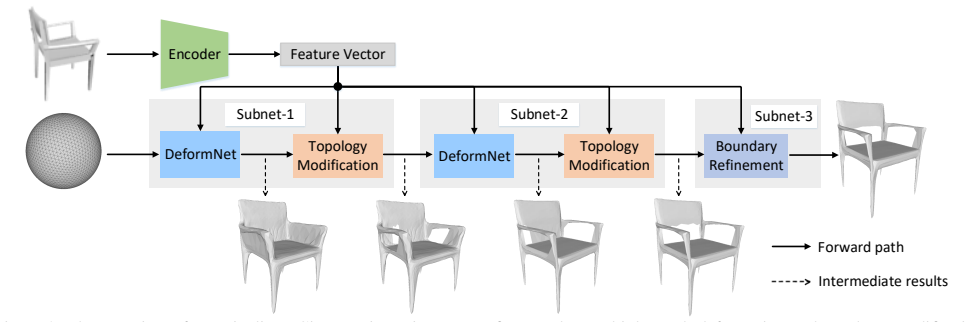
The load-bearing component is the topology modification network, made of an error-estimation multi-layer perceptron and a face-pruning rule. The MLP takes the image feature vector concatenated with randomly sampled points on each triangle of the current mesh and regresses per-point distance to the ground-truth surface; averaging over the samples gives a per-face error. Faces with error above threshold $\tau$ are removed, with $\tau$ decreasing across subnets so pruning starts coarse and becomes precise. A boundary refinement network then moves boundary vertices inside their local tangent planes, and a zigzag regularizer penalizes boundary roughness. The whole system alternates deformation and pruning twice before boundary refinement, and is trained with Chamfer distance, an error-regression loss, the boundary regularizer, and standard mesh-smoothness losses.
What would settle it
Reconstruct a mug with a handle or a torus-like object from a single image and inspect the intermediate coarse mesh produced after only the first deformation stage. If the handle region is not already present as a high-error bulge before pruning, and the final mesh contains no closed handle loop, then the topology is not being created by face removal and the central claim collapses.
Extended reading notes
Core claim
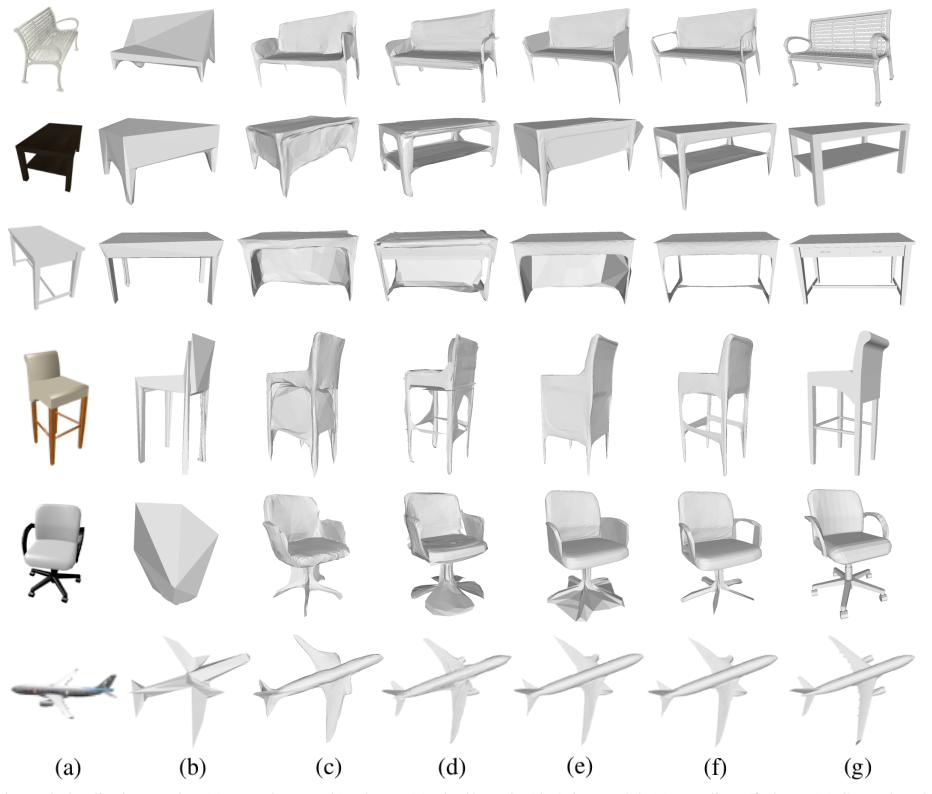
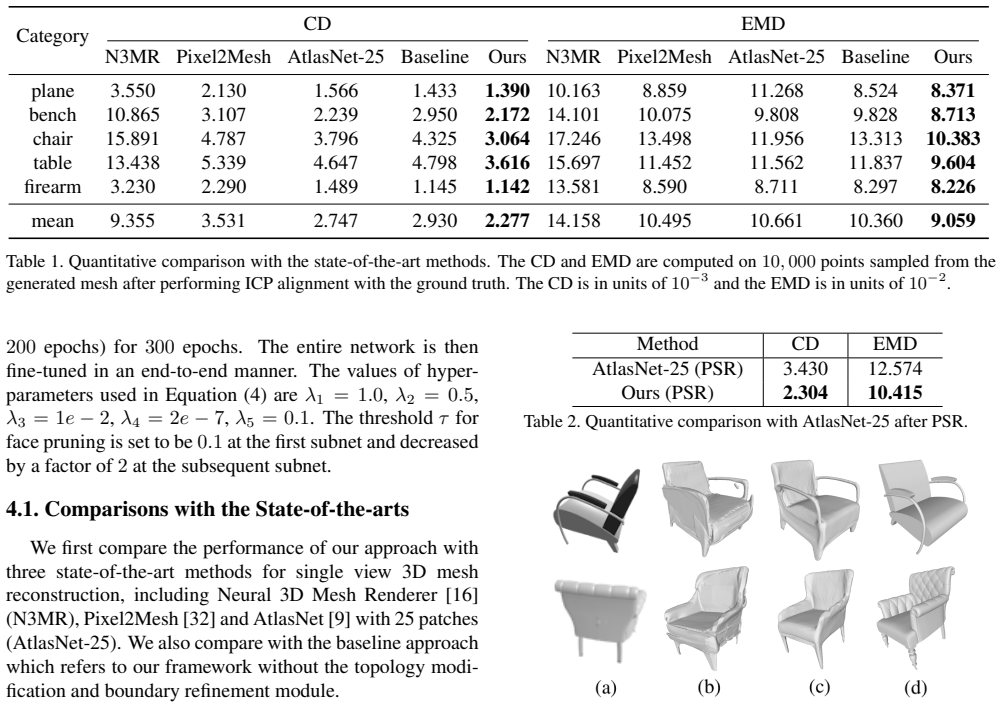
The paper's central claim is that topology does not have to be fixed when the template is chosen. The network first deforms a sphere into a coarse approximation of the target, then a topology modification network estimates, for every triangle face, how far that face is from the ground-truth surface and deletes faces whose error exceeds a threshold. Iterating deformation and pruning opens holes and separates components progressively, and a boundary refinement network smooths the jagged edges left by pruning. On the five ShapeNet categories used in the experiments, Chamfer distance and Earth mover's distance are reported to be lower than N3MR, Pixel2Mesh, AtlasNet-25, and the method's own baseline without topology modification or boundary refinement.
Load-bearing premise
The load-bearing premise is that after the first deformation stage, the sphere mesh is already a coarse but roughly correct version of the target, so the high-error faces that get pruned are exactly the places where topology must change; if the coarse shape is globally wrong, pruning cannot create the correct holes or branches.
Editorial extensions
If this is right
- Objects with non-genus-zero topology, such as chairs and tables, can be reconstructed from an ordinary sphere mesh without stitching multiple patches.
- The topology modification network is modular and can be inserted into other mesh-learning frameworks that currently keep connectivity fixed.
- On the five ShapeNet categories tested, the method reports lower Chamfer distance and Earth mover's distance than N3MR, Pixel2Mesh, AtlasNet-25, and its own baseline without topology change.
- After closing the open surfaces with Poisson surface reconstruction, the meshes remain more accurate than AtlasNet-25's post-processed outputs.
- The same deformation-plus-pruning loop applies to shape autoencoding from point clouds, again outperforming AtlasNet-25.
Reading between the lines
- This suggests that a learned or differentiable face-pruning threshold could replace the hand-set schedule, making the method adaptive to categories with very different error distributions.
- If the coarse deformation stage is reliable, the same prune-after-deform idea should transfer to multi-view or depth-based reconstruction, where the input mesh already sits near the target and only topology needs correction.
- Because outputs are open surfaces and need a separate Poisson step to close them, tying error-threshold pruning to an implicit-surface prediction could produce closed meshes directly and make the loop differentiable end-to-end.
- The reported robustness to starting from a sphere or a unit square suggests the method is choosing where to remove material from the learned error field rather than from template-specific geometry; a stress test on shapes with several disconnected components would reveal how far that generalizes.
Signed reviews
Editorial analysis
A structured set of objections, weighed in public.
Referee Report
Summary. The paper proposes a single-view mesh reconstruction pipeline that starts from a genus-0 sphere template and alternates between mesh deformation and a learned topology-modification step. A deformation MLP predicts per-vertex offsets, an error-estimation network regresses per-face distances to the ground truth, and a progressive threshold-based face-pruning strategy removes high-error faces, enabling topological changes. A boundary-refinement module smooths the resulting open boundaries. The authors report quantitative CD/EMD gains over N3MR, Pixel2Mesh, AtlasNet-25, and a baseline on five ShapeNet categories, along with qualitative results and an autoencoding experiment.
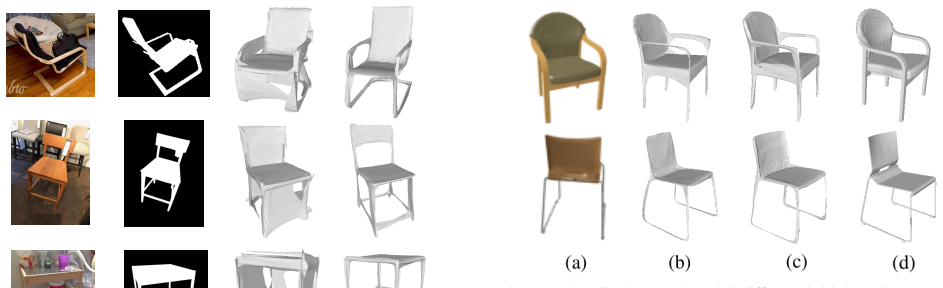
Significance. The core idea—using a learned error predictor to guide face pruning so that a deformation-based reconstructor can change topology—is a genuine conceptual contribution. Prior deformation methods such as Pixel2Mesh and AtlasNet are confined to the template topology, and the proposed progressive deformation-plus-pruning framework is a natural way to address this. The paper also includes useful ablations (progressive shaping, pruning threshold, boundary refinement, initial-mesh robustness) and demonstrates plausibly better qualitative reconstructions on complex shapes. If the quantitative claims were clean, this would be a solid step for mesh-based single-view reconstruction. However, as detailed in the major comments, the evaluation is confounded by the metric design and lacks statistical rigor, so the central quantitative claim is not yet established.
major comments (3)
- [§3.2.2, Eq. (2), Table 1] The CD gains in Table 1 are confounded by the pruning operation itself. In Eq. (2), CD sums over sampled points from the generated mesh M and from the ground truth S. When a face with high estimated error is removed, its sampled points disappear from the first sum, so the first term drops by roughly the squared distance of those points to the ground truth; the second term cannot decrease when the set M shrinks and may increase. Because §3.2.2 removes exactly the faces with the largest estimated errors, the reported CD improvement over the Baseline is at least partly a mechanical artifact of discarding poorly reconstructed geometry, not evidence of better topology correction. No control separates these effects: there is no random-pruning comparison with the same number of removed faces, no oracle-error-pruning baseline, and no separate reporting of the two directional CD terms. The paper needs such a control, or a closed-surface evaluation on the full test set, to support the quantitative claim.
- [§4.1, Table 2] The only closed-mesh evaluation is limited to 20 randomly selected chair shapes and compares only Ours (PSR) with AtlasNet-25 (PSR). It does not compare with the Baseline or with the open-surface version of the method, and the small sample size cannot establish that the advantage persists after closing the surface. Since Section 5 concedes the method has the 'inherent drawback of producing non-closed meshes,' the claim of high-quality mesh reconstruction needs a broader closed-surface evaluation, ideally across all categories with the baseline included.
- [Table 1, experimental methodology] No error bars or statistical significance tests are reported. Several category-level improvements are very small (plane CD from 1.433 to 1.390; firearm from 1.145 to 1.142), so without variance estimates or paired tests across individual shapes, the claim of consistent improvement over all five categories is not robust. Per-shape paired comparisons or at least standard deviations across the test set should be reported.
minor comments (6)
- [Abstract, §3] The pipeline is described as 'end-to-end' in the abstract and Section 3, but the face-pruning operation in §3.2.2 is a discrete thresholding step that is not differentiable, and the error-estimation network is trained with a separate loss in Eq. (3). The term 'end-to-end' should be qualified or replaced with a more precise description of the training procedure.
- [§3.2.2] The face-pruning operation is not fully specified: it is unclear how removing a face affects its neighboring faces, whether boundary vertices are retained or collapsed, and what range of face counts survive after pruning for each category. This information is needed to understand the actual topology modifications.
- [Eq. (1)] The symbol E is used inconsistently: in Section 3 the mesh is defined as M=(V,E,T) with E the edge set, while in Eq. (1) E denotes the set of boundary vertices. Using a different symbol for one of these would avoid confusion.
- [Figure 9] The horizontal-axis label appears as 'Threshold( )' with the tau symbol missing; this should be corrected.
- [§4.3, Table 3] The autoencoding metrics in Table 3 are computed on the open-surface output of the method, but the text does not state whether PSR or another closing procedure is applied. This should be clarified so that a fair comparison with AtlasNet-25 is possible.
- [Additional comments] No code or trained models are released, which limits reproducibility of the quantitative results; providing them would strengthen the paper.
Circularity Check
No circular derivation; learned error-prediction pruning is a trained component, not a fitted parameter renamed as a prediction.
full rationale
This paper reports no circular derivation. The pipeline is an encoder-decoder: deformations are predicted by an MLP, topology is modified by a separately trained error-estimation network that regresses per-point distances to ground truth, and boundaries are refined by another MLP. None of these components is defined in terms of the final evaluation numbers. The CD loss in Eq. (2) and the error loss in Eq. (3) do use the same nearest-neighbor distances, and Section 3.2.2 removes faces with large estimated error, but the estimated errors come from a learned network trained on ground-truth distances rather than from an analytic identity; the reported CD in Table 1 is computed on the output mesh, not read off from the error predictor. The self-citations, such as Residual MeshNet [24], are architectural precedents and are not load-bearing for the central claim; comparisons are made against external baselines such as AtlasNet, Pixel2Mesh, and N3MR on ShapeNet, and the PSR and autoencoding results provide additional external checks. The acknowledged open-surface limitation and the absence of a random-pruning control are experimental and correctness concerns, not circularity, because no equation in the paper defines the final reconstruction as equal to the fitted error predictor. Thus no step reduces by construction to its inputs.
Assumptions & free parameters
free parameters (3)
- Face pruning threshold tau =
0.1 initial, halved per subnet
- Loss weights lambda_1..lambda_5 =
1.0, 0.5, 1e-2, 2e-7, 0.1
- Initial mesh resolution =
sphere with 2562 vertices
assumptions (4)
- domain assumption A single genus-0 sphere can be deformed close enough to the target that face pruning only has to remove localized high-error regions.
- domain assumption Per-face reconstruction error can be learned from sampled points and generalizes from training to test shapes.
- domain assumption Chamfer distance and EMD on 10,000 sampled points, after ICP alignment, are faithful proxies for reconstruction quality.
- domain assumption The adopted AtlasNet evaluation protocol is a fair common benchmark for all compared methods.
Cite this review
Pith. "Pith review of Deep Mesh Reconstruction from Single RGB Images via Topology Modification Networks." pith.science (2026). https://pith.science/paper/K5RBKBCP
@misc{pith2026190900321,
  author       = {Pith},
  title        = {Pith review of: Deep Mesh Reconstruction from Single RGB Images via Topology Modification Networks},
  year         = {2026},
  howpublished = {\url{https://pith.science/paper/K5RBKBCP}},
  note         = {Machine review of arXiv:1909.00321}
}
read the original abstract
Reconstructing the 3D mesh of a general object from a single image is now possible thanks to the latest advances of deep learning technologies. However, due to the nontrivial difficulty of generating a feasible mesh structure, the state-of-the-art approaches often simplify the problem by learning the displacements of a template mesh that deforms it to the target surface. Though reconstructing a 3D shape with complex topology can be achieved by deforming multiple mesh patches, it remains difficult to stitch the results to ensure a high meshing quality. In this paper, we present an end-to-end single-view mesh reconstruction framework that is able to generate high-quality meshes with complex topologies from a single genus-0 template mesh. The key to our approach is a novel progressive shaping framework that alternates between mesh deformation and topology modification. While a deformation network predicts the per-vertex translations that reduce the gap between the reconstructed mesh and the ground truth, a novel topology modification network is employed to prune the error-prone faces, enabling the evolution of topology. By iterating over the two procedures, one can progressively modify the mesh topology while achieving higher reconstruction accuracy. Moreover, a boundary refinement network is designed to refine the boundary conditions to further improve the visual quality of the reconstructed mesh. Extensive experiments demonstrate that our approach outperforms the current state-of-the-art methods both qualitatively and quantitatively, especially for the shapes with complex topologies.
Figures


Figures from the paper (7 more)


Reference graph
Works this paper leans on
-
[1]
Learning representations and generative models for 3d point clouds
Panos Achlioptas, Olga Diamanti, Ioannis Mitliagkas, and Leonidas Guibas. Learning representations and generative models for 3d point clouds. In International Conference on Machine Learning, pages 40–49, 2018
work page 2018
-
[2]
A method for registration of 3-d shapes
PJ Besl and Neil D McKay. A method for registration of 3-d shapes. IEEE Transactions on Pattern Analysis and Machine Intelligence, 14(2):239–256, 1992
work page 1992
-
[3]
Shapenet: An information-rich 3d model repository
Angel X Chang, Thomas Funkhouser, Leonidas Guibas, Pat Hanrahan, Qixing Huang, Zimo Li, Silvio Savarese, Manolis Savva, Shuran Song, Hao Su, et al. Shapenet: An information-rich 3d model repository. arXiv preprint arXiv:1512.03012, 2015
arXiv 2015
-
[4]
Deep RBFNet: Point Cloud Feature Learning using Radial Basis Functions
Weikai Chen, Xiaoguang Han, Guanbin Li, Chao Chen, Jun Xing, Yajie Zhao, and Hao Li. Deep rbfnet: Point cloud feature learning using radial basis functions. arXiv preprint arXiv:1812.04302, 2018
work page Pith review arXiv 2018
-
[5]
Zhiqin Chen and Hao Zhang. Learning implicit fields for generative shape modeling.Proceedings of IEEE Conference on Computer Vision and Pattern Recognition (CVPR), 2019
work page 2019
-
[6]
3d-r2n2: A unified approach for single and multi-view 3d object reconstruction
Christopher B Choy, Danfei Xu, JunYoung Gwak, Kevin Chen, and Silvio Savarese. 3d-r2n2: A unified approach for single and multi-view 3d object reconstruction. In Pro- ceedings of the European Conference on Computer Vision (ECCV), pages 628–644. Springer, 2016
work page 2016
-
[7]
Haoqiang Fan, Hao Su, and Leonidas J. Guibas. A point set generation network for 3d object reconstruction from a single image. In 2017 IEEE Conference on Computer Vision and Pattern Recognition (CVPR), pages 2463–2471, 2017
work page 2017
-
[8]
Accurate, dense, and robust multiview stereopsis
Yasutaka Furukawa and Jean Ponce. Accurate, dense, and robust multiview stereopsis. IEEE transactions on pattern analysis and machine intelligence, 32(8):1362–1376, 2010
work page 2010
Show all 36 references
-
[9]
Kim, Bryan Russell, and Mathieu Aubry
Thibault Groueix, Matthew Fisher, Vladimir G. Kim, Bryan Russell, and Mathieu Aubry. AtlasNet: A Papier-M ˆach´e Approach to Learning 3D Surface Generation. In Proceed- ings of the IEEE conference on computer vision and pattern recognition, pages 216–224, 2018
2018
-
[10]
High-resolution shape com- pletion using deep neural networks for global structure and local geometry inference
Xiaoguang Han, Zhen Li, Haibin Huang, Evangelos Kalogerakis, and Yizhou Yu. High-resolution shape com- pletion using deep neural networks for global structure and local geometry inference. In Proceedings of the IEEE In- ternational Conference on Computer Vision , pages 85–93, 2017
2017
-
[11]
Multiple view ge- ometry in computer vision
Richard Hartley and Andrew Zisserman. Multiple view ge- ometry in computer vision . Cambridge university press, 2003
2003
-
[12]
Deep residual learning for image recognition
Kaiming He, Xiangyu Zhang, Shaoqing Ren, and Jian Sun. Deep residual learning for image recognition. In Proceed- ings of the IEEE conference on computer vision and pattern recognition, pages 770–778, 2016
2016
-
[13]
Deep volumetric video from very sparse multi-view perfor- mance capture
Zeng Huang, Tianye Li, Weikai Chen, Yajie Zhao, Jun Xing, Chloe LeGendre, Linjie Luo, Chongyang Ma, and Hao Li. Deep volumetric video from very sparse multi-view perfor- mance capture. In Proceedings of the European Conference on Computer Vision (ECCV), pages 336–354, 2018
2018
-
[14]
Unsupervised learning of shape and pose with differentiable point clouds
Eldar Insafutdinov and Alexey Dosovitskiy. Unsupervised learning of shape and pose with differentiable point clouds. In Advances in Neural Information Processing Systems , pages 2802–2812, 2018
2018
-
[15]
Learning category-specific mesh reconstruc- tion from image collections
Angjoo Kanazawa, Shubham Tulsiani, Alexei A Efros, and Jitendra Malik. Learning category-specific mesh reconstruc- tion from image collections. In Proceedings of the Euro- pean Conference on Computer Vision (ECCV) , pages 371– 386, 2018
2018
-
[16]
Neu- ral 3d mesh renderer
Hiroharu Kato, Yoshitaka Ushiku, and Tatsuya Harada. Neu- ral 3d mesh renderer. InProceedings of the IEEE Conference on Computer Vision and Pattern Recognition , pages 3907– 3916, 2018
2018
-
[17]
Screened poisson sur- face reconstruction
Michael Kazhdan and Hugues Hoppe. Screened poisson sur- face reconstruction. ACM Transactions on Graphics (ToG), 32(3):29, 2013
2013
-
[18]
Learning efficient point cloud generation for dense 3d object recon- struction
Chen-Hsuan Lin, Chen Kong, and Simon Lucey. Learning efficient point cloud generation for dense 3d object recon- struction. In Thirty-Second AAAI Conference on Artificial Intelligence, 2018
2018
-
[19]
Soft ras- terizer: A differentiable renderer for image-based 3d reason- ing
Shichen Liu, Tianye Li, Weikai Chen, and Hao Li. Soft ras- terizer: A differentiable renderer for image-based 3d reason- ing. The IEEE International Conference on Computer Vision (ICCV), Oct 2019
2019
-
[20]
3D-LMNet: Latent embedding matching for accurate and diverse 3d point cloud reconstruction from a single image
Priyanka Mandikal, K L Navaneet, Mayank Agarwal, and R Venkatesh Babu. 3D-LMNet: Latent embedding matching for accurate and diverse 3d point cloud reconstruction from a single image. In Proceedings of the British Machine Vision Conference (BMVC), 2018
2018
-
[21]
Occupancy networks: Learning 3d reconstruction in function space
Lars Mescheder, Michael Oechsle, Michael Niemeyer, Se- bastian Nowozin, and Andreas Geiger. Occupancy networks: Learning 3d reconstruction in function space. In Proceed- ings IEEE Conf. on Computer Vision and Pattern Recogni- tion (CVPR), 2019
2019
-
[22]
Deep level sets: Implicit surface representations for 3d shape inference
Mateusz Michalkiewicz, Jhony K Pontes, Dominic Jack, Mahsa Baktashmotlagh, and Anders Eriksson. Deep level sets: Implicit surface representations for 3d shape inference. arXiv preprint arXiv:1901.06802, 2019
1901 arXiv
-
[23]
Siclope: Silhouette-based clothed people
Ryota Natsume, Shunsuke Saito, Zeng Huang, Weikai Chen, Chongyang Ma, Hao Li, and Shigeo Morishima. Siclope: Silhouette-based clothed people. In Proceedings of the IEEE Conference on Computer Vision and Pattern Recognition , pages 4480–4490, 2019
2019
-
[24]
Resid- ual meshnet: Learning to deform meshes for single-view 3d reconstruction
Junyi Pan, Jun Li, Xiaoguang Han, and Kui Jia. Resid- ual meshnet: Learning to deform meshes for single-view 3d reconstruction. In International Conference on 3D Vision (3DV), pages 719–727, 2018
2018
-
[25]
Image2mesh: A learning framework for single image 3d reconstruction
Jhony K Pontes, Chen Kong, Sridha Sridharan, Simon Lucey, Anders Eriksson, and Clinton Fookes. Image2mesh: A learning framework for single image 3d reconstruction. In Asian Conference on Computer Vision , pages 365–381, 2018
2018
-
[26]
Pointnet: Deep learning on point sets for 3d classification and segmentation
Charles R Qi, Hao Su, Kaichun Mo, and Leonidas J Guibas. Pointnet: Deep learning on point sets for 3d classification and segmentation. InProceedings of the IEEE Conference on Computer Vision and Pattern Recognition , pages 652–660, 2017
2017
-
[27]
Machine perception of three- dimensional solids
Lawrence G Roberts. Machine perception of three- dimensional solids. PhD thesis, Massachusetts Institute of Technology, 1963
1963
-
[28]
Pix3d: Dataset and methods for single-image 3d shape modeling
Xingyuan Sun, Jiajun Wu, Xiuming Zhang, Zhoutong Zhang, Chengkai Zhang, Tianfan Xue, Joshua B Tenenbaum, and William T Freeman. Pix3d: Dataset and methods for single-image 3d shape modeling. InProceedings of the IEEE Conference on Computer Vision and Pattern Recognition , page...
2018
-
[29]
Octree generating networks: Efficient convolutional archi- tectures for high-resolution 3d outputs
Maxim Tatarchenko, Alexey Dosovitskiy, and Thomas Brox. Octree generating networks: Efficient convolutional archi- tectures for high-resolution 3d outputs. InProceedings of the IEEE International Conference on Computer Vision , pages 2088–2096, 2017
2017
-
[30]
Multi-view supervision for single-view re- construction via differentiable ray consistency
Shubham Tulsiani, Tinghui Zhou, Alexei A Efros, and Ji- tendra Malik. Multi-view supervision for single-view re- construction via differentiable ray consistency. In Proceed- ings of the IEEE conference on computer vision and pattern recognition, pages 2626–2634, 2017
2017
-
[31]
Bodynet: V olu- metric inference of 3d human body shapes
Gul Varol, Duygu Ceylan, Bryan Russell, Jimei Yang, Ersin Yumer, Ivan Laptev, and Cordelia Schmid. Bodynet: V olu- metric inference of 3d human body shapes. In Proceedings of the European Conference on Computer Vision (ECCV) , pages 20–36, 2018
2018
-
[32]
Pixel2mesh: Generating 3d mesh models from single rgb images
Nanyang Wang, Yinda Zhang, Zhuwen Li, Yanwei Fu, Wei Liu, and Yu-Gang Jiang. Pixel2mesh: Generating 3d mesh models from single rgb images. In Proceedings of the Euro- pean Conference on Computer Vision (ECCV), pages 52–67, 2018
2018
-
[33]
High-fidelity facial reflectance and geometry infer- ence from an unconstrained image
Shuco Yamaguchi, Shunsuke Saito, Koki Nagano, Yajie Zhao, Weikai Chen, Kyle Olszewski, Shigeo Morishima, and Hao Li. High-fidelity facial reflectance and geometry infer- ence from an unconstrained image. ACM Transactions on Graphics (TOG), 37(4):162, 2018
2018
-
[34]
Perspective transformer nets: Learning single- view 3d object reconstruction without 3d supervision
Xinchen Yan, Jimei Yang, Ersin Yumer, Yijie Guo, and Honglak Lee. Perspective transformer nets: Learning single- view 3d object reconstruction without 3d supervision. In Advances in Neural Information Processing Systems , pages 1696–1704, 2016
2016
-
[35]
Fold- ingnet: Point cloud auto-encoder via deep grid deformation
Yaoqing Yang, Chen Feng, Yiru Shen, and Dong Tian. Fold- ingnet: Point cloud auto-encoder via deep grid deformation. In Proceedings of the IEEE Conference on Computer Vision and Pattern Recognition, pages 206–215, 2018
2018
-
[36]
Hairnet: Single-view hair reconstruc- tion using convolutional neural networks
Yi Zhou, Liwen Hu, Jun Xing, Weikai Chen, Han-Wei Kung, Xin Tong, and Hao Li. Hairnet: Single-view hair reconstruc- tion using convolutional neural networks. In Proceedings of the European Conference on Computer Vision (ECCV) , pages 235–251, 2018
2018
Reviewed August 14, 2026 · model on record in the stance chip above.
Discussion (0). Continue with ORCID to comment.