REVIEW 4 major objections 5 minor 14 references
Theory of the flow-induced deformation of shallow compliant microchannels with thick walls
T0 review · 4 major / 5 minor · reviewed 2026-08-14 · deepseek-v4-flash
Pith's one-line read A parameter-free law for flow in thick-walled soft microchannels
desk verdict A genuinely parameter-free theory for thick-walled compliant microchannels; solid derivation, mostly convincing validation, but the simple-support idealization and one circular validation step should be addressed. read the letter →
The pith
A machine-rendered reading of the paper's core claim, the machinery that carries it, and where it could break.
The reading
What carries the argument
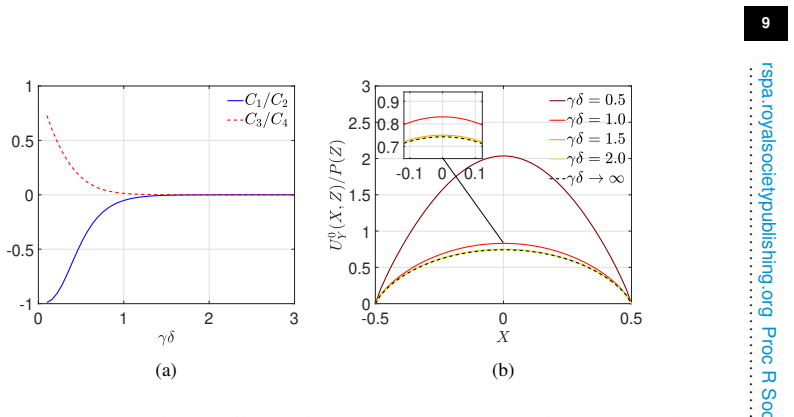
The central object is the reduction of the thick top wall to a simply supported rectangle under uniform pressure. This is justified by a scaling analysis showing that the in-plane stress $\sigma_{xx}$ becomes negligible when $(w/t)^2 \ll 1$, so the side edges act as simple supports. The elastic problem is solved exactly using Fourier series for the Airy stress function, giving a self-similar cross-sectional deflection profile $G(X)$ that is independent of stream-wise position. This profile directly yields the coefficients $S_1, S_2, S_3$ in the flow rate–pressure drop relation.
What would settle it
A direct measurement of the cross-sectional deformation profile of a thick-walled microchannel under pressure, comparing it to the predicted self-similar shape $G(X)$, would test the central claim. If the profile deviates significantly from the simply supported rectangle prediction for a channel with $(t/w)^2 \gg 1$, the theory would be invalidated.
Extended reading notes
Core claim
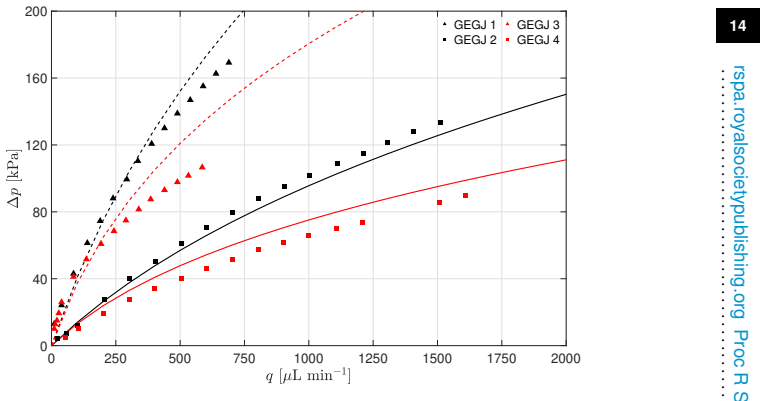
For a shallow microchannel with a thick top wall such that $(t/w)^2 \gg 1$, the top wall deformation at each stream-wise cross-section is independent and equals the deflection of a simply supported rectangle under uniform pressure. The resulting flow rate–pressure drop relation is $q = \frac{w h_0^3 \Delta p}{12 \mu l} \left[ 1 + S_1 \left(\frac{w}{E_Y' h_0}\right) \Delta p + S_2 \left(\frac{w}{E_Y' h_0}\right)^2 \Delta p^2 + S_3 \left(\frac{w}{E_Y' h_0}\right)^3 \Delta p^3 \right]$, with $S_1 \approx 0.8139$, $S_2 \approx 0.3333$, $S_3 \approx 0.05396$, and $E_Y' = E_Y/(1-\nu^2)$. This relation has no fitting parameters and agrees favorably with experiments, explaining why the earlier Gervais et al. model's fitting parameter $\alpha$ is related to $S_1$ by $(3/2)\alpha = S_1$.
Load-bearing premise
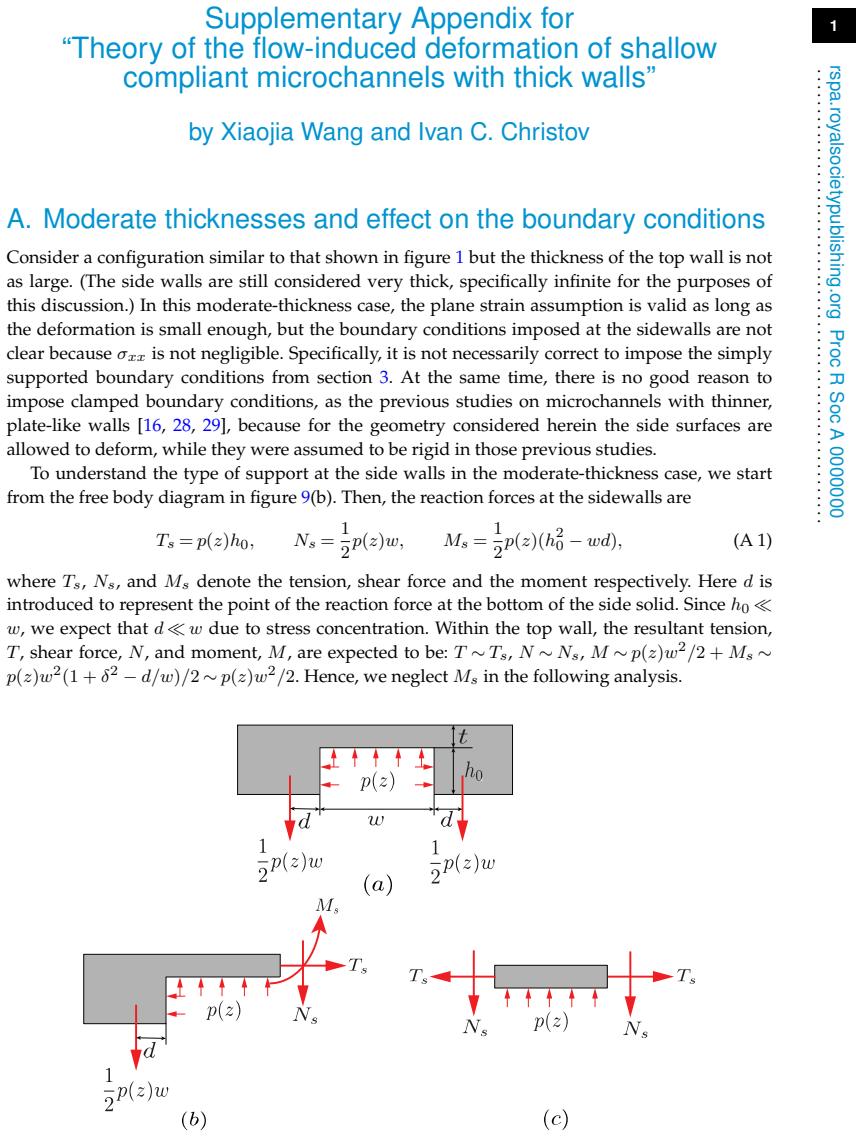
The reduction to a simply supported rectangle assumes that the reaction at the side edges is a pure simple support with no moment, which is an idealization; the actual elastic connection may produce small but non-zero moments that could shift the deformation profile.
Editorial extensions
If this is right
- A single formula replaces the need to calibrate a fitting parameter for each microchannel geometry and material, enabling predictive design of thick-walled compliant microchannels.
- The theory identifies the physical content of the empirical parameter $\alpha$ in the Gervais model, showing it is not arbitrary but set by the cross-sectional deformation shape.
- The relation indicates that the flow rate–pressure drop curve becomes nonlinear at higher pressures, with the cubic term becoming significant when $\Delta p$ approaches $E_Y' h_0 / w$.
- The analysis distinguishes thick-wall deformation (simple-support-like) from thin-wall deformation (plate-like with bending), clarifying which model applies in which regime.
Reading between the lines
- The paper's result suggests that for thick walls, the deformation is governed by the plane-strain modulus $E_Y'$ rather than the Young's modulus, which may matter for materials with different Poisson ratios.
- The self-similar profile could be used to design microchannels with a desired pressure-dependent flow resistance, e.g., for passive valves or flow regulators.
- A testable extension is to check whether the same cubic relation holds for channels with finite side-wall thickness or for non-Newtonian fluids, which the paper does not address.
Signed reviews
Editorial analysis
A structured set of objections, weighed in public.
Referee Report
Summary. This paper develops a theory for the steady flow-induced deformation of shallow compliant microchannels with a thick top wall. The fluid is treated with lubrication theory, and the solid with plane-strain linear elasticity. A scaling analysis of the elastostatic equations is used to argue that, for (t/w)^2 much larger than unity, the top-wall stress component sigma_xx is negligible and the top wall can be modeled as a simply supported rectangle under uniform pressure at each streamwise cross-section. The Airy stress function solution yields a self-similar dimensionless deflection profile G(X), and integration of the parabolic lubrication velocity profile over the deformed cross-section gives a closed-form, parameter-free flow rate-pressure drop relation q = (w h0^3 Delta p)/(12 mu l) [1 + S1 (w/(E_Y' h0)) Delta p + S2 (w/(E_Y' h0))^2 Delta p^2 + S3 (w/(E_Y' h0))^3 Delta p^3], with S1 ~ 0.8139, S2 ~ 0.3333, S3 ~ 0.05396 and E_Y' = E_Y/(1-nu^2). The relation is compared with the experiments of Gervais et al. and Raj et al., showing good R^2 values, and is used to rationalize the empirical fitting parameter alpha of the Gervais model through (3/2) alpha = S1.
Significance. If the central idealizations hold, this is a useful closed-form design relation for a common microfluidic configuration, and the identification of S1 with (3/2) alpha gives a physical interpretation of a widely used empirical parameter. The paper's strengths are the parameter-free character of the derivation, the explicit analytic solution of the elasticity problem, the clear scale separation, and the transparent validation against two independent experimental data sets. The authors are also candid about deviations at large flow rates and about the uncertainty in h0. The main open question is whether the simply supported boundary condition is an accurate reduction of the actual connected elastic geometry, since the shape G(X) and therefore all three coefficients S1, S2, S3 depend on it.
major comments (4)
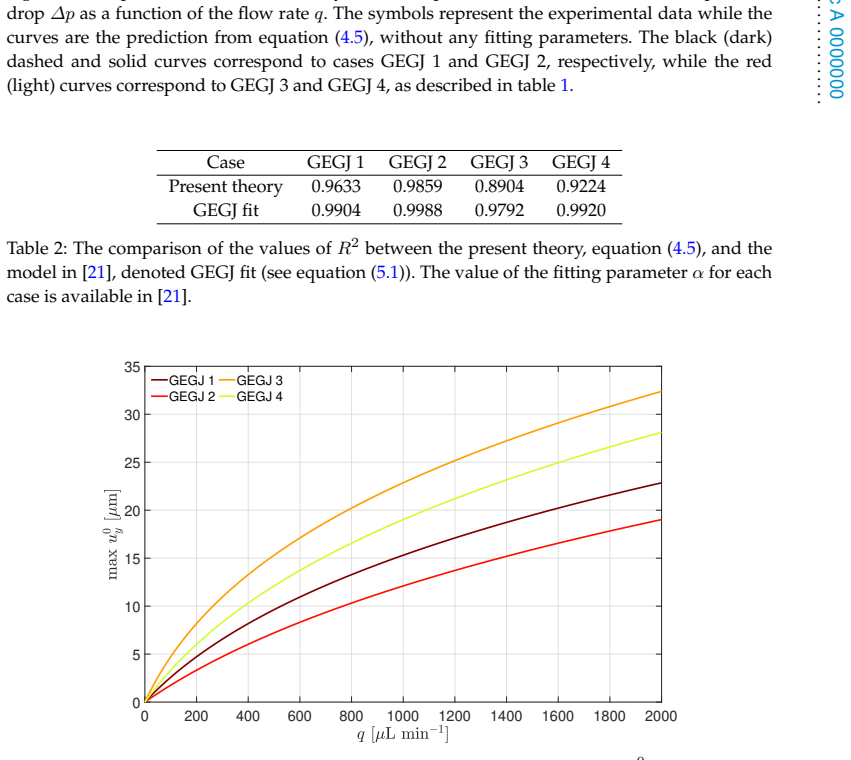
- [§3(b), Eqs. (3.5)–(3.16)] The reduction to a simply supported rectangle is the load-bearing step: the deflection profile G(X) and therefore the coefficients S1, S2, S3 follow from it. However, the boundary condition at x = ±w/2 is imposed by 'Taking σxx|x=±w/2 = 0 and assuming that the displacement at the corner is negligible' rather than derived. The scaling in Eq. (3.3) controls the magnitude of σxx, but the kinematic condition u_y = 0 at the edges is a separate assumption about the side-wall compliance. The paper should either derive this condition by a matched-asymptotic analysis of the full connected geometry or verify it with a numerical solution of the plane-strain problem; the current Figure 2 only shows internal convergence of the Fourier coefficients within the simple-support model, not the validity of the idealization.
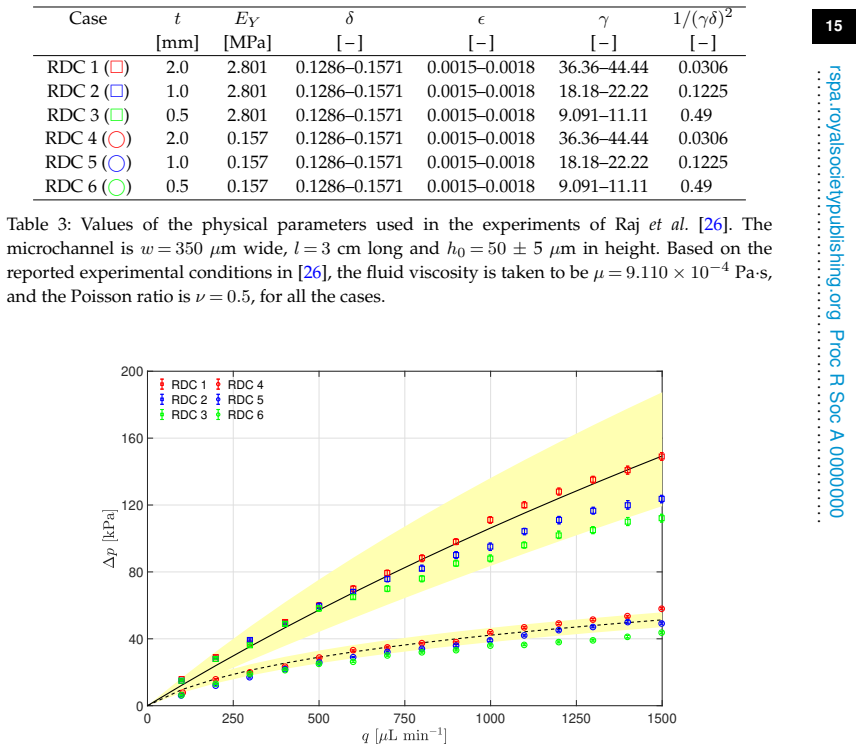
- [§5, Table 3 and Figure 7] RDC 3 and RDC 6 have t/w = 1.43, giving (w/t)^2 = 0.49, while the theory's stated validity region is (w/t)^2 << 1. The sentence in §5 acknowledging these as 'least favorable' cases does not remove them from the validation set. Please quantify the expected error from finite (w/t)^2 for these cases, or separate them from the asymptotic comparisons; otherwise the favorable agreement in Figure 7 cannot be distinguished from the robustness of the idealization.
- [§5, Table 1 and Figure 5] The correction of h0 for GEGJ 4 from 26 µm to 30 µm 'based on the value of α' uses the empirical fitting parameter of the Gervais model. Since the central claim is that the present theory is parameter-free, using α to recalibrate an input parameter makes the validation for that case partly circular. Please provide an independent justification for the corrected h0 or show that the comparison is insensitive to h0 within its reported uncertainty.
- [§4, Eq. (4.5)] The prefactor w h0^3/(12 μ l) is the infinite-slab lubrication result and neglects O(h0/w) sidewall drag. For the Gervais experiments h0/w ranges from about 0.06 to 0.10, so this is a several-percent effect that is not obviously negligible relative to the 'almost constant shift' reported for GEGJ 2 and GEGJ 4. The manuscript should quantify this known correction (for example, the standard aspect-ratio factor for rectangular channels) or argue that it lies within the experimental uncertainty.
minor comments (5)
- [§3(d)] The sentence 'For some cases with w/t≃1, asymptotically, we can still satisfy (w/t)^2≪1' is self-contradictory; the intended condition is likely t/w ≃ O(1) with (w/t)^2 not strictly small, or the text should be reworded.
- [§3(c)] The notation for the plane-strain modulus is inconsistent: the text writes EY = EY/(1−ν^2) with the same symbol on both sides. Please use a distinct notation, such as an overbar, throughout the manuscript.
- [§3(c), Eq. (3.15)] The limit is written as γ^2δ^2 = t^2/w^2 → ∞; it would be clearer to state t/w → ∞ explicitly, since γδ = (t/h0)(h0/w) = t/w.
- [Appendix A] There is a typo in the sentence 'Soving equations (A 2)–(A 3)'; it should read 'Solving equations (A 2)–(A 3)'.
- [Figure 2 caption] The caption mentions a 'magnified plot' but does not label the inset panel in the figure; please add a clear label for the inset.
Circularity Check
Parameter-free derivation is self-contained; only the GEGJ 4 validation borrows the fitted α to reset h0.
-
fitted input called prediction
[Section 5, paragraph following Table 1]
"Moreover, the undeformed height, h0, for the case GEGJ 4 is corrected to 30 µm instead of the reported 26 µm based on the value of α."
The theory's flow rate-pressure drop relation (4.5) and deformation profile (3.15) depend on h0 as an input. Here h0 is not independently measured but is reset using α, the one-parameter fit of the Gervais model (5.1) that the paper aims to rationalize via S1. Therefore the GEGJ 4 comparison is not a fully independent test of the parameter-free theory; one degree of freedom from the fitted model is transferred into the supposedly fixed geometric input. This is a minor validation-only circularity and does not affect the derivation of S1, S2, S3 from G(X).
full rationale
The core derivation is self-contained. The authors start from lubrication theory for the fluid and plane-strain linear elasticity for the solid, perform a scaling analysis to identify the large-thickness limit, solve the biharmonic equation for a simply supported rectangle via Fourier series, and compute the coefficients S1, S2, S3 as integrals of the derived self-similar profile G(X). No coefficient is fitted to experimental data in the derivation, and the deformation scale uses literature values of geometry and material properties. The simple-support reduction at x = ±w/2 is an asymptotic idealization whose accuracy could be questioned, but that is a correctness concern, not circularity. The only concrete circular element is the validation step for case GEGJ 4, where the reported undeformed height is corrected using the fitting parameter α of the very model being compared and rationalized. This injects a fitted quantity into one validation case, but it does not propagate into the derivation, so the overall circularity score is low.
Assumptions & free parameters
assumptions (6)
- domain assumption The lubrication approximation applies: h0 << w << l and ϵRe << 1 so that the leading-order velocity profile is parabolic in each cross-section (Eq. 2.3).
- domain assumption The top wall is in a state of plane strain, with no displacement in the flow-wise direction, justified by rigid inlet and outlet connectors (Section 3(a)).
- domain assumption In the large-thickness limit (w/t)^2 << 1, the stress σ_xx in the top wall is negligible so the sidewall boundary condition becomes simple support with σ_xx = 0 at x = ±w/2 (Section 3(b)).
- standard math Linear elasticity with infinitesimal strain and an isotropic Hookean solid (Eqs. 3.11).
- standard math The Airy stress function satisfies the biharmonic equation and the Fourier eigenfunction expansion is complete for the simply supported rectangle (Eqs. 3.4-3.6).
- domain assumption The side walls are rigid or semi-infinite so only the top wall deforms, justified by the h0 << w scaling from Gervais et al. (Section 1).
Cite this review
Pith. "Pith review of Theory of the flow-induced deformation of shallow compliant microchannels with thick walls." pith.science (2026). https://pith.science/paper/K5U7FXSS
@misc{pith2026190803556,
  author       = {Pith},
  title        = {Pith review of: Theory of the flow-induced deformation of shallow compliant microchannels with thick walls},
  year         = {2026},
  howpublished = {\url{https://pith.science/paper/K5U7FXSS}},
  note         = {Machine review of arXiv:1908.03556}
}
abstract
Long, shallow microchannels embedded in thick soft materials are widely used in microfluidic devices for lab-on-a-chip applications. However, the bulging effect caused by fluid--structure interactions between the internal viscous flow and the soft walls has not been completely understood. Previous models either contain a fitting parameter or are specialized to channels with plate-like walls. This work is a theoretical study of the steady-state response of a compliant microchannel with a thick wall. Using lubrication theory for low-Reynolds-number flows and the theory for linearly elastic isotropic solids, we obtain perturbative solutions for the flow and deformation. Specifically, only the channel's top wall deformation is considered, and the ratio between its thickness $t$ and width $w$ is assumed to be $(t/w)^2 \gg 1$. We show that the deformation at each stream-wise cross-section can be considered independently, and that the top wall can be regarded as a simply supported rectangle subject to uniform pressure at its bottom. The stress and displacement fields are found using Fourier series, based on which the channel shape and the hydrodynamic resistance are calculated, yielding a new flow rate--pressure drop relation without fitting parameters. Our results agree favorably with, and thus rationalize, previous experiments.
Figures

Figures from the paper (7 more)


Reference graph
Works this paper leans on
-
[1]
1 Squires, T. M. & Quake, S. R. 2005 Microfluidics: Fluid physics at the nanoliter scale. Rev. Mod. Phys., 77, 977–1026. (doi:10.1103/RevModPhys.77.977). 2 Bruus, H. 2008 Theoretical Microfluidics. Oxford Master Series in Condensed Matter Physics. Oxford, UK: Oxford University Press. 3 Xia, Y. & Whitesides, G. M. 1998 Soft lithography. Annu. Rev. Mater. Sci...
arXiv 2005
-
[2]
Start-up flow in shallow deformable microchannels
(doi:10.1088/1361-648X/ aaa226). 30 Martínez-Calvo, A., Sevilla, A., Peng, G. G. & Stone, H. A. 2019 Start-up flow in shallow deformable microchannels. preprint, (arXiv:1902.07167). 31 Anand, V ., David JR, J. & Christov, I. C. 2019 Non-Newtonian fluid–structure interactions: Static response of a microchannel due to internal flow of a power-law fluid. J. Non-...
work page Pith review arXiv 2019
-
[13]
(doi:10.1063/1.4759493). 46 Schomburg, W. K. 2011Introduction to Microsystem Design. Berlin/Heidelberg: Springer-Verlag. (doi:10.1007/978-3-642-19489-4). 47 Wells, J. 2012 R-square: The coefficient of determination, version 1.4.0.0. MATLAB Central File Exchange, https://www.mathworks.com/matlabcentral/fileexchange/ 34492-r-square-the-coefficient-of-determi...
-
[17]
11 Delamarche, E., Schmid, H., Michel, B
(doi:10.1088/0960-1317/24/3/035017). 11 Delamarche, E., Schmid, H., Michel, B. & Biebuyck, H. 1997 Stability of molded polydimethylsiloxane microstructures. Adv. Mat. , 9, 741–746. (doi:10.1002/adma. 19970090914). 12 Hui, C. Y., Jagota, A., Lin, Y. Y. & Kramer, E. J. 2002 Constraints on microcontact printing imposed by stamp deformation. Langmuir, 18, 139...
-
[31]
20rspa.royalsocietypublishing.org Proc R Soc A 0000000
(doi:10.1007/ s10404-016-1702-9). 20rspa.royalsocietypublishing.org Proc R Soc A 0000000. . . . . . . . . . . . . . . . . . . . . . . . . . . . . . . . . . . . . . . . . . . . . . . . . . . . . . . . . . 40 Boyko, E., Eshel, R., Gommed, K., Gat, A. D. & Bercovici, M. 2019 Elastohydrodynamics of a pre-stretched finite elastic sheet lubricated by a thin visc...
-
[66]
(doi:10.1007/s10404-019-2235-9). 42 Mortensen, N. A., Okkels, F. & Bruus, H. 2005 Reexamination of Hagen-Poiseuille flow: Shape dependence of the hydraulic resistance in microchannels.Phys. Rev. E, 71, 57
-
[70]
(doi:10.1007/s10404-017-1908-5). 27 Seker, E., Leslie, D. C., Haj-Hariri, H., Landers, J. P ., Utz, M. & Begley, M. R. 2009 Nonlinear pressure-flow relationships for passive microfluidic valves. Lab Chip, 9, 2691–2697. (doi:10. 1039/B903960K). 28 Christov, I. C., Cognet, V ., Shidhore, T. C. & Stone, H. A. 2018 Flow rate–pressure drop relation for deformabl...
-
[116]
(doi:10.1063/1. 5036632). 33 Tavakol, B., Froehlicher, G., Stone, H. A. & Holmes, D. P . 2017 Extended lubrication theory: Improved estimates of flow in channels with variable geometry. Proc. R. Soc. A, 473, 20170
doi:10.1063/1 2017
Show all 14 references
-
[234]
34 Davis, S
(doi:10.1098/rspa.2017.0234). 34 Davis, S. H. 2017 The importance of being thin. J. Eng. Math. , 105, 3–30. (doi:10.1007/ s10665-017-9910-1). 35 Reynolds, O. 1886 On the theory of lubrication and its application to Mr. Beauchamp tower’s experiments, including an experimental d...
2017
-
[301]
43 Happel, J
(doi:10.1103/ PhysRevE.71.057301). 43 Happel, J. R. & Brenner, H. 1983 Low Reynolds Number Hydrodynamics , vol. 1 of Mechanics of fluids and transport processes. The Hague: Martinus Nijhoff Publishers, 2nd edn. (doi:10.1007/ 978-94-009-8352-6). 44 Rubinow, S. I. & Keller, J. B....
1983 doi
-
[377]
19rspa.royalsocietypublishing.org Proc R Soc A 0000000
(doi:10.1021/acs.analchem.7b02287). 19rspa.royalsocietypublishing.org Proc R Soc A 0000000. . . . . . . . . . . . . . . . . . . . . . . . . . . . . . . . . . . . . . . . . . . . . . . . . . . . . . . . . . 19 Duprat, C. & Stone, H. A. (eds.) 2016Fluid–Structure Interactions in...
-
[501]
26 Raj, M
(doi:10.1063/1.4720394). 26 Raj, M. K., DasGupta, S. & Chakraborty, S. 2017 Hydrodynamics in deformable microchannels. Microfluid. Nanofluid., 21,
2017 doi
-
[502]
15 Hosokawa, K., Hanada, K
(doi:10.1103/PhysRevLett.119.144502). 15 Hosokawa, K., Hanada, K. & Maeda, R. 2002 A polydimethylsiloxane (PDMS) deformable diffraction grating for monitoring of local pressure in microfluidic devices. J. Microelectromechan. Syst., 12, 1–6. (doi:10.1088/0960-1317/12/1/301). 16 ...
2002 doi
-
[753]
Theory of the flow-induced deformation of shallow compliant microchannels with thick walls
(doi:10.1098/rspa.2016. 0753). 52 Timoshenko, S. & Goodier, J. N. 1951 Theory of Elasticity. Engineering Societies Monographs. New York: McGraw-Hill, 2nd edn. 53 Challamel, N. & Elishakoff, I. 2019 A brief history of first-order shear-deformable beam and plate models. Mech. Res...
2016 doi
Reviewed August 14, 2026 · model on record in the stance chip above.
Discussion (0). Continue with ORCID to comment.