Causal Forecasting in Panel Data: A Two-Way Synthetic Forecasting Approach
Pith reviewed 2026-06-26 21:36 UTC · model grok-4.3
The pith
A two-way estimator extends synthetic controls to forecast causal effects in panel data beyond the observed period.
A machine-rendered reading of the paper's core claim, the machinery that carries it, and where it could break.
Core claim
The Two-Way Synthetic Forecasting (TWSF) estimator identifies prospective causal forecast estimands by imposing low-rank temporal structure on latent time factors in panel models, then learns cross-unit pre-treatment relationships and combines them with time-series models from treated donor trajectories; under suitable conditions this yields finite-sample forecasting error bounds implying pointwise consistency and an orthogonalized correction that produces asymptotic normality for pointwise inference.
What carries the argument
The Two-Way Synthetic Forecasting (TWSF) estimator, which merges unit-side synthetic control matching on pre-treatment data with time-series modeling of treated trajectories under the intervention.
If this is right
- Pointwise consistency and asymptotic normality hold for single-step forecasts under the stated conditions.
- Both direct and recursive procedures for fixed multi-step horizons inherit the same pointwise guarantees.
- The orthogonalized correction enables valid pointwise confidence intervals for the causal forecasts.
- The approach applies to policy settings such as evaluating future public-health effects of interventions.
Where Pith is reading between the lines
- If the low-rank temporal assumption holds in non-panel settings, the same two-way logic could extend causal forecasting to other multivariate series.
- The finite-sample bounds suggest that TWSF may remain reliable even with modest numbers of units or time periods, a property worth checking in small-sample policy data.
- Combining TWSF with existing robustness checks for synthetic controls could produce hybrid procedures that handle both retrospective and prospective questions in one workflow.
Load-bearing premise
Imposing low-rank temporal structure on the latent time factors correctly identifies the prospective causal forecast estimands.
What would settle it
A panel dataset in which the latent time factors exhibit high rank yet the TWSF estimator still attains the claimed finite-sample error bounds and consistency would falsify the identification strategy.
Figures
read the original abstract
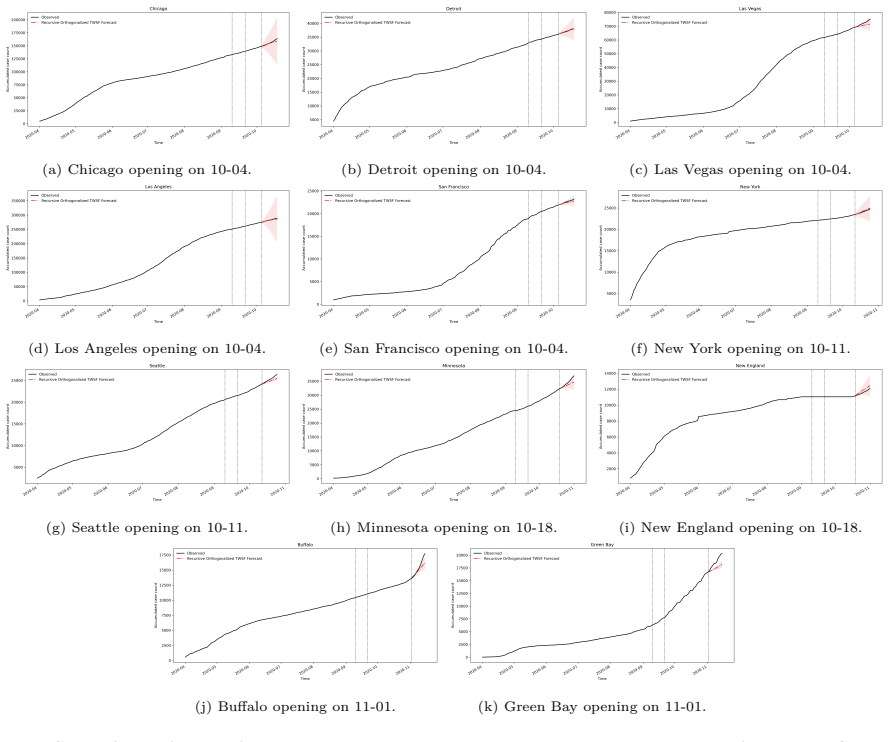
Estimating causal effects in panel data is a central problem in policy evaluation. Existing methods largely address retrospective questions of the form: what would have happened to a target unit under a different intervention during the observed panel? In many applications, however, decision-makers face prospective questions: what will happen to a target unit under an intervention it has not yet experienced, beyond the observed panel? This article develops a framework for answering such causal forecasting questions by integrating the retrospective counterfactual logic of synthetic-controls-based approaches with the extrapolative structure of multivariate time-series forecasting. Building on the latent factor models that justify unit-side regressions in synthetic controls, we impose low-rank temporal structure on the latent time factors to identify prospective causal forecast estimands. We operationalize this strategy through the Two-Way Synthetic Forecasting estimator, or TWSF, which learns cross-unit relationships from pre-treatment outcomes and combines them with a time-series model learned from treated donor trajectories under the intervention of interest. Under suitable conditions, we establish finite-sample forecasting error bounds that imply pointwise consistency and introduce an orthogonalized correction that yields asymptotic normality and thus enables pointwise inference. We extend the framework to fixed multi-step forecasting horizons through both direct and recursive procedures, each of which inherits analogous pointwise guarantees. We corroborate the theory with simulation studies and illustrate the practical utility of TWSF by studying the public-health impact of opening NFL stadiums during the 2020 season.
Editorial analysis
A structured set of objections, weighed in public.
Referee Report
Summary. The manuscript introduces the Two-Way Synthetic Forecasting (TWSF) estimator for prospective causal questions in panel data. It extends synthetic-control logic by imposing low-rank temporal structure on latent time factors to identify future causal forecast estimands, learns cross-unit relationships from pre-treatment outcomes, combines them with time-series models from treated donor trajectories, establishes finite-sample forecasting error bounds implying pointwise consistency, and introduces an orthogonalized correction yielding asymptotic normality for pointwise inference. The framework is extended to fixed multi-step horizons via direct and recursive procedures, with supporting simulation studies and an empirical illustration on the public-health effects of opening NFL stadiums in 2020.
Significance. If the finite-sample bounds, consistency, and asymptotic normality results hold under the stated conditions, the work would provide a useful bridge between retrospective synthetic control methods and prospective time-series forecasting, enabling pointwise causal inference for post-panel outcomes. The orthogonalized correction for inference and the explicit finite-sample guarantees are notable strengths if the derivations are complete and the low-rank temporal assumption is non-circular.
major comments (2)
- [Abstract and identification section] Abstract and identification section: the central claim that low-rank temporal structure on the latent time factors identifies prospective causal forecast estimands (extending retrospective SC logic) is load-bearing for the consistency and normality results; explicit conditions ensuring this identification does not reduce to in-sample fitted quantities by construction must be stated and verified, as the abstract presents the extension without detailing the prospective identification argument.
- [Theory section on error bounds] Theory section on error bounds: the finite-sample forecasting error bounds are asserted to imply pointwise consistency under suitable conditions, but without the full statement of those conditions (including verification of the latent factor model assumptions), it is not possible to assess whether the bounds support the claimed consistency and the subsequent orthogonalized correction for asymptotic normality.
minor comments (2)
- [Abstract] The abstract refers to 'suitable conditions' for the bounds and normality without enumerating the key assumptions; adding a concise list would improve readability.
- [Simulation studies] Simulation studies: more detail is needed on how the data-generating process enforces the low-rank temporal structure to align with the theoretical assumptions.
Simulated Author's Rebuttal
We thank the referee for the constructive comments, which highlight areas where the identification and theoretical arguments can be made more explicit. We address each major comment below and will incorporate revisions to strengthen the manuscript.
read point-by-point responses
-
Referee: [Abstract and identification section] Abstract and identification section: the central claim that low-rank temporal structure on the latent time factors identifies prospective causal forecast estimands (extending retrospective SC logic) is load-bearing for the consistency and normality results; explicit conditions ensuring this identification does not reduce to in-sample fitted quantities by construction must be stated and verified, as the abstract presents the extension without detailing the prospective identification argument.
Authors: We agree that the prospective identification requires clearer separation from in-sample fitting. In the revised version, we will expand the identification section to explicitly state the conditions on the latent time factors for post-panel periods, including the low-rank structure that permits extrapolation from pre-treatment cross-unit relationships and untreated donor trajectories. This will verify that the estimand is identified prospectively rather than by construction from observed data alone. revision: yes
-
Referee: [Theory section on error bounds] Theory section on error bounds: the finite-sample forecasting error bounds are asserted to imply pointwise consistency under suitable conditions, but without the full statement of those conditions (including verification of the latent factor model assumptions), it is not possible to assess whether the bounds support the claimed consistency and the subsequent orthogonalized correction for asymptotic normality.
Authors: We acknowledge the need for a complete statement of conditions. We will revise the theory section to list all assumptions explicitly, verify their compatibility with the low-rank latent factor model, and include a detailed argument showing how the finite-sample bounds yield pointwise consistency and underpin the asymptotic normality result after the orthogonalized correction. revision: yes
Circularity Check
No significant circularity detected
full rationale
The derivation establishes finite-sample forecasting error bounds implying pointwise consistency and an orthogonalized correction for asymptotic normality, conditional on the low-rank temporal structure imposed on latent time factors. This structure is introduced as an identifying assumption extending retrospective synthetic control logic, rather than being defined in terms of the target estimands or fitted outputs. The bounds and normality results are presented as theoretical guarantees under suitable conditions and do not reduce by construction to the inputs via self-definition, fitted-parameter renaming, or self-citation chains. The framework integrates existing latent factor models with new extrapolative elements without the central claims collapsing into tautological or statistically forced predictions.
Axiom & Free-Parameter Ledger
axioms (2)
- domain assumption Latent factor models justify unit-side regressions in synthetic controls
- ad hoc to paper Low-rank temporal structure on the latent time factors identifies prospective causal forecast estimands
Reference graph
Works this paper leans on
-
[1]
, title =
Newey, Whitney K. , title =. Econometrica , year =
-
[2]
The Econometrics Journal , year =
Chernozhukov, Victor and Chetverikov, Denis and Demirer, Mert and Duflo, Esther and Hansen, Christian and Newey, Whitney and Robins, James , title =. The Econometrics Journal , year =
-
[3]
and Robins, James M
Chernozhukov, Victor and Escanciano, Juan Carlos and Ichimura, Hidehiko and Newey, Whitney K. and Robins, James M. , title =. Econometrica , year =
-
[4]
and Singh, Rahul , title =
Chernozhukov, Victor and Newey, Whitney K. and Singh, Rahul , title =. Econometrica , year =
-
[5]
and Singh, Rahul , title =
Chernozhukov, Victor and Newey, Whitney K. and Singh, Rahul , title =. The Econometrics Journal , year =
-
[6]
and Wager, Stefan , title =
Hirshberg, David A. and Wager, Stefan , title =. The Annals of Statistics , year =
-
[7]
Bernardo García Bulle and Dennis Shen and Devavrat Shah and Anette E. Hosoi , title =. Proceedings of the National Academy of Sciences , volume =. 2022 , doi =. https://www.pnas.org/doi/pdf/10.1073/pnas.2114226119 , abstract =
-
[8]
2025 , eprint=
Using Multiple Outcomes to Improve the Synthetic Control Method , author=. 2025 , eprint=
2025
-
[9]
Wisconsin COVID-19 update , organization =
-
[10]
and Buckley, Eileen , title =
Mason, Aaron J. and Buckley, Eileen , title =
-
[11]
Governor Cuomo Announces Updated COVID-19 Micro-Cluster Focus Zones , organization =
-
[12]
Annals of Internal Medicine , year =
Variation in False-Negative Rate of Reverse Transcriptase Polymerase Chain Reaction-Based SARS-CoV-2 Tests by Time Since Exposure , author =. Annals of Internal Medicine , year =. doi:10.7326/M20-1495 , url =
-
[13]
2022 , month = oct, day =
Symptoms of COVID-19 , author =. 2022 , month = oct, day =
2022
-
[14]
and Stoffer, David S
Shumway, Robert H. and Stoffer, David S. , title =
-
[15]
2009 , volume=
2009 IEEE 12th International Conference on Computer Vision , title=. 2009 , volume=
2009
-
[16]
Tensor completion and low—rank tensor recovery via convex optimization , volume =
Gandy, Silvia and Recht, Benjamin and Yamada, Isao , year =. Tensor completion and low—rank tensor recovery via convex optimization , volume =. Inverse Problems , doi =
-
[17]
and Telgarsky, Matus , title =
Anandkumar, Animashree and Ge, Rong and Hsu, Daniel and Kakade, Sham M. and Telgarsky, Matus , title =. J. Mach. Learn. Res. , month =. 2014 , issue_date =
2014
-
[18]
2015 , eprint=
Noisy Tensor Completion via the Sum-of-Squares Hierarchy , author=. 2015 , eprint=
2015
-
[19]
Mack and Erin B
Christina D. Mack and Erin B. Wasserman and Cria G. Perrine and Adam MacNeil and Deverick J. Anderson and Emily Myers and Sabrina Smith and L. Clifford McDonald and Michael Osterholm and Gary S. Solomon and Thom Mayer and Allen Sills , title =. MMWR Morb Mortal Wkly Rep. , volume =
-
[20]
Coronavirus (Covid-19) Data in the United States , author =
-
[21]
Inference on average treatment effects in aggregate panel data settings , doi =
Chernozhukov, Victor and Wuthrich, Kaspar and Zhu, Yinchu , year =. Inference on average treatment effects in aggregate panel data settings , doi =
-
[22]
Journal of the American Statistical Association , volume =
Victor Chernozhukov and Kaspar Wüthrich and Yinchu Zhu , title =. Journal of the American Statistical Association , volume =. 2021 , publisher =. doi:10.1080/01621459.2021.1920957 , URL =
-
[23]
2024 , eprint=
Forecasting Algorithms for Causal Inference with Panel Data , author=. 2024 , eprint=
2024
-
[24]
Journal of the American Statistical Association , volume =
Eli Ben-Michael and Avi Feller and Jesse Rothstein , title =. Journal of the American Statistical Association , volume =. 2021 , publisher =. doi:10.1080/01621459.2021.1929245 , URL =
-
[25]
SIAM review , volume=
On the perturbation of pseudo-inverses, projections and linear least squares problems , author=. SIAM review , volume=. 1977 , publisher=
1977
-
[26]
Arkhangelsky, Dmitry and Athey, Susan and Hirshberg, David A. and Imbens, Guido W. and Wager, Stefan , Title =. American Economic Review , Volume =. 2021 , Month =. doi:10.1257/aer.20190159 , URL =
-
[27]
Agarwal, Anish and Alomar, Abdullah and Shah, Devavrat , title =. SIGMETRICS Perform. Eval. Rev. , month = jul, pages =. 2022 , issue_date =. doi:10.1145/3547353.3526952 , abstract =
-
[28]
Operations Research , volume =
Agarwal, Anish and Shah, Devavrat and Shen, Dennis , title =. Operations Research , volume =. 2026 , doi =. https://doi.org/10.1287/opre.2025.1590 , abstract =
-
[29]
2026 , eprint=
Counterfactual Forecasting for Panel Data , author=. 2026 , eprint=
2026
-
[30]
2024 , eprint=
Entrywise Inference for Missing Panel Data: A Simple and Instance-Optimal Approach , author=. 2024 , eprint=
2024
-
[31]
2025 , url=
Match Made with Matrix Completion: Efficient Offline and Online Learning in Matching Markets , author=. 2025 , url=
2025
-
[32]
The Annals of Statistics , number =
Yuxin Chen and Jianqing Fan and Cong Ma and Yuling Yan , title =. The Annals of Statistics , number =. 2021 , doi =
2021
-
[33]
and Li, Andrew A
Farias, Vivek F. and Li, Andrew A. and Peng, Tianyi , title =. Proceedings of the 35th International Conference on Neural Information Processing Systems , articleno =. 2021 , isbn =
2021
-
[34]
SIAM Journal on Optimization , volume =
Chen, Yuxin and Chi, Yuejie and Fan, Jianqing and Ma, Cong and Yan, Yuling , title =. SIAM Journal on Optimization , volume =. 2020 , doi =. https://doi.org/10.1137/19M1290000 , abstract =
-
[35]
Ercument Cahan and Jushan Bai and Serena Ng , keywords =. Factor-based imputation of missing values and covariances in panel data of large dimensions , journal =. 2023 , issn =. doi:https://doi.org/10.1016/j.jeconom.2022.01.006 , url =
-
[36]
2023 , eprint=
Learning Treatment Effects in Panels with General Intervention Patterns , author=. 2023 , eprint=
2023
-
[37]
Journal of the American Statistical Association , volume =
Jungjun Choi and Ming Yuan and , title =. Journal of the American Statistical Association , volume =. 2024 , publisher =. doi:10.1080/01621459.2024.2380105 , URL =
-
[38]
, author=
Spectral biclustering of microarray data: coclustering genes and conditions. , author=. Genome research , year=
-
[39]
Journal of Economic Literature , Year =
Abadie, Alberto , Title =. Journal of Economic Literature , Year =
-
[40]
, author=
A note on the Use of Principal Components in Regression. , author=. Journal of the Royal Statistical Society , volume=
-
[41]
Proceedings of the National Academy of Sciences , volume =
Yuxin Chen and Jianqing Fan and Cong Ma and Yuling Yan , title =. Proceedings of the National Academy of Sciences , volume =. 2019 , doi =. https://www.pnas.org/doi/pdf/10.1073/pnas.1910053116 , abstract =
-
[42]
BIT Numerical Mathematics , year=
Perturbation bounds in connection with singular value decomposition , author=. BIT Numerical Mathematics , year=
-
[43]
1986 , Edition =
Probability and Measure , Author =. 1986 , Edition =
1986
-
[44]
Synthetic Combinations: A Causal Inference Framework for Combinatorial Interventions , url =
Agarwal, Abhineet and Agarwal, Anish and Vijaykumar, Suhas , booktitle =. Synthetic Combinations: A Causal Inference Framework for Combinatorial Interventions , url =
-
[45]
Journal of Machine Learning Research , year =
Anish Agarwal and Devavrat Shah and Dennis Shen , title =. Journal of Machine Learning Research , year =
-
[46]
Bernoulli , number =
Alexandra Carpentier and Olga Klopp and Matthias L. Bernoulli , number =. 2018 , doi =
2018
-
[47]
Tony Cai and Tengyuan Liang and Alexander Rakhlin , title =
T. Tony Cai and Tengyuan Liang and Alexander Rakhlin , title =. The Annals of Statistics , number =. 2016 , doi =
2016
-
[48]
Netflix update: Try this at home , author=
-
[49]
Electronic Journal of Statistics , volume=
Matrix completion via max-norm constrained optimization , author=. Electronic Journal of Statistics , volume=. 2016 , publisher=
2016
-
[50]
Collaborative Filtering in a Non-Uniform World: Learning with the Weighted Trace Norm , url =
Srebro, Nathan and Salakhutdinov, Russ R , booktitle =. Collaborative Filtering in a Non-Uniform World: Learning with the Weighted Trace Norm , url =
-
[51]
ArXiv , year=
Nice latent variable models have log-rank , author=. ArXiv , year=
-
[52]
SIAM Journal on Mathematics of Data Science , volume =
Udell, Madeleine and Townsend, Alex , title =. SIAM Journal on Mathematics of Data Science , volume =. 2019 , doi =. https://doi.org/10.1137/18M1183480 , abstract =
-
[53]
2023 , eprint=
Conformalized matrix completion , author=. 2023 , eprint=
2023
-
[54]
Low-Rank Matrix Completion: A Contemporary Survey , year=
Nguyen, Luong Trung and Kim, Junhan and Shim, Byonghyo , journal=. Low-Rank Matrix Completion: A Contemporary Survey , year=
-
[56]
com recommendations: Item-to-item collaborative filtering , author=
Amazon. com recommendations: Item-to-item collaborative filtering , author=. IEEE Internet computing , volume=. 2003 , publisher=
2003
-
[57]
2018 , publisher=
Explaining the success of nearest neighbor methods in prediction , author=. 2018 , publisher=
2018
-
[58]
Journal of Computer and System Sciences , volume=
Using mixture models for collaborative filtering , author=. Journal of Computer and System Sciences , volume=. 2008 , publisher=
2008
-
[59]
Recommender systems handbook , pages=
Advances in collaborative filtering , author=. Recommender systems handbook , pages=. 2015 , publisher=
2015
-
[60]
Proceedings of the 4th ACM conference on Electronic commerce , pages=
Convergent algorithms for collaborative filtering , author=. Proceedings of the 4th ACM conference on Electronic commerce , pages=
-
[61]
Communications of the ACM , volume=
Using collaborative filtering to weave an information tapestry , author=. Communications of the ACM , volume=. 1992 , publisher=
1992
-
[62]
Matrix Completion With Data-Dependent Missingness Probabilities , year=
Bhattacharya, Sohom and Chatterjee, Sourav , journal=. Matrix Completion With Data-Dependent Missingness Probabilities , year=
-
[63]
Proceedings of the 40th International Conference on Machine Learning , articleno =
Vanderschueren, Toon and Curth, Alicia and Verbeke, Wouter and Van Der Schaar, Mihaela , title =. Proceedings of the 40th International Conference on Machine Learning , articleno =. 2023 , publisher =
2023
-
[64]
Proceedings of The 26th International Conference on Artificial Intelligence and Statistics , pages =
A Multi-Task Gaussian Process Model for Inferring Time-Varying Treatment Effects in Panel Data , author =. Proceedings of The 26th International Conference on Artificial Intelligence and Statistics , pages =. 2023 , editor =
2023
-
[65]
2022 , eprint=
Continuous-Time Modeling of Counterfactual Outcomes Using Neural Controlled Differential Equations , author=. 2022 , eprint=
2022
-
[66]
Forecasting Treatment Responses Over Time Using Recurrent Marginal Structural Networks , url =
Lim, Bryan , booktitle =. Forecasting Treatment Responses Over Time Using Recurrent Marginal Structural Networks , url =
-
[67]
The Annals of Applied Statistics , number =
Eli Ben-Michael and David Arbour and Avi Feller and Alexander Franks and Steven Raphael , title =. The Annals of Applied Statistics , number =. 2023 , doi =
2023
-
[68]
2018 , publisher=
High-dimensional probability: An introduction with applications in data science , author=. 2018 , publisher=
2018
-
[69]
A Bayesian Alternative to Synthetic Control for Comparative Case Studies , volume=. Political Analysis , author=. 2022 , pages=. doi:10.1017/pan.2021.22 , number=
-
[70]
arXiv preprint arXiv:2107.02780 , year=
Causal Inference with Corrupted Data: Measurement Error, Missing Values, Discretization, and Differential Privacy , author=. arXiv preprint arXiv:2107.02780 , year=
-
[71]
Same Root Different Leaves: Time Series and Cross-Sectional Methods in Panel Data , volume =
Shen, Dennis and Ding, Peng and Sekhon, Jasjeet and Yu, Bin , journal =. Same Root Different Leaves: Time Series and Cross-Sectional Methods in Panel Data , volume =
-
[72]
Journal of the Royal Statistical Society Series B: Statistical Methodology , volume =
Ben-Michael, Eli and Feller, Avi and Rothstein, Jesse , title =. Journal of the Royal Statistical Society Series B: Statistical Methodology , volume =. 2022 , month =. doi:10.1111/rssb.12448 , url =
-
[73]
Arbitrage, Factor Structure, and Mean-Variance Analysis on Large Asset Markets , volume =
Gary Chamberlain and Michael Rothschild , journal =. Arbitrage, Factor Structure, and Mean-Variance Analysis on Large Asset Markets , volume =
-
[74]
On factor models with random missing: EM estimation, inference, and cross validation , journal =
Sainan Jin and Ke Miao and Liangjun Su , keywords =. On factor models with random missing: EM estimation, inference, and cross validation , journal =. 2021 , issn =. doi:https://doi.org/10.1016/j.jeconom.2020.08.002 , url =
-
[75]
Operations Research , year=
Nonconvex low-rank tensor completion from noisy data , author=. Operations Research , year=
-
[76]
Ruoxuan Xiong and Markus Pelger , keywords =. Large dimensional latent factor modeling with missing observations and applications to causal inference , journal =. 2023 , issn =. doi:https://doi.org/10.1016/j.jeconom.2022.04.005 , url =
-
[77]
Fan, Jianqing and Wang, Weichen and Zhong, Yiqiao , journal=. An _. 2018 , publisher=
2018
-
[78]
Bernoulli , number =
Peter B. Bernoulli , number =. 2013 , doi =
2013
-
[79]
Advances in neural information processing systems , pages=
Bayesian pca , author=. Advances in neural information processing systems , pages=
-
[80]
Journal of the Royal Statistical Society: Series B (Statistical Methodology) , volume=
Probabilistic principal component analysis , author=. Journal of the Royal Statistical Society: Series B (Statistical Methodology) , volume=. 1999 , publisher=
1999
-
[81]
2024 , eprint=
Synthetic Interventions , author=. 2024 , eprint=
2024
discussion (0)
Sign in with ORCID, Apple, or X to comment. Anyone can read and Pith papers without signing in.