Photon Escape from Slab Thomson Media: A Scattering-order-resolved Recursive Formalism for Comptonization Applications
Pith reviewed 2026-06-28 16:50 UTC · model grok-4.3
The pith
A recursive formalism tracks photon scattering order by order in slab Thomson media to compute exact escape probabilities and mean scatter numbers.
A machine-rendered reading of the paper's core claim, the machinery that carries it, and where it could break.
Core claim
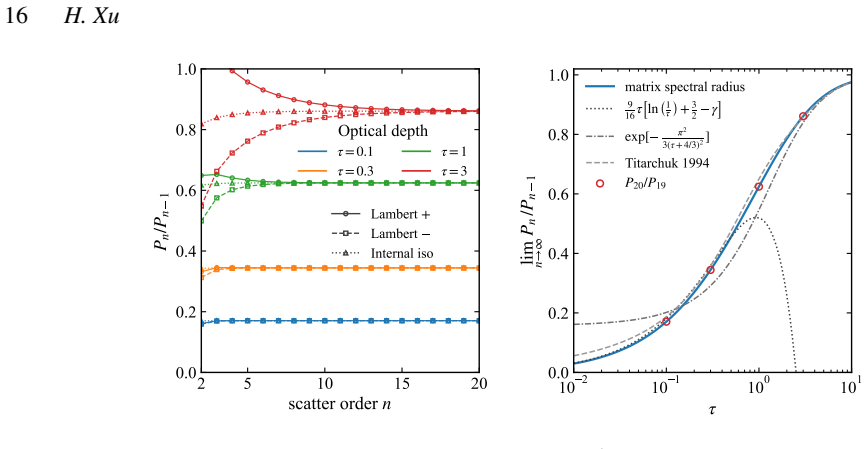
The scattering-order-resolved recursive formalism evolves the post-scattering depth-direction distribution in slab Thomson media, closing the angular dependence in a two-component basis for azimuth-integrated problems. This reduces the transport to an efficient depth-kernel recursion that yields boundary- and angle-resolved escape probabilities at each order. For Lambert-law injection the mean scattering number is exactly 2τ, while high-order terms are controlled by the spectral radius λ(τ) of the recursion operator, which also sets a limiting normalized angular distribution.
What carries the argument
The depth-kernel recursion operator whose spectral radius λ(τ) controls the ratio of successive high-order escape probabilities and determines the limiting angular distribution.
If this is right
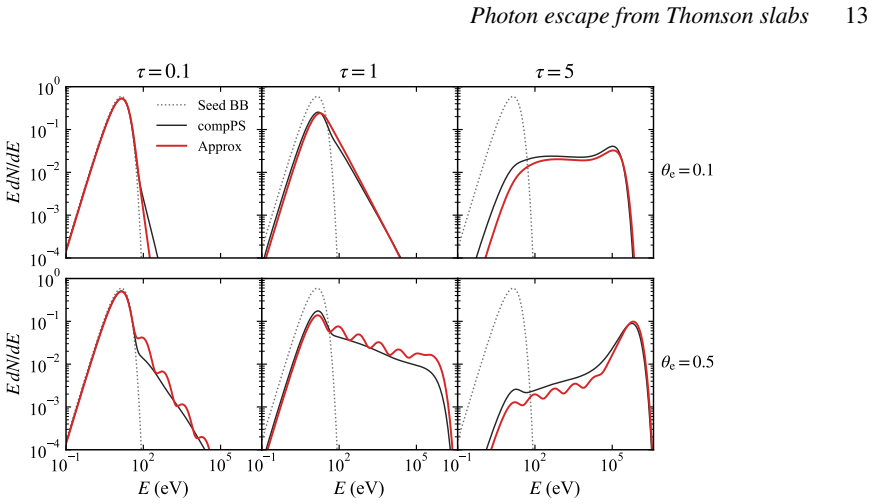
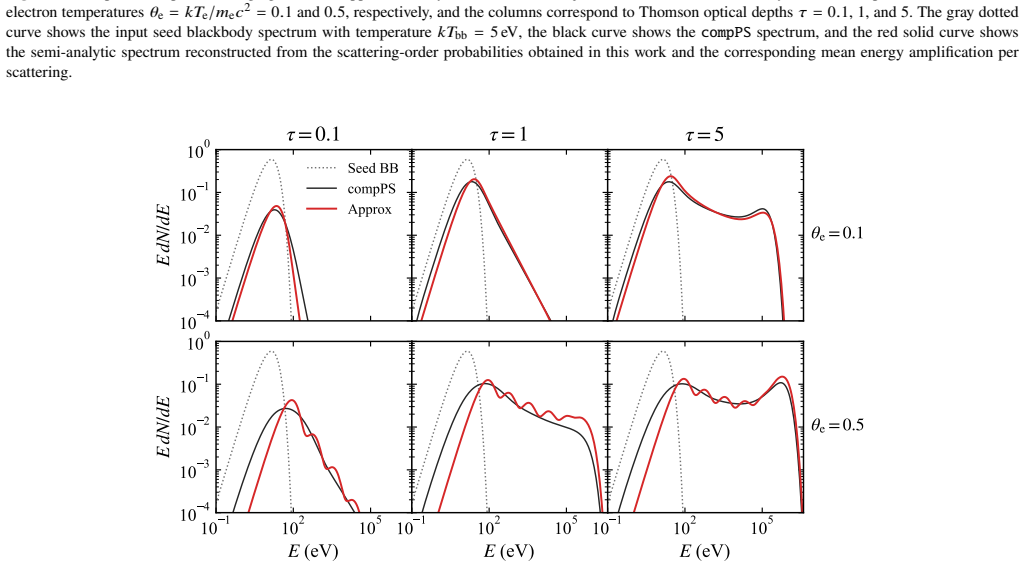
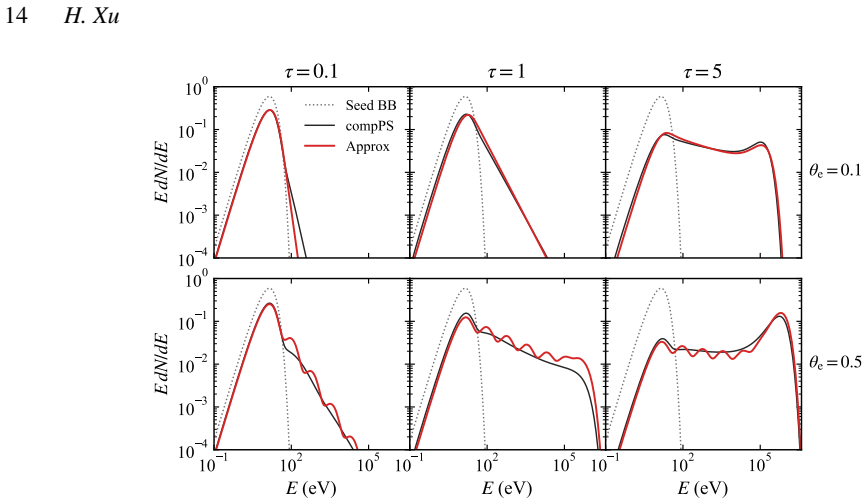
- The resulting distributions enable photon-number-conserving semi-analytic Comptonized spectra.
- Estimates of the Compton amplification factor and fraction of downwardly scattered luminosity become available.
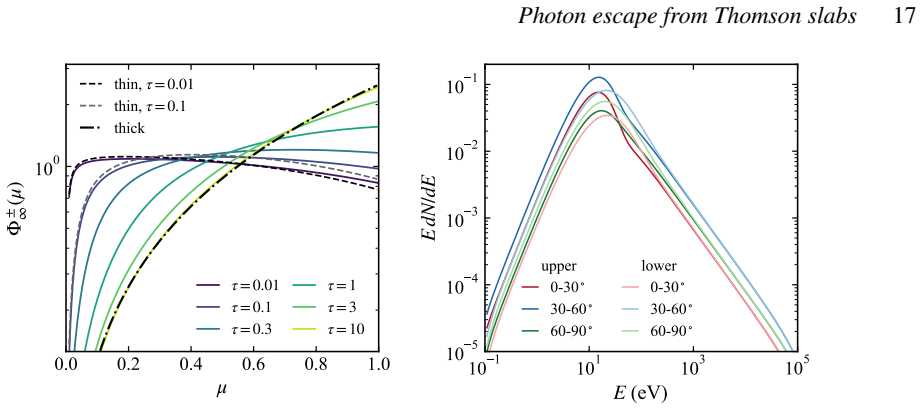
- Viewing angle and escape boundary mainly affect the normalization of the high-order X-ray component, while spectral shape differences are confined to low-order components.
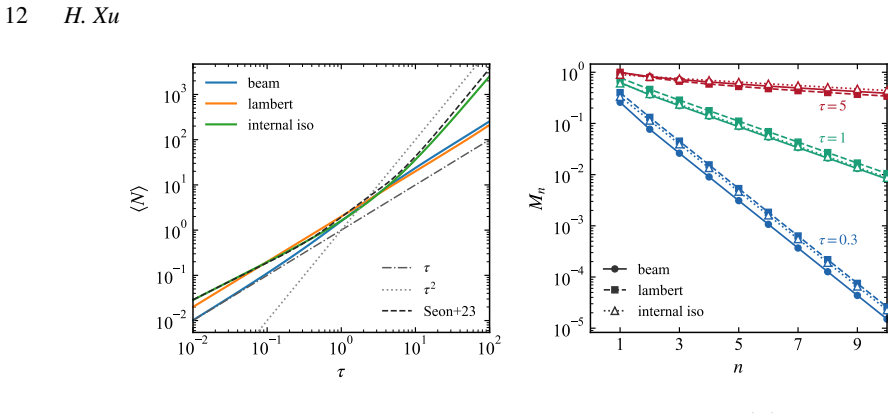
- The uniform internal source shows optically thin τ ln(1/τ) and thick τ²/4 scalings for mean scatterings.
Where Pith is reading between the lines
- If extended to energy-dependent scattering, the same recursion could yield full Compton spectra without Monte Carlo.
- The eigenmode approach may generalize to other geometries or anisotropic scattering.
- These ingredients could improve radiative feedback models in disc-corona systems by providing order-resolved photon budgets.
Load-bearing premise
The angular dependence of the photon distribution closes within a two-component basis for azimuth-integrated problems.
What would settle it
A Monte Carlo simulation for Lambert-law injection at optical depth τ=1 that measures the average number of scatterings per escaped photon and checks if it equals exactly 2.
Figures
read the original abstract
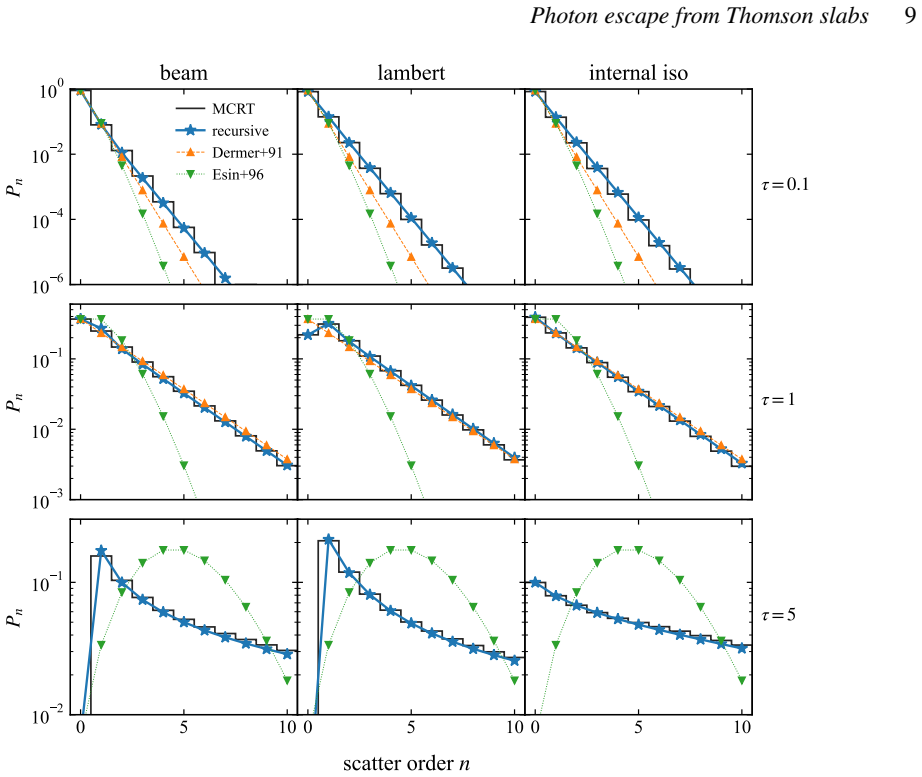
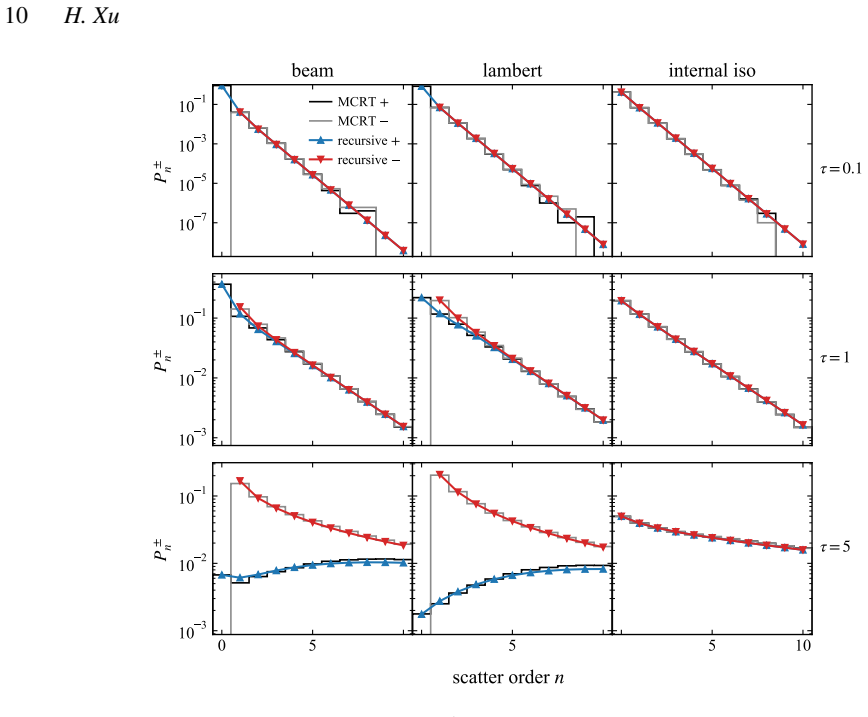
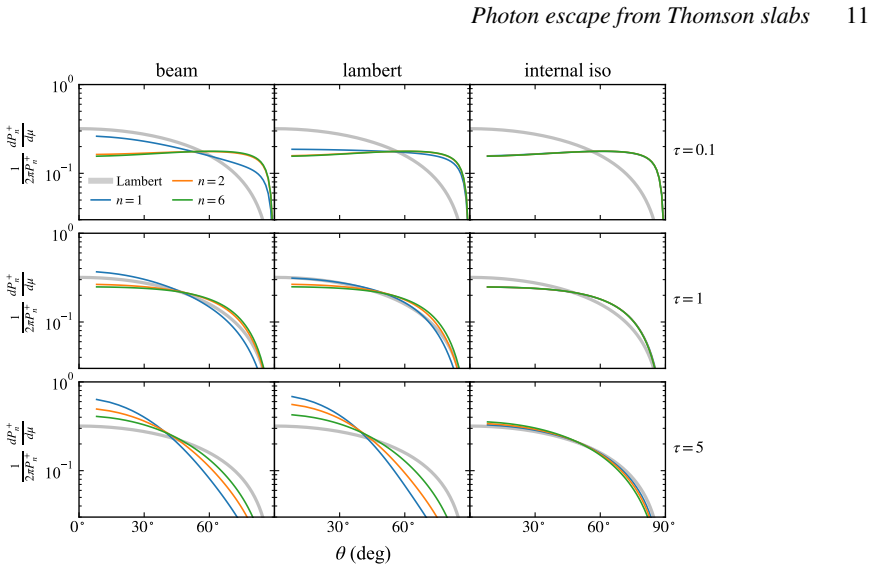
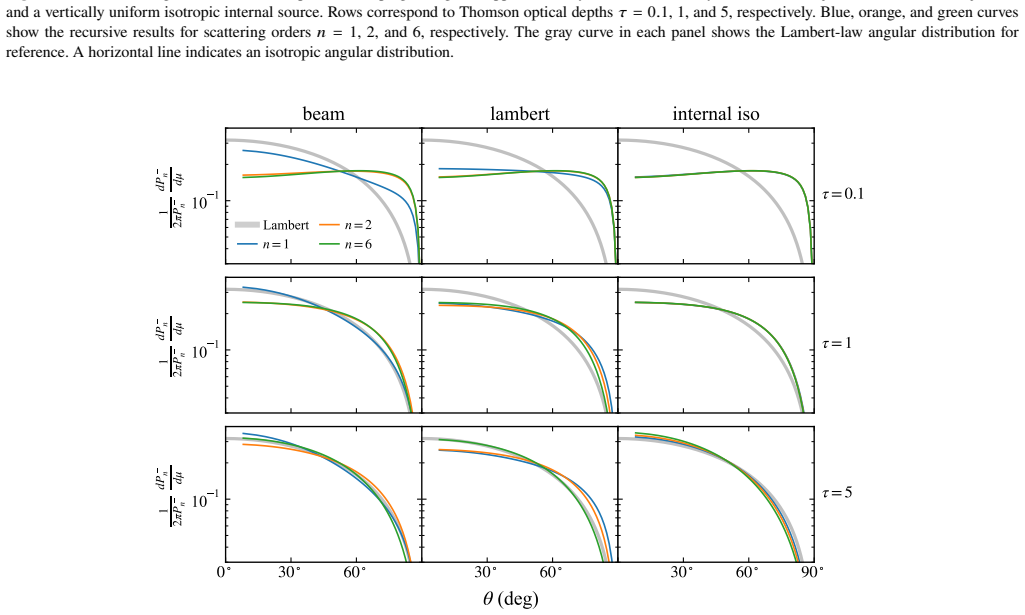
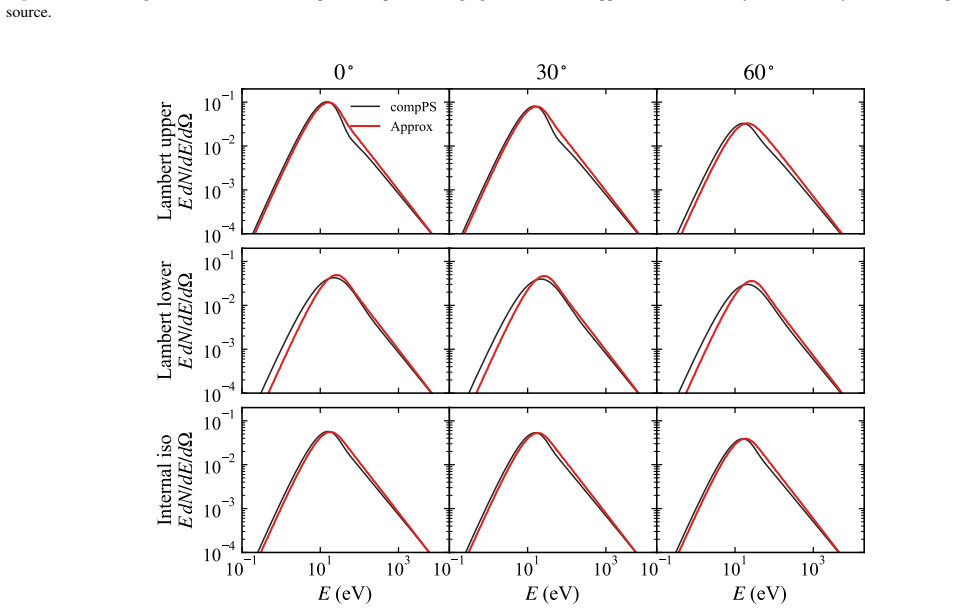
The scattering history of photons in slab media plays an important role in modelling Comptonized spectra and disc-corona radiative feedback. We develop a recursive formalism that evolves the post-scattering depth--direction distribution in slab Thomson media and yields boundary- and angle-resolved escape probabilities at each scattering order. For azimuth-integrated problems, the angular dependence closes within a two-component basis, reducing the transport problem to an efficient depth-kernel recursion. We apply the method to normally incident beam injection, Lambert-law boundary injection, and a vertically uniform isotropic internal source, and verify the results with Monte Carlo radiative-transfer simulations. The resulting distributions provide a photon-number-conserving route to semi-analytic Comptonized spectra and estimates of the Compton amplification factor and the fraction of downwardly scattered luminosity. We also derive the mean scattering number within this framework, obtaining the exact result $\langle N\rangle=2\tau$ for Lambert-law injection, while the uniform internal source changes from an optically thin $\tau\ln(1/\tau)$ behaviour to an optically thick $\tau^2/4$ scaling. At high scattering orders, the recursion is controlled by a dominant eigenmode: $P_n/P_{n-1}\rightarrow\lambda(\tau)$, where $\lambda(\tau)$ is the spectral radius of the slab recursion operator. This eigenmode also determines a limiting normalized angular distribution, so that viewing angle and escape boundary primarily affect the normalization of the high-order X-ray component, while spectral-shape differences are mainly confined to the unscattered and low-order components. These eigenvalue and eigenfunction results provide transport ingredients for future energy-dependent slab Comptonization models.
Editorial analysis
A structured set of objections, weighed in public.
Referee Report
Summary. The paper develops a recursive formalism for scattering-order-resolved escape probabilities in azimuth-integrated slab Thomson media. For such problems the angular dependence closes exactly in a two-component basis, reducing the transport problem to an efficient depth-kernel recursion. The method is applied to normally incident beam injection, Lambert-law boundary injection, and a vertically uniform isotropic internal source; results are verified against Monte Carlo radiative-transfer simulations. Exact analytic results are obtained for the mean scattering number (⟨N⟩=2τ for Lambert-law injection) together with the optically thin τ ln(1/τ) to optically thick τ²/4 transition for the uniform source. At high orders the recursion is controlled by the spectral radius λ(τ) of the slab recursion operator, which also fixes a limiting normalized angular distribution.
Significance. The formalism supplies a photon-number-conserving, semi-analytic route to Comptonized spectra and to the Compton amplification factor in slab geometries. The exact ⟨N⟩=2τ result, the eigenvalue analysis, and the Monte Carlo verification constitute concrete strengths that would be directly usable in disc-corona radiative-feedback calculations.
minor comments (2)
- The abstract states that the angular dependence 'closes within a two-component basis'; the precise definition of the two basis functions and the projection step should be stated explicitly in §2 or §3 so that readers can reproduce the kernel construction without ambiguity.
- Figure captions for the Monte Carlo comparisons should include the number of simulated photons and the binning scheme used for the angular and depth distributions.
Simulated Author's Rebuttal
We thank the referee for their positive assessment of the manuscript, detailed summary of the recursive formalism, and recommendation to accept. No major comments were raised that require addressing.
Circularity Check
No significant circularity; derivation self-contained against external benchmarks
full rationale
The paper constructs a recursive formalism for scattering-order-resolved escape probabilities in azimuth-integrated slab Thomson media, closing the angular dependence in a two-component basis to enable depth-kernel recursion. It derives exact results such as ⟨N⟩=2τ for Lambert-law injection and the τ ln(1/τ) to τ²/4 transition for uniform sources, along with the spectral radius λ(τ) governing high-order behavior, all obtained directly from the recursion operator. These are verified by independent Monte Carlo radiative-transfer simulations, with no quantities reducing by the paper's own equations to fitted parameters, self-citations, or ansatzes imported from prior author work. The central claims are independent of the inputs and externally falsifiable.
Axiom & Free-Parameter Ledger
axioms (2)
- domain assumption Thomson scattering (elastic, isotropic, frequency-independent) in slab geometry
- domain assumption Azimuth-integrated problems allow closure in a two-component angular basis
Reference graph
Works this paper leans on
-
[1]
N., 2013, Journal of Improbable Astronomy, 1, 1
Author A. N., 2013, Journal of Improbable Astronomy, 1, 1
2013
-
[2]
D., 2015, Journal of Interesting Stuff, 17, 198
Jones C. D., 2015, Journal of Interesting Stuff, 17, 198
2015
-
[3]
B., 2014, The Example Journal, 12, 345 (Paper I)
Smith A. B., 2014, The Example Journal, 12, 345 (Paper I)
2014
-
[4]
, keywords =
Comptonization of X-Rays in Plasma Clouds - Typical Radiation Spectra. , keywords =
-
[5]
A two-temperature accretion disk model for Cygnus X-1: structure and spectrum. , keywords =. doi:10.1086/154162 , adsurl =
-
[6]
Advection-Dominated Accretion: Underfed Black Holes and Neutron Stars
Advection-dominated Accretion: Underfed Black Holes and Neutron Stars. , keywords =. doi:10.1086/176343 , archivePrefix =. astro-ph/9411059 , primaryClass =
work page internal anchor Pith review Pith/arXiv arXiv doi:10.1086/176343
-
[7]
Luminosity Enhancement Factor for Thermal Comptonization and the Electron Energy Balance. , keywords =. doi:10.1086/169770 , adsurl =
-
[8]
Hot One-Temperature Accretion Flows Around Black Holes
Hot One-Temperature Accretion Flows around Black Holes. , keywords =. doi:10.1086/177421 , archivePrefix =. astro-ph/9601074 , primaryClass =
work page internal anchor Pith review Pith/arXiv arXiv doi:10.1086/177421
-
[9]
and Lightman, Alan P
Rybicki, George B. and Lightman, Alan P. , address =. Radiative processes in astrophysics , year =. Radiative processes in astrophysics , isbn =
-
[10]
Spectrum of Optically Thin Advection-dominated Accretion Flow around a Black Hole: Application to Sagittarius A*. , keywords =. doi:10.1086/304817 , archivePrefix =. astro-ph/9708234 , primaryClass =
work page internal anchor Pith review Pith/arXiv arXiv doi:10.1086/304817
-
[11]
A Two-Phase Model for the X-Ray Emission from Seyfert Galaxies. , keywords =. doi:10.1086/186171 , adsurl =
-
[12]
X-Ray Spectra from Two-Phase Accretion Disks. , keywords =. doi:10.1086/173020 , adsurl =
-
[13]
, year = 1962, month = jan, volume =
The Escape of Resonance-Line Radiation from an Optically Thick Nebula. , year = 1962, month = jan, volume =. doi:10.1086/147258 , adsurl =
-
[14]
The Two-Phase Pair Corona Model for Active Galactic Nuclei and X-Ray Binaries: How to Obtain Exact Solutions. , keywords =. doi:10.1086/177865 , archivePrefix =. astro-ph/9605073 , primaryClass =
work page internal anchor Pith review Pith/arXiv arXiv doi:10.1086/177865
-
[15]
Escape Probability and Mean Numbers of Photon Scatterings. I. Exact and Asymptotic Formulas. Astrophysics , keywords =. doi:10.1007/s10511-023-09764-4 , adsurl =
-
[16]
Escape Probability and Average Numbers of Photon Scattering Events. II. Monochromatic Isotropic Scattering in a One-Dimensional Medium and Plane Media. Astrophysics , keywords =. doi:10.1007/s10511-024-09839-w , adsurl =
-
[17]
Angle-dependent Compton reflection of X-rays and gamma-rays. , keywords =. doi:10.1093/mnras/273.3.837 , adsurl =
-
[18]
Block Toeplitz Matrices , bookTitle =
B. Block Toeplitz Matrices , bookTitle =. 1999 , publisher =
1999
-
[19]
arXiv e-prints , keywords =
A Nearly Constant Compton y-parameter for Mildly Relativistic Slab Coronae in AGN. arXiv e-prints , keywords =
-
[20]
Journal of Korean Astronomical Society , keywords =
Number of Scatterings in Random Walks. Journal of Korean Astronomical Society , keywords =. doi:10.5303/JKAS.2023.56.2.287 , archivePrefix =. 2312.15860 , primaryClass =
-
[21]
Generalized Comptonization Models and Application to the Recent High-Energy Observations. , keywords =. doi:10.1086/174760 , adsurl =
-
[22]
, year = 1990, month = aug, volume =
Reaction rates and energy distributions for elementary processes in relativistic pair plasmas. , year = 1990, month = aug, volume =. doi:10.1093/mnras/245.3.453 , adsurl =
-
[23]
Radiation Spectra from Advection-Dominated Accretion Flows in a Global Magnetic Field
Radiation Spectra from Advection-dominated Accretion Flows in a Global Magnetic Field. , keywords =. doi:10.1086/308962 , archivePrefix =. astro-ph/0002010 , primaryClass =
work page internal anchor Pith review Pith/arXiv arXiv doi:10.1086/308962
-
[24]
Apspr , keywords =
Comptonization and the shaping of X-ray source spectra - Monte Carlo calculations. Apspr , keywords =
-
[25]
X-ray reflection from cold matter in Active Galactic Nuclei and X-ray binaries. , keywords =. doi:10.1093/mnras/249.2.352 , adsurl =
-
[26]
Comptonization Models and Spectroscopy of X-Ray and Gamma-Ray Sources: A Combined Study by Monte Carlo and Analytical Methods. , keywords =. doi:10.1086/176045 , adsurl =
-
[27]
, address =
Chandrasekhar, S. , address =. Radiative transfer , year =. Radiative transfer , isbn =
-
[28]
Soviet Journal of Experimental and Theoretical Physics , year = 1957, month = may, volume =
The Establishment of Thermal Equilibrium between Quanta and Electrons. Soviet Journal of Experimental and Theoretical Physics , year = 1957, month = may, volume =
1957
-
[29]
Plasma Ejection from Magnetic Flares and the X-ray Spectrum of Cygnus X-1
Plasma Ejection from Magnetic Flares and the X-Ray Spectrum of Cygnus X-1. , keywords =. doi:10.1086/311810 , archivePrefix =. astro-ph/9809383 , primaryClass =
work page internal anchor Pith review Pith/arXiv arXiv doi:10.1086/311810
-
[30]
Spectral and temporal properties of Compton scattering by mildly relativistic thermal electrons. , keywords =. doi:10.1093/mnras/staa159 , archivePrefix =. 1910.04535 , primaryClass =
-
[31]
Calculated Spectrum of Inverse-Compton-Scattered Photons.Phys
Calculated Spectrum of Inverse-Compton-Scattered Photons. Physical Review , year = 1968, month = mar, volume =. doi:10.1103/PhysRev.167.1159 , adsurl =
-
[32]
Physical Review , year = 1947, month = apr, volume =
Note on the Spherical Harmonic Method As Applied to the Milne Problem for a Sphere. Physical Review , year = 1947, month = apr, volume =. doi:10.1103/PhysRev.71.443 , adsurl =
-
[33]
, keywords =
A study of Comptonization of radiation in an electron plasma using the Monte Carlo method. , keywords =
-
[34]
A large-particle Monte Carlo code for simulating non-linear high-energy processes near compact objects. , keywords =. doi:10.1093/mnras/272.2.291 , adsurl =
-
[35]
Investigating the interplay between the coronal properties and the hard X-ray variability of active galactic nuclei with NuSTAR. , keywords =. doi:10.1051/0004-6361/202450777 , archivePrefix =. 2407.06769 , primaryClass =
-
[36]
The Imaging X-Ray Polarimetry Explorer (IXPE): Pre-Launch.J
The Imaging X-Ray Polarimetry Explorer (IXPE): Pre-Launch. Journal of Astronomical Telescopes, Instruments, and Systems , keywords =. doi:10.1117/1.JATIS.8.2.026002 , archivePrefix =. 2112.01269 , primaryClass =
-
[37]
Uncovering the geometry of the hot X-ray corona in the Seyfert galaxy NGC 4151 with IXPE. , keywords =. doi:10.1093/mnras/stad1697 , archivePrefix =. 2303.12541 , primaryClass =
-
[38]
Advection-Dominated Accretion and the Spectral States of Black Hole X-Ray Binaries: Application to Nova Muscae 1991. , keywords =. doi:10.1086/304829 , archivePrefix =. astro-ph/9705237 , primaryClass =
work page internal anchor Pith review Pith/arXiv arXiv doi:10.1086/304829 1991
-
[39]
Effects of Cold Matter in Active Galactic Nuclei: A Broad Hump in the X-Ray Spectra. , keywords =. doi:10.1086/166905 , adsurl =
-
[40]
A comprehensive range of X-ray ionized-reflection models. , keywords =. doi:10.1111/j.1365-2966.2005.08797.x , archivePrefix =. astro-ph/0501116 , primaryClass =
-
[41]
X-ray Reflected Spectra from Accretion Disk Models. I. Constant Density Atmospheres. , keywords =. doi:10.1088/0004-637X/718/2/695 , archivePrefix =. 1006.0485 , primaryClass =
work page internal anchor Pith review Pith/arXiv arXiv doi:10.1088/0004-637x/718/2/695
-
[42]
Broad-band -ray and X-ray spectra of NGC 4151 and their implications for physical processes and geometry. , keywords =. doi:10.1093/mnras/283.1.193 , archivePrefix =. astro-ph/9607015 , primaryClass =
work page internal anchor Pith review Pith/arXiv arXiv doi:10.1093/mnras/283.1.193
-
[43]
1999, MNRAS, 309, 447, doi: 10.1046/j.1365-8711.1999.02853.x
The 1989 May outburst of the soft X-ray transient GS 2023+338 (V404 Cyg). , keywords =. doi:10.1046/j.1365-8711.1999.02885.x , archivePrefix =. astro-ph/9904304 , primaryClass =
-
[44]
Properties of AGN coronae in the NuSTAR era
Properties of AGN coronae in the NuSTAR era. , keywords =. doi:10.1093/mnras/stv1218 , archivePrefix =. 1505.07603 , primaryClass =
work page internal anchor Pith review Pith/arXiv arXiv doi:10.1093/mnras/stv1218
-
[45]
Polarized x-rays constrain the disk-jet geometry in the black hole x-ray binary Cygnus X-1. Science , keywords =. doi:10.1126/science.add5399 , archivePrefix =. 2206.09972 , primaryClass =
-
[46]
Green's matrix for Compton reflection of polarized radiation from cold matter. , keywords =. doi:10.1093/mnras/283.3.892 , adsurl =
-
[47]
, year = 1971, month = may, volume =
Compton Fokker-Planck Equation for Hot Plasmas. , year = 1971, month = may, volume =. doi:10.1103/PhysRevD.3.2312 , adsurl =
-
[48]
Power-Law Spectra as a Result of Comptonization of the Soft Radiation in a Plasma Cloud. , keywords =. doi:10.1086/176191 , adsurl =
-
[49]
, keywords =
Comptonization of low-frequency radiation in accretion disks Angular distribution and polarization of hard radiation. , keywords =
-
[50]
Accretion Power in Astrophysics: Third Edition
-
[51]
Mathematics of Computation , year = 1965, month = jan, volume =
An algorithm for the machine calculation of complex Fourier series. Mathematics of Computation , year = 1965, month = jan, volume =. doi:10.1090/S0025-5718-1965-0178586-1 , adsurl =
discussion (0)
Sign in with ORCID, Apple, or X to comment. Anyone can read and Pith papers without signing in.