Optimal Deployment of Electric Aircraft for Canadian Domestic Flights
Pith reviewed 2026-06-29 01:25 UTC · model grok-4.3
The pith
A model for switching Canadian short-haul flights to electric aircraft shows emissions can drop more than 70 percent in five years at no extra cost, yet fleet size and schedules, not charging stations, create the main bottleneck and leave s
A machine-rendered reading of the paper's core claim, the machinery that carries it, and where it could break.
Core claim
The central claim is that a multi-period mixed-integer linear programming model that jointly optimizes fleet purchases, charger placement, and service allocation can achieve more than 70 percent emission reductions within five years on a real short-haul network while staying within budget, yet the binding limits are aircraft numbers and operational structure, which produce unmet demand when electric planes directly replace conventional ones.
What carries the argument
A multi-period mixed-integer linear programming (MILP) model that simultaneously chooses fleet acquisition, infrastructure locations, and route service levels across years subject to emissions, electric-share, and budget constraints.
If this is right
- Emission targets and electric-service shares can be met economically on short-haul routes when fleet and schedule decisions are made together.
- Direct one-for-one aircraft replacement produces unmet passenger demand because electric planes cannot yet replicate the capacity and routing flexibility of the current fleet.
- Charging infrastructure is not the primary bottleneck; fleet sizing and route prioritization are.
- Coordinated planning across acquisition, scheduling, and route selection is required for a practical transition.
Where Pith is reading between the lines
- Similar models applied to other regional networks would likely show the same pattern that fleet capacity, not chargers, sets the transition pace.
- If battery energy density improves, the unmet-demand problem identified here would shrink because each electric aircraft could cover more routes per day.
- Regulators setting electric-service-share rules may need to pair them with incentives for larger electric fleets rather than only for charger installation.
Load-bearing premise
The policy targets, budget limits, and operational data drawn from one operator's network accurately reflect the conditions that will actually prevail.
What would settle it
Running the same network data through the model but with actual 2029 fleet sizes and schedules shows either emission cuts below 70 percent or costs above the stated budget, or shows that charger shortages rather than aircraft numbers become the binding constraint.
Figures
read the original abstract
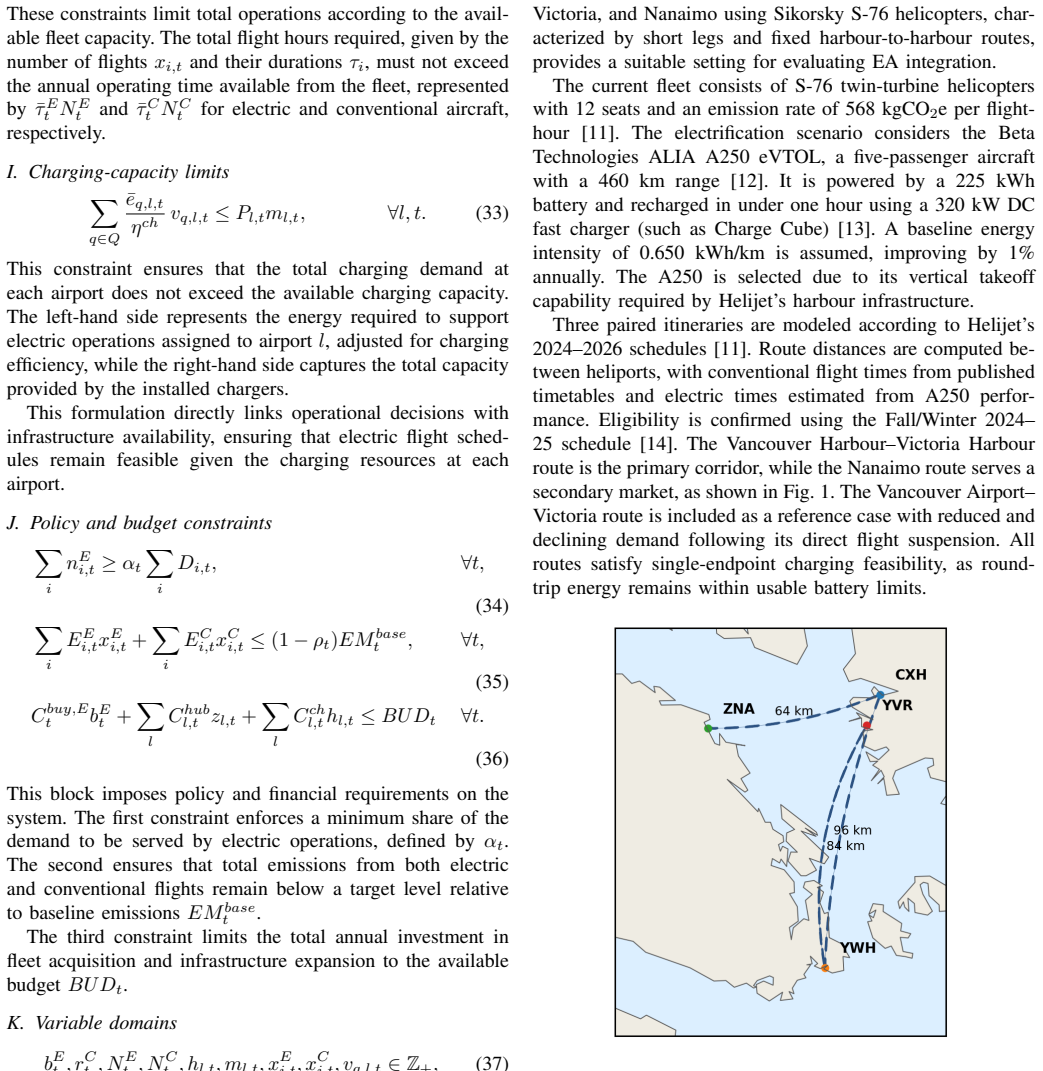
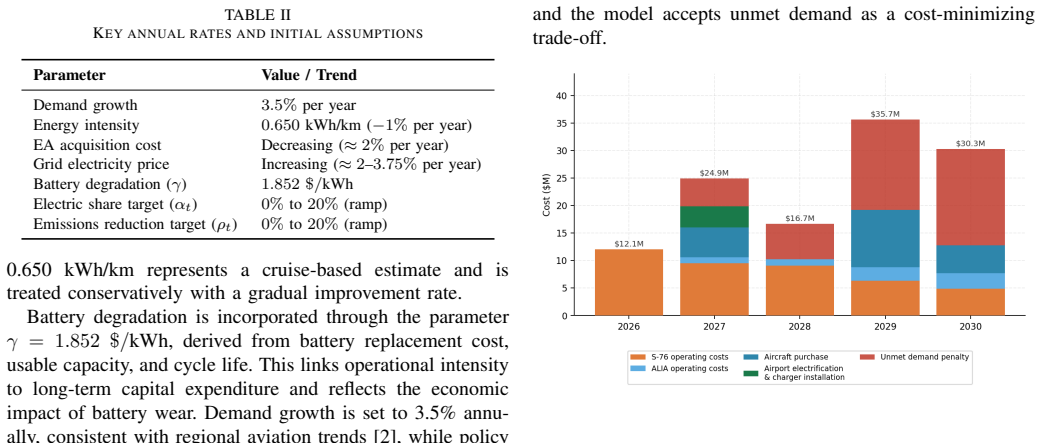
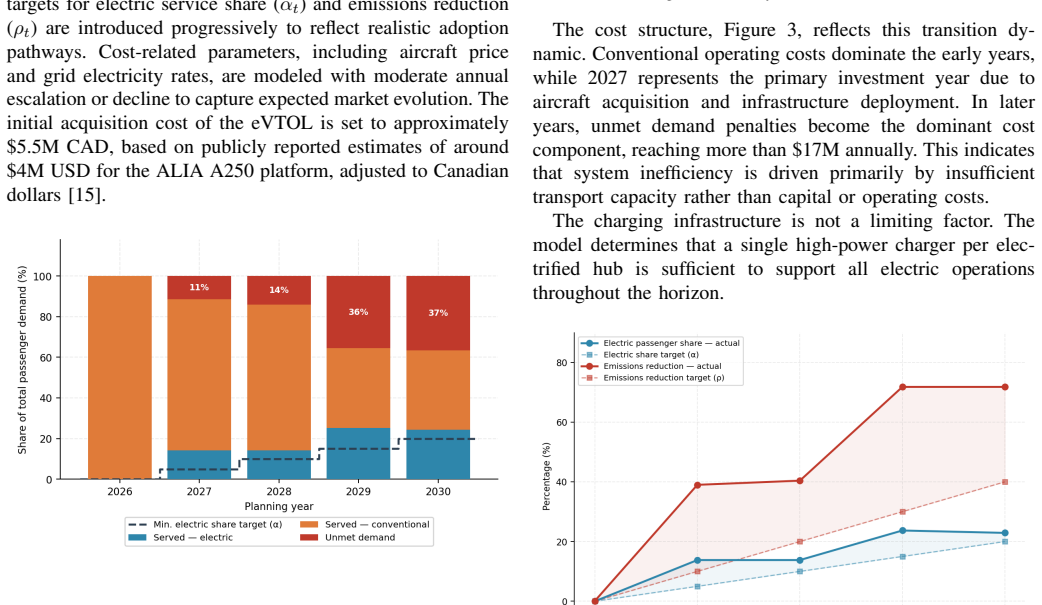
This paper presents a multi-period mixed-integer linear programming (MILP) framework for planning the transition from conventional to electric aircraft in regional aviation. The model jointly optimizes fleet acquisition, infrastructure deployment, and service allocation over time, while accounting for policy constraints such as emissions reduction targets, electric service share, and budget limits. A real-world case study based on Helijet's short-haul network in British Columbia demonstrates the applicability of the model. The results show that electrification can reduce emissions by more than 70\% within five years while remaining economically viable. However, the transition is primarily limited by the capacity of the fleet and operational structure, rather than the charging infrastructure, leading to unmet demand under direct aircraft replacement. These findings emphasize the need for coordinated planning across fleet sizing, scheduling, and route prioritization to ensure a practical and efficient transition to electric aviation.
Editorial analysis
A structured set of objections, weighed in public.
Referee Report
Summary. The manuscript develops a multi-period mixed-integer linear programming (MILP) framework that jointly optimizes fleet acquisition, infrastructure deployment, and service allocation for the transition from conventional to electric aircraft. Policy constraints on emissions targets, electric service share, and budgets are incorporated. A case study on Helijet's short-haul network in British Columbia is used to demonstrate the model, with results claiming more than 70% emissions reduction within five years while remaining economically viable; the transition is found to be limited by fleet capacity and operational structure rather than charging infrastructure, producing unmet demand under direct aircraft replacement.
Significance. If the data and assumptions hold, the work supplies a concrete optimization-based planning tool for regional electric aviation transitions and isolates fleet capacity as the primary bottleneck, which is a useful distinction for prioritizing investments. The real-world case study adds practical relevance for Canadian domestic routes.
Simulated Author's Rebuttal
We thank the referee for the positive assessment of our MILP framework, the case study on Helijet's network, and the recommendation for minor revision. No specific major comments were raised in the report.
Circularity Check
Standard MILP optimization on external data; no circularity
full rationale
The paper describes a multi-period MILP that optimizes fleet acquisition, infrastructure, and allocation subject to explicit external policy constraints (emissions targets, electric share, budget) and real case-study data from Helijet's network. All reported outcomes (70%+ emissions cut, fleet-limited transition, unmet demand) are direct solver outputs from this model. No self-definitional relations, fitted parameters presented as predictions, load-bearing self-citations, or ansatz smuggling appear in the derivation chain. The work is a standard applied optimization study whose results are independent of its own outputs.
Axiom & Free-Parameter Ledger
Reference graph
Works this paper leans on
-
[1]
What share of global CO2 emissions come from aviation?
H. Ritchie, “What share of global CO2 emissions come from aviation?” 2024, Link
2024
-
[2]
ACI world projects 22.3 billion passengers by 2053,
ACI World, “ACI world projects 22.3 billion passengers by 2053,” 2025, Link
2053
-
[3]
Canada’s aviation climate action plan 2022– 2030,
Government of Canada, “Canada’s aviation climate action plan 2022– 2030,” 2022, Link
2022
-
[4]
Components of electrical power systems in more and all-electric aircraft: A review,
A. Barzkar and M. Ghassemi, “Components of electrical power systems in more and all-electric aircraft: A review,”IEEE Transactions on Transportation Electrification, vol. 8, no. 4, pp. 4037–4053, 2022, doi:10.1109/TTE.2022.3174362
-
[5]
L. Dorn-Gomba, J. Ramoul, J. Reimers, and A. Emadi, “Power electronic converters in electric aircraft: Current status, chal- lenges, and emerging technologies,”IEEE Transactions on Trans- portation Electrification, vol. 6, no. 4, pp. 1648–1664, 2020, doi:10.1109/TTE.2020.3006045
-
[6]
Real-time simulation-based energy management of air- port microgrid for electric aircraft,
Anonymous, “Real-time simulation-based energy management of air- port microgrid for electric aircraft,” in2022 IEEE International Conference on Power Systems Technology (POWERCON), 2022, doi:10.1109/POWERCON53406.2022.9930083
-
[7]
A. Kinene, S. Birolini, M. Cattaneo, and T. A. Granberg, “Electric aircraft charging network design for regional routes: A novel math- ematical formulation and kernel search heuristic,”European Jour- nal of Operational Research, vol. 309, no. 3, pp. 1300–1315, 2023, doi:10.1016/j.ejor.2023.02.006
-
[8]
Power optimized battery swap and recharge strategies for electric aircraft operations,
C. Y . Justin, A. P. Payan, S. I. Briceno, B. J. German, and D. N. Mavris, “Power optimized battery swap and recharge strategies for electric aircraft operations,”Transportation Research Part C: Emerging Technologies, vol. 115, p. 102605, 2020, doi:10.1016/j.trc.2020.02.027
-
[9]
F. Vehlhaber and M. Salazar, “Electric aircraft assignment, routing, and charge scheduling considering the availability of renewable en- ergy,”IEEE Control Systems Letters, vol. 7, pp. 3669–3674, 2023, doi=10.1109/LCSYS.2023.3339998
-
[10]
Forecasting the operational lifetime of battery-powered electric aircraft,
M. A. Clarke and J. J. Alonso, “Forecasting the operational lifetime of battery-powered electric aircraft,”Journal of Aircraft, vol. 60, no. 1, pp. 47–55, 2023, doi:10.2514/1.C036851
-
[11]
Fall/winter 2025–26 schedule,
Helijet International-25, “Fall/winter 2025–26 schedule,” 2025, Link
2025
-
[12]
ALIA aircraft,
Beta Technologies, “ALIA aircraft,” 2025, Link
2025
-
[13]
Betas growing charge network,
Beta Charge Team, “Betas growing charge network,” 2025, Link
2025
-
[14]
Fall/winter 2024–25 schedule,
Helijet International, “Fall/winter 2024–25 schedule,” 2024, Link
2024
-
[15]
Beta alia-250 electric aircraft specifications,
Motorwatt, “Beta alia-250 electric aircraft specifications,” 2024, Link
2024
-
[16]
Performance analysis of regional electric aircraft,
J. Mukhopadhaya and B. Graver, “Performance analysis of regional electric aircraft,” International Council on Clean Transportation (ICCT), Tech. Rep., 2022, Link
2022
-
[17]
This record-breaking electric aircraft just got a massive edge in the evtol certification race,
M. Verdon, “This record-breaking electric aircraft just got a massive edge in the evtol certification race,” 2025, Link
2025
discussion (0)
Sign in with ORCID, Apple, or X to comment. Anyone can read and Pith papers without signing in.