REVIEW 3 major objections 5 minor 33 references
High-Efficiency Quantum Memory of Full-Bandwidth Squeezed Light
T0 review · 3 major / 5 minor · reviewed 2026-08-15 · deepseek-v4-flash
Pith's one-line read A far-off-resonant Raman memory stores squeezed vacuum light at up to 24 MHz bandwidth with 80 percent memory efficiency, preserving 1.0 dB of squeezing from a 1.6 dB input.
desk verdict Raman memory of squeezed vacuum is a real first, but the headline numbers contradict the paper's own noise model and need major correction before quantitative claims can be trusted. read the letter →
The pith
A machine-rendered reading of the paper's core claim, the machinery that carries it, and where it could break.
The reading
What carries the argument
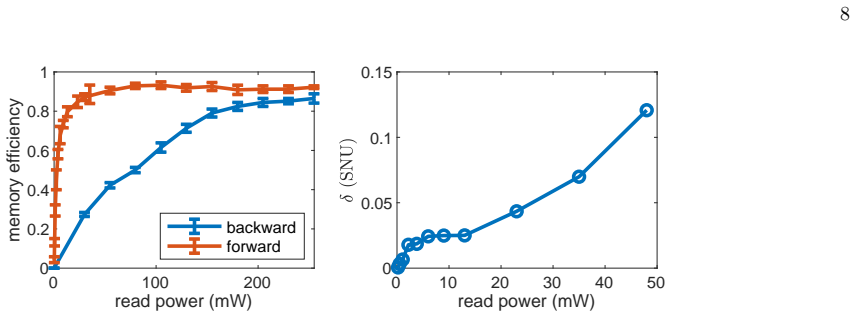
The load-bearing mechanism is a backward-retrieval Raman memory in a hot $^{87}\mathrm{Rb}$ vapor, in which the write pulse is temporally mode-matched to the input squeezed pulse and the read pulse counter-propagates to extract the spin wave. Backward retrieval is the piece that makes the claims cohere: it delivers high memory efficiency at relatively low read power, and since excess noise grows with read power, reaching 80 percent efficiency without adding much noise is what lets the retrieved state keep its squeezing. The paper's quantitative claims are connected through a noisy-channel model, $\hat{a}_{\mathrm{out}} = \sqrt{\eta}\,\hat{a}_{\mathrm{in}} + \sqrt{1-\eta}\,\hat{v} + \hat{b}_{\mathrm{th}}$, where $\eta$ is the end-to-end efficiency and $\hat{b}_{\mathrm{th}}$ adds phase-independent excess noise $\delta$; the authors use this model to extract $\delta = 0.025$ SNU from measured quadrature variances. The dual-pulse time-domain homodyne tomography supplies the state characterization: a squeezed vacuum pulse gives the quadrature values and a delayed bright coherent pulse with the same waveform tracks the phase, cancelling Stark-shift and phase-drift effects.
What would settle it
Reconstruct the input and output states with a single calibrated homodyne detector, or apply the paper's own model: with $\eta = 0.642$ and $\delta = 0.025$ SNU, a 1.6 dB input should come out with about 0.8 dB of squeezing rather than the quoted 1.0 dB, so a direct measurement of the output squeezing under one common calibration decides whether the quoted numbers are mutually consistent.
Extended reading notes
Core claim
The central discovery is that a far-off-resonant Raman memory in an atomic vapor can act as a broadband, low-noise, high-efficiency memory for squeezed vacuum states. The authors demonstrate write-in and retrieval of a squeezed vacuum with an 80 percent memory efficiency and 80.3 percent optical transmission, giving a 64.2 percent end-to-end efficiency; the output state retains 1.0 dB of squeezing from a 1.6 dB input, with excess noise estimated at 0.025 SNU by a noisy-channel model. They further store squeezed states with bandwidths from 4.4 to 24 MHz, and every retrieved state remains below the shot-noise level with fidelity above 92 percent, including 0.55 dB output squeezing at 24 MHz from a 0.9 dB input. In the authors' picture, the memory protects the full squeezing bandwidth rather than only its low-frequency part, and the backward-retrieval strategy is what makes high efficiency and low noise compatible.
Load-bearing premise
The load-bearing premise is that the measured input and output quadrature variances are placed on the same loss-normalized scale, so that one efficiency $\eta$ and one excess noise $\delta$ describe the whole memory channel; if the two homodyne paths are calibrated differently, the quoted 1.0 dB output squeezing no longer follows from the 1.6 dB input.
Editorial extensions
If this is right
- A squeezed state of up to 24 MHz bandwidth can be stored and retrieved with the retrieved noise still below the shot-noise level, so the memory covers the full bandwidth of the squeezed source rather than a narrow slice.
- Retrieved squeezing of 1.0 dB from an input of 1.6 dB, with memory efficiency 80 percent and end-to-end efficiency 64.2 percent, implies the memory can serve as a loss- and noise-tolerant interface for continuous-variable protocols that require non-classical states.
- A 4.4 MHz input state can be retrieved with 43.1 MHz bandwidth, since the output bandwidth is set by the read pulse, offering bandwidth conversion within a memory.
- Fidelity above 92 percent across the 4.4 to 24 MHz range means the memory process preserves the quantum state, not just its photon statistics.
- A backward retrieval strategy, rather than forward retrieval, is the practical route to simultaneously high efficiency and low excess noise in Raman memories.
Reading between the lines
- The bandwidth-enhancement observation (4.4 MHz input to 43.1 MHz output) suggests the same Raman memory could act as a quantum state converter between sources and processors with different spectral widths, though the paper does not test that function directly.
- If the noisy-channel model is the right description, then the squeezing of the retrieved state should be predictable from $\eta$ and $\delta$ alone; checking that prediction at more than one input squeezing level would be a direct test of whether the quoted noise is phase-independent.
- The excess noise of order 0.02 SNU limits the achievable output squeezing at higher input squeezing; pushing input squeezing beyond 1.6 dB would likely require further suppression of the four-wave-mixing noise, so the present performance may set a practical ceiling for this architecture.
- The method of using a delayed bright coherent pulse for phase tracking could be applied to other pulsed squeezed-state measurements where the photon number per pulse is too low for conventional time-domain homodyne tomography.
Signed reviews
Editorial analysis
A structured set of objections, weighed in public.
Referee Report
Summary. This manuscript reports an experimental far-off-resonant Raman quantum memory for squeezed vacuum states in warm rubidium vapor. The paper claims storage of squeezed light over bandwidths from 4.4 to 24 MHz, with a memory efficiency of 80%, an end-to-end efficiency of 64.2%, excess noise as low as 0.025 SNU, retrieved squeezing of 1.0 dB from a 1.6 dB input, and unconditional fidelity above 92% across the full bandwidth range. The technical approach combines an OPA-based squeezer, write-pulse waveform optimization by a differential evolution algorithm, a backward retrieval strategy, and a dual-pulse time-domain homodyne tomography protocol. The central quantitative claims are summarized in Figs. 2 and 3 and Table I, and are connected through the noisy-channel model of Eq. (1) and the excess-noise estimator Eq. (D2).
Significance. If the quantitative claims survive scrutiny, this would be a substantial experimental advance: the factor-of-12 bandwidth increase over previous narrowband EIT- or QND-based squeezed-light memories, combined with high end-to-end efficiency and sub-shot-noise retrieval, would make the system a practical interface for broadband continuous-variable quantum processing. The dual-pulse phase-tracking tomography and the backward-retrieval noise reduction are concrete technical contributions. The claims are explicit and falsifiable, which is a strength, but they must first be made mutually consistent under the paper's own model.
major comments (3)
- [Memory Performance, Eq. (1), Table I, Appendix D (Eq. D2)] The four headline numbers are internally inconsistent under the paper's own model. With η=0.642, δ=0.025 SNU, and input squeezing of 1.6 dB (V_in=10^(-1.6/10)=0.692 SNU), Eq. (1) predicts V_out = η V_in + (1−η) + δ = 0.642×0.692 + 0.358 + 0.025 = 0.827 SNU, which is 0.82 dB of squeezing, not the quoted 1.0 dB (0.794 SNU). To reproduce the reported 1.0 dB with η=0.642, one would need δ=−0.008 SNU, which is unphysical. The same contradiction follows directly from Eq. (D2) if the phase-resolved variances are substituted consistently. At least one of the quoted input squeezing, end-to-end efficiency, excess noise, or output squeezing is defined on a different reference plane or is misreported. The manuscript must resolve this by reporting the raw variances at all measured phases and stating explicitly which detection efficiencies enter V_in, V_out, and η. I note that using η=0.80 (the memory efficiency) instead of η=0.642 in the same formula would give V_out≈0.779 SNU, i.e. 1.09 dB, much closer to the quoted 1.0 dB; the authors should clarify which efficiency is actually used in Eq. (D2).
- [Figs. 2(b), 3, and Table I] No statistical or systematic uncertainties are given for the squeezing values, efficiencies, excess noise, or fidelities. Without error bars, the reader cannot tell whether the 0.18 dB discrepancy between the quoted output squeezing and the model prediction is a typo, a normalization issue, or a genuine contradiction. The paper should provide standard errors from repeated measurements and a systematic error budget for the homodyne interference efficiencies (98.5% versus 95%) and the 92% photodiode quantum efficiency reported in Appendix A. This is load-bearing because the central claims are numerical and the consistency check depends on these values.
- [Appendix A and Eq. (D2)] The two homodyne detection paths have different interference efficiencies (98.5% for the input channel and 95% for the output channel), but the main text does not state whether the quoted dB squeezing values are corrected for these differences. Since Eq. (1) relates variances in a common reference plane, the manuscript must specify whether η includes detection losses and whether V_in and V_out are corrected before substitution into Eq. (D2). This point is closely related to the inconsistency above and needs to be settled before the performance claims can be evaluated.
minor comments (5)
- [Experimental setup section] The figure references are inconsistent: the experimental setup is shown in Fig. 1, but the text in the 'Experimental setup' section refers to 'Fig. 4 (a)', 'Fig. 4 (b)', and 'Fig. 4 (c)', while Fig. 4 is also the detailed setup diagram. Please correct the cross-references.
- [Throughout] There are several typos: '87Rbatomic transition' should read '^87Rb atomic transition'; the Fig. 1 caption says 'filp mirror' instead of 'flip mirror'; and the input FWHM is given as 227.2 ns in one place and 227.5 ns in another.
- [Fig. 2(c)] The reconstructed Wigner functions are shown without error bars, contour levels, or a statement of the number of quadrature samples and Hilbert-space truncation used in the maximum-likelihood reconstruction; this information is needed to assess the fidelity claim.
- [Appendix C, Eqs. (C1)-(C3)] The Raman memory equations use g_s, g_a, and Δk without defining all symbols or specifying the boundary conditions; please add a sentence stating the assumptions under which these equations are solved.
- [Reference list] Reference [28] is incomplete: 'See Supplemental Material at for additional details' contains no URL or identifier.
Circularity Check
No circularity found: the performance claims are experimental measurements, and the noisy-channel model is used as an estimator rather than as a source of the claimed results.
full rationale
The paper's central claims are measured outcomes of an experiment: input squeezing of 1.6 dB, retrieved squeezing of 1.0 dB, memory efficiency of 80%, end-to-end efficiency of 64.2%, and excess noise of 0.025 SNU. None of these quantities is derived from an assumed version of itself. The excess noise is obtained from Eq. (D2), which uses the measured quadrature variances and the measured efficiency eta to estimate delta; this is a parameter-estimation procedure, not a prediction forced by construction. The memory efficiency and end-to-end efficiency are separately measured quantities, and the quoted fidelity is computed from reconstructed density matrices. The self-citations, notably Refs. [21] and [32], are cited for the temporal mode-matching optimization method and for the backward-retrieval strategy; these are methodological references from the same group, but they do not assert or assume the headline performance numbers. Therefore the derivation chain does not reduce to its inputs. A separate concern is that the reported values for B = 4.4 MHz may be internally inconsistent under Eq. (1): using eta = 0.642 and delta = 0.025 SNU with a 1.6 dB input predicts about 0.82 dB of output squeezing, not 1.0 dB. That is a correctness or consistency issue, not a circularity issue, and it does not change the circularity verdict.
Assumptions & free parameters
free parameters (1)
- Optimized write-pulse temporal waveform (delay and FWHM) =
Not reported
assumptions (4)
- domain assumption Noisy-channel model: the memory acts as a beam splitter with efficiency eta followed by a phase-independent thermal noise mode (Eq. 1 and Eq. D2).
- domain assumption The Raman memory equations in the co-moving frame (Eqs. C1-C3) describe the write and read dynamics with negligible decoherence.
- domain assumption Phase drift is below 100 kHz, so the 500 ns delay between the squeezed pulse and the bright coherent tracking pulse introduces negligible phase error.
- domain assumption The write-pulse waveform optimized with a strong coherent probe transfers to the squeezed vacuum state.
Cite this review
Pith. "Pith review of High-Efficiency Quantum Memory of Full-Bandwidth Squeezed Light." pith.science (2026). https://pith.science/paper/K7C3UIM4
@misc{pith2026250615399,
  author       = {Pith},
  title        = {Pith review of: High-Efficiency Quantum Memory of Full-Bandwidth Squeezed Light},
  year         = {2026},
  howpublished = {\url{https://pith.science/paper/K7C3UIM4}},
  note         = {Machine review of arXiv:2506.15399}
}
read the original abstract
In continuous-variable quantum information processing, it is crucial to develop high-efficiency and broadband quantum memory of squeezed light, which enables the storage of full-bandwidth information. Here, we present a quantum memory of squeezed light with up to 24 MHz bandwidth, which is at least 12 times that of previous narrowband resonant memory systems, via a far-off resonant Raman process. We achieve output squeezing of as high as 1.0 dB with fidelity above 92% and a memory efficiency of 80%, corresponding to an end-to-end efficiency of 64.2%, when input squeezing is 1.6 dB. The lowest excess noise of 0.025 shot-noise-unit in the memory system is estimated by the noisy channel model which is benefited from optimizing quantum memory performance with a backward retrieval strategy. Our results represent a breakthrough in high-performance memory for squeezed states within tens of MHz-level bandwidth, which has potential applications in high-speed quantum information processing.
Figures


Figures from the paper (3 more)


Reference graph
Works this paper leans on
-
[1]
S. L. Braunstein and P. van Loock, Rev. Mod. Phys.77, 513 (2005)
2005
-
[2]
and phase quadrature (ˆp= ˆa−ˆa† / √ 2i) of the squeezed state are squeezed and anti-squeezed respectively, where ˆa† and ˆaare the creation and annihilation operators. In the part of the memorizer, a87Rbatomic ensemble is initially prepared in the state|5S 1/2,F= 2⟩by a 780 nm pumping laser with FWHM of 45µs. The squeezed vac- uum state ˆain is co-inject...
-
[3]
Weedbrook, S
C. Weedbrook, S. Pirandola, R. Garc´ ıa-Patr´ on, N. J. Cerf, T. C. Ralph, J. H. Shapiro, and S. Lloyd, Rev. Mod. Phys.84, 621 (2012)
2012
-
[4]
X.-B. Wang, T. Hiroshima, A. Tomita, and M. Hayashi, Physics Reports448, 1 (2007)
work page 2007
-
[5]
M. Huo, J. Qin, J. Cheng, Z. Yan, Z. Qin, X. Su, X. Jia, C. Xie, and K. Peng, Sci. Adv.4, eaas9401 (2018)
work page 2018
- [6]
- [7]
- [8]
Show all 33 references
-
[9]
Jain, H.-M
N. Jain, H.-M. Chin, H. Mani, C. Lupo, D. S. Nikolic, A. Kordts, S. Pirandola, T. B. Pedersen, M. Kolb, B. ¨Omer, C. Pacher, T. Gehring, and U. L. Andersen, Nat Commun13, 4740 (2022)
2022
-
[10]
A. A. E. Hajomer, I. Derkach, N. Jain, H.-M. Chin, U. L. Andersen, and T. Gehring, Sci. Adv.10, eadi9474 (2024)
2024
-
[11]
Konno, W
S. Konno, W. Asavanant, F. Hanamura, H. Nagayoshi, K. Fukui, A. Sakaguchi, R. Ide, F. China, M. Yabuno, S. Miki, H. Terai, K. Takase, M. Endo, P. Marek, R. Filip, P. Van Loock, and A. Furusawa, Science383, 289 (2024)
2024
-
[12]
Enomoto, K
Y. Enomoto, K. Anai, K. Udagawa, and S. Takeda, Phys. Rev. Research5, 043005 (2023)
2023
-
[13]
U. L. Andersen, T. Gehring, C. Marquardt, and G. Leuchs, Physica Scripta91, 053001 (2016)
2016
-
[14]
Kuruma, B
K. Kuruma, B. Pingault, C. Chia, M. Haas, G. D. Joe, D. R. Assumpcao, S. W. Ding, C. Jin, C. J. Xin, M. Yeh, N. Sinclair, and M. Lonˇ car, Nat. Phys. (2024), 10.1038/s41567-024-02697-5
2024 doi
-
[15]
Quan- tum memory: A missing piece in quantum computing units,
C. Liu, M. Wang, S. A. Stein, Y. Ding, and A. Li, “Quan- tum memory: A missing piece in quantum computing units,” (2023), arXiv:2309.14432 [quant-ph]
2023 arXiv
-
[16]
J.-M. Mol, L. Esguerra, M. Meister, D. E. Bruschi, A. W. Schell, J. Wolters, and L. W¨ orner, Quantum Sci. Tech- nol.8, 024006 (2023)
2023
-
[17]
Hillmann, F
T. Hillmann, F. Quijandr´ ıa, G. Johansson, A. Ferraro, S. Gasparinetti, and G. Ferrini, Phys. Rev. Lett.125, 160501 (2020)
2020
-
[18]
Z. Yan, L. Wu, X. Jia, Y. Liu, R. Deng, S. Li, H. Wang, C. Xie, and K. Peng, Nat Commun8, 718 (2017)
2017
-
[19]
Arikawa, K
M. Arikawa, K. Honda, D. Akamatsu, S. Nagatsuka, K. Akiba, A. Furusawa, and M. Kozuma, Phys. Rev. A81, 021605 (2010)
2010
-
[20]
K. F. Reim, J. Nunn, V. O. Lorenz, B. J. Sussman, K. C. Lee, N. K. Langford, D. Jaksch, and I. A. Walmsley, Nature Photon4, 218 (2010)
2010
-
[21]
K. A. G. Fisher, D. G. England, J.-P. W. MacLean, P. J. Bustard, K. J. Resch, and B. J. Sussman, Nat Commun 7, 11200 (2016)
2016
-
[22]
J. Guo, X. Feng, P. Yang, Z. Yu, L. Q. Chen, C.-H. Yuan, and W. Zhang, Nat Commun10, 148 (2019). 9
2019
-
[23]
D. G. England, K. A. Fisher, J.-P. W. MacLean, P. J. Bustard, R. Lausten, K. J. Resch, and B. J. Sussman, Physical review letters114, 053602 (2015)
2015
-
[24]
D. J. Saunders, J. H. D. Munns, T. F. M. Champion, C. Qiu, K. T. Kaczmarek, E. Poem, P. M. Ledingham, I. A. Walmsley, and J. Nunn, Phys. Rev. Lett.116, 090501 (2016)
2016
-
[25]
Zhang, J
K. Zhang, J. Guo, L. Chen, C. Yuan, Z. Ou, and W. Zhang, Physical Review A90, 033823 (2014)
2014
-
[26]
S. E. Thomas, T. M. Hird, J. H. Munns, B. Brecht, D. J. Saunders, J. Nunn, I. A. Walmsley, and P. M. Leding- ham, Physical Review A100, 033801 (2019)
2019
-
[27]
M. D. browski, R. Chrapkiewicz, and W. Wasilewski, Opt. Express22, 26076 (2014)
2014
-
[28]
Z. Yu, Z. Wu, X. Li, X. Feng, W. Huang, K. Zhang, C.- H. Yuan, W. Zhang, and L. Q. Chen, Phys. Rev. Lett. 131, 150804 (2023)
2023
-
[29]
See Supplemental Material at for additional details
-
[30]
M. Wang, M. Zhang, Z. Qin, Q. Zhang, L. Zeng, X. Su, C. Xie, and K. Peng, Laser & Photonics Reviews16, 2200336 (2022)
2022
-
[31]
A. I. Lvovsky, J. Opt. B: Quantum Semiclass. Opt.6, S556 (2004)
2004
-
[32]
Zhang, Y
J. Zhang, Y. Li, M. Zhao, D. Han, J. Liu, M. Wang, Q. Gong, Y. Xiang, Q. He, and X. Su, Light: Science & Applications14, 25 (2025)
2025
-
[33]
S. Ming, J. Guo, Y. Wu, G. Bao, S. Wu, M. Shi, L. Chen, and W. Zhang, Sci. China Inf. Sci.66, 180505 (2023)
2023
Reviewed August 15, 2026 · model on record in the stance chip above.
Discussion (0). Continue with ORCID to comment.