REVIEW 3 major objections 5 minor 2 cited by
Phenomenology of the new light Higgs bosons in Gildener-Weinberg model
T0 review · 3 major / 5 minor · reviewed 2026-08-14 · deepseek-v4-flash
Pith's one-line read Gildener-Weinberg models predict new Higgs bosons below 500 GeV, with the 125 GeV Higgs self-couplings at twice and four times the Standard Model values, so direct scalar searches are the decisive LHC test.
desk verdict A clean and honest one-loop calculation of GW Higgs self-couplings; the main caveat is the unpropagated O(100 GeV) uncertainty in the 540 GeV sum rule. read the letter →
The pith
A machine-rendered reading of the paper's core claim, the machinery that carries it, and where it could break.
The reading
What carries the argument
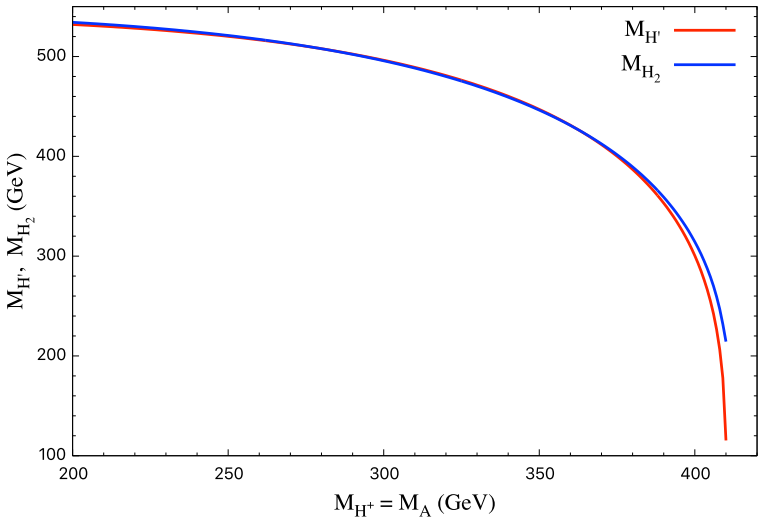
The central mechanism is the Gildener-Weinberg two-Higgs-doublet model, in which a scale-invariant quartic potential has a flat direction and a massless tree-level dilaton (the scale-symmetry Goldstone boson) that is exactly aligned with Standard Model couplings. The one-loop Coleman-Weinberg potential gives this dilaton its 125 GeV mass. Two identities carry the argument: the sum rule $(M_{H'}^4+M_A^4+2M_{H^\pm}^4)^{1/4}=540$ GeV, obtained by inserting tree-level masses into the one-loop mass formula, which extends the low-mass prediction to all GW models; and the vanishing of the dilaton's tree-level cubic and quartic self-couplings, which follows from the homogeneity of the scale-invariant potential and its vanishing along the flat direction. These vanishings force $\lambda_{HHH}$ and $\lambda_{HHHH}$ to start at one-loop order, producing the numerical ratios near $2$ and $4$ times the Standard Model.
What would settle it
Measure $\sigma(pp\to HH)$ at the 27 TeV HE-LHC and run dedicated LHC searches for $H^\pm\to t\bar b$ and $A/H_2\to b\bar b$ over 200–500 GeV at $\tan\beta\simeq0.3$; a di-Higgs rate well above 20 fb, or exclusion of the new scalars at their predicted masses and rates, would contradict the sum-rule and coupling forecasts.
Extended reading notes
Core claim
On its own terms, the paper claims that every Gildener-Weinberg model of electroweak symmetry breaking shares a sum rule $(M_{H'}^4+M_A^4+2M_{H^\pm}^4)^{1/4}=540$ GeV, so at least some of the new Higgs bosons must be light enough for the LHC. It further claims that, because the classical potential is scale invariant and homogeneous of degree four, the trilinear and quartic self-couplings of the 125 GeV Higgs vanish at tree level and first appear in the Coleman-Weinberg loop expansion. In the GW-2HDM the one-loop calculation gives $\lambda_{HHH}\simeq2(\lambda_{HHH})_{\rm SM}=64$ GeV and $\lambda_{HHHH}\simeq4(\lambda_{HHHH})_{\rm SM}=0.129$. Because the sum rule applies to any GW model, the paper concludes these coupling values and the resulting cross sections apply to all GW models, not only the two-doublet example. The collider consequence is that di-Higgs production stays near its theoretical minimum of 15–20 fb at 13–14 TeV, tri-Higgs production needs a 100 TeV machine, and direct production of $H^\pm$, $A$, and $H_2$ is the realistic discovery channel.
Load-bearing premise
The load-bearing premise is that first-order Coleman-Weinberg perturbation theory, evaluated with tree-level masses, fixes the 125 GeV Higgs mass and the 540 GeV sum rule closely enough that higher-order corrections shift the scalar masses by only $O(100)$ GeV or less.
Editorial extensions
If this is right
- If the sum rule holds, every GW model with only $W^\pm$, $Z$, and top quark in the loop has at least one new scalar boson below about 500 GeV, and models with more scalars must put some of them even lower.
- The predicted trilinear coupling $\lambda_{HHH}\simeq64$ GeV gives $\sigma(pp\to HH)\simeq15$--$20$ fb at 13–14 TeV, so an HL-LHC observation of di-Higgs production would be a surprise; the 27 TeV HE-LHC is needed to see it.
- The quartic coupling $\lambda_{HHHH}\simeq0.129$ is four times the Standard Model value, yet $pp\to HHH$ remains unobservable until a 100 TeV hadron collider.
- Searches for $H^\pm\to t\bar b$, $A/H_2\to b\bar b,t\bar t$, and $A/H_2\to ZH_2,ZA\to \ell^+\ell^- b\bar b$ in the 200–500 GeV range are the decisive near-term tests; null results at the expected rates would strongly constrain the class.
- Because near alignment suppresses $H_2,A\to WW,ZZ$ and $H^\pm\to WZ$, observing unsuppressed decays of this type from a new scalar would be a significant, possibly fatal, blow to GW models.
Reading between the lines
- The paper leaves implicit that the sum rule's universality cuts both ways: if LHC searches cover the 200–500 GeV window and find nothing at the expected $\tan\beta\sim0.5$ rates, the entire GW class is disfavored, not just the two-doublet example.
- Because the one-loop sum rule could shift by $O(100)$ GeV, the robust forecast is better read as 'some new scalar below roughly a TeV' than as a sharp 540 GeV cut, so low-mass searches discriminate GW models from decoupled Higgs sectors.
- The sharp rise of $\kappa_\lambda$ and $\mu_\lambda$ near the sum-rule endpoint suggests a testable corner: if $M_{H^\pm}=M_A$ is close to 400 GeV with a light $H_2$, $H_2$-associated multi-Higgs final states could have enhanced rates that the present paper does not quantify.
- A natural extension is to compute $\sigma(pp\to H_2H_2)$ using the sizable $\lambda_{H_1H_2H_2}$ coupling found here, a rate the paper identifies as interesting but leaves for future work.
Signed reviews
Editorial analysis
A structured set of objections, weighed in public.
Referee Report
Summary. This paper studies the Gildener-Weinberg (GW) mechanism in a two-Higgs-doublet model (GW-2HDM). The authors review the one-loop effective-potential calculation of Ref. [2], which yields a sum rule for the new scalar masses, (M_H'^4 + M_A^4 + 2M_H±^4)^(1/4) = 540 GeV, once the 125 GeV Higgs mass is used as input. They then compute the one-loop triple and quartic Higgs self-couplings λ_HHH and λ_HHHH, finding κλ ≈ 1.6–3.6 and μλ ≈ 3.6–5.6 relative to the SM, with representative values near κλ ≈ 2 and μλ ≈ 4. These are translated into a forecast that σ(pp→HH) ≈ 15–20 fb, near the minimum of the di-Higgs cross section at 13–14 TeV, and that λ_HHHH would require a 100 TeV collider. Because the sum rule is independent of the number and type of Higgs multiplets, the authors claim these conclusions apply to all GW models. The paper concludes by advocating direct LHC searches for the new charged and neutral scalars below about 500 GeV.
Significance. If the central claims hold, the paper provides a concrete and falsifiable phenomenological target for GW models: new scalars below roughly 500 GeV, while di-Higgs and tri-Higgs rates remain at or below the SM values, so that direct scalar searches are the most promising probe. The one-loop effective-potential machinery is standard, the formulas for the self-couplings are given explicitly, and the numerical values in Table 1 are internally consistent with the stated expressions. The paper also usefully connects the sum rule to existing LHC searches and identifies the most sensitive channels. However, the strength of the conclusions depends on two aspects that are not fully established: the numerical impact of the acknowledged O(100 GeV) higher-order uncertainty in the sum rule, and the validity of the 'all GW models' generalization given the logarithmic mass dependence of the one-loop couplings.
major comments (3)
- [Sec. II (after Eq. (15)) and Secs. III–IV] The paper explicitly states that higher-order corrections may change the right-hand side of Eq. (15) by O(100 GeV), but this uncertainty is never propagated into any of the downstream results. The mass assignments in Fig. 3 and Table 2, the coupling ratios in Fig. 4 and Table 1, and the di-Higgs and tri-Higgs forecasts in Sec. III all use the one-loop sum-rule constant 540 GeV. Because the scalar contribution to λ^(1)_HHH in Eq. (37) is proportional, up to logarithms, to M_H'^4 + M_A^4 + 2M_H±^4, a shift of the constant from 540 GeV to, say, 440 GeV reduces that scalar fourth-power sum by a factor (440/540)^4 ≈ 0.44 and changes the one-loop scalar contribution by tens of GeV, which can move κλ by order one. The authors should either quantify the resulting spread in κλ, μλ, and σ(pp→HH), or explicitly state that the quoted forecasts are conditional on the one-loop value of the sum rule being exact.
- [Sec. III, Eqs. (37)–(41), and the universal claim in the abstract] The claim that the results apply to all GW models because of the sum rule is stronger than what Eqs. (37)–(41) establish. The non-logarithmic scalar term in λ^(1)_HHH is fixed by Σ M_H^4 = (540 GeV)^4, but the logarithmic terms Σ M_H^4 ln(M_H^2/Λ^2) depend on the distribution of the new scalar masses. In the GW-2HDM scan of this paper these logarithms are numerically significant and are comparable to the non-log term. In a general GW model with a different number of scalars or a different mass hierarchy, the logarithmic contribution can shift λ_HHH by tens of GeV. The universal statement should therefore be either restricted to the GW-2HDM or backed by an explicit demonstration that the logarithmic dependence is negligible over the full GW parameter space.
- [Sec. III, text after Fig. 4 and Table 1] The abstract and Sec. III quote λ_HHH ≈ 2(λ_HHH)_SM = 64 GeV and σ(pp→HH) = 15–20 fb as the minimum, but Fig. 4 and Table 1 show that κλ ranges from about 1.6 to 3.6 over the allowed MH± = MA range. Since the di-Higgs cross section is a function of κλ (and μλ), the paper should present σ(pp→HH) as a function of MH±, using the parametrizations of Refs. [16–18], and specify for which value of κλ the minimum applies. Quoting a single 15–20 fb range together with κλ ∈ [1.6, 3.6] requires justification, as the cross section is not generally flat over that interval.
minor comments (5)
- [Abstract and Fig. 4] The abstract presents κλ ≈ 2 and μλ ≈ 4 as clean values, whereas Fig. 4 and Table 1 show a range κλ ≈ 1.6–3.6 and μλ ≈ 3.6–5.6; the abstract should state that these are representative values rather than predictions valid across the whole allowed parameter space.
- [Sec. III, after Eq. (26)] There is a duplicated word in 'the nonzero cubic terms terms in the tree-level potential'; this should be corrected.
- [Sec. II, Eq. (15)] The phrase 'below about 500 GeV' is looser than what the sum rule strictly implies: the sum rule bounds the fourth-power combination, and in principle one scalar could be as heavy as 540 GeV if the others are very light. The wording should be adjusted to describe a bound on mass combinations rather than a strict upper bound on every individual scalar mass.
- [Sec. IV, Table 2] The ATLAS and GW-2HDM entries in Table 2 include B(Z→ℓ+ℓ−) implicitly through the cross-section definition, while the CMS entry includes B(Z→e+e−, μ+μ−); the text notes this, but a footnote or a column header making the normalization identical would improve comparability.
- [Sec. IV, after item (3)] The statement that there appear to be no dedicated searches for H±→W±H2 and H2→W±H∓ would be more useful with a brief estimate of the expected yields in the GW-2HDM parameter region, or with a dedicated search reference if one now exists.
Circularity Check
No significant circularity: the self-coupling predictions follow from the one-loop effective potential with measured masses as inputs, and self-citations are not load-bearing.
full rationale
The central quantitative claims do not reduce to their inputs. The mass formula Eq. (14) is a one-loop expression relating the 125 GeV Higgs mass to the known gauge-boson, top-quark, and scalar masses; Eq. (15) is obtained by inserting M_H = 125 GeV, so the 540 GeV sum-rule combination is a derived constraint, not a fitted input. The triple and quartic Higgs couplings are then computed as third and fourth derivatives of the one-loop improved potential, Eqs. (33)-(41), with scalar masses satisfying that sum rule; no observed Higgs self-coupling data are used to fix parameters. The choice tan beta = 0.5 is taken from a prior paper by one of the authors, but the paper states there is no discernible effect on kappa_lambda and mu_lambda for any plausible tan beta, so that self-citation is not load-bearing. The agreement with Agrawal et al. (Ref. [6]) is an external cross-check, not the source of the prediction. The authors' explicit caveat that higher-order corrections may shift the right side of Eq. (15) by O(100 GeV) is an honest limitation of first-order perturbation theory, not a circular reduction; it affects the reliability of the numerical forecasts but does not make the derivation self-referential.
Assumptions & free parameters
free parameters (2)
- tan β =
0.50 (current experimental upper limit)
- MH± = MA bench-points =
200, 400, 410 GeV (scanned)
assumptions (5)
- domain assumption The tree-level scalar potential V0 is exactly scale invariant and contains only quartic couplings, with no quadratic or cubic terms.
- domain assumption The only heavy fermion is the top quark and the only weak bosons are W and Z; no other states contribute appreciably to V1.
- domain assumption First-order (one-loop) Coleman-Weinberg perturbation theory is accurate enough that tree-level masses can be inserted on the right side of Eq. (14).
- domain assumption The 125 GeV Higgs H1 is the nearly aligned dilaton with decay constant f=v=246 GeV.
- ad hoc to paper MH±=MA is assumed so scalar contributions to the T parameter vanish.
Cite this review
Pith. "Pith review of Phenomenology of the new light Higgs bosons in Gildener-Weinberg model." pith.science (2026). https://pith.science/paper/K7DZDDUK
@misc{pith2026190902111,
  author       = {Pith},
  title        = {Pith review of: Phenomenology of the new light Higgs bosons in Gildener-Weinberg model},
  year         = {2026},
  howpublished = {\url{https://pith.science/paper/K7DZDDUK}},
  note         = {Machine review of arXiv:1909.02111}
}
abstract
Gildener-Weinberg (GW) models of electroweak symmetry breaking are especially interesting because the low mass and nearly Standard Model couplings of the $125\,{\rm GeV}$ Higgs boson, $H$, are protected by approximate scale symmetry. Another important but so far under-appreciated feature of these models is that a sum rule bounds the masses of the new charged and neutral Higgs bosons appearing in {\em all} these models to be below about $500\,{\rm GeV}$. Therefore, they are within reach of LHC data currently or soon to be in hand. Also so far unnoticed of these models, certain cubic and quartic Higgs scalar couplings vanish at the classical level. This is due to spontaneous breaking of the scale symmetry. These couplings become nonzero from explicit scale breaking in the Coleman-Weinberg loop expansion of the effective potential. In a two-Higgs doublet GW model, we calculate $\lambda_{HHH} \simeq 2(\lambda_{HHH})_{\rm SM} = 64\,{\rm GeV}$. This corresponds to $\sigma(pp \to HH) \cong 15$--$20\,{\rm fb}$, its {\em minimum} value for $\sqrt{s} = 13$--$14\,{\rm TeV}$ at the LHC. It will require at least the $27\,{\rm TeV}$ HE-LHC to observe this cross section. We also find $\lambda_{HHHH} \simeq 4(\lambda_{HHHH})_{\rm SM} = 0.129$, whose observation in $pp \to HHH$ requires a $100\,{\rm TeV}$ collider. Because of the above-mentioned sum rule, these results apply to {\em all} GW models. In view of this unpromising forecast, we stress that LHC searches for the new relatively light Higgs bosons of GW models are by far the surest way to test them in this decade.
Figures


Figures from the paper (2 more)


Forward citations
Cited by 2 Pith papers
-
GOOFy-compatible 3HDMs and beyond
A GOOFy-compatible quadratic sector requires a sign character realized in R*otimesR, and the RG stability of the 2HDM r0 relation is a unique SU(2) accident.
-
Systematic analysis of 3HDM symmetries
A systematic catalogue of realisable Higgs-family, general-CP, and GOOFy/T-GOOFy symmetries in three-Higgs-doublet models, with new invariant potentials and a corrected U(1)◦V4 group structure.
Reference graph
Works this paper leans on
-
[6]
Shape of Higgs Potential at Future Colliders,
P. Agrawal, D. Saha, L.-X. Xu, J.-H. Yu, and C. P. Yuan, “Shape of Higgs Potential at Future Colliders,” 1907.02078
arXiv 1907
-
[2]
Radiative Corrections to Scalar Masses and Mixing in a Scale Invariant Two Higgs Doublet Model,
J. S. Lee and A. Pilaftsis, “Radiative Corrections to Scalar Masses and Mixing in a Scale Invariant Two Higgs Doublet Model,” Phys. Rev. D86 (2012) 035004, 1201.4891
arXiv 2012
-
[1]
Symmetry Breaking and Scalar Bosons,
E. Gildener and S. Weinberg, “Symmetry Breaking and Scalar Bosons,” Phys. Rev. D13 (1976) 3333
work page 1976
-
[3]
Radiative Corrections as the Origin of Spontaneous Symmetry Breaking,
S. R. Coleman and E. J. Weinberg, “Radiative Corrections as the Origin of Spontaneous Symmetry Breaking,” Phys. Rev. D7 (1973) 1888–1910
1973
-
[4]
K. Hashino, S. Kanemura, and Y. Orikasa, “Discriminative phenomenological features of scale invariant models for electroweak symmetry breaking,” Phys. Lett. B752 (2016) 217–220, 1508.03245
arXiv 2016
-
[5]
Natural stabilization of the Higgs bosons mass and alignment,
K. Lane and W. Shepherd, “Natural stabilization of the Higgs bosons mass and alignment,” Phys. Rev. D99 (2019), no. 5, 055015, 1808.07927
arXiv 2019
-
[7]
The CP conserving two Higgs doublet model: The Approach to the decoupling limit,
J. F. Gunion and H. E. Haber, “The CP conserving two Higgs doublet model: The Approach to the decoupling limit,” Phys. Rev. D67 (2003) 075019, hep-ph/0207010
arXiv 2003
-
[8]
S. Weinberg, “A Model of Leptons,” Phys.Rev.Lett. 19 (1967) 1264–1266
work page 1967
Show all 23 references
-
[9]
A Higgslike Dilaton,
B. Bellazzini, C. Csaki, J. Hubisz, J. Serra, and J. Terning, “A Higgslike Dilaton,” Eur. Phys. J. C73 (2013), no. 2, 2333, 1209.3299
2013 arXiv
-
[10]
Natural Conservation Laws for Neutral Currents,
S. L. Glashow and S. Weinberg, “Natural Conservation Laws for Neutral Currents,” Phys. Rev. D15 (1977) 1958. 23
1977
-
[11]
Theory and phenomenology of two-Higgs-doublet models,
G. C. Branco, P. M. Ferreira, L. Lavoura, M. N. Rebelo, M. Sher, and J. P. Silva, “Theory and phenomenology of two-Higgs-doublet models,” Phys. Rept. 516 (2012) 1–102, 1106.0034
2012 arXiv
-
[12]
Search for a charged Higgs boson in pp collisions at √s = 8 TeV,
CMS Collaboration, V. Khachatryan et. al. , “Search for a charged Higgs boson in pp collisions at √s = 8 TeV,” JHEP 11 (2015) 018, 1508.07774
2015 arXiv
-
[13]
Search for charged Higgs bosons decaying into top and bottom quarks at √s = 13 TeV with the ATLAS detector,
ATLAS Collaboration, M. Aaboud et. al. , “Search for charged Higgs bosons decaying into top and bottom quarks at √s = 13 TeV with the ATLAS detector,” JHEP 11 (2018) 085, 1808.03599
2018 arXiv
-
[14]
Vacuum Topology of the Two Higgs Doublet Model,
R. A. Battye, G. D. Brawn, and A. Pilaftsis, “Vacuum Topology of the Two Higgs Doublet Model,” JHEP 08 (2011) 020, 1106.3482
2011 arXiv
-
[15]
On the Classification of Accidental Symmetries of the Two Higgs Doublet Model Potential,
A. Pilaftsis, “On the Classification of Accidental Symmetries of the Two Higgs Doublet Model Potential,” Phys. Lett. B706 (2012) 465–469, 1109.3787
2012 arXiv
-
[16]
Combination of searches for Higgs boson pair production in proton-proton collisions at √s = 13 TeV,
CMS Collaboration, A. M. Sirunyan et. al. , “Combination of searches for Higgs boson pair production in proton-proton collisions at √s = 13 TeV,” Phys. Rev. Lett. 122 (2019), no. 12, 121803, 1811.09689
2019 arXiv
-
[17]
Combination of searches for Higgs boson pairs in pp collisions at√s =13 TeV with the ATLAS detector,
ATLAS Collaboration, G. Aad et. al. , “Combination of searches for Higgs boson pairs in pp collisions at√s =13 TeV with the ATLAS detector,” Phys. Lett. B800 (2020) 135103, 1906.02025
2020 arXiv
-
[18]
Analytical parametrization and shape classification of anomalous HH production in the EFT approach,
A. Carvalho, M. Dall’Osso, P. De Castro Manzano, T. Dorigo, F. Goertz, M. Gouzevich, and M. Tosi, “Analytical parametrization and shape classification of anomalous HH production in the EFT approach,” 1608.06578
-
[19]
Search for low-mass resonances decaying into bottom quark-antiquark pairs in proton-proton collisions at√s = 13 TeV,
CMS Collaboration, A. M. Sirunyan et. al. , “Search for low-mass resonances decaying into bottom quark-antiquark pairs in proton-proton collisions at√s = 13 TeV,” Phys. Rev. D99 (2019), no. 1, 012005, 1810.11822. 24
2019 arXiv
-
[20]
Search for a charged Higgs boson decaying into top and bottom quarks in events with electrons or muons in proton-proton collisions at √s = 13 TeV,
CMS Collaboration, A. M. Sirunyan et. al. , “Search for a charged Higgs boson decaying into top and bottom quarks in events with electrons or muons in proton-proton collisions at √s = 13 TeV,” JHEP 01 (2020) 096, 1908.09206
2020 arXiv
-
[21]
Search for a heavy Higgs boson decaying into a Z boson and another heavy Higgs boson in the 𝓁𝓁bb final state in pp collisions at√s = 13 TeV with the ATLAS detector,
ATLAS Collaboration, M. Aaboud et. al. , “Search for a heavy Higgs boson decaying into a Z boson and another heavy Higgs boson in the 𝓁𝓁bb final state in pp collisions at√s = 13 TeV with the ATLAS detector,” Phys. Lett. B783 (2018) 392–414, 1804.01126
2018 arXiv
-
[22]
Search for new neutral Higgs bosons through the H→ ZA→𝓁+𝓁−b¯b process in pp collisions at√s = 13 TeV,
CMS Collaboration, A. M. Sirunyan et. al. , “Search for new neutral Higgs bosons through the H→ ZA→𝓁+𝓁−b¯b process in pp collisions at√s = 13 TeV,” 1911.03781
1911 arXiv
-
[23]
Search for heavy Higgs bosons decaying to a top quark pair in proton-proton collisions at√s = 13 TeV,
CMS Collaboration, A. M. Sirunyan et. al. , “Search for heavy Higgs bosons decaying to a top quark pair in proton-proton collisions at√s = 13 TeV,” 1908.01115. 25
1908 arXiv
Reviewed August 14, 2026 · model on record in the stance chip above.
Discussion (0). Continue with ORCID to comment.