PeerMathDial: A Middle School Dialogue Dataset for Student Collaborative Math Problem Solving
Pith reviewed 2026-06-26 14:08 UTC · model grok-4.3
The pith
PeerMathDial supplies the first dataset of middle school students solving math problems through peer dialogue in real classrooms.
A machine-rendered reading of the paper's core claim, the machinery that carries it, and where it could break.
Core claim
The paper establishes PeerMathDial as the first dataset of peer CPS dialogues collected from authentic middle school math classrooms, containing 55 dialogues from 27 students for a total of 6,406 turns, together with a corpus-grounded dialogue act taxonomy built with LLM support that enables the three demonstrated applications in evolution tracking, trait-behavior alignment, and LLM evaluation for student simulation.
What carries the argument
The PeerMathDial dataset of recorded student-student dialogues during math problem solving, which supplies the raw interaction data for taxonomy construction and the three use cases.
If this is right
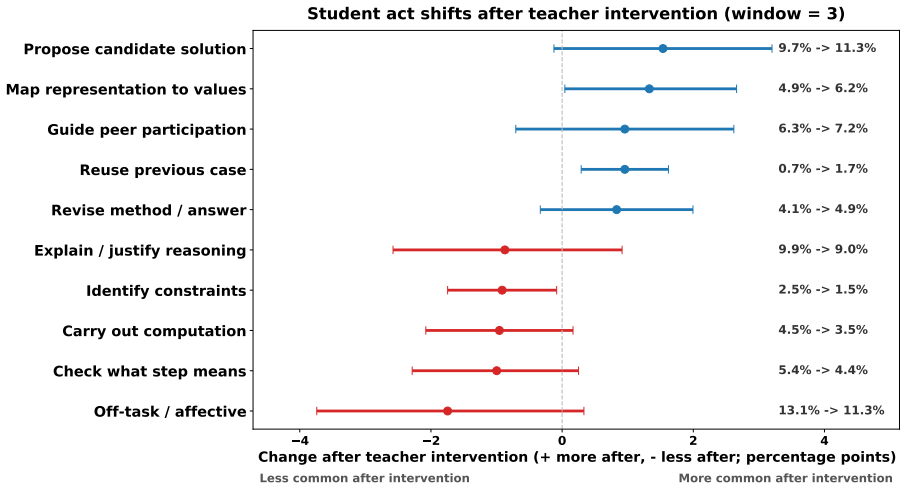
- Dialogue patterns can be tracked across problem-solving sessions to quantify the effects of teacher interventions.
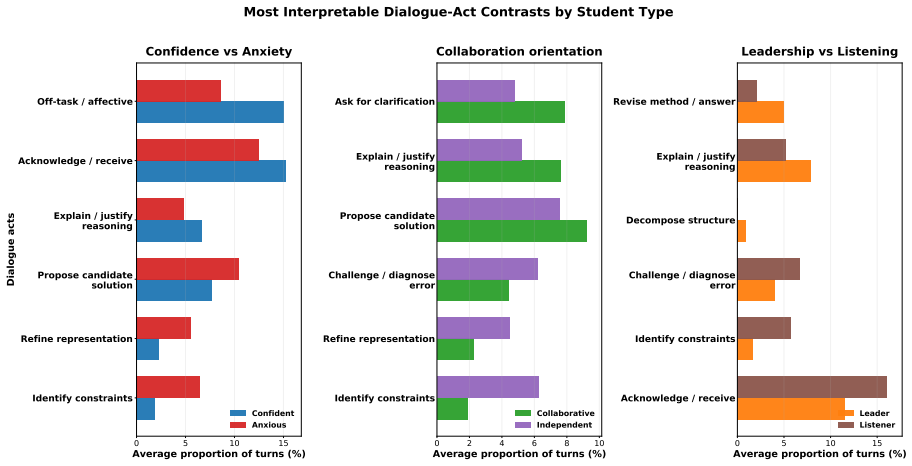
- Student survey responses on traits such as confidence and leadership can be aligned with specific dialogue actions to reveal behavioral connections.
- Large language models can be tested on dialogue act prediction tasks to assess their suitability for simulating student conversations in educational settings.
Where Pith is reading between the lines
- The dataset could support tools that detect when peer groups stall and suggest timely prompts without constant teacher involvement.
- Extending the taxonomy to other subjects would allow comparisons of collaboration styles across different academic domains.
- Longer-term collection from the same students could reveal how peer problem-solving skills develop over a school year.
Load-bearing premise
The recorded dialogues preserve natural student-student interactions without significant changes from the presence of recording equipment or researchers.
What would settle it
Direct comparison of interaction patterns in recorded versus unrecorded sessions in the same classrooms that reveals systematic differences in turn-taking or problem-solving language would undermine the dataset's authenticity claim.
Figures
read the original abstract
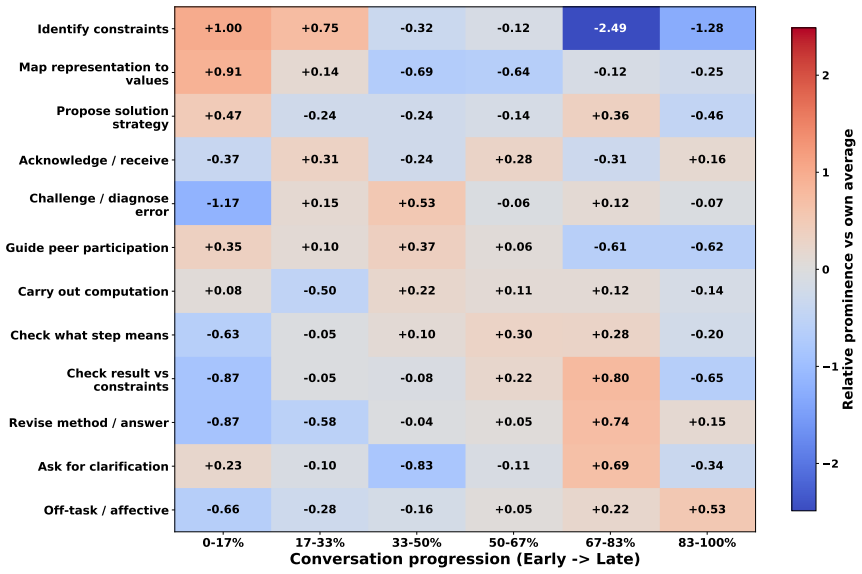
Collaborative Problem Solving (CPS) is a core skill in education, where the process of peer interaction is highly important. However, existing educational dialogue datasets mostly focus on classroom instruction or tutoring (i.e., teacher/tutor-student interaction), yet datasets centering small-group, student-student interaction are limited. This thus leaves research with limited resources for studying how students interact, coordinate, and solve problems together in real educational settings. To address this, we introduce PeerMathDial, the first dataset of peer CPS dialogues collected from authentic middle school math classrooms. It contains 55 dialogues from 27 students, totaling 6,406 turns. To facilitate research on CPS discourse analysis, we further build a corpus-grounded dialogue act taxonomy assisted by LLMs. Using the dataset and the dialogue act taxonomy, we demonstrate the practical applications of PeerMathDial across three use cases. First, we track how dialogues evolve over time and measure the impact of teacher interventions. Second, we align dialogue actions with student surveys to reveal the connection between students' traits (e.g., confidence, leadership) and their actual behaviors. Third, by evaluating LLMs on dialogue act prediction, we glimpse at the potential of LLMs for student simulation in educational applications. Our dataset and source code will be released to the community.
Editorial analysis
A structured set of objections, weighed in public.
Referee Report
Summary. The paper introduces PeerMathDial, claimed as the first dataset of peer collaborative problem solving (CPS) dialogues from authentic middle school math classrooms. It contains 55 dialogues from 27 students totaling 6,406 turns. The authors also construct a corpus-grounded dialogue act taxonomy with LLM assistance and demonstrate three use cases: tracking dialogue evolution and teacher intervention effects, aligning dialogue acts with student survey traits (e.g., confidence, leadership), and evaluating LLMs on dialogue act prediction tasks. The dataset and code are to be released.
Significance. If the data collection process is shown to preserve natural interactions and the methodological details are supplied, the dataset would address a clear gap in educational dialogue resources, which currently emphasize teacher-student rather than peer interactions. The use cases provide initial illustrations of downstream value for CPS discourse analysis and educational AI applications.
major comments (2)
- [Abstract and §3 (Dataset Construction)] Abstract and §3 (Dataset Construction): The central claim that PeerMathDial consists of dialogues 'collected from authentic middle school math classrooms' is load-bearing for the paper's novelty assertion, yet the manuscript provides no details on recruitment, informed consent, recording equipment/setup, student awareness of observation, researcher presence during sessions, transcription accuracy, or any controls for observer effects. Without this information it is impossible to assess whether the dialogues contain artifacts that would undermine the 'authentic' descriptor.
- [§4 (Use Cases)] §4 (Use Cases): The three demonstrated applications lack reported statistical validation. For instance, the alignment of dialogue actions with student surveys reports no sample sizes per trait, correlation coefficients, significance tests, or inter-rater reliability for the survey measures, weakening the claim that the dataset reveals connections between traits and behaviors.
minor comments (2)
- [Abstract] The abstract states the dataset size and use cases but omits any mention of the dialogue act taxonomy size or inter-annotator agreement metrics, which would help readers gauge the taxonomy's reliability.
- [Figures and Tables] Figure captions and table headers should explicitly define all abbreviations (e.g., CPS, LLM) on first use to improve standalone readability.
Simulated Author's Rebuttal
We thank the referee for their thoughtful review and constructive comments on our manuscript. We address each major comment below and plan to revise the paper to incorporate the suggested improvements.
read point-by-point responses
-
Referee: [Abstract and §3 (Dataset Construction)] Abstract and §3 (Dataset Construction): The central claim that PeerMathDial consists of dialogues 'collected from authentic middle school math classrooms' is load-bearing for the paper's novelty assertion, yet the manuscript provides no details on recruitment, informed consent, recording equipment/setup, student awareness of observation, researcher presence during sessions, transcription accuracy, or any controls for observer effects. Without this information it is impossible to assess whether the dialogues contain artifacts that would undermine the 'authentic' descriptor.
Authors: We agree that additional details on the data collection process are necessary to substantiate the 'authentic' nature of the dialogues. The collection was performed in real middle school classrooms with IRB approval, parental consent, and student assent. To address this, we will add a new subsection in §3 describing the recruitment of participating schools and students, the consent process, the audio recording equipment and setup, the level of researcher involvement, transcription procedures including quality control, and any efforts to minimize observer effects (e.g., acclimating students to the recording devices). This revision will enable a better assessment of potential artifacts. revision: yes
-
Referee: [§4 (Use Cases)] §4 (Use Cases): The three demonstrated applications lack reported statistical validation. For instance, the alignment of dialogue actions with student surveys reports no sample sizes per trait, correlation coefficients, significance tests, or inter-rater reliability for the survey measures, weakening the claim that the dataset reveals connections between traits and behaviors.
Authors: The use cases are meant to illustrate potential applications of the dataset rather than to provide conclusive statistical evidence. We concur that reporting statistical details would enhance the section. In the revised manuscript, we will include sample sizes for each trait alignment, correlation coefficients (e.g., Pearson's r), significance levels (p-values), and inter-rater reliability measures for the survey instruments where available. We will also temper the language to emphasize the exploratory character of these analyses. revision: yes
Circularity Check
No circularity: empirical dataset release with no derivations or predictions
full rationale
The paper introduces PeerMathDial as a new dialogue dataset collected from middle school classrooms and builds a dialogue act taxonomy, then shows three use cases (tracking evolution, aligning with surveys, LLM evaluation). No equations, fitted parameters, predictions, or self-citation chains appear in the provided text. The central claim reduces to data collection and release rather than any derivation that could loop back to its own inputs. This matches the default expectation for non-circular empirical contributions.
Axiom & Free-Parameter Ledger
Reference graph
Works this paper leans on
-
[1]
IEEE Transactions on Learning Technologies , volume=
Architecture for building conversational agents that support collaborative learning , author=. IEEE Transactions on Learning Technologies , volume=. 2010 , publisher=
2010
-
[2]
The NCTE Transcripts: A Dataset of Elementary Math Classroom Transcripts
Demszky, Dorottya and Hill, Heather. The NCTE Transcripts: A Dataset of Elementary Math Classroom Transcripts. Proceedings of the 18th Workshop on Innovative Use of NLP for Building Educational Applications (BEA 2023). 2023. doi:10.18653/v1/2023.bea-1.44
-
[3]
1978 , publisher=
Mind in society: Development of higher psychological processes , author=. 1978 , publisher=
1978
-
[4]
2002 , publisher=
Words and minds: How we use language to think together , author=. 2002 , publisher=
2002
-
[5]
International journal of computer-supported collaborative learning , volume=
Analyzing collaborative learning processes automatically: Exploiting the advances of computational linguistics in computer-supported collaborative learning , author=. International journal of computer-supported collaborative learning , volume=. 2008 , publisher=
2008
-
[6]
Proceedings of the thirteenth language resources and evaluation conference , pages=
The TalkMoves dataset: K-12 mathematics lesson transcripts annotated for teacher and student discursive moves , author=. Proceedings of the thirteenth language resources and evaluation conference , pages=
-
[7]
Proceedings of the Fifteenth Workshop on Innovative Use of NLP for Building Educational Applications , pages=
CIMA: A large open access dialogue dataset for tutoring , author=. Proceedings of the Fifteenth Workshop on Innovative Use of NLP for Building Educational Applications , pages=
-
[8]
Findings of the Association for Computational Linguistics: EMNLP 2023 , pages=
Mathdial: A dialogue tutoring dataset with rich pedagogical properties grounded in math reasoning problems , author=. Findings of the Association for Computational Linguistics: EMNLP 2023 , pages=
2023
-
[9]
Computers & Education , volume=
The assessment of collaborative problem solving in PISA 2015: An investigation of the validity of the PISA 2015 CPS tasks , author=. Computers & Education , volume=. 2020 , publisher=
2015
-
[10]
2012 , publisher=
Assessment and teaching of 21st century skills , author=. 2012 , publisher=
2012
-
[11]
Assessment and teaching of 21st century skills: Methods and approach , pages=
A framework for teachable collaborative problem solving skills , author=. Assessment and teaching of 21st century skills: Methods and approach , pages=. 2014 , publisher=
2014
-
[12]
PISA 2015 Assessment and Analytical Framework: Science, Reading, Mathematic, Financial Literacy and Collaborative Problem Solving , author=. 2017 , publisher =. doi:10.1787/9789264281820-en , url =
-
[13]
arXiv preprint arXiv:2404.06711 , year=
Mathvc: An llm-simulated multi-character virtual classroom for mathematics education , author=. arXiv preprint arXiv:2404.06711 , year=
-
[14]
Educational Research Review , volume=
Computer-based assessment of collaborative problem solving skills: A systematic review of empirical research , author=. Educational Research Review , volume=. 2024 , publisher=
2024
-
[15]
Learning and individual differences , volume=
ChatGPT for good? On opportunities and challenges of large language models for education , author=. Learning and individual differences , volume=. 2023 , publisher=
2023
-
[16]
Information Fusion , pages=
Survey of Uncertainty Estimation in LLMs-Sources, Methods, Applications, and Challenges , author=. Information Fusion , pages=. 2025 , publisher=
2025
-
[17]
The international handbook of collaborative learning , pages=
Introduction: What is collaborative learning?: An overview , author=. The international handbook of collaborative learning , pages=. 2013 , publisher=
2013
-
[18]
Computer supported collaborative learning , pages=
The construction of shared knowledge in collaborative problem solving , author=. Computer supported collaborative learning , pages=. 1995 , organization=
1995
-
[19]
Computational linguistics , volume=
Dialogue act modeling for automatic tagging and recognition of conversational speech , author=. Computational linguistics , volume=
-
[20]
Models overview , year =
-
[21]
Gemini 3 Developer Guide , year =
-
[22]
Qwen3.5-35B-A3B , year =
-
[23]
arXiv preprint arXiv:2504.06460 , year=
Can llms simulate personas with reversed performance? a benchmark for counterfactual instruction following , author=. arXiv preprint arXiv:2504.06460 , year=
discussion (0)
Sign in with ORCID, Apple, or X to comment. Anyone can read and Pith papers without signing in.