Out-of-Distribution (OOD) Detectors for Open-Set RF Fingerprinting
Pith reviewed 2026-06-27 09:50 UTC · model grok-4.3
The pith
Out-of-distribution detectors tuned without OOD data match the performance of those with true OOD tuning data for open-set RF fingerprinting on POWDER.
A machine-rendered reading of the paper's core claim, the machinery that carries it, and where it could break.
Core claim
The paper claims that OOD detection methods from the machine learning literature, expressed in a unified information-theoretic framework natural to communication systems, can be applied to open-set RF fingerprinting, and that tuning methods which require no given OOD tuning data achieve performance on the POWDER dataset comparable to baselines with access to true OOD tuning data and superior to baselines without such access, demonstrating practical viability for the RFF problem.
What carries the argument
A unified mathematical framework based on information theory that permits systematic analysis of OOD detectors and development of new methods for communication systems.
Load-bearing premise
The POWDER dataset and chosen evaluation protocol represent real open-world RF conditions sufficiently to support claims of practical viability.
What would settle it
A follow-up experiment on a different RF fingerprinting dataset or in a live wireless environment where no-OOD-tuned detectors show substantially lower detection rates than OOD-tuned baselines would falsify the viability claim.
Figures
read the original abstract
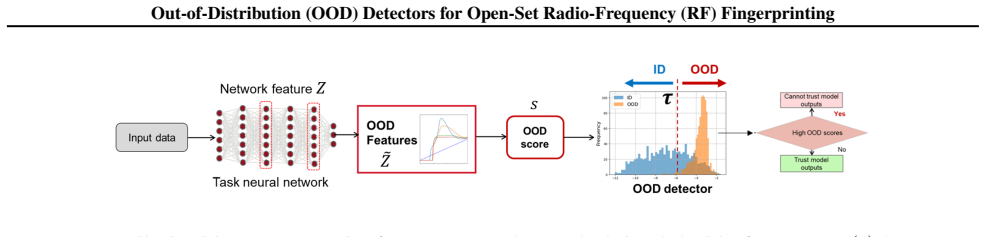
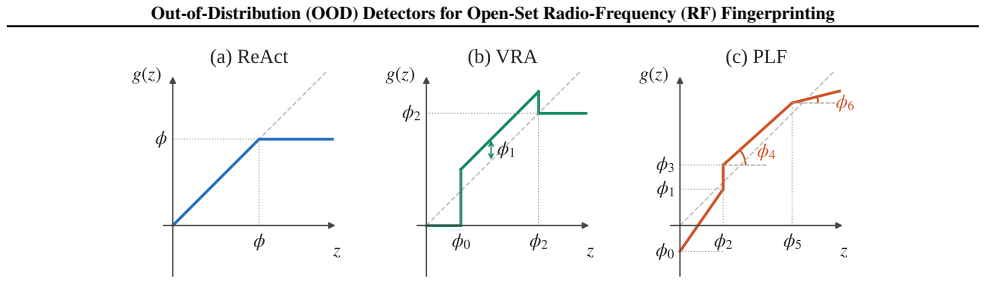
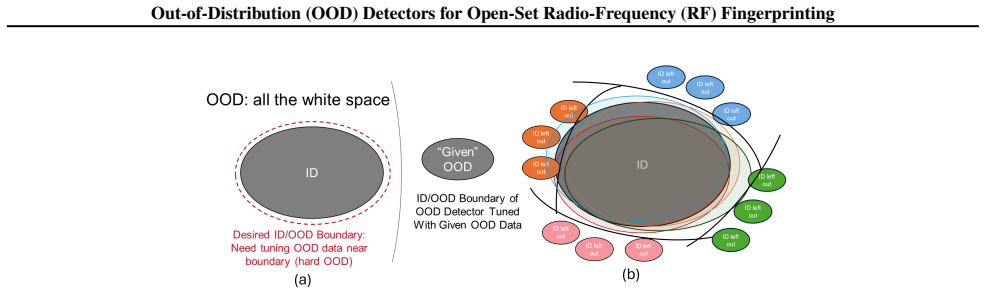
Radio-frequency (RF) fingerprinting systems must operate in open-world environments where signals from unknown transmitters and temporal drift introduce distribution shift at test time. Out-of-distribution (OOD) detection provides a natural framework for this problem, yet its application to RF fingerprinting (RFF) remains limited. A key barrier to their adoption is that most OOD detectors require auxiliary OOD data for parameter tuning, an assumption that is difficult to satisfy in RF environments where representative OOD data is impractical to collect. In this work, we introduce a promising set of OOD detection methods from the machine learning literature to open-set RFF domain. We present these methods within a unified mathematical framework based on information theory, which is a natural framework for communication systems. Our framework allows for the systematic analysis of methods and development of new methods. We further demonstrate the applicability of recent work on tuning OOD detectors without given OOD tuning data for open-set RFF. We evaluate on the POWDER RF fingerprinting dataset, showing that detectors tuned without any given OOD data achieve performance comparable to baselines with access to true OOD tuning data and greatly out-perform baseline approaches without access to true OOD tuning data, showcasing the practical viability for the RFF problem.
Editorial analysis
A structured set of objections, weighed in public.
Referee Report
Summary. The paper introduces OOD detection methods from the ML literature to open-set RF fingerprinting, unifies them in an information-theoretic framework, and evaluates recent no-OOD-tuning methods on the POWDER dataset. It claims that detectors tuned without any OOD data achieve performance comparable to baselines with true OOD tuning data and greatly outperform baselines without OOD access, demonstrating practical viability for RFF.
Significance. If the central performance claims hold under a representative evaluation, the work would be significant for enabling OOD-based open-set RFF without requiring impractical auxiliary OOD samples. The information-theoretic framing is a natural fit for communication systems and could support systematic method development. The result would directly address a key adoption barrier noted in the abstract.
major comments (2)
- [Abstract] Abstract: performance results are asserted (comparable to true-OOD baselines, outperformance of no-OOD baselines) but no metrics (AUROC, FPR@TPR, etc.), baselines, statistical tests, dataset splits, or implementation details are provided, so the central claim cannot be verified from the manuscript text.
- [Evaluation] Evaluation (POWDER results): the claim of practical viability for real open-world RFF rests on POWDER plus the chosen protocol being representative of temporal drift, unknown transmitters, channel/hardware variation, and device diversity; no justification or ablation of these dimensions is given, so comparability to true-OOD baselines does not establish the asserted practicality.
minor comments (1)
- [Abstract] The unified mathematical framework is mentioned but not sketched in the abstract; a brief equation or high-level description would improve accessibility.
Simulated Author's Rebuttal
We thank the referee for the detailed and constructive report. We address each major comment below and indicate the revisions we will make to strengthen the manuscript.
read point-by-point responses
-
Referee: [Abstract] Abstract: performance results are asserted (comparable to true-OOD baselines, outperformance of no-OOD baselines) but no metrics (AUROC, FPR@TPR, etc.), baselines, statistical tests, dataset splits, or implementation details are provided, so the central claim cannot be verified from the manuscript text.
Authors: We agree that the abstract should contain the key quantitative results to allow immediate verification of the central claims. In the revised manuscript we will update the abstract to report the specific AUROC and FPR@TPR values obtained on POWDER, name the baselines, and briefly indicate the dataset splits and evaluation protocol. Full implementation details, statistical significance tests, and additional metrics will remain in the main evaluation section but will be referenced from the abstract. revision: yes
-
Referee: [Evaluation] Evaluation (POWDER results): the claim of practical viability for real open-world RFF rests on POWDER plus the chosen protocol being representative of temporal drift, unknown transmitters, channel/hardware variation, and device diversity; no justification or ablation of these dimensions is given, so comparability to true-OOD baselines does not establish the asserted practicality.
Authors: We acknowledge that the manuscript would be strengthened by explicit justification that the POWDER protocol captures the relevant dimensions of real-world open-set RFF. We will add a new subsection in the evaluation section that (i) describes how the POWDER collection protocol incorporates temporal drift, unknown transmitters, channel/hardware variation, and device diversity, and (ii) provides ablations or sensitivity analyses across these factors where the existing data permit. These additions will clarify the scope of the practicality claim. revision: yes
Circularity Check
No circularity detected in derivation or claims
full rationale
The paper introduces existing OOD detection methods to the RFF domain, unifies them under an information-theoretic framework, and evaluates empirical performance on the external POWDER dataset. No equations, parameter-fitting steps, or self-citations are presented that reduce any claimed result to a tautology or input by construction. The central viability claim rests on comparative evaluation against baselines rather than a closed mathematical derivation, making the work self-contained against external benchmarks.
Axiom & Free-Parameter Ledger
Reference graph
Works this paper leans on
-
[1]
Agadakos, I., Agadakos, N., Polakis, J., and Amer, M. R. Deep complex networks for protocol-agnostic radio fre- quency device fingerprinting in the wild.arXiv preprint arXiv:1909.08703,
arXiv 1909
-
[3]
Cai, D., Shan, J., Gao, N., He, B., Chen, Y ., Jin, S., and Fan, P
URL http://arxiv.org/ abs/1009.5419. Cai, D., Shan, J., Gao, N., He, B., Chen, Y ., Jin, S., and Fan, P. Open set RF fingerprinting identification: A joint prediction and Siamese comparison framework.arXiv preprint arXiv:2501.15391,
-
[4]
URL https://arxiv.org/abs/1807.02811. Gal, Y . and Ghahramani, Z. Dropout as a Bayesian approxi- mation: Representing model uncertainty in deep learning. InProceedings of the 33rd International Conference on Machine Learning (ICML), pp. 1050–1059,
-
[5]
Gritsenko, A., Wang, Z., Jian, T., Dy, J., Chowdhury, K., and Ioannidis, S
URL http://arxiv.org/abs/1412.6572. Gritsenko, A., Wang, Z., Jian, T., Dy, J., Chowdhury, K., and Ioannidis, S. Finding a ‘new’ needle in the haystack: Unseen radio detection in large populations using deep learning. In2019 IEEE International Symposium on Dynamic Spectrum Access Networks (DySPAN), pp. 1– 10, Newark, NJ, USA, November
-
[6]
doi: 10.1109/SPAWC48557. 2020.9154254. Hanna, S., Karunaratne, S., and Cabric, D. Open set wireless transmitter authorization: Deep learning approaches and dataset considerations.IEEE Transactions on Cognitive Communications and Networking, 7(1):59–72,
-
[7]
doi: 10.1109/TCCN.2020.3043332. Hendrycks, D. and Gimpel, K. A baseline for detecting misclassified and out-of-distribution examples in neural networks,
-
[8]
Jeleni´c, F., Juki ´c, J., Tutek, M., Puljiz, M., and ˇSnajder, J
URL https://arxiv.org/abs/ 1610.02136. Jeleni´c, F., Juki ´c, J., Tutek, M., Puljiz, M., and ˇSnajder, J. Out-of-distribution detection by leveraging between- layer transformation smoothness,
-
[9]
Karunaratne, S., Hanna, S., and Cabric, D
URL https: //arxiv.org/abs/2310.02832. Karunaratne, S., Hanna, S., and Cabric, D. Open set rf fin- gerprinting using generative outlier augmentation,
-
[10]
URLhttps://arxiv.org/abs/2108.13099. 9 Out-of-Distribution (OOD) Detectors for Open-Set Radio-Frequency (RF) Fingerprinting Kirchheim, K., Filax, M., and Ortmeier, F. Pytorch-ood: A library for out-of-distribution detection based on pytorch. InProceedings of the IEEE/CVF Conference on Com- puter Vision and Pattern Recognition, pp. 4351–4360,
-
[11]
URL https://arxiv.org/abs/ 1706.02690. Liu, W., Wang, X., Owens, J. D., and Li, Y . Energy-based out-of-distribution detection,
-
[12]
URL https:// arxiv.org/abs/2010.03759. Ma, Z., Fang, S., and Fan, Y . Open-set radio frequency fingerprint identification method based on multi-task prototype learning.Sensors, 25(17):5415,
arXiv 2010
-
[13]
Mondal, S., Jiang, Z., and Sundaramoorthi, G
doi: 10.3390/s25175415. Mondal, S., Jiang, Z., and Sundaramoorthi, G. A variational information theoretic approach to out-of-distribution de- tection. InProceedings of the 42nd International Con- ference on Machine Learning (ICML),
-
[14]
URL https://arxiv.org/abs/2506.14194. Mondal, S., Xie, X. M., Duan, R., Wong, A., and Sun- daramoorthi, G. Tuning out-of-distribution (ood) de- tectors without given ood data,
-
[15]
Reus-Muns, G., Jaisinghani, D., Sankhe, K., and Chowd- hury, K
URL https: //arxiv.org/abs/2602.05935. Reus-Muns, G., Jaisinghani, D., Sankhe, K., and Chowd- hury, K. R. Trust in 5g open rans through machine learning: Rf fingerprinting on the powder pawr plat- form. InGLOBECOM 2020 - 2020 IEEE Global Com- munications Conference, pp. 1–6,
arXiv 2020
-
[16]
doi: 10.1109/ GLOBECOM42002.2020.9348261. Sun, Y ., Guo, C., and Li, Y . React: Out-of-distribution detection with rectified activations,
arXiv 2020
-
[17]
Sun, Y ., Ming, Y ., Zhu, X., and Li, Y
URL https: //arxiv.org/abs/2111.12797. Sun, Y ., Ming, Y ., Zhu, X., and Li, Y . Out-of-distribution de- tection with deep nearest neighbors. InInternational Con- ference on Machine Learning, pp. 20827–20840. PMLR,
-
[18]
Tishby, N., Pereira, F. C., and Bialek, W. The informa- tion bottleneck method.arXiv preprint physics/0004057,
-
[19]
Open-set RF finger- printing via improved prototype learning.arXiv preprint arXiv:2306.13895,
Wang, W., Liao, H., and Gan, L. Open-set RF finger- printing via improved prototype learning.arXiv preprint arXiv:2306.13895,
-
[20]
Yang, J., Zhou, K., Li, Y ., and Liu, Z
URLhttps://arxiv.org/abs/2302.11716. Yang, J., Zhou, K., Li, Y ., and Liu, Z. Generalized out-of- distribution detection: A survey,
-
[21]
Z., Krovi, H., Silovsky, J., and Valk, C
Youssef, K., Bouchard, L.-S., Haigh, K. Z., Krovi, H., Silovsky, J., and Valk, C. P. V . Machine learning ap- proach to RF transmitter identification.arXiv preprint arXiv:1711.01559,
-
[23]
URL https://arxiv. org/abs/2306.09301. Zhang, Y ., Lu, J., Peng, B., Fang, Z., and Cheung, Y .-m. Learning to shape in-distribution feature space for out- of-distribution detection. InThe Thirty-eighth Annual Conference on Neural Information Processing Systems. Zhao, Q., Xu, M., Gupta, K., Asthana, A., Zheng, L., and Gould, S. Towards optimal feature-shap...
-
[24]
Zhao, T., Sarkar, S., Krijestorac, E., and Cabric, D. GAN-RXA: A practical scalable solution to receiver- agnostic transmitter fingerprinting.arXiv preprint arXiv:2303.14312,
-
[25]
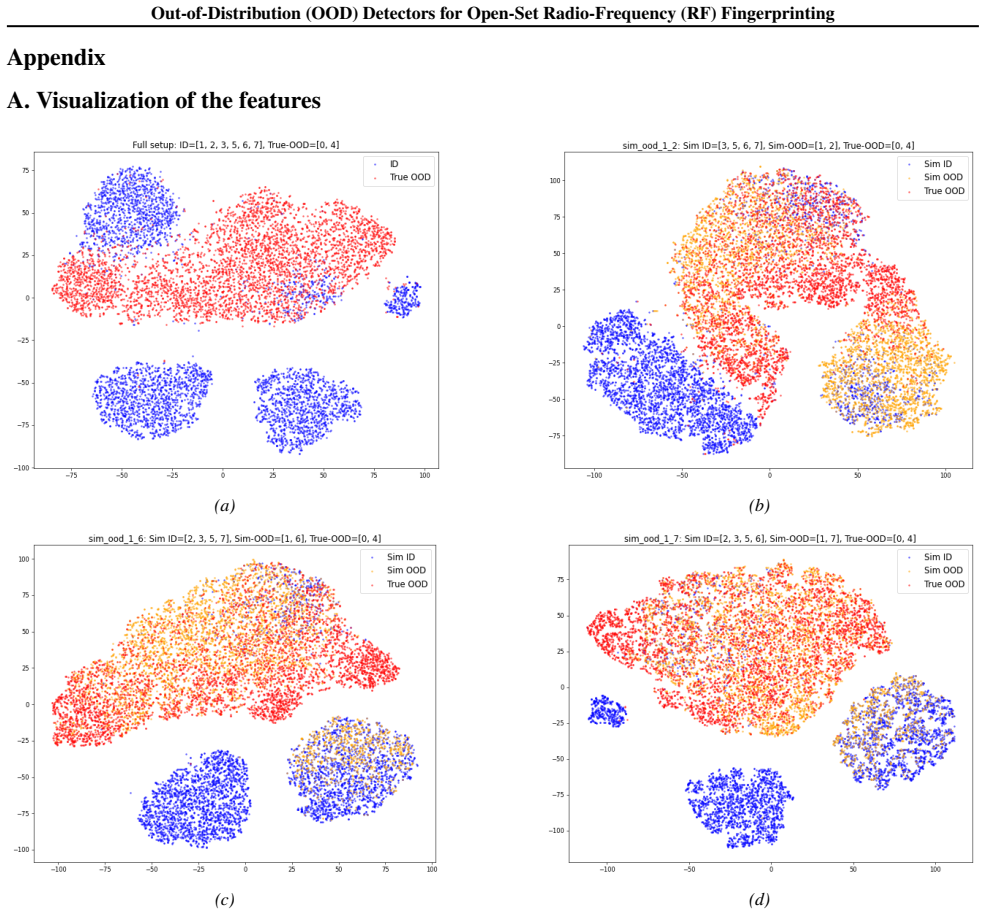
doi: 10.1109/CVPR52688.2022. 00723. 10 Out-of-Distribution (OOD) Detectors for Open-Set Radio-Frequency (RF) Fingerprinting Appendix A. Visualization of the features (a) (b) (c) (d) Figure 4.t-SNE visualizations of ResNet-1D classifier penultimate layer features for the POWDER RF fingerprinting (a) shows the full ID classifier features in blue with true O...
discussion (0)
Sign in with ORCID, Apple, or X to comment. Anyone can read and Pith papers without signing in.